R E S E A R C H
Open Access
A graph-based algorithm for estimating
clonal haplotypes of tumor sample from
sequencing data
Yixuan Wang
1,2, Xuanping Zhang
1,2*, Shuai Ding
3, Yu Geng
1,2, Jianye Liu
1,2, Zhongmeng Zhao
1,2,
Rong Zhang
1,2, Xiao Xiao
2,4and Jiayin Wang
1,2*FromThe International Conference on Intelligent Biology and Medicine (ICIBM) 2018 Los Angeles, CA, USA. 10-12 June 2018
Abstract
Background: Haplotype phasing is an important step in many bioinformatics workflows. In cancer genomics, it is suggested that reconstructing the clonal haplotypes of a tumor sample could facilitate a comprehensive understanding of its clonal architecture and further provide valuable reference in clinical diagnosis and treatment. However, the sequencing data is an admixture of reads sampled from different clonal haplotypes, which complicates the computational problem by exponentially increasing the solution-space and leads the existing algorithms to an unacceptable time-/space- complexity. In addition, the evolutionary process among clonal haplotypes further weakens those algorithms by bringing indistinguishable candidate solutions.
Results: To improve the algorithmic performance of phasing clonal haplotypes, in this article, we propose MixSubHap, which is a graph-based computational pipeline working on cancer sequencing data. To reduce the computation complexity,MixSubHapadopts three bounding strategies to limit the solution space and filter out false positive candidates. It first estimates the global clonal structure by clustering the variant allelic frequencies on sampled point mutations. This offers a priori on the number of clonal haplotypes when copy-number variations are not considered. Then, it utilizes a greedy extension algorithm to approximately find the longest linkage of the locally assembled contigs. Finally, it incorporates a read-depth stripping algorithm to filter out false linkages according to the posterior estimation of tumor purity and the estimated percentage of each sub-clone in the sample. A series of experiments are conducted to verify the performance of the proposed pipeline.
Conclusions: The results demonstrate thatMixSubHapis able to identify about 90% on average of the preset clonal haplotypes under different simulation configurations. Especially,MixSubHapis robust when decreasing the mutation rates, in which cases the longest assembled contig could reach to 10kbps, while the accuracy of assigning a mutation to its haplotype still keeps more than 60% on average.MixSubHapis considered as a practical algorithm to reconstruct clonal haplotypes from cancer sequencing data. The source codes have been uploaded and maintained athttps:// github.com/YixuanWang1120/MixSubHapfor academic use only.
Keywords: Cancer genomics, Haplotype phasing, Clonal haplotype, Computational pipeline, Sequencing data analysis
*Correspondence:[email protected];[email protected] 1Department of Computer Science and Technology, School of Electronic and Information Engineering, Xi’an Jiaotong University, Xi’an 710048, China 2Shaanxi Engineering Research Center of Medical and Health Big Data, School of Electronic and Information Engineering, Xi’an Jiaotong University, Xi’an 710048, China
Full list of author information is available at the end of the article
Background
Modern canceration theory summarizes that tumor het-erogeneity is one of the key results of tumor proliferation and evolution [1]. Any macroscopic tumor tissue is con-sidered as an admixture of cancerous and non-cancerous cells, where the cancerous cells, in many cases, could be further clustered into multiple sub-clones, according to their somatic mutational events [2,3]. These somatic mutations, interacting with germline variations, often underlie different deleterious selective advantages, which may further contribute to drug resistance, tumor recur-rence and metastasis, and many other phenotypes [4–6]. For example, it is observed that the presence of multiple sub-clones could be associated with poor clinical out-comes in a group of chronic lymphocytic leukemia cases [7]. It is also reported that the clonal competition for predominance occurs spontaneously in multiple myeloma cases and the heterogeneous clonal mixtures may shift predominant clones with therapeutic selection [8]. Not only in blood cancer cases, similar conclusions could be drawn in many other cancer types, such as esophageal adenocarcinoma [9], lung adenocarcinoma [10] and renal clear cell carcinoma [11]. It is now a popular opinion that a comprehensive understanding on tumor hetero-geneity benefits clinical diagnosis and potential precision treatments.
Genomic analysis on tumor heterogeneity has two lev-els: genotype level and haplotype level. The genotype-level bioinformatics pipelines differentiate homozygous muta-tional events, including loss of heterozygosity (LOH), from heterozygous ones [12–14], and then cluster them into sub-clones [3,15]. On this basis, the haplotype level analysis requires locating each heterozygous mutation on the corresponding chromosomal sequence of alle-les, named haplotype, whose computational problem is often calledhaplotype phasing. Actually, haplotype phas-ing has already been an important step in many
bioin-formatics workflows besides cancer research [16], but
its importance in cancer genomics is recently
empha-sized [17]. Understanding haplotype heterogeneity is
suggested not only to elucidate a series of critical genome-to-transcriptome events, e.g. gene fusion transcripts and their driver partners [18], but to facilitate the studies on the interactions among different germline and somatic variations, e.g. two-hit events and allelic amplifications [4, 5, 17]. Such results could significantly benefit down-stream analyses and studies in many fields, including dis-ease association studies [6,19], clinical decision-support with electronic medical record data [20–22], drug and treatment designs and improvements [23,24], etc.
Benefiting from the second generation sequencing tech-nology, tens of thousands of cancer patients have been sequenced, and the cancer sequencing data have been accumulating rapidly as well, which greatly promotes the
studies on clonal heterogeneity and expansion [25] and the developments of related computational approaches [26]. Nowadays, tumor heterogeneity analyses are almost built up on cancer sequencing data. Although the existing approaches differ in models, algorithms, and the eval-uation standards for “well suited”, based on our best knowledge, the core algorithms may be roughly divided into two categories: the phylogenetic model-based meth-ods and model-free ones. The phylogenetic model-based methods, just as the name implies, usually focus on the computational problem of inferring phylogenetic trees that describe clonal expansion and evolution [27–32]:
TrAp proposed an expanded algorithm from a
brute-force algorithm for sub-clonal deconvolution, which generated the evolutionary tree(s) by comprising the
max-imum number of first-generation trees [27]. PhyloWGS
established a probabilistic model for phylogeny inference, which incorporated the information of variant allele fre-quencies and the estimations of allelic amplifications and LOHs [28].BitPhylogenydesigned a graphical model, and then it adopted two strategies, which were a Markov chain Monte Carlo (MCMC) sampling and a maximum pos-terior method on expected adjusted rand, to solve the
possible phylogenies [29]. SPRUCE utilized a bounded
enumeration strategy to search the solution space of can-didate perfect phylogenies which were consistent with the given data set [30].Canopyimproved the statistical frame-work and was capable of handling the data sequenced from temporally and/or spatially separated samples from
the same patient to reconstruct tumor phylogeny [31].
A recent published method further addressed the lack of methods for tumor deconvolution and phylogenet-ics of diverse classes of structural variations at base-pair resolution [32].
On the other hand, it is argued that the specific features of tumor evolution may challenge the direct applications of classical phylogenetic models [33]. One of the key issues occurs when classical phylogenetic approaches require a priori on the number of sub-clones, which is an unknown parameter for cancer sequencing data. To overcome such issues, the model-free methods often focus on the clonal structures with the maximum likelihood on global variant allelic frequencies [3, 34–38]: THetAdesigned a convex optimization algorithm to solve the maximum likelihood mixture decomposition, which optimized the multinomial probability [34].PhyloSubproposed a series of topologi-cal constraint rules to limit the possible phylogenies that were able to explain the frequency changes [35].PyClone
introduced a Bayesian clustering method, which inte-grated the estimations on cellular prevalences, normal-cell
contamination and segmental copy-number changes [36].
established a graphical model to estimate sub-populations based on copy number alterations and loss of heterozygos-ity events [37]. Automate learning was also incorporated for deconvolution of genomic mixtures, where the RNA expression data was involved in addition to improve the performance [38]. In general, there is no clear bound-ary between the two categories, and several comprehen-sive reviews compared the advantages among the existing approaches [26,33].
However, most of the existing approaches are not able to deepen the analyses to haplotype level efficiently. When multiple haplotypes are considered, the evolutionary pro-cess should be represented by a set of parallel phyloge-netic trees rather than possible single phylogenies, which is different from the hypothesis on which most of the existing methods, the phylogenetic model-based meth-ods or model-free ones, rely [3, 28–30, 32, 34, 36–38]. For those methods considering concurrent evolutionary processes, haplotype phasing algorithms are needed to locate heterozygous mutations prior to inferring clonal structure [27,31,35]. Moreover, phasing multiple haplo-types is also a quite challenging computational problem because the solution space of possible haplotypes is expo-nentially increased along with the increasing of
sub-clones. For example, for k sub-clones each with n
het-erozygous variation sites, the solution space of 2kclonal haplotypes (allelic imbalance events are not considered) reachesO2(2k−1)n[39]. The polyploid phasing problem
has already been suggested as an NP-hard problem [39–
44], hence probabilistic algorithms and heuristic strate-gies are commonly used to approximate optimization solutions, such as Gibbs sampling [39], greedy binning
algorithm [41], branch-and-bound scheme by maximum
likelihoods [42], semi-definite programming [43], sparse tensor decomposition [44], etc.
Different from polyploid haplotypes, the haplotypes of multiple sub-clones from the same sample always imply the information of its clonal structure. Thus, to enhance the efficiency of the existing computational pipeline, e.g. [17], we consider to incorporate the priori of clonal struc-ture to bound the solution space, and then polish the clonal structure with estimated clonal haplotypes. To
achieve this, in this article, we propose MixSubHap, a
computational pipeline for phasing clonal haplotypes as well as estimating clonal structure. To reduce the
com-putation complexity,MixSubHapadopts three bounding
strategies to limit the solution space and filter out false positive candidates. It first estimates the global clonal structure by clustering the variant allelic frequencies on sampled point mutations. This offers a priori on the num-ber of clonal haplotypes when copy-numnum-ber variations are not considered. Then, it utilizes a greedy extension algorithm to approximately find the longest linkage of the locally assembled contigs. Finally, it incorporates a read-depth stripping algorithm to filter out false linkages according to the posterior estimation of tumor purity and the estimated percentage of each sub-clone in the sample.
Methods
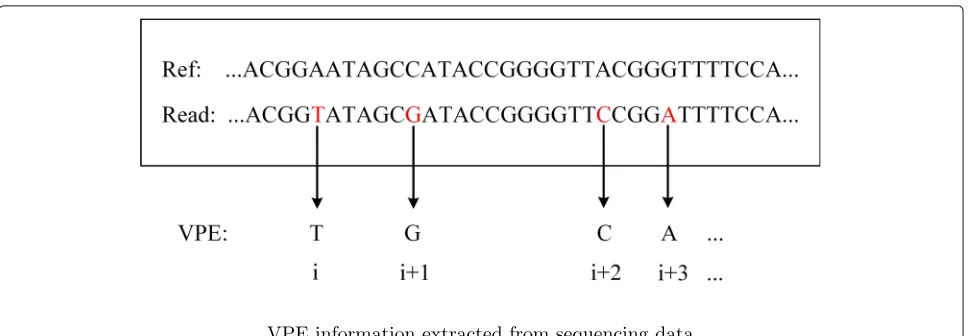
Suppose that we are given a set of paired-end sequenc-ing data with mappsequenc-ing information, and the outputs of the proposed pipeline include both the number of sub-clones and the haplotypes of each sub-clone. The given data is first pre-processed: a read is retained if it brings at least one point mutations, while a read-pair is retained if it brings at least two point muta-tions. Each read-pair that passed the filter is then col-lapsed to a much shorter sequence, named VPE as in [45], by extracting the sites with point mutations from
this read-pair, as shown in Fig. 1. A VPE consists of
only the sites with variants from the corresponding read-pair. In the current stage of this research, the struc-tural variations, including the allelic imbalance events on point mutations, are temporarily not considered. According to these reads (VPEs), the variant allelic fre-quency (VAF) of each variant is calculated. We adopt a model-free method to provide a priori of the clonal structure according to global variant allelic frequencies. A series of model-free method could achieve this. Here, we incorporate SciClone[3], a popular method, into the proposed pipeline.
MixSubHap consists of three major components: assembling local VPEs, expanding local contigs and itera-tively stripping clonal read-depth. The flowchart is shown in Fig.2.
• Assembling local VPEs: As the first component, a divide-and-conquer strategy is adopted to assemble the VPEs to multiple groups of contigs. Different from assembling reads, VPEs are first clustered by starting sites, and then for each cluster, the VPEs with the same starting site are processed together to form a small set of contigs. Note that, multiple reads whose mapping positions are slightly different may collapse to the same VPE sequence if they bring the same variants. In addition, several constraints which imply the inheritance principle across sub-clones are applied. The details of these constraints are further discussed in Discussion section.
• Expanding local contigs: To link the contigs across different clusters, an efficient greedy algorithm is conducted. An undirected weighted graph is established. Each vertex represents a variant site. An edge exists between two vertexes if at least one VPE supports the linkage of them. The edges are weighted according to the likelihoods of possible linkage modes. The greedy algorithm first generates a maximum spanning tree on the sub-graph that consists of the vertexes from the founding clone. Here, the estimation of founding clone is provided by SciClone. Moreover, the computation is also
simplified by the inheritance constraint, which limits the linkage mode in all of the descendant sub-clones. • Stripping each clonal read-depth: For the variants do not occur in the founding clone, different genotypes are brought by different sub-clones. In these cases, the likelihoods are interfered by allelic clonal haplotypes. To filter out the bias on the likelihoods, a thickness stripping algorithm is designed. According to the VAFs and the estimations on clonal structure, the VPEs that have higher probabilities of sampling from other sub-clones are removed, and then the spanning tree is extended based on the corrected edge weights. The parental haplotypes guide the clonal haplotypes
of its descendants. When the tree is traversed, the clonal haplotypes are then reconstructed.
Assembling local VPEs
Let V denote the set of given variant sites. VPEs are
defined as the information which contain the base states of all the mutated sites along with their actual positions in reads and relative positions in setV. When extracting VPE information, it is necessary to ensure that the number of mutations brought by the read or read-pair is not less than two. Sequencing reads that contain only one mutation do not reflect the interrelationship between mutations and do not provide useful information for haplotype recon-struction, thus we do not take such information into consideration. It is assumed that each sequence library is well prepared and the insert-size obeys a normal dis-tribution with a small variance. Therefore, libraries with different lengths are introduced, more variant sites can be extracted correctly.
In general, the rare somatic mutations on cancer suscep-tibility genes may reach 10,000, which is a huge challenge for the computational capability of ordinary computer. At this time, the computational complexity is too high due to
the large amount of variants. Therefore, theMixSubHap
uses the Dividing and Assembling strategy to process the VPE information. The strategy appropriately clusters the length of the division and designs the connection ways, so that the resulting short chains can accurately exhibit fragments of the sub-clonal haplotypes. To achieve this, the VPE is first mapped to the reference by mapping the base state of corresponding variant against the reference according to its actual position. After that, the aligned
VPE are divided intoMgroups according to its starting
position, then the algorithm processes group by group.
Assume that the number of sub-clonesI is known, then
the number of haplotypes is determined, which is 2I, and the total number of variants isN. The process consists of the following steps:
• Sorting the VPEs via the starting positions. • Constructing initial short chain groups. VPE
Fig. 2The flowchart of the proposed pipeline
does not produce redundant, we add each VPE into a short chain group only when the VPE not contained in the existing short chains, otherwise, the VPE remains in the candidate set and the short chain group retains the same.
• According to the principle of inheritance, arrange all short chain groups and keep qualified arrangement. Process VPEs whose starting sites arep(p∈N), then process group by group, until all VPEs are
Until now, all the VPEs are rationally and effectively connected, and a large number of short chain groups car-rying haplotype information are formed. Next, we will present a reasonable and efficient strategy to further con-struct the haplotypes of each sub-clone.
Expanding local contigs
According to the hypothesis of linear evolution mode
between tumor sub-clones (see inDiscussion), we know
that, once the connection mode of a pair of variants from
the founding clone S0 is fixed in the tumor
evolution-ary process, the differentiation of subsequent sub-clone
Si, i ∈ {1, 2,. . .,I−1}will inherit the same connection without any change. In the same way, once the connec-tion between a pair of variants from sub-cloneSi at any level is confirmed, it will not change in its descendant cloneSj
i<j. According to the linear evolution mode, the mutation sites in the clones are separated layer by layer. Thus, the parental clonal haplotype structure can be used as a known condition to guide the construction of the descendant clonal haplotypes.
In order to recognize the clonal haplotypes efficiently
and accurately, MixSubHap algorithm first clusters all
the variant sites according to the VAF of each site. The variants in the same cluster are from the same sub-clone [3], and then the clustering results are con-sidered as the basis to initialize the clonal haplotypes. The clustering method used in this paper isSciClone ver-sion 1.1.0 [3], which is reported to be relatively accurate in clustering the somatic mutations by clonal structure.
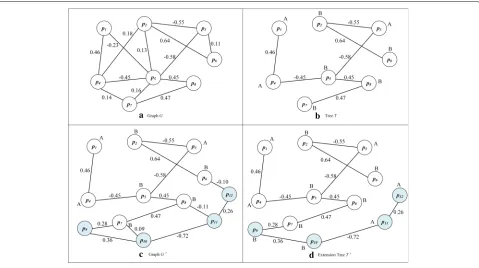
MixSubHap algorithm mainly generates a maximum spanning tree based on the short chain groups we obtained. LetMbe the set of all variants, andpi,pj rep-resent two adjacent allelic sites, pi,pj ∈ M. LetHSkpi,pj
represent the connection mode between the pith
vari-ant site and thepjth variant site from the sub-cloneSk.
A stands for the same base as the reference genome,
while B stands for a base different from the reference
genome, namely Bstands for a mutation. Therefore, for
any two sites from the same sub-clone, possible values for
HSkpi,pjare{(A,A), (B,B)}or{(A,B), (B,A)}. For the found-ing cloneS0, according to the short chain groups, we can
get many different values ofHSpi,pj
0 and add these
differ-ent values respectively to the corresponding coverage of variant pair pi,pj
. In order to separate the sub-clones layer by layer, variant pair pi,pj
from every sub-clone and the corresponding coverage level ci,j are used to estimate the clonal haplotypes. For variant pairs, the cov-erage of each pair and the probability of various pos-sible connection modes between the two variants are calculated together. According to the probabilities of var-ious connection patterns, the corresponding undirected weighted graphs are established. When calculating the
coverage levelci,jof allelic sitespi,pj
, only short chain groups are considered. Let F(i,j) represent the set of short chains containing both allelic sites pi,pj
. F(i,j)
represents the number of chains in this set. We set the connection probability of {(A,A), (B,B)} to be positive and set the connection probability of {(A,B), (B,A)} to be negative. LetGrepresent a weighted undirected graph where the variant sites are the vertexes of the graph. Here, we set the coverage thresholdCov, with a default value of 2. IfF(i,j)≥Cov, there will be an edge between variants
pi,pjand the weight of edge will be the probability of the connection. The formula of weight is:
Wi,j =f bpi,bpj,A
−fbpi,bpj,B
Nbpi,bpj(p i,pj)=
r∈F(i,j)
Ir(pi,pj)=
bpi,bpj
Where, Nbpi,bpj(pi,pj) represents the number of chains across allelic sites pi,pj corresponding to the connec-tion mode(bpi,bpj).bpi andbpj respectively indicate the base states of the variant site pi andpj. r(pi,pj) repre-sents alleles for variant site pi and pj. There are four kinds of joint states for allelepiandpj, where(bpi,bpj) ∈ {(A,B),(B,A),(A,A),(B,B)}.I(.)is the indicator function. Whenr(pi,pj) = (bpi,bpj)is true, the function value is 1, 0 otherwise. For variant sitepi, consider the sequencing error and alignment error of each siteε.
Let
NA(pi,pj)=NA,A(pi,pj)+NB,B(pi,pj)
NB(pi,pj)=NA,B(pi,pj)+NB,A(pi,pj)
Two connection probabilities of the paired variant sites
pi,pjare, f(bpi,bpj,A)=
(1−)2+2×NA(pi,pj)+2×(1−)×NB(pi,pj)
F(i,j)
f(bpi,bpj,B)=
(1−)2+2×NB(pi,pj)+2×(1−)×NA(pi,pj)
F(i,j)
Where Wi,j > 0 indicates that the connection mode of allelic sites pi,pj
isHSA,A
0 /H B,B
S0 ; otherwise, Wi,j < 0 indicates that the connection mode of allelic sitespi,pj
is HSA,B
0 /H B,A
S0 . The greater the absolute value of Wi,j, the higher the reliability of the corresponding connection pattern.
After constructing the undirected weighted graphGof
the founding clone is constructed, the number of ver-texes in the graph is Nv. All the vertexes in the graph
G are all derived from variant sites in the founding
clone S0. The algorithm selects a vertex, whose base
state is known, as the starting point sp for
construct-ing the sub-clonal haplotypes and generatconstruct-ing the
ini-tial maximum spanning tree T corresponding to graph
G. The processing steps are as follows, as shown in
a b
c d
Fig. 3Extension of TreeTConstruction Process
• Find all variant sites connected tospfrom graphG; • Select the corresponding edge ofmaxWi,j as
one edge of the maximum spanning treeT; • According to the positive or negative of the edge
weight, the state of another variant connected tosp
can be determined and these variants will be considered as new known vertexes;
• Conduct the second step successively for other unkonwn variants and repeat adding border process to maximum spanning treeT till all the variants have appeared inTor cannot be added any more.
In actual, due to the sparseness of the founding clone variants and the limitation of the read length of the sec-ond generation sequencing data, the generated undirected
weighted graph G is often not a connected graph, but
consists of several mutually disconnected subgraphs. Mix-SubHapalgorithm generates an equal number of subtrees on these subgraphs and identifies the base states, thus guides the later extension of the spanning tree.
Stripping each clonal read-depth
After the initial maximum spanning treeT is built, the
connection patterns of partial variant sites on the hap-lotypes have been determined. However, there are a large quantity of variant sites not included in the initial
maximum spanning tree T. The connection modes of
these variant sites are relatively complex, including three types of linkages (B,A),(A,A),(A,B) with varying pro-portion of each according to the sub-clone propro-portion in the tumor sample. So we adopt the thickness strip-ping strategy to strip the read depth level by level from the founding clone to the uppermost layer descendant sub-clone. The remaining sub-clones can be processed in accordance with the method of constructing tree in the founding clone.
ratio of the sub-clones. Set the number of clones to beNs, and then the thickness stripping formula is:
PA(pi,pj)=F(pi,pj)×
⎛
⎝
0≤i≤Sk
ri+
Sk+1≤i≤SNs 1 2ri
⎞ ⎠
PB(pi,pj)=F(pi,pj)×
⎛
⎝
Sk+1≤i≤SNs 1 2ri
⎞ ⎠
Adjust the coverage of the allelic sitepi,pj
, we have ˆ
NA(pi,pj)=NA(p
i,pj)−PA(pi,pj) ˆ
NB(p
i,pj)=NB(pi,pj)−PB(pi,pj)
After separating the data, the new undirected weighted graphGis established by using the same method for the
undirected weighted graphGand the weight calculation
formula becomes
Wpi,pj=fbpi,bpj,A
−f(bpi,bpj,B) f(bpi,bpj,A)=
(1−)2+2×NA(pi,pj)+2×(1−)×NB(pi,pj)
NA(pi,pj)+NB(pi,pj)
f(bpi,bpj,B)=
(1−)2+2×NB(pi,pj)+2×(1−)×NA(pi,pj)
NA(pi,pj)+NB(pi,pj)
Where Wpi,pj > δ represents an effective edge betweenpi,pj
allelic sites. When adding it to the graph
G, the corresponding weight is Wpi,pj
. The default
value of δ is 0.1. When the graph G is constructed, it
can basically contain all the variation sites from the
ref-erence sequence. Then the maximum spanning treeT is
extended to T according to the graphG following the
steps in section Expanding local contigs.
In order to finally reconstruct the haplotype that con-tains the variants as many as possible, it is necessary
to ensure that the extended treeT contains more
vari-ants. Lower coverage and higher threshold of coverage will cause some variation sites be left out. Thus, we auto-matically adjust to lower coverage threshold and edge weight threshold to ensure lower false-negative as much as possible. We adopt depth-first traversal of all vertexes in extended treeTand sort according to the relative posi-tions in the order of reference sequence. After sorting, the state set of vertexes is a haplotype of the last sub-clone. Assuming that all variation sites are heterozygous, another haplotype of the last sub-clone is easily obtained. According to the linear evolution relationship among the sub-clones, the haplotypes of the remaining sub-clones are obtained by the following formula.
h2i,j=
⎧ ⎨ ⎩
A,h2(i+1),j=A
B,h2(i+1),j=B and sub(j)≤i
A,h2(i+1),j=B and sub(j) >i
Where,irepresents the label of sub-clone andjrepresents variation site number. sub(j) represents the sub-clone
label of thejth variation site,h2i,jrepresents the base state of thejth site from father chain on theith sub-clone. By the above formula, we can find base state of the site from one haplotype corresponding to the paired haplotype.
h2i,j=
h2i,j⊕1,sub(j)≤i
h2i,j,i<sub(j)≤I−1
The construction process is shown in Fig.4.
Results
To generate simulation datasets, a chromosome is ran-domly selected from the human reference genome as a reference sequence. Simulating single point variation, germline mutation rate is set to 0.1%, and the somatic mutation rate is 1%. Consider the purity of the tumor sam-ple: the founding cloneS0and two descendant sub-clone
S1andS2, the ratio of them is set to 3 : 5 : 2. Several
parameters, such as coverage, the number of libraries, the
length of read, have impact on the performance of
Mix-SubHapalgorithm, only one parameter value was changed for each experiment.
Varying read length
Three libraries were set with different insert-sizes of 1000 bp, 1500 bp, and 2000 bp, respectively. Three sub-clonal mixing ratio is 3 : 5 : 2. A priori of sub-clone haplotype depends on the result ofSciClone, whereas the accuracy ofSciClonemainly depends on the library cover-age and the sequence deviation of VAF. The library used for computing VAF is called base library. The coverage of the base library is set to be 100×, the coverage of other libraries is 50×, and the lengths of the paired-end reads are 100 bp , 150 bp , 200 bp , and 250 bp .
We have caculated the propotion of the clonal hap-lotypes we can recognize among all the variants, the accuracy rate of reconstruction, the longest length of frag-ment we can assemble, and the number of fragfrag-ments
assembled. The results are shown in Table 1.
MixSub-Hapshows strong robustness, which can recognize over
90% clonal haplotypes, with the longest assembled frag-ments longer than 10 kbp under different read lengths. With the increase of read length, the recognition rate can be improved steadily.
Analysis on the influence of new library coverage
Fig. 4Final Sub-clonal haplotype
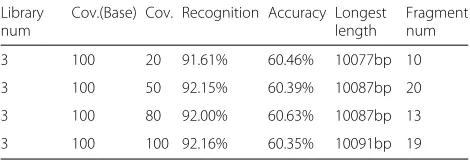
rate in sub-clones are shown in Table2. All the recogni-tion rate is over 91%, and the longest assembled fragment is longer than 10077 bp. When the coverage of new library changes from 20×to 100×, the change of recognition rate in sub-clone recognition is inconspicuous (less than 1%), indicating that a minor effect is caused by new libraries.
Analysis on the influence of the number of the libraries
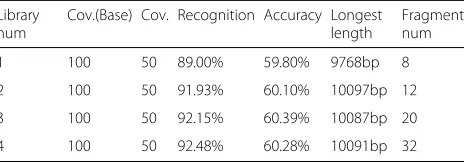
We found that the coverage of the new library almost had no effect on the accuracy of the clonal haplotype reconstruction, so the next experiment was performed on the number of introduced libraries. The coverage of base library is set to 100×, and the other libraries are all set to 50×, which can reduce the cost of sequencing. The effect of the libraries number on the recognition accuracy of sub-clonal haplotypes is shown in the following Table3.
As can be seen, the base library cannot recoginze the clonal haplotypes well. The recognition rate is less than 90%, the accuracy is less than 60%, and the longest assem-bled fragment is shorter than 10kbp. Meanwhile, we can see that the more libraries introduced toMixSubHap, the better the algorithm performs. Since the cost of sequenc-ing sharply increases when the new library is added, we recommend two libraries with different insert-sizes to reconstruct the clonal haplotypes.
Table 1The accuracy of haplotype reconstruction under different read length
Read length
Recognition rate
Accuracy rate
Longest length
Fragments num
100bp 91.58% 60.50% 10068bp 4
150bp 91.84% 60.41% 10092bp 5
200bp 91.85% 60.50% 10091bp 5
250bp 92.15% 60.39% 10087bp 20
Discussion
The proposed pipeline follows several constraints which imply the inheritance principle: Suppose that the micro evolution process of tumor tissue which satisfies the phylogenetic tree model [35,45]. Assume that sub-clones in the tumor samples are in a linear evolution mode, the somatic mutations in the evolutionary process satisfying the two hit hypothesis, with the selective advantage, and the sites having the repair mechanism are not consid-ered. In another word, one locus varies at most once in the process of evolution and the mutated site cannot be recovered. Thus, VAF is an important index to distin-guish the various sub-clones, following certain inheritance principles in the process of sub-clone differentiation. For
any variant site of p, VAF Vp is the number of reads
supporting the mutation accounted for the proportion of the site’s sequenced depth, which can be statistically calculated from the sequencing reads data. We set the col-lection of sub-cloneSi’s somatic mutation sites to beMi, among whichi ∈ {0, 1,. . .,I−1}andIis the total num-ber of sub-clones. CloneS0represents sub-clone with the
largest common ancestor characteristics estimated from sequencing data, called the founding clone. The set of
all the somatic mutations in sequencing samples isM =
iMi. LetGpi represents the genotype of sitepon sub-cloneSi,Sj represents the descendant clone ofSi, where
Table 2The accuracy of haplotype reconstruction under different library coverage
Library num
Cov.(Base) Cov. Recognition Accuracy Longest length
Fragment num
3 100 20 91.61% 60.46% 10077bp 10
3 100 50 92.15% 60.39% 10087bp 20
3 100 80 92.00% 60.63% 10087bp 13
Table 3The accuracy of haplotype reconstruction under different number of libraries
Library num
Cov.(Base) Cov. Recognition Accuracy Longest length
Fragment num
1 100 50 89.00% 59.80% 9768bp 8
2 100 50 91.93% 60.10% 10097bp 12
3 100 50 92.15% 60.39% 10087bp 20
4 100 50 92.48% 60.28% 10091bp 32
i < j. IfVp = 1, thenp ∈ M0andpis a homozygous
mutation, while ifVp = 0.5, thenp ∈ M0andpis a
het-erozygous mutation.Vp andVqare the VAF of variantp and q, if Vp ≤ Vq, then variant q belongs to the sub-clone which must be the descendant of the sub-clone variant p belongs to. In addition, haplotype heterogeneity follows the inheritance principle that homozygous variation sites which are different from the reference sequence will not appear in clone. So kVi,p,k ≤ 1 and inheritance rela-tionship in evolution process: IfVi,p,k = 1, then for all
i ≥ iwe haveVi,p,k = 1, while ifVi,p,k = 0, then for all
i ≤ iwe haveVi,p,k = 0. Among them,Vi,p,k indicates the VAF of variation sitepis on thekth haplotype of sub-cloneSi. The reconstruction of clonal haplotypes in tumor sample must satisfy the inheritance principle among sub-clones.
In addition, most of algorithms are based on the sec-ond generation sequencing data using linkage disequilib-rium of haplotype. Different data input should also be considered [46]. the proposed pipeline consists of three components, which are assembling local VPEs, expanding local contigs and iteratively stripping clonal read-depth. These components are also prolongable to other types of sequencing data once the VPEs can be generated. Based on the second generation sequencing data, the VPEs are short relative to the sub-clonal haplotype, and the uncer-tainty is quite large: On the aspect of time complexity, if the tumor tissue contains nsites, there are 2n
haplo-types.MixSubHapprocesses VPEs that defines a proper
partition length and connection, the short chains after partition can be accurately show sub-clonal haplotypes, and the time complexity is O((2I)!×M). Among them,
M is the number of groups divided by the start
posi-tion of the variaposi-tion sites in VPE and I is the number
of sub-clones. If the VPEs are extended,Mmay decrease
significantly.
Conclusions
The heterogeneity patterns on haplotypes are suggested to provide not only comprehensive information on tumor evolution and micro-environment, but valuable clini-cal implications as well. Most of the existing methods investigated the heterogeneity on genotype level, while the computational methods that facilitate the analyses
on clonal haplotypes are in urgent needs. In this
arti-cle, we presentedMixSubHap, which is a computational
pipeline for reconstructing clonal haplotypes.MixSubHap
is able to identify about 90% on average of the preset clonal haplotypes under different simulation
configura-tions. Especially,MixSubHapis robust when decreasing
the mutation rates, in which cases the longest assembled contig could reach to 10kbps, while the accuracy of assign-ing a mutation to its haplotype still keeps more than 60% on average. According to the experimental results on the simulation datasets, we may conclude that the proposed pipeline is a practical tool working on cancer sequencing data. On the other hand, we also notice that two compo-nents ofMixSubHapuse the estimation of clonal structure to reduce the solution space. However, such estimation provided by the model-free methods yields more or less errors, especially when the VAFs are close among different sub-clones. This transferred errors could hurt the accu-racy on reconstructing clonal haplotypes. Current version only considers point mutations, which will be further extended to structural variations and more complicated cases.
Abbreviations
VAF: Variant allelic frequency
Acknowledgements
The authors would like to thank the conference organizers of the International Conference on Intelligent Biology and Medicine (ICIBM 2018). We also would like to thank the reviewers for their valuable comments and suggestions, which guide us to improve the work and manuscript.
Funding
Publication of this article is funded by the National Science Foundation of China (Grant Nos: 31701150, 91846107, 71571058) and the Fundamental Research Funds for the Central Universities (CXTD2017003), China Postdoctoral Science Foundation funded project 2018M643684.
Availability of data and materials
The source codes has been uploaded and maintained athttps://github.com/ YixuanWang1120/MixSubHap.gitfor academic use only.
About this supplement
This article has been published as part ofBMC Medical Genomics Volume 12 Supplement 1, 2019: Selected articles from the International Conference on Intelligent Biology and Medicine (ICIBM) 2018: medical genomics. The full contents of the supplement are available online athttps://bmcmedgenomics. biomedcentral.com/articles/supplements/volume-12-supplement-1.
Authors’ contributions
JYW and ZXP conducted this research. YXW, SD, YG, JYL and ZMZ designed the algorithms and the pipeline. YXW applied the simulation experiments. YXW, RZ, XX and JYW wrote this manuscript. All authors read and approved the final version of this manuscript.
Ethics approval and consent to participate Not applicable.
Consent for publication Not applicable.
Competing interests
Publisher’s Note
Springer Nature remains neutral with regard to jurisdictional claims in published maps and institutional affiliations.
Author details
1Department of Computer Science and Technology, School of Electronic and
Information Engineering, Xi’an Jiaotong University, Xi’an 710048, China.
2Shaanxi Engineering Research Center of Medical and Health Big Data, School
of Electronic and Information Engineering, Xi’an Jiaotong University, Xi’an 710048, China.3School of Management, Ministry of Education Key Laboratory
of Process Optimization and Intelligent Decision-Making, Hefei University of Technology, Hefei 23009, China.4Institute of Health Administration and Policy,
School of Public Policy and Administration, Xi’an Jiaotong University, Xi’an 710048, China.
Published: 31 January 2019
References
1. Knudson AG. Mutation and cancer: statistical study of retinoblastoma. Proc Natl Acad Sci. 1971;68(4):820–3.
2. Kandoth C, McLellan MD, Vandin F, et al. Mutational landscape and significance across 12 major cancer types. Nature. 2013;502(7471):333–9. 3. Miller CA, White BS, Dees ND, et al. SciClone: inferring clonal architecture
and tracking the spatial and temporal patterns of tumor evolution. PLoS Comput Biol. 2014;10(8):e1003665.1–15.
4. Lu C, Xie M, Wendl MC, Wang J, McLellan MD, Leiserson MD, et al. Patterns and functional implications of rare germline variants across 12 cancer types. Nat Commun. 2015;10086(6):1–13.
5. Huang KL, Mashl RJ, Wu Y, et al. Pathogenic germline variants in 10,389 adult cancers. Cell. 2018;173(2):355–70.
6. Geng Y, Zhao Z, Zhang X, et al. An improved burden-test pipeline for identifying associations from rare germline and somatic variants. BMC Genomics. 2017;18(7:753):55–62.
7. Landau DA, Carter SL, Stojanov P, et al. Evolution and impact of subclonal mutations in Chronic Lymphocytic Leukemia. Cell. 2013;152(4):714–26. 8. Keats JJ, Chesi M, Egan JB, et al. Clonal competition with alternating
dominance in multiple myeloma. Blood. 2012;120(5):1067–76.
9. Merlo LM, Shah NA, Li X, et al. A comprehensive survey of clonal diversity measures in Barrett’s esophagus as biomarkers of progression to esophageal adenocarcinoma. Cancer Prev Res. 2010;3(11):1388–97. 10. Turke AB, Zejnullahu K, Wu YL, et al. Preexistence and clonal selection of
MET amplification in EGFR mutant NSCLC. Cancer Cell. 2010;17(1):77–88. 11. Huang Y, Wang J, Jia P, et al. Clonal architectures predict clinical
outcome in clear cell renal cell carcinoma. Nat Commun. 2018. accepted and in publication.
12. McKenna A, Hanna M, Banks E, et al. The Genome Analysis Toolkit: a MapReduce framework for analyzing next-generation DNA sequencing data. Genome Res. 2010;20(9):1297–303.
13. Ye K, Wang J, Jayasinghe R, et al. Systematic discovery of complex insertions and deletions in human cancers. Nat Med. 2016;22(1):97–104. 14. Zheng T, Li Y, Geng Y, et al. CIGenotyper: A machine learning approach
for genotyping complex indel calls. In: Rojas I, Ortuño F, editors. Bioinformatics and Biomedical Engineering. IWBBIO 2018: Bioinformatics and Biomedical Engineering. Lecture Notes in Computer Science, Vol 10813. Cham: Springer; 2018. p. 473–85.
15. Geng Y, Zhao Z, Xu J, et al. Identifying heterogeneity patterns of allelic imbalance on germline variants to infer clonal architecture. In: Huang DS, Jo KH, Figueroa-García J, editors. Intelligent Computing Theories and Application. ICIC 2017: Intelligent Computing Theories and Application. Lecture Notes in Computer Science, Vol 10362. Cham: Springer; 2017. p. 286–297.
16. Browning SR, Browning BL. Haplotype phasing: existing methods and new developments. Nat Rev Genet. 2011;12(10):703–14.
17. Aguiar D, Wong W, Istrail S. Tumor haplotype assembly algorithms for cancer genomics. In: Proceedings of the 2014 Pacific Symposium on Biocomputing (PSB 2014). Big Island. Biocomputing 2014, pp. 3-14 (2013) https://doi.org/10.1142/9789814583220_0002.
18. Xu M, Zhao Z, Zhang X, et al. Synstable Fusion: a network-based algorithm for estimating driver genes in fusion structures. Molecules. 2018;2055(8):1–20.
19. Xu H, Guan Y. Detecting local haplotype sharing and haplotype association. Genetics. 2014;197(3):823–38.
20. Samwald M, Miñarro Giménez JA, Boyce RD, et al. Pharmacogenomic knowledge representation, reasoning and genome-based clinical decision support based on OWL 2 DL ontologies. BMC Med Inform Decis Making. 2015;15(12):1–10.
21. Wang H, Ding S, Wu D, et al. Smart connected electronic gastroscope system for gastric cancer screening using multi-column convolutional neural networks. Int J Prod Res. online publication.https://doi.org/0.1080/ 00207543.2018.1464232.
22. Ding S, Li Y, Wu D, et al. Time-aware cloud service recommendation using similarity-enhanced collaborative filtering and ARIMA. Decis Support Syst. 2018;107:103–15.
23. Hoehe MR, Timmermann B, Lehrach H. Human inter-individual DNA sequence variation in candidate genes, drug targets, the importance of haplotypes and pharmacogenomics. Curr Pharm Biotechnol. 2003;4(6): 351–78.
24. McLeod HL. Cancer pharmacogenomics: early promise, but concerted effort needed. Science. 2013;339(6127):1563–6.
25. Xie M, Lu C, Wang J, et al. Age-related cancer mutations associated with clonal hematopoietic expansion and malignancies. Nat Med. 2014;20(12): 1472–8.
26. Schwartz R, Schäffer AA. The evolution of tumour phylogenetics: principles and practice. Nat Rev Genet. 2017;18(4):213–29.
27. Strino F, Parisi F, Micsinai M, et al. TrAp: a tree approach for fingerprinting subclonal tumor composition. Nucleic Acids Res. 2013;e165(17):1–15. 28. Deshwar AG, Vembu S, Yung CK, et al. PhyloWGS: reconstructing
subclonal composition and evolution from whole-genome sequencing of tumors. Genome Biol. 2015;16(35):1–20.
29. Yuan K, Sakoparnig T, Markowetz F, et al. BitPhylogeny: a probabilistic framework for reconstructing intra-tumor phylogenies. Genome Biol. 2015;16(36):1–16.
30. El-Kebir M, Satas G, Oesper L, et al. Inferring the mutational history of a tumor using multi-state perfect phylogeny mixtures. Cell Syst. 2016;3(1): 43–53.
31. Jiang Y, Qiu Y, Minn A, et al. Assessing intratumor heterogeneity and tracking longitudinal and spatial clonal evolutionary history by next-generation sequencing. Proc Natl Acad Sci U S A. 2016;113(37): E5528–37.
32. Eaton J, Wang J, Schwartz R. Deconvolution and phylogeny inference of structural variations in tumor genomic samples. Bioinformatics. 2018;34(13):i357—65.
33. Beerenwinkel N, Schwarz RF, Gerstung M, et al. Cancer evolution: mathematical models and computational inference. Syst Biol. 2015;64(1): e1–25.
34. Oesper L, Mahmoody A, Raphael BJ. THetA: inferring intra-tumor heterogeneity from high-throughput DNA sequencing data. Genome Biol. 2013;R80(7):1–21.
35. Jiao W, Vembu S, Deshwar AG, et al. Inferring clonal evolution of tumors from single nucleotide somatic mutations. BMC Bioinformatics. 2014;15(35):1–16.
36. Roth A, Khattra J, Yap D. PyClone: statistical inference of clonal population structure in cancer. Nat Methods. 2014;11(4):396–8. 37. Ha G, Roth A, Khattra J, et al. TITAN: inference of copy number
architectures in clonal cell populations from tumor whole-genome sequence data. Genome Res. 2014;24(11):1881–93.
38. Roman T, Xie L, Schwartz R. Automated deconvolution of structured mixtures from heterogeneous tumor genomic data. PLoS Comput Biol. 2017;13(10):e1005815.1-23.
39. He D, Saha S, Finkers R, et al. Efficient algorithms for polyploid haplotype phasing. BMC Genomics. 2018;19(Suppl 2):110.1–10.
40. Bansal V, Bafna V. HapCUT: an efficient and accurate algorithm for the haplotype assembly problem. Bioinformatics. 2008;24(16):i153–9. 41. Aguiar D, Istrail S. Haplotype assembly in polyploid genomes and
identical by descent shared tracts. Bioinformatics. 2013;29(13):i352–60. 42. Berger E, Yorukoglu D, Peng J, et al. HapTree: a novel Bayesian
framework for single individual polyplotyping using NGS data. PLoS Comput Biol. 2014;10(3):e1003502.1-10.
44. Hashemi A, Zhu B, Vikalo H. Sparse tensor decomposition for haplotype assembly of diploids and polyploids. BMC Genomics. 2018;19(Suppl 4): 191.1–15.
45. Geng Y, Zhao Z, Liu J, et al. An algorithm with base-pair resolution for identifying cancer heterogeneity by estimating multiple clonal haplotypes. J Xi’an Jiaotong Univ. 2017;51(6):92–6.