R E S E A R C H
Open Access
Pentoxifylline and the proteasome inhibitor
MG132 induce apoptosis in human leukemia
U937 cells through a decrease in the expression
of Bcl-2 and Bcl-XL and phosphorylation of p65
Alejandro Bravo-Cuellar
1,2, Georgina Hernández-Flores
1, José Manuel Lerma-Díaz
1,2,
Jorge Ramiro Domínguez-Rodríguez
1,3, Luis F Jave-Suárez
1, Ruth De Célis-Carrillo
1, Adriana Aguilar-Lemarroy
1,
Paulina Gómez-Lomeli
1,4and Pablo Cesar Ortiz-Lazareno
1*Abstract
Background:In Oncology, the resistance of the cancerous cells to chemotherapy continues to be the principal limitation. The nuclear factor-kappa B (NF-κB) transcription factor plays an important role in tumor escape and resistance to chemotherapy and this factor regulates several pathways that promote tumor survival including some antiapoptotic proteins such as Bcl-2 and Bcl-XL. In this study, we investigated, in U937 human leukemia cells, the effects of PTX and the MG132 proteasome inhibitor, drugs that can disrupt the NF-κB pathway. For this, we evaluated viability, apoptosis, cell cycle, caspases-3, -8, -9, cytochromecrelease, mitochondrial membrane potential loss, p65 phosphorylation, and the modification in the expression of pro- and antiapoptotic genes, and the Bcl-2 and Bcl-XL antiapoptotic proteins.
Results:The two drugs affect the viability of the leukemia cells in a time-dependent manner. The greatest
percentage of apoptosis was obtained with a combination of the drugs; likewise, PTX and MG132 induce G1 phase cell cycle arrest and cleavage of caspases -3,-8, -9 and cytochromecrelease and mitochondrial membrane potential loss in U937 human leukemia cells. In these cells, PTX and the MG132 proteasome inhibitor decrease p65 (NF-κB subunit) phosphorylation and the antiapoptotic proteins Bcl-2 and Bcl-XL. We also observed, with a combination of these drugs overexpression of a group of the proapoptotic genesBAX,DIABLO, andFASwhile the genesBCL-XL, MCL-1,survivin,IκB, andP65were downregulated.
Conclusions:The two drugs used induce apoptosisper se, this cytotoxicity was greater with combination of both drugs. These observations are related with the caspases -9, -3 cleavage and G1 phase cell cycle arrest, and a decrease in p65 phosphorylation and Bcl-2 and Bcl-XL proteins. As well as this combination of drugs promotes the upregulation of the proapoptotic genes and downregulation of antiapoptotic genes. These observations strongly confirm antileukemic potential.
Keywords:U937, Apoptosis-related genes, Caspases, p65 phosphorylation, Bcl-2, Bcl-XL, pentoxifylline, MG132
* Correspondence:[email protected]
1División de Inmunología, Centro de Investigación Biomédica de Occidente (CIBO), Instituto Mexicano del Seguro Social (IMSS), Sierra Mojada 800, Col. Independencia, Guadalajara, Jalisco 44340, México
Full list of author information is available at the end of the article
Background
Leukemia is a heterogenic group of diseases characterized by infiltration of neoplastic cells of the hematopoietic sys-tem into the blood, bone marrow, and other tissues [1,2]. Leukemia is the most common malignancy among people aged <20 years. In the last decade, these diseases have exhibited a clear ascending pattern in the morbidity index, becoming a great challenge to health institutions [3].
The main treatment for this disease is chemotherapy. However, its results are very often limited due to the treatment resistance that the neoplastic cells develop [4,5]. In an attempt to increase the efficiency of antileu-kemic treatments, higher doses of the cytotoxic agents have been used or different combinations of them [6,7], but in the majority of the cases, higher doses have been put into effect in an empirical manner without good re-sults and incrementing side effects.
Given this situation, our research team has developed the concept of chemotherapy with a rational molecular basis. The former is based on the premise that chemo-therapy acts mainly to induce a genetically programmed death of the cell called apoptosis, and that this depends in turn on the synthesis of proteinsde novoand the acti-vation of biochemical factors as a result of a modifica-tion in the balance between expression of pro- and antiapoptotic genes in response to treatment [8,9]. The cells undergoing apoptosis show internucleosomal frag-mentation of the DNA, followed by nuclear and cellular morphologic alterations, which leads to a loss of the in-tegrity of the membrane and the formation of apoptotic bodies. All of these processes are mediated by caspases, which are the main enzymes that act as apoptosis initia-tors and effecinitia-tors. Some of these molecules can active themselves, while others require other caspases in order to acquire biological activity. This proteolytic cascade breaks down specific intracellular proteins including nuclear pro-teins of the cytoskeleton, endoplasmic reticulum, and cytosol, finally hydrolyzing the DNA [10-12].
On the other hand, it is noteworthy that upon apop-totic stimulus such as that generated by chemotherapy, this not only induces apoptosis but can also activate antiapoptotic mechanisms [13,14]. Similarly, the nuclear factor-kappa B (NF-κB) transcription factor plays an im-portant role in tumor cell growth, proliferation, invasion, and survival. In inactive cells, this factor is linked with its specific inhibitor I-kappa B (IκB), which sequesters NF-κB in the cytoplasm and prevents activation of target genes [15-18]. In this respect, NF-κB can activate antiapoptotic genes such as Bcl-2, Bcl-XL, and survivin, affecting chemotherapy efficiency, even if the chemo-therapy itself or the radiochemo-therapy itself can activate the NF-κB factor [19-21]. Blast cells exhibit overexpression of antiapoptotic proteins (Bcl-2 and Bcl-XL), which in-crease resistance to antitumor therapy [22].
In this regard, the drug PTX can prevent the phosphor-ylation of serines 32 and 36 of IκB, and we have found that PTX in combination with antitumor drugs such as adriamycin and cisplatin inducedin vitroandin vivoa sig-nificant increment of apoptosis in fresh leukemic human cells [8], lymphoma murine models [9], and cervical can-cer cells [23]. Similar results have also been observed with PTX in other studies [24]. PTX is a xanthine and a com-petitive nonselective phosphodiesterase inhibitor that in-hibits tumor necrosis factor (TNF) and leukotriene synthesis and reduces inflammation [25,26]. The MG132 proteasome inhibitor is another drug that decreases
NF-κB activity [27]. Proteasome inhibitors are becoming pos-sible therapeutic agents for a variety of human tumor types that are refractory to available chemotherapy and radiotherapy modalities [28,29]. The proteasome is a multicatalytic complex that is responsible for regulating apoptosis, cell cycle, cell proliferation, and other physio-logical processes by regulating the levels of important sig-naling proteins such as NF-κB, IκB, and the MG132 proteasome inhibitor have been shown to induce apop-tosis in tumor cells [30,31]. This is important because apoptosis is regulated by the ubiquitin/proteasome system at various levels [32]. The aim of the present work was to studyin vitroin U937 leukemic cells the effects on viabil-ity, apoptosis, cell cycle, caspases cleavage, cytochrome c
release and mitochondrial membrane potential (ΔΨm), the Bcl-2 and Bcl-XL antiapoptotic proteins, and related genes activated by the PTX and/ or MG132 proteasome inhibitor, compounds that possess a NF-κB-mediated in-hibitory effect.
Methods Cells
The cell line U937 (ATCC CRL-1593.2), human mono-cytic leukemia, was used. These cells were cultivated in an RPMI-1640 culture medium (GIBCO, Invitrogen Co., Carlsbad, CA, USA) with the addition of 10% fetal bovine serum (FBS) (GIBCO), a 1% solution of L-glutamine 100X (GIBCO), and antibiotics (GIBCO), which will be desig-nated as RPMI-S. The cells were maintained at 37°C in a humid atmosphere containing 5% CO2and 95% air.
Drugs
Cell culture and experimental conditions
U937 cells (2.5 × 10⁵-mL in T75 flasks, Corning Incor-porated, Corning, NY, USA) were grown in RPMI-S for 24 hours and collected by centrifugation. The cells were reseeded onto 24 well plates; U937 cells were either treated with PTX (8 mM) or MG132 (1μΜ), or PTX + MG132 (final concentrations). The cells were incubated with PTX for 1 hour prior to the addition of MG132. All experiments were carried out 24 hours after treat-ment, to exception of the p65 phosphorylation that it was analyzed 1 hour after treatment with PTX or MG132 and in the gene expression studies the cells were incubated with the drugs for only 3 hours. The concentrations of the treatments employed in this study were previously confirmed as being the most favorable for the induction of apoptosis in this experimental model [33,34].
Cellular viability
Cell viability was determined at different times in U937 cells (2 X 10⁴). They were incubated with PTX, MG132 or PTX + MG132 during 18, 24, 36 and 48 hours, we use a WST-1 cell proliferation reagent commercial kit (BioVision, Inc. Milpitas, CA, USA) following the manu-facturer’s instructions. This study is based on the reduc-tion of tetrazolium salts (WST-1) to formazan. After of the incubation 10 μL/well of WST-1/ECS reagent was added and the U937 cell were incubated for another 3 -hours. The absorbance was measured in a microplate reader (Synergy™ HT Multi-Mode Microplate Reader; Biotek, Winooski, VT, USA) at 450 nm as reading refer-ence wavelength at 690 nm. Data are reported as the mean ± standard deviation of the optical density values obtained in each group.
Cell cycle analysis by flow cytometry
For cell cycle analysis, the U937 cells were synchronized [35]. In brief, cells were culture in RPMI-1640 containing 5% FBS by 12 hours then the cells were washed and culture in RPMI-1640 containing 1% FBS overnight. After the cells were washed with PBS and changed to serum free medium for 18 hours, and finally the cells were passage and released into cell cycle by addition of 10% FBS in RPMI-1640 culture medium and 1 × 10⁶ cells were treated 24 hours with the different drugs. The BD Cycletest™ Plus DNA Reagent Kit was used following the manufacturer’s instructions (BD Bio-sciences, San Jose, CA, USA). DNA QC Particles (BD Biosciences) were used for verification of instrument performance and quality control of BD FACSAria I (BD Biosciences) cell sorter employed in DNA analysis. For each sample, at least 20,000 events were acquired and data were processed with Flowjo v7.6.5 software (Tree Star Inc., OR, USA).
Assessment of apoptosis induction by PTX and MG132 proteasome inhibitor
Apoptosis was evaluated by means of the Annexin V-FITC FLUOS Staining kit (Annexin-V-Fluos; Roche, Mannheim, Germany). Briefly, 1×10⁶ U937 cells were treated 24 hours with PTX, MG132 or PTX + MG132 after that the samples were washed twice with PBS and resuspended in 100 μL of incubation buffer; 2 μL of Annexin V- Fluorescein Isothiocyanate (FITC) and 2μL of propidium iodide (PI) solution were added. The samples were mixed gently and incubated for 10 min at 20°C in the dark. Finally, 400 μL of incubation buffer was added to each suspension, which was analyzed by flow cytometry. Annexin V- FITC-negative and PI-negative cells were con-sidered live cells. Percentage of cells positive for Annexin V-FITC but negative for PI was considered to be in early apoptosis. Cells positive for both Annexin V-FITC and PI were considered to be undergoing late apoptosis and cells positive to PI were considered to be in necrosis. At least 20,000 events were acquired with the FACSAria I cell sorter and analysis was performed using FACSDiva soft-ware (BD Bioscience).
Assessment of mitochondrial membrane potential by flow cytometry
U937 cells (1 × 10⁶) were treated 24 hours with the differ-ent drugs after that the cells were washed twice with PBS, resuspended in 500μL of PBS containing 20 nM of 3,3-dihexyloxacarbocyanine iodide (DIOC6, Sigma-Aldrich), and incubated at 37°C for 15 min and the percentage of cells with ΔΨm loss was analyzed by flow cytometry. As an internal control of the disrupted ΔΨm, cells were treated for 4 hours with 150μM of protonophore carbonyl cyanide m-chlorophenylhydrazone (CCCP, Sigma-Adrich) positive control. Flow cytometry was performed using FACSAria I (BD Biosciences). At least 20,000 events were analyzed with the FACSDiva Software (BD Biosciences) in each sample.
Protein extraction for caspases-3, -8 and -9 and cytochromecand Western blot assay
membranes (Millipore, Bedford, MA, USA) and incubated with 1× Western blocking reagent (Roche) during 1.5 hour for nonspecific binding. Immunodetection of caspases3, -8 and -9 were performed using anti-caspases -3, --8 and -9 antibodies (BioVision, Inc.) and cytochromecwas effected using anti-cytochrome cantibody (Biolegend, San Diego, CA, USA) at 4°C overnight. After incubation with a horse-radish peroxidase-conjugated secondary antibody (Santa Cruz Biotechnology, CA, USA) immunoreactive proteins were visualized by Western blotting luminol reagent using the ChemiDoc™ XRS equipment (Bio-Rad) with the Quantity OneW 1-d Analysis Software (Bio-Rad). Control
β-actin antibody (Santa Cruz Biotechnology). Protein levels on Western blot were quantified using the IMAGEJ 1.46r package (NIH, Bethesda, MD, USA).
Detection of Bcl-2 and Bcl-XL antiapoptotic proteins, and p65 phosphorylation by flow cytometry
For determination of Bcl-2, Bcl-XL, and phosphorylated p65, 1 × 10⁶U937 cells were treated or not treated for 1 -hour with PTX, MG132 or PTX + MG132. We employed Alexa FluorW 647mouse anti-human Bcl-2 and Alexa FluorW 647 mouse anti human Bcl-XL proteins (Santa Cruz Biotechnology) and Alexa FluorW 647 mouse anti-human NF-κB p65 (pS529) (BD Biosciences) antibodies. The staining procedures were according to protocol for detecting protein or activation of the phosphorylation state by flow cytometry. An appropriate isotype control was utilized in each test to adjust for background fluor-escence, and the results are represented as the mean fluorescence intensity (MFI) of Bcl-2, Bcl-XL proteins, and phosphorylated p65 protein. For each sample, at least 20,000 events were acquired in a FACSAria I cell sorter (BD Biosciences) and data were processed with FACSDiva software (BD Biosciences).
Quantitative real-time PCR
Total RNA of the U937 cells (5×10⁶) was obtained after 3 -hours of incubation with the different treatments using the Purelink™Micro-to-Midi purification system for total RNA (Invitrogen Co.). The DNAc was synthesized begin-ning with 5μg of total RNA utilizing the Superscript™III First-Strand Synthesis Supermix kit (Invitrogen Co.). Real-Time PCR was carried out with the System Light CyclerW 2.0 (Roche Applied Science, Mannheim, Germany), for which we employed DNA Master plus SYBR Green I (Roche Applied Science). The PCR program consisted of an initial 10-min step at 95°C, and 40 cycles of 15-sec at 95°C, 5-sec at 60°C, and 15-sec cycles at 72°C. Analysis of the PCR products was carried out with Light CyclerW soft-ware (Roche Applied Science). Data are presented in rela-tive normalized quantities employingL32ribosomal gene expression to verify the specificity of the amplified reac-tion, which was nearly 100%. The oligonucleotides
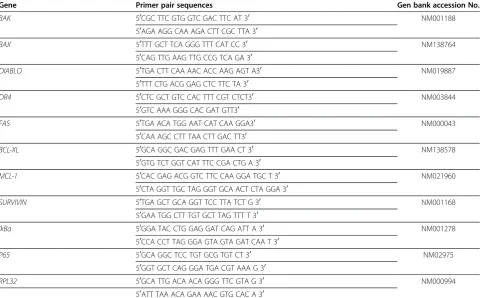
(Invitrogen Co.) were designed in the data base of nucleo-tides of the Gen Bank of the National Information Center for Biotechnology (http://www.ncbi.nlm.nih.gov) using the oligo v.6 program (Table 1).
Statistical analysis
All experiments were carried out in triplicate and were repeated three times. The values represent mean ± standard deviation of the values obtained. Statistical ana-lysis was performed with the non-parametric Mann-Whitney U test considering p <0.05 as significant. In some experiments, we calculated the Δ%, which repre-sents the percentage of increase or diminution in rela-tion to the corresponding untreated control group (UCG). For the different gene expressions, we consid-ered significant variations as≥at 30% compared with the constitutive gene [8].
The committee of ethics, biosafety and research of CIBO approved the study with the number 1305-2005-16.
Results
PTX and MG132 proteasome inhibitor induce a decrease in viability in U937 cells
We evaluated the effect on viability of U937 leukemic cells treated with both drugs. PTX, MG132, or PTX + MG132 induce inhibition of cell viability in time-dependent man-ner (Figure 1). In the case of PTX or PTX + MG132 treated cells, these treatments at 18 hours exhibited simi-lar behavior inducing around 60% of diminution of cell viability (p< 0.05 vs all groups). These values practically did not change in the other times. In contrast, at this same time the cellular viability was slightly modified by MG132 treatment (p <0.05 vsother treated groups) and reached similar values to those of the other two treated groups at 48 hours after treatment (optical density = PTX 0.48 ± 0.06, MG132 0.54 ± 0.06, PTX + MG132 0.49 ± 0.11, p< 0.05 vs untreated control group 1.87 ± 0.9).
PTX and MG132 proteasome inhibitor induce G1 cell cycle arrest in U937 cells
0 0.2 0.4 0.6 0.8 1 1.2 1.4 1.6 1.8 2
untreated control group Pentoxifylline, 8mM MG132, 1 M Pentoxifylline + MG132
18 24 36 48
Hours
A
b
sorbance (A
450nm-A
690nm)
*
Figure 1Evaluation of viability in U937 human leukemia cells treated with PTX, MG132 and PTX + MG132.U937 cells were incubated in the presence of PTX, MG132, or PTX + MG132 for 18, 24, 36, and 48 hours as previously indicated. After incubation, WST-1 was added and 3 hours later, viability was assessed by spectrophotometry at 450 nm. The results represent mean ± standard deviation of three independent experiments performed in triplicate. Statistical analysis Mann-WhitneyUtest.♦p<0.05 PTX or PTX + MG132vsuntreated control group or MG132 group.●p <0.05 PTX + MG132vsall groups. *p< 0.05 PTX, MG132 or PTX + MG132vsuntreated control group.
Table 1 Primer pair used for real-time (RT) quantitative PCR
Gene Primer pair sequences Gen bank accession No.
BAK 50CGC TTC GTG GTC GAC TTC AT 30 NM001188
50AGA AGG CAA AGA CTT CGC TTA 30
BAX 50TTT GCT TCA GGG TTT CAT CC 30 NM138764
50CAG TTG AAG TTG CCG TCA GA 30
DIABLO 50TGA CTT CAA AAC ACC AAG AGT A30 NM019887 50TTT CTG ACG GAG CTC TTC TA 30
DR4 50CTC GCT GTC CAC TTT CGT CTCT30 NM003844
50GTC AAA GGG CAC GAT GTT30
FAS 50TGA ACA TGG AAT CAT CAA GGA30 NM000043
50CAA AGC CTT TAA CTT GAC TT30
BCL-XL 50GCA GGC GAC GAG TTT GAA CT 30 NM138578 50GTG TCT GGT CAT TTC CGA CTG A 30
MCL-1 50CAC GAG ACG GTC TTC CAA GGA TGC T 30 NM021960 50CTA GGT TGC TAG GGT GCA ACT CTA GGA 30
SURVIVIN 50TGA GCT GCA GGT TCC TTA TCT G 30 NM001168 50GAA TGG CTT TGT GCT TAG TTT T 30
IkBa 50GGA TAC CTG GAG GAT CAG ATT A 30 NM001278
50CCA CCT TAG GGA GTA GTA GAT CAA T 30
P65 50GCA GGC TCC TGT GCG TGT CT 30 NM02975
50GGT GCT CAG GGA TGA CGT AAA G 30
RPL32 50GCA TTG ACA ACA GGG TTC GTA G 30 NM000994 50ATT TAA ACA GAA AAC GTG CAC A 30
Oligonucleotides were designed using the Oligo v.6 software. Gene sequences were obtained from the GenBank Nucleotide Database of the National Center for
G1 = 47.88% S = 36.97% G2 = 15.15%
untreated control group
Pentoxifylline
MG132
Pentoxifylline + MG132
0
10
20
30
40
50
60
70
80
G1 = 69.81% S = 18.78% G2 = 11.41%
G1 = 59.93% S = 27.20% G2 = 12.87%
G1 = 69.24% S = 16.87% G2 = 13.89%
Percentage
1. -untreated control group
2. -Pentoxifylline
4. -Pentoxifylline + MG132
3. -MG132
*
•
•
*
G1
S
G2
1 2 3 4 1 2 3 4 1 2 3 4
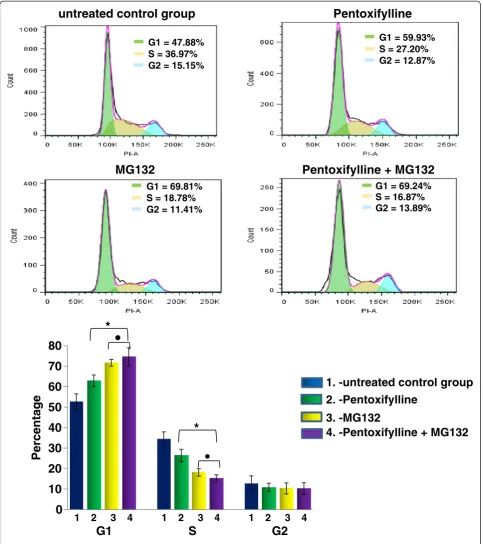
however, theΔ% in PTX, MG132 or the combination of both drugs were - 26.4%, -49.2% and -54.3% respectively
p< 0.05. Finally for the G2 phase the percentage of cells from untreated control group was 12.8 ± 3.6%, it dimin-ished in treated groups Δ% = -15.2%, -24.5%, -10.9% for PTX, MG132 and PTX + MG132 groups respectively. These observations suggest that PTX and MG132 or its combination induce a cell arrest in the G1 phase.
Apoptosis induction by PTX + MG132
At 24 hours of culture, apoptosis was evaluated in the U937 human leukemia cells that was induced by the dif-ferent treatments under experimental conditions as pre-viously described. In Figure 3, it is observed that the untreated control group showed a low percentage of early and late apoptosis (2.1 ± 0.9% and 2.6 ± 1.1% re-spectively) compared with the group treated exclusively with either PTX (18.2 ± 2.1% and 28.5 ± 7.3% of early and late apoptosis, respectively,p<0.05), or treated with MG132 proteasome inhibitor so we observed 28.1 ± 8.1% and 20.7 ± 6.6% of early and late apoptosis, respectively (p< 0.05vsuntreated control group). It was also very in-teresting to observe that the group of cultures exposed
to PTX + MG132 showed a greater percentage of late apoptosis 44.1 ± 4.5% in comparison with all other groupsp<0.05.
PTX + MG132 induce mitochondrial membrane potential (ΔΨm) loss
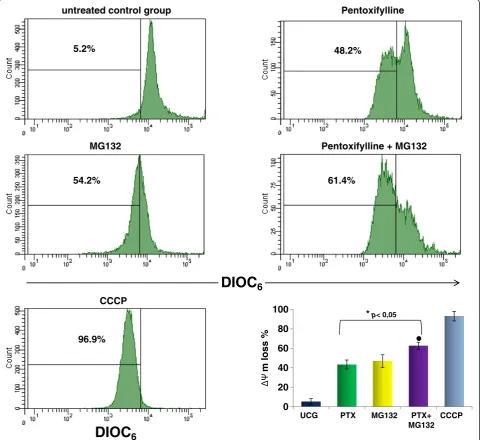
As mitochondria plays an important role in apoptosis, for that reason we determined the ΔΨm in U937 leukemia cells treated with PTX, MG132 or PTX + MG132 and the results are represented in the Figure 4. TheΔΨm did not change in untreated control group. However when the cells were treated with either PTX or MG132 an import-ant loss of theΔΨm were noted 43.4 ± 4.7% and 46.8 ± 6.6 respectively (p< 0.05 compared with untreated control group), and it is interesting that PTX + MG132 induce an important ΔΨm loss in U937 cells 62.7 ± 3.7%, in com-parison with the other groupsp< 0.05.
PTX + MG132 increase cleavage in caspases-3, -9 and cytochromecrelease
We determined caspases -3, -8, -9 and cytochromec by Western blot. The analysis reveals that the combination PTX + MG132 was more effective in the activation of
0 20 40 60 80 100
0.3% 3.9%
94.5% 1.3%
2.4% 47.3%
23.5% 26.8%
1.1% 24.9%
45.1% 28.9%
1.2% 30.1%
49.1% 19.6%
untreated control group Pentoxifylline MG132 Pentoxifylline + MG132
LIVE EARLY NECROSIS
APOPTOSIS
LATE APOPTOSIS *p< 0,05
*p< 0,05
*p< 0,05
•
•
untreated control group Pentoxifylline, 8 mM
Pentoxifylline + MG132 MG132, 1 μM
Percentage
Annexin-V FITC
PI
caspases-9 and -3. The results in Figure 5 allow us to ob-serve that PTX increase cleavage of caspases-9 (2.8 fold) and -3 (10.4 fold), and the release of cytochrome c (5.2 fold) compared with untreated control group p< 0.05. In similar way MG132 proteasome inhibitor increase cleavage of caspase-3 in 5.4 fold, caspase-9 in 1.7 fold and caspase-8 in 1.4 fold change and release of cytochromecin 4.8 fold compared with untreated control groupp< 0.05. It is im-portant to stress that when we used PTX + MG132 we ob-served considerably cleavage of caspase-9 (13.5 fold) and caspase-3 (13.4 fold) compared with PTX or MG132 alone
and with untreated control group, p< 0.05. In the same way, when we use both drugs simultaneity we observed an increase in the release of cytochrome c (5.11 fold) and cleavage of caspase-8 (1.88 fold) in comparison with un-treated control groupp< 0.05.
Determination by flow cytometry of phosphorylated p65 protein from NF-κB, Bcl-2 and Bcl-XL antiapoptotic proteins
The phosphorylated p65 protein was quantified deter-mining the Mean Fluorescence Intensity by flow cytome-try. As we expected, in comparison with the Untreated
5.2%
61.4% 54.2%
48.2%
96.9%
DIOC
6untreated control group Pentoxifylline
MG132 Pentoxifylline + MG132
CCCP
0 20 40 60 80 100
UCG PTX MG132 PTX+ CCCP
MG132
m loss %
*p< 0,05
•
DIOC
6Figure 4PTX + MG132 induces loss of the mitochondrial membrane potential (ΔΨm).U937 cells were cultured and treated with 8 mM PTX, 1μM MG132, or PTX + MG132. After 24 hours, the cells were harvested and theΔΨm was assessment by flow cytometry using DIOC6staining.
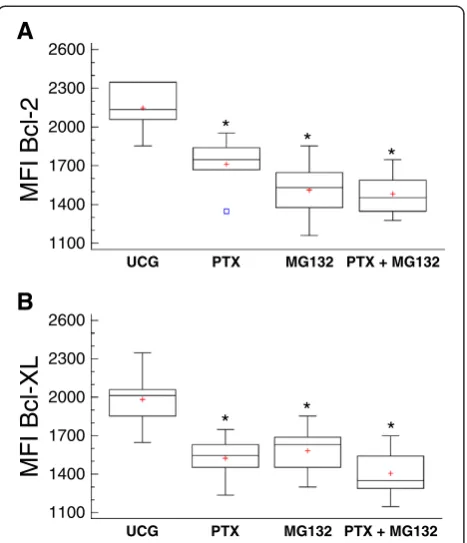
Control Group, Figure 6 shows that U937 human leukemia cells treated with PTX or the MG132 proteasome inhibi-tor decrease the phosphorylation of p65 (p<0.05), and in the combination of both compounds, this diminution is more pronounced. The antiapoptotic proteins Bcl-2 and Bcl-XL play a transcendent role in chemoresistance in tumor cells; therefore, these proteins could be regulated by the NF-κB transcription factor. For this, we studied the effect of PTX and MG132 in these proteins. We can ob-serve in Figure 7A that tumor U937 cells treated with PTX, MG132, or PTX + MG132 in a similar manner re-duce the expression of Bcl-2 protein in comparison with the untreated control group (p<0.05). In the same way, in Figure 7B, we can see that when U937 cells were treated with the same schedule of treatments. We also observed a reduction in Bcl-XL in comparison with the untreated control group (p<0.05), with a tendency to be the most pronounced in the group treated with both drugs. These results together are according with apoptosis, caspases cleavage, and cytochromecrelease andΔΨm loss experi-ments and strongly suggest that assayed treatexperi-ments inhibited the expression of important proteins related with
0 2 4 6 8 10 12 14
Procaspase-9
Procaspase-8
Procaspase-3 Fully cleaved
Fully cleaved
Fully cleaved
UCG PTX MG PTX + MG132
Cytochrome c
β-actin
0 2 4 6 8 10 12 14
0 0.5 1 1.5 2
0 1 2 3 4 5 6
1 1
1
1. - untreated control group (UCG), procaspase 5. - UCG cleaved caspase 2. - PTX, procaspase 6. - PTX, cleaved caspase 3. - MG132 , procaspase 7. - MG132, cleaved caspase 4. - PTX + MG132, procaspase 8. - PTX + MG132, cleaved caspase
2 3 4 5 6 7 8 2 3 4 5 6 7 8
2 3 4 5 6 7 8 UCG PTX MG132 PTX+
MG132
Caspase-9 Caspase-8
Caspase-3 Cytochrome c
Relative
density
Figure 5Western blot analysis of caspases -3,-8,-9 and cytochromecin U937 cells treated with PTX, MG132 or PTX + MG132.U937 cells were cultured and treated with 8 mM PTX, 1μM MG132, or PTX + MG132. After 24 hours, the cells were harvested and lysed. Equivalent amounts of individual lysates were placed on 10% SDS gradient polyacrylamide gels for electrophoresis and then were electrotransferred to Immobilon-P PVDF membranes. A representative study is shown and two additional experiments yielded similar results.
*
* *
UCG PTX MG132 PTX+MG132
MFI p-p65
600
550
500
450
400
350
300
the survival of the cells, being most important with the combination of the drugs.
Changes in the expression of proapoptotic, antiapoptotic, and NF-κB-related genes
Real-Time PCR was employed to determine relative change in gene expression (Figure 8). Arbitrary was con-sidered as significant upregulation or downregulation when the change was≥30% in relation to constitutive gene. In PTX-treated U937 cells, we found upregulation of
BAX,DIABLO,DR4, andFASproapoptotic genes in com-parison with untreated control group, and the most im-portant upregulation observed with BAX (2.17-fold upregulation). Similarly, PTX induces downregulation of
BCL-XL and MCL-1antiapoptotic genes and of IκB and
p65 NF-κB-related genes. When U937 culture cells were treated with the MG132 proteasome inhibitor, we ob-served upregulation ofBAX, DIABLO, andFASgenes. In the case of antiapoptotic genes, MG132 induces down-regulation of Survivin and p65genes. When the cell cul-tures were treated with PTX + MG132 we observed
upregulation of the proapoptotic genes BAX with the greatest upregulation (4.6-fold upregulation), and withFAS
and DIABLO genes. In relation to PTX + MG132-treated U937 culture cells antiapoptotic genes BCL-XL, MCL-1, andSurvivinwere downregulated as well as the NF-κ B-re-lated genesIκBand p65. In general, with these treatment schedules the data suggest a balance in favor of proapop-totic genes in U937 human leukemia cells treated with PTX + MG132.
Discussion
In the present work, we studied the viability of U937 hu-man leukemia cells treated with PTX and/or MG132 using the spectrophotometric assay of WST-1 as well as apoptosis by flow cytometry. These results are in agree-ment between them and with prior experiagree-ments clearly showing that PTX and MG132 possess an important antitumor activity per se, as has been reported [24,36]. This increasing in cytotoxicity when the drugs are added simultaneously to tumor cell cultures in an important manner, suggests an additive effect. In addition, the fact of having found a clear effect of time-dose dependence speaks to the specificity of the treatments. In this re-spect, the potential of PTX and MG132 is great because there reports of successful combinations of PTX with antitumoral drugs such as adriamycin [8] and cisplatin [23], and MG132 can synergize the antitumoral activity of TRAIL receptor agonist [37] and propyl gallate [38]. In these sense our study conincide with these reports be-cause we observe an important induction of late apop-tosis (44.1%) when we use the combination PTX + MG132 in U937 leukemia cells.
The growth arrest of tumor cells in G1 phase provides an opportunity for cells to either undergo apoptosis or induce cell repair mechanisms [39,40]. Interestingly, in our study we observed with the different treatment ar-rest in G1 phase and apoptosis induction. In this point apparently the lower percentages of cells in S phase are due to MG132 effect because the percentage of cells treated exclusively with the proteasome inhibitor shows the same values than the cells treated with PTX + MG132, suggesting different action mechanisms be-tween two drugs.
Based in the correlation of our observations related with theΔΨm loss, cytochromecrelease, caspase assays we think that apoptosis observed it is due principally to the mitochondrial pathway. In addtion these results to-gether are in aggremeent with previously reports [41,42]. It is known that PTX prevents the activation of NF-κB by avoiding the breakdown of its inhibitory molecule, IκB [43]; MG132 is also an NF-κB inhibitor as well as of the proteasome [44]. We used both drugs in our experiments in order to observe the modifications in p65 (NF-κB sub-unit) phosphorylation. In U937 leukemic cells, we found a
*
*
*
*
*
*
UCG PTX MG132 PTX + MG132
UCG PTX MG132 PTX + MG132
MFI Bcl-2
MFI Bcl-XL
A
B
2600
2300
2000
1700
1400
1100 2600
2300
2000
1700
1400
1100
decrease in p65 phosphorylation with PTX and MG132 or its combination compared with untreated cells (p< 0.05). The fact that the experimental treatment induces a de-crease in NF-κB phosphorylation allows us to suppose the presence of important alterations in a mechanism that promotes resistance to antitumor therapy [45,46].
We decided to study the Bcl-2 and Bcl-XL proteins that possess antiapoptotic activity that can be regulated by NF-κB activation [47,48]. In others tumor cells have shown an overexpression of these proteins promoting a resistance to radiotherapy or chemotherapy [49,50]. Likewise, some studies have reported that various chemotherapeutic agents commonly used upregulated Bcl-2 and Bcl-XL ex-pression through the NF-κB-dependent pathway [51,52]. These proteins suppress apoptosis by preventing the acti-vation of the caspases that carry out the process [53,54]. The susceptibility in U937 leukemia cells to apoptosis in-duced by PTX and MG132, it can explain for the decrease in the expression of Bcl-2 and Bcl-XL proteins when the cells are expose to both drugs. Moreover the decrease in the levels of Bcl-2 leads toΔΨm loss potential. This fact is key event for the apoptosis induction [55]. The data sug-gest that PTX + MG132 treatment induces caspases-dependent mitochondrial intrinsic pathway because we found disruption in mitochondrial membrane potential, cytochrome c release and an important cleavage of caspases-9 and it is well known that it leads to caspase–3 cleavage and apoptosis induction [56]. Our result show
that the proapoptotic genes exhibited upregulation with the different treatments and this tendency is observed mainly in BAX, DIABLO, and FAS genes. Contrarily, the antiapoptotic genes were downregulated, mainlyBCL-XL,
MCL-1, andsurvivin.
It is important to stress that in relation to proapoptotic genes study we found the highest upregulation in theBAX geneand this is in agreement with our data in relationship to the mitochondrial pathway participation observed in this paper.
Above suggests that there is a gene balance that favors apoptosis induction. We found a downregulation in the
IκBwhen leukemia cells were treated with PTX or PTX + MG132 and inp65genes when U937 leukemic cells were treated with PTX, MG132, or its combination, suggesting a diminution of the biological availability of these factors that facilitate cell death.
Conclusion
Our results show that in this experimental model with U937 human leukemia cells, PTX and MG132 showed an-tileukemic activity, and together have an additive effect. These drugs disturb the NF-κB pathway and induce cell ar-rest in G1 phase, and decrease of antiapoptotic proteins Bcl-2 and Bcl-XL and induceΔΨm loss, cytochrome c re-lease and a caspases-3,-9,-8 cleavage resulting in an increase in apoptosis. In addition the different treatments gave rise to equilibrium in favor of the expression of proapoptotic
mRNA fold change
mRNA fold change
8 mM PTX 1 μM MG132 8 mM PTX + 1 μM MG132
-0.3 -0.2 -0.1 0 -0.45 -0.3 -0.15 0
BAK
BCL-XL
*
*
0 0.5 1 1.5 -0.3 -0.2 -0.1 0FAS
p65
*
*
*
*
*
*
-0.3 0 0.3 0.6 -0.9 -0.6 -0.3 -1E-16DR4
I
κ
B
*
*
*
0 0.4 0.8 1.2 -0.6 -0.4 -0.2 0DIABLO
Survivin
*
*
*
*
*
0 2 4 6 -0.45 -0.3 -0.15 0BAX
MCL-1
*
*
*
*
*
genes. For these previously mentioned reasons, in general our results support the idea that chemotherapy must be administered under rational molecular bases.
Competing interests
The author declares no potential conflict of interests.
Authors’contributions
PCO-L, AB-C, and GH-F designed and performed the research, analyzed the data, and drafted the manuscript; JML-D, JRD-R, PG-L, and RC-C performed some of the research and analyzed the data, and AA-L and LFJ-S conducted the molecular study and analyzed the data. All of the authors read and approved the final manuscript.
Acknowledgments
This work was supported by a grant (FIS/IMSS/PROT/283) from the Instituto Mexicano del Seguro Social (IMSS). We thank to our technicians Marlin Corona Padilla and María de Jesús Delgado Ávila.
Author details
1División de Inmunología, Centro de Investigación Biomédica de Occidente (CIBO), Instituto Mexicano del Seguro Social (IMSS), Sierra Mojada 800, Col. Independencia, Guadalajara, Jalisco 44340, México.2Departamento Ciencias de la Salud, Centro Universitario de los Altos, Universidad de Guadalajara, Tepatitlán de Morelos, Jalisco, México.3Departamento de Farmacobiología, Centro Universitario de Ciencias Exactas e Ingeniería, Universidad de Guadalajara, Guadalajara, Jalisco, México.4Programa de Doctorado en Ciencias Biomédicas Orientación Inmunología, Centro Universitario de Ciencias de la Salud, Universidad de Guadalajara, Guadalajara, Jalisco 44340, México.
Received: 4 July 2012 Accepted: 18 February 2013 Published: 28 February 2013
References
1. Wu CP, Qing X, Wu CY, Zhu H, Zhou HY:Immunophenotype and increased presence of CD4(+)CD25(+) regulatory T cells in patients with acute lymphoblastic leukemia.Oncol Lett2012,3(2):421–424.
2. Simon T, Anegon I, Blancou P:Heme oxygenase and carbon monoxide as an immunotherapeutic approach in transplantation and cancer.
Immunotherapy2011,3(4 Suppl):15–18.
3. Terracini B:Epidemiology of childhood cancer.Environ Health2011,
10(Suppl 1):S8.
4. Snead JL, O’Hare T, Eide CA, Deininger MW:New strategies for the first-line treatment of chronic myeloid leukemia: can resistance be avoided?
Clin Lymphoma Myeloma2008,8(Suppl 3):S107–S117.
5. Shaffer BC, Gillet JP, Patel C, Baer MR, Bates SE, Gottesman MM:Drug resistance: still a daunting challenge to the successful treatment of AML.
Drug Resist Updat2012,15(1–2):62–69.
6. Martelli AM, Chiarini F, Evangelisti C, Ognibene A, Bressanin D, Billi AM, Manzoli L, Cappellini A, McCubrey JA:Targeting the liver kinase B1/AMP-activated protein kinase pathway as a therapeutic strategy for hematological malignancies.Expert Opin Ther Targets2012,16(7):729–742. 7. Benelli R, Vene R, Ciarlo M, Carlone S, Barbieri O, Ferrari N:The
AKT/NF-kappaB inhibitor xanthohumol is a potent anti-lymphocytic leukemia drug overcoming chemoresistance and cell infiltration.Biochem Pharmacol2012,83(12):1634–1642.
8. Bravo-Cuellar A, Ortiz-Lazareno PC, Lerma-Diaz JM, Dominguez-Rodriguez JR, Jave-Suarez LF, Aguilar-Lemarroy A, del Toro-Arreola S, de Celis-Carrillo R, Sahagun-Flores JE, de Alba-Garcia JE,et al:Sensitization of cervix cancer cells to Adriamycin by Pentoxifylline induces an increase in apoptosis and decrease senescence.Mol Cancer2010,9:114.
9. Lerma-Diaz JM, Hernandez-Flores G, Dominguez-Rodriguez JR, Ortiz-Lazareno PC, Gomez-Contreras P, Cervantes-Munguia R, Scott-Algara D, Aguilar-Lemarroy A, Jave-Suarez LF, Bravo-Cuellar A:In vivo and in vitro sensitization of leukemic cells to adriamycin-induced apoptosis by pentoxifylline. Involvement of caspase cascades and IkappaBalpha phosphorylation.Immunol Lett2006,103(2):149–158.
10. Adrain C, Martin SJ:Apoptosis: calling time on apoptosome activity.
Sci Signal2009,2(91):pe62.
11. Pop C, Salvesen GS:Human caspases: activation, specificity, and regulation.J Biol Chem2009,284(33):21777–21781.
12. Smith MA, Schnellmann RG:Calpains, mitochondria, and apoptosis.
Cardiovasc Res2012,96(1):32–37.
13. Sarmento-Ribeiro AB, Dourado M, Paiva A, Freitas A, Silva T, Regateiro F, Oliveira CR:Apoptosis deregulation influences chemoresistance to azaguanine in human leukemic cell lines.Cancer Invest2012,30(5):331–342. 14. Aoudjit F, Vuori K:Integrin signaling in cancer cell survival and
chemoresistance.Chemotherapy research and practice2012,2012:283181. 15. Ahn KS, Sethi G, Aggarwal BB:Reversal of chemoresistance and
enhancement of apoptosis by statins through down-regulation of the NF-kappaB pathway.Biochem Pharmacol2008,75(4):907–913.
16. Tracey L, Streck CJ, Du Z, Williams RF, Pfeffer LM, Nathwani AC, Davidoff AM:
NF-kappaB activation mediates resistance to IFN beta in MLL-rearranged acute lymphoblastic leukemia.Leukemia2010,24(4):806–812.
17. Choi YH, Park HY:Anti-inflammatory effects of spermidine in lipopolysaccharide-stimulated BV2 microglial cells.J Biomed Sci2012,
19:31.
18. Chang CC, Lu WJ, Ong ET, Chiang CW, Lin SC, Huang SY, Sheu JR:A novel role of sesamol in inhibiting NF-kappaB-mediated signaling in platelet activation.J Biomed Sci2011,18:93.
19. Oiso S, Ikeda R, Nakamura K, Takeda Y, Akiyama S, Kariyazono H:
Involvement of NF-kappaB activation in the cisplatin resistance of human epidermoid carcinoma KCP-4 cells.Oncol Rep2012,28(1):27–32. 20. Yadav VR, Prasad S, Gupta SC, Sung B, Phatak SS, Zhang S, Aggarwal BB:
3-Formylchromone interacts with cysteine 38 in p65 protein and with cysteine 179 in IkappaBalpha kinase, leading to down-regulation of nuclear factor-kappaB (NF-kappaB)-regulated gene products and sensitization of tumor cells.J Biol Chem2012,287(1):245–256. 21. Deorukhkar A, Krishnan S:Targeting inflammatory pathways for tumor
radiosensitization.Biochem Pharmacol2010,80(12):1904–1914. 22. Fakler M, Loeder S, Vogler M, Schneider K, Jeremias I, Debatin KM, Fulda S:
Small molecule XIAP inhibitors cooperate with TRAIL to induce apoptosis in childhood acute leukemia cells and overcome Bcl-2 -mediated resistance.Blood2009,113(8):1710–1722.
23. Hernandez-Flores G, Ortiz-Lazareno PC, Lerma-Diaz JM, Dominguez-Rodriguez JR, Jave-Suarez LF, Aguilar-Lemarroy Adel C, de Celis-Carrillo R, del Toro-Arreola S, Castellanos-Esparza YC, Bravo-Cuellar A:Pentoxifylline sensitizes human cervical tumor cells to cisplatin-induced apoptosis by suppressing NF-kappa B and decreased cell senescence.BMC Cancer 2011,11:483.
24. Barancik M, Bohacova V, Gibalova L, Sedlak J, Sulova Z, Breier A:
Potentiation of anticancer drugs: effects of pentoxifylline on neoplastic cells.Int J Mol Sci2012,13(1):369–382.
25. Goel PN, Gude RP:Unravelling the antimetastatic potential of pentoxifylline, a methylxanthine derivative in human MDA-MB-231 breast cancer cells.Mol Cell Biochem2011,358(1–2):141–151. 26. Green LA, Kim C, Gupta SK, Rajashekhar G, Rehman J, Clauss M:
Pentoxifylline reduces tumor necrosis factor-alpha and HIV-induced vascular endothelial activation.AIDS Res Hum Retroviruses2012,
28(10):1207–1215.
27. Ortiz-Lazareno PC, Hernandez-Flores G, Dominguez-Rodriguez JR, Lerma-Diaz JM, Jave-Suarez LF, Aguilar-Lemarroy A, Gomez-Contreras PC, Scott-Algara D, Bravo-Cuellar A:MG132 proteasome inhibitor modulates proinflammatory cytokines production and expression of their receptors in U937 cells: involvement of nuclear factor-kappaB and activator protein-1.Immunology2008,124(4):534–541.
28. Landis-Piwowar KR:Proteasome inhibitors in cancer therapy: a novel approach to a ubiquitous problem.Clin Lab Sci2012,25(1):38–44. 29. Kisselev AF, van der Linden WA, Overkleeft HS:Proteasome inhibitors: an
expanding army attacking a unique target.Chem Biol2012,19(1):99–115. 30. Catalgol B:Proteasome and cancer.Prog Mol Biol Transl Sci2012,109:277–293. 31. Park HS, Jun do Y, Han CR, Woo HJ, Kim YH:Proteasome inhibitor
MG132-induced apoptosis via ER stress-mediated apoptotic pathway and its potentiation by protein tyrosine kinase p56lck in human Jurkat T cells.
Biochem Pharmacol2011,82(9):1110–1125.
32. Neutzner A, Li S, Xu S, Karbowski M:The ubiquitin/proteasome system-dependent control of mitochondrial steps in apoptosis.Semin Cell Dev Biol2012,23(5):499–508.
Dominguez-Rodriguez JR, Bravo Cuellar A:In vitro induction of apoptosis in U937 cells by perillyl alcohol with sensitization by pentoxifylline: increased BCL-2 and BAX protein expression.Chemotherapy2006,52(6):308–315. 34. Hernandez-Flores G, Bravo-Cuellar A, Aguilar-Luna JC, Lerma-Diaz JM,
Barba-Barajas M, Orbach-Arbouys S:[In vitro induction of apoptosis in acute myelogenous and lymphoblastic leukemia cells by adriamycine is increased by pentoxifylline].Presse Med2010,39(12):1330–1331. 35. Misra S, Sharma S, Agarwal A, Khedkar SV, Tripathi MK, Mittal MK, Chaudhuri
G:Cell cycle-dependent regulation of the bi-directional overlapping promoter of human BRCA2/ZAR2 genes in breast cancer cells.
Mol Cancer2010,9:50.
36. Niu XF, Liu BQ, Du ZX, Gao YY, Li C, Li N, Guan Y, Wang HQ:Resveratrol protects leukemic cells against cytotoxicity induced by proteasome inhibitors via induction of FOXO1 and p27Kip1.BMC Cancer2011,11:99. 37. Sung ES, Park KJ, Choi HJ, Kim CH, Kim YS:The proteasome inhibitor
MG132 potentiates TRAIL receptor agonist-induced apoptosis by stabilizing tBid and Bik in human head and neck squamous cell carcinoma cells.Exp Cell Res2012,318(13):1564–1576.
38. You BR, Park WH:The enhancement of propyl gallate-induced apoptosis in HeLa cells by a proteasome inhibitor MG132.Oncol Rep2011,
25(3):871–877.
39. Pilat MJ, Kamradt JM, Pienta KJ:Hormone resistance in prostate cancer.
Cancer Metastasis Rev1998,17(4):373–381.
40. Mantena SK, Sharma SD, Katiyar SK:Berberine, a natural product, induces G1-phase cell cycle arrest and caspase-3-dependent apoptosis in human prostate carcinoma cells.Mol Cancer Ther2006,5(2):296–308.
41. Wurstle ML, Laussmann MA, Rehm M:The central role of initiator caspase-9 in apoptosis signal transduction and the regulation of its activation and activity on the apoptosome.Exp Cell Res2012,318(11):1213–1220. 42. Dai Y, Rahmani M, Grant S:Proteasome inhibitors potentiate leukemic cell
apoptosis induced by the cyclin-dependent kinase inhibitor flavopiridol through a SAPK/JNK- and NF-kappaB-dependent process.Oncogene2003,
22(46):7108–7122.
43. Ji Q, Jia H, Dai H, Li W, Zhang L:Protective effects of pentoxifylline on the brain following remote burn injury.Burns2010,36(8):1300–1308. 44. Juvekar A, Ramaswami S, Manna S, Chang TP, Zubair A, Vancurova I:
Electrophoretic mobility shift assay analysis of NFkappaB transcriptional regulation by nuclear IkappaBalpha.Methods Mol Biol2012,809:49–62. 45. Perkins ND:The diverse and complex roles of NF-kappaB subunits in
cancer.Nat Rev Cancer2012,12(2):121–132.
46. Sohma I, Fujiwara Y, Sugita Y, Yoshioka A, Shirakawa M, Moon JH, Takiguchi S, Miyata H, Yamasaki M, Mori M,et al:Parthenolide, an NF-kappaB inhibitor, suppresses tumor growth and enhances response to chemotherapy in gastric cancer.CANCER GENOMICS PROTEOMICS2011,
8(1):39–47.
47. Wang YW, Wang SJ, Zhou YN, Pan SH, Sun B:Escin augments the efficacy of gemcitabine through down-regulation of nuclear factor-kappaB and nuclear factor-kappaB-regulated gene products in pancreatic cancer both in vitro and in vivo.J Cancer Res Clin Oncol2012,138(5):785–797. 48. Go HS, Seo JE, Kim KC, Han SM, Kim P, Kang YS, Han SH, Shin CY, Ko KH:
Valproic acid inhibits neural progenitor cell death by activation of NF-kappaB signaling pathway and up-regulation of Bcl-XL.J Biomed Sci2011,
18(1):48.
49. Cao W, Shiverick KT, Namiki K, Sakai Y, Porvasnik S, Urbanek C, Rosser CJ:
Docetaxel and bortezomib downregulate Bcl-2 and sensitize PC-3-Bcl-2 expressing prostate cancer cells to irradiation.World J Urol2008,
26(5):509–516.
50. Mena S, Rodriguez ML, Ortega A, Priego S, Obrador E, Asensi M, Petschen I, Cerda M, Brown BD, Estrela JM:Glutathione and Bcl-2 targeting facilitates elimination by chemoradiotherapy of human A375 melanoma xenografts overexpressing bcl-xl, bcl-2, and mcl-1.J Transl Med2012,
10:8.
51. Chanvorachote P, Pongrakhananon V, Wannachaiyasit S, Luanpitpong S, Rojanasakul Y, Nimmannit U:Curcumin sensitizes lung cancer cells to cisplatin-induced apoptosis through superoxide anion-mediated Bcl-2 degradation.Cancer Invest2009,27(6):624–635.
52. Kannaiyan R, Hay HS, Rajendran P, Li F, Shanmugam MK, Vali S, Abbasi T, Kapoor S, Sharma A, Kumar AP,et al:Celastrol inhibits proliferation and induces chemosensitization through down-regulation of NF-kappaB and STAT3 regulated gene products in multiple myeloma cells.Br J Pharmacol2011,164(5):1506–1521.
53. Choi YH, Park HS:Apoptosis induction of U937 human leukemia cells by diallyl trisulfide induces through generation of reactive oxygen species.
J Biomed Sci2012,19(1):50.
54. Estaquier J, Vallette F, Vayssiere JL, Mignotte B:The mitochondrial pathways of apoptosis.Adv Exp Med Biol2012,942:157–183.
55. Gupta S, Kass GE, Szegezdi E, Joseph B:The mitochondrial death pathway: a promising therapeutic target in diseases.J Cell Mol Med2009,
13(6):1004–1033.
56. Li Z, Huang Y, Dong F, Li W, Ding L, Yu G, Xu D, Yang Y, Xu X, Tong D:
Swainsonine promotes apoptosis in human oesophageal squamous cell carcinoma cells in vitro and in vivo through activation of mitochondrial pathway.J Biosci2012,37(6):1005–1016.
doi:10.1186/1423-0127-20-13
Cite this article as:Bravo-Cuellaret al.:Pentoxifylline and the proteasome inhibitor MG132 induce apoptosis in human leukemia U937 cells through a decrease in the expression of Bcl-2 and Bcl-XL and phosphorylation of p65.Journal of Biomedical Science201320:13.
Submit your next manuscript to BioMed Central and take full advantage of:
• Convenient online submission
• Thorough peer review
• No space constraints or color figure charges
• Immediate publication on acceptance
• Inclusion in PubMed, CAS, Scopus and Google Scholar
• Research which is freely available for redistribution