R E S E A R C H A R T I C L E
Open Access
Risk factor analysis of the decrease in gait
speed among Japanese older outpatients
with polypharmacy
Masataka Deguchi
1,2, Keigo Nishida
3, Tomoyuki Enokiya
4and Kazuya Ooi
2*Abstract
Background:Both polypharmacy and frailty are critical issues faced by the elderly. The decrease in gait speed is an index of frailty, and it is generally associated with falls and fractures, which are risk factors requiring the need for support or long-term patient care. In this study, we assess the risk factors responsible for the decrease in gait speed in older outpatients with polypharmacy.
Methods:Thirty-one persons (13 men, 18 women) aged 65 years or above and regularly taking 5 or more internal medications participated in this study.
Results:Propensity score-adjusted multivariate logistic analysis showed that only number of medications was associated with the risk of decreasing gait speed (odds ratio: 16.00, 95% confidence interval:1.72–149.00,
pvalue = 0.0149). A negative correlation was found between the number of medications and gait speed. In addition, the gait speed of the calcium channel blocker medication group was significantly slower than that of the non-medication group.
Conclusion:These results suggest that not only the number of medications but also the prescription contents is a risk factor for decrease in gait speed and may serve as indexes to identify patients at high risk of requiring support or long-term care.
Keywords:Older outpatients, Polypharmacy, Gait speed, Prescription contents, Calcium channel blocker, Stratum corneum moisture content
Background
The percentage of elderly in the Japanese population was estimated to be 28.3% by April 2019 [1]. Accord-ingly, the number of older outpatients has remarkably risen owing to the rapid aging of the population as well as the increase in chronic medical conditions such as hypertension, diabetes mellitus, and dyslipidemia that are often accompanied by multiple diseases, resulting in polypharmacy [2]. Polypharmacy leads to not only de-creases in patient compliance but also inde-creases in health care costs [3]. Moreover, it has been reported that the concomitant assumption of more than 5 or 6 medications
can lead to risk factors such as falling [4] or adverse drug reactions [5], respectively.
Besides polypharmacy, Fried et al. proposed the con-cept of frailty as an additional issue in the elderly [6]. In recent years, the importance of frailty has attracted widespread interest to prevent long-term care owing to its pathophysiology and diagnosis [7]. The authors pro-posed 5 symptoms as the phenotype of frailty: 1) weight loss, 2) weakness, 3) exhaustion, 4) slowness, and 5) low activity. In addition, they suggested that if patients showed more than three of these symptoms, they should be deemed as frailty [6]. Other studies have been re-ported that decreases in gait speed, which is an index of slowness, is associated with falling and fractures [8–11]. For the elderly, these are risk factors requiring the need for support or long-term patient care [12]. Therefore, it can be assumed that the evaluation of the gait speed at
© The Author(s). 2019Open AccessThis article is distributed under the terms of the Creative Commons Attribution 4.0 International License (http://creativecommons.org/licenses/by/4.0/), which permits unrestricted use, distribution, and reproduction in any medium, provided you give appropriate credit to the original author(s) and the source, provide a link to the Creative Commons license, and indicate if changes were made. The Creative Commons Public Domain Dedication waiver (http://creativecommons.org/publicdomain/zero/1.0/) applies to the data made available in this article, unless otherwise stated.
* Correspondence:[email protected]
2Laboratory of Clinical Pharmacology, Graduate School of Pharmaceutical
Sciences, Suzuka University of Medical Science, 3500-3 Minamitamagaki, Suzuka, Mie 513-8670, Japan
the community pharmacy settings might lead to health care support for patients.
By identifying a risk factor associated with the decrease in gait speed, it is possible to detect in advance a patient with a high risk of frailty, falls, and fracture. The aim of this study is to assess the risk factors for the decrease in gait speed in older outpatients with polypharmacy.
Methods Patient selection
Between November 2016 and April 2018, 65 years or older outpatients who visited the Heart Pharmacy Zaitaku Center (Matsusaka-city, Mie-Pref.) and regularly took 5 or more internal medications, were enrolled in the study. Patients with gait disturbance were excluded from the study.
Propensity score-adjusted multivariate logistic analysis Risk factors for the decrease in gait speed were evaluated by performing a multivariate logistic analysis with an ad-justed propensity score. When explaining the instruc-tions indicated on a medication at our pharmacy, we performed a multifaceted listening to older outpatients who appeared to have issues with walking. A tendency of these patients to complain about itchy dry skin was observed. Furthermore, it was reported that a low body mass was associated with increased dry skin manifesta-tions and decreased skin elasticity in community-dwelling older adults [13], thus suggesting that dry skin may be an indicator of frailty. Therefore, in the present study, we selected the stratum corneum moisture con-tent, an indicator of dry skin, as a risk factor candidate. Overall, this analysis identified 8 risk factors for frailty: sex, height, weight, thigh circumference, gait speed, body mass index (BMI), stratum corneum moisture content, and number of medications. Height (cm), weight (kg), and thigh circumference (cm) were measured, and their BMI was calculated using the following formula: BMI = Weight (kg) / [Height (m)]2.
The participants were asked to walk 5 m in the phar-macy room at their usual pace, and then their gait speed (m/s) was calculated. The stratum corneum moisture content was measured non-invasively in the forearm of the patients with a portable skin moisture meter (Cour-age + Khazaka, Germany; HP10-N) by using the electric capacitance method. The resulting measurements were indicated using a relative value ranging from 0 to 99 ar-bitrary unit (a.u.). The environment of the room where the measurements were conducted was independent of the outside air, and the room temperature was kept within the range between 15 and 25 °C by using an air conditioner to remove the effect of perspiration. After acclimatization by leaving the forearm exposed from the clothes and standing still for about 15 min, the
measurement was performed 3 times for each patient, and the mean value was calculated. The number of med-ications was calculated by adding the number of internal drug prescription filled for patients of the Heart Phar-macy Zaitaku Center and all other medical institutions, and it was confirmed via a medication record kept by a pharmacist. The medications to be counted were those that have been taken continuously for more than 1 month. This calculation was performed at the time when the gait speed and stratum corneum moisture con-tent were measured. Based on the therapeutic category number [14] of the medicine that each patient was tak-ing, we tabulated and analyzed the number of patients for each therapeutic category.
The participants were divided based on the J-CHS standards, which are the criteria used in the diagnosis of frailty in Japan, into the following two groups: 1) fast gait speed group with a gait speed of ≥1.0 m/s and 2) slow gait speed group with a gait speed of < 1.0 m/s. The pre-scription contents for both the fast and slow gait speed group of patients were tabulated. Subsequently, the dif-ference in the proportion of patients belonging to each group was analyzed. Furthermore, the difference in gait speed between the medication and non-medication group for medicines of the therapeutic category with dif-ferences in the number of patients was analyzed.
Statistical analysis
The propensity scores for a target variable were calcu-lated based on a multivariate logistic model using the 7 other variables. For quantitative variables (age, number of medications, stratum corneum moisture content, height, weight, BMI, and thigh circumference), each cut-off value was set by the receiver operating characteristic curve analysis.
The correlation between the number of medications and gait speed was analyzed using the Spearman’s rank correlation coefficient. The differences in variables be-tween the two groups were analyzed using the Mann Whitney U test as well as the Fisher’s exact test.
All statistical analyses were performed using EZR (Saitama Medical Center, Jichi Medical University, Saitama, Japan, version 1.33), which is a graphical user inter-face for R (the R Foundation for Statistical Comput-ing, Vienna, Austria, version 3.3.1). More precisely, it is a modified version of the R commander (version 2.3–0) designed to add statistical functions frequently used in biostatistics [15]. The significance was estab-lished when the p value was < 0.05.
Heat map analysis
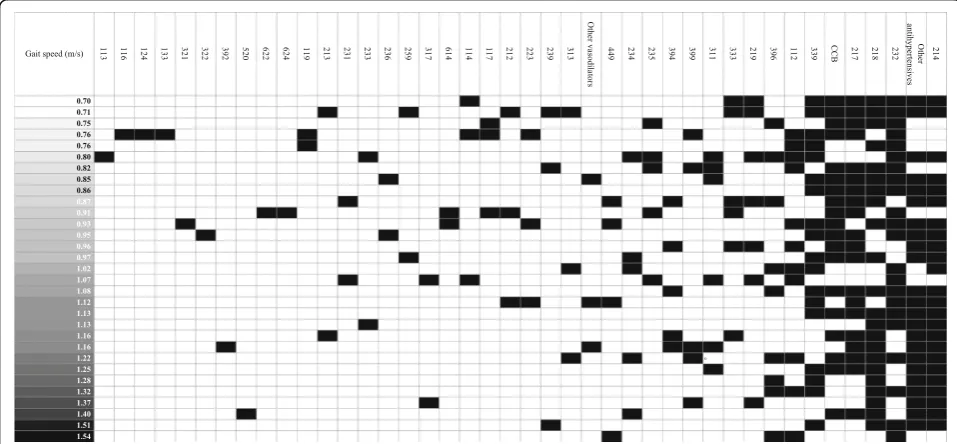
with the therapeutic category number of the medicine that each patient was taking. The trends were visually examined by sorting the heat map based on the gait speed of each patient.
Ethical consideration
This study was approved by the institutional review board of the Suzuka University of Medical Science (Ap-proval No.274, September 5, 2016).
Results
Participants and propensity score-adjusted multivariate logistic analysis
A total of 31 participants (13 men, 18 women, 79.00 [65.00–89.00] years) was enrolled in the study (Table 1). Propensity score-adjusted multivariate logistic analysis showed that only number of medications was associated with the risk of decreasing gait speed (odds ratio [OR]: 16.00, 95% confidence interval (CI):1.72–149.00, p
value = 0.0149). In contrast, stratum corneum moisture content was not significantly associated with the risk of decreasing gait speed (odds ratio [OR]: 0.362, 95% confidence interval (CI):0.07–1.88, p value = 0.227) (Table 2). Height, weight and BMI were not analyzed due to lack of freedom. In addition, a negative correl-ation between the gait speed and number of medica-tions was found (Fig. 1).
Relationship between the gait speed and prescription contents
As a result of a further analysis, it was found that the proportion of the slow gait speed group patients on 117.Psychotropic agents, 217.Vasodilators, and 333.Anti-coagulant tended to be higher (Table3), therefore we fo-cused among this group on 217.Vasodilators which the group with the largest number of people in the above three groups.
In this therapeutic category, medicines classified as 217.Vasodilators were mainly calcium channel blocker (CCB) such as amlodipine, nifedipine, benidipine, and
nitrates. However, the CCB cilnidipine was classified as 214.Antihypertensives. Therefore, the patients were di-vided into three groups according to the medicines they took, i.e., CCB, other vasodilators (Remains after remov-ing CCB from vasodilators), and other antihypertensives (Remains after removing CCB from antihypertensives). In the fast gait speed group there were 6 patients who took CCB (37.50%), while the slow gait speed group con-sisted of 13 patients who took CCB (86.67%). It was shown that the proportion of patients who took CCB in the slow gait speed group was significantly higher than that in the fast gait speed group (p= 0.009). Further-more, by comparing the gait speed for the CCB medica-tion group and non-medicamedica-tion group, it was shown that the gait speed of the medication group was significantly slower than that of the non-medication group (Table4).
In addition, the CCB taken by each patient were grouped based on the specific ingredients. Amlodipine, nifedipine, benidipine, cilnidipine were 16, 2, 1, and 1, respectively.
Heat map analysis
For this study, we focused on 6 or more patients, which was determined to be the average number of patients for each category. When examining the gait speed for the 217.Vasodilators, 232.Agents for peptic ulcer, and 333.Anticoagulants, a tendency was observed that the higher was the decrease in gait speed, the more patients took the medications (Fig.2).
Discussion
The results of the statistical analysis carried out in this study showed that a correlation existed between a de-creased gait speed and inde-creased number of medications. Subsequently, owing to careful examination and analysis of the prescription contents, it was observed that pa-tients taking CCB had a decreased gait speed. In large-scale clinical trials or guidelines for the management of hypertension worldwide, CCB is regarded as the first choice for hypertension treatments owing to its excellent
Table 1Patient demographic characteristics (n= 31)
Characteristics Number (%) or Median [range]
Men 13 (41.93)
Age 79.00 [65.00–89.00]
Gait speed (m/s) 1.02 [0.70–1.54]
Number of medications 8.00 [5.00–19.00]
Stratum corneum moisture content (a.u.) 33.33 [17.00–49.67]
Height (cm) 154.00 [140.00–169.00]
Weight (kg) 53.00 [40.00–75.00]
Thigh circumference (cm) 43.00 [36.00–51.00]
antihypertensive effect and safety profile [16–21]. In par-ticular, this drug is widely used because it displays an ex-cellent organ blood flow retention effect and is suitable for cases of organ dysfunction in the elderly [22].
In order to determine the factors associating the use of CCB with the gait speed, the effect of edema was at first assessed as a common adverse drug reaction of CCB [23]. CCB-induced edema is considered to be caused by fluid extravasation due to the fact that the vasodilatation action of CCB is larger in the peripheral arteries than in the veins, thus the arterioles expand without vasodilation of the venules, and the capillary pressure rises [24]. The edema may lead to a reduced range of motion [25,26], as a result of a decrease in the gait speed. This correlates with the patient’s complaints of edema.
Experiments that subjected mouse soleus and extensor digitorum longus muscles to continuous stimulation in vitro under Ca2+-free conditions caused a dramatic
increase of fatigue in the muscles [27]. CCB are medica-tions used for the treatment of chronic diseases such as hypertension and cardiovascular diseases, and are com-monly taken over a long period of time. By blocking for a long period of time the voltage-dependent calcium channels, which are one of the Ca2+ influx pathways to the skeletal muscle, it was assumed that the muscular fatigue would affect the muscle contraction, resulting in a decreased gait speed.
These findings are in agreement with a previous report that polypharmacy significantly increases the risk of frailty in older Japanese adults [28]. A similar study demonstrated that compared with participants taking 0– 3 medications, the incidence of frailty was approximately double in those taking 4–6 medications and six times higher in people taking≥7 medications during an eight-year follow-up [29]. On the other hand, other studies in healthy adults determined that the gait speed is Table 2Propensity score-adjusted multivariate logistic analysis (n = 31)
Risk factors OR (95% CI) C statistics pvalue
Sex 4.91 (0.06–402.00) 0.996 0.479
Age 4.73 (0.91–24.50) 0.684 0.0643
Number of medications 16.00 (1.72–149.00) 0.794 0.0149
Stratum corneum moisture content (a.u.) 0.362 (0.07–1.88) 0.756 0.227
Height (cm) no data
Weight (kg) no data
BMI no data
Thigh circumference (cm) 0.911 (0.04–22.70) 0.982 0.955
associated with age, height, and lower limb muscle strength [30,31]. Our results, however, indicate an asso-ciation only between the gait speed and number of
medications, most likely due to the differences in the pa-tient characteristics. The participants to the reported study were in fact adults over 20 years, while the Table 3Number of patients aggregated based on therapeutic category medication
Therapeutic category number
Name of therapeutic category All patients
n = 31
Fast gait speed groupn= 16
Slow gait speed
groupn= 15 p
value
112 Hypnotics and sedatives, antianxietics 11 35.48% 5 31.25% 6 40.00% 0.716
113 Antiepileptics 1 3.23% 0 0.00% 1 6.67% 0.484
114 Antipyretics, analgesics and anti-inflammatory agents 3 9.38% 1 5.88% 2 13.33% 0.600
116 Antiparkinsonism agents 1 3.13% 0 0.00% 1 6.67% 0.484
117 Psycotropic agents 3 9.68% 0 0.00% 3 20.00% 0.101
119 Other agents affecting the central nervous system 2 6.45% 0 0.00% 2 13.33% 0.226
124 Antispasmodics 1 3.23% 0 0.00% 1 6.67% 0.484
133 Antimotionsickness agents 1 3.23% 0 0.00% 1 6.67% 0.484
212 Antiarrhythmic agents 3 9.68% 1 6.25% 2 13.33% 0.600
213 Diuretics 2 6.45% 1 6.25% 1 6.67% 1.000
214 Antihypertensives 24 77.42% 14 87.50% 10 66.67% 0.220
217 Vasodilators 20 64.52% 8 50.00% 12 80.00% 0.135
218 Agents for hyperlipidemias 22 70.97% 12 75.00% 10 66.67% 0.704
219 Other cardiovascular agents 7 22.58% 2 12.50% 5 33.33% 0.220
223 Expectorants 3 9.68% 1 6.25% 2 13.33% 0.600
231 Antidiarrheals, intestinal regulators 2 6.45% 1 6.25% 1 6.67% 1.000
232 Agents for peptic ulcer 22 70.97% 10 62.50% 12 80.00% 0.433
233 Stomachics and digestives 2 6.45% 1 6.25% 1 6.67% 1.000
234 Antiacids 5 16.13% 3 18.75% 2 13.33% 1.000
235 Purgatives and clysters 5 16.13% 1 6.25% 4 26.67% 0.172
239 Other agents affecting digestive organs 3 9.68% 1 6.25% 2 13.33% 0.600
259 Other agents for uro-genital and anal organs 2 6.45% 0 0.00% 2 13.33% 0.226
311 Vitamin A, D and preparations 6 19.35% 3 18.75% 3 20.00% 1.000
313 Vitamin B preparations (except Vitamin B1) 3 9.68% 2 12.50% 1 6.67% 1.000
317 Mixed vitamin preparations (except mixed vitamin preparations compounded of vitamin A and D)
2 6.45% 2 12.50% 0 0.00% 0.484
321 Calcium compounds and preparations 1 3.23% 0 0.00% 1 6.67% 0.484
322 Mineral preparations 1 3.23% 0 0.00% 1 6.67% 0.484
333 Anticoagulants 6 19.35% 1 6.25% 5 33.33% 0.083
339 Other agents relating to blood and body fluides 18 58.06% 8 50.00% 10 66.67% 0.473
392 Antidotes 1 3.23% 1 6.25% 0 0.00% 1.000
394 Agents for treatment of goat 5 16.13% 3 18.75% 2 13.33% 1.000
396 Antidiabetic agents 9 29.03% 6 37.50% 3 20.00% 0.433
399 Agents affecting metabolism, n.e.c. 5 16.13% 3 18.75% 2 13.33% 1.000
449 Other antiallergic agents 4 12.90% 2 12.50% 2 13.33% 1.000
520 Chinese medicines 1 3.23% 1 6.25% 0 0.00% 1.000
614 Antibiotic preparations acting mainly on gram-positive bacteria and mycoplasma
2 6.45% 0 0.00% 2 13.33% 0.226
622 Anti-tuberculous agents 1 3.23% 0 0.00% 1 6.67% 0.484
624 Synthetic antibacterials 1 3.23% 0 0.00% 1 6.67% 0.484
participants in our study were older outpatients over 65 years. In addition, no association was observed between the gait speed and stratum corneum moisture content. There have been reports suggesting that the stratum corneum moisture content and frailty maybe related [14], however their relationship is still unclear and add-itional work is required for acquiring a better understanding.
Hackett et al. reported that the risk of dementia is ele-vated in elderly over 60 years with a decreased gait speed [32]. In the present study, no participants were taking medications for dementia. Furthermore, upon confirm-ation the diagnosis disease to attending physicians, no par-ticipant with dementia. Thus, the association between the gait speed and dementia was not considered. Although de-mentia is the main condition requiring support or long-term care [13] in the elderly, focusing on the gait speed is deemed important to observe its further increase.
In the heat map analysis of the gait speed in the case of 217.Vasodilators, 232.Agents for peptic ulcer, and 333.An-ticoagulants, we visually observed a higher tendency for patients taking these medications of having an increasingly slower gait speed. Some of the patients who took CCB
and anticoagulants were affected by cardiovascular dis-eases. In patients with a cardiovascular disease, the risk of frailty increased from 2.7 to 4.1; it has been reported that the risk of becoming frailty in the follow-up period of three or more years increased 1.5-fold even if frailty did not exist at the baseline [33]. Thus, some patients who took CCB and anticoagulants were considered affected by frailty owing to the effect of the cardiovascular diseases, which led to a decrease in the gait speed.
The present study has some limitations that need to be considered. First, it was difficult to exclude the poten-tial effects of unknown confounders other than those employed in the present study. Second, patients with dementia such as the Alzheimer’s disease were not in-cluded in the study as we targeted patients who were able to visit the pharmacy on their own, while patients with Parkinson’s disease did not participate since pa-tients with gait disturbance were excluded. Another limi-tation is that the multivariate logistic regression analysis of height, weight, and BMI could not be carried out due to a lack of freedom. However, no correlation was found with the gait speed for any of the variables, therefore it was assumed that no relationship occurred with the gait Table 4Comparison of the gait speed between non-medication and medication groups
Gait speed (m/s) pvalue
Non-medication group Medication group
CCB 1.15 [0.76–1.54] n= 12 0.93 [0.70–1.40] n= 19 0.020
Other antihypertensive 0.87 [0.75–1.54] n= 8 1.12 [0.70–1.51] n= 23 0.132
Other vasodilators 1.00 [0.70–1.54] n= 28 1.12 [0.85–1.16] n = 3 0.925
Data are expressed as median [minimum-maximum] pvalue based upon Mann Whitney U test
speed. Therefore, to validate our result, a controlled pro-spective observational study will be required. Recently, there have been many reports about polypharmacy in Japan, and Kojima et al. described that the number of adverse drug reactions increases with an increased num-ber of medications [4,5]. In this study, we demonstrated that not only the number of medications should be con-sidered as risk factor but also the prescription contents of the medications taken by older outpatients.
Conclusions
In older outpatients with a decreasing gait speed, a high rate of CCB intake was observed. It was suggested that not only the number of medications but also the prescrip-tion contents could serve as an index to identify patients with a high risk of requiring support or long-term care.
Adverse drug reactions such as edema that can affect the gait speed may be developed upon CCB intake. Fur-thermore, in patients with edema, the risk of falling in-creases due to a decrease in the gait speed. By performing a proper prescription proposal, it can be assumed that the pharmacists may contribute to the reduction of the risk of needing support or long-term care required by the elderly.
Abbreviations
a.u:Arbitrary unit; BMI: Body mass index; CCB: Calcium channel blocker; CI: Confidence interval; OR: Odds ratio
Acknowledgements
We thank Mr. K Goto for helpful discussion.
Authors’contributions
KO designed the study. MD contributed to data collection and wrote the initial draft of the manuscript. TE contributed to analysis and interpretation of data, and assisted in the preparation of the manuscript. KN have contributed interpretation, and critically reviewed the manuscript. All authors approved the final version of the manuscript, and agree to be accountable for all aspects of the work in ensuring that questions related to the accuracy or integrity of any part of the work are appropriately investigated and resolved.
Funding None.
Availability of data and materials
The datasets during and/or analysed during the current study available from the corresponding author on reasonable request.
Ethics approval and consent to participate
All patients provided written informed consent. This study was approved by the institutional review board of the Suzuka University of Medical Science (Approval No.274, September 5, 2016).
Consent for publication Not applicable.
Competing interests
The authors declare that they have no competing interests.
Author details
1Life Pharmacy, 475-1, Kozubeta, Tsu, Mie 514-0061, Japan.2Laboratory of
Clinical Pharmacology, Graduate School of Pharmaceutical Sciences, Suzuka University of Medical Science, 3500-3 Minamitamagaki, Suzuka, Mie 513-8670, Japan.3Laboratory of Immune Regulation, Graduate School of
Pharmaceutical Sciences, Suzuka University of Medical Science, 3500-3
Minamitamagaki, Suzuka, Mie 513-8670, Japan.4Labolatory of
Pharmacoinformatics, Department of Pharmaceutical Sciences, Suzuka University of Medical Science, 3500-3 Minamitamagaki, Suzuka, Mie 513-8670, Japan.
Received: 27 September 2019 Accepted: 23 October 2019
References
1. Statistics Bureau, Ministry of internal affairs and Communications: Population Estimates. 2019http://www.stat.go.jp/english/data/jinsui/tsuki/index.html Accessed 9 Sept 2019.
2. The Japan Geriatrics Society. Guidelines for Medical Treatment and Its Safety in the Elderly 2015. Tokyo: The Japan Geriatrics Society, Medical View Co., Ltd; 2015. p. 12–6. (in Japanese)
3. Fulton MM, Allen ER. Polypharmacy in the elderly: a literature review. J Am Acad Nurse Pract. 2005;17:123–32.
4. Kojima T, Akishita M, Nakamura T, Nomura K, Ogawa S, Iijima K, Ouchi Y. Polypharmacy as a risk for fall occurrence in geriatric outpatients. Geriatr Gerontol Int. 2012;12:425–30.
5. Kojima T, Akishita M, Kameyama Y, Yamaguchi K, Yamamoto H, Eto M, Ouchi Y. High risk of adverse drug reactions in elderly patients taking six or more drugs: analysis of inpatient database. Geriatr Gerontol Int. 2012;12:761–2.
6. Fried LP, Tangen CM, Walston J, Newman AB, Hirsch C, Gottdiener J, Seeman T, Tracy R, Kop WJ, Burke G, McBurnie MA. Frailty in older adults: evidence for a phenotype. J Gerontol A Biol Sci Med Sci. 2001;56:M146–56. 7. The Japan Geriatrics Society: Statement on the frailty from the Japan
Geriatrics Society. 2014http://www.jpn-geriat-soc.or.jp/info/topics/pdf/2014 0513_01_01.pdfAccessed 24 Sept 2019. (in Japanese).
8. Viccaro LJ, Perera S, Studenski SA. Is timed up and go better than gait speed in predicting health, function, and falls in older adults? J Am Geriatr Soc. 2011;59:887–92.
9. Smeesters C, Hayes WC, McMahon TA. Disturbance type and gait speed affect fall direction and impact location. J Biomech. 2001;34:309–17. 10. Dargent-Molina P, Schott AM, Hans D, Favier F, Grandjean H, Baudoin C.
Separate and combined value of bone mass and gait speed measurements in screening for hip fracture risk: results from the EPIDOS study. Epidémiol de l'Ostéoporose Osteoporos Int. 1999;9:188–92.
11. Dargent-Molina P, Favier F, Grandjean H, Baudoin C, Schott AM, Hausherr E. Fall-related factors and risk of hip fracture: the EPIDOS prospective study. Lancet. 1996;348:145–9.
12. Ministry of Health, Labour and Welfare: Summary Report of Comprehensive Survey of Living Conditions 2016. 2017https://www.mhlw.go.jp/english/ database/db-hss/dl/report_gaikyo_2016.pdfAccessed 24 Sept 2019. 13. Iizaka S. Frailty and body mass index are associated with biophysical
properties of the skin in community-dwelling older adults. J Tissue Viability. 2018;27:141–5.
14. Ministry of Health, Labour and Welfare: Therapeutic category.2009https:// www.mhlw.go.jp/shingi/2009/11/dl/s1106-11v.pdfAccessed 24 Sept 2019. (in Japanese).
15. Kanda Y. Investigation of the freely available easy-to-use software‘EZR’for medical statistics. Bone Marrow Transplant. 2013;48:452–8.
16. Go AS, Bauman MA, Coleman King SM, Fonarow GC, Lawrence W, Williams KA, Sanchez E. An effective approach to high blood pressure control: a science advisory from the American Heart Association, the American College of Cardiology, and the Centers for Disease Control and Prevention. J Am Coll Cardiol. 2014;63:1230–8.
17. James PA, Oparil S, Carter BL, Cushman WC, Dennison-Himmelfarb C, Handler J, Lackland DT, LeFevre ML, MacKenzie TD, Ogedegbe O, Smith SC Jr, Svetkey LP, Taler SJ, Townsend RR, Wright JT Jr, Narva AS, Ortiz E. 2014 evidence-based guideline for the management of high blood pressure in adults: report from the panel members appointed to the eighth joint National Committee (JNC 8). JAMA. 2014;311:507–20.
hypertension of the European Society of Hypertension (ESH) and of the European Society of Cardiology (ESC). J Hypertens. 2013;31:1281–357. 19. The National Institute for Health and Care Excellence: Hypertension in
adults: diagnosis and management. 2011https://www.nice.org.uk/guidance/ cg127Accessed 24 Sept 2019.
20. Qaseem A, Wilt TJ, Rich R, Humphrey LL, Frost J, Forciea MA. Pharmacologic treatment of hypertension in adults aged 60 years or older to higher versus lower blood pressure targets: a clinical practice guideline from the American College of Physicians and the American Academy of family physicians. Ann Intern Med. 2017;166:430–7.
21. Weber MA, Schiffrin EL, White WB, Mann S, Lindholm LH, Kenerson JG, Flack JM, Carter BL, Materson BJ, Ram CV, Cohen DL, Cadet JC, Jean-Charles RR, Taler S, Kountz D, Townsend RR, Chalmers J, Ramirez AJ, Bakris GL, Wang J, Schutte AE, Bisognano JD, Touyz RM, Sica D, Harrap SB. Clinical practice guidelines for the management of hypertension in the community: a statement by the American Society of Hypertension and the International Society of Hypertension. J Clin Hypertens. 2014;16:14–26.
22. Shimamoto K, Ando K, Fujita T, Hasebe N, Higaki J, Horiuchi M, Imai Y, Imaizumi T, Ishimitsu T, Ito M, Ito S, Itoh H, Iwao H, Kai H, Kario K, Kashihara N, Kawano Y, Kim-Mitsuyama S, Kimura G, Kohara K, Komuro I, Kumagai H, Matsuura H, Miura K, Morishita R, Naruse M, Node K, Ohya Y, Rakugi H, Saito I, Saitoh S, Shimada K, Shimosawa T, Suzuki H, Tamura K, Tanahashi N, Tsuchihashi T, Uchiyama M, Ueda S, Umemura S. The Japanese Society of Hypertension Guidelines for the Management of Hypertension (JSH 2014). Hypertens Res. 2014;37:253–390.
23. Papavassiliou MV, Vyssoulis GP, Karpanou EA, Belegrinos DA,
Giannakopoulou AE, Toutouzas PK. P-256: side effects of antihypertensive treatment with calcium channel antagonists. Am J Hypertens. 2001;14:114A. 24. De la Sierra A. Mitigation of calcium channel blocker-related oedema in
hypertension by antagonists of the renin-angiotensin system. J Hum Hypertens. 2009;23:503–11.
25. Gajdosik RL, Bohannon RW. Clinical measurement of range of motion. Review of goniometry emphasizing reliability and validity. Phys Ther. 1987;67:1867–72. 26. Back TL, Padberg FT Jr, Araki CT, Thompson PN, Hobson RW. Limited range of motion is a significant factor in venous ulceration. J Vasc Surg. 1995;22:519–23. 27. Germinario E, Esposito A, Midrio M, Peron S, Palade PT, Betto R,
Danieli-Betto D. High-frequency fatigue of skeletal muscle: role of extracellular Ca(2+). Eur J Appl Physiol. 2008;104:445–53.
28. Yuki A, Otsuka R, Tange C, Nishita Y, Tomida M, Ando F, Shimokata H. Polypharmacy is associated with frailty in Japanese community-dwelling older adults. Geriatr Gerontol Int. 2018;20:1497–500.
29. Veronese N, Stubbs B, Noale M, Solmi M, Pilotto A, Vaona A, Demurtas J, Mueller C, Huntley J, Crepaldi G, Maggi S. Polypharmacy is associated with higher frailty risk in older people: an 8-year longitudinal cohort study. J Am Med Dir Assoc. 2017;18:624–8.
30. Himann JE, Cunningham DA, Rechnitzer PA, Paterson DH. Age-related changes in speed of walking. Med Sci Sports Exerc. 1988;20:161–6. 31. Kim JD, Kuno S, Soma R, Masuda K, Ishizu M, Adachi T, Nishijima T, Okada
M. Relationship between reduction of hip joint and thigh muscle and walking ability in elderly people. Jpn J Phys Fitness Sports Med. 2000;49: 589–96 (in Japanese).
32. Hackett RA, Davies-Kershaw H, Cadar D, Orrell M, Steptoe A. Walking speed, cognitive function, and dementia risk in the English longitudinal study of ageing. J Am Geriatr Soc. 2018;66:1670–5.
33. Afilalo J, Karunananthan S, Eisenberg MJ, Alexander KP, Bergman H. Role of frailty in patients with cardiovascular disease. Am J Cardiol. 2009;103:1616–21.
Publisher’s Note