www.geosci-model-dev.net/8/1877/2015/ doi:10.5194/gmd-8-1877-2015
© Author(s) 2015. CC Attribution 3.0 License.
NCIO 1.0: a simple Fortran NetCDF interface
A. Robinson1,2,3and M. Perrette3
1Universidad Complutense de Madrid, 28040 Madrid, Spain 2Instituto de Geociencias, UCM-CSIC, 28040 Madrid, Spain
3Potsdam Institute for Climate Impact Research, 14473 Potsdam, Germany Correspondence to: A. Robinson ([email protected])
Received: 19 November 2014 – Published in Geosci. Model Dev. Discuss.: 16 January 2015 Revised: 10 June 2015 – Accepted: 16 June 2015 – Published: 30 June 2015
Abstract. The NetCDF (Network Common Data Form) li-brary has become an indispensable tool for data and model output management in geoscience. However for simple tasks, particularly in Fortran, the complexity of native NetCDF functionality can be cumbersome. The NCIO (NetCDF In-put/Output) module has been designed as an interface to the NetCDF library with simplicity and ease of use in mind. While this implies that some NetCDF functionality is masked from the user, the subroutines provided here are adequate for basic serial reading and writing tasks of up to 6-D data arrays along with corresponding data attributes. The code is avail-able online via a GitHub repository (http://www.github.com/ alex-robinson/ncio), which includes an example program to illustrate the approach.
1 Introduction
The NetCDF (Network Common Data Form) library devel-oped by Unidata (Unidata, 2014) has revolutionized the stor-age of large geoscientific data sets, reproducibility of exper-iments and archiving of model output. It eliminates the de-pendencies of binary output on a given computing system and ensures that data is fully self-described within a file. The fact that its use has been adopted so widely in the geoscien-tific community has ensured that many tools are available for data processing and analysis based on this storage format.
To provide a library that is useful over a wide range of ap-plications, the low-level functionality of NetCDF gives users full control over how a program interacts with the data files. For this reason, the native NetCDF interface relies on a series of intermediate function calls and helper variables to be able to read or write data. This flexibility can be critical for some
applications, for example for storing large, complex data sets with many attributes or for parallel I/O (input/output) in global circulation models (GCMs; Huang et al., 2014).
However, for more common tasks, these intermediate steps tend to make programming data I/O with NetCDF more com-plex and even cumbersome, in some cases. Several versions of NetCDF wrappers already exist to make NetCDF writ-ing more straightforward, such as Gtool5 (Ishiwatari et al., 2012) meant for use in GCMs, or the Climate Model Out-put Rewriter (CMOR, 2015), which aides in writing climate and forecast (CF, 2015) compliant files. These libraries share common characteristics in that they mask some of the inter-mediate steps of loading and writing NetCDF data from the user. However, at least for Fortran, a NetCDF wrapper that was both generic and simple has not been available until now. The NCIO (NetCDF Input/Output) module is intended to fill that gap. The goal of the module is to provide access to NetCDF functionality in Fortran in the simplest way possi-ble. This implies that it is not appropriate for every appli-cation, but it should be generic enough to be widely useful. Here NCIO is described and provided, in the hope that it will be helpful for others developing geoscientific models. The application programming interface (API) is provided in the Appendix.
2 Reading from NetCDF
each data type and data size, so it automatically handles any of the above inputs from the user.
In its most basic form, the user supplies the filename to be read from, the name of the variable to read and the scalar or array that will hold the data. In this case, the size of the variable in the file and the dimensions of the array should be consistent. The user can also optionally supply start andcountvectors, which indicate which slices of the array should be read from the file (analogous to low-level NetCDF functions). If neither is given, the subroutine will start from the beginning of the data record in each dimension and count up to the size of the array in each dimension.
nc_read can handle missing data, as long as the vari-able attributemissing_valueis defined in the NetCDF file. The user can specify a new value to represent missing data via thenc_readsubroutine call. NCIO reads the data from the file and replaces missing data points with the de-sired value.
In order to facilitate the reading of data of unknown di-mension sizes, an additional helper function nc_size is available. This function returns the size of a dimension vari-able in the NetCDF file. This can be used, for example, to determine the dimensions of the array to allocate in Fortran before reading data from the NetCDF file.
Additionally, it is possible to read string attributes from the file usingnc_read_attr. The user provides the filename, the name of the attribute of interest and optionally the per-tinent variable name (if it is not a global attribute), and the subroutine will return the string associated with that attribute in the file.
3 Writing to NetCDF
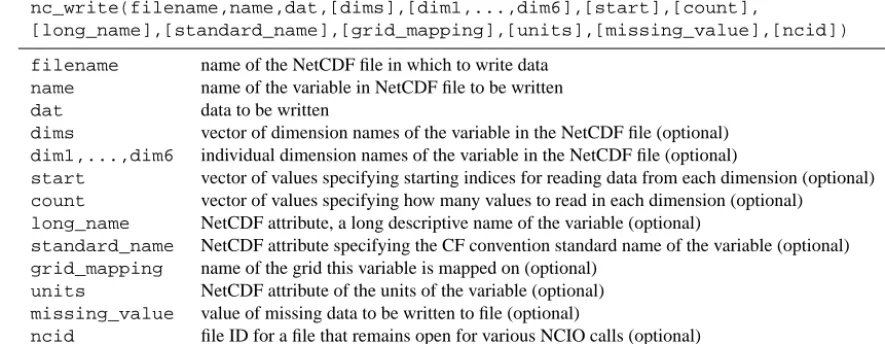
Writing NetCDF files is achieved through one sub-routine for writing variables (nc_write), two neces-sary subroutines for file initialization (nc_create and nc_write_dim), and two optional ones for adding at-tributes (nc_write_attr and nc_write_map). The data to be written to a file, as withnc_read, can be a scalar, vector, or an array of up to 6 dimensions and of type integer, float, double precision or logical. The subroutine has an
in-It is also possible to specify a grid mapping variable in the file vianc_write_map, which can be used to define a pro-jection or other type of map to associate with a grid variable. Such a map definition is helpful to (and sometimes neces-sary for) programs that plot NetCDF data, such as Panoply (Schmunk, 2014), when the spatial coordinates of the data are not longitude and latitude. Currently, only stereographic and polar stereographic projections are handled by this sub-routine, but it is planned to be made more generic in the fu-ture.
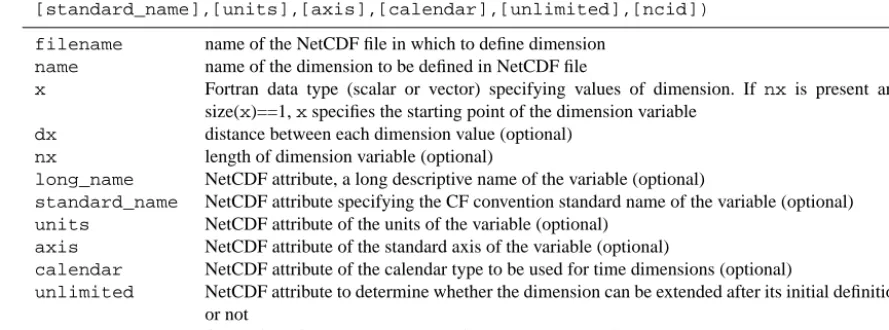
Once the NetCDF file is prepared with global information, the next step is to define dimension variables, which is done with the subroutinenc_write_dim. To write a dimension variable, the user must supply the filename and name of the variable to be written. The vector of dimension values can be provided directly, or a vector of values can be generated from a starting value, the total number of points and the distance between them. When the argumentunlimited=.TRUE. is specified, then the dimension can be extended via calls tonc_write(see below). Additionally, some Climate and Forecast (CF) variable attributes can be supplied via this sub-routine, such aslong_nameandunits, while the subrou-tinenc_write_attrcan be used directly to write any ad-ditional variable specific attributes. It should be noted that all dimension variables must be written to the file before any data can be written.
to make reading and writing NetCDF files as easy as read-ing and writread-ing binary or ASCII data. The subroutine design in NCIO mimics what is available in other languages, such as the ncdf library in R (Pierce, 2014), and should be useful for a wide range of applications. The basic functionality pro-vided here has been tested thoroughly and works robustly in several real geoscientific programs.
The subroutines have been designed to mask any inter-mediate and temporary variables from the user. For exam-ple, low-level NetCDF functions make use of ID values of the file and other variables to know what is being loaded or written. Here only the filename and name of the vari-able are needed to find the right field in the NetCDF file, because the low-level functions are wrapped by the NCIO subroutines. In this way, the only variable that needs to be defined in the user’s program is the data itself. Variable initialization and attribute definition, as well as data writ-ing, are all easily handled with one subroutine call. Thus, for quick diagnostic output to a NetCDF file, for example, a user can easily write the variable to a file without ad-ditional variable definitions or subroutine calls. For exam-ple, Unidata provides a NetCDF tutorial program to write 4-D temperature and pressure fields (pres_temp_4D_wr.f90 found at http://www.unidata.ucar.edu/software/netcdf/docs/ netcdf-tutorial). The native NetCDF approach require 25 lines of code and 25 intermediate variable definitions, while NCIO achieves the same result with only 7 lines of code.
Such ease of use does incur minor computational costs. One such cost comes from the overhead of opening and clos-ing the NetCDF file within each subroutine call, rather than leaving the NetCDF file open for writing throughout the en-tire program. The reason for this approach was to maintain the simplest interface possible – otherwise additional func-tions and external variables would be needed for opening and closing the file. In testing the NCIO module, it was found that in most cases, any additional overhead incurred is small in absolute terms and does not appear to affect the speed of
a program significantly. Comparing the native and NCIO-based tutorial program pres_temp_4D_wr.f90, we find that one iteration of writing these variables takes about 4 times longer using NCIO. For 1000 iterations, using NCIO takes about 80 times longer than the native NetCDF calls. How-ever, in absolute terms, the total time for 1000 iterations us-ing NCIO is about 1 s.
Nonetheless, for programs that write data with a very high frequency, this approach could result in noticeably slower ex-ecution than using the low-level NetCDF functions directly. For this reason, all reading/writing subroutines include an optional “ncid” argument and two additional subroutines are provided in the library:nc_openandnc_close. These subroutines allow the user to keep a given NetCDF file through multiple NCIO subroutine calls and identify the open file using the “ncid” intermediate variable. Using this ap-proach reduces the cost of 1 and 1000 iterations as above to about 2 and 20 times longer than the native calls, respec-tively. It should be noted that the timing is dependent on the size of the arrays being written as well. The default test is for rather small arrays (12×6×2 grid points). When writing larger arrays (e.g., 100×100×2 grid points), NCIO consis-tently needs about 10 times longer than the native calls using either approach.
5 Conclusions
Appendix A
Table A1. Subroutine call and argument descriptions fornc_read.
subroutine nc_read(filename,name,dat,[start],[count],[missing_value],[ncid])
filename name of the NetCDF data file to read from
name name of the variable in the NetCDF file to be read
dat output: Fortran data type into which data will be loaded
start vector of values specifying starting indices for reading data from each dimension (optional)
count vector of values specifying how many values to read in each dimension (optional)
missing_value value to assign to missing data read from the file (optional)
ncid file ID for a file that remains open for various NCIO calls (optional)
Table A2. Function call and argument descriptions fornc_size.
function nc_size(filename,name,[ncid]) result(size)
filename name of the NetCDF data file to read from
name name of the dimension variable in the NetCDF file of which to determine size
size output: integer size (length) of the dimension variable returned from the function
ncid file ID for a file that remains open for various NCIO calls (optional)
Table A3. Subroutine call and argument descriptions fornc_read_attr.
subroutine nc_read_attr(filename,[varname],name,value,[ncid])
filename name of the NetCDF file from which to read attribute
varname name of the variable from which to read the attribute (optional)
name name of the attribute to be read
value output: value of the attribute to be read
ncid file ID for a file that remains open for various NCIO calls (optional)
Table A4. Subroutine call and argument descriptions fornc_create.
subroutine
Table A5. Subroutine call and argument descriptions fornc_write_attr.
subroutine nc_write_attr(filename,[varname],name,value,[ncid])
filename name of the NetCDF file in which to write attribute
varname name of the variable to which the attribute should be associated (optional)
name name of the attribute to be written
value value of the attribute to be written
ncid file ID for a file that remains open for various NCIO calls (optional)
Table A6. Subroutine call and argument descriptions fornc_write_map.
subroutine nc_write_map(filename,name,[lambda],[phi],[x_e],[y_n],[ncid])
filename name of the NetCDF file in which to write the grid map definition
name name of the grid mapping to be defined
lambda longitude of projection origin (optional)
phi latitude of projection origin (optional)
x_e false easting (optional)
y_n false northing (optional)
ncid file ID for a file that remains open for various NCIO calls (optional)
Table A7. Subroutine call and argument descriptions fornc_write_dim.
subroutine nc_write_dim(filename,name,[x],[dx],[nx],[long_name], [standard_name],[units],[axis],[calendar],[unlimited],[ncid])
filename name of the NetCDF file in which to define dimension
name name of the dimension to be defined in NetCDF file
x Fortran data type (scalar or vector) specifying values of dimension. If nx is present and size(x)==1,xspecifies the starting point of the dimension variable
dx distance between each dimension value (optional)
nx length of dimension variable (optional)
long_name NetCDF attribute, a long descriptive name of the variable (optional)
standard_name NetCDF attribute specifying the CF convention standard name of the variable (optional)
units NetCDF attribute of the units of the variable (optional)
axis NetCDF attribute of the standard axis of the variable (optional)
calendar NetCDF attribute of the calendar type to be used for time dimensions (optional)
unlimited NetCDF attribute to determine whether the dimension can be extended after its initial definition or not
Table A8. Subroutine call and argument descriptions fornc_write.
subroutine
nc_write(filename,name,dat,[dims],[dim1,...,dim6],[start],[count],
[long_name],[standard_name],[grid_mapping],[units],[missing_value],[ncid])
filename name of the NetCDF file in which to write data
name name of the variable in NetCDF file to be written
dat data to be written
dims vector of dimension names of the variable in the NetCDF file (optional)
dim1,...,dim6 individual dimension names of the variable in the NetCDF file (optional)
start vector of values specifying starting indices for reading data from each dimension (optional)
count vector of values specifying how many values to read in each dimension (optional)
long_name NetCDF attribute, a long descriptive name of the variable (optional)
standard_name NetCDF attribute specifying the CF convention standard name of the variable (optional)
grid_mapping name of the grid this variable is mapped on (optional)
units NetCDF attribute of the units of the variable (optional)
missing_value value of missing data to be written to file (optional)
ncid file ID for a file that remains open for various NCIO calls (optional)
Table A9. Subroutine call and argument descriptions fornc_open.
subroutine nc_open(filename,ncid,[writable])
filename name of the NetCDF file from which to read attribute
ncid output: integer variable to identify a NetCDF file through multiple NCIO calls
writable switch to determine whether file should be opened for writing (optional, default TRUE)
Table A10. Subroutine call and argument descriptions fornc_close.
subroutine nc_close(ncid)
Code availability
The NCIO module is open source and available under the MIT License, making it suitable for community-driven de-velopment or for each user to adapt the module to more par-ticular needs. The code is hosted in a public Git repository lo-cated at http://www.github.com/alex-robinson/ncio. Sugges-tions and improvements are welcome. Any GitHub users who wish to make a contribution should email the authors to add them as contributors. The above-mentioned tutorial compari-son is included in the repository, as well as a simple test pro-gram with its output to ensure the code is working properly and to provide examples of subroutine calls.
Acknowledgements. We would like to thank Mario Krapp and
Reinhard Calov for valuable input and testing of the NCIO module. A. Robinson is supported by the Marie Curie 7th framework programme (project 2012-IEF-331835, EURICE).
Edited by: D. Roche
References
CF: Climate and Forecast Conventions and Metadata, available at: http://cfconventions.org/ (last access: 25 June 2015), 2015. CMOR: Climate Model Output Rewriter, available at: http://pcmdi.
github.io/cmor-site/index.html (last access: 25 June 2015), 2015. Huang, X. M., Wang, W. C., Fu, H. H., Yang, G. W., Wang, B., and Zhang, C.: A fast input/output library for high-resolution climate models, Geosci. Model Dev., 7, 93–103, doi:10.5194/gmd-7-93-2014, 2014.
Ishiwatari, M., Toyoda, E., Morikawa, Y., Takehiro, S., Sasaki, Y., Nishizawa, S., Odaka, M., Otobe, N., Takahashi, Y. O., Nakajima, K., Horinouchi, T., Shiotani, M., Hayashi, Y.-Y., and Gtool development group: “Gtool5”: a Fortran90 library of in-put/output interfaces for self-descriptive multi-dimensional nu-merical data, Geosci. Model Dev., 5, 449–455, doi:10.5194/gmd-5-449-2012, 2012.
Pierce, D.: ncdf: Interface to Unidata netCDF data files, avail-able at: http://CRAN.R-project.org/package=ncdf (last access: 25 June 2015), r package version 1.6.8, 2014.
Schmunk, R. B.: Panoply, available at: http://www.giss.nasa.gov/ tools/panoply/ (last access: 25 June 2015), 2014.