S H O R T R E P O R T
Open Access
Task-specific ankle robotics gait training
after stroke: a randomized pilot study
Larry W. Forrester
1, Anindo Roy
2, Charlene Hafer-Macko
3, Hermano I. Krebs
4,5,6,7,8and Richard F. Macko
3*Abstract
Background:An unsettled question in the use of robotics for post-stroke gait rehabilitation is whether task-specific locomotor training is more effective than targeting individual joint impairments to improve walking function. The paretic ankle is implicated in gait instability and fall risk, but is difficult to therapeutically isolate and refractory to recovery. We hypothesize that in chronic stroke, treadmill-integrated ankle robotics training is more effective to improve gait function than robotics focused on paretic ankle impairments.
Findings:Participants with chronic hemiparetic gait were randomized to either six weeks of treadmill-integrated ankle robotics (n= 14) or dose-matched seated ankle robotics (n= 12) videogame training. Selected gait measures were collected at baseline, post-training, and six-week retention. Friedman, and Wilcoxon Sign Rank and Fisher’s exact tests evaluated within and between group differences across time, respectively. Six weeks post-training, treadmill robotics proved more effective than seated robotics to increase walking velocity, paretic single support, paretic push-off impulse, and active dorsiflexion range of motion. Treadmill robotics durably improved gait dorsiflexion swing angle leading 6/7 initially requiring ankle braces to self-discarded them, while their unassisted paretic heel-first contacts increased from 44 % to 99.6 %, versus no change in assistive device usage (0/9) following seated robotics.
Conclusions:Treadmill-integrated, but not seated ankle robotics training, durably improves gait biomechanics, reversing foot drop, restoring walking propulsion, and establishing safer foot landing in chronic stroke that may reduce reliance on assistive devices. These findings support a task-specific approach integrating adaptive ankle robotics with locomotor training to optimize mobility recovery.
Clinical trial identifier:NCT01337960. https://clinicaltrials.gov/ct2/show/NCT01337960?term=NCT01337960&rank=1 Keywords:Stroke, Hemiparetic gait, Robotics, Locomotor training, Task-specific training
Introduction
Stroke is a leading cause of chronic disability, with hemiparetic ankle deficits contributing to impaired gait and balance [1–4]. Current management is lim-ited to either an ankle foot orthosis (AFO) or func-tional electrical stimulation (FES) that can improve gait velocity, but neither is proven to therapeutically mitigate the underlying ankle neuromotor deficits,
except when worn or activated [1, 4–7]. A controver-sial neuromotor learning question is whether task-specific training or isolated massed-practice across an impaired joint is more effective to improve locomotor function after stroke [8]. This is especially important for ankle which is difficult to therapeutically isolate, and refractory to recovery with more severe deficits such as chronic foot drop.
This randomized study in chronic hemiparetic subjects utilized an impedance-controlled ankle robot (Anklebot: Interactive Motion Technologies, Watertown, MA) with deficit-adjusted adaptive control architecture [9–14] to investigate the hypothesis that 6 weeks Anklebot therapy directly integrated into locomotor treadmill robotic * Correspondence:[email protected]
Larry W. Forrester and Anindo Roy are shared first authors.
3Department of Neurology, University of Maryland School of Medicine; University Maryland Rehabilitation & Orthopaedics Institute; Maryland Exercise & Robotics Center of Excellence, Veterans Affairs Maryland Health Care System; Geriatrics Research, Education, and Clinical Center, Veterans Affairs Medical Center, Baltimore, MD, USA
Full list of author information is available at the end of the article
© 2016 The Author(s).Open AccessThis article is distributed under the terms of the Creative Commons Attribution 4.0 International License (http://creativecommons.org/licenses/by/4.0/), which permits unrestricted use, distribution, and reproduction in any medium, provided you give appropriate credit to the original author(s) and the source, provide a link to the Creative Commons license, and indicate if changes were made. The Creative Commons Public Domain Dedication waiver (http://creativecommons.org/publicdomain/zero/1.0/) applies to the data made available in this article, unless otherwise stated. Forresteret al. Journal of NeuroEngineering and Rehabilitation (2016) 13:51
training (TMR) is more effective than matched dose im-pairment focused seated robotic training (SRT) across the paretic ankle to durably improve unassisted over-ground gait function and safety.
Methods
University of Maryland, Baltimore Institutional Review Board and Veterans Affairs Research and Development approved the study (HP-00046304); written informed consent was obtained. Eligibility included adults with mild-moderate severity chronic (>6 months) hemiparetic gait, paretic ankle dorsi-flexor manual muscle test score≥2 (full ROM gravity eliminated) and≤4 (full ROM against gravity, moderate resistance) in dorsiflex-ion and/or plantarflexdorsiflex-ion, and capacity to treadmill
walk≥0.12 m/sec for 3 min with handrail support.
Exclusion criteria included conditions precluding exer-cise, concurrent physical therapy, and non-stroke mobil-ity disabilmobil-ity conditions. Clinical evaluations included screening for dementia, depression, medical and neuro-logical exams, and treadmill exercise stress test. [15] Performance assessments included preferred speed over-ground walks over an 8-meter instrumented walkway (GaitRite, CIR Systems, Clifton, NJ) and over force plates (Bertec, Columbus, OH), clinical goniometry, paretic ankle motor control measured during unassisted seated, visually-evoked and guided targeting tasks and robot-derived ankle kinematics during unassisted preferred speed treadmill walking (TMR group only) [10–14]. See Table 1 for subject characteristics.
Both protocols were initiated by matching task diffi-culty to baseline ankle deficits, and progressed on performance over 18 sessions (3x weekly; 6 weeks). Each 1-h session of SRT included Anklebot-assisted par-etic ankle targeting practice (720 dorsi/plantar-flexion, inversion-eversion repetitions total), with target difficulty progressed (target spacing and frequency increased 38 %
and 26 %, respectively) and robotic support decreased, as tolerated [10, 12]. The 1-h TMR sessions aimed for two 15–20-min trials, or as tolerated with rests, at preferred speed (increased from 0.34 to 0.45 m/s and duration from 16 to 37 min), to accumulate a mean number of 889 paretic steps/session, with robotic assistance pro-vided to actuate swing dorsi-flexion or stance plantar-flexion, according to individual gait deficits (i.e. deficit-adjusted) [11, 13, 14]. Level of robotic assist-ance in early sessions was adjusted to promote foot clearance and push-off, with a tapering of support in the latter sessions to promote autonomy. Robotic as-sistance was precisely timed to the gait sub-events of interest using insole micro-switches [11, 14].
Outcomes obtained at entry, after 6-weeks training, and 6 weeks post-completion included preferred over-ground walking speed, paretic limb single support dura-tions, and paretic anterior-posterior propulsive impulses. Seated ankle motor control measures included un-assisted volitional targeting speed and accuracy [10, 12], and active range of motion in dorsiflexion. Secondary measures included paretic foot center of pressure (CoP) length and CoP symmetry (paretic-to-nonparetic) during stance [16, 17]. Locomotor learning profile in the TMR group was measured by paretic peak swing angle and heel-first strikes (% footfalls) obtained from robot- and
footswitch-measured data during unassisted 1-min
treadmill walking before each session [11, 13]. We re-corded self-reported changes in utilization of ankle brace and/or assistive device.
Group baseline characteristics were compared using Wilcoxon Sign Rank tests. Fisher’s exact test evaluated between group differences across time points. Non-parametric Friedman tests were performed across all time points, followed by Wilcoxon Sign Rank tests where warranted to evaluate within-group pairwise differences. Two-tail significance was set at 0.05.
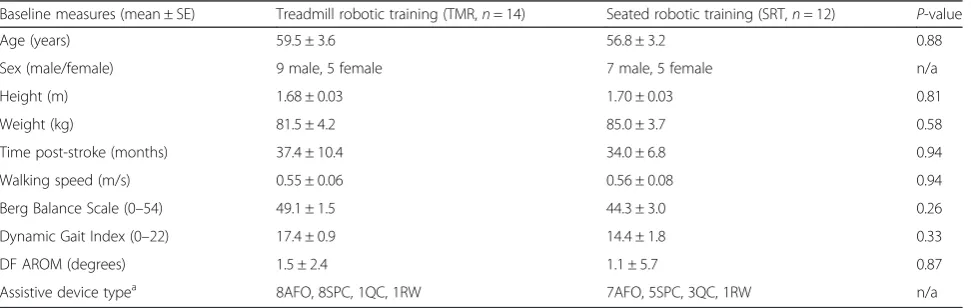
Table 1Subject demographics
Baseline measures (mean ± SE) Treadmill robotic training (TMR,n= 14) Seated robotic training (SRT,n= 12) P-value
Age (years) 59.5 ± 3.6 56.8 ± 3.2 0.88
Sex (male/female) 9 male, 5 female 7 male, 5 female n/a
Height (m) 1.68 ± 0.03 1.70 ± 0.03 0.81
Weight (kg) 81.5 ± 4.2 85.0 ± 3.7 0.58
Time post-stroke (months) 37.4 ± 10.4 34.0 ± 6.8 0.94
Walking speed (m/s) 0.55 ± 0.06 0.56 ± 0.08 0.94
Berg Balance Scale (0–54) 49.1 ± 1.5 44.3 ± 3.0 0.26
Dynamic Gait Index (0–22) 17.4 ± 0.9 14.4 ± 1.8 0.33
DF AROM (degrees) 1.5 ± 2.4 1.1 ± 5.7 0.87
Assistive device typea 8AFO, 8SPC, 1QC, 1RW 7AFO, 5SPC, 3QC, 1RW n/a
Abbreviations: DFdorsiflexion,AROMactive range of motion,AFOankle-foot orthosis,SPCsingle point cane,QCquad caneRWrolling walker. Wilcoxon Sign Rank
Results
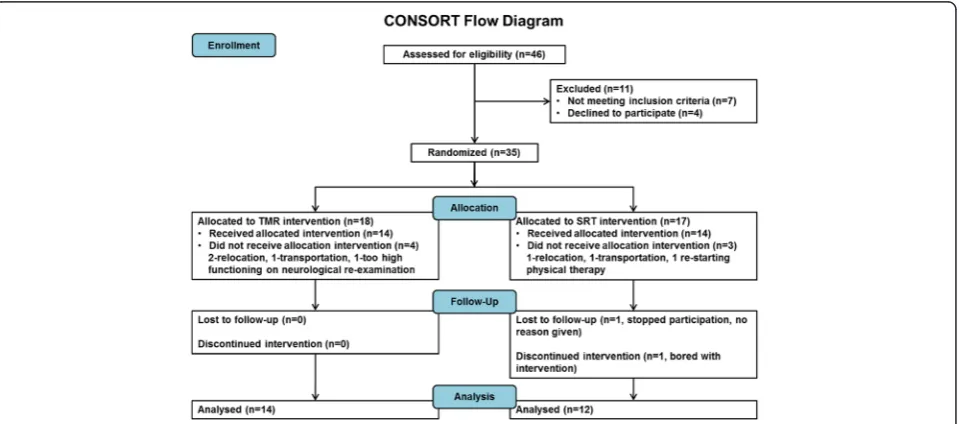
Forty-six subjects were screened and thirty-five were randomized; 18 to TMR and 17 to SRT (Fig. 1). Twenty-six completed training for TMR (n= 14) and SRT (n= 12); attrition was due to relocation (3); transportation (2); physical therapy (1); exclusion on baseline re-test (1); or withdrawal (2). Group demo-graphics did not differ at baseline (Table 1).
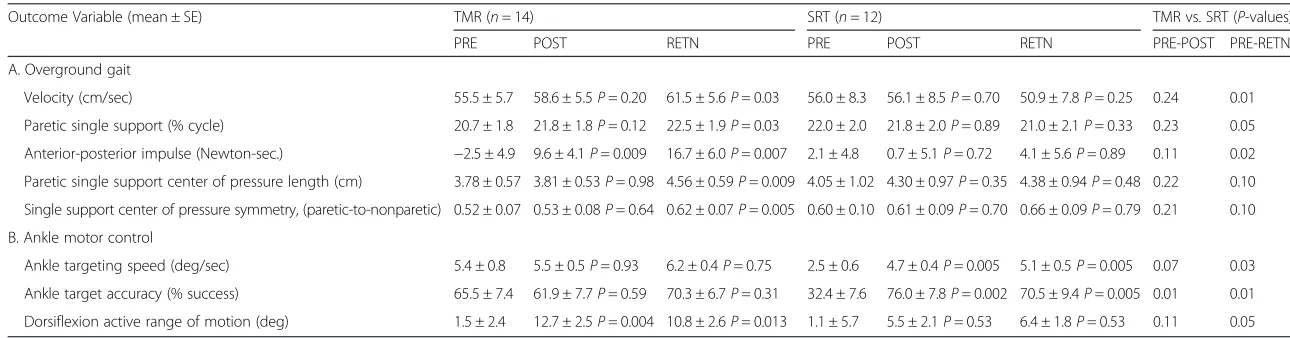
After training between group differences in walking velocity showed larger gains for TMR with continued improvement over the six-week retention period (Table 2). SRT did not increase walking velocity at either time-point. TMR increased paretic single support duration, achieving significance at retention testing; SRT elicited no changes. TMR increased paretic propulsive impulse post-training, with further improvement toward 80 % of normal at retention (Table 2) [18], whereas SRT impulses did not change. Paretic foot CoP excursion and CoP sym-metry during single support trended toward signifi-cance (P= 0.10) for TMR at retention. Within group analysis showed improvement in the TMR group for both kinetic measures at retention, whereas SRT showed no changes in dynamic loading during gait.
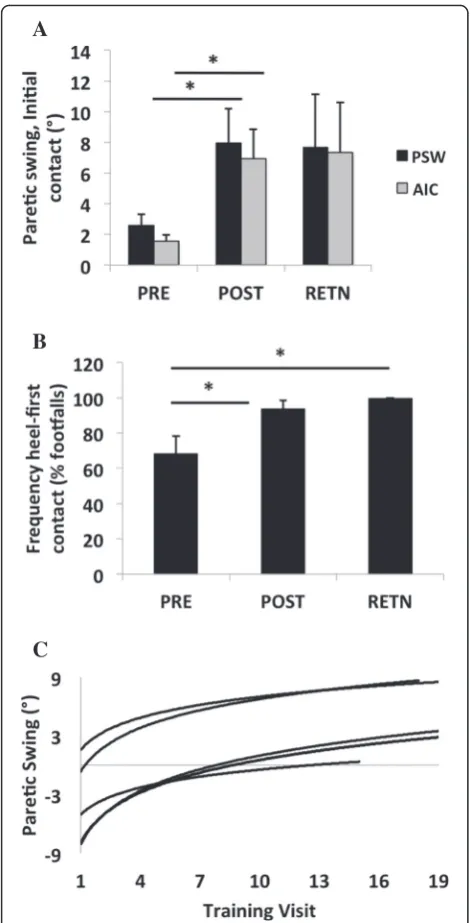
TMR increased peak swing angle and dorsiflexion angle at initial contact during unassisted treadmill walk-ing, with gains sustained at retention (Fig. 2a). These ankle kinematic improvements translated into increased frequency of heel-first ground contacts for most (12/14) TMR subjects (Fig. 2b). Across 18 training sessions, im-provement in volitional peak swing angles conformed to a power-law learning model [19], demonstrating emer-gent autonomous paretic ankle control with different learning rates (Fig. 2c). Improved paretic dorsiflexion ac-tive range of motion favored TMR (Table 2), indexed by
7-fold increase post-training and 6-fold at retention; SRT did not differ from baseline at either time point. A majority (5/8) of AFO users in TMR self-reported dis-carding their AFOs, while 3 others changed to less sup-portive assistive devices, compared to no changes (0/10) in assistive device use in SRT (P< 0.05).
Group differences favored SRT only for changes in seated paretic ankle motor control post-training and at retention testing (Table 2). SRT durably increased mean paretic speed and accuracy of unassisted ankle targeting. TMR produced no gains in seated ankle motor control. Both groups had 100 % training compliance (all 18 ses-sions attended). Both protocols were well tolerated, with two adverse events including fall while entering their ve-hicle and an ankle sprain during gait testing.
Discussion
This is the first randomized study to test the efficacy of impedance-controlled Anklebot with an adaptive control architecture integrated into treadmill training versus impairment-focused seated Anklebot training. The key finding is that TMR, but not SRT, durably improves gait biomechanics and paretic ankle function during inde-pendent walking in chronic stroke survivors. TMR pro-gressively increased unassisted paretic swing to normal levels with retained improvements 6 weeks after cessa-tion of training such that a majority of TMR graduates self-discarded their ankle braces. The significant increase in propulsive impulse with TMR to near-normal levels at retention, versus no change in SRT, contributes to ongoing increases in gait velocity after training ended [2, 18]. This unexpected observation that TMR partici-pants continued improving gait measures across the re-tention phase cannot be fully explained, but anecdotal
Fig. 1CONSORT flow diagram
Table 2Outcomes across testing time points (baseline: PRE, post-testing: POST, follow-up: RETN)
Outcome Variable (mean ± SE) TMR (n= 14) SRT (n= 12) TMR vs. SRT (P-values)
PRE POST RETN PRE POST RETN PRE-POST PRE-RETN
A. Overground gait
Velocity (cm/sec) 55.5 ± 5.7 58.6 ± 5.5P= 0.20 61.5 ± 5.6P= 0.03 56.0 ± 8.3 56.1 ± 8.5P= 0.70 50.9 ± 7.8P= 0.25 0.24 0.01
Paretic single support (% cycle) 20.7 ± 1.8 21.8 ± 1.8P= 0.12 22.5 ± 1.9P= 0.03 22.0 ± 2.0 21.8 ± 2.0P= 0.89 21.0 ± 2.1P= 0.33 0.23 0.05
Anterior-posterior impulse (Newton-sec.) −2.5 ± 4.9 9.6 ± 4.1P= 0.009 16.7 ± 6.0P= 0.007 2.1 ± 4.8 0.7 ± 5.1P= 0.72 4.1 ± 5.6P= 0.89 0.11 0.02
Paretic single support center of pressure length (cm) 3.78 ± 0.57 3.81 ± 0.53P= 0.98 4.56 ± 0.59P= 0.009 4.05 ± 1.02 4.30 ± 0.97P= 0.35 4.38 ± 0.94P= 0.48 0.22 0.10
Single support center of pressure symmetry, (paretic-to-nonparetic) 0.52 ± 0.07 0.53 ± 0.08P= 0.64 0.62 ± 0.07P= 0.005 0.60 ± 0.10 0.61 ± 0.09P= 0.70 0.66 ± 0.09P= 0.79 0.21 0.10
B. Ankle motor control
Ankle targeting speed (deg/sec) 5.4 ± 0.8 5.5 ± 0.5P= 0.93 6.2 ± 0.4P= 0.75 2.5 ± 0.6 4.7 ± 0.4P= 0.005 5.1 ± 0.5P= 0.005 0.07 0.03
Ankle target accuracy (% success) 65.5 ± 7.4 61.9 ± 7.7P= 0.59 70.3 ± 6.7P= 0.31 32.4 ± 7.6 76.0 ± 7.8P= 0.002 70.5 ± 9.4P= 0.005 0.01 0.01
Dorsiflexion active range of motion (deg) 1.5 ± 2.4 12.7 ± 2.5P= 0.004 10.8 ± 2.6P= 0.013 1.1 ± 5.7 5.5 ± 2.1P= 0.53 6.4 ± 1.8P= 0.53 0.11 0.05
Abbreviations: TMRtreadmill robotic training,SRTseated robotic training,SEstandard error. Within group analyses used Wilcoxon Sign Rank test withP-values referenced to baseline (PRE) and between groups used Fisher’s exact test
al.
Journal
of
NeuroEng
ineering
and
Rehabilitatio
n
(2016) 13:51
Page
4
of
participant self-reports suggest increased free-living par-etic ankle usage. TMR-mediated improvements in parpar-etic leg single support duration, increased paretic foot CoP ex-cursion, and improved spatial symmetry are consistent with improved gait stability [16–18]. Compared to longer-term studies comparing a range of 3–12 months daily AFO versus FES that produced greater gains in gait vel-ocity, the current study reports functional improvements after only 18 training sessions, demonstrating that deficit-adjusted adaptive control Anklebot locomotor training can improve the quality and stability of gait within the time constraints of typical therapy regimens [1, 6, 7].
Durable gains in isolated ankle motor control with SRT is a positive result consistent with our previous studies [10, 12], suggesting that seated Anklebot training may be useful as an adjunct to impairment focused therapies that address isolated ankle neuromotor deficits. The absence of similar gains with TMR also reinforces the notion of training-to-task and highlights its relevance to the evolv-ing field of rehabilitation robotics. Small sample size, brief training duration, and participants with only chronic, mild-moderate gait deficits limit generalizability of these findings. While the two groups experienced similar ther-apy session durations, the TMR group performed more repetitions per session than for SRT, however both modal-ities exposed subjects to the same order of magnitude of repetitions (several hundred per day). Gait biomechanics and robotics outcomes were not conducted in a blinded fashion in this pilot study.
Conclusions
We report that a novel deficit-adjusted approach inte-grating adaptive ankle robotics into task-specific loco-motor training, but not isolated massed practice across the affected joint, improves gait biomechanics and dy-namic stability, even years post-stroke. To our know-ledge, this is the first therapy, robotic or otherwise, to therapeutically improve functional dorsiflexion and re-store impaired push-off during independent walking in chronic stroke enabling individuals to self-reduce reli-ance on their assistive devices. These results support the overarching hypothesis that in the chronic phase post-stroke, locomotor task-integrated Anklebot training is superior to impairment-focused massed practice across the paretic joint for improving gait function. Larger randomized studies directly comparing TMR to other locomotor rehabilitations approaches are needed to inves-tigate the optimal training paradigm(s) for robotics-assisted rehabilitation across the phases of stroke recovery and for persons with other neurological conditions that include ankle neuro-motor deficits.
A
B
C
Fig. 2aGroup data (mean ± SE) from 1-min unassisted treadmill trials at self-selected speed showing paretic peak swing (PSW) and initial contact angles (AIC) at baseline (“PRE”), 6-week post-test (“POST”), and 6-week retention (“RETN”) time points.bGroup data (mean ± SE) from 1-min unassisted treadmill trials at self-selected speed showing frequency of heel-first ground contact at baseline (“PRE”), 6-week post-test (“POST”), and 6-week retention (“RETN”) time points. cMotor learning profiles in unassisted paretic peak swing angle across 18 training sessions from five TMR subjects whose training targeted foot drop. Each profile conforms to a power-law function that is fitted to the peak swing angle averaged across individual steps during a 1-min unassisted trial at self-selected speed, across visits. The profiles are representative of the spectrum of different learning rates in swing clearance
Abbreviations
AFO, ankle foot orthosis; FES, functional electrical stimulation; TMR, locomotor treadmill robotic training; SRT, seated robotic training; CoP, center of pressure.
Funding
This work was supported by the Veterans Affairs Rehabilitation Research and Development Service (VA RR&D) under Merit Pilot Award A7461-P VA, the VA RR&D Maryland Exercise and Robotics Center of Excellence (MERCE), and the Baltimore VA Geriatrics Research, Education and Clinical Center (GRECC).
Availability of data and materials
Information on this clinical trial (Clinical Trial Identifier: NCT01337960) can be found at: https://clinicaltrials.gov/ct2/show/NCT01337960?term= NCT01337960&rank=1.
Authors’contributions
LF, AR, CHM, HIK, and RM contributed to the conception and design of the study, interpreted the data, and drafted the manuscript. LF, AR, RM also performed the data and statistical analyses. AR additionally carried out data collection. All authors read and approved the final manuscript.
Competing interests
The author(s) declared a potential conflict of interest (e.g. a financial relationship with the commercial organizations or products discussed in this article) as follows: Dr. H. I. Krebs is a co-inventor in the MIT patents for the robotic devices. He holds equity positions in Interactive Motion Technologies, Inc., the company that manufactures this type of technology under license to MIT. Drs. A. Roy, L.W. Forrester, and Macko are listed as inventors on U.S. Patent Pending“Method and apparatus for providing deficit-adjusted adaptive assistance during movement phases of an impaired joint (application no. 14/549,370).”
Consent for publication
The Research Consent Form includes consent for data from the study to be published.
Ethics approval and consent to participate
University of Maryland, Baltimore Institutional Review Board and Veterans Affairs Research and Development approved the study (HP-00046304). Written informed consent was obtained from all participants. The Research Consent Form includes consent for data from the study to be published.
Author details 1
Maryland Exercise & Robotics Center of Excellence, Veterans Affairs Maryland Health Care System, Geriatrics Research, Education, and Clinical Center, Veterans Affairs Medical Center, Baltimore, MD, USA.2Department of Neurology, University of Maryland School of Medicine; University Maryland Rehabilitation & Orthopaedics Institute; Maryland Exercise & Robotics Center of Excellence, Veterans Affairs Maryland Health Care System, Baltimore, MD, USA.3Department of Neurology, University of Maryland School of Medicine; University Maryland Rehabilitation & Orthopaedics Institute; Maryland Exercise & Robotics Center of Excellence, Veterans Affairs Maryland Health Care System; Geriatrics Research, Education, and Clinical Center, Veterans Affairs Medical Center, Baltimore, MD, USA.4Department of Mechanical Engineering, Massachusetts Institute of Technology, Cambridge, MA, USA. 5
Department of Neurology, University of Maryland School of Medicine, Baltimore, MD, USA.6Department of Physical Medicine and Rehabilitation, Fujita Health University, Toyoake, Aichi Prefecture, Japan.7Institute of Neuroscience, Newcastle University, Newcastle upon Tyne, UK.8Department of Mechanical Sciences and Bioengineering, Osaka University, Osaka, Japan.
Received: 25 February 2016 Accepted: 24 May 2016
References
1. Bethoux F, Rogers HL, Nolan J, et al. Long-term follow-up to a randomized controlled trial comparing peroneal nerve functional electrical stimulation to an ankle-foot orthosis for patients with chronic stroke. Neurorehabil Neural Rep. 2015;29:911–22.
2. Bowden MG, Balasubramanian CK, Neptune RR, Kautz SA. Anterior-posterior ground reaction forces as a measure of paretic leg contribution in hemiparetic walking. Stroke. 2006;37:872–6.
3. Brown DA, Kautz SA. Speed-dependent reductions of force output in people with poststroke hemiparesis. Phys Ther. 1999;79:919–30. 4. Sheffler LR, Bailey SN, Wilson RD, Chae J. Spatiotemporal, kinematic,
and kinetic effects of a peroneal nerve stimulator versus an ankle foot orthosis in hemiparetic gait. Neurorehabil Neural Rep. 2013;27:403–10.
5. Ring H, Treger I, Gruendlinger L, Hausdorff JM. Neuroprosthesis for footdrop compared with an ankle-foot orthosis: effects on postural control during walking. J Stroke Cerebrovasc Dis. 2009;8:41–7.
6. Kluding PM, Dunning K, O’Dell MW, Wu SS, Ginosian J, Feld J, et al. Foot drop stimulation versus ankle foot orthosis after stroke: 30-week outcomes. Stroke. 2013;44:1660–9.
7. Everaert DG, Stein RB, Abrams GM, Dromerick AW, Francisco GE, Hafner BJ, et al. Effect of a foot-drop stimulator and ankle-foot orthosis on walking performance after stroke: a multicenter randomized controlled trial. Neurorehabil Neural Rep. 2013;27:579–91. 8. Nadeau SE, Wu SS, Dobkin BH, Azen SP, Rose DK, Tilson JK, et al. Effects of
task-specific and impairment-based training compared with usual care on functional walking ability after inpatient stroke rehabilitation: LEAPS Trial. Neurorehabil Neural Rep. 2013;27:370–80.
9. Roy A, Krebs HI, Williams DJ, Bever CT, Forrester LW, Macko RF, et al. Robot-aided neurorehabilitation: a robot for ankle rehabilitation. IEEE Trans Rob. 2009;25:569–82.
10. Forrester LW, Roy A, Krebs HI, Macko RF. Ankle training with a robotic device improves hemiparetic gait after a stroke. Neurorehabil Neural Rep. 2011;25:369–77.
11. Roy A, Krebs HI, Barton JE, Macko RF, Forrester LW. Anklebot-Assisted Locomotor Training After Stroke: A Novel Deficit-Adjusted Control Approach. In: Proceedings IEEE Int Conf Rob Auto (ICRA), Karlsruhe, Germany: IEEE; 2013.2175–2182.
12. Forrester LW, Roy A, Krywonis A, Kehs G, Krebs HI, Macko RF. Modular ankle robotics in early sub-acute stroke: A randomized controlled pilot study. Neurorehabil Neural Rep. 2014;28:678–87.
13. Roy A, Krebs HI, Macko RF, Forrester LW. Facilitating Push-Off Propulsion: A Biomechanical Model for Ankle Robotics Assistance for Plantarflexion Gait Training. In: Proceedings IEEE Int Conf Biomed Rob Biomech. São Paulo, Brazil: IEEE; 2014.656–663.
14. Roy, Anindo (Baltimore, MD, US), Forrester, Larry W (Washington, DC, US), Macko, Richard F (Ellicott City, MD, US) 2015 Method and apparatus for providing deficit-adjusted adaptive assistance during movement phases of an impaired joint. The University of Maryland, Baltimore, The United States of America as represented by the Department of Veterans Affairs (Assignee) 20150141878.
15. Luft AR*, Macko RF*, Forrester LW, Villagra F, Ivey, F, Sorkin JD, et al. Treadmill exercise activates subcortical neural networks and improves walking after stroke: a randomized controlled trial. Stroke 2008;39:3341–3350 (*Shared).
16. Chisholm AE, Perry SD. McIlroy. Inter-limb centre of pressure symmetry during gait among stroke survivors. Gait Posture. 2011;33:238–43. 17. Mizelle C, Rodgers M, Forrester L. Bilateral foot center of pressure measures
predict hemiparetic gait velocity. Gait Posture. 2006;24:356–63. 18. Peterson CL, Hall AL, Kautz SA, Neptune RR. Pre-swing deficits in forward
propulsion, swing initiation and power generation by individual muscles during hemiparetic gait. J Biomech. 2010;43:2348–55.
19. Newell A, Rosenbloom PS. Mechanisms of skill acquisition and the law of practice. In: Anderson JR, editor. Cognitive skills and their acquisition. Hillsdale, NJ: Erlbaum; 1981. p. 1–55.
• We accept pre-submission inquiries
• Our selector tool helps you to find the most relevant journal
• We provide round the clock customer support
• Convenient online submission
• Thorough peer review
• Inclusion in PubMed and all major indexing services
• Maximum visibility for your research
Submit your manuscript at www.biomedcentral.com/submit