R E S E A R C H A R T I C L E
Open Access
Development of a Microsoft Excel tool for
one-parameter Rasch model of continuous
items: an application to a safety attitude
survey
Tsair-Wei Chien
1,2, Yang Shao
3and Shu-Chun Kuo
4,5,6*Abstract
Background:Many continuous item responses (CIRs) are encountered in healthcare settings, but no one uses item
response theory’s (IRT) probabilistic modeling to present graphical presentations for interpreting CIR results. A computer module that is programmed to deal with CIRs is required.
To present a computer module, validate it, and verify its usefulness in dealing with CIR data, and then to apply the model to real healthcare data in order to show how the CIR that can be applied to healthcare settings with an example regarding a safety attitude survey.
Methods:Using Microsoft Excel VBA (Visual Basic for Applications), we designed a computer module that
minimizes the residuals and calculates model’s expected scores according to person responses across items. Rasch models based on a Wright map and on KIDMAP were demonstrated to interpret results of the safety attitude survey.
Results:The author-made CIR module yielded OUTFIT mean square (MNSQ) and person measures equivalent to
those yielded by professional Rasch Winsteps software. The probabilistic modeling of the CIR module provides messages that are much more valuable to users and show the CIR advantage over classic test theory.
Conclusions:Because of advances in computer technology, healthcare users who are familiar to MS Excel can
easily apply the study CIR module to deal with continuous variables to benefit comparisons of data with a logistic distribution and model fit statistics.
Keywords:Rasch model, Continuous item response, Wright’s map, KIDMAP, Visual basic for application
Background
A great deal of work has been devoted to the probabilis-tic modeling of Likert-type responses in the past 50 years [1]. Questionnaires built and tested using item response theory (IRT) are common in educational assessment, and they are being used more frequently in health as-sessment [2]. However, collecting continuous responses is more often and prevalent in healthcare settings than is
collecting categorically ordered data such as question-naire surveys.
Many researchers have proposed IRT-based models of continuous item responses to deal with those multivari-ate behavioral research in real world [3–9], no one has provided user-friendly healthcare software for assessing, for example, pain intensity [10] or personality [4, 11]. We were, therefore, interested in developing a Microsoft Excel-based computer module that executes continuous observations similar to easily deal with binary and poly-tomous scores based on IRT modeling [12, 13].
Samejima [6] developed a unidimensional latent trait model for continuous responses, but it did not aim at “specifically objective” comparisons of persons and * Correspondence:[email protected]
4
Department of Ophthalmology, Chi-Mei Medical Center, Yong Kang, Tainan City, Taiwan
5Department of Optometry, Chung Hwa University of Medical Technology,
Jen-Teh, Tainan City, Taiwan
Full list of author information is available at the end of the article
tion mechanism using R language software: extending the linear response model to a nonlinear congeneric model that takes the bounded nature of the data into ac-count rather than rescaling a latent response to fit the response format. This study creates a model in MS Excel that will take the bounded nature of the data into ac-count and rescale a latent response to fit the response format. A unidimensional latent trait model for continu-ous responses that is easy and friendly use for ordinary practitioners is thus required.
There are two forms for continuous and percentage observations [16]: (i) they are very rarely exist in additive, such as continuous form (e.g., weight and height) and allow us using standard statistical techniques to make direct comparisons between groups; and (ii) they are frequently seen in the real world and might not be directly additive (e.g., time to perform a task and weight lifted with the left hand) or follow a logistic distribution. Their impli-cations in the specific context are unlikely to be additive until they have been transformed to a linear interval score, for instance, using Rasch modeling technique.
IRT-based Rasch probabilistic modeling is a way to transform ordinal scores into interval Rasch measures [2, 3, 9, 12–16], but this type of transformation applies only to discretely ordered category scores. A computer module that is required to deal with continuous item re-sponses (CIRs) that are often seen in healthcare settings. Accordingly, we are interested in rescaling CIRs in a per-centage range from 0 to 1 using Rasch probability theory to program a Microsoft Excel-based computer module.
The first section of this article presents the designed
response mechanism using the Newton-Raphson
method, from which the parameters of items and per-sons can be estimated and well calibrated. Some result-ing estimations yielded by the author-made computer module are verified with the professional Rasch Win-steps software [17] on two discretely ordered category scales [12, 13]. The second applies the model to real healthcare data and shows CIR analysis is more advanta-geous than is classic test theory (CTT) because the CIR uses probabilistic modeling to deal with continuous and percentage observations.
Module design for the continuous item responses (CIRs)
Using Microsoft Excel VBA (Visual Basic for Applica-tions), we designed a computer module that minimizes
the residuals (i.e., MinX
N
n¼1
XL
j¼1
Onj−Enj
, whereN=
sam-ple size, L = item length, O = observed score, and E = ex-pected value) for estimating item difficulties parameters (δj) and person ability (ϑn). The five module steps are il-lustrated below:
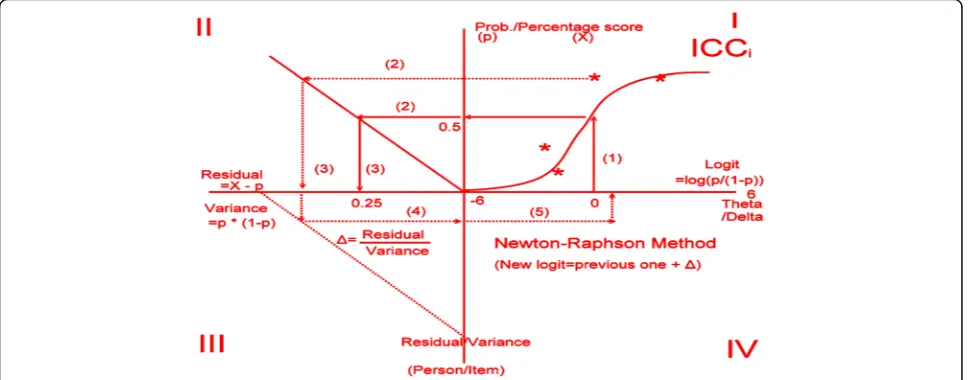
i) Rescaling the variable scores to a percentage response [i.e., recorded response = (observed response−minimum response)/(maximum response −minimum response)], and setting both initialϑn andδj= 0 in a logit unit. This is, at the origin of the measurement scale, every person is estimated to be at the same level of ability, and each item is estimated to be equally difficult.
ii) Calculating the initial expected values for each response using the one-parameter Rasch probability (Prob) equation: Prob ¼ expθn−δj=ð1þ exp
θn−δj
¼ exp 0ð −0Þ=ð1 þ exp 0ð −0ÞÞ ¼ 1= 1 þ 1
ð ÞÞ ¼ 0:5(see Quadrant I in Fig.1). iii) Computing variances (VarnJ=pnj× (1−pnj)) and
residuals (Rnj=XnJ−pnj) for each response (see Quadrant II in Fig.1).
iv) Estimating the provisionalθfor the row examinees
¼ previousϑþX L
j¼1
Rnj=XL j¼1
V arnj
!
andδfor the
column items ¼ previousδj−X N
n¼1
Rnj=XN n¼1
Varnj
!
using the Newton-Raphson Method (see Quadrants III and IV in Fig.1), whereas the mean ofδjis set at
zero (i.e.,X L
j¼1
δj¼0) [1].
from Quadrant II through IV in Fig. 1 until reaching the minimized (Min) sum square residuals (i.e., Min XN
n¼1
XL
j¼1
Onj−Enj
at a level of 0.05, 0.01, or less.
Rasch fit statistics used in this study
In addition to the person measures and item difficulties estimated in our proposed computer module, Rasch mean square (MNSQ) fit statistics (consisting of both item index and person INFIT and OUTFIT indices) de-scribe the fit to the model. The MNSQ fit statistics have a χ2 distribution and an expected value of 1, where fit statistics greater than 1 can be interpreted as demon-strating that the observed scores are aberrant distortions of (or underfit) the model’s expectation of unidimension-ality [18]. Conversely, fit statistics less than 1 can be ex-plained as items (or persons) that overfit the model, or that are highly correlated (i.e., item loading in an ex-plorative factor analysis) with the summation score.
The INFIT MNSQ is referred to as the weighted MNSQ and OUTFIT MNSQ is referred to the un-weighted MNSQ. Both are derived from the squared
standardized residuals [ Znj¼
ffiffiffiffiffiffiffiffiffiffiffiffiffiffiffiffiffiffiffiffiffi
Rnj2=Varnj
q
, whereas
Varnj are response variances, and the person (n) and
item (j) OUTFIT MNSQs are presented as X
L
j¼1
Znj2=L
and X
N
n¼1
Znj2=N] for each item/person interaction. The
OUTFIT MNSQ is the average of the standardized re-sidual variance across items and persons; it is un-weighted, which means that the estimate produced is relatively more affected by unexpected responses distant to item or person measures [19]. For the INFIT MNSQ
the residuals are weighted by their individual variance
[i.e.,
XN
n¼1
Rnj ð Þ2
XN
n¼1
Vnji
for the item (j) and
XL
j¼1
Rnj ð Þ2
XL
j¼1
Vnj
for the
person (n)] to minimize the effect of unexpected re-sponses far from the measure.
The INFIT MNSQ is relatively more affected by unex-pected responses closer to item and person measures [18]. In this study, the INFIT MNSQs for items less than 1.5 means data fitting to the Rasch model of the unidi-mensionality requirement and the OUTFIT MNSQs for persons less than 2.0 indicates person responses without aberrant or careless behaviors [20]. Additionally, the squared standardized residuals Znj¼pffiffiffiffiffiffiffiRnj2=Varnj
for each response less than 2.0 (i.e.,p< 0.05) is defined as a nonsignificant deviation from the model’s expected value.
Validation of the CIR model
Besides the aforementioned theoretical modelling method, two ordered-category datasets derived using the 11-item dichotomous and 26-item polytomous scales [12, 13] were further used to verify whether our pro-posed computer module yield accurate results in mea-sures, difficulties, and fit statistics similar to those of the professional Rasch Winsteps software [17]. The percent-age scores were rescaled to a range between 0 and 1.0. For instance, the only two values of 0 and 1.0 were assigned the original codes of 0 and 1, and the 5-point Likert-type scaling scores were uniformly transformed to 0, 0.25, 0.5, 0.75, and 1.0, respectively.
more valuable messages. One data source was collected from a Taiwan hospital in a safety attitude survey [22, 23]. An online computer adaptive testing (CAT) that can deal with many CAT procedurals on each domain in a test was demonstrated to collect safety attitude data from hospital employees.
Statistical analysis
In the author-made CIR module, R2was calculated using
the regression equation ¼XN n¼1
XL
j¼1
Enj−Xij
2
=XN
n¼1
XL
j¼1
Xnj−Xij
2
!
. The Paired-tand independent-ttests for two variables were used to compare the raw scores, percentage scores, and Rasch expected response scores using the 2-variable dataset of safety attitudes. The person OUTFIT MNSQ was obtained using the two values of standardized re-sidual (Z) and item length (L) in the equation
¼XL
j¼1
Znj 2
=L
!
. The Wright Map (or named
person-item map) [24] and the KIDMAP [25] were drawn using the CIR module.
Results
Validation of the Rasch CIR model
The Outfit MNSQ statistics and measures yielded by the proposed CIR computer module and by the Rasch pro-fessional Winsteps software [17] on the two study scales [12, 13] were equivalent (Fig. 2). We can see that spot lines of the CIR and Winsteps software in 4 combina-tions of Outfit MNSQ and measures on two scales (i.e., dichotomous and polytomous responses) are closely overlaid [26].
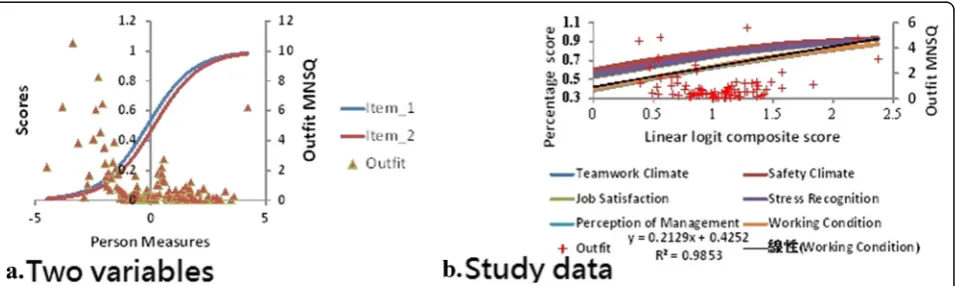
The CIR was applied to the 2-item competition bas-ketball scores between GSW and OKC on Feb. 27, 2016. Two variables’item character curves (ICC) with person Outfit MNSQ are present in Fig. 3 (left panel) after transforming raw scores into linear logits. It can be evi-dent of the fact that logit scores (on X axle) are more appropriate than those raw scores (on Y axle) when add-ing them for group comparisons and release more infor-mation, such as person Outfit MNSQ, to readers on a
from a Taiwan medical center with 1200 beds in 2015 to demonstrate the application of the CIR t (see Add-itional file 1 in Appendix). A total of 80 departments were included to show the 6 domain scores (including Teamwork Climate, Safety Climate, Job Satisfaction, Stress Recognition, Perception of Management, and Working Condition) [21, 22, 27, 28] on a plot (right panel in Fig. 3). All domain scores are above a per-centage of 0.3 (equivalent to 30 points in a 0–100 scale), two domains (i.e., Perception of Management and Working Condition, not present a linear pattern with a R-square around 0.98) are more difficult than other four, and several aberrantly unexpected re-sponses are present in Figure (right) with Outfit MNSQ greater than 2.0 [20].
The data metric of 80 units * 6 domains were analyzed with the model-data fit (see Additional file 2 in Appendix). R2 was 0.65 with F = 1.96 (p= 0.18) using the regression
equation ¼XN
n¼1
XL
j¼1
Enj−Xij
2
=XN n¼1
XL
j¼1
Xnj−Xij
2
!
. The t
-value of the two item difficulties (−0.23 and −0.42 logits for Teamwork Climate and Safety Climate) was 0:48
¼ð‐0:23‐ ‐0:42Þ=p1ffiffiffiffiffiffiffiffiffiffiffiffiffiffiffiffiffiffiffiffiffiffiffiffiffiffiffiffiffiffiffiffiffiffiffiffiffiffi=13:76þ1=12:39
;p¼0:63Þ, not significantly different from each other using the traditional
t-test.
A Wright map shows that the 6 domains and a single construct when referring to INFIT MNSQs <1.5; the per-son distribution is also shown (Fig. 4, left).
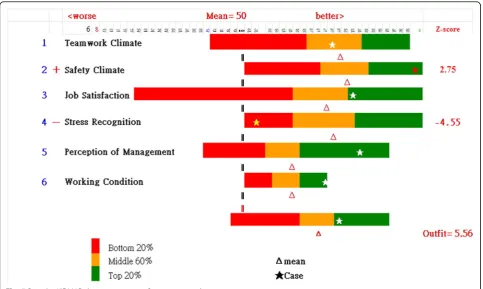
The results of a case department show an aberrant OUTFIT MNSQ of 5.67 (>2.0) in the Box KIDMAP (Fig. 5, right bottom). One domains—Safety Climate— -shows a significantly high Z-score (=2.75): > 2.0, and another dimension—Stress Recognition—shows a signifi-cantly low Z-score (=−4.55): < −2.0, implying the strength and weak comparing to other counterparts.
scores appear to be normally distributed, but Job Satis-faction was slightly negatively distributed.
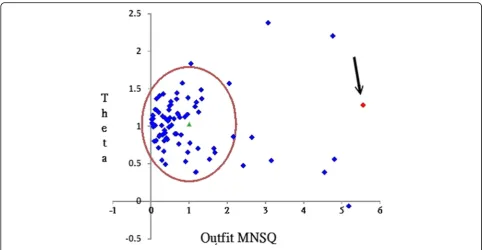
The most unexpected misfit case—an OUTFIT MNSQ 5.56 (>2.0)—was extracted at the 1.28 logits point (Fig. 6). We can see the aberrant response pattern with a high OUTFIT MNSQ (>2.0) (e.g., this anomaly might be most attributable to the two domains with the two Z-scores of 2.75 and−4.55 in Fig. 5).
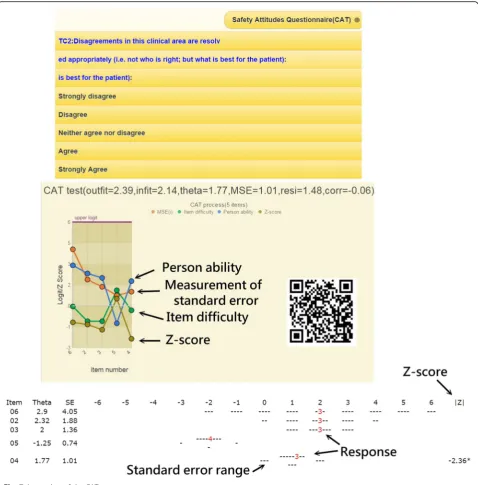
An online computer adaptive testing (CAT) was demonstrated
By scanning the QR code (Fig. 7, middle right), the CAT icon appears on the patient’s mobile phone. We demon-strate an alternative way for gathering respondent’s safety attitudes with item-by-item in action (see Add-itional file 3 in Appendix). Person fit (ie, infit and outfit mean square) statistics showed the respondent behav-iors. Person theta is the provisional ability estimated by the online CAT module.
The MSE (e.g., measurement of standard error) in Fig. 7 was generated by the following formula [29]: 1/√(Σ varian-ce(i)), whereirefers to the CAT finished items responded to by a person [30]. The residual (resi) on top in Fig. 7 was
the average of the last three change differences between the pre-and post-estimated abilities on each CAT step. CAT will stop if the residual value is less than 0.05, indi-cating a stable estimation in process. Corr refers to the correlation coefficient between the CAT estimated mea-sures and its step series numbers using the last three esti-mated theta (= person measure) values. The flatter the theta trend, the higher the probability that the person measure is convergent with a final estimation.
Discussion
Principal findings
Our most important finding was that the OUTFIT MNSQ and person measures yielded by our proposed CIR module were not significantly different from the professional Rasch Winsteps software on the two dichotomous and polyto-mous scales. Our second most important finding was that the probabilistic modeling of our CIR module presented readers much more valuable messages (e.g., fit statistics and visual representations of a Wright map and KIDMAP) and illustrated the CIR module’s advantage over CTT, especially when using the expected scores (instead of the raw scores) in comparing group (or item) differences.
Fig. 2Four combinations of Outfit MNSQ and measures on two scales are closely overlaid
A video regarding the CIR application is demonstrated in a MP4 format at reference [31].
There are so many comparative scores that are not, or might not be, additive but that follow a logistic distribu-tion in the real world [16]. The Rasch model formulates a nonlinear relationship between nonlinear raw scores and additive measures [31]. Figure 4 shows that we were
more concerned about locating that person on the true score trait (on X axle) than in having that person obtains a raw score (on Y axle). This is why we preferred to use the model-expected scores for comparison in Fig. 1. Unfortunately, we have not seen a statistical modeling technique that can deal with CIRs as we did using our Microsoft Excel module.
Fig. 4Wright map shows person and item dispersions
Implications and future considerations
We showed that fit statistics and visual representations of a Wright map and KIDMAP offer much more valu-able messages to readers. The premises consist of the model-expected scores that should first be yielded by Rasch analysis. Fit statistics are thus produced, and the Wright map and KIDMAP follow. An adequate CIR computer routine is thus required.
Using our proposed module in the future will not be lim-ited to the two types of continuous item responses (i.e., two basketball completion scores and six items of the patient safety survey shown in Fig. 4) illustrated here. Scores for a single item (e.g., serum levels of liver enzymes and lipids [32]) can also be easily transformed into Rasch interval logit measures used for statistical group comparison or product moment correlation analysis in practice.
Our CIR computer program can be simultaneously used for many between-test dimension scores in a sur-vey, like in this study. For example, the Clinical Demen-tia Rating scale [33] used for patients with demenDemen-tia consists of six domains. We can present the Wright map and KIDMAP to the patient or their family proxy in the same way that educational performance sheets are pre-sented to students or their parents [24, 25].
Strengths
All Rasch measurement analysis software is used for dichot-omous and polytdichot-omous ordered category scales [33, 34]. In the healthcare field, there are so many continuous variables that cannot be analyzed and plotted a Wright map and KIDMAP. Many studies [3–9] have proposed IRT-based
models used for CIRs but have not provided user-friendly software such as MS Excel version in this study. We dem-onstrated one example of a safety attitude survey using continuous variables analyzed with a user-friendly MS Excel module to plot a Rasch Wright map and KIDMAP.
The Wright map was improved by adding the item INFIT MNSQ dispersion on the right (see Fig. 4) and with color features, which has never before been used to interpret the unidimensionality feature together with person distribution in a diagram.
The KIDMAP has evolved to a colorful item-by-item bar-chart plot (see Fig. 5) different from the traditional monochrome diagram [35, 36–38] or KIDMAP solely for dichotomous scales [25]. More information has been included in the colorful KIDMAP: all person distribu-tions and dispersions along all items, Z-scores displaying the most unexpected items, and the individual person location points on items suitable for polytomous and continuous variables. A person performance referred to the overall counterparts is also present in a scatter plot (Fig. 6) that can easily select aberrant respondents for further improvement and concerns with respect to the example of hospital safety attitude survey.
between groups (with continuous format) after gathering data on the individual base (with ordered category format).
Many studies [39–43] have reported that item response theory (IRT)-based computer adaptive testing (CAT) has the advantages of both long-form and short-form ques-tionnaires [44–46] in precision and efficiency. Many em-ployees already own mobile phones. No studies reported online CAT via mobile phones in medical fields, especially implementing multiply-domain online CAT together in a test. We demonstrated it for gathering survey data regard-ing safety attitudes here (See Fig. 7).
Limitations
This study has at least four limitations. First, the resid-uals in person-item interaction cells are significantly small in the CIR format scenario. A normalization pro-cedure for letting the mean of INFIT and OUTFIT MNSQ = 1.0 is necessary for easy interpretation by readers, assuming that the acceptable criterion is be-tween 0.5 and 1.5 required by the Rasch model.
“specifically objective”comparisons of persons and items as the unique feature of Rasch models [14]. We can replace all the discrimination parameters in GRM with 1 to fit Rasch model’s requirement in future study.
Third, we combined the person OUTFIT MNSQ into the model-expected item character curves in a diagram (Fig. 3) because two vertical axles with a significant difference distort the diagram and make it difficult to interpret without train-ing, but easy to compare the two vertical axles after training.
Fourth, the CIR module is easy to yield greater Outfit MNSQ in the extreme two sides (i.e., toward zero and 100 percentage score) because of minimal variance leading a higher value of person Outfit
MNSQ ¼X
L
j¼1
Rnj2=Varnj=L¼
XL
j¼1
Znj2=L
!
. For
in-stance, a variance (=0.5*0.5) in middle point is greater than it (=0.1*.09) in both extreme sides.
Fifth, we merely emphasize the usefulness on the healthcare settings, not suggest the CIR being applied to the clinical utility. Because the chemical Lab examin-ation scores are not like the survey items having a con-sistent scaling score. Whether the clinical scores should be standardized first prior to analysis is required to fur-ther explored and researched in future.
Conclusion
Because of advances in computer technology, healthcare users who are familiar to MS Excel can easily apply the study CIR module to deal with continuous variables to benefit comparisons of data with a logistic distribution and model fit statistics.
Additional files
Additional file 1:Microsoft Excel-based computer module for continuous item responses. (XLSM 2705 kb)
Additional file 2:Video demonstration regarding application of the Excel CIR module http://www.healthup.org.tw/marketing/course/information/ rasch_cir.mp4. (MP4 45229 kb)
Additional file 3:Computerized adaptive testing of the patient safety survey on six subscales http://www.healthup.org.tw/marketing/course/ information/safetysurveyKREA.mp4. (MP4 14747 kb)
Abbreviations
CAT:Computer adaptive testing; CIR: Continuous item responses; CTT: Classic test theory; GRM: Graded response model; ICC: Item character curves; IRT: Item response theory; MNSQ: Mean square error; MSE: Measurement of standard error; RSM: Rating scale model; VBA: Visual basic for applications
Acknowledgements
We thank Frank Bill who provided medical writing services to the manuscript.
Funding
There are no sources of funding to be declared.
Availability of data and materials
All data used for verifying the proposed computer module during this study are extracted from the published articles [12, 13]. The Microsoft Excel-based computer module including the demonstrated data of safety attitudes can be downloaded from the supplementary information files.
Authors’contributions
TW developed the study concept and design. TW and YS analyzed and interpreted the data. TW drafted the manuscript, and all authors provided critical revisions for important intellectual content. All authors have read and approved the final manuscript as well as agreed to be accountable for all aspects of the work in ensuring that questions related to the accuracy or integrity of any part of the work are appropriately investigated and resolved. The study was supervised by SC.
Competing interests
The authors declare that they have no competing interests.
Consent for publication Not applicable.
Ethics approval and consent to participate Not applicable.
The secondary data were retrieved from published papers on references from 21 to 23, one for CAT used as item pool and another for demonstration in MS Excel. With permission from the CEO of the Joint Commission of Taiwan who is the correspondence author on reference 23, the data of safety attitudes demonstrated were obtained from the published paper, in which all hospital and study participant identifiers were stripped and merely grouped into composite scores of 80 anonymous divisions.
Author details
1Medical Research Department, Chi-Mei Medical Center, Tainan, Taiwan. 2
Department of Hospital and Health Care Administration, Chia-Nan University of Pharmacy and Science, Tainan, Taiwan.3Department of Electronics and
Information Engineering, Tongji Zhejiang College, Jiaxing, China.
4Department of Ophthalmology, Chi-Mei Medical Center, Yong Kang, Tainan
City, Taiwan.5Department of Optometry, Chung Hwa University of Medical Technology, Jen-Teh, Tainan City, Taiwan.6Chi-Mei Medical Center, No. 901,
Chung Hwa Road, Yung Kung Dist, Tainan 710, Taiwan.
Received: 20 October 2016 Accepted: 8 December 2016
References
1. Noel Y, Dauvier B. A Beta item response model for continuous bounded responses. Appl Psychol Meas. 2007;31:47.
2. Djaja N, Janda M, Olsen CM, Whiteman DC, Chien TW. Estimating Skin Cancer Risk: Evaluating Mobile Computer-Adaptive Testing. J Med Internet Res. 2016;18(1):e22.
3. Müller H. A Rasch model for continuous ratings. Psychometrika. 1987;52(2): 165–81.
4. Ferrando PJ. A nonlinear congeneric model for continuous item responses. Br J Math Stat Psychol. 2001;54:293–313.
5. Mellenbergh GJ. A unidimensional latent trait model for continuous item responses. Multivar Behav Res. 1994;29:223–36.
6. Samejima F. Homogeneous case of the continuous response model. Psychometrika. 1973;38:203–19.
7. Samejima F. Normal ogive model on the continuous response level in the multidimensional latent space. Psychometrika. 1974;39:111–21.
8. Wang T, Zeng L. Item parameter estimation for a continuous response model using an EM algorithm. Appl Psychol Meas. 1998;22:333–44. 9. Linacre JM. Percentages with continuous Rasch models. Rasch Meas Trans.
2001;14(4):771–4.
10. Morin C, Bushnell MC. Temporal and qualitative properties of cold pain and heat pain: A psychophysical study. Pain. 1998;4:67–73.
11. Bejar II. An application of the continuous response model to personality measurement. Appl Psychol Meas. 1977;1:509–21.
2002;3(1):85–106.
21. Jeong HJ, Lee WC. Item response theory-based evaluation of psychometric properties of the safety attitudes questionnaire—Korean version (SAQ-K). Biometrics Biom Biostat Int J. 2016;3(5):00079.
22. Lee WC, Wung HY, Liao HH, Lo CM, Chang FL, Wang PC, Fan A, Chen HH, Yang HC, Hou SM. Hospital safety culture in Taiwan: a nationwide survey using Chinese version Safety Attitude Questionnaire. BMC Health Serv Res. 2010;10:234.
23. Chien TW, Chang Y, Chien PS, Lin HJ. A dashboard used for displaying the results of the hospital patient safety culture survey. J Taiwan Assoc Med Inform. 2015;24(4):49–59.
24. Wilson M. Some Notes on the Term:“Wright Map”. Rasch Meas Trans. 2011; 25(3):1331.
25. Masters GN. KIDMAP–a history. Rasch Meas Trans. 1994;8(2):366. 26. Chien TW, Shao Y. Rasch analysis for continuous variables. Rasch Meas
Trans. 2016;30(1):1574–6.
27. Jeong HJ, Jung SM, An EA, Kim SY, Yoon H. Development of the safety attitudes questionnaire-Korean version (SAQ-K) and Its novel analysis methods for safety managers. Biometrics Biostatistics Int J. 2015;12(1):1–20.
28. Jeong HJ, Jung SM, An EA, Kim SY, Song BJ. A strategy to develop tailored patient safety culture Improvement Programs with Latent Class Analysis Method. Biometrics Biostatistics Int J. 2015;2(2):1–27.
29. Chien TW, Lin WS. Improving Inpatient Surveys: Web-Based Computer Adaptive Testing Accessed via Mobile Phone QR Codes. JMIR Med Inform. 2016;4(1):e8.
30. Linacre JM. Computer-adaptive tests (CAT), standard errors and stopping rules. Rasch Meas Trans. 2006;20(2):1062.
31. Linacre JM. Iterations - PROX & JMLE. Winsteps® Rasch measurement computer program User’s Guide. Beaverton: Winsteps.com; 2016. 32. Alcalay J, Landau M, Zucker A. Analysis of laboratory data in acne patients
treated with isotretinoin: is there really a need to perform routine laboratory tests? J Dermatolog Treat. 2001;12(1):9–12.
33. Hughes CP, Berg L, Danziger WL, Coben LA, Martin RL. A new clinical scale for the staging of dementia. Br J Psychiatry. 1982;140(6):566–72.
34. Wang WC, Chen CT. Item parameter recovery, standard error estimates, and fit statistics of the Winsteps program for family of Rasch models. Educ Psychol Meas. 2005;65(3):376–404.
35. Linacre JM. Rasch measurement analysis software directory. retrieved at http://www.rasch.org/software.htm. Accessed 20 Feb 2016.
36. Chien TW, Wang WC, Wang HY, Lin HJ. Online assessment of patients’views on hospital performances using Rasch model’s KIDMAP diagram. BMC Health Serv Res. 2009;9:135.
37. Chien TW, Wang WC, Roberto VC, Su SB. A graphical health report constructed as a KIDMAP using Rasch analysis of IRT model. Health Med. 2012;6(1):29–36.
38. Chien TW, Wang WC, Lin SB, Lin CY, Guo HR, Su SB. KIDMAP, a web based system for gathering patients’feedback on their doctors. BMC Med Res Methodol. 2009;9:38.
39. Chien TW, Wu HM, Wang WC, Castillo RV, Chou W. Reduction in patient burdens with graphical computerized adaptive testing on the ADL scale: Tool development and simulation. Health Qual Life Outcomes. 2009;7:39. 40. Chien TW, Wang WC, Huang SY, Lai WP, Chou JC. A web-based
computerized adaptive testing (CAT) to assess patient perception of hospitalization. J Med Internet Res. 2011;13(3):e61.
46. Shear MK, Greeno C, Kang J, Ludewig D, Frank E, Swartz HA, et al. Diagnosis of nonpsychotic patients in community clinics. Am J Psychiatry.
2000;157(4):581–7.
47. Samejima F. Estimation of latent ability using a response pattern of graded scores. Research Bulletin, Princeton: Educational Testing Service; 1962. p. 2.
• We accept pre-submission inquiries
• Our selector tool helps you to find the most relevant journal
• We provide round the clock customer support
• Convenient online submission
• Thorough peer review
• Inclusion in PubMed and all major indexing services
• Maximum visibility for your research
Submit your manuscript at www.biomedcentral.com/submit