Munich Personal RePEc Archive
Excel formula and Islamic norms for
home financing
Hasan, Zubair
INCEIF the Global University in Islamic Finance, Kuala Lumpur
2 November 2012
Online at
https://mpra.ub.uni-muenchen.de/42835/
1
1
1 (1)1 . P
A 0
n
n
r r r
Excel formula Islamic norms and home financing models
1Zubair Hasan
Professor of Islamic Economics and Finance
INCEIF: The Global University of Islamic Finance, Kuala Lumpur, Malaysia
--- Abstract
This paper is in a series of writings on Islamic home financing. It spells out certain norms Islamic banks must observe in home financing and demonstrates that the conventional model based on an Excel formula does not meet the stated norms. It may well be emphasized that in Islam the question of observing these norms arises before not after the selection of the formula; additional juristic requirements may only follow subsequently. Is it not then queer that many Islamic banks are using the formula to determine the periodic installment payments in their home financing programs? The paper finds for example the popular MMP non-compliant of the stated norms. It presents a new model and argues that the alternative is not only fully observant but is superior to MMP on some other counts as well.
Key words: Home finance; Excel amortization formula; Compounding; Islamic norms; Justice
---
The norms
In home financing Islamic banks take care as they must to ensure two things: First that they
avoid erecting structures that leave any room for interest to enter the contract they sign with
their clients. Recall in this context that compounding is even more vociferously condemned
in the Quran (3: 130-132) than interest.
Second, the ownership of the property passes to the customer in the same ratio as the
payment made has to the total charge at any point in time. Both these norms follow from
Qur’an the word of God and fall under the Islamic notion of justice (Al-adl). And justice has an overriding position among the objectives or maqasid of Shari’ah. It is an inalienable
ingredient of the Islamic notion of Amanah the soul of religion. Justice with reference to
financial contracts means equality before the law and the scripture forbids withholding from
the people “that which rightfully belongs to them” (Qur’an 7:85).
Compounding and Excel
Now, in home financing contracts most of the Islamic banks use across the globe an Excel
formula for the determination of uniform periodic installment payments. This paper
investigates if the resultant contract leads to meeting the stated norms? The formula is as
under.
1
2 )
2 ( ely
approximat 5887
1 20 0.04) (1
20 0.04) (1 0.04 80000
A
Here,
A = Installment amount the customer has to pay per time unit to the bank
P0= Bank’s contribution (loan) to the purchase price of the house
r = the rate of interest payable on outstanding loan per period
n = number of time units the payment period is divided; be it a week, a month or a year.
To illustrate, let us assume that a customer buys a house worth $100,000. He makes a
down payment of $20,000 to the seller from his savings and plans to borrow the
remaining amount P0=$80000 from a bank payable in 10 years in 20 half-yearly
installments. To explore possibilities, he first approaches a conventional bank. He is
offered the required terms, the rate of interest per year being 8%. He is to mortgage the
house with the bank as security. The bank calculates the installment amount inserting the
relevant values in the above formula as follows:
The half-yearly rate of interest used in the formula is 8/2 = 4% or 0.04 per dollar. Using the
value of A from equation (2) we get the total amount Pn the bank will receive in 10 years as
under:
Pn=A * n = 5886.54 * 20 = $117731. Bank’s profit (interest income) will be:
Pn– P0 = 117731 – 80000 = $37731 in 10 years i.e. 3773 a year or 4.72% on $80,000.
Notice that A is an exponential function of P0, r and n. The formula clearly implies
compounding of interest income. Interestingly, the fact has explicitly been stated in a
2008 article of Microsoft Excel published on the internet. Still, how compounding comes
into the picture is not clear to many; it needs explanation. We know that the standard
compound interest formula is
Pn = P0 (1 + r) n (3)
The formula capitalizes interest for each of the n terms to calculate interest for the
next or (n + 1) term. The compounding is cumulative if there are no intervening
installment payments. Thus, inserting P0 = $80000, r = 0.08 and n = 10 in the above
formula we get:
Pn = 80000 (1 + 0.08)10 (4)
3 We may discount back this amount using the formula P0 = Pn/ (1 + r)n to arrive back at
the initial loan amount $80000.
However, in our illustration half-yearly installments are paid. Therefore, we have to
find out the rate r0 to verify compounding. Inserting in the formula Pn = P0 (1 + r0)n the
values of Pn = A* n, P0 and n, we may find r0 as under.
5886.54 * 20 = 80000 (1 + r0)20 (5)
Dividing through by 20, we get 5886.54 = 4000 (1 + r0)20
ln (5886.54) = ln (4000) + 20 ln (1 + r0)
3.7699 = 3.60205 + 20 ln (1 + r0)
ln (1+ r0) = (3.7699 – 3.60205) /20
= 0.00839 (1 + r0) = 10 0.00839
= 1.01951 r0 = 0.01951
The compounding rate, r0 = 0.01951 gives us 1.951% half-yearly or 3.9% annually
Verification:
Pn = 80000 (1 + 0.01951)20 (6) = 80000 * 1.47174
= 117739
Return on capital = 117739 – 80000 = 37739
Rate of return per year 4.72% [same as before]
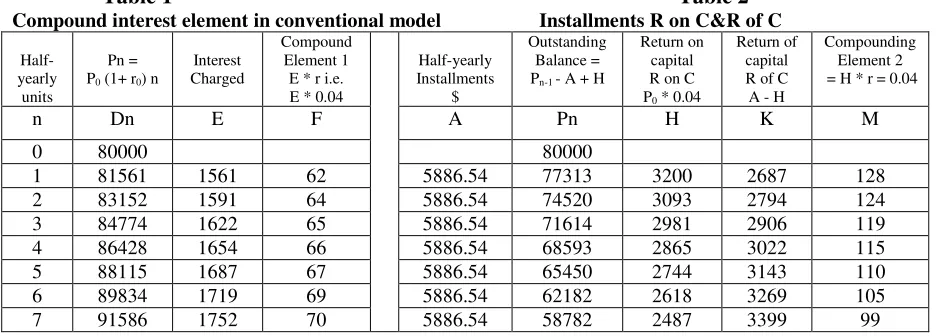
Using the data we now have, we produce Table 1 below to show how compounding
enters into the working of the conventional home financing model. The interest charged
shown in column E can also be found for each time point n, multiplying (n-1) value of E
by r0 = 0.0 1951 that equation (5) gives. Thus, for n = 1 it would be 80,000 * 0. 01951 =
[image:4.612.75.543.549.717.2]1560.8 and for n = 2, (80,000 + 1560.8) * 0.01951 = 1591.25 and so on.
Table 1 Table 2
Compound interest element in conventional model Installments R on C&R of C
Half-yearly
units
Pn = P0 (1+ r0) n
Interest Charged
Compound Element 1 E * r i.e. E * 0.04
Half-yearly Installments
$
Outstanding Balance = Pn-1 - A + H
Return on capital R on C P0 * 0.04
Return of capital R of C
A - H
Compounding Element 2 = H * r = 0.04
n Dn E F A Pn H K M
0 80000 80000
1 81561 1561 62 5886.54 77313 3200 2687 128
2 83152 1591 64 5886.54 74520 3093 2794 124
3 84774 1622 65 5886.54 71614 2981 2906 119
4 86428 1654 66 5886.54 68593 2865 3022 115
5 88115 1687 67 5886.54 65450 2744 3143 110
6 89834 1719 69 5886.54 62182 2618 3269 105
4
8 93373 1787 71 5886.54 55247 2351 3535 94
9 95195 1822 73 5886.54 51571 2210 3677 88
10 97052 1857 74 5886.54 47748 2063 3824 83
11 98946 1894 76 5886.54 43771 1910 3977 76
12 100876 1930 77 5886.54 39636 1751 4136 70
13 102844 1968 79 5886.54 35335 1585 4301 63
14 104851 2007 80 5886.54 30862 1413 4473 57
15 106896 2045 82 5886.54 26209 1234 4652 49
16 108982 2086 83 5886.54 21370 1048 4838 42
17 111108 2126 85 5886.54 16338 855 5032 34
18 113280 2172 87 5886.54 11105 654 5233 26
19 115486 2206 88 5886.54 5662 444 5442 18
20 117739 2253 90 5886.54 1 227 5660 9
Total 37733 1510 117730.8 37733 79998 1509
Compounding then is precisely the capitalization of interest for charging interest on
interest. Column F isolates the compounding element in interest, for F = En –En-1. Notice
that column Dn records cumulative amounts. Thus, the value for n = 20 in that column
gives us the aggregated amount ($117739).
Table 1 shows that the Microsoft Excel formula for installment determination
involves compounding of interest in home financing. Column Dn is obtained by using
equation (4) for each n time point. Column E records the excess in each cell over the
preceding cell value in column Dn. Compounding element in F column is obtained by
multiplying the amount in column E by the half-yearly rate of interest r = 0.04. Notice
that in Table 2 we have:
Pn = Pn -1 - A + H (7)
Thus, each time we deduct installment payment from the preceding value or Pn-1
but at the same time we add back the return on capital (H) to arrive at current balance
(Pn). In other words, we regularly leave the return on capital embedded in the outstanding
balance. We know that H = Pn-1* r. Putting this value of H in (7) we get:
Pn = Pn - 1– A + Pn-1* r.
Simplifying we get
Pn = Pn-1 (1 + r)n– A (8)
Compounding is so vivid in the formula: interest is charged on interest all along
down the line.We have once more isolated the compounding as shown in column M.
Thus, two demonstrations are presented on compounding giving identical results – the
sum of column F equals the sum of column M. Compounding yields a return of almost
5 does not provide the details of how the process of repayment goes with the customer but
Table 2 clarifies the process. Interestingly, one may find return of capital in column K
growing over time on the compounding principle (1+r)n in conformity with evidence
provided. Let us now take up the issue of ownership transfer (rate) to the customer in
conventional financing.
Ownership transfer to the customer
Justice demands that the rates of payment and transfer of ownership to the customer must
be identical. However, under interest financing the transfer rate is all through lower than
of the payment completed. Out of the uniform installment the compounding process
compulsively allocates more towards the payment of interest than return of capital. Thus,
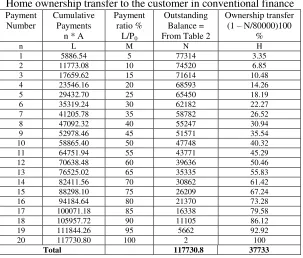
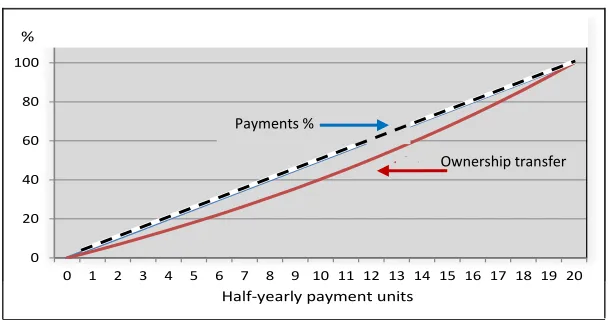
the latter amount becomes smaller than the payment rate. Figure 1 provides a visual
evidence of this crucial fact violating the Islamic norm. The evidence follows from the
[image:6.612.156.459.357.615.2]data in Table 3.
Table 3
Home ownership transfer to the customer in conventional finance
Payment Number
Cumulative Payments
n * A
Payment ratio %
L/P0
Outstanding Balance = From Table 2
Ownership transfer (1 – N/80000)100
%
n L M N H
1 5886.54 5 77314 3.35
2 11773.08 10 74520 6.85
3 17659.62 15 71614 10.48
4 23546.16 20 68593 14.26
5 29432.70 25 65450 18.19
6 35319.24 30 62182 22.27
7 41205.78 35 58782 26.52
8 47092.32 40 55247 30.94
9 52978.46 45 51571 35.54
10 58865.40 50 47748 40.32
11 64751.94 55 43771 45.29
12 70638.48 60 39636 50.46
13 76525.02 65 35335 55.83
14 82411.56 70 30862 61.42
15 88298.10 75 26209 67.24
16 94184.64 80 21370 73.28
17 100071.18 85 16338 79.58
18 105957.72 90 11105 86.12
19 111844.26 95 5662 92.92
20 117730.80 100 2 100
[image:6.612.154.460.362.615.2]6
The above discussion reinforces the assertion that Excel formula for installment
determination is not free of compounding. Microsoft has mentioned as said earlier the
fact in its publications. In addition to compounding,we have candidly established that if
the formula is used the ownership of the house would unavoidably pass to the customer
all along at a slower rate than at which he makes the payment. Thus, the formula meets
neither of the two basic Islamic norms we started with.
We have already shown elsewhere (Hasan, 2011) that if the periodic installment
payments in an Islamic home financing program like the MMP are determined the same
way as in the conventional model using the Excel formula; the consequences must be
identical if the annual rental equals interest rate i.e. 8% a year for our illustration. The
MMP would defy the stated Islamic norms identically. We produce comparative facts in
Table 4 to make the argument of the paper self-contained. For details of arriving at the
Table 4 below the reader may find data in our earlier writings on the subject (See for
example Hasan, 2010).
Table 4:Excel formula gives identical results in the conventional and the MMP models
N
A B C D E F G H
Balance outstanding
Return of capital Compound Rate
Return on capital Installment
CON MMP CON MMP CON MMP CON MMP
1 80000 80000 2687 2687 1.04 3200 3200 5887 5887
2. 77313 77313 2794 2794 1.04 3093 3093 5887 5887
-- -- -- -- -- -- -- -- -- --
19. 11091 11091 5443 5443 1.04 444 444 5887 5887
20. 5647 5647 5661 5661 1.04 226 226 5887 5887
Total 94475 94475 80000 80000 37740 37740 117740 117740
0 20 40 60 80 100 120
0 1 2 3 4 5 6 7 8 9 10 11 12 13 14 15 16 17 18 19 20
Ownership transfer to the customer: ZDBM and MMP compared
%
ZDBM
MMP
[image:7.612.156.461.72.232.2]Half-yearly payment units
Figure 1: Conventional home financing transfers ownership to the customer at a slower than the payments rate
Payments %
P
7
ZDBM – An alternative
The customer in our illustration subsequently approaches an Islamic bank to find details
for obtaining the remaining $80,000 payable in 10 years spread over 20 half-yearly
installments sans interest. The bank agreeing to meet his requirements makes the offer as
follows. “The bank shall provide the remaining $80,000 to acquire a proprietary share in the house, you acting as our agent. For getting back our investment of $80,000 in 20
equal installments spread over ten years, you will pay $4000 each six-months. In
addition, we shall put a yearly mark-up of 8% (4% half-yearly) on our ownership share in
the house any point in time i.e. the mark-up amount will be calculated on the diminishing
balance (value) of our share in the property.That would help reduce your liability to the
bank over time proportionately. The registration of the house in the court will be in your
name but you will have to sign simultaneously a mortgage deed pledging the property
with the bank as security until installments are all cleared”. The client agrees to the terms
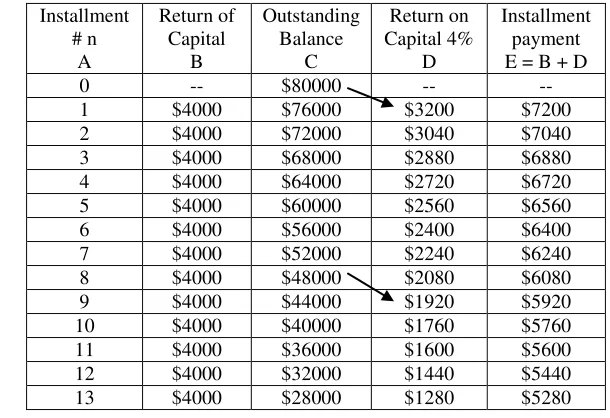
offered2. The bank provides him a Table given below detailing his half-yearly installment
payments combining the two components return of capital and the return on capital. This
is a simple table; the arrows illustrating how the return on capital is calculated. The de
facto average rate of return the client would pay to the bank is [$33600/80000] /10 =
[image:8.612.148.453.463.672.2]4.2% per annum.
Table 5: ZDBM in operation
Installment # n
A
Return of Capital
B
Outstanding Balance
C
Return on Capital 4%
D
Installment payment E = B + D
0 -- $80000 -- --
1 $4000 $76000 $3200 $7200
2 $4000 $72000 $3040 $7040
3 $4000 $68000 $2880 $6880
4 $4000 $64000 $2720 $6720
5 $4000 $60000 $2560 $6560
6 $4000 $56000 $2400 $6400
7 $4000 $52000 $2240 $6240
8 $4000 $48000 $2080 $6080
9 $4000 $44000 $1920 $5920
10 $4000 $40000 $1760 $5760
11 $4000 $36000 $1600 $5600
12 $4000 $32000 $1440 $5440
13 $4000 $28000 $1280 $5280
2
8
14 $4000 $24000 $1120 $5120
15 $4000 $20000 $960 $4960
16 $4000 $16000 $800 $4800
17 $4000 $12000 $640 $4640
18 $4000 $8000 $480 $4480
19 $4000 $4000 $320 $4320
20 $4000 $0 $160 $4160
Total $80000 $8400000 $33600 $113600
Shorn of the finer legal and regulatory details, the ZDBM structure the Table contains
would require three mutually exclusive and independent contracts for consecutive
execution.
1. A sale contract involving the customer, the bank and the seller giving co-ownership of
the house to the first two in their initial payments ratio of 20:80. The customer will work
as their agent, the bank arranging legal authority for him.
2. A second contract whereby the bank sells his share in the property to the customer with
an agreed 8% mark-up over their $80000 investment.
3. A third contract whereby the customer mortgages the house with the bank until the acts
[image:9.612.160.453.72.170.2]installments have all been paid in full.
Figure 2 shows the contractual relationships of the three parties. The seller will be out of
the picture after the first contract. Only the client and the bank will stay together for 10
years. In essence, ZDBM is a murabahah-mortgage combination.
BANK
SELLER
CUSTOMER
HOUSE Bank share 80%
Customer share 20%
B a n k s el ls it s sha re t o t h e cu st o m er w it h 8 % m a rk u p fo r R M I 1 3 6 0 0 T h e cu st o m er p le d g es t h e h o u se w it h th e b a n k to p a y t h e lo a n in in st a llm en ts
House sold for RM100000
Bank $80000, customer RM 20000 RM 80000 RM 20000 (1 Wakalah) (2 Murabaha) (3 Rahn)
[image:9.612.138.489.443.646.2]9
Comparison of models
Let us compare the main features of the ZDBM with the Musharakah Mutanaqisah
Partnership (MMP) program. We found in Table 4 the results of the two models –
conventional and the MMP identical because both models use the same Excel formula
for fixing the installment payment. Leaving aside the compounding of interest issue, we
find some other merits too in the ZDBM. The comparison is facilitated by the following
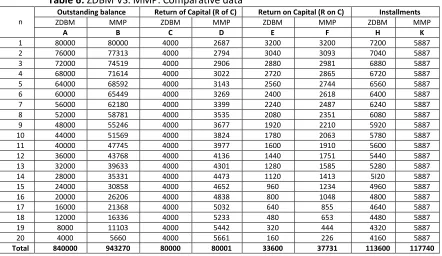
[image:10.612.87.529.225.481.2]Table. 6. Take note of the following facts.
Table 6: ZDBM VS. MMP: Comparative data
n
Outstanding balance Return of Capital (R of C) Return on Capital (R on C) Installments
ZDBM MMP ZDBM MMP ZDBM MMP ZDBM MMP
A B C D E F H K
1 80000 80000 4000 2687 3200 3200 7200 5887 2 76000 77313 4000 2794 3040 3093 7040 5887 3 72000 74519 4000 2906 2880 2981 6880 5887 4 68000 71614 4000 3022 2720 2865 6720 5887 5 64000 68592 4000 3143 2560 2744 6560 5887 6 60000 65449 4000 3269 2400 2618 6400 5887 7 56000 62180 4000 3399 2240 2487 6240 5887 8 52000 58781 4000 3535 2080 2351 6080 5887 9 48000 55246 4000 3677 1920 2210 5920 5887 10 44000 51569 4000 3824 1780 2063 5780 5887 11 40000 47745 4000 3977 1600 1910 5600 5887 12 36000 43768 4000 4136 1440 1751 5440 5887 13 32000 39633 4000 4301 1280 1585 5280 5887 14 28000 35331 4000 4473 1120 1413 5I20 5887 15 24000 30858 4000 4652 960 1234 4960 5887 16 20000 26206 4000 4838 800 1048 4800 5887 17 16000 21368 4000 5032 640 855 4640 5887 18 12000 16336 4000 5233 480 653 4480 5887 19 8000 11103 4000 5442 320 444 4320 5887 20 4000 5660 4000 5661 160 226 4160 5887
Total 840000 943270 80000 80001 33600 37731 113600 117740
ZDBM turns out to be cheaper for the customer due to a faster repayment of capital
plan. For example, in our illustration the customer gains $4131 - the difference between
the return on capital columns’ total in Table 6.
Significantly, the customer does not gain at the cost of the banker. Notice that the sum of outstanding balances, which we take as proxy for funding deposits, reduces in the
ZDBM proportionate to the reduction in the return on capital volume. See the following
equation. Figures are from the column totals in the Table.
891 . 0 37731
33600 943270
840000
Capital on
Return Deposis
Funding Models
10 Thus, the margin on funding deposits remains the same in both cases i.e. 4%. ZDBM is
a win-win model for both the parties: The cost of the house is reduced for the client.
Islamic banks get an edge over their conventional rivals while their profit margin
remains unchanged.
The ZDBM is more efficient; it absorbs fewer resources – funding deposits are smaller. For the same reason, the model must also increase the liquidity levels in the system.
.
The
The ownership of property passes faster to the customer. Researches show that
constant amortization programs as in the ZDBM are more equitable than any other
scheme in operation. (Chambers et al 2007). In our illustration, half way down the
time scale 50% ownership passes to the customer as compared to 40% under the
MMP. (See Figure 3). Thus, the margin on funding deposits remains the same in both
cases i.e. 4%. ZDBM is a win-win model for both the parties: The cost of the house is
reduced for the client. Islamic banks get an edge over their conventional rivals without
losing on the profitability front.
It follows that the ZDBM is more efficient; it absorbs fewer resources – funding deposits are smaller. For the same reason, the model must also increase the liquidity
levels in the system.
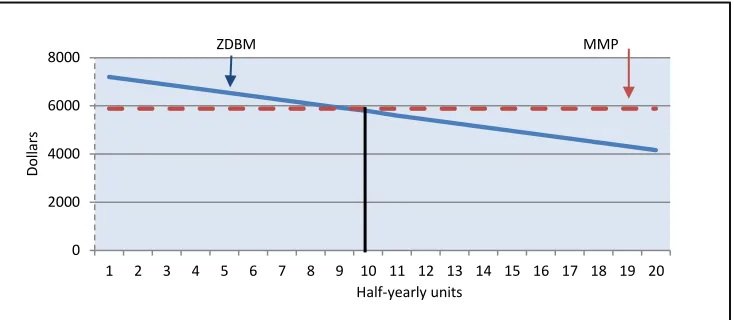
The ownership of property passes faster to the customer. The reason is that the Excel formula allocates in the beginning more of installment payments to return on capital
making the return of capital which remains uniform in the ZDBM. as figure 4 candidly
shows. In the case of default, ZDBM is more equitable to the parties. Suppose in our
0 2000 4000 6000 8000
1 2 3 4 5 6 7 8 9 10 11 12 13 14 15 16 17 18 19 20
D
o
ll
ar
s
Half-yearly units ZDBM
M
[image:11.612.115.482.202.362.2]MMP
11 illustration default takes place half-way i.e. after 10 instalments have been paid in each
case (See Table 6). Under the ZDBM, the buyer’s liability reduces proportionately to
50% while under the MMP he will still have to pay almost 60% of the debt, $7744 more
to be exact.
The condition of the customer in default may not be comfortable under the MMP for
another reason. A few banks have insisted that not only the balance of capital remaining
outstanding but also the return on it for the remaining period must be treated as unpaid
liability of the client to meet the banks’ commitment to their depositors.
Home financing usually being long-term, there may arise and have arisen in the MMP disputes on the revision of rental, the value of the property and the amount of liability
remaining unpaid once default takes place. In the ZDBM matters are much clearer. The
return on capital – the operation of the mark-up stops at once in case of default. The
house will remain under charge for any outstanding balance on capital account alone. The MMP also requires the creation of three transactions: (i) creation of a joint
ownership in property. (ii) the financier leases his share in the house to the customer on
rent and (iii) the customer undertakes to purchase different units of the financier’s share
until the ownership is completely transferred to the former. Taken singly, the jurists
regard the three transactions valid if certain conditions are fulfilled. However, it is
strongly doubted if their combination in a single contract can be allowed.
Scholars are divided on the issue if the undertaking of the customer to buy-back the
financier’s share in the property would be enforceable in a court of law because of the absence of consideration, if not for the lack of free will.
Return of capital: MMP versus ZDBM
0 2000 4000 6000
1 2 3 4 5 6 7 8 9 10 11 12 13 14 15 16 17 18 19 20
Six-m onthly tim e units
M
Y
R
ZDBM
Figure 4: Return of capital compared
12
The shares are not divided in uniform units and the mechanism of determining the fair value of each is never in place. What is done is to treat the rent portion accruing to the
client as both the price and the market value of the share – the client never sees a penny
of the rent he earns. He has no option but to agree to this arrangement.
Some scholars provide implicit support to the MMP structure on the plea that interest rate serves as a benchmark. The statement is misleading. A benchmark is the reference
point to measure the efficacy the actual value. If it is used in place of the value, it no
longer remains a benchmark. Sea level is used as the benchmark for heights of the
existing or future structures from the geographic viewpoint, not to put structures at
that level.
Finally, uniformity of installment payments is claimed as the main advantage of the
MMP program. The customer is not to readjust every time his budget as the upfront
payment is the same. This payment not only remains uniform but is lower than in ZDBM
for the early periods thus making easier for the young people to go in for housing even
when they are at the lower rungs of the income ladder. But even if one concedes the
advantage for a moment, can meeting the Islamic imperatives be sacrificed for that gain?
When one may want to buy a house does not always or entirely dependent on age. It is
well to note that periodic payments in the ZDBM though not constant, are regular in the
sense of falling at a constant rate. The payments are of course on the higher side to start
with but they become increasingly lower half-way through. Figure 4 above vividly
brings out these facts. Which side of the divider one would see the advantage cannot be
determined a priori; individuals’ circumstances would matter. Furthermore, the two-income households becoming increasingly common tend to pale the life-cycle theory into
insignificance.
Conclusion
Most Islamic banks have been shifting to musharakah-mutanaqisah program or the MMP
model for home financing. We have shown that Islamic banks using the Excel formula in the
MMP models have results identical with those of our conventional model illustration (See
also Hasan 2011, 2012). Our main concern here was to show that there is no juristic ground
the banks using the Excel formula to stand on. The use palpably violates Islamic
13 for that matter, starts before selecting the formula for use not thereafter. We have provided an
alternative model for replacing the commonly used MMP. The new model is not only free of
blemishes the MMP has, it is cheaper for the customer without any reduction in the margin of
profit for the banks as it absorbs proportionately less funds. It is also much better on some
related issues like costs, efficiency, liquidity, and equity compared to models Islamic banks
presently use for home financing. We feel that the life cycle concerns are trivial in the face of
these gains. The fixity of upfront payments cannot condone Shari’ah non-compliance. In any case, the payments in the ZDBM too diminish at a constant amount. The readers may find
some of the references helpful for further clarification of the issues.
References
American Finance House – LARIBA: Financing alternative to the conventional, Riba System,
Lariba.com Home Financing – Accessed on 24.10.2011
Chambers, M. S, Garage, C and Sehlagehauf, D (September 2007): Mortgage contracts and housing tenure decisions, Working Paper, Federal Reserve Bank of St. Louis (Research Division), pp. 1-40.
Hasan Zubair (2012) Mortgage Contracts in Islamic Home Finance:MusharakahMutanaqisah Program vs. Diminishing Balance Model, International Journal of Banking and Finance (Forthcoming).
Hasan, Zubair (2012): Islamic home finance, INCEIF Blog postings, 16.5.12 and 18.5.12. www.inceif.org/blog.
HasanZubair (2011): Islamic home finance in the social mirror, ISRA: International Journal of Islamic Finance, Vol. 3, No.1 June.
Hasan, Zubair (2011a): The Diminishing balance model for home financing, Journal of Islamic Banking & Finance, Karachi Vol 28 Issue 3 pp. 150-156.
HasanZubair (2011b): Riba in La-riba contracts – Where to turn in Islamic home financing?
MPRA working paper # 35421
14
Hussain, A (2010): Islamic Home Financing and Mortgages, .Islamic Mortgages.co.uk.Accessed on 1.1.2012.
ISRA (2011): Financing based on Musharikah Mutanaqisa contracts, Downloaded on 12.11. 2011.
LARIBA, Knowledge Center: Frequently asked questions: In answer to the question -- I heard that in your contract you have a term as interest. What does that mean? Accessed on 1.1.2012.
Malaysia International Islamic Finance Centre (November 12, 2011): Shaping Islamic Finance together – MusharikahMutanaqisah – Last update Downloaded 12.11.2011.
Maybank2u.com (November 12, 2011: MusharkahMutanaqisah Term Financing (MMTF-i) – A
shari’ah compliant financing facility for asset acquisitions and refinancing. Downloaded 12.11.2011.
Meera, A. K. M &Razak, D. A (2009): Home financing through the Musharakah Mutanaqisah contracts: some practical issues, JKAU: Islamic Economics, Vol. 22, No.1, pp. 3-25.
Microsoft (2012): Amortization Calculation Formula – Excel,
http://www.vertex42.com/ExcelArticles/amortization-calculation.html (Cached Page)
Microsoft (2011): How to calculate compound interest for an intra-year period in Excelhttp://support.microsoft.com/kb/213907
Osmania, N.M & Abdullah, M.F (July 2010): Musharakah Mutanaqisa Home Financing: A Review of Literatures and Practices of Islamic Banks in Malaysia, International Review of Business Research Papers, Volume 6, and No. 2 13
Smolo, E. and Hasssn, M.K (2011): The potentials of musharakah mutanaqisa for Islamic housing finance. International journal of Middle Eastern Finance and Management, Vol.4; No.3 PP. 237 – 258
Usmani, MaulanaTaqi (2010): MusharakahandMudarabah as modes of financing, Journal of Islamic Banking & Finance, Volume 27, Number 3, July-September, PP. 56-76
Zayan Finance: The declining balance program - integrity in financing; Shari'ah Compliance