R E S E A R C H A R T I C L E
Open Access
Frequency of data extraction errors and
methods to increase data extraction
quality: a methodological review
Tim Mathes
*, Pauline Klaßen and Dawid Pieper
Abstract
Background:Our objective was to assess the frequency of data extraction errors and its potential impact on results in systematic reviews. Furthermore, we evaluated the effect of different extraction methods, reviewer characteristics and reviewer training on error rates and results.
Methods:We performed a systematic review of methodological literature in PubMed, Cochrane methodological registry, and by manual searches (12/2016). Studies were selected by two reviewers independently. Data were extracted in standardized tables by one reviewer and verified by a second.
Results:The analysis included six studies; four studies on extraction error frequency, one study comparing different reviewer extraction methods and two studies comparing different reviewer characteristics. We did not find a study on reviewer training. There was a high rate of extraction errors (up to 50%). Errors often had an influence on effect estimates. Different data extraction methods and reviewer characteristics had moderate effect on extraction error rates and effect estimates.
Conclusion:The evidence base for established standards of data extraction seems weak despite the high prevalence of extraction errors. More comparative studies are needed to get deeper insights into the influence of different extraction methods.
Keywords:Systematic reviews, Data extraction, Accuracy, Errors, Reviewers
Background
Systematic reviews (SRs) have become the cornerstone of evidence based healthcare. A SR should use explicit methods to minimize bias with the aim to provide more reliable findings [1]. The reduction of bias concerns all process steps of the review. For example, bias can occur in the identification of studies, in the selection of studies (e.g. unclear inclusion criteria), in the data collection process and in the validity assessment of included stud-ies [2]. Many efforts have been made to further develop methods for SRs.
However, the evidence base for most recommenda-tions that aim to minimize bias in the preparation process for a systematic review in established guidelines
is sparse [1, 3, 4]. Previous studies found only little re-search on the influence of different approaches on risk of bias in systematic reviews [5]. The use of work exten-sive methods without really knowing the benefit might waste scientific resources. For example a recent study found that alternatives to duplicate study selection by two independent reviewers (e.g. liberal acceleration) are more cost-effective than independent study selection [6]. As the timely preparation and publication of SR is an important goal to support decision making consider-ations on the balance between resources/time and valid-ity play an important role [7].
Data extraction is a crucial step in conducting SRs. The term data collection is often used synonymously. We defined data extraction as any type of extracting data from primary studies into any form of standardized ta-bles. It is one of the most time-consuming and most critical tasks for the validity of results of a SR [1]. Data
* Correspondence:[email protected]
Institute for Research in Operative Medicinem, Chair of Surgical Research, Faculty of Health, School of Medicine, Witten/Herdecke University, Ostmerheimer Str. 200, 51109 Cologne, Germany
extraction builds the basis for the results and conclusion in a SR. However, a previous study has shown a very high prevalence of data extraction errors in SRs [8].
Our objective was to assess the frequency of data ex-traction errors and its potential impact on results in sys-tematic reviews of interventions. Furthermore, we evaluated the effect of different extraction methods (e.g. independent data extraction by two reviewers vs. verifi-cation by a second reviewer), reviewer characteristics (e.g. experience) and reviewer training on error rates and results.
Methods
Information sources and search
We searched all PubMed databases and the Cochrane Methodology Register (12/2016). The full search egies are provided in Additional file 1. The search strat-egies were tested by checking whether articles already known to us (e.g. Buscemi et al. [9]) were identified. We screened all abstracts of the Cochrane Colloquium (since 2009) and searched the Cochrane database of oral, pos-ter and workshop presentations (since 1994) in Decem-ber 2016. In addition we cross checked the references-list of all included articles, excluded articles, established guidelines for systematic review preparation and system-atic reviews on similar topics [1, 3–5, 7, 10]. Moreover, we screened the publications linked in the related arti-cles functions (cited artiarti-cles and similar artiarti-cles) in PubMed for all included articles.
Eligibility criteria and study selection
Two types of articles were eligible. First, we included ar-ticles on the frequency of data extraction errors. Second, we included studies that compared aspects that can in-fluence the quality of data extraction. We considered the following types of comparisons:
– Comparison of different methods (index methods) for data extraction regarding the involvement of a second reviewer for quality assurance (e.g. independent data extraction versus extraction by one reviewer and verification by a second) for data extraction (in the following called extraction method),
– Reviewer characteristics: experience, degree, education,
– Reviewer training: training on data extraction before performing the review, including extraction of a sample and calibration with the second reviewer and oral and written instructions.
Studies on technical tools (software, dual monitors, data extraction templates etc.) to reduce data extraction errors were excluded.
All studies (studies on error frequency and compara-tive studies) had to report a quantitacompara-tive measure for data extraction errors (e.g. error rate), determined by use of a reference standard (a data extraction sample that was considered correct). We included only studies on the assessment of data extraction for intervention re-views written in English or German.
All titles/abstracts identified in the electronics data-bases were screened by two reviewers independently. The abstracts of the Cochrane Colloquium and the data-base of oral poster and workshop presentations were screened by one reviewer. All potentially relevant full-texts were screened by two reviewers (not independ-ently). In case of discrepancies, we discussed eligibility until consensus.
Data collection and analysis
We used a semi-structured template for data extraction (see Tables 1, 2 and 3). For each study, we extracted the sam-ple size (the number of included studies and, if applicable the number of systematic reviews feeding the sample), infor-mation on the index and reference method, and inforinfor-mation on outcome measures. We extracted all data on data ex-traction errors and the influence on pooled effect esti-mates. If possible, we distinguished data extraction errors in accuracy (e.g. correct values), completeness (e.g. all relevant outcomes are extracted)/selection (e.g. choice of correct outcome measure or outcome measurement time point) and correct interpretation (e.g. confuse mean and median). In addition, we extracted quantitative mea-sures for effort (e.g. time, resource use) and rates of agreement between different approaches.
If provided in the article, we extracted confidence limits (preferred) or p-values for all outcomes/compari-sons. Rates with a denominator of at least 10 were con-verted into percentages to increase the comparability of the results.
All data were extracted in standardized tables. Be-fore starting the data extraction the involved re-viewers discussed each article to agree about the relevant items for data extraction to avoid misinter-pretation and omission. Subsequently, one reviewer (experienced statistician) extracted all data and a sec-ond reviewer (experienced epidemiologist) verified the accuracy of data extraction.
Synthesis of data
Results
Study selection
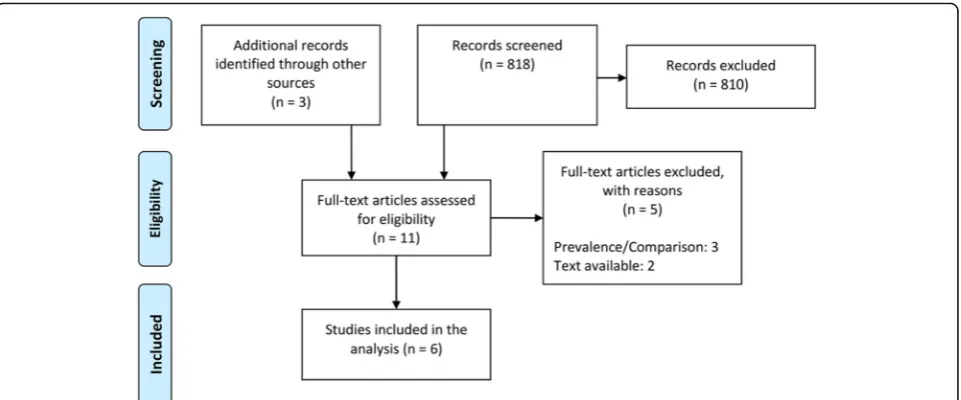
The search in the electronic databases resulted in 818 hits. The search of the abstracts of the Cochrane Col-loquium and the database of the Cochrane database of oral, poster and workshop presentations revealed three additional potentially relevant publications. Add-itionally, the reference list of included articles and systematic reviews on similar topics did not reveal further relevant articles. For two studies, no full-texts were available. We screened the full-texts of nine arti-cles. Of these, three studies were excluded [11–13]. The study selection process is illustrated in the flow-diagram (Fig. 1).
The analysis included six studies [8, 9, 14–17]; four studies on extraction error frequency [8, 15–17], one study comparing different reviewer extraction methods [9] and two studies comparing different reviewer
characteristics [14, 15] (Tendal et al. [15] included in both analysis). No studies on reviewer training were identified.
Studies on frequency of extraction errors
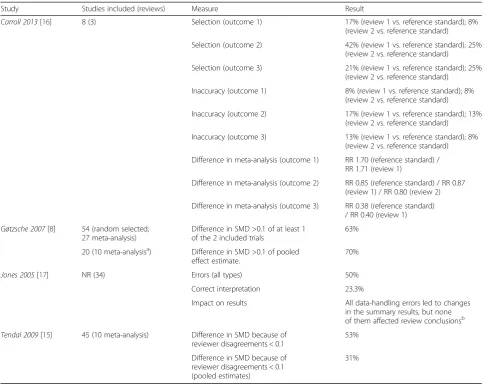
Carroll et al. compared the results of three dichotomous outcomes [16]. The database was three systematic re-views on the same topic that included the same studies (N= 8). Their own systematic review was used as the ref-erence standard. Deviations in the other systematic re-views were considered as errors. The rate of data extraction errors ranged between 8% and 42% (depend-ing on outcome and review). Differences in pooled effect estimates were small (difference of relative risk, range: 0.01–0.05).
Gøtzsche et al. [8] replicated the results of 27 meta-analyses. For the quantification of errors two trials of each meta-analysis were randomly selected. The reference
Table 1Results of studies quantifying the frequency of data extraction errors
Study Studies included (reviews) Measure Result
Carroll 2013[16] 8 (3) Selection (outcome 1) 17% (review 1 vs. reference standard); 8% (review 2 vs. reference standard)
Selection (outcome 2) 42% (review 1 vs. reference standard); 25% (review 2 vs. reference standard)
Selection (outcome 3) 21% (review 1 vs. reference standard); 25% (review 2 vs. reference standard)
Inaccuracy (outcome 1) 8% (review 1 vs. reference standard); 8% (review 2 vs. reference standard)
Inaccuracy (outcome 2) 17% (review 1 vs. reference standard); 13% (review 2 vs. reference standard)
Inaccuracy (outcome 3) 13% (review 1 vs. reference standard); 8% (review 2 vs. reference standard)
Difference in meta-analysis (outcome 1) RR 1.70 (reference standard) / RR 1.71 (review 1)
Difference in meta-analysis (outcome 2) RR 0.85 (reference standard) / RR 0.87 (review 1) / RR 0.80 (review 2)
Difference in meta-analysis (outcome 3) RR 0.38 (reference standard) / RR 0.40 (review 1)
Gøtzsche 2007[8] 54 (random selected; 27 meta-analysis)
Difference in SMD >0.1 of at least 1 of the 2 included trials
63%
20 (10 meta-analysisa) Difference in SMD >0.1 of pooled effect estimate.
70%
Jones 2005[17] NR (34) Errors (all types) 50%
Correct interpretation 23.3%
Impact on results All data-handling errors led to changes in the summary results, but none of them affected review conclusionsb
Tendal 2009[15] 45 (10 meta-analysis) Difference in SMD because of reviewer disagreements < 0.1
53%
Difference in SMD because of reviewer disagreements < 0.1 (pooled estimates)
31%
a
: meta-analyses at least including one erroneous trial;b
standard was data extraction by two independent re-viewers. A difference in the standardized mean difference of greater 0.1 was classified as error. In 63% of meta-analysis at least one of the two trials were erroneous. Of these meta-analyses 70% also showed an error of the pooled effect estimate.
In the study of Jones et al. [17] 42 systematic reviews of a Cochrane group were included. A statistician checked the data of these systematic reviews for errors. Half of the sys-tematic reviews contained errors and approximately 23% of this were misinterpretations (e.g. confusing standard devia-tions and standard error). According to the study authors
Table 2Characteristics of studies comparing different reviewer extraction methods and reviewer characteristics
Study Comparator/s Referencea Studies included
Buscemi 2006[9] One reviewer verification by a second
Two reviewers independently Extraction by one reviewer and verification by an experienced statistician
N= 30 (6 meta-analysis)
Horton 2010[14] Minimal data extraction experience (n= 28)
Moderate data extraction experience (n= 19)
Substantial data extraction experience (n= 23)
NA
Minimal systematic review experience (n= 28)
Moderate systematic review experience (n= 31)
Substantial systematic review experience (n= 18)
NA
Minimal overall experienceb(n= 26) Moderate overall experienceb(
n= 24)
Substantial overall experienceb(
n= 37)
NA
Tendal 2009[15] Experienced methodologists PhD students No reference standard (comparison of raw
agreement between reviewers)
45 (10 meta-analysis)
a
denominator or subtrahend;b
based on time involved in systematic reviews and data extraction and the number of systematic reviews;NAnot applicable
Table 3Results of studies comparing different reviewer extraction methods and reviewer characteristics
Measure Result (effect measure, CI orp-value)
Reviewer constellation
Buscemi 2006[9] Agreement rate 28.0% (95% CI: 25.4, 30.7, range 11.1–47.2%)
Errors (all types) RD 21.7% (p= 0.019)
Omission RD 6.6% (p= 0.308)
Time (min, mean) RD−49 (p= 0.03)
Difference of pooled effect estimates * 0/0
Reviewer experience
Horton 2010[14] Errors (all types) 24.3%/26.4%/25.4% (p= 0.91)
Inaccuracy 14.3%/13.6%/15.7% (p= 0.41)
Omission 10.0%/12.1%/12.1% (p= 0.24)
Time (min, mean) 200/149/163 (p = 0.03)
MD in point estimates of meta -analysis ns (5 outcomes)
Errors (all types) 25.0%/ 26.1%/ 24.3% (p= 0.73)
Inaccuracy 14.6%/ 13.2%/ 15.7% (p= 0.39)
Omission 10.0%/ 11.4%/ 10.7% (p= 0.53)
Time (min, mean) 198/179/ 152 (p= 0.01)
MD in point estimates of meta -analysis ns (5 outcomes)
Errors (all types) 26.4%/27.9%/27.9% (p= 0.73)
Inaccuracy 16.4%/12.1%/15.7% (p= 0.22)
Omission 10.4%/12.1%/13.6% (p= 0.47)
Time (min, mean) 211/180/173 (p= 0.12)
MD in point estimates of meta -analysis ns (5 outcomes)
Tendal 2009[15] Difference of SMD < 0.1 61%/46% (NR)
Difference of SMD < 0.1 (pooled estimates) 33%/27% (NR)
“all data-handling errors led to changes in the summary re-sults, but none of them affected review conclusions”[17].
Tendal et al. [15] estimated the influence of deviations in data extractions between reviewers on results. A stan-dardized mean difference smaller than 0.1 was consid-ered as reviewer agreement. Approximately, 53% and 31% reviewers agreed on the trial level and meta-analysis level, respectively. At the level of meta-analysis the dif-ference in standardized mean difdif-ference (SMD) was at least 1 in one of ten meta-analyses.
Table 1 shows the frequency of data extraction errors and influence on the effect estimates for each included study.
Studies comparing different reviewer extraction methods and reviewer characteristics
Buscemi et al. [18] compared data extraction of 30 ran-domized controlled trials by two independent reviewers with data extraction by one reviewer and verification by a second. The reference standard was the data extraction by one reviewer with verification by an experienced stat-istician. The agreement rate of the two extraction methods was 28%. The risk difference of the total error rate was statistically significant (risk difference 21.7%,p = 0.019) in favor of double data extraction. This differ-ence was primarily because of inaccuracy (risk differdiffer-ence 52.9%, p= 0.308). However, in average double data ex-traction took 49 min longer. Pooled effect estimates of both extraction methods varied only slightly and were not statistically significant different from the reference standard in any of the meta-analyses (N= 6).
In the study by Horton et al. [14] the data extractions of minimally experienced, moderately experienced and substantially experienced reviewers were compared. Ex-perience classifications were based on years involved in
systematic review preparation (≤2, 4–6, >7) and the num-ber of performed data extractions (≤50, 51–300, >300). Three outcome measures were used; systematic review ex-perience, extraction experience and a composite of these two (overall experience). The reference data extractions were prepared by independent data extraction by two re-viewers and additional verification with the data in the ori-ginal review. Error rates were similar across all overall experience levels. The median error rates ranged between 24.3%–26.4%, 13.6%–15.7% and 10.0%–12.1% for total er-rors, inaccuracy and omission, respectively (p-values >0.2 for all comparisons). Unexperienced reviewers required more time for data extraction (range: 173–211). There were no statistically significant differences (according authors, p-values not specified) in point estimates (5 outcomes) of meta-analysis between overall reviewer experience levels.
Tendal et al. [15] estimated the influence of deviations in data extractions between reviewers on results. Agree-ment was defined as a standardized mean difference for the effect estimates smaller than 0.1. Agreement was cal-culated for all pairs of experienced methodologist and all pairs of PhD students. Experienced methodologists agreed more than the PhD students (61% vs. 46% of tri-als; 33% vs. 27% of meta-analyses).
Table 2 shows the characteristics, and Table 3 the re-sults of the comparison of different extraction methods and reviewer characteristics.
Discussion
There is a high prevalence of extraction errors [8, 13, 15, 16]. However, extraction errors seem to have only a mod-erate impact on the results/conclusion of systematic re-views. Nevertheless, the high rate of extraction errors indicates that measures for quality assurance of data
extraction are important to minimize the risk of biased results and wrong conclusions [8].
Comparative evidence on the influence of different re-viewer extraction methods and rere-viewer characteristics is sparse [9, 14, 15]. Reviewer characteristics seem to have only a moderate influence on extraction errors [7, 9]. Data extraction by two independent reviewers seems to result in less extraction errors than data extraction by one reviewer and verification by a second. These large differences might cause significant difference in effect estimates [15]. However, in view of the limited influence on the conclusions of a systematic review, double data extraction of all data by two independent reviewers seems not always necessary, but reduced data extraction methods might be justified. The basic principal of re-duced extraction methods is the focus on critical aspects (e.g. primary outcomes), which constitute the basis for conclusions, and reduced emphasize on the data extrac-tion of less important aspects (e.g. patient characteris-tics, additional outcomes). Also in the Methodological
Expectations of Cochrane Intervention Reviews
(MECIR), it is stated that “dual data extraction may be less important for study characteristics than it is for out-come data, so it is not a mandatory standard for study characteristics” and “dual data extraction is particularly important for outcome data, which feed directly into syntheses of the evidence, and hence to the conclusions of the review”[19]. This is comparable to the recent pol-icy of the Institute of Medicine (IOM). The IOM states that“at minimum, use two or more researchers, working independently, to extract quantitative and other critical data from each study”[20].
Such methods would reduce the effort for data ex-traction. Considering that the reviewer experience showed only little influence on extraction errors, cost might be further reduced by not employing only ex-perienced methodologists but also staff with less sys-tematic review experience for data extraction [14, 15]. However, reviewer training seems especially import-ant, if less experienced reviewers are involved. The reviewer team should be trained in data extraction (e.g. using a sample) before performing the complete data extraction to harmonize data extraction and clear up common misunderstandings. This could in par-ticular reduce interpretation and selection errors [13]. The reduction of time and effort is especially relevant for rapid reviews because this form of evidence syn-thesis aims timely preparation while remaining sys-tematic [21]. Thus, clarifying which methods can reduce the time required for preparation without sig-nificantly increasing the risk of bias would also con-tribute to better control the short cuts in rapid reviews. The risk of bias of reduced data extraction methods could be further reduced if a detailed
systematic review protocol and data entry instructions are prepared beforehand because the risk of selecting wrong outcomes (e.g. time points, measures) and omission would be reduced [15, 22].
The wide range of agreement between different extrac-tion methods suggests that some studies are more diffi-cult to extract than others [9]. There can be many reasons for this. First, data extraction is probably dependent on the reporting quality in primary studies. Often methods and results of trials are insufficiently re-ported [23, 24]. Bad reporting can complicate the identi-fication of relevant information (e.g. primary outcome is not clearly indicated) and impede the extraction of treat-ment effects in a useful manner (e.g. only statetreat-ments on statistical significance without effect measures and confi-dence intervals). Thus, bad reporting can increase the risk of omission and varying interpretation.
Second, the level of necessary statistical expertise might vary by study. Also reviewers who are familiar with a var-iety of statistical methods may not be aware of more ad-vanced statistical methods (e.g. hierarchical regression models) or recently developed methods (e.g. mean cumu-lative function). Data extraction is particularly challenging when very different statistical methods (which can result in different effect estimates) are used across articles.
Third, different backgrounds (e.g. clinicians, epidemi-ologists) and levels of expertise might also play a role. However, drawing conclusions for practice seems diffi-cult without an approach to differentiate between“easy” and “difficult” studies beforehand (e.g. tools to classify statistical complexity). Furthermore, it should be ac-knowledged that the complexity of data extraction not only depends on the data items in included studies but also on its aim. For example, to support data extraction a guide for complex meta-analysis (DECiMAL) has been recently published [10].
Findings are consistent across our included studies. Moreover, for short cuts in other process steps (e.g. quality assessment) that can have influence on the risk of bias in systematic reviews, similar results have been observed. For example, a study on the influence of searching multiple databases found only a weak impact of reducing the number of searched databases (because of not searching additional databases) on the results of meta-analysis and review conclusions [18, 25]. There-fore, also for other process steps, research on extraction methods seems to be needed. Future research should consider the influence on the risk of bias as well as the impact on scientific resources.
Limitations
Although the included studies are probably not free from bias we did not perform a formal risk of bias
established risk of bias tool for methodological studies. A source for risk of bias (correct extraction) is probably the imperfect reference standard in the included studies. For example, in the study by Jones et al. [17] only one statistician performed data extraction of results. Carroll et al. [16] considered their own systematic review as the reference standard. However, a perfect gold standard might be hardly achievable in such studies. Moreover, most studies considered only a certain research question regarding patients, intervention and comparison. The generalizability of the results is therefore unclear.
The search terms describing our research question were very unspecific (e.g. data collection). Because of this reason we used field limitations to balance the specificity and sensitivity. Therefore, we might not have identified all rele-vant articles.
We did not investigate novel computer-aided ap-proaches for data extraction. Computer-aided data ex-traction can result in more efficiency and accuracy [26]. Although such approaches are only in their infancy, it can be expected that they will become more common in the future. Biomedical natural language processing tech-niques will be developed further in the near future [27].
Conclusion
There is a high prevalence of extraction errors. This might cause relevant bias in effect estimates [8, 15–17]. However, there are only a few studies on the influence of different data extraction methods, reviewer characteris-tics and reviewer training on data extraction quality. Thus, the evidence base for the established standards of data extraction seems sparse because the actual benefit of a certain extraction method (e.g. independent data traction) or the composition of extraction team (e.g. ex-perience) is not sufficiently proven. This is surprising given that data extraction is a very crucial step in conduct-ing a systematic review. More comparative studies are needed to get deeper insights into the influence of differ-ent extraction methods. In particular, studies investigating training for data extraction are needed because there is no such analysis, to date. Similar studies were recently pub-lished for risk of bias assessment [28]. The application of methods that require less effort without threating the in-ternal validity would result in a more efficient utilization of scientific manpower. Increasing the knowledge base would also help to design effective training strategies for new reviewers and students in the future.
Additional file
Additional file 1:Search strategies. (DOCX 13 kb)
Abbreviations SR:Systematic review
Acknowledgements Not applicable.
Funding
This research did not receive any specific funding.
Availability of data and materials Not applicable.
Authors’contributions
TM: idea for the review, study selection, data extraction, interpretation of results, writing of manuscript. PK: study selection. DP: idea for the review, study selection, verification of data extraction, interpretation of results. All authors read and approved the final manuscript.
Ethics approval and consent to participate Not applicable. This work contains no human data.
Consent for publication
All authors reviewed the final manuscript and consented for publication.
Competing interests
The authors declare that they have no competing interests.
Publisher’s Note
Springer Nature remains neutral with regard to jurisdictional claims in published maps and institutional affiliations.
Received: 17 July 2017 Accepted: 15 November 2017
References
1. Higgins JPT, Green S, editors. Cochrane handbook for systematic reviews of interventions version 5.1.0 [updated March 2011]. The Cochrane Collaboration; 2011. Available from www.cochrane-handbook.org. 2. Felson DT. Bias in meta-analytic research. J Clin Epidemiol. 1992;45(8):885–92. 3. Centre for reviews dissemination. CRD's guidance for undertaking reviews in
health care. York Publishing Services Ltd. 2009;32:Jg.
4. Joanna Briggs Institute. Reviewers’manual: 2011 edition. Adelaide: JBI; 2014. 5. Tricco AC, Tetzlaff J, Sampson M, Fergusson D, Cogo E, Horsley T, Moher D. Few systematic reviews exist documenting the extent of bias: a systematic review. J Clin Epidemiol. 2008;61(5):422–34.
6. Shemilt I, Khan N, Park S, Thomas J. Use of cost-effectiveness analysis to compare the efficiency of study identification methods in systematic reviews. Syst Rev. 2016;5(1):140.
7. Ganann R, Ciliska D, Thomas H. Expediting systematic reviews: methods and implications of rapid reviews. Implement Sci. 2010;5(1):56.
8. Gøtzsche PC, Hróbjartsson A, MarićK, Tendal B. Data extraction errors in meta-analyses that use standardized mean differences. JAMA. 2007;298(4):430–7. 9. Buscemi N, Hartling L, Vandermeer B, Tjosvold L, Klassen TP. Single data
extraction generated more errors than double data extraction in systematic reviews. J Clin Epidemiol. 2006;59:697–703.
10. Pedder H, Sarri G, Keeney E, Nunes V, Dias S. Data extraction for complex meta-analysis (DECiMAL) guide. Syst Rev. 2016;5(1):212.
11. Peters MDJ, Godfrey CM, Khalil H, McInerney P, Parker D, Soares CB. Guidance for conducting systematic scoping reviews. Int J Evid Based Healthc. 2015;13(3):141–6.
12. Zaza S, Wright De Aguero LK, Briss PA, Truman BI, Hopkins DP, Hennessy MH, Sosin DM, Anderson L, Carande Kulis VG, Teutsch SM, et al. Data collection instrument and procedure for systematic reviews in the guide to community preventive services. Task force on community preventive services. Am J Prev Med. 2000;18:44–74.
13. Haywood KL, Hargreaves J, White R, Lamb SE. Reviewing measures of outcome: reliability of data extraction. J Eval Clin Pract. 2004;10:329–37. 14. Horton J, Vandermeer B, Hartling L, Tjosvold L, Klassen TP, Buscemi N.
Systematic review data extraction: cross-sectional study showed that experience did not increase accuracy. J Clin Epidemiol. 2010;63:289–98. 15. Tendal B, Higgins JP, Juni P, Hrobjartsson A, Trelle S, Nuesch E, Wandel S,
16. Carroll C, Scope A, Kaltenthaler E: A case study of binary outcome data extraction across three systematic reviews of hip arthroplasty: errors and differences of selection. BMC research notes. 2013;6:539.
17. Jones AP, Remmington T, Williamson PR, Ashby D, Smyth RL. High prevalence but low impact of data extraction and reporting errors were found in Cochrane systematic reviews. J Clin Epidemiol. 2005;58:741–2. 18. Hartling L, Featherstone R, Nuspl M, Shave K, Dryden DM, Vandermeer B.
The contribution of databases to the results of systematic reviews: a cross-sectional study. BMC Med Res Methodol. 2016;16(1):127.
19. Higgins JPT, Lasserson T, Chandler J, Tovey D, Churchill R. Methodological Expectations of Cochrane Intervention Reviews. London: Cochrane; 2016. 20. Morton S, Berg A, Levit L, Eden J. Finding what works in health care:
standards for systematic reviews.National Academies Press; 2011. 21. Schünemann HJ, Moja L. Reviews: rapid! Rapid! Rapid!…and systematic.
Syst Rev. 2015;4(1):4.
22. Silagy CA, Middleton P, Hopewell S. Publishing protocols of systematic reviews: comparing what was done to what was planned. JAMA. 2002; 287(21):2831–4.
23. Adie S, Harris IA, Naylor JM, Mittal R. CONSORT compliance in surgical randomized trials: are we there yet? A systematic review. Ann Surg. 2013; 258(6):872–8.
24. Zheng SL, Chan FT, Maclean E, Jayakumar S, Nabeebaccus AA. Reporting trends of randomised controlled trials in heart failure with preserved ejection fraction: a systematic review. Open Heart. 2016;3(2):e000449. 25. Halladay CW, Trikalinos TA, Schmid IT, Schmid CH, Dahabreh IJ. Using data
sources beyond PubMed has a modest impact on the results of systematic reviews of therapeutic interventions. J Clin Epidemiol. 2015;68(9):1076–84. 26. Saldanha IJ, Schmid CH, Lau J, Dickersin K, Berlin JA, Jap J, Smith BT, Carini
S, Chan W, De Bruijn B, et al. Evaluating data abstraction assistant, a novel software application for data abstraction during systematic reviews: protocol for a randomized controlled trial. Syst Rev. 2016;5(1):196. 27. Jonnalagadda SR, Goyal P, Huffman MD. Automating data extraction in
systematic reviews: a systematic review. Syst Rev. 2015;4:78.
28. da Costa BR, Beckett B, Diaz A, Resta NM, Johnston BC, Egger M, Jüni P, Armijo-Olivo S. Effect of standardized training on the reliability of the Cochrane risk of bias assessment tool: a prospective study. Syst Rev. 2017;6(1):44.
• We accept pre-submission inquiries
• Our selector tool helps you to find the most relevant journal
• We provide round the clock customer support
• Convenient online submission
• Thorough peer review
• Inclusion in PubMed and all major indexing services
• Maximum visibility for your research
Submit your manuscript at www.biomedcentral.com/submit