ISSN: 2306-9007 Afrane & Adusei (2014) 485
I
www.irmbrjournal.com March 2014I
nternationalR
eview ofM
anagement andB
usinessR
esearchVol. 3 Issue.1
R
M
B
R
Promoting Micro-Savings through the NGO Model: The
Success Story of Sinapi Aba Trust
SAM AFRANE
Department of Planning, Kwame Nkrumah University of Science and Technology Kumasi Email: [email protected]
MICHAEL ADUSEI
Department of Accounting and Finance, Kwame Nkrumah University of Science and Technology, Kumasi Email: [email protected]
Abstract
The aim of this paper is to offer a cogent basis for integration of voluntary micro-savings into the NGO model of microfinance. We use data from SINAPI ABA TRUST (SAT), a microfinance institution operating in Ghana. The study finds that voluntary savings scheme of SAT has outperformed its compulsory counterpart in terms of annual growth in savings mobilization and that despite the predominance of females in the microfinance industry their propensity to save is less than their male counterparts. The paper concludes that, contrary to the orientation of the NGO model of microfinance, the poor and financially excluded are willing to save.
Key Words: Microfinance, Micro-savings, Sinapi Aba Trust, NGO.
Introduction
The development and growth of a considerable number of microfinance institutions (MFIs) in most economies could be attributed to the drudgery involved in transacting business with commercial banks. These MFIs mostly Rotating Savings and Credit Associations(ROSCAs), mobile informal banking (Susu clubs), savings and loans societies and credit unions (CUs) have adopted innovative strategies through the use of informal methodologies based on personal relations, family connections or knowledge and business relations for providing easier loans (Ofei, 2002). ADB (2000) defines microfinance as the extension of a broad range of financial services such as loans, deposits, payment services, money transfers, and insurance to poor and low-income households and their microenterprises. Microfinance has been hailed as a ‘‘silver bullet’’ approach to development because of its supposed ability to transform the poor and marginalized (Aach, 2008).
ISSN: 2306-9007 Afrane & Adusei (2014) 486
I
www.irmbrjournal.com March 2014I
nternationalR
eview ofM
anagement andB
usinessR
esearchVol. 3 Issue.1
R
M
B
R
As an NGO with focus on microfinance, SAT used to rely heavily on funds from its development partners for its credit operations. However, these donor funds had not only been irregular but also been dwindling over the years. It was, therefore, not a reliable source. In its bid to serve its customers, SAT looked to overdraft facility or loans from financial institutions which came at huge cost to the institution. With time, it became increasingly difficult for SAT to meet credit demands or requests of its clients due to its inability to raise sufficient funds. This resulted in the loss of clients to competitors, decline of confidence in the institution and invariably contributed to default in loan repayments.
In addressing the above operational challenges, SAT introduced the Progressive Savings Scheme (PSS) in 2006 to complement its traditional loan security or Compulsory Savings Scheme (CSS). CSS which is common to most microfinance schemes represents cash collateral of 10% or more of the approved loan amount to an individual or group, deposited with the organization until the expiry of the loan contract when it can either be withdrawn with interest or left as a follow–on loan or as savings. PSS is a voluntary accumulation of funds at individual level through a gradual, continuous and consistent savings process purposely to either serve as cash collateral for next loan or be withdrawn as and when required. The purpose of this study is to (1) to establish whether microfinance clients are willing to save by assessing the relative performance of CSS and PSS; and (2) ascertain the factors to consider in promoting progressive or voluntary micro-savings.
The current study is significant for two reasons. It provides insights into the NGO model of microfinance from one of the emerging markets in the world which expands the frontiers of the microfinance literature. Two, it makes a case that despite the predominance of women in the microfinance industry, they show low propensity to engage in micro-savings which is suggestive of loan-dependency syndrome among women clients of microfinance.
The rest of the paper is divided as follows. The next section reviews literature followed by brief profile of SAT section. The methodology section is next followed by the results section. Conclusion and policy implications section ends the paper.
Related Literature
The worldwide recognition of the importance of savings mobilization in the process of abating financial exclusion among the poor and financially excluded informed the paradigm shift from microcredit to microfinance (Adusei, 2013). According to Zellar and Sharma (2000), this paradigm shift has come about due to the realization of the inadequacy of loans to help the poor improve their well-being especially women. It is now widely accepted that it is encouraging savings in the operations of MFIs that is pivotal to extricating people from the shackles of financial exclusion (Bynner and Paxton, 2001; Regan and Paxton, 2001; Kempson et al., 2005).
Having savings positively alters the way people feel about themselves and enables them to be more open about the way they use financial services in the future (Jones, 2008). Accessing funds at affordable rather than extortionate rates certainly maximizes income in the short term but, by itself, cannot result in greater financial stability and independence (Jones, 2008). It results only in further dependence on borrowing in the future. Conversely, building savings, or assets, directly contributes to delivering people from poverty, both economically and psychologically.
ISSN: 2306-9007 Afrane & Adusei (2014) 487
I
www.irmbrjournal.com March 2014I
nternationalR
eview ofM
anagement andB
usinessR
esearchVol. 3 Issue.1
R
M
B
R
In summary, many experts in microfinance have seen the need to depart from micro-credit provision to microfinance with savings as the means for capital accumulation. Kabeer (2001) is one of such experts who share this position. He acknowledges that the increased preference for micro-savings as opposed to micro- credit by microfinance practitioners has come about because of the evidence which now exists that small loans do not work as well for the poor as savings. Johnson and Kidder (1999) posit that the core service offering of MFIs should be saving opportunity since access to saving accounts is perhaps crucial to the condition of the poor.
Robinson (1994) attributes the low savings among the poor stems to inappropriate institutional structures and deposit facilities tailor-made for the poor. This presupposes that whether or not the poor will save is contingent on a number of factors. Among these are those outlined by the June, 2000 edition of the Donor Brief (a microfinance news letter): security, transaction cost, the design of the saving scheme, and interest rate. Transaction cost, liquidity of the savings option, the real rate of return, the divisibility of the savings, safety of the savings, trustworthiness and confidence in the system, financial reciprocity, and anonymity are also listed as important determinants (Robinson, 1994; Bouman, 1994). Security as used in connection with micro savings has to do with reduced risk in terms of theft, fraud, fire and abuse of accumulated assets by relatives. Stigltz (1986) identifies transaction cost as a substantial interest for development financing. A scheme that reduces paper work and hence has a lower transaction cost is more likely to encourage savings as transaction cost reduces. In sum, it can safely be said that micro-savings and micro credit are two inextricable elements of financial intermediation.
On the determinants of micro-savings, not much work has been done on them especially in Ghana. Adusei (2013) explores the determinants of CU savings in Ghana and finds that credit risk, assets and female membership are significant determinants of CU savings. Whereas a rise in CU credit risk increases CU savings, a rise in female membership as well as CU assets is characterized by a fall in CU savings. The current study seeks to add to the literature on the determinants of micro-savings in Ghana by testing the following hypotheses:
H1.Female clients are more likely to save than male clients
H2. Age positively correlates with propensity to save
H3. Educational level of a microfinance client positively correlates with Propensity to save
H4. Microcredit experience positively correlates with propensity to save
Brief Profile of Sinapi Aba Trust
SAT as a financial NGO operates in nine out of the 10 administrative regions in Ghana. SAT presently manages a net worth of $9.6million, and a portfolio of $7.3 million. In terms of number of borrowers, it had over 55,000 with US$3.3million loans outstanding as at December, 2006. It provides basic training for its clients in entrepreneurship, credit acquisition, basic accounting, savings and record keeping, among others. Although some of the operations of SAT are in the regional capitals, majority of its credit programmes and clients are in smaller and rural communities across the length and breadth of the country.
Methodology
This section provides information on the methodology used for the study. It is in two parts: sample, sampling technique and data sources; and the models used for the study.
Sample, Sampling Technique and Data Sources
ISSN: 2306-9007 Afrane & Adusei (2014) 488
I
www.irmbrjournal.com March 2014I
nternationalR
eview ofM
anagement andB
usinessR
esearchVol. 3 Issue.1
R
M
B
R
areas of its operations across Ghana. Simple random sampling technique in which the 481 clients have been randomly picked from the client database of SAT has been used, meaning every savings client of SAT had the chance of being included in the study. The study, therefore, benefits from the advantages of simple random sampling technique such as no case selection bias.
The Models
In addressing objective 1, we adopt Gordon’s growth model to assess the annual growth rate of CSS and PSS. The model is stated as:
F (t) = abt (1)
Where f (t) = Savings after t years a= savings in base year
b= growth factor t= time in years
In addressing objective 2, we use Ordinary Least Squares (OLS) regression model. Savings is the dependent variable in our model. It is defined as the natural logarithm of total PSS savings of SAT client in 2010 (LnSAVINGS). The hypothesized explanatory variables are gender (GENDER), natural logarithm of age (LnAGE), educational level (EDUC) and natural logarithm of microcredit experience (LnMEXP). Gender and educational level are dummy variables. Gender takes the value of 1 if client is a female and set to 0 if a client is a male. Education takes the value of 1 if the borrower has secondary or better level of education and 0 otherwise. Microcredit experience is proxied by the borrowing status of the client. The numeric variables are logged to ensure standardization (Sarel, 1996).
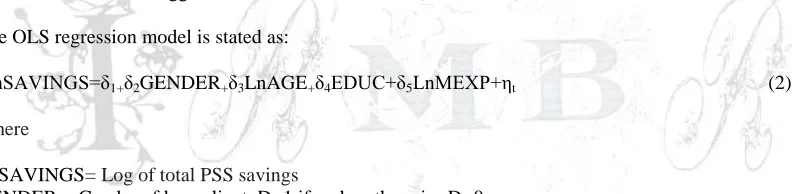
The OLS regression model is stated as:
LnSAVINGS=δ1+δ2GENDER+δ3LnAGE+δ4EDUC+δ5LnMEXP+ηt (2)
Where
LnSAVINGS= Log of total PSS savings
GENDER = Gender of loan client. D=1 if male; otherwise D=0 LnAGE= Natural logarithm of age of client
EDUC=Educational Level of Client. D=1 client has secondary or better level of education; otherwise D=
LnMEXP= Natural logarithm of microcredit experience proxied by number of times a client has borrowed from the MFI
δ = is the parameter to be estimated ηt = stochastic error term
Results
This section has been divided into two parts in line with the objectives of the study. The first part addresses objective 1 of the study which assesses the performance of CSS and PSS in terms of growth in savings mobilization whilst the second part addresses objective 2 of the study which relates to the predictors of voluntary micro-savings.
Performance of CSS and PSS
ISSN: 2306-9007 Afrane & Adusei (2014) 489
I
www.irmbrjournal.com March 2014I
nternationalR
eview ofM
anagement andB
usinessR
esearchVol. 3 Issue.1
R
M
B
R
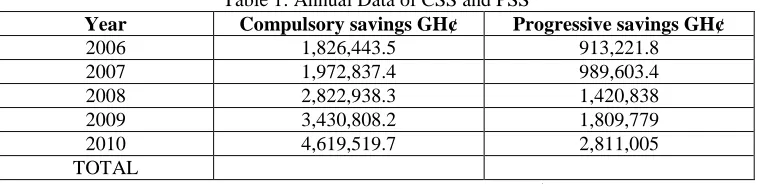
savings respectively. Using the Gordon’s annual growth rate model, CSS has been growing at the rate of 20.39% whilst PSS has been growing at the rate of 25.22% in the period under study. This presupposes that PSS which is voluntary has outperformed CSS in terms of growth in savings mobilization. However, in absolute terms it is obvious that the latter has outperformed the former. This is understandable in the sense that the latter is driven by the scale of lending operations of SAT. When the loan portfolio of SAT soars up, CSS also soars up.
Table 1: Annual Data of CSS and PSS
Year Compulsory savings GH¢ Progressive savings GH¢
2006 1,826,443.5 913,221.8
2007 1,972,837.4 989,603.4
2008 2,822,938.3 1,420,838
2009 3,430,808.2 1,809,779
2010 4,619,519.7 2,811,005
TOTAL
Source: Microsave Department, SAT, 2010 (US $1: GH¢ 1.85)
The superior performance of PSS suggests that the introduction of the voluntary saving scheme has created a growing interest in saving than in loans among the clients of SAT. This gives weight to the position of Robinson (1994) that the low savings among the poor stems from inappropriate institutional structures and deposit facilities tailor-made for the poor and makes a case for policy makers to review the modus operandi of MFIs in Ghana. Obviously, there is a cogent reason for one to believe that given the right saving schemes and the right motivation to save, the poor and financially excluded are ever ready to save their widow’s mite. Voluntary savings must be integrated into the NGO model because that is the best way of ensuring economic transformation among the poor and financially excluded. This is because overreliance on microcredit has been found to be inadequate in helping the poor out of their economic predicament (Zellar and Sharma, 2000). Besides, there is a consensus that encouraging savings in the operations of MFIs is pivotal to extricating people from the shackles of financial exclusion (Bynner and Paxton, 2001; Regan and Paxton, 2001; Kempson et al., 2005). In short, the finding carries one message: Given the opportunity, the poor and financially excluded are willing to save!
Determinants of Progressive or Voluntary Micro-savings
Having established that the poor and financially excluded are willing to save let us turn our attention to factors that determine their propensity to save. The descriptive statistics of the continuous data are provided in Table 2. The average savings value is GH¢0.0018, the average age is approximately 31 whilst average microcredit experience is approximately 4 times. Cross-tabulation of the categorical data is labeled Table 3.
Table 2: Descriptive Statistics of Continuous Data
Variable Minimum Maximum Mean
SAVINGS GH¢5.02 GH¢1,816.70 0.0018
AGE 22 50 31.26
MEXP 1 8 3.99
Table 3: Cross-tabulation of Gender and Education
Gender Education Total
Below Secondary Education
Secondary or better Education
FEMALE 382 20 402
MALE 79 0 79
ISSN: 2306-9007 Afrane & Adusei (2014) 490
I
www.irmbrjournal.com March 2014I
nternationalR
eview ofM
anagement andB
usinessR
esearchVol. 3 Issue.1
R
M
B
R
Of the 481 clients sampled, 402 representing approximately 83% are females, whilst 79 representing approximately 17% are males. It is obvious, that our data are skewed in favor of females. However, this is acceptable because microfinance usually seeks to empower women (Asiama and Osei, 2007). Of the 402 females, 382 representing approximately 95% have below secondary level of education, whilst 20 representing 5% have secondary or better level of education. All the 79 males have below secondary level of education. It can be observed that the level of education of the clients is low.
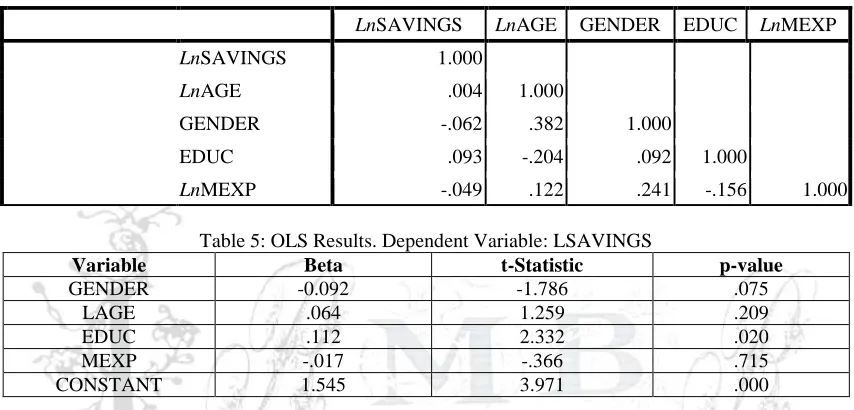
The correlations between variables are presented in Table 4. As can be observed, the correlations are low suggesting little or no multicollinearity problem in our model. This underscores the appropriateness of our model.
Table 4: Pearson Correlation Matrix
LnSAVINGS LnAGE GENDER EDUC LnMEXP
LnSAVINGS 1.000
LnAGE .004 1.000
GENDER -.062 .382 1.000
EDUC .093 -.204 .092 1.000
LnMEXP -.049 .122 .241 -.156 1.000
Table 5: OLS Results. Dependent Variable: LSAVINGS
Variable Beta t-Statistic p-value
GENDER -0.092 -1.786 .075
LAGE .064 1.259 .209
EDUC .112 2.332 .020
MEXP -.017 -.366 .715
CONSTANT 1.545 3.971 .000
The results of the OLS regression are presented in Table 5. Gender has a significant, negative relationship with savings, suggesting that compared to male clients, female microfinance clients are less likely to save than their male counterparts. Therefore, hypothesis H1 is unsupported. A study by Adusei (2013) in the CU industry in Ghana reports that a rise in the female membership of a CU undermines the savings mobilization performance of the union. The current study confirms this finding. Female microfinance clients tend to save less. This is partly due to the fact that studies have shown that female entrepreneurs tend to allocate a greater share of profits for family and child welfare (Kessey, 2005; Clark, 1991; Downing, 1990). Women tend to spend more of their income on their households (Cheston and Kuhn, 2002). It could also be that female microfinance clients in Ghana save less because they are poorer than their male clients due to unfavorable cultural practices. Unfavorable cultural practices in Ghana have confined most women to the kitchen, making them dependent on their husbands (if any) for their survival. Although the situation seems to be improving now with most women rising into influential positions both at the political and corporate levels yet, in relative terms, men generally dominate women.
Evidence in Table 5 shows age has a positive, statistically insignificant relationship with savings. This suggests that age may not be an important factor in micro-savings. Hypothesis H2is, thus, unsupported.
ISSN: 2306-9007 Afrane & Adusei (2014) 491
I
www.irmbrjournal.com March 2014I
nternationalR
eview ofM
anagement andB
usinessR
esearchVol. 3 Issue.1
R
M
B
R
essence of saving part of one’s income as insurance for future events. The uneducated usually lack planning resulting in the abuse of scarce financial resources that come their way.
It has been hypothesized that microfinance clients who have micro-credit experience are more likely to save than their counterparts. The intuition is that when microfinance clients are granted micro-credit, all things being equal, their economic status improves which may translate into micro-savings. However, evidence in Table 5 indicates that micro-credit experience (MEXP) has a negative statistically insignificant relationship with savings. Hypothesis H4 is, thus, unsupported. The reason could be that clients of SAT who have benefited from micro-credit have developed loan-dependency attitude and are thus, finding it difficult to save.
Conclusion and Policy Implications
The purpose of this study is to (1) establish whether microfinance clients are willing to save by assessing the relative performance of CSS and PSS; and (2) ascertain the factors to consider in promoting progressive or voluntary micro-savings. Gordon’s growth rate model and OLS regression model have been used for the study. The results of the analysis indicate that compared to CSS, the PSS has performed better in terms of annual growth in savings mobilization and that male gender and level of education are significant predictors of micro-savings. Age and micro-credit experience have been found to be insignificant predictors of micro-savings. The study, therefore, concludes that the poor and financially excluded are willing to save and that MFIs interested in boosting their savings-mobilization performance should consider males and the educational level of their targets.
To the extent that the females have been found to have less probability to save, it is reasonable to suggest that targeting micro-savings campaign at income-earning males could improve the micro-savings performance of MFIs in Ghana. However, this will have social and economic costs for Ghana in the midst of strenuous efforts towards women emancipation. Targeting savings campaign at income-earning males means widening the social and economic gap between males and females. Thus, to avoid this we recommend that MFIs in Ghana should craft women-centred savings-mobilizing campaigns. After all, microfinance targets women who are mostly poor. Therefore, encouraging them to save some of their income will be a step in the right direction.
Education has been found to have a significant relationship with savings. We, therefore, recommend that MFIs desiring to increase their savings should focus their marketing activities on income-earning targets who have secondary or higher level of education. Additionally, MFIs could enhance their savings-mobilization performance if they support the education of their clients. Credit with education currently being practiced by some MFIs should be vigorously pursued to help the poor in their match towards economic and social emancipation.
In summary, the success story of SAT in integrating micro-savings into its interventions is worthy of replication in Ghana and other parts of the world. We humbly submit that the administration of microcredit which normally creates a loan-dependency syndrome among microfinance clients should be jettisoned if the economic and social conditions of the poor and the financially excluded are to be improved. In this regard, we encourage future researchers to take up the challenge of delving into the impact of the integration of micro-savings into the NGO model of microfinance (if any) in order to shape policy and provide solutions to the socio-economic problems of the poor and financially excluded in society.
References
ISSN: 2306-9007 Afrane & Adusei (2014) 492
I
www.irmbrjournal.com March 2014I
nternationalR
eview ofM
anagement andB
usinessR
esearchVol. 3 Issue.1
R
M
B
R
ADB (2000) Finance for the poor: Microfinance Development Strategy. Manila: Asian Development Bank. Adusei, M. (2013). Determinants of credit union savings in Ghana, Journal of International Development,
25: 22-30. DOI: 10.1002/jid.2828
Asiama P, Osei V. (2007) Microfinance in Ghana: an overview. Research Department - Bank of Ghana, Economic Web Institute.
Bouman, F.J.A. (1994). ROSCA and ASCRA: beyond the financial landscape in: F.J.A. Bouman and O Bynner J, and Paxton, W. (2001). The Asset Effect. London: IPPR.
Cheston, S. and Kuhn, L. (2002). Empowering women through microfinance, UNIFEM.
Clark, M.H. (1991). Gender issues in micro enterprise assistance. Studies in Third World Societies, 44: 109-133.
Donor Brief (a microfinance news letter), June, 2000 edition
Downing, J. (1990). Gender and the growth and dynamics of micro enterprises. US Agency for International Development, Private Enterprise Bureau: Washington D.C.
Hörkkö, M. (2010). The determinants of default in consumer credit market, Master’s Thesis Submitted to Aalto University
Jalilian, H, and Kirkpatrick C. (2002). Financial development and poverty reduction in developing countries. International Journal of Finance and Economics: 97–108.
Jones, PA. (2008). From tackling poverty to achieving financial inclusion—the changing role of British credit unions in low income communities. The Journal of Socio-Economics: 2141–2154
Johnson, S. and Kidder, T. (1999). Globalization and gender – dilemmas for microfinance organizations.
Small Enterprise Development, 10(3): 4-15
Kabeer, N. (2001). Conflicts over credit: re-evaluating the empowerment potential of loans to women in Rural Bangladesh. World Development, 29(1): 63-84
Kempson, E, McKay S, and Collard, S. (2005). Incentives to save: encouraging saving among low-income households. London: HM Treasury
Kessey, C. (2005). Empowering Muslim women through microcredit scheme: the case of the Sunyani Gonja Muslim women’s group, Working Papers on Ghana: Historical and Contemporary Studies No.7 October.
Kočenda E. and Vojtek, M. (2009). Default predictors and credit scoring models for retail banking. CESifo Working Paper, No. 2862.
Montgomery, H. and Weiss, J. (2006).Modalities of microfinance delivery in Asia and Latin America: lessons for China. China & World Economy, 14: 30 – 43.
Ofei, KA. (2002). Retooling credit unions: the case of credit union association of Ghana. International Labour Organization. ISBN 92-2-112804-0 ISSN 1609–8382
Regan, S. and Paxton, W. (2001). Asset-based welfare: international experiences. London: Institute for Public Policy Research:
Robinson, M. S. (1994). Savings mobilization and micro enterprise finance: The Indonesian Experience,
Maria Otera and Elisabeth Rhyne (Eds) The New World of Micro Finance, West Hartford: Kumarian:
27-54
Sarel M. (1996). Nonlinear effects of inflation on economic growth. International Monetary Fund Staff
Papers, 43:199-215.
Sherraden, M. (1991). Assets and the poor: a new American welfare policy. New York: M.E. Sharpe Stiglitz, J.E. (1986). The new development economics. World Development, 14 (2): 257-65.
Vasanthi, P. and Raja, P. (2006). Risk management model: an empirical assessment of the risk of default.
International Research Journal of Finance and Economics, 1(1):42-56.
Vonderlack, RM, and Shreiner, M. (2001). Women, microfinance, and savings: lessons and proposals. United States of America: Centre for Social Development.