This document is published in:
Bossé, E
. et al. (eds.) (201
3
)
Prediction and Recognition of Piracy
Efforts Using Collaborative Human-Centric Information Systems,
Proceedings of the NATO Advanced Study Institute (ASI), Salamanca,
Spain 19-30 September, 2011, (NATO Science for Peace and Security,
Sub-Series-E: Human and Societal Dynamics, v. 109), IOS Press
,
pp. 2
44
- 27
1
.
Doi: http:
//
dx.doi.org/
10.3233/978-1-61499-201-1-244
Towards Characterizing Maritime Piracy
Problem and Solution Spaces: Preliminary
Results from Study Group Discussions
Éloi BOSSÉ1, Elisa SHAHBAZIAN2, Jesús García HERRERO3, Galina ROGOVA4
and Alan STEINBERG5 1Université Laval, Québec, QC, Canada
Director of NATO HSD.MD.ASI.984016
2President OODA Technologies Inc., Montréal, QC, Canada 3University Carlos III of Madrid, Madrid, Spain
4Encompass Consulting, NY, USA 5Georgia Tech Research Institute, VA, USA
Abstract. The main objective of the NATO HSD.MD.ASI.984016 on Prediction and Recognition of Piracy Efforts Using Collaborative Human-Centric Information Systems is to provide discussions on prediction, recognition and deterrence of maritime piracy through the use of collaborative human-centric information support systems. A group of more than 70 specialists and students gathered in Salamanca, Spain during the period of 19-30 September 2011 to examine maritime piracy problems and possible solutions. The ASI involved both technology and domain experts who exchanged their knowledge through lectures, plenary and brainstorming breakout study sessions in smaller interdisciplinary groups. They certainly improved their mutual awareness of the requirements, issues, policy as well as technology capable of helping to predict, recognize and deter maritime piracy. This paper presents the results of the discussions of the four interdisciplinary groups formed to study the various aspects of the maritime piracy problem.
Keywords. Maritime piracy, decision support, situation analysis, information fusion, cognitive engineering
Introduction
The members of the organizing committee previously organized a number ([1], [2], [6], [7], [8], [9]) of NATO Advanced Research Workshops (ARW) and Advanced Study Institutes (ASIs), symposia and Research Task Groups that discussed applications of decision support technologies to various security problems. A significant observation obtained during these meetings was that the domain experts (e.g., personnel from various organizations responsible for maritime security) have little understanding of the wide variety of technology solutions available, and how these solutions can enhance the performance of decision makers. Similarly, although technology experts have a general understanding of the various security system requirements, they do not have sufficient knowledge of antipiracy operations including constraints and a variety of factors (policy, geopolitical, legal, personnel, training, etc.) to overcome this problem. this ASI gathered both technology and domain experts to provide an opportunity for
them to improve their mutual understanding of the specific requirements, issues, and policies of the antipiracy domain, as well as of technology capable to predict, recognize and deter maritime piracy. The ASI comprised lectures, plenary sessions and brainstorming study sessions in smaller interdisciplinary groups. We have been fortunate to have lecturers comprising many leading scientists and very knowledgeable maritime piracy domain experts. We also had students from various countries whose research topics were precisely maritime piracy. The results of the study group discussions presented here are preliminary, and focus mostly on identifying various aspects of concern for both the problem space and the solution space of maritime piracy. Finally, an ASI is not usually structured to have intensive or extensive working sessions to conduct in depth analysis of these aspects, but at least, by conducting these brainstorming sessions, this ASI was able to deliver a list of issues or topics on which future ARWs can be proposed.
1. Piracy Threat Management Framework
Before the study groups could start their assessments, a framework to help structure the analyses to be performed by the groups was developed in a plenary session. This framework leveraged the participants’ background, as well as past publications, presentations and conclusions from previous NATO-funded meetings organized by the members of the organizing committee ([4], [5]) and other scientific events on crisis and emergency response, harbour protection and other defence and security problems.
A detailed analysis of these contributions is beyond the scope of this paper, but would certainly deserve to be considered in the context of maritime piracy. Note that all contributions including the companion contributions to past publications focus on a wide variety of information systems ranging from sensing, to making sense, to decision making that is behind the model of the piracy threat management framework
1.1.An analysis Framework
In a previous ASI entitled Data Fusion for Situation Monitoring, Incident Detection, Alert and Response Management, held in Albena, Bulgaria, 2005, a triadic model [3] was proposed to characterise interactions between the task, the technology and the people.
As illustrated in Figure 1, three elements compose the triad: the task, the technology and the human. In the command and control context, the OODA (Observe-Orient-Decide-Act) loop represents the task to be accomplished. Systems designers are introduced via the technology element.
Their main axis of interest is the link between the technology and the task. The general question related to this link is: “What systems must be designed to accomplish the task?” Systems designers are also considering the human. Their secondary axis of interest is thus the link between the technology and the human. The main question of this link is: “How to design the system so it is suitable for the human?” However, systems designers have also a hidden axis of interest, namely, the axis between the human and the task is usually not covered by their expertise. From the analyses of the axis, technological possibilities and limitations are identified. However, all environmental constraints may not be covered by the technological possibilities. These
XQFRYHUHGFRQVWUDLQWVQDPHGWKHUHDIWHUGHILFLHQFLHVDUHWKHQDGGUHVVHGDVVWDWHPHQWV RIUHTXLUHPHQWVWRWKHKXPDQIDFWRUFRPPXQLW\
)LJXUH7DVN+XPDQ7HFKQRORJ\7ULDG0RGHO
7KHVH UHTXLUHPHQWV OHDG WR EHWWHU WUDLQLQJ SURJUDPV WKH UHRUJDQLVDWLRQ RI ZRUN DQGWKHUROHVIRUOHDGHUVKLSWHDPFRPPXQLFDWLRQHWF7KLVYHU\KLJKOHYHOIUDPHZRUN KDVEHHQXVHGWRVWUXFWXUHRXUGLVFXVVLRQVRQPDULWLPHSLUDF\
8QGHUVWDQGLQJ&RPSOH[6LWXDWLRQV
7KH SUHGLFWLRQ DQG UHFRJQLWLRQ RI SLUDF\ HQWHUSULVHV KHUHDIWHU UHIHUUHG WR DV ³3LUDF\ 7KUHDW 0DQDJHPHQW´ LV DQ H[WUHPHO\ FRPSOH[ SUREOHP VSDQQLQJ PDQ\ RSHUDWLRQDO SKDVHV DQG LQYROYLQJ PDQ\ SDUWLFLSDWLQJ RUJDQL]DWLRQV 7KH DQDO\VLV RI WKH GHFLVLRQ VXSSRUW UHTXLUHPHQWV IRU VXFK D ODUJH DQG FRPSOH[ DSSOLFDWLRQ LV HQYLVDJHG WR KDYH PDQ\ GLPHQVLRQV ,W ZDV DJUHHG WR VWUXFWXUH WKH DQDO\VLV IUDPHZRUN LQWR ILYH GLPHQVLRQVFRUUHVSRQGLQJWRWKHILYHRSHUDWLRQDOSKDVHVRIDSLUDF\VLWXDWLRQHYROXWLRQ VKRZQLQ)LJXUH )LJXUH)LYHGLPHQVLRQVRIWKHDQDO\VLVIUDPHZRUN
For each Piracy Threat Management dimension, analysis topics (activities, factors, relationships, dependencies, technologies, organizations, issues, etc.) were identified and detailed in some cases into more than one level. The resulting “trees” of mapping the Piracy Threat Management dimensions into analysis topics have been included in Annex A of this paper, hereafter referred to as the Management Framework. It is clear that the presented framework does not cover the complete problem space and subsequent analyses are required. Subsequent analyses need to examine the currently identified topics as well as identify other analysis topics to mature and complete the framework. However considering the scope of the ASI, the strategy for the problem of Piracy Threat Management has been structured into an initial set of numerous smaller topics which can be easier to analyse.
2.Study Sessions Analyses
The study teams used the Management Framework as a starting point for their discussions aimed at identifying technologies which could enable enhanced decision making for the overall piracy threat management. Different topics of each dimension of the analysis framework were examined to establish the degree to which they could help in the decision making process, or identify important factors to also be taken into account. However, fully recognizing that within the scope of the ASI it is not feasible to cover a significant part of the problem space, the team leaders were given freedom to select a subset of the topics (accordingly to the experience and expertise of the group members) as well as the methodology for their analysis. While two teams followed the sequential path of taking the analysis topics one at a time and discussing technological solutions, two others chose alternate paths. One of these two teams concentrated on classifying topics by the type of solution that will make the biggest impact on the performance of decision makers, and grouping them into families: operational, political, legal or technological. The second of these two teams looked at the overall problem of prediction and recognition of piracy attacks by decomposing the process of prediction and recognition of attacks (the mission) into a set of technical issues (i.e., needed capabilities that technology might help provide) and analysing the technological solutions.
Considering the time available for the study sessions, the main output represented preliminary methodologies for each of the paths taken by the teams.
A short description of these methodologies is presented below. 2.1.The Methodology of “Sequential Path”
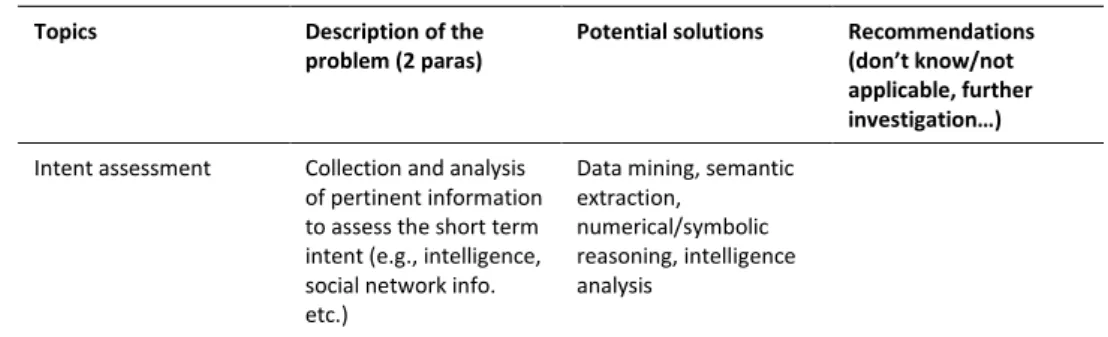
Figure 3 illustrates the analysis methodology proposed at the plenary session. As an example, it shows how the topic “intent assessment,” within block “Containment,” could be examined.
Topics Description of the problem (2 paras)
Potential solutions Recommendations (don’t know/not applicable, further investigation…)
Intent assessment Collection and analysis of pertinent information to assess the short term intent (e.g., intelligence, social network info. etc.)
Data mining, semantic extraction,
numerical/symbolic reasoning, intelligence analysis
Figure 3. Sequential path methodology for topic analysis (example)
2.2.The Topic Classification Methodology
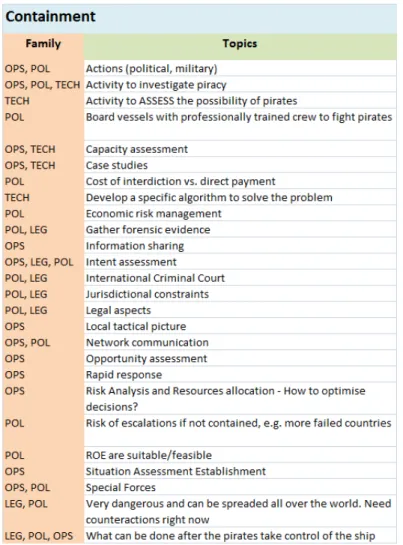
As mentioned above, one of the study teams decided to first classify the analysis topics by what type of change or solution would make the biggest impact in enhancing performance, grouping them into families: operational, political, legal or technological.
Figure 4 presents an initial classification into families of the topics of the “Containment” dimension (the shorter of the dimensions).
The members of this study group observed that the technological solutions would be very much dependent on the specific political, operational and legal context of how all participating countries and jurisdictions addressed piracy situations. Only a small number of topics have been classified in the TECH family; however it is apparent that in fact there will be very few topics for which no technological solutions will be required. Specifically, the experts in this study groups debated whether all topics in the OPS family should be also in the TECH family, as operations will require technology enabled decision support, while specific technological solutions will be operations and doctrine dependent.
Figure 4. Classification of topics
The abbreviations in the family names are: OPS – operational; POL – political; LEG – legal; and TECH – technological.
2.3.The Technology Centred Methodology The approach adopted by this study group was to:
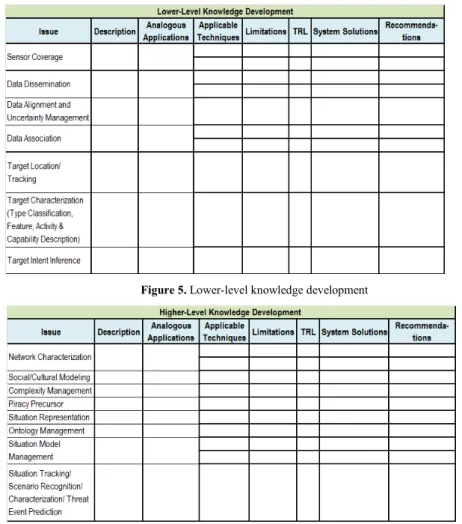
Decompose the process of predicting and characterizing piracy attacks (the mission) into a set of technical issues (i.e., needed capabilities which technology might help provide).
For each such issue, list potential technical solutions in terms of their maturity and potential effectiveness in resolving the issue.
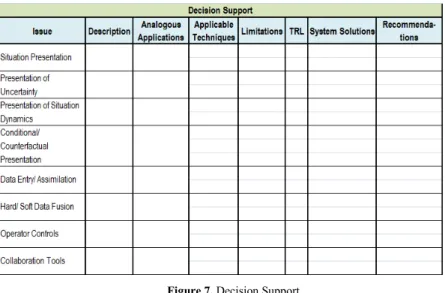
Figure 5-7 present the decompositions, while preliminary findings performed by this study team are included in Annex B. While for Figures 5 and 6 potential technical
solutions for some identified technical issues have been developed and included in the annex, the issues for Figure 7 are still awaiting possible technical solutions.
Figure 5. Lower-level knowledge development
Figure 6. Higher-level knowledge development
Figure 7. Decision Support
Definitions and Metrics in these tables are defined as follows:
Mission Capability: The ability to predict and recognize piracy efforts sufficiently to support effective responses: Prevention, Containment, and Consequence Management.
Issues: A problem relevant to achieving the mission capability.
Analogous Applications: Other mission capabilities that involve related technical issues.
Applicable Techniques: Technologies or designs that might be used to solve the given issue.
Limitations: Technical, operational or other factors that limit the capability of the given technique to provide a complete solution to the given problem. Maturity: The technology readiness level (TRL) of the given technique
(presented in Figure 8).
System Solutions: Candidate approaches to addressing given issues.
Recommendations: Suggested actions for NATO or NATO members to solve the given issues.
Figure 8. Technology readiness levels
Again, there was not sufficient time to complete the tables analysing the technologies further. Additional discussion on this approach would be beneficial.
3. Conclusion
This paper presents a high-level discussion on the potential support of collaborative information support systems to improve the ability to predict and prevent the occurrence of piracy incidents or rapidly recognize its nature and extent for effective collective response. The problem of maritime piracy is quite complex, and substantial research efforts are required to effectively design or adapt information systems to support the three actions of the Partnership and Action Plan presented in the introduction.
References
[1]É. Bossé, Chair of NATO RTO-IST-086, C3I for Crisis, Emergency and Consequence Management, NATO symposium, Bucharest, Romania, 11-12 May 2009. NATO report RTO-MP-IST-086, May 2009. [2]É. Bossé, Ed., Modelling of organisations and decision architectures, Final report of
RTO/IST-019/TG006, Dec. 2004, 249 pages.
[3]É. Bossé, S. Paradis, R. Breton, Decision Support in Command and Control: A Balanced Human-Technological Perspective, in Data Fusion for Situation Monitoring, Incident Detection, Alert and Response Management, 16-27 May 2005, 205-222.
[4]É. Bossé, J. Roy and S. Wark, Concepts, Models, and Tools for Information Fusion, Artech House, Norwood, 2007, 352 pages.
[5]A. Guitouni, A Time Sensitive Decision Support System for Crisis and Emergency Management, NATO RTO-IST-086, C3I for Crisis, Emergency and Consequence Management, paper 13, Bucharest, Romania, 11-12 May 2009.
[6]E. Lefebvre, Ed., Advances and Challenges in Multisensor Data and Information Processing, NATO Sciences Series, IOS Press, The Netherlands, 2007.
[7]E. Shahbazian, G. Rogova, Eds., Human Systems Integration to Enhance Maritime Domain Awareness for Port/Harbour Security, NATO Sciences for Peace and Security Series D: Information and Communication Security-Vol 28, IOS Press, ISSN 1874-6268, The Netherlands, 2010.
[8]E. Shahbazian, G. Rogova, M.J. de Weert, Eds., Harbour Protection Through Data Fusion Technologies, NATO Sciences Series, Springer, The Netherlands, 2009.
[9]E. Shahbazian, G. Rogova, P. Valin, Eds., Data Fusion for Situation Monitoring, Incident Detection, Alert and Response Management, NATO Sciences Series, IOS Press, The Netherlands, 2005.
Annex A