http://www.sciencepublishinggroup.com/j/optics doi: 10.11648/j.optics.20170601.13
ISSN: 2328-7780 (Print); ISSN: 2328-7810 (Online)
The Various Speeds of Lights in Inertial Frames of
Reference
Harry H. Mark
Department of Ophthalmology, Yale New Haven Hospital, New Haven, CT, USA
Email address:
To cite this article:
Harry H. Mark. The Various Speeds of Lights in Inertial Frames of Reference. Optics. Vol. 6, No. 1, 2017, pp. 11-16.
doi: 10.11648/j.optics.20170601.13
Received: August 19, 2017; Accepted: September 14, 2017; Published: October 23, 2017
Abstract:
The speed of light in empty space was first measured by Roemer in 1676 who also found it faster on approach to its source and slower on recession. James Bradley in 1728 reported the speed of light incident vertically to be higher on approach and slower on recession. In 1881 and 1887 Albert Michelson showed that the speed of light did not change when both its source and observer moved forward uniformly on the same platform. These observations, often repeated, demonstrated that the motion of lights in inertial frame of reference varied according to the general laws of motion. However, erroneous interpretation of Michelson's experiments by Lorentz and FitzGerald lead to the notion that the speed of light was unaffected by the speed of its source or observer - it was a universal constant - later incorporated into Einstein's Theory of Relativity.Keywords:
Speed of Light, Universal Constant, Michelson, Einstein, Lorentz1. Roemer's Measurement
By measuring the periods of Jupiter's satellites, Ole Roemer determined that the speed of light was higher when approaching and lower when receding from Jupiter than when at a steady distance from it.
Between 1672 and 1676 the Danish astronomer Ole Roemer (1644-1710) -- son-in-law of Dr. Erasmus Bartholin, and later mayor of Copenhagen -- worked in Paris under the patronage and with the help of the Italian astronomer Gian Domenico Cassini(1625-1712). The two engaged in measuring the periods of time it takes the Jovian satellite Io to revolve around its planet, with the aim of synchronizing clocks around the world according to the positions of celestial bodies (establishing ephemerides)—of particular import to navigators at sea. In August of 1675, Cassini reported to the Academy in Paris some irregularities in the periods of Io, and in September 1676, Roemer reported his conclusion that these irregularities were caused by the different times it takes light from Jupiter to arrive to earth positioned at different distances from it [1, 2].
Roemer actually discovered two facts. First, he found that the duration of Io’s eclipses (the beginning or end of the period) as measured from earth when it was nearest Io occurred earlier on the clock than when the earth was farthest
away. The difference was about 22 minutes; therefore, Roemer concluded, light must have a certain velocity, for it took time to cover the distance of the diameter of the earth’s orbit around the sun.
The second fact Roemer found was that each of Io’s periods was longer when earth was in the process of receding from Jupiter, and shorter when earth was on the approach, than when it was at a fairly constant distance from the light source. This second measurement is hardly ever mentioned in the relevant literature and may have been forgotten. The difference between one period measured from a fairly stationary position compared to the same period measured from a receding or approaching position was quite small, but became obvious when Roemer added forty periods on approach, compared to forty periods measured at rest, or compared to forty periods on recession. As translated in the Philosophical transactions of the Royal Society in 1677 it read:
than forty others observed in any place of the Zodiack where Jupiter may be met with."
Furthermore, the loss of time on approach equaled the gain on recession, and the mean of the two equaled the period measured from a stationary position. At equidistance from Jupiter, the length of the period was greater when the direction of the earth's motion was away from the planet from point L to K, and shortest of all when the earth’s direction was towards Jupiter at position F. That is, generally, the speed of light varied according to the speed of the observer.
Figure 1. Ole Roemer found the speed of light higher on approach at F.
2. Ernst Mach's View
Ernst Mach [3] compared the revolutions of Jupiter's satellite to the revolving sails of the wind-mill; their light is slower to reach a receding observer and their revolutions therefore appear longer; the opposite occurs on approach when the speed of light in reference to the observer increases and the wings appear to rotate faster: "In order to make Roemer’s ideas quite clear, let us think of the revolving sails of a wind-mill. At a constant distance from an observer the revolution of the sails appear to be just as quick as it actually is. If, however, the observer moves very quickly away, the revolution must appear slower, because the light from each successive position reaches him later. The period of revolution apparently depends upon the relative velocity [emphasis added] with regards to the observer."
The rotating wings of the windmill may be replaced by the rotating hands of a clock. To a receding observer they move slower. If, however, he believes that they should move just as fast as when he was standing still, he would have to conclude that time retarded, or distance shrunk.
3. Bradley's Observation
By measuring the angle which light from a star forms with an observer moving perpendicular to it James Bradley (1728) determined that the speed of light was higher when
approaching the vertical and lower when receding from it than when positioned directly under it.
In the early part of the 18th century a controversy was alive as to whether the fixed stars exhibited a parallax observable from earth. James Bradley (1693-1762), later Astronomer Royal, and his rich friend Samuel Molyneux set out to investigate the problem in the latter’s home in Kew by London. They aimed a telescope at a bright star in the constellation Dragon, gamma draconis, which in that latitude was almost straight overhead—thus to avoid atmospheric refraction and aid acurate positioning of the telescope relative to a plumb line. As Bradley reported to the Royal Society in 1728, these observations revealed that all stars overhead seemed to move in direction of the earth’s motion around the sun, and during the course of one year completed a full circle whose diameter subtended about 40”. Stars near the horizon seemed to be moving in a straight line in direction of the earth’s motion, and the length of this line also subtended an angle of about 40” at the eye [4, 5, 6].
Figure 2. Bradley's observations from his original paper.
When the earth in its annual orbit went from B to A Bradley had to change the direction of his telescope from straight upwards (AC) to a little forwards (BC) in order to see the star overhead (C), and when orbiting the other way the tilt of the telescope was also reversed., tilted in reverse at the same angle.
Having pondered the phenomenon for some time, Bradley concluded that the angular aberration in the position of the star was an effect caused by the compounding of the motion of the observer on earth moving in one direction [B to A] (in reference to the fairly stationary extraterrestrial firmament) with the motion of the light [C to A] moving almost perpendicular to this observer. The value of the earth’s velocity and the angle of aberration being known, Bradley deduced the velocity of light (c=v/tan
α
), and his result concurred very well with the then only available other data obtained by Roemer’s method.The fact of aberration means that the velocity of light (c') referred to a moving earth ( 2 2
c +v ; or c/cos
α
) is greaterRoemer’s measurements so did it in Bradley’s. Accordingly so far, in general, the speed of light evidently follows the general principles of all motions as established by Galileo and Newton.
Now enter Michelson.
4. Michelson's Error
By determining that the speed of light did not change when both its source and its observer were at steady distance from one another and moving forward uniformly on the same platform, Michelson confirmed that light's motions were no different than those of any other motion. Figure 3 represents the standard Galilean circumstances as seen from a stationary reference point outside cabin ABCD (say 4 x 4 meters in size). Two balls (or light beams) are sent simultaneously at right angles from A (say at speeds of 4m/sec). At standstill the vertical one moves from corner A to B, while the horizontal one from A to D. They arrive back to point A after 2 seconds. When the cabin moves uniformly from point A to point a (say at speed of 3 m/sec), this uniform motion does not matter to the man inside -- when the car is enclosed he cannot even tell whether he is moving at all. The horizontal light is seen from outside to move to d (at speed 3 + 4 =7 m/sec) [bottom arrow in Figure], and the vertical to b (at √32 + 42 = 5 m/sec). In the next step the cabin moves from point a to A’, the horizontal light moves back from d to A’ (at speed 4-3=1 m/sec), and the vertical from b to A’ (at 5 m/sec).
The vertical beam (ball) covered a total distance of 10 meters, the horizontal one 8 m. They finally both return to the same corner of the cabin at the same time because their speeds differed, as determined by the person inside the cabin as well as an observer stationed outside.
FigF
Figure 3. Galilean kinematics.
Albert A. Michelson (1852 --1931) accepted Maxwell’s belief [7] that the speed of light in direction of the earth’s movement was not equal to its speed in the opposite direction, and that this difference could be detected on the earth itself. He thought with Maxwell that the success of these efforts to determine the earth’s motion by experiments on its surface failed due to inadequately sensitive measuring devices, and trusted that with the help of his newly invented interferometer he could do it.
“On the hypothesis of a stationary ether it appeared
possible to detect a motion of the earth independent of astronomical observations.” He trusted this fundamental possibility, the basis of the whole project, at the beginning of his 1881 paper copied here: “Assuming then that the ether is at rest, the earth moving through it, the time required for light to pass from one point to another on the earth’s surface, would depend on the direction in which it travels.” (Figure 4) [8].
“ART. XXL—The relative motion of the Earth and the
Luminiferous ether; by ALBERT A. MICHELSON.Master, U.S.
Navy.
THE undulatory theory of light assumes the existence of a
medium called the ether, whose vibrations produce the phenomena of heat and light, and which is supposed to fill all space. According to Fresnel, the ether, which is enclosed in optical media, partakes of the motion of these media, to an extent depending on their indices of refraction. For air, this motion would be but a small fraction of—that of the air itself and will be neglected.
Assuming then that the ether is at rest, the earth moving through it, the time required for light to pass from one point to another on the earth’s surface, would depend on the direction in which it travels.
Let V be the velocity of light.
v = the speed of the earth with respect to the ether. D = the distance between the two points.
d = the distance through which the earth moves, while light travels from one point to the other.
d1 = the distance earth moves, while light passes in the opposite direction.
Suppose the direction of the line joining the two points to coincide with the direction of earth’s motion, and let T = time required for light to pass from the one point to the other, and T1 = time required for it to pass in the opposite direction. Further, let To = time required to perform the journey if the earth were at rest.
Then T=
v d V
d D
=
+ ; T
1=
v d V
d D− = 1
From these relations we find d= D
v
V
v
−
and d,=DV v v +whence T=
n V
D
− and T1=
v
V
D
+
; T-T1=2T,V
v
nearly, and
v=V 1
0
2
T T
T −
.
If now it were possible to measure T—T1 since Y and To are known, we could find v the velocity of the earth’s motion through the ether.
Figure 4. From Michelson's paper.
We start our analysis with Michelson’s definitions and arithmetic. On the first page of his first paper (see above) he said: "ether at rest", at rest relative to what? “Let V be the velocity of light.” The velocity of light in reference to what? As Michelson himself often measured, it was always understood to mean light's speed between two stationary positions on earth, or, as Roemer did, between a fairly stationary earth and Jupiter, such as the velocity of light measured when the earth was in fairly steady position closest to Jupiter and when farthest away from it, about 300,000 km/sec [In general, and by definition: Velocity = Distance/Time, and T = D/V].
Said Michelson: “D = the distance between two points. d = the distance through which earth moves, while light travels from one point to the other.” And here was the crux of the problem.
“D” is the distance between two points on earth. “d” is the distance the earth moves in reference to what? As previously noted, it is of paramount importance to continually keep in mind that the motion of the earth in this and similar instances can only be considered from a stationary position outside the earth, such as the “man in the moon” according to Kepler [10], or “man in heaven” in Oresme’s words. Michelson’s saying “Assuming then that the ether is at rest, the earth moving through it” is tantamount to the earth moving in reference to some other generally accepted stationary object or medium outside it, such as the stars or the sun. The decisive difficulty was that Michelson was not observing the phenomena from a stationary position outside the earth or outside the ether. In the ether or on the earth itself, without an external point of reference, the distance “d” he was talking about cannot be determined.
“v = the speed of the earth with respect to the ether [at rest]”. Now, therefore, if the earth moved in reference to an external stationary medium or object, the velocity of light traveling in the same direction on this earth, as employed by Michelson in his experiment and as seen from the stationary position in outer space, would necessarily be: V + v, not
simply v. No evidence whatsoever existed in Michelson’s time to permit neglect of compounding the velocity of light with the velocity of the source or observer; on the contrary, Roemer and Bradley have already furnished the necessary data in support of the need to do it.
Furthermore, if “T = the time required for light to pass from one point to the other” [on the moving earth, equals D/V], and light’s velocity in reference to a stationary position outside earth increased by the earth’s velocity, then it should be: T = (D + d)/ (V + v). But instead Michelson wrote “T = (D + d)/ V”. The velocity of light (V) was a priori not compounded by the velocity (v) of the source on the earth moving in reference to the stationary ether or sun, while the distance covered (D + d) was indeed reckoned in this frame. The events were considered confusedly from two different points of reference and therefore could not possibly correspond.
At the bottom of the second page of his first paper of 1881 he explained: “the pencil which has traveled in the direction of the earth’s motion will in reality travel 4/100 of a wave-length farther than it would have done were the earth at rest. The other pencil being at right angles to the motion would not be affected.” However, as noted above, the pencil will only travel farther forward when seen from a point outside the earth in reference to which it is at rest or moving, not from a position on it, where Michelson and the reader of his report were in fact positioned.
The paper ended with the conclusion: “The result of the hypothesis of stationary ether is thus shown to be incorrect, and the necessary conclusion follows that the hypothesis is erroneous. This conclusion directly contradicts the explanation of the phenomenon of aberration which has been hitherto generally accepted, and which presupposes that the earth moves through the ether, the latter remaining at rest.”
In the winter of 1881 Michelson went to Paris to study at the Collège de France and the École Polytechnique, and to demonstrate his apparatus to some famous physicists in Paris, such as Cornu, Mascart, and Lippmann. He also demonstrated his experiment to the Paris Académie des Sciences at the February 20, 1882 meeting, subsequently published in French , and there he admitted to an error: “Dans ce Memoire [paper of 1881] j’ai oublié l’efet du mouvement sur le rayon bc [the perpendicular]. La correction m’a été signalé par M. Potier.” [11] More clearly expressed in the 1887 paper: [12]"In deducing the formula for the quantity to be measured, the effect of the motion of the earth through the ether on the path of the ray at right angles to this motion was overlooked… It may be mentioned here that the error was pointed out to the author of the former paper by M. A. Potier, of Paris, in the winter of 1881. "
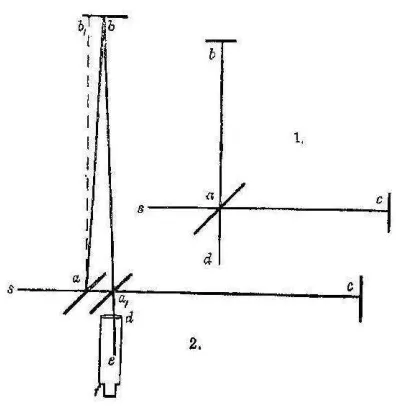
have not yet seen Lorentz’ paper and fear I could hardly make it out when it does appear.” [13] In the 1887 paper, written with Edward Morley, Michelson accordingly amended the route of the perpendicular light from ab1 to ab (Figure 2). When the instrument on the moving earth is observed from a stationary point outside earth, the mirror at b1 already moved to b while light was traveling there from a. “This meant that Michelson had overestimated by a factor of two the fringe shifts originally expected.” The mirror at c also moved forward at the same time, but this curiously was not taken into account. It thus seemed that light traveled different distances at the same time.
The obscure M. Potier in Paris clearly viewed the experiment on earth from a stationary position outside: if one considered with Michelson “d = the distance through which the earth moves, while light travels from one point to the other” carrying with it the perpendicular mirror, one ought also consider the distance b1b (Figure 2. left) through which light traveled while in the perpendicular path to this displaced mirror. Compared to the diagram of 1881, (and Figure 1. right) the perpendicular ray in 1887 did not go perpendicularly to b1 but a bit forward to position b (Figure 2). “The angle bab1 being equal to the aberration = α”. “Let it now be required to find the difference in the two paths aba1, and aca1.”
The distances covered are unequal, and if the velocities in the two directions perpendicular to one another are the same, the times of return are indeed unequal. Given, however, that the compounded velocities are in fact unequal, the times of going forward and return, and going sideways and return are certainly equal, and no shift in interference fringes should be expected. The speed forward is V+v, and return in V-v. The speed perpendicularly is the same going and return. it is 2(v tan α), or 2√V2 + v2, which is larger than simply V, and equals (V+v) + (V-v).
The angle of aberration in Bradley’s case was formed by a moving observer on earth in reference to the stationary source, the star. When Michelson’s case is viewed from a stationary point outside earth, the angle was formed by the moving light source in reference to this stationary observer, which as we know since Oresme and Copernicus, is the same thing. The compounding of the velocity of light by the velocity of the observer created the angle of aberration in both observations, and the value ab in Michelson’s case was certainly larger than ab1, just as Bradley’s velocity CB was higher than CA. Whatever moved the light from position b1 to b in the experiment was imparted to it by the motion of the earth, the same motion that moved Bradley from position B to A. Had the light from the source not been compounded by the earth’s motion (momentum) it would have gone perpendicularly to b1, and thus missed the mirror which was already a little forward.
Michelson then accepted the fact that the motion of the earth altered (increased) the motion of light in the perpendicular direction: “In consequence, the quantity to be measured had in fact but one-half the value supposed.” “If, as was the case in the first experiment, D=2 x 10⁶ waves of
yellow light, the displacement to be expected would be 0.04 of the distance between interference fringes.”
The wave-length difference diminished by half, and yet, the two rays were still a bit out of phase, and therefore theoretically according to Michelson the fringes should have shifted, but in reality they did not, the expected displacement did not occur!
When in 1887 it was admitted in this manner that the earth’s motion influenced the distance and speed of light in its perpendicular direction, it may be seen as no small oversight not to have gone back and corrected the 1881calculations for the forward direction as well. And yet the definitions have not changed: “Let V = velocity of light”, that is, the light emanating from the source on the moving earth. Now if the velocity of the transverse ray was compounded by the earth’s motion, it must do so also in direction of its forward motion, and velocity V was in reality V + v (as pointed out previously). When incorporating this correction into the calculations the other “one-half of the value supposed” is found, and the two opposing rays portrayed do indeed cancel one another, and the null shift in fringes comes as no surprise or disappointment.
Michelson concluded: "It appears from all that precedes, reasonably certain that if there be any relative motion between the earth and the luminiferous ether, it must be small; quite small enough entirely to refute Fresnel’s explanation of aberration… It is obvious from what has gone before that it would be hopeless to attempt to solve the question of the motion of the solar system by observations of optical phenomena at the surface of the earth [his emphasis]."
Not only “by observations of optical phenomena”, for in a uniformly moving ship or the earth, as stressed by Oresme, Galileo or Newton -- in an ‘inertial frame of reference’ if you wish --all uniformly linear motions are the same. The first method of detecting any motion of the earth, its daily angular spin, by observing motions on its own surface was discovered in 1851 by Jean Foucault with his pendulum.
5. Interpretations
reconcile this opposition [to ether drift] is that the length of material bodies changes, according as they are moving through the ether or across it."
The motion of light was believed to be independent of the motions of its source or its observer, hence in order to explain the results the instrument’s arm must have shrunk – "The Fitz Gerald-Lorentz Contraction". Lorentz’s interpretation of Michelson’s experiments as the “Principle of the constant velocity of light" was then readily accepted by his admirers in their own subsequent theories: 'We wish to elevate the assumption (whose contents shall subsequently be named "Principle of Relativity") to a precondition, and in addition import a seemingly incompatible precondition, that light in empty space always advances in a definite speed V, independent of the state of motion of the emitting body [16, 17].
Einstein recalled later that he may not have read Michelson's reports in their original but rather took for granted their results as reported by Lorentz [18]. His Theory of Relativity is celebrated and carries so much popular weight nowadays that no arguments in its disfavor are considered seriously.
Purpose
The aim of this paper is to explore the curious change of opinion about the speed of light that occurred around the end of the nineteenth century. Till then light was judged to move according to the general laws of material motion as described by Nicole Oresme, Galileo Galilei and Isaac Newton - it accelerated and retarded with its source or observer. Michelson's experiments as interpreted by FitzCerald and Lorentz then lead to the notion that the speed of light was a universal constant, it did not change by the speed of its source or observer.
References
[1] Roemer, O. Demonstration touchant le Mouvement de la lumiere trouve Par. M. Roemer. Mem. de Fac. Roy. de Sc.
1666-1699: 575 (1730).
[2] Cohen, I. B. Roemer and the first determination of the velocity of light (1676). Isis 31: 327-79 (1940). Also: New York,
Burndy Library (1944).
[3] Mach E. The principles of physical optics, Dover Publications,
New York, (n.d.): 23 (1926).
[4] Bradley, J. A new apparent Motion discovered in the Fixed Stars; its cause assigned; the Velocity and equable Motion of Light deduced. Phil transactRoy Soc: 35:637 (1728).
[5] Sarton, G. Discovery of the Aberration of Light. Isis 16: 233
(1931).
[6] Hogben L. Science and the Citizen. New York, Knopf:
330-336 (1958).
[7] Maxwell, J. C. On the influence of the motions of the heavenly bodies on the index of refraction of light. Phil transact Roy Soc clviii: 532-535 (1868).
[8] Michelson A. A. The relative motion of the Earth and the luminiferous ether. American Journal of Science, series 3,
xxii: 120-29 (1881).
[9] Maxwell J. C. On the possible mode of detecting a motion of the solar system through the luminiferous ether. Nature xxi:
315. Also: Proc Roy Soc. 30: 1018 (1880).
[10] Rossmann F. Nikolaus Kopernikus, Erster Entwurf seines Weltsystems. Hermann Rinn, Munich: 12 (1948).
[11] Michelson A. Sur le movement relative de la Terre et le l'ether.
Comptes Rendu: 520 - 23 (1882).
[12] Michelson A. A., Morley E. W. On the relative motion of the earth and the luminiferous ether, American Journal of Science,
3rd series, xxxiv: 333-45 (1887).
[13] Livingston, D. M. The Master of Light. New York, Charles
Scribner’s Sons: 124 (1973). [14] Lorentz,H. 1892.
http://en.wikisource.org/wiki/The_Relative_Motion_of_the _Earth_and_the_Aether. Accessed July 29 (2017).
[15] FitzGerald, G. F. The Ether and the Earth’s Atmosphere.
Science. 13: 390 (1889).
[16] Einstein A. Zur Elektrodynamik bewegter Koerper. Ann der Physik; 17: 1-24 (1905).
[17] Einstein, A. Über das Relativitätsprinzip und die aus Demselben gezogenen Folgerungen. Jahrbuch der Radioaktivität und Elektronik (4), 411-46 (1908).
[18] Pais A. Subtle is the Lord. New York, NY, Oxford Univ. Press: