QUALITY IN KONDAPALLI CITY, ANDHRA PRADESH
V. Bhagya Lakshmi1,Dr.M.Raghu Ram2andDr. Shaheda Niloufer31,3
FED, LBRCE, Mylavaram, 2
Department of Botony & Microbiology, Acharya Nagarjuna University,
Abstract
Municipal Solid Waste (MSW) disposal through land filling is the cheapest and common option for getting rid of the waste generated in many parts of the world. Generally low lying areas and outskirts of the city Kondapalli are used for the purpose of open dumping. The management of solid wastes in Indian cities like Kondapalli is largely unscientific and unsatisfactory. The uncontrolled dumping of urban wastes destroys the beauty of country side also there is danger of water pollution when the leachate from a refuse dump enters surface water or ground water resource. In addition, uncontrolled release of landfill gas, burning of open dumps can cause air pollution. The main risks of human health arise from the breeding of disease vectors, primary flies and rats thriving in the exposed garbage and refuse dumps. The present study was aimed at estimating the basic water quality parameters like Temperature, pH, Total Dissolved Solids (TDS), Total Alkalinity (TA), Dissolved Oxygen (DO), Biological Oxygen Demand (BOD), and Chemical Oxygen Demand (COD) for a complete annual cycle i.e. from January 2016 to December 2016. It was observed that most of the tested parameters were not within the acceptable limit given by the IS 10500 Drinking Water Quality Standards. The correlation prevailed among the parameters was also estimated. The study revealed a seasonal impact of the leachate quality adjacent areas.
Keywords-Municipal Solid Waste (MSW), Leachate, Dissolved Oxygen (DO), Biological Oxygen
Demand (BOD), Chemical Oxygen Demand (COD).
I. INTRODUCTION
Land filling of municipal solid waste is a common waste management practice and one of the cheapest methods for organized waste management in many parts of the world [4], [2], [10] & [6]. Leachate generated from municipal solid waste dumpsites affect the groundwater quality in the adjacent areas through percolation in the subsoil. MSW dumpsites if improperly managed pose a serious threat to the quality of the environment. The threat to surface and ground waters could be deleterious. The scale of this threat depends on the composition and quantity of leachate and the distance of a landfill from water sources [9]. Groundwater contamination is a major concern in landfill operations because of pollution effects of landfill leachate and its potential health risks [5], [1] & [8]. Our future use of ground water which is very important alternative for living cannot be allowed to degrade from these local sources of leachate pollution [7].
II. MATERIALS AND METHODS
2.1 Study Area
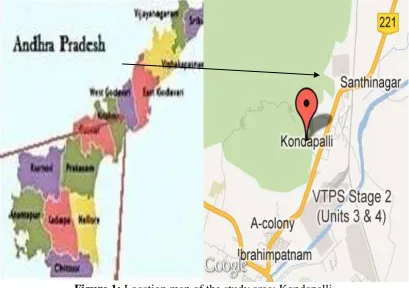
present study. It is active in operation. The dumpsite is open with road on the three sides and a residential colony on the fourth side. However no dedicated security is provided within the municipal site. The dumpsite is located in a densely populated area.
Figure 1: Location map of the study area: Kondapalli
Breeding of flies, insects and rodents are an inherent nuisance attached to all MSW dump sites in different degree. Kondapalli is no different from other MSW sites in this respect.
2.2 Ground water quality monitoring
In an effort to study the extent of groundwater contamination, five (5) sampling points were selected at the two dumpsites from where the groundwater samples were taken. The samples were collected in clean 500 ml plastic bottles after the extraction of water from the hand pumps for complete annual cycle i.e. from January 2016 to December 2016. Monthly analysis was done for the samples collected in the five sampling stations.
2.3 Physico-chemical analysis of leachate and groundwater
The groundwater samples were immediately transported to the laboratory, stored at 4°C and analyzed the same day. All the samples were analyzed for selected physico-chemical parameters according to internationally accepted procedures and standard methods (APHA, 1994). The parameters analyzed in the groundwater and leachate samples include Temperature, pH, total dissolved solids (TDS), Total Alkalinity, Dissolved oxygen (DO), Biological oxygen demand (BOD), chemical oxygen demand (COD).
2.4 Statistical analysis
The results of the analysis were presented as mean ± SD. Statistical tools were applied to find out the correlation among the parameters.
III. RESULTS AND DISCUSSION
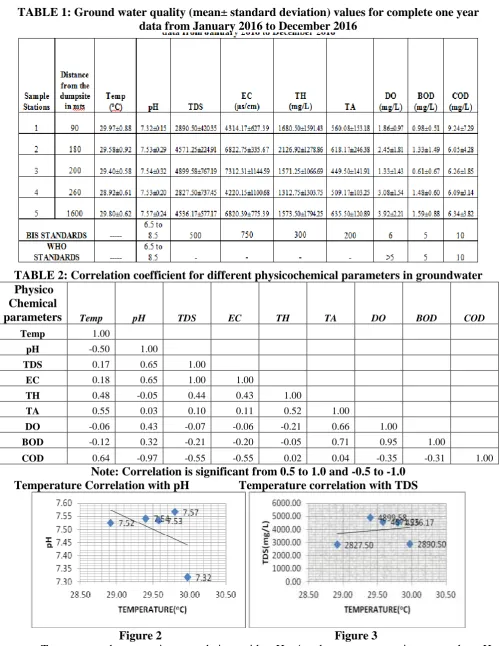
TABLE 1: Ground water quality (mean± standard deviation) values for complete one year data from January 2016 to December 2016
TABLE 2: Correlation coefficient for different physicochemical parameters in groundwater Physico
Chemical
parameters Temp pH TDS EC TH TA DO BOD COD
Temp 1.00
pH -0.50 1.00
TDS 0.17 0.65 1.00
EC 0.18 0.65 1.00 1.00
TH 0.48 -0.05 0.44 0.43 1.00
TA 0.55 0.03 0.10 0.11 0.52 1.00
DO -0.06 0.43 -0.07 -0.06 -0.21 0.66 1.00
BOD -0.12 0.32 -0.21 -0.20 -0.05 0.71 0.95 1.00
COD 0.64 -0.97 -0.55 -0.55 0.02 0.04 -0.35 -0.31 1.00
Note: Correlation is significant from 0.5 to 1.0 and -0.5 to -1.0 Temperature Correlation with pH Temperature correlation with TDS
Figure 2 Figure 3
water temperature increased the TDS was observed high in the analysis result of the five sample stations.
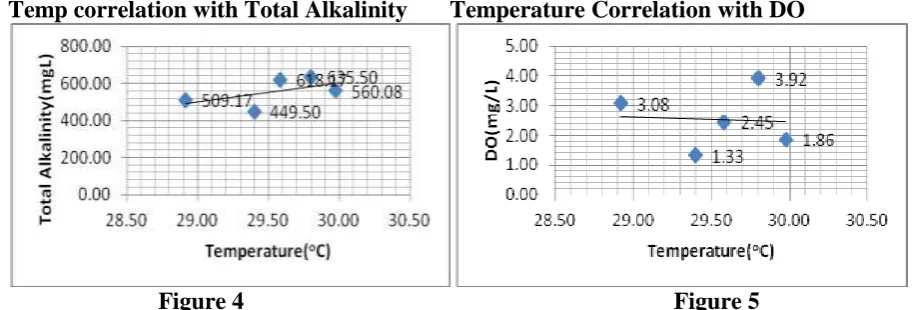
Temp correlation with Total Alkalinity Temperature Correlation with DO
Figure 4 Figure 5
Temperature has positive correlation to Total Alkalinity. Increase in temperature showed an increase in the concentration of alkalinity in the ground water. Hence in the month of March as the water temperature increases the value of TA was observed high in the analysis result of the five sample stations. Temperature has a strong negative correlation with Dissolved oxygen. As the temperature raises the values of DO are found to decrease. Hence in the months of December and January the DO values were high when compared to other months.
Temperature Correlation to BOD Temperature correlation with COD
Figure 7 Figure 6
Temperature has a weak negative correlation with Biological oxygen demand in ground water. As the temperature raises the values of BOD are found to increase. Hence during the months of May the values BOD were found to be negligible when compared to the month of January in the five sample stations. Temperature has a strong positive correlation with Chemical oxygen demand. The COD is found to increase with water temperature. Hence the COD was found high in the month of May in the five sample stations.
pH Correlation with TDS pH Correlation with DO
pH has a positive correlation with TDS in ground water. As the pH raises the values of TDS increased. Hence during the months of April and May TDS values were high in all the sampling stations. pH has a positive correlation with DO. As the pH rises the DO increased. DO was found high in the months of December and January.
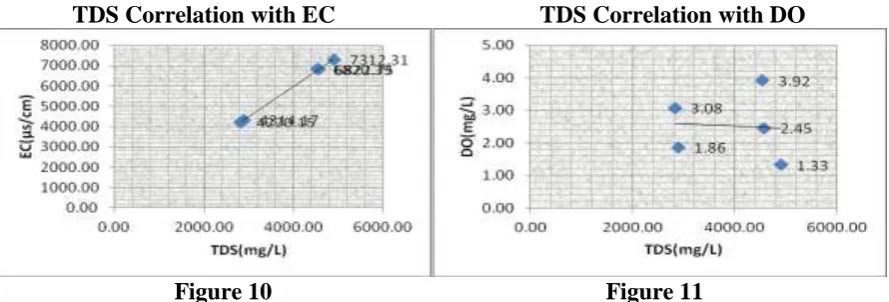
TDS Correlation with EC TDS Correlation with DO
Figure 10 Figure 11
TDS has a direct positive correlation with EC. As the TDS increased the EC values also increased in all the five sample stations. Hence in the month of March and April both the values of TDS and EC were high.
TDS has a negative correlation with DO. As the values of TDS increased the DO values decreased. Hence DO was found less in the months of March, April and May in all the sample stations.
IV. CONCLUSION
The findings of the study suggest that the seasonal and site specific variations have impact on the leachate quality polluting the ground water at the dump sites. Thus, for any waste management work in cities a careful consideration of all the seasonal factors and site specifications must the basis of a sound and sustainable programme. To date no concerted efforts have been made by the corporations to consider the issues. Finally no municipal solid waste management can be effective without the proper monitoring of water and air quality at the MSW dumpsites. Thus its effectiveness must be tested at regular basis.
V. BIBLIOGRAPHY
[1] Christensen, T.H.; Kjeldsen, P.; Bjerg, P.L.; Jensen, D.L.; Christensen, J.B. and Baun, A. 2001. Biogeochemistry of landfill leachate plumes, Appl. Geochem., 16: 659–718.
[2] Daskalopoulos, E.; Badr, O. and Probert, S.D. 1998. An integrated approach to municipal solid waste management, Journal of Resources, Conservation and Recycling, 24(1): 33-50.
[3] Bureau of Indian Standards (BIS). 1991. Indian Standard specification for drinking water, BIS Publication No. IS: 10501, New Delhi.
[4] El-Fadel, M.; Findikakis, A.N. and Leckie, J.O. 1997. Environmental impacts of solid waste landfilling, Journal of Environmental Management, 50(1): 1-25.
[5] Lee, G.F. and Jones-Lee, A. 1993. Groundwater Quality Protection: A Suggested Approach for Water Utilities, Report to the CA/NV AWWA Section Source Water Quality Committee, Aug, 8.
[6] Longe, E.O. and Balogun, M.R. 2010. Groundwater quality assessment near a municipal landfill, Lagos, Nigeria, Department of Civil and Environmental Engineering, University of Lagos, Nigeria. Research Journal of Applied Sciences, Engineering and Technology, 2(1): 39-44.
[7] Niloufer, S.; Swamy, A.V.V.S. and Devi, S.K. 2013. Ground water quality in the vicinity of municipal solid waste dumpsites in Vijayawada, A.P, International Journal of Engineering and Scientific Research, 3(8): 419-425.
[8] Stollenwerk, K.G. and Colman, J.A. 2003. Natural remediation potential of arsenic contaminated groundwater. Arsenic in groundwater, Geochemistry and occurrence, Boston, Kluwer, 351-379.
[9] Slomczynska, B. and Slomczynski, T. 2004. Physicochemical and toxicological characteristics of leachate from MSW landfill, Polish Journal of Environmental Studies, 13(6): 627-637.
[10]Jhamnani, B. and Singh, S.K. 2009. Groundwater Contamination due to Bhalaswa Landfill Site in New Delhi, Department of Civil and Environmental Engineering, Delhi College of Engineering, Delhi, India. Journal of Environmental Science and Engineering, 1(3): 121-125.