http://www.sciencepublishinggroup.com/j/jher doi: 10.11648/j.jher.s.2017030301.14
ISSN: 2472-3584 (Print); ISSN: 2472-3592 (Online)
Addressing the Wicked Problems of Sustainability Through
Consciousness-Based Education
Christopher Jones, Gabriel Akura
Education Department, Maharishi University of Management, Fairfield, IA, USA
Email address:
[email protected] (C. Jones)
To cite this article:
Christopher Jones, Gabriel Akura. Addressing the Wicked Problems of Sustainability Through Consciousness-Based Education. Journal of Health and Environmental Research. Special Issue: Maharishi Vedic Science: Creating a Sustainable Future. Vol. 3, No. 3-1, 2017, pp. 44-62. doi: 10.11648/j.jher.s.2017030301.14
Received: March 6, 2017; Accepted: April 6, 2017; Published: April 27, 2017
Abstract:
In order to imagine and then create a sustainable future, education will have to be significantly rethought and redesigned. Starting from the UNO 2030 Agenda for Sustainable Development, we tackle the competencies, and then the curricula and methods, that education will have to adopt in order to pursue this agenda. After identifying outstanding issues in competencies, curricula and methods, we introduce a new agenda for education structured around developing the consciousness of the knower, or learner, as a basis for improved teaching and learning. This new agenda, which addresses several of the issues of Education for Sustainability, is called Consciousness-Based Education, first introduced by Maharishi Mahesh Yogi in the early 1970s. At the end we present a model that integrates the development of consciousness into higher education for sustainability.Keywords:
Education for Sustainability, Sustainability Education, Sustainability, Consciousness-Based Education, Maharishi Mahesh Yogi, Vedic Science, Transcendental Meditation, Consciousness1. Introduction
Since the United Nations Commission on Environment and Development in 1987 (World Commission), the term “sustainability” has become the umbrella term for a host of problems which threaten at least the standard of living for most of the people around the globe, and possibly the survival of the species. These problems, due to their complexity, their mix of technical and definitional issues, and their intractability have also been identified as “wicked problems,” i.e., problems with no right answer—only good and better solutions (Rittel and Webber, 1973; Pryshlakivsky and Searcy, 2013). Whether we think of these problems as inconvenient truths or a crisis; whether we contemplate slowing or reversing current trends; whether we even believe at this point that sustainability is possible; certainly, improved education must be at the center of any long-term plan for a sustainable future.
As the American Philosopher, John Dewey, so eloquently put it:
By law and punishment, by social agitation and discussion, society can regulate and form itself in a more or less
haphazard and chance way. But through education society can formulate its own purposes, can organize its own means and resources, and thus shape itself with definiteness and economy in the direction in which it wishes to move. (1897, p. 80)
At the same time that education is central to shaping society and solving the problems which threaten our future, clearly it is a new kind of education that is needed. Education, at least as it was for today’s government leaders, is largely responsible for the problems we face today, and so we can hardly think that more of this is likely to address the problems we face.
improvements for the field to consider.
EfS is growing rapidly, with more than half a dozen journals focusing on it1, and there are nations (like the U.S.) which are moving this focus up the ladder of their priorities2. We will see that education for sustainability, as with educational reform in general, is pointing more and more in the direction of competencies in systems thinking, anticipatory thinking, normative thinking, strategic planning, and interpersonal skills. In teaching methods it is trending toward real world learning, critical problem solving, and experiential learning—all in an attempt to more directly and deeply affect behavior.
We agree that new and developing pedagogies for problem-solving and experiential learning are important innovations that must continue, but we do not think they are sufficient in themselves to solve the wicked problems they are purported to address. They are not sufficient to transform the world-views, institutions, and technologies (WITs) that compose modern culture (Beddoe, et al., 2009; Murphy, et al., 2009). Something more is needed to change the WITs that have led us to the position we are in today—something deeply transformative, universally applicable, and interdisciplinary by nature.
This “something more,” we will argue, is called Consciousness-Based Education (CBE), an approach to education which integrates the best of modern western approaches to knowledge, including the innovative goals and pedagogies of EfS alluded to above, with a subjective science of consciousness, called Maharishi Vedic Science (see also in this issue the first article by Fergusson, Wells, and Kettle for more detail on the tenets of Maharishi Vedic Science). CBE was created in the early 70s by Maharishi Mahesh Yogi working together with western-trained educators. It includes new technologies—especially the Transcendental Meditation and TM-Sidhi techniques—for developing human consciousness in ways not found in current educational practice. Putting together these techniques for personal development with a scientific, transdisciplinary framework that integrates western and eastern knowledge leads to an approach that can be said to transform individual life from its very root in self-knowledge. This educational approach, we will argue, has the best chance of addressing today’s wicked problems and transforming the WITs of today in the direction of the UNO goals for sustainable development.
2. Goals and Competencies of Education
for Sustainability
When asking what kind of an education is needed for a sustainable future, the starting point would logically be a set of goals for sustainability education, identifying the
1 There are five journals and one magazine in English focused on education for sustainability. There are another four journals focused on environmental education.
2 A particularly striking example of this is the National Sustainability Education
Summit sponsored by the U.S. Department of Education in September, 2010.
knowledge, skills, and attitudes we hope to achieve with students of sustainability. To begin thinking about goals for sustainability education, however, we much first adopt a set of Sustainable Development Goals that envision the future state that we want our students to be competent to achieve— especially in view of the fact that this future state is probably very different from the life they are leading now.
Many organizations and groups have made attempts to set the sustainability goals, including but not limited to, the Millenium Project, the UN Environmental Programme (UNEP), Worldwatch, and many of the national academies of science around the world. There is much overlap among these sets of goals, but we choose as our starting point probably the most widely accepted of these goal sets taken from the resolution adopted by the UN General Assembly on 25 September 2015, called “Transforming our World: the 2030 Agenda for Sustainable Development.” In it the UN identified the 17 goals in Table 1.
We invite the reader at this point to take a moment and reflect on what kind of a school he or she might build to prepare students to achieve these goals. Consider what would be required in terms of curriculum, instruction and assessment? Does the current range of offerings in a school prepare students to understand and address the wicked problems implied in the discrepancy between the current world and the goals espoused here—especially in light of the fact that the problems are cross-disciplinary and challenge the status quo? Would it be a separate course or is it something we should infuse into all the existing courses? Does the school itself run in accord with these goals? What kind of a person could be a leader in sustainable development and capable of solving these problems?
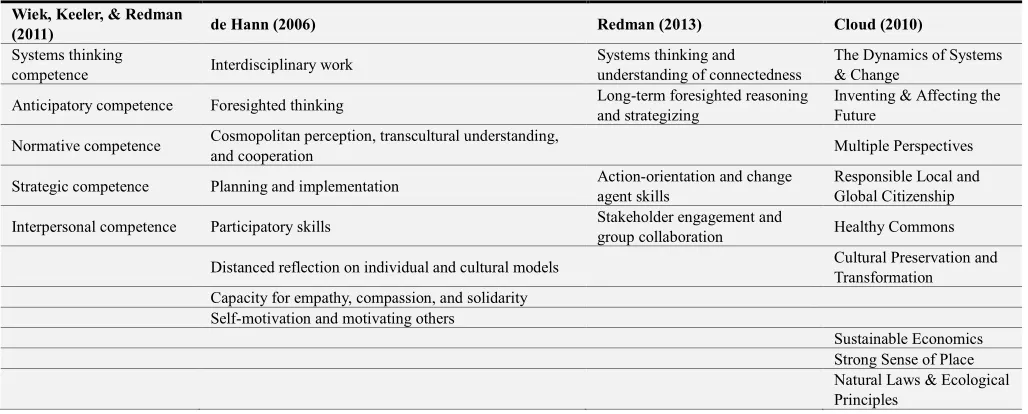
These 17 goals are the broadest picture of what we are aiming at with sustainability, but the issue of how we actually achieve this kind of world brings us to another level of outcomes altogether: learning outcomes for the programs or courses designed to prepare students to address current problems and move toward the 17 UN Goals. The generation of such outcomes is still relatively new, the earliest references being in the mid 2000s, but Table 2 shows four such sets of outcomes. We have placed Wiek, Redman, and Keeler (2011) first in the left column because they are the most recent and comprehensive synthesis, summarizing eight other authors. Where the competency or outcome was similar among authors, we have listed them in the same row, though sometimes with different wording. Where the goals themselves are different between authors, we have left the corresponding cells open.
Table 1. Sustainable Development Goals from the UNO: “Transforming our World: the 2030 Agenda for Sustainable Development”.
Goal 1.: End poverty in all its forms everywhere
Goal 2.: End hunger, achieve food security and improved nutrition and promote sustainable agriculture
Goal 3.: Ensure healthy lives and promote well-being for all at all ages Goal 4.: Ensure inclusive and equitable quality education and promote lifelong learning opportunities for all
Goal 6.: Ensure availability and sustainable management of water and sanitation for all
Goal 7: Ensure access to affordable, reliable, sustainable and modern energy for all
Goal 8.: Promote sustained, inclusive and sustainable economic growth, full and productive employment and decent work for all
Goal 9.: Build resilient infrastructure, promote inclusive and sustainable industrialization and foster innovation
Goal 10.: Reduce inequality within and among countries
Goal 11.: Make cities and human settlements inclusive, safe, resilient and sustainable
Goal 12.: Ensure sustainable consumption and production patterns Goal 13.: Take urgent action to combat climate change and its impacts* Goal 14.: Conserve and sustainably use the oceans, seas and marine resources for sustainable development
Goal 15.: Protect, restore and promote sustainable use of terrestrial ecosystems, sustainably manage forests, combat desertification, and halt and reverse land degradation and halt biodiversity loss
Goal 16.: Promote peaceful and inclusive societies for sustainable development, provide access to justice for all and build effective, accountable and inclusive institutions at all levels
Goal 17.: Strengthen the means of implementation and revitalize the Global Partnership for Sustainable Development
Acknowledging that the United Nations Framework Convention on Climate Change is the primary international, intergovernmental forum for negotiating the global response to climate change.
If we look at the Table 2 further we note several interesting similarities and differences between the competencies listed. As for similarities, systems thinking, some kind of foresightedness or thinking about the future, action
orientation, and the ability to work with and motivate groups, are common to all of the writers. An ability to recognize and work with values is common to three of the four. And while Wiek, et al. (2011, p. 9) write that “The capacity to understand, embrace, and facilitate diversity across cultures, social groups, communities, and individuals is recognized as a key component of [Interpersonal competence],” de Hann (2006) and Cloud (2010) bring this capacity to the status of a separate competence in their “reflection on cultural models” and “Cultural Preservation and Transformation” respectively. Cloud also includes in her “standards” several complex concepts (sustainable economics, sense of place, and Natural Laws & Ecological Principles), raised to a status of outcomes, whereas Wiek, et al. (2011) refer to five to nine “concepts” under each of their competencies that must be taught in the context of developing the competencies. In none of these do they refer specifically to what Cloud calls “Natural Laws,” or what we might call “subject-matter content” from, for example, chemistry or biology. They do not refer either to economics or sense of place. (Interestingly, Cloud [2010, p. 173] defines sense of place as “The strong connection to the place in which one lives: students will recognize and value the interrelationships between the social, economic, ecological, and architectural history of that place and contribute to its continuous health”—a concept unique among all the authors).
Table 2. Alternative Sets of Competencies, Outcomes or Standards for Programs that Teach Sustainability Research and Problem Solving.
Wiek, Keeler, & Redman
(2011) de Hann (2006) Redman (2013) Cloud (2010)
Systems thinking
competence Interdisciplinary work
Systems thinking and understanding of connectedness
The Dynamics of Systems & Change
Anticipatory competence Foresighted thinking Long-term foresighted reasoning
and strategizing
Inventing & Affecting the Future
Normative competence Cosmopolitan perception, transcultural understanding,
and cooperation Multiple Perspectives
Strategic competence Planning and implementation Action-orientation and change agent skills
Responsible Local and Global Citizenship
Interpersonal competence Participatory skills Stakeholder engagement and
group collaboration Healthy Commons
Distanced reflection on individual and cultural models Cultural Preservation and Transformation Capacity for empathy, compassion, and solidarity
Self-motivation and motivating others
Sustainable Economics Strong Sense of Place Natural Laws & Ecological Principles
There are many issues that surround trying to identify competencies (Wiek, et al., p. 201). One of the main issues is that sustainability competencies overlap with what could be called general education competencies. The American Association of Colleges and Universities LEAP Project (AACU, 2015), for example, identifies among its twelve outcomes Civic knowledge and engagement—local and global; Ethical reasoning and actions; Synthesis; and advanced accomplishment across general and special studies. These outcomes are all parallel to several of the Wiek, et.al. competencies. Thus, separating out the relative
responsibilities in college of general and special faculties for these competencies will be important, as will be separating out which competencies are unique to sustainable studies programs from those competencies that are to be attained by all students.
given the prominence that they should be given. Other writers have noted the importance of dispositions, but we were unable to find an author who has attempted to identify key dispositions (cf. Barth, et al., 2007, for one who emphasizes the importance of dispositions but without articulating them). Even critical thinking, for example, viewed by many as a cognitive skill, we know to be strongly intertwined with the disposition for fair-mindedness and openness to alternative points of view (Lipman, 2003, p. 132; Danvers, 2015, p. 1). We suspect the same is true of sustainable competencies: they are intertwined with dispositions to care about the welfare of others and to make a better world.
This issue is tantamount to whether the competencies can be divorced from personal values or ideological stances which Wiek et al. note as well, without resolving:
…some authors argue that the normative character of sustainability requires the acquisition of certain values (social-ecological integrity, justice, etc.). Others argue that sustainability graduates need to know different value-laden concepts, but their role is to facilitate dialogue rather than position themselves in value-laden debates (p. 211). We believe this issue can be resolved if we can accept that there may be some values, such as care for others or self-actualization, which are fundamental to progress by any point of view. From this perspective, values and needs are aligned with a fundamental drive for community, or for self-actualization. This is of course an ideological stance, but one that can be supported by biology (Piaget, 1971) and psychology (Maslow, 1954). Thus we take the stance that so-called value-laden concepts, as long as they are values for self-actualization, self-determination, and well-being, are no more values than they are requirements of sustainability. Sustainability itself, then, becomes the primary value and cognitive focus at the same time.
A fourth issue, not raised by Wiek, et al., is the distinction between working on one’s own worldview and its attendant behaviors, or helping others to do the same—similar to the issue of where healing oneself fits into becoming a doctor who heals others. One might ask whether changing others necessitates first trying to change oneself and one’s behavior. Or, putting it more positively, learning to change oneself and one’s life style is important work for the would-be change maker. If there were an effective technology for developing the perception, cognition, and behavior of the student, this technology should be part of any sustainable science program.
This consideration leads us to a competency that should be added to the lists we outlined above. This is competency related to the person who is to be a sustainability researcher or problem solver, to the wholeness of that person that is more than the some of the parts. And by this “more” we are not referring to the personality of the would be sustainability worker, but to the underlying person, what Consciousness-Based Education refers to as the “knower,” or individual self. Wiek, et al., take a step in this direction (2011, p. 10):
Our analysis emphasizes individual sustainability
competence while positioning it within a sustainability research and problem-solving framework. Yet, the overarching competence in sustainability research and problem solving is more than the sum of its parts. It involves not only the mastery of the individual competencies but also the ability [our emphasis] to combine these competencies in a meaningful and effective way. Analyzing and solving sustainability problems requires linking and activating all of the individual competencies…
This kind of wholeness of awareness that connects all the parts and integrates them in an effective way is the specialty of Consciousness-Based Education. We will argue (in more detail later) that there is a holistic quality of consciousness that needs to be cultivated in the student of sustainability— both as direct experience within oneself, and as a unifying concept necessary for the interdisciplinary, systems-oriented work that is so central to sustainability education. In short, there should be a competency for experiencing and understanding wholeness in one’s own life and in the world around one. This is needed to connect all the competencies together in a transdisciplinary whole and to make them effective in the world.
At our home institution, Maharishi University of Management (MUM) in Fairfield, Iowa, USA, the faculty have developed “Essential Learning Outcomes” for all undergraduate students (Jones, 2017). Two of these outcomes are specifically aimed at development of consciousness and holistic thinking. They currently are framed as follows:
Development of Consciousness: College graduates will be able to display improvements in perception, thinking, feeling, and overall growth of consciousness.
Holistic Thinking: College graduates will be able to apply unifying principles within and across disciplines to synthesize ideas, integrate divergent perspectives, and understand what they have learned in light of their own consciousness.
The exact language and measuring tools for these two competencies in the context of college education continue to evolve, but MUM has both objective and self-report measures for both of these general outcomes and nearly 40 years of research with objective measures of development of consciousness (Jones, 1987; Travis, 2009).
3. Curriculum and Teaching for
Sustainability
One of the early attempts to outline EfS was the Rio de Janeiro Earth Summit of 1992. Chapter 36 of Agenda 21 from the summit, “Promoting Education, Public Awareness, and Training” (UNCED, 1992) outlined the programs of action, including objectives and activities, which educators could use to promote sustainable development and improve “the capacity of the people to address environmental and development issues.” Section 5 (f) of the document specifically points out the need for new pedagogies, suggesting that “educational authorities should promote proven educational methods and the development of innovate teaching methods for educational settings.” In response to this call to action, numerous sustainability education programs and initiatives have been developed and implemented around the world (see for example, Sterling, 2001; UNESCO, 2010; Williams & Brown, 2013; and Padmanabhan, 2016).
The resulting EfS programs and curricular initiatives have ranged from stand-alone courses to degree programs in colleges and universities to institutions that integrate sustainability across the curriculum. Church & Skelton (2010) identified four different approaches to integrating sustainability in education, including: (1) sustainability as the context within which to teach core subjects, (2) sustainability projects in standard courses, (3) sustainability as its own course or degree, and (4) sustainability at the school-wide or district-level to guide institutional and curricular innovation.
K-12 education has demonstrated the most vitality and innovation when it comes to methods of teaching. Programs designed to integrate sustainability have emphasized best practices in teaching and learning, especially pedagogical methods that involve real-world, problem-based, experiential approaches (Church and Skelton, 2010; O’Brien, 2010; Sterling, 2001; Williams & Brown, 2012; UNESCO, 2010). For example at our home institution, students study soil biology and organic farming in the context of broader issues of food quality and security. As part of this study students conceived a composting project that quickly grew into a composting process for the whole University. Students created the means to collect food scraps at each meal and turn these into compost for the University’s greenhouses, as well as those of local farms. Students learned not only how to compost and replenish the soil; they also learned how to work with kitchen staff to collect leftover food and turn it into compost. Such methods serve to advance the call made by reformers such as Sterling (2001) to move away from “transmissive” learning to “transformative” learning where, through “whole systems thinking,” students can be better prepared to respond to the challenges of sustainability in an organization, like a college.
An example of a particularly detailed treatment of strategies for teachers is UNESCO’s professional development resource for teachers titled “Teaching and Learning for a Sustainable Future” (UNESCO, 2010). This
site provides material for pre-service and in-service teachers to enable them to integrate the concepts and themes of sustainable development into the school curriculum. The program contains modules with different themes that revolve around sustainability and innovative pedagogy. A key objective of the program, therefore, is “to enhance skills for using a wide range of interactive and learner-centered teaching and learning strategies that underpin the knowledge, critical, thinking, values and citizenship objectives implicit in reorienting education towards sustainable development.”3 The key teaching and learning strategies that the UNESCO program recommends include experiential learning, storytelling, values education, enquiry learning, future problem solving, learning outside the classroom, and community problem solving (UNESCO, 2010).
Individual educators and researchers in colleges and universities have also developed programs, resource materials, and books that teachers have used to integrate sustainability in their classrooms. Williams and Brown (2011), in their influential book “Learning gardens and sustainability education: Bringing life to schools and schools to life,” describe how, through learning gardens in schools, students can learn about sustainability in an engaging, meaningful way, through real world experiences. Learning gardens, according to Williams and Brown, provide a whole-system solution to the issues of sustainability. They identify several key schools and programs across the USA that have successfully integrated school gardens in teaching and learning4. One of us (Dr. Akura) is engaged in the region of Lake Victoria, Kenya, using this methodology. He currently helps teachers introduce Kenyan school children to the concepts of sustainability through learning gardens. Students learn about food supply, water quality, bio-diversity conservation, and energy use as they create their own school gardens. They begin to apply whole systems thinking naturally as they see the interdependence of these four issues in their own gardens.
At the school where the authors have consulted, Maharishi School in Fairfield, Iowa, USA, a Consciousness-Based institution, as well as promoting development of consciousness and teaching holistic thinking, teachers integrate the concepts of sustainability through project-based learning as well a high school-level course in sustainability. Students have undertaken projects such as rain catchment, as well as designing pizza gardens and edible food plots. Students learn about botany and agriculture first hand in a 4,100 square foot greenhouse in the schoolyard. The lower school also has utilized the Nature Explore Classroom program sponsored by the Arbor Day Foundation where pre-school children grow in awareness and appreciation of the earth. In the accompanying high school a sustainable living
3 From the objectives of the program:
elective course has been offered (MSAE, 2015).
Research projects of various sizes and durations have been conducted on sustainability education curriculum over the years. An example of a small-scale research project is found in Redman (2013), who investigated sustainability competencies and transformative change in sustainable behaviors among a small group of students in Phoenix, Arizona. The case study research demonstrated a significant change in student knowledge and sustainability behaviors. A bigger curriculum research program touching on food systems and nutrition – and important component of sustainability – is the Linking Food and the Environment (LiFE) research project developed at Teachers College, Columbia University (LiFE, 2005; Calabrese et.al., 2005). The LiFE curriculum aims at promoting scientific habits of mind and knowledge about food systems and the environment among youth living in urban poverty in the USA. This project has demonstrated that sustainability curricula in schools or in after-school programs can promote sustainable behaviors among students.
Whereas a lot of resources have been developed to bring the concepts of sustainability in the classroom through projects and as tools to teach core subjects, it is in the approaches where sustainability is taught as its own subject, as well as where sustainability initiatives are implemented at institutional levels – school-wide, district-level, or in universities and colleges – where the most significant work has been done. According to Church and Skelton (2010), the approach to teaching sustainability as its own subject can be divided into three categories, including teaching sustainability as an entire course, sustainability taught as a thematic unit, and incorporating sustainability as a single lesson. Examples of colleges in the U.S. that offer sustainability majors or degree programs include the School of Sustainability at Arizona State University; Maharishi University of Management in Iowa; and Santa Clara University in Santa Clara, offering a Master of Science in Sustainable Energy degree. Apart from offering degree courses in sustainability, these universities, as well as hundreds of other universities in the USA, offer courses with a focus on sustainability science in different departments and disciplines (see Best Colleges, 2017). In 2014, for example, Santa Clara University offered nearly 800 courses with an environment or sustainability focus. Others include Michigan State University, offering 15 environmental or sustainability focused majors or specializations (MSU, 2017) and Stanford University that offers about 500 courses on sustainability in different departments and disciplines (Best Colleges, 2017).
Thousands of Colleges and universities in the USA and around the world have also committed to “greening their campuses” through environmentally friendly operations and research on sustainability. The University of Indonesia has developed a ranking system, the GreenMetric World University Ranking which ranks universities on various sustainability issues (Greenmetric UI, 2015). Such commitments provide students with opportunities to learn about sustainability through active engagement on the
various greening projects on campus and to see working models of sustainable development.
The main challenge to sustainability research and problem solving arises largely from the highly compartmentalized organization of the modern university and secondary schools. Faculty in biology, literature, and foreign language are, due to the organization of the academy, not ideally equipped to deal with interdisciplinary issues. Beyond curriculum compartmentalization, the major issues or limitations are mostly due to limitations in teacher preparedness. Few teachers in secondary or tertiary education are provided the background knowledge to teach sustainability as its own subject, even if they are biology teachers. Fewer still are trained in the more advanced pedagogies of enquiry learning or project-based learning. Even fewer have the understanding or skills to teach systems thinking, interdisciplinary research, or problem-solving in an interdisciplinary context. (Mills & Tomas, 2013; Sims & Falkenberg, 2013; Hopkins & McKeown, 2005).
4. Issues and Challenges for
Sustainability Education Programs
As we can see from the previous section, EfS has been moving in the same direction as mainstream educational reform, toward a student-centered, project-oriented, critical, constructivist, inclusive approach to teaching and learning. The emphasis in teaching over the last two decades has shifted from the teacher as authority, delivering knowledge, to a more interactive, process orientation, focused on student learning. In short, EfS, like education generally, has become process oriented—at least as espoused by its lead reformers.
While adopting these advances, several challenges or issues remain to be addressed. Recounting, they are
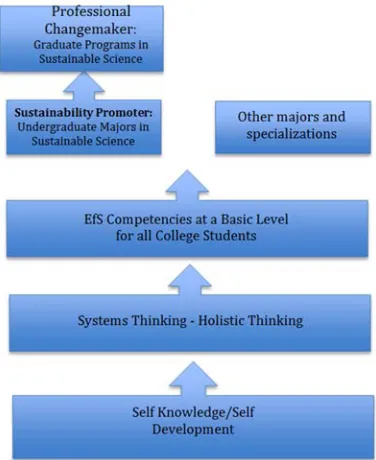
1.Distinguishing general from special competencies. As mentioned above, in a school or college one of the decisions that comes first is what do all students need to know and what do only those interested in the subject need to know? A challenge that remains is where to draw the line between the general and special competencies that are needed by graduates from sustainable science programs.
2.Adding dispositions and values to student learning outcomes. Dispositions and values must be included in any comprehensive list of desired outcomes. If we didn’t care about supporting a good quality of life for our children and their children, the field of sustainability science would not exist. Thus the commitment to the future and to the people who will live in the future must be systematically cultivated and frequently discussed. A challenge remains to articulate these dispositions. (For an interesting comparison, see the history of identifying dispositions in teacher education in Villegas (2005).)
address both the life of the student (we call it “sustainable living”) and policies and strategies for improving the world around us (sustainable science). The two domains are intertwined, but it is the authors’ position that both should be taught explicitly (even if under the broad heading of “sustainable science”). A challenge remains here to articulate goals and teaching strategies to develop both the student and the subject matter expertise.
4.Moving toward transdisciplinary study and wholeness. Many authors (Steinfeld & Mino, 2009, Ferrer-Balas, et al., 2009) have pointed out the radically interdisciplinary nature of sustainable science, cross-cutting as it does social science, physical science, and the humanities. In light of this challenge, approaches best equipped to pursue EfS are those which go beyond collaboration of experts in a number of fields (interdisciplinary study) toward identifying methods and unifying principles—principles that capture fundamental patterns at the root of many disciplines (Boothby, 2007; Winquist, 1982, Leavy, 2011). Thus sustainable science is in need of a transdisciplinary bridge to connect the natural sciences, social sciences, and the humanities, and to identify such unifying principles.
5.Compartmentalization of modern discipline-centered instruction. It is difficult to get faculty to focus on skills or knowledge that does not arise in their home discipline. If the institution does not make an effort to develop interdisciplinary knowledge or skills, then it will be difficult to find a place for the study of a knew discipline, such as sustainable science. Such subjects are often relegated to electives and so the first to get cut in challenging budgetary times (Hopkins & McKeown, 2005).
6.Faculty lack training in EfS and its more advanced pedagogies. For EfS to make significant inroads in academia it must upgrade the knowledge and training of its faculties to include background knowledge and skills necessary to change student worldviews and behaviors. The kinds of knowledge and skills necessary are new, however, and must be introduced first in teacher education institutions and then in higher education faculty training.
5. The Basic Framework of
Consciousness-Based Education
We will come back to address each of the EfS challenges identified above. To achieve a proper synthesis, however, we need to lay a foundation for this task in a basic overview of Consciousness-Based Education (CBE).
Consciousness-Based Education (CBE) was created by Maharishi to be a complete integration of modern science and Maharishi Vedic Science. Though one can see the basic tenets around which CBE is organized as early as when
Maharishi first began teaching the Transcendental Meditation technique in India in the 1950s, the educational system as a system begins to take shape in the early 1970s. At that time, institutions of elementary, secondary, and tertiary education were established5, a new discipline called the Science of Creative Intelligence was formulated from the Vedas6, and the basic principles of CBE were articulated.
In a now-famous address given in 1973 to the American Association for Higher Education in Chicago, Maharishi introduced the basic idea of CBE in this way (1973):
The stream of knowledge has two banks—on one side is the object of knowledge, and on the other side, the knower. With these two points of reference, the knower and the object of knowledge, the first point of reference is the knower. This is very important, because we know that knowledge is as the knower is. When the mind is dull, when the knower is sleepy, the knowledge is something different than what it is when one is fresh and wide awake in the morning. Perception is different, understanding is different, emotions are different. Knowledge is different in different states of consciousness (p. 3).
In the same address Maharishi went on to explain that the Transcendental Meditation technique was a simple educational technology that could be used to gradually open to awareness the knowledge and experience of the knower, that which had been missing in modern educational systems. By “knower” Maharishi was not referring only to the thoughts and feelings of the learner. He explained that there was an aspect of mind that was beyond thoughts and feelings and that this transcendental self could be experienced directly by the mind. It was a unique state where the mind reflects on itself by itself — a self-referral state.
Since Maharishi first began teaching the Transcendental Meditation technique, people had had the experience of this self-referral state of consciousness. The technique itself is a simple, natural mental technique practiced twice daily for 15 to 20 minutes, and during the practice, mental activity settles down gradually to its quietest state, a state of restful alertness, where the mind is quiet but fully awake and alert. At the same time, there’s a sense of expansion and peace. A typical experience is described subjectively as follows:
During the Transcendental Meditation technique my mind settles down, thoughts become less and then suddenly all thought activity ceases and I slip into an unbounded ocean of awareness which is pure, quiet, unexcited and infinitely extended beyond space and time. I am not aware of any thought or any thing; I am just aware of awareness, you could say, wide awake inside but not thinking. Simultaneously my body settles down, breathing becomes
5 Maharishi University of Management was incorporated first in 1971 in Santa Barbara, CA, moving later to Fairfield, Iowa, USA. Maharishi School of the Age of Enlightenment was formed as a laboratory school, under the umbrella of MUM in 1974, in Fairfield, Iowa.
less, and I feel relaxed. (quoted in Pearson, 2013, p. 52). While pleasant and personally meaningful in its own right, it became clear from research that this experience of inner restful alertness, especially as it began to infuse itself into waking activity, made the mind clearer and learning easier (Dillbeck & Dillbeck, 1987). More important, however, was the significance of this experience in light of the broader search for self-knowledge, long thought to be at the foundation of education. The experience of transcendental consciousness was presented by Maharishi as the experience of the Self, the knower, the one bank of the river in the analogy of 1973, that had been missed by conventional education. Thus, in light of the experience of the Self, the entire field of education had to be rethought (Grant & Jones, 1997).
Maharishi worked closely with professional educators to craft the new approach, and what emerged was essentially four components:
1.The traditional disciplines of western education would be taught in their completeness as before, ensuring that the most up-to-date knowledge was presented, but connected to the knower.
2.Every student would practice the Transcendental Meditation technique twice daily to ensure the experience of the full range of human subjectivity. 3.The curriculum would also include a new subject, the
Science of Creative Intelligence (SCI) that could be used to bridge the traditional disciplines and the new dimension of human experience brought to light by the TM technique.
4.Teachers, in addition to practicing the TM technique and learning the Science of Creative Intelligence, would learn new principles of teaching which would help them to use SCI to make the connections between all aspects of subjectivity and the disciplines—to develop a new kind of holistic thinking that incorporated subject, object, and the connection between the two.
Beginning in about 1980, Maharishi began to formulate a science closer to the Veda and Vedic Literature itself, but still entirely grounded in publicly available experience, called Maharishi Vedic Science (see Fergusson, Wells, and Kettle 2016 for more detail on Maharishi Vedic Science). Today both SCI and Maharishi Vedic Science are taught as interdisciplinary subjects in Consciousness-Based Education. Through the combination of both the experience of consciousness during the Transcendental Meditation technique and the interdisciplinary study of it, Maharishi created a new experience-based approach to education, integrating personal experience, modern science, and traditional wisdom, especially Maharishi Vedic Science.
Maharishi summarized the importance of this new approach:
If the age is to change to one of invincibility7 a
7 “Invincibility” is the state where a nation is impervious to negative outside influences: both at peace and internally strong. Though a full explication of invincibility is beyond the scope of this paper, Fergusson, Wells, and Kettle discuss it further in this issue.
fundamental value has to be supplied to the field of education. This missing fundamental is knowledge of pure consciousness and how to experience it. (Maharishi, 1978, pp. 148–149)
6. Three Sources of Knowledge for
Consciousness-Based Education
Maharishi Vedic Science is a science of subjectivity, objectivity, and the link between the two. It uses methods taken from modern science, from direct personal experience, and from “traditional wisdom,” especially that of the Vedic Literature of ancient India. It triangulates the three in methods typical of the qualitative methods from social science. A simple example will clarify.
As described above, the core technology of Consciousness-Based Education is the Transcendental Meditation technique. One experience has already been shared above. Another is given here:
When I sit to meditate and my awareness sinks into the transcendent, the concerns and worries that may have been gripping my mind fall away, and become supplanted with bliss (sometimes quiet, sometimes bubbly) and peace. The experience is very nourishing….The transcendent is a completeness. (quoted in Pearson, 2013, p. 52).
This is one of hundreds of similar descriptions from people practicing Transcendental Meditation technique, portraying a unique restfully alert state at the end of the thinking process. It occurs not only through the TM technique, but also— though rarely—through other practices and even without any technique, spontaneously in moments of silent reverie. We find clear and nearly equivalent experiences reported by Laozi, Plato, Plotinus, St. Augustine, Shankara, Attar of Nishapur, Meister Eckart, and many others, both modern and ancient (Pearson, 2013, Chapter 4).
When scientists ask subjects to describe experiences that they have during the practice of the Transcendental Meditation technique, these experiences can be classified into transcending and other experiences (such as paying attention to thoughts). When the transcendental experiences are then linked to psychophysiological data, scientists can assemble a physiological portrait that is both consistent with the experience, unique among physiological states, and, at the same time, a physiological perspective on that experience. According to physiological research, the state is characterized by
a) significantly lower breath rates (indicative of lower metabolism),
b) higher EEG alpha amplitude (indicative of greater alertness),
c) higher alpha coherence (indicative of greater coordination of brain functions),
d) reduced skin conductance (indicative of reduced arousal, greater relaxation),
f) decreased plasma cortisol (a stress hormone)
g) and increased levels of prolactin (a hormone associated with calm alertness) (Travis, 2001, Travis & Pearson, 2000, Jevning, et al., 1996, Wallace, Benson, and Wilson, 1971).
In general this state of transcending has been characterized as a distinct hypometabolic state, where the mind is quiet, yet fully alert, and the body is deeply rested and relaxed (Jevning, Wallace, & Biedebach, 1992). The brain is coherent, meaning the electroencephalographic (EEG) signals from different sensors on the scalp are synchronized in phase and frequency.
When one looks to the sources of traditional wisdom, we find descriptions such as Wordsworth’s famous description of his own transcending in “Tintern Abbey” in which he writes of “That blessed mood in which…”
the burthen of the mystery,
In which the heavy and the weary weight Of all this unintelligible world
Is lighten'd:—that serene and blessed mood, In which the affections gently lead us on, Until, the breath of this corporeal frame, And even the motion of our human blood Almost suspended, we are laid asleep In body, and become a living soul:
While with an eye made quiet by the power Of harmony, and the deep power of joy, We see into the life of things.
The Vedas of ancient India were particularly focused on identifying and explaining this experience they called Samadhi. In the Yoga Sutras of Patanjali (Egenes, 2000, pps 11, 33, 37, and 39), for example, we find several relevant “sutras”:
Now is the teaching on Yoga. Yoga is the complete settling of the activity of the mind. Then the seer is established in the Self8…
When mental activity decreases, then knower, knowing and known become absorbed one into another, like a transparent crystal which assumes the appearance of that upon which it rests.
In the clear experiences of nirvicara Samadhi dawns the splendor of the Self. There resides the intellect that knows only the truth…
In the settling of that state also, all is calmed, and what remains is unbounded wakefulness.
Pearson (2013) has many other similar examples of descriptions of transcendental consciousness, the Self, or consciousness knowing itself, covering all the major spiritual traditions of the world. The point here, however, is not to try to examine similarities and differences among these statements, but only to establish one point: Consciousness-Based education achieves a breadth of analysis rare in the field of education because it seeks knowledge at the
8 “Self” is often capitalized when referring to the transcendental Self, as distinguished from the individual ego that identifies with one’s personal history, values, and personality. To avoid having to carefully distinguish these two throughout we default to the lower-case “self” hereafter.
intersection of these three sources: direct personal experience, modern scientific experimentation, and traditional wisdom from the spiritual traditions, including indigenous traditions, and especially focused on the Veda and Vedic literature of India.
In this one example, one can see already the overlapping perspectives on one fundamental event. We can see, for example, from all three sources that the transcending experience is characterized by bodily rest, combined with heightened mental alertness and a pervasive calm. We see also in the Wordsworth quote, as well as the research findings, a kind of harmony or coherence, as all brain functioning becomes coordinated (Travis, 2010). We see from the personal experience and from the Vedic texts that it is a unified experience. Combining these three perspectives gives us a more accurate and richer picture than any one alone can give.
7. An Overview of Relevant Research on
CBE
While it might be argued that knowing one’s self is inherently beneficial, it is well established through research that this experience of the self is transformative for those having the experience, and the research on this transformation helps further establish its importance to EfS. More than 700 research studies on the technique have been collected in seven volumes (Orme-Johnson & Farrow, [1] 1977; Chalmers & Clements, [2-4] 1989; Wallace & Orme-Johnson, [5] 1990; Dillbeck, [6] 2011; Dillbeck, et al., [7] 2013) and yet only a few themes of this research are relevant to EfS. We will review five traditions of research, starting with the changes in achievement and behavioral indicators that school administrators care most about and moving after into psychological and physiological change that helps explain the behavioral changes9.
7.1. Greater Engagement and Achievement
EfS must be structured around an academic program that delivers a sound educational program and hopefully one that offers improvement over current practices. Students will need strong mastery of content in the disciplines to address the wicked problems of the 21st century, and Consciousness-Based Education has shown itself capable of raising overall engagement and academic achievement, as measured by standardized tests.
There are a number of studies which indicate that students who are participating in school-based programs using the Transcendental Meditation technique are more engaged in their studies than their peers who do not. The most extensive studies have been done in a large urban school district, showing a 15% greater on-time graduation than controls
(Colbert & Nidich, 2013); improved performance on standardized math and English achievement tests; and improved GPA in the same school among students in the treatment group (Nidich, et al., 2011). Two schools using CBE showed improvements in the Academic Performance Index (API) over nine years, when compared to other non-CBE high schools in the same district (CWAE, 2015). The API index is a government-mandated index, where every school is required to combine performance year over year on standardized academic achievement (primarily the California State Test and California High School Exit Exam tests), attendance, graduation rate and other indicators of school progress.
Though not specifically focused on academic achievement, there have been several studies showing that the regular practice of the TM technique develops fluid intelligence that correlates strongly with academic achievement. Cranson, et al. (1989) found increases on the Cattell Culture Fair test of intelligence, as well as choice reaction time, a correlate of intelligence among CBE college students, as compared with students at a nearby non-CBE institution. So (2001) found in junior high children practicing the technique significant increases in a number of cognitive factors, including intelligence, creativity, field independence, and practical intelligence.
Improved attendance and reduced suspensions were found in another large (though not urban) public school system (Barnes, et al., 2003). Researchers found similar results in a private high school where students performance on standardized measures improved relative to statewide norms (Nidich, 1989).
CBE has also been shown to support teacher resilience. In Vermont the Transcendental Meditation technique was found to be effective in reducing psychological distress in teachers and support staff working in a therapeutic school for students with behavioral problems (Nidich, 2014).
7.2. Reducing Stress and Psychological Distress
Stress is an important factor to address in sustainability education because stress inhibits students’ abilities to see the world as it is and deal effectively with it. Chronic stress contributes to reactive thinking, rather than strategic, systems thinking identified above. In addition, stress and anxiety contribute to a sense of hopelessness and the kind of downshifting that looks only to getting by in the current situation. “Just getting by” is a hallmark of non-sustainable behaviors.
Over the last 30 years, neuroscience has begun to examine in detail the effects of stress on brain function, and it is well established that chronic stress, in addition to harming health and physiological functioning, inhibits cognitive functions and is a significant risk factor for violent and anti-social behavior (McEwen, 1998; McEwen 2004; McEwen, 2006). The general picture that emerges from cases of chronic stress is that stress is associated with structural remodeling of brain—that is the strengthening and proliferation of some neural pathways and the weakening and atrophying of others.
Stress causes regions involved in memory and emotions, such as the hippocampus, amygdala, and prefrontal cortex to be weakened, with the result that memory is impaired and anxiety and aggression are increased. Chronic stress has also been associated with lowered serotonin and high levels of cortisol, which in turn are associated with depression, immune disorders, and heart disease (Travis, 2008).
Even mild stress that is continuous and unavoidable has been found to cause “downshifting” in the brain “to more traditional, more familiar, cruder behavior—to what we would do if we had much less brain” (Hart, 1983, p. 128, in Caine and Caine, 1994). Downshifting gets its name from the shift of brain systems from the more sophisticated and integrated response of the pre-frontal cortex to a stimulus-response mode characterizing the older, more automatic limbic system and reptilian complex. The R-complex does not reason, it reacts. In other words, we seek to avoid and protect ourselves from repeated stress that is beyond our capacity to manage. We slip into a simpler mode of behavior that minimizes unwanted stressors and avoids reflective, reasoned responses that have shown themselves to be relatively useless. It is easy to see how this state may occur in schools that require students to sit through classes where they may feel threatened or at continuous risk of failure.
both reduced (Nidich, et al., 2009).
7.3. Increasing Brain Coherence and Performance
As we have seen above, EfS requires systems thinking, interdisciplinary thinking, and holistic thinking that integrates head and heart. A third tradition in the research on the Transcendental Meditation technique looks at brain functioning and its effects on performance. The kind of brain function brought out in this research draws upon and coordinates all parts of the brain, from brain stem to cortex, from front executive functions to parietal and occipital functions more associated with perception and memory.
Early researchers looking at the brain physiology of people practicing the technique noticed coherence, or synchrony of phase and frequency, between the Electroencephalographic (EEG) outputs on different parts of the scalp, especially in the Alpha1 (8-10 Hz) range. In addition they found increases in frontal and central alpha1 power (Banquet, 1973; Levine, Haynes, & Strobel, 1975; Hebert & Lehmann, 1977). Alpha activity has been associated with cortical idling, but may also be associated with inner wakefulness, the ground of outer experiences (Travis, et al., 2010)
Brain wave coherence is important, it was reasoned, because as different parts of the brain work together, the amount of brain resources that can be applied to any task increases. Recent research suggests that Alpha EEG synchrony coordinates brain areas for conscious awareness, attention, efficient transmission of sensory information, multisensory coordination, perception, working memory and fine motor behavior (Thatcher, 2012). A recent study even indicates that connectivity strength in the resting brain, as measured by EEG coherence, may be the neural mechanism of general intelligence (Lee, et al., 2012).
Coherence helps us understand how the Transcendental Meditation technique, the core of Consciousness-Based Education, works. It also helps us understand its value to education. High alpha coherence during the Transcendental Meditation technique, for example, is correlated with
a) neurological efficiency (Dillbeck, Orme-Johnson, & Wallace, 1981; Wallace, et. al, 1983);
b) creativity (Orme-Johnson & Haynes, 1981; Travis & Lagrosen, 2014);
c) concept learning (Dillbeck, Orme-Johnson, & Wallace, 1981; Dillbeck & Vesely, 1986);
d) academic performance (Nidich, 1989);
e) moral reasoning (Travis & Arenander, 2006; Nidich, et al., 1983);
f) intelligence (Orme-Johnson et al., 1989), and
g) emotional stability (Travis & Arenander, 2006; Orme-Johnson, et. al, 1989).
Another source of understanding what is happening in the brain during Transcendental Meditation comes from research on the brain’s default mode network (DMN). Recent research indicates that the brain maintains two parallel networks. One, called the default mode network, is associated with the sense of self. It’s active, for example, during the construction of a biography; it’s also more active whenever the mind is
wandering or not responding to external stimuli. The other, the thalmic-cortical axis, is associated with the processing of sensory and memory inputs—content generally. As one might expect, the Transcendental Meditation technique seems to enliven the DMN, but the interesting finding is that the TM technique creates higher DMN activation than eyes closed rest, suggesting that the practice is different that just autobiographical or mind-wandering thoughts. More than enlivening the DMN, the TM technique may contribute to just the wakefulness and coordinating power of this network. Travis, et. al speculate that “TM experiences may be as foundational to the closed resting default state, as eyes-closed rest is to extrinsic, localized modes of cognitive processing” (2010, p. 28).
How does this quietly alert brain affect performance? The correlates of EEG coherence listed above give a sense of the broad range of psychophysiological effects. Recently Travis has created a Brain Integration Scale involving three EEG measures recorded during challenging tasks: 1) higher broad and coherence in frontal executive areas of the brain; 2) higher alpha relative power; and 3) efficiency in brain functioning (a measure of preparatory response) (Harung & Travis, 2012). Scores on the Brain Integration Scale systematically increase with TM practice in college students (Travis and Arenander, 2006; Travis, Haaga, et al., 2009). Brain integration has also been associated with better performance in top managers (Harung, H., et al., 2009), professional musicians (Travis, Harung, & Lagrosen, 2011), police officers who are resilient to job stress (Charles, Travis, and Smith, 2014), and professional athletes who won medals in the Olympics, World Games or National Games for three consecutive years compared to professional athletes who did not consistently place (Harung, Travis, et. al, 2011; Harung & Travis, 2015).
These findings are relevant to EfS in regard to the strategic competence identified above in the outcomes section. To deal with the wicked problems of the 21st century our students must be prepared to do something about them. They must be prepared to perform at high levels.
7.4. Advanced Levels of Human Development
The perfectability of human life is an issue central to the theory and practice of sustainable development. Can humans achieve their goals without compromising future generations ability to do the same? Or must we reduce our needs, scale back our desires? In other words, even if we allow that sustainability will require an adjustment in our values, must it also require adjustments in our satisfaction?
which human beings live in complete fulfillment (Maharishi, 1969). Thus it would seem that, according to this model, sustainable development may be attainable at least in equal parts through internal shifts in their perception, as through outer shifts in their possessions or circumstances.
Empirical research on Maharishi’s model of human development began using the Personality Orientation Inventory inspired by Maslow’s theory of self-actualization (Maslow, 1971). This research culminated in a meta-analysis of the effects of regular practice of the Transcendental Meditation technique on self actualization (Alexander, Rainforth & Gelderlos, 1991). It found an effect size of.78 associated with the practice of the Transcendental Meditation technique, more than three times the effect size found from studies of other relaxation and meditation techniques. Later research on university students at a Consciousness-Based institution using the Loevinger’s sentence completion test also found 53% of graduates ten years after graduation from a CBE institution at a post-conventional level, compared to 12-18% of students at non-CBE institutions (the adult norm is 10%) (Chandler, et al., 2005). Brown used the same measure but over 2-4 years of Consciousness-Based Education and found 30% of graduating seniors to be at the post-conventional level (Brown, 2008).
Two other sources have found useful corroboration for Maharishi’s model, if not for the impact of CBE on human development. Pearson (2015) has assembled impressive evidence from scientists, philosopher, poets, and religious leaders throughout history documenting experiences of all four advanced higher states of consciousness (transcendental consciousness, Cosmic consciousness, glorified cosmic consciousness, and unity consciousness). Based on this research it seems highly likely that these experiences are possible for humankind.
Using a different methodology Nader (1995) has discovered precise parallels between human anatomy and physiology and the structures and functions of the Vedic Literature, indicating, as he has expressed, that “The specialized components, organs, and organ systems of the human physiology, including all the various parts of the nervous system, match the 37 branches of the Vedic Literature one to one, both in structure and function” (p. 253). This discovery gives hope that the physiology, if handled properly, might be able to match the depth and beauty of extensive literature of the Vedas.
In summary, the research, empirical and otherwise, suggests that it is possible to apply a system of education that can reliably and systematically culture human beings in the direction of a more satisfying experience in life, one that continues to progress without necessarily acquiring more or gaining more power over others.
7.5. A Positive Impact on the Environment
An implicit theme of the 2030 UN Agenda (see above) is reducing conflict at every level, starting with the family and ending with international relations. Other organizations, such as the Millenium Project (2014), specifically identify “peace
and conflict” as one of their 15 global challenges to sustainable development.
Consciousness-Based Education is the only educational approach of which we are aware that has a documented impact on social conflict, as measured by publicly available data. Peace or conflict resolution is not approached through intellectual analysis in CBE, rather it is a by-product of the brain coherence discussed above when the TM technique is practiced at a CBE institution. The model proposed to explain the discovered effect is a “field theoretic model” (Dillbeck, et al., 1988), suggesting that consciousness is a field, which the individual mind can both stimulate and be stimulated by. Specifically, using sophisticated time-series analyses that controls for known confounds, individual or, in some cases, group practice of the Transcendental Meditation technique has been found to
a) decrease crime (Dillbeck, et al., 1988; Dillbeck, Landrith, & Orme-Johnson; Hagelin, 1999);
b) reduce violent death (Dillbeck, 1990);
c) improve quality of life (Dillbeck, et al., 1987; Assimakis & Dillbeck, 1995; Orme-Johnson, et. al, 1988);
d) reduce war and conflicts (Orme-Johnson, et al., 1988; Davies & Alexander, 2005), and
e) improve international relations (Gelderlos, Cavanaugh, and Davies, 1990).
This body of research presents an entirely new dimension of possibilities to EfS. It suggests that schools employing Consciousness-Based Education can have a calming effect on their region, and in this way contribute to the goals of sustainable development.
8. Resolving the Issues
Having reviewed the research on CBE in light of the current state of Education for Sustainability, we turn next to an attempt to address the issues we have identified one by one.
8.1. Distinguishing Between General and Special Training for Sustainability
We noted earlier the similarities between the goals of general education or liberal education identified by the American Association of Colleges and Universities and the 21st Century Skills identified by Partnership for 21st Century Learning for K-12 education. Every educational institution must ask itself what knowledge and skills all students should have and what might be the study for just those who want to go more deeply into a specialization, such as sustainability science? A corollary question is should the general education component of SE be in a single course or integrated into all courses? Though we do not have a final answer to these questions, we will make a recommendation.