A.Nancy, International Journal of Computer Science and Mobile Applications,
Vol.3 Issue. 4, April- 2015, pg. 1-7
ISSN: 2321-8363
Quality of Service Enhancement Analysis
Process in Mobile Ad-Hoc Networks
A. Nancy
School of Computer Science and Engineering, Bharathidasan University, Trichy
Abstract: MANET is a communication network with infrastructure less environment. It consists of
large number of mobile nodes or devices that can change location and configure it dynamically.
The devices are also moves independently in arbitrary location. The data transaction in MANET is
called routing. Routing is a main feature of Manet and it has many issues for ensure the QoS
(Quality of Service). There are many routing protocols are available for routing process based on
energy, traffic, shortest path, multicasting, cost, routing overhead, and security, etc. A single
protocol cannot solve all the issues at a time. So there is a need for continuous implementation of
routing protocols.
Keywords: MANET, QoS, Routing, Protocols.
1. Introduction:
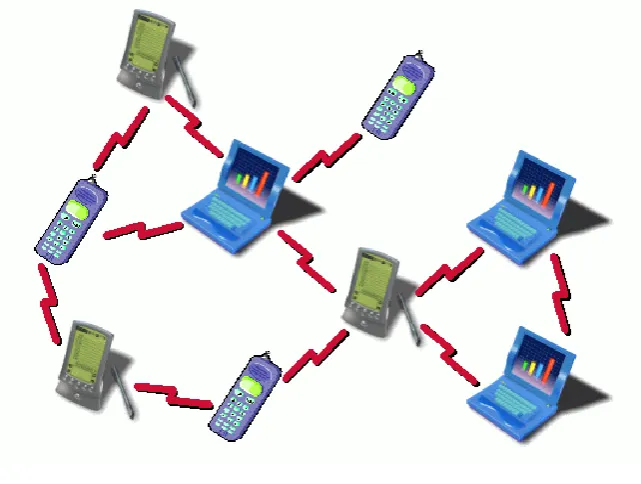
Mobile ad-hoc networks (MANETs) that contains wireless mobile nodes that can independently and dynamically self-configure and self-organize with temporary ad hoc network topologies. There is any structure of topologies are possible to make their network environment. Manet routing is a bidirectional communication process. Every routing transaction divided into route discovery and route management.
Fig. 1: Ad hoc network
A.Nancy, International Journal of Computer Science and Mobile Applications,
Vol.3 Issue. 4, April- 2015, pg. 1-7
ISSN: 2321-8363
the nodes. Maintaining accurate information about the status of a network for routing purposes becomes difficult because of the constraints of the Mobile Ad hoc Network.
Major Challenges in Routing:
Mobility Bandwidth constraint
Error-prone and shared channel Location-dependent contention Other resource constraints Limited power supply Security
Traffic Path distance delay
Requirements of Routing Protocols for Ad Hoc Networks:
Minimum route acquisition delay:
Procurement delay of route for a node that does not have minimal possible destination node. The delay may change based on size of network and network load.Quick route reconfiguration:
The incalculable changes in network topology require to quickly performing path configuration to manage path break and subsequent packet losses.Loop-free routing:
The basic requirements of any routing protocols are avoid the unnecessary wastage of network bandwidth. The routing protocol should detect transient loop formation and take corrective actions.Distributed routing approach:
An ad hoc network is a distributed wireless network and it use centralized routing approaches in large amount of bandwidth consumption.Minimum control overhead:
Minimum management process in finding new route and maintaining existing route. It consumes higher bandwidth and can cause in collision with packets to reduce the network throughput.Scalability:
Scalability is a main ability feature to perform efficiency with large number of nodes. It requires minimum control overhead and network size.Provisioning of QoS:
This should able to provide certain amount of QoS depends upon nodes requirements.Support for time-sensitive traffic:
Strategically communication and related applications need support for time-sensitive traffic such as hard real-time and soft real-time.Security and privacy:
The QoS must be resilient to the cause of threats and vulnerabilities. It must have the capability to avoid resource utilization, denial of service, impersonation, and attacks.2. Quality of Services (QoS):
The network provides number of necessary services to some congestion for satisfying the users related process is known as Quality of Services. The aim of QOS is ensure the limitation of predetermined service operations based on end-to-end delay, available bandwidth and Packet loss probability [1]. Some of factors that influence QoS of wireless networks include [2]:
Throughput of Network:
A.Nancy, International Journal of Computer Science and Mobile Applications,
Vol.3 Issue. 4, April- 2015, pg. 1-7
ISSN: 2321-8363
Retransmission attempts:
It shows total number of retransmission attempts by all wireless LAN in the network until the final changes in transmission process such as successful delivery or discarded.
Data dropped:
Data dropped due to unavailability of medium access in the transaction.
Medium Access Delay:
It has total of queuing and contention delays of data.
2.1. QoS based Challenges:
Dynamic varying network topology Imprecise state information Scare resources
Absence of communication infrastructure Lack of centralized control
Power limitations
Heterogeneous nodes and networks Error-prone shared radio channel Hidden terminal problem Insecure medium Other layers
3. QoS Routing Protocols:
The QoS routing protocol classified based on five aspects. They are
Network topology: (Flat, Hierarchical and Location-aware),
An approach to route discovery with QoS: (Proactive, Reactive and Hybrid). Interaction between the network and the MAC layer: (Dependent or Independent) QoS metrics focused: (Single constrained or Multi constrained)
Type of QoS guarantee assured: (Hard or Soft)
3.1. Network Topology based Protocols:
HQMRP (Hierarchical QoS Multicast Routing protocol) provide multicast routing at each level for efficient and scalable packet delivery. SOM (Self Organizing Map) providing a feature for automatic organizing the hierarchical structure. LGF (Location-based Geo casting and Forwarding) and SPBM (Scalable Position-Based Multicast) protocols are different location based routing protocols [3].
3.2. Route Discovery with QoS based protocols:
QoS Optimized Link State Routing (QOLSR):
A.Nancy, International Journal of Computer Science and Mobile Applications,
Vol.3 Issue. 4, April- 2015, pg. 1-7
ISSN: 2321-8363
Predictive Location-Based QoS Routing (PLBQR):
QoS routing is based on resource possibility between two neighbour nodes. Perfect prediction is not possible because of direction changed dynamically. But the transmission is made when the linear pattern is available. The benefit of this approach is the prediction for new available location based on previous location [5].
QoS Multicast Routing Protocol with Dynamic group topology (QMRPD):
The QMRPD is a hybrid protocol which attempts to significantly reduce the overhead of constructing a multicast tree with multiple QoS constraints. In QMRPD, a multicast group member can join or leave a multicast session dynamically, which should not disrupt the multicast tree. It satisfies the multiple QoS constraints and least cost’s (or lower cost) requirements. Its main objective is to construct a multicast tree that optimizes a certain objective function (e.g., making effective use of network resources) with respect to performance-related constraints (e.g., end-to-end delay bound, inter-receiver delay-jitter bound, minimum bandwidth available, and maximum packet-loss probability) and design a multicast routing protocol with dynamic group topology. It attempts to minimize the overall cost of the tree. The dynamic group membership has been handled by this protocol with less message processing overhead [6].
Ad hoc QoS on-demand routing (AQOR):
This protocol uses limited flooding to discover the best route available in terms of smallest End-to-end delay with bandwidth guarantee. A route request packet includes both bandwidth and end-to-end delay constraints. If multiple request packets arrive at the destination, it will send back a reply packet along each of these routes. Intermediate nodes will only forward the reply, if they are still in explored state. However, the bandwidth reservation for each flow is only activated by the arrival of the first data packet from the source node. Delay is measured during route discovery. The route with the least delay is chosen by the source. No mechanism for connection tear-down is needed or integrated, since all reservations are only temporary. Timers are reset every time a route is used. So there is an upper time bound after which broken routes are detected.
To further reduce communication overhead during route discovery, AQOR can work with some location aided routing protocols. For delay violation detection, the estimated time offset between the systems clocks of source and destination node has to be known [7].
QoS Routing Protocol Route Discovery Network Architecture Resource Reservation Types of QoS Guarantee
QoS Metrics Routing
Overhead
PLBQR Hybrid Location Prediction
No Soft Delay and
Bandwidth
Route computation link breakage QMRPD Reactive Hierarchical Yes Pseudo-Hard Bandwidth
Delay, Delay Jitter, and Cost Less message processing overhead
QOLSR Proactive Hierarchical Yes Soft Throughput and Delay
Minimum flooding of RREQ
QAODV Reactive Flat No Soft Bandwidth,
Delay
Node traversal delay
A.Nancy, International Journal of Computer Science and Mobile Applications,
Vol.3 Issue. 4, April- 2015, pg. 1-7
ISSN: 2321-8363
3.3. Protocols depends on communication between network and MAC layer:
A.QoS based Metric protocols:
Single Constrained: Single constrained routing protocol is faced many success in many aspects. It cannot capable for supporting the entire situation. In CEDAR protocol, the only parameter is bandwidth used for QoS routing. Most of the application in multimedia requires the communication to meet stringent requirements on delay, delay-jitter, cost and other QoS metrics. In this status, we moved from single constrained to multi constrained.
Multi Constrained: The main aspect of multi constrained QoS routing is to find a optimal path that satisfies multiple constraints simultaneously, which is a big challenge for MANETs where the topology may change constantly and dynamically. It has been proved that such a problem is NP-complete. QMRPD (QoS Multicast Routing Protocol for Dynamic group topology) [33] GAMAN (Genetic Algorithm-based routing for MANETs) HMCOP (Heuristic multi Constrained Optimal Path) are typical multi constrained routing protocols.
B.QoS guarantee based protocols:
Hard QoS: The QoS provisioning approaches can be broadly classified into two categories, hard QoS and soft QoS approaches. If QoS requirements of a connection are guaranteed to be met for the whole duration of the session, the QoS approach is termed as hard QoS approach. In MANETS it is very challenging to provide hard QoS guarantees to user applications. Some of the protocols NSR and SIRCCR [35] (SIR and Channel Capacity based Routing).
Soft QoS: If the QoS requirements are not guaranteed for the entire session, the QoS approach is termed as soft QoS approach. Thus, QoS guarantees can only be given within certain statistical bounds. Most of the protocols provide soft QoS guarantees.
3.3. Difficulties of QoS Routing:
QoS provides higher computational and communicational cost. It needs large time to connection setup and maintenance process. Various complex issues faced by QoS routing in Ad hoc Networks such as [8]
Unreliable Channel Maintenance of Route Mobility of the node Limited Power Supply Lack of Centralized Control Channel Contention Security
4. Description of QoS
4.1. Evaluation Metrics to prove its Need of QoS Routing:
Minimum Throughput: data throughput for desired process.
Maximum Delay: Maximum acceptable end-to-end delay for every data packets.
Maximum Delay Jitter: variation between maximum end-to-end delay and minimum delay. Maximum Packet Loss Ratio: Total packet sent and counting of received packets.
4.2. Improved QoS for Real Time Traffic in MANETs:
A.Nancy, International Journal of Computer Science and Mobile Applications,
Vol.3 Issue. 4, April- 2015, pg. 1-7
ISSN: 2321-8363
queue of that node is counted and then ratio of number of BE packets to the number of rest of the packets of queue is calculated [9].
This process is repeated at each node through which the RREQ message is passed and reached up to the destination. The value of R is finally reached at the destination and the destination will divide R with hop count value of the REEQ message it has received and produces the average R. The destination will compare the average R value with all requests it received with same sequence number and broad cast ID and unicast RREP message back to the neighbour whose average R value is less. Figure 3 above is explaining the whole process in detail [10].
4.3. Quality of Service Provisioning:
A.QoS Parameters:
There are different applications are available recently. Each application has different parameters as per their level of QoS. For example, the bandwidth, and delay are the QoS key parameters of multimedia applications. MANET has for basic parameters such as Packet delivery ratio, Energy, Bandwidth, and Delay.
B.QoS Aware Routing:
The QoS routing protocol is use QoS Parameters for finding path. The decision making progress consider the following parameters are network throughput, Packet delivery ratio, reliability, delay, delay jitter, packet loss rate, bit error rate, and path loss.
4.4. QoS Framework:
A framework for QoS is a finalized system to provide the services to user or application. The key component of QoS framework is a service model which defines the user requirements. The issue of key design is per-session basis or per-class basis. The other key component is QoS routing to find the feasible paths to satisfy user requirements, QoS signal for resource reservation, QoS medium access control, and scheduling schemes. Routing protocol, signalling protocol, and resource management are modules of QoS which are changes according to network state and flow state.
5. Conclusion:
In this work, we discussed about supporting factors for QoS routing in Mobile Ad Hoc Networks such as evaluation metrics, routing protocols, strength, need and challenges. An individual protocol cannot give any quality of routing so there is some need for implementation based on updates of QoS routing requirements. These protocols satisfied the QoS of efficient routing when it satisfy all the parameters of QoS.
Future focus for Some Open Issues:
Selection of QoS metric and design of cost function. Multi-class traffic
Scheduling mechanism at source
Packet prioritization for control messages QoS routing that allows pre-emption Integration with MAC layer
Heterogeneous network
References:
[1] Luo Liu, Cuthbert, L.,2008, ”A Novel QoS in Node-Disjoint Routing for Ad-Hoc Networks”, IEEE ICC Workshop.
A.Nancy, International Journal of Computer Science and Mobile Applications,
Vol.3 Issue. 4, April- 2015, pg. 1-7
ISSN: 2321-8363
[3] G. Santhi, Alamelu Nachiappan, August 2010, “A survey of QoS Routing Protocols for Mobile Ad Hoc Networks”, International journal of computer science & information technology (IJCSIT), Vol.2, No.4.
[4] R.Sivakumar, P.Sinha and V.Bharghavan, “CEDAR: a core-extraction distributed ad hoc routing algorithm” IEEE J.Select.Areas Commun., vol.17, pp.1454-1465, 1999.
[5] L.A.Latif, A.Alliand, C.C. Ooi, 2005, “Location based geocasting and forwarding (LGF) routing protocol in mobile-adhoc network”, Proceedings on the Advanced Industrial Conference on Telecommunications/Service assurance with partial
Intermittent Resources, 536-541.
[6] Li Layuan and Li Chunlin, 2005, “A QoS Multicast Routing Protocol for Dynamic group topology”,Information Sciences 169, 113-130.
[7] L.Barolli, A.Koyama et al., 2003, “A QoS routing method for ad-hoc networks based on genetic algorithm”, in Proc.14th
Int.Wksp. Database and Expert Systems Applications, pp.175-179.
[8] S.Saunders, 1999, “Antennas and Propagation for Wireless Communication System Concept and design”, New York,
USA: John Wiley and Sons.
[9] P. R. J. Jeni, A.V. Juliat and B. Shaji 2010, “A novel QoS frame work for MDSRAODV Routing Protocol in MANET” International Journal of Computer Science and Network Security, VOL.10 No.10, October.
[10] P. K. Suri, M .K. Soni and P. Tomar, October 2010, “Cluster Based QoS Routing Protocol for MANET” International Journal of Computer Theory and Engineering, Vol. 2 No. 5.
[11] C.R.Lin and J.S. Liu., 1999, “QoS routing in ad hoc wireless networks”, IEEE J.Select.Areas Commun., vol.17,
pp.1426-11438.
[12] Ash Mohammed Abbas, Kure, 2008, “Quality of Service in Mobile Ad Hoc Networks a survey”, Int J Ad Hoc and Ubiquitous Computing, Vol X, No xxxx.
[13] Imad Jawhar, Jie Wu, 2004, “Quality of Service in Mobile Ad Hoc Networks”, Resource Managemnt in Wireless Networking.
[14] Seema, Yudhvir Singh, Vikas Siwach, Oct 2012,”Quality of Service in MANET”, International Journal of Engineering and Technology (IJIET), Vol. 1, Issue 3.
[15] Zazti, November 2001, “A Glance at Quality of Service in Mobile Ad Hoc Networks”, Seminar in Mobile Ad Hoc Networks.