http://mojem.um.edu.my 89
Corresponding Author:
Department of Educational Management, Planning and Policy Faculty of Education, University of Malaya
Email: [email protected]
ABSTRACT
School finance is a crucial component of every education system, but comprehensive guidance on what matters in school finance systems is lacking. Systems Approach for Better Education Results (SABER) presents a clear framework for benchmarking school finance systems together with six policy goals that all systems should meet. These goals promote effective strategies for channeling resources through the system, which begins with policies to ensure basic learning conditions, especially for disadvantaged students. This requires an informed and objective budgeting process, as well as monitoring resources on their way to the service delivery unit, the schools. This research deployed qualitative methodology to identify the appropriate framework for Malaysian school finance systems. The Malaysian government has launched a comprehensive review of the education system in Malaysia in order to develop a new National Education Blueprint. This decision was made in the context of rising international education standards, the Government’s aspiration of better preparing Malaysia’s children for 21st century needs, and increased public and parental expectations of education policy. The Malaysian government plans to maximize student outcomes for every ringgit. In this context, the SABER theoretical framework serves as guidance for efficient school financial system management.
Keywords: School finance; equity, efficiency, adequacy, Malaysia OCTOBER 2014, VOLUME 2, ISSUE 4, 89 - 110
E-ISSN NO: 2289 – 4489
FUTURE TRENDS IN THE MANAGEMENT OF SCHOOL FINANCE: A DOCUMENTARY ANALYSIS
http://mojem.um.edu.my 90 INTRODUCTION
Education is a key driver of growth in our economy. The Malaysian Government has sustained high levels of investment in education over the 55 years since independence. In 2011, the amount spent, at 3.8% of GDP or 16% of total government spending, was not only higher than the OECD average of 3.4% of GDP and 8.7% of total public spending respectively, but also at par with or more than top-performing systems such as Singapore, Japan, and South Korea. In 2012, with an education budget of RM37 billion, the Government has continued to devote the largest proportion of its budget, 16%, to the Ministry. This demonstrates the high level of Government commitment to education as a national priority. The education system has made tremendous progress since 1957. At the time of Independence, over half the population had no formal schooling, while only 6% of Malaysian children had been educated to secondary level, and a paltry 1% to the post-secondary level.
However, in 2011, Malaysia had achieved near universal enrolment at the primary level at 94%, and the percentage of primary school drop-outs had been significantly reduced (from 3% in 1989 to just 0.2% in 2011). Enrolment rates at the lower secondary level (Form 1 to 3) had risen to 87%. The greatest improvement was undoubtedly at upper secondary level (Form 4 to 5), where enrolment rates had almost doubled, from 45% in the 1980s, to 78% in 2011.
Despite this, Malaysian students’ achievement in international assessment such as the Programme for International Students Assessment (PISA) and Trends in International Mathematics and Science Study (TIMSS) are not compatible with the amount allocated by the Malaysian government. Recently, international assessments are used as benchmark for comparing the outcome of student learning from different educational systems. This assessment takes into consideration various cognitive skills such as application and synthesis.
In the latest PISA assessment, almost 60% of Malaysian students failed to meet the minimum benchmarks in Mathematics—the baseline proficiency required for students to participate effectively and productively in life. Similarly, 44% and 43% of students do not meet minimum proficiency levels in Reading and Science respectively. Data as of 2010 indicates that Malaysia’s performance lags behind other countries having similar or lower levels of expenditure per student, such as Thailand, Chile, and Armenia. This suggests that the system may not be allocating funds towards the factors that have the highest impact on student outcomes, such as the training and continuous upskilling of teachers. High-performing systems such as Singapore, South Korea, and Shanghai, however, do spend more per student than Malaysia (OECD, 2011, 2013). The education system is also about to embark on a major transformation effort. Consequently, Malaysia’s expenditure levels should be maintained but the efficiency and effectiveness of fund allocation and expenditure should be reviewed.
http://mojem.um.edu.my 91 According to the National Education Blueprint 2013, the Malaysian government will be fully responsible for ensuring that students’ outcome is maximized for every ringgit. The transformation includes changes in the way the government evaluates, distributes resources and monitors the programs and initiatives. Priority is given to the program and initiatives that will yield in the greatest impact on students learning.
This article discusses the basic principles in school financial management. It then presents SABER as a clear framework for benchmarking school finance systems together with six policy goals that all systems should meet (World Bank, 2012).
Basic Principles in the School Finance System
School finance is an essential component of every education system, but comprehensive guidance on what matters in school finance systems is lacking. SABER-School Finance analysis identifies the strengths, which can serve as examples to other school finance systems, and weaknesses, or areas to target for reform or additional in-depth research (World Bank, 2012). The theoretical framework for school finance management can be used as guidance for other countries having similar characteristics. It is hoped that the data analysis using this framework can be beneficial for policy makers, researchers and other stakeholders.
Previous research in school finance states that there are three basic principles in education financing: adequacy, equity and efficiency. The concept of equity and adequacy ensures that the educational system provides at least the minimum resources needed for students’ learning regardless of student socio-economic background (Underwood, 1995). Meanwhile the concept of efficiency determines whether the financial allocation has been utilized to the maximum level.
Adequacy
Education finance systems should provide sufficient resources to ensure that all students receive a high quality basic education. Specific basic education standards and goals differ according to the context of each country and the costs of achieving these standards will vary by student (Baker & Green, 2008). Even though each country in the world has its own objectives and standards of education, almost all the countries have a similar concern, that is, to ensure the school finance system provides sufficient resources to develop citizens who are able to make informed decisions and acquire the skills and knowledge to succeed in work and life.
http://mojem.um.edu.my 92 Alternatively, given the absence of data on student performance in many low income countries, an adequate education may be defined as a minimum set of school inputs required for learners to have a quality basic education (Reschovsky, 2009).
An adequate level of education is associated with the education production model. This model is usually used to estimate the total educational input that is needed to achieve a certain level of learning outcomes. Examples of educational inputs are resources that are required in schools (for example, school resources, teacher quality, the socio-economic background, student ability and others). In theory, education finance policymakers set a target for student achievement, and then allocate at least the minimum resources required to meet that goal. However, in practice, education finance policymakers can only control school related factors. There are two ways to determine the adequate amount of school resources. Policymakers can tally the amount necessary to purchase the required inputs based on professional judgment, or they can benchmark against the inputs used by a successful school.
Efficiency
The efficient education system requires investment in educational inputs with the largest marginal return. The necessity to increase and preserve access to quality education is becoming a huge challenge for policy makers in developing countries where education is the most important item in the government budget. It is important for governments, providers and beneficiaries to use educational resources in a transparent, accountable manner, utilizing good governance. An efficient school finance system achieves higher learning outcomes with the same amount of resources. This can occur if two comparable education systems have the same test scores, but one has a lower cost per student, or if two systems have the same cost of provision, but one has higher test scores. The degree of efficiency in a school finance system will impact future allocations: if resources are not used to their potential in the present. In this case, additional resources will not necessarily improve learning outcomes. Lack of efficiency in school finance systems can be the reason for the lack of clear relationship between expenditure and educational outcomes.
http://mojem.um.edu.my 93 Equity
One of the important aims of financing an educational system is to promote equity of educational opportunities. Each student should be given equal chance to acquire quality education regardless of gender, ethnicity, socio-economic background or ethnic group. Yet, there are multiple non-school factors that influence students’ learning. Inequalities in educational achievement due to differences in socio-economic background have greater impact than those due to other influences. Gender still affects attainment. In some parts of the world, girls and boys are not given equal opportunity in education even though various initiatives have been taken to overcome this inequality (Brown & Park, 2002; Filmer, 2008; World Bank, 2011). Although socio-economic background is the most influential factor in determining learning outcomes, the intersection of two or more factors can multiply the negative effect.
There are two types of equity in school finance. Horizontal equity emphasizes equal funding across schools and school districts. Schools and school districts are considered to be similar to each other with respect to the cost of providing basic education, such as wealth, size and socioeconomic status (Toutkoushian & Michael, 2007). On the other hand, vertical equity states that for education funding to be equitable, school districts that comprise of students that are more costly to educate (such as student from lower socio economic groups or indigenous populations) should receive more funding than their counterparts to compensate for such variance (World Bank, 2012). In other words, this means states will make adjustments in their funding formulas to allocate more money to schools with more needs. For example, Kansas increases per-pupil funding levels for students who are receiving free lunch by 10 percent (Toutkoushian & Michael, 2007). However, the decision to focus on the vertical or horizontal equity depends on the objective of financial management system.
The Malaysia Education Blueprint (2013) emphasizes equal opportunity for education of international quality in the shift 1. The Ministry would like to improve quality provision for a few groups of students whose circumstances or needs are different from the mainstream. These groups include children in under enrolled schools, students from indigenous and minority groups including Orang Asli and Penan, gifted children and children with special needs. Programs, schools and initiatives that cater to the additional needs of these students will allow them to benefit equally from the Malaysian education system. Currently, the mainstream schools lack disabled-friendly facilities such as ramps, railings, handicap toilets and lifts. However, the national education blueprint promises to ensure provision of appropriate technical aids for special education students such as Braille typing machine for visually impaired students. The allocation of financial aids resources towards the allocation of special education needs will be based on careful, case by case, cost benefit analysis.
METHODOLOGY
http://mojem.um.edu.my 94 FINDINGS
SABER in the Malaysian Context
The financial resource that is needed depends on the surrounding and the objective of education. However, each educational financial system is responsible for determining the minimum resources needed to produce quality education. This system needs to take into consideration the differences in the financial allocations and student learning and promote equity in leaning opportunities. Previous researches emphasized six policy objectives that each school financial system needs to achieve to overcome the issue of adequacy, equity and efficiency.
Figure 1. SABER: School finance policy goals. Ensuring basic
conditions for learning
Overseeing service delivery
Budget with adequate and
transparency information Managing resources
effectively
Monitoring learning conditions and
outcome
Providing more resources to students who need
them
http://mojem.um.edu.my 95
Policy Goals
Policy Levers
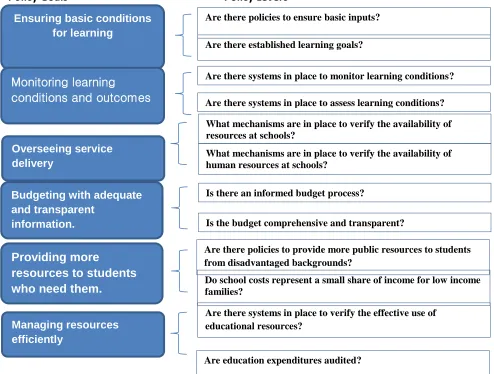
Figure 2. Summary of School Finance Policy Goals and Policy Levers (World Bank, 2012, p. 17)
School Finance Policy Goals and Policy Levers
Policy Goals 1: Ensuring Basic Conditions for Learning
School finance management system should create a conducive learning environment for the children. Even though the standard of students’ achievement as well as the costs to reach those standards might vary across countries and students group, there is minimum resource that is required to encourage learning. It is difficult to estimate the precise costs for these resources. However, if students do not have access to a fundamental set of resources, they will be unable to acquire the skills and knowledge necessary to fully develop their capacities and make informed decisions.
Ensuring basic conditions for learning
Are there policies to ensure basic inputs?
Providing more
resources to students
who need them.
Managing resources efficiently
Monitoring learning
conditions and outcomes
Overseeing service delivery
Budgeting with adequate and transparent
information.
Are there established learning goals?
Are there systems in place to monitor learning conditions? ?
Are there systems in place to assess learning conditions?
What mechanisms are in place to verify the availability of resources at schools?
What mechanisms are in place to verify the availability of human resources at schools?
Is there an informed budget process?
Is the budget comprehensive and transparent?
Do school costs represent a small share of income for low income families?
Are there systems in place to verify the effective use of educational resources?
Are there policies to provide more public resources to students from disadvantaged backgrounds?
http://mojem.um.edu.my 96 There are 2 policy levers to assess these policy goals:
Policy Lever 1a) Are there policies to ensure basic inputs?
Policies at the government level are needed to ensure that government is fully committed to providing equal learning opportunities for school children. This includes the commitment to provide basic infrastructure and facilities needed for learning. The process of translating inputs to learning outcome is quite complex but school financial policy needs to stipulate which inputs need to be provided so that financial allocation can be channeled appropriately. A school funding formula is usually based on number of students enrolled or number of schools in a district.
At a minimum, policies should provide basic infrastructure, teachers and instructional materials. Three aspects of basic infrastructure contribute to learning: water supply, functional hygienic facilities, for instance, toilets or latrines as appropriate (Chaudury et al., 2006). The Malaysia Education Blueprint 2013-2025 ensures that 100 percent of schools meet basic infrastructure requirements by 2015, starting with Sabah and Sarawak—that currently faces the greatest infrastructure challenges. Every school in Malaysia, regardless of location, size, or type, will meet a set of minimum infrastructure requirements to create a safe, hygienic, and conducive environment for learning. This includes access to clean, treated water; at least 12 hours of electricity per day, along with sufficient toilets, classrooms, tables, and chairs for the student and teacher population.
The teachers’ qualities are determined by the criteria used to select a public school teacher (Rockoff et al., 2009). Teachers and school leaders are the most important school-based drivers of student outcomes. Seminal research conducted in the state of Tennessee, USA in the mid-1990s showed that high-performing teachers can improve student achievement by up to 50% over a three-year period, relative to low-performing teachers. According to the Malaysia Education Blueprint, the entry bar for teachers has been raised from 2013 to be among the best 30 percent of the graduates.
http://mojem.um.edu.my 97 To maximize the impact from investment, the Ministry will also invest in ICT-competency training for all teachers, and gradually improve the device-to-student ratio from approximately 1:30 in 2011 to 1:10 by 2020. In order to maintain cost effectiveness, the Ministry will invest in fit-for-purpose devices such as basic computers or low-cost laptops.
Policy Lever 1B: Are there established learning goals?
Defining learning goals provides guidance to the education system on how to use its resources. For example, in Ontario, Canada, education goals include improving performance on mathematics and reading assessments, and increasing the secondary school graduation rates (Education Quality and Accountability Office, 2010). Other countries with well-defined performance goals (such as France, Japan, and the Netherlands) perform well on international assessments (Resnick et al., 1995). Specific performance goals such as attaining certain level of scores in national examinations can also provide set targets for school finance.
Policy Goals 2: Monitoring learning conditions and outcomes
Accurate information on learning conditions and learning outcomes is necessary to inform policy, and policy makers are more likely to use this data for decision making (Crouch, 1997). Monitoring learning conditions and student achievement will also allow school finance systems to hold schools accountable and measure resource use efficiency. Without knowledge on which inputs are available and how these inputs translate into learning outcomes, it will be difficult for school finance systems to allocate funds strategically.
Two policy levers to assess progress in this policy goal:
(A) Are there systems in place to monitor learning conditions? (B) Are there systems in place to assess learning outcomes?
Policy Lever 2A: Are there systems in place to monitor learning conditions?
Even though there are policies that require basic educational inputs to be provided, there is no guarantee that those inputs are available in all schools. So school finance systems must track the extent to which these policies are implemented. A system to monitor educational inputs can be a tool for accountability in the use of funding at the school level as well as a way to improve budget plans. Policy makers will be able to use the information on basic infrastructure, teachers, and teaching and learning materials availability to redirect resources to the neediest schools or to make appropriate intervention in schools lacking the desired inputs. Ultimately, monitoring learning conditions is only useful if the data are actually used by the actors in the school finance system (Amin et al., 2008).
Policy Lever 2A: Are there systems in place to assess learning conditions?
http://mojem.um.edu.my 98 A system to monitor educational inputs can be a tool for accountability in the use of funding at the school level as well as a way to improve budget plans. Policy makers will be able to use the information on basic infrastructure, teachers, and teaching and learning materials availability based on assessment of learning conditions, to redirect resources where necessary or undertake remedial action in schools deprived of the desired inputs. (Amin et al., 2008).
In order to provide relevant feedback to the policy makers, the information system needs to collect information on educational inputs consistently. Such information enables policy makers to channel resources to the schools most in need and also hold schools accountable for the use of resources, such as teacher salary. Availability of administrative information on current enrollment and teacher information at the school level also allows budgets to be systematically allocated to represent school and student needs (Porta & Arcia, 2011). In addition, monitoring students’ attendance is important for education policy makers to verify whether learning has occurred (Sparks, 2010). It is also important for education authorities to know how many students are present in cases where schools receive funding on a per student basis.
According to the Malaysia Education Blueprint (2013-2025), the Ministry of Education acknowledges that there are still significant gaps in school infrastructure. A sizeable number of schools still lack basic infrastructure—an estimated 300 schools still lack access to 24-hour electricity while 1,500 schools lack access to potable water. Furthermore, many schools also lack more advanced facilities—approximately 2,700 schools do not have computer labs while 2,000 schools also lack functioning science labs. In addition, maintenance of existing facilities is also a significant concern. A 2011 Physical Infrastructure Audit report found that over 30% of all schools in Malaysia were in need of immediate repair. The Ministry allocated RM600 million in 2012 to address these concerns and will make further investments as necessary.
There is certain degree of uncertainty about whether or not the standard brief for new building is the right definition of the required minimum infrastructure. The standard brief stipulates the provision of utilities, such as 24-hour access to electricity and clean water, and facilities such as science laboratories, staff room, canteen, library, and school playing field. However, the Smart School roadmap, introduced in 2005, included an extra commitment to provide one computer for every 20 students, along with internet access. This situation has resulted in confusion about whether or not every school needs to be upgraded to meet those specifications.
Another important element is the infrastructure that the school needs might differ based on location and type of schools. For instance, technical, vocational and special education schools need equipment that is different from that of the normal schools. Thus, the government needs to be careful in identifying
http://mojem.um.edu.my 99 Figure 3. Gaps in school infrastructure identified by the Malaysia Education Blueprint.
Policy Lever 2B: Are there systems in place to monitor learning conditions?
http://mojem.um.edu.my 100 Policy Objective 3: Overseeing service delivery
In addition to monitoring at the policy level, proper monitoring at implementation level is needed. An efficient school financial management system ensures that the resources are translated into educational opportunities at the provider level. Unfortunately, most of the previous research focuses either on the educational inputs or outputs, without considering the middle step of adequate service delivery.
Two policy levers used to assess progress in this policy are:
(A) What mechanisms are in place to verify the delivery of resources at schools?
(B) What mechanisms are in place to verify the availability of human resources at schools?
Policy Lever 3A: What mechanisms are in place to verify the delivery of resources at schools?
School Finance systems should ensure that resources are used to the most efficient extent possible. This includes the number of hours that children spend in school. Previous researches show that increasing the teaching and learning hours in school are linked to the learning gains across subjects and settings (Lavy, 2010; Bellei, 2009; Cerdan-Infantes & Vermeersch, 2007). In addition, delays in disbursement of text books at the beginning of the year can hinder learning. Thus, all the schools and the involved parties need to ensure that text books are provided to schools in time.
According to the Malaysia Education Blueprint 2013-2025, in the shift number 7, the Malaysian government will leverage ICT to scale up quality learning across Malaysia. Even though the Ministry has spent more than RM6 billion on Information and Communications Technology (ICT) over the past decade in education initiatives such as Smart Schools—one of the most capital-intensive investments the system has undertaken. However, ICT usage in schools continues to lag expectations—both in terms of quantity and quality. For example, a 2010 Ministry study found that approximately 80% of teachers spend less than one hour a week using ICT, and only a third of students perceive their teachers to be using ICT. One main reason for teachers not using the computer might be the delay in internet access. Thus, the government plans to provide internet access and virtual learning environments via 1BestariNet for all 10,000 schools by 2013.
Policy Lever 3B: What mechanisms are in place to verify the availability of human resources at schools?
http://mojem.um.edu.my 101 Policy Objective 4: Budget with adequate and transparent information.
Educational budget represents the plan for implementing educational policies. Objective information with respect to resource needs should be incorporated to develop a budget that reflects educational priorities and the need to use reliable data continues throughout budget execution. Reported educational expenditures of all levels of government along budget priorities allow school finance systems to monitor the success of budget execution and make adjustments as necessary.
Policy Lever 4A: Is there an informed budget process?
Educational budgets are created in a political environment to deliver education priorities, preferences, and goals, which creates opportunity for subjective distribution of resources (Gildenhuys, 1997). A clear and systematic financial management system enables various stakeholders to monitor the distribution process of resources from the ministry and eventually to schools (Alonso & Sanchez, 2011). Other budget decision-making processes, such as negotiations or an incremental increase of the previous year’s budget, may not result in allocations that accurately reflect school needs. Factors that influence the budget should explicitly address drivers of education expenditure, such as teaching staff, enrollment, or changes in unit costs.
Education expenditure has long-term consequences as a cumulative investment in students over their schooling years. Certain commitments may require recurring spending each year, whereas other spending such as school construction may preclude spending in future years. Therefore, education expenditure must be considered on a multi-year basis to allow for sustainability and predictability of funding (Andrews & Campos, 2003). Future educational expenditure should be budgeted and clearly linked to policy plans.
Policy Lever 4B: Is the budget comprehensive and transparent?
http://mojem.um.edu.my 102 Policy Objective 5: Providing more resources to students who need them
School financial systems should seek to improve educational outcomes especially for students from disadvantaged backgrounds. Access and achievement in education should not be influenced by the student’s socio-economic background (Oosterbeek & Patrinos, 2009). However, in most circumstances, when poverty increases, students’ attendance rates decreases (Glick & Sahn, 2009). The differences in students’ academic achievement are not only due to income level differences across countries but also to a greater extent by socio-economic background within countries (Filmer, 2008). Equity can be difficult to measure but the objective is to promote equal opportunities by fairly providing unequal resources to
students with differing educational challenges.
The Malaysia Education Blueprint (2013-2025) mentioned that the Ministry is aware that the largest equity gaps in Malaysia are due to socio-economic differences among students. In order to overcome this, the Ministry has committed itself to eliminating this inequity through various initiatives such providing financial assistance to disadvantaged students (KWAPM financial aid). However, the evidence consistently demonstrates that students from poor families are less likely to perform as well as students from middle-income or high-income households. Schools with higher concentrations of low income students were more likely to fall in Band 6 or 7 on the NKRA scale. Similarly, more than three-quarters of all high performing schools have less than a third of their students on financial aid. It appears that the largest achievement gaps in Malaysia are still those driven by socio-economic status, despite the government’s significant investments thus far.
Policy Lever 5A: Are public resources available to students from disadvantaged backgrounds?
Most often, the school financing system will provide additional allocations to schools that teach students from lower socio-economic background so that schools can provide targeted services such as specialized learning materials. In some countries, the school funding formula has been modified so that additional allocations can be provided based on students’ needs. For instance, in the USA, the school funding formula incorporates additional allocations to Hispanic children (Odden, 2010). In less developed countries, government provides initiatives in terms of money to encourage poor families to send their children to school (Schultz, 2004)). Various approaches can be used to identify disadvantaged students. For instance, these students can be identified based on income, ethnicity or geographical characteristics. Additional provisions are also needed for special need students since their learning materials need to cater to their specific needs. The United Nations Convention on the rights of persons with disabilities recognizes the right of all children with disabilities to be included in the general education systems and to receive the individual support they require (World Health Organization, 2011).
Policy Lever 5B: Do payments for schooling represent a small share of income for low income households?
http://mojem.um.edu.my 103 However, if these expenses comprise a large portion of household income, then this will be a burden especially for low income households. Although these expenses may seem small, this will increase the opportunity costs for low income families and students. Thus, students from these families need additional assistance to pursue education.
Policy Objective 6: Efficient resource management
Merely allocating resources does not guarantee that learning will occur. Tracking inputs, outcomes, and service delivery is a good start, but insufficient. Reviews of final expenditure are necessary to hold actors in the school finance system accountable for using resources as intended. These mechanisms include how teachers and education staff are paid and monitored (Fiszbein et al., 2011).
Policy Lever 6A: Are there systems in place to verify the use of educational resources?
Financing education begins with the distribution of government funds according to resource needs, or budgeting. After funds have been allocated, they must be disbursed, eventually reaching schools and students. The governance policies affecting transfer of education resources have a substantial influence on quality of service delivery at school level (Fiszbein et al., 2011). This is especially true when actual education expenditure does not resemble the planned budget, hence weakening education policy implementation. Teachers’ salaries account for the majority of education expenditures in many systems. Therefore, school finance systems should maintain a personnel database, or list of all education staff who should be paid every pay period. This database should be updated frequently to account for transfers, dismissals, and new hires, and verified against the payroll database. Teachers’ salaries are unlikely to be misappropriated for other purposes because teachers are usually aware of the amount of expected payments. However, there is a significant risk in salary payment for ghost workers who do not actually teach.
Aside from current educational expenditures, capital educational expenditures such as construction of school buildings are required. Contracts for school constructions should be given to companies that can provide quality services. Any awards for tender should be announced in public so that all interested companies can compete for the tender; open competition has proven to be the most efficient method for awarding these contracts.
Policy Lever 6B: Are educational expenditures audited?
http://mojem.um.edu.my 104 Internal audits can provide regular feedback to education authorities on fund management. These reports should address reliability and integrity of financial and operational information; effectiveness and efficiency of operations; safeguarding of assets; and compliance with laws, regulations, and contracts (PEFA Secretariat, 2005).
Shift 11 in the Malaysia Education Blueprint (2013-2025) focuses on increasing transparency for direct public accountability. The Ministry promises to publish an annual public report on progress against Blueprint targets and initiatives, starting from 2013. All stakeholders will have access to regular and transparent information about the Ministry’s progress against the Blueprint. This information will enable them to engage in a constructive dialog with the Ministry on existing and forthcoming initiatives, and to get involved in their local community school or the broader education system.
SABER’s theoretical framework is used to understand the basic principles of school financial management. Although this framework is not applied by the Malaysian government when designing the Malaysia Education Blueprint (2013-2025), most of the aspects of financial management have been analyzed by the Malaysian government. SABER theoretical framework serves as guidance for us to manage the school financial system efficiently. The subsequent section will detail the Malaysian government plan to maximize student outcomes for every ringgit. One of the major transformations in the school financial management is incorporating the outcome based budgeting and the differentiated budget allocation that will be implemented during the thirteen- year period (2013-2025).
Achieving Efficiency in Malaysian Educational Finance Management
The Roadmap for shift 10: Maximizing student outcomes for every ringgit
The Ministry will ensure greater effectiveness in education expenditure, raising the ROI, and conducting a clear socioeconomic cost-benefit analysis of each major investment. The goal is to minimize the requirement for additional funds while maximizing the ROI in critical areas such as student outcomes. The Ministry aims to achieve efficiency in financial management during the three waves, namely:
Wave 1 (2013 to 2015): Quick wins in rationalization
http://mojem.um.edu.my 105 Review of national policies and programs
The Ministry will review its existing portfolio of policies and programs to focus financial and human resources on the programs that have the most impact on student outcomes (as outlined in this Blueprint). In the initial review in Wave 1, this reprioritization and rationalization exercise was guided by three core principles:
▪▪ Effectiveness: Each program should have a significant, net-positive, and quantifiable impact on a key priority area as established in this Blueprint;
▪▪ Efficiency: Each program should be executed in a resource-efficient manner; and
▪▪ Integration: Each program should integrate smoothly and coherently with all other programs to avoid duplication of effort and/or contradictory objectives and impacts.
In line with this review process, the Ministry has identified a number of programs for rationalization in Wave 1. For example, under the Teaching and Learning of Science and Mathematics in English Language policy or Pengajaran dan Pembelajaran Sains dan Matematik dalam Bahasa Inggeris (PPSMI), the Incentive for Education Subjects or Bayaran Insentif Subjek Pendidikan (BISP) provides an allowance to teachers who teach subjects in English. In 2011, over 210,000 teachers received these Mathematics and Science incentives. Given that PPSMI is in the process of being phased out, the Ministry will also reduce BISP. A 2012 review of teachers who actually teach in English indicated that only approximately 40,000 teachers actually meet the criteria for BISP. Going forward, the Ministry will restrict BISP payments only to eligible teachers, reducing the cost to the Ministry by up to RM413 million. This rationalization process will start by end 2013. Through this rationalization effort, the Ministry expects to reduce the annual cost of those initiatives that can be deprioritized by approximately RM579 million to RM813 million by 2015. These funds will be reallocated to other Blueprint priorities.
Revising procurement processes
The Ministry has undertaken a detailed review of individual line items to identify cost saving opportunities. This includes potential measures such as devolving authority for procurement of certain goods and services to state authorities to enable better matching of supply and demand. Another potential measure is to contract out certain services to the private sector in cases where the Ministry is less well-placed to provide them. This exercise is expected to generate annual savings of RM190 million based on actual expenditure in 2011. The Ministry will also ensure that this detailed review process cascades down to the JPN and PPD levels. The significant variances in expenditure observed at these levels indicate that there are important lessons that JPNs and PPDs can learn from each other.
Incorporating outcome-based budgeting into financial management
http://mojem.um.edu.my 106 priorities outlined in this Blueprint, such that sufficient funding has been put against each of these priorities. The Ministry will also increase the transparency of the budgeting and spending process to ensure clarity of intent and process.
2. The Ministry will explicitly link funding requests to outcome-based targets. Progress against these targets will be tracked each quarter, with further funding conditional on the initiative having demonstrated intended outcomes.
3. The Ministry will link and reconcile system data in a single, integrated dashboard. This will provide the Ministry with the relevant, timely information required to enable quick analyses of effectiveness of expenditure down to the level of individual schools. An integrated online financial management and tracking system will be fully rolled out and implemented across the Ministry by 2015.
4. The Ministry will upskill all relevant administrative personnel by 2015 in critical disciplines such as management accounting and value management to ensure that they are capable of developing comprehensive, need based, and forward-looking budgets.
Wave 2 (2016 to 2020): Effecting system-wide efficiency
The Ministry will shift the focus of its rationalization efforts from delivery of “quick wins” to a system-wide exercise, including elimination of duplication in budgets between divisions as the restructuring process described in the previous section occurs. The Ministry will also expand its review of cost categories from education management expenses to all other costs. As in Wave 1, the Ministry will conduct a detailed line item analysis to identify additional cost-saving opportunities, and build on the OBB process developed in Wave 1 to strengthen its financial budgeting and management processes.
Wave 3 (2021 to 2025): Maintaining best practices
By 2021, the Ministry expects to complete the overall reorganization, including the implementation of the revamped financial management system and processes. As a result, resource productivity will be in line with international standards. For instance, levels of public expenditure should be in line with other education systems with a similar level of performance in international assessments. In Wave 3, the Ministry will focus on maintaining the best practices in ensuring financial efficiency that were developed during earlier Waves.
CONCLUSION
http://mojem.um.edu.my 107 Policy makers do not always know the best way to improve their school finance systems, even though financing is an essential part of any education system; without resources, schools will not function. SABER-School Finance presents a clear framework for benchmarking school finance systems along six policy goals that all systems should meet. These goals promote effective strategies for channeling resources through the system, which starts with policies to ensure learning resources and outcomes, especially for disadvantaged students. This requires an informed and objective budgeting process, as well as monitoring resources on their way to the service delivery unit, the schools.
The Malaysian government has launched a comprehensive review of the national education system in order to develop a new Education Blueprint. This decision was made in the context of rising international education standards, the Government’s aspiration of better preparing Malaysia’s children for the 21st century, and increased public and parental expectations of education policy. The Blueprint also offers a vision of the education system and students that Malaysia both needs and deserves, and suggests 11 strategic and operational shifts that would be required to achieve that vision.
REFERENCES
Alonso, J. D., & Sanchez, A. (Eds.). (2011). Reforming education finance in Transition Countries: Six case
studies in Per Capita Financing Systems. Washington, DC: The World Bank.
Amin, S., Das, J., & Goldstein, M. (Eds.). (2008). An introduction to methodologies for measuring service delivery in education. Washington, DC: The World Bank.
Andrews, M., & Campos, J. E. (2003). The Management of Public Expenditures and its Implications for Service Delivery. Washington, DC: The World Bank.
Banerjee, A., Cole, S., Duflo, E., & Linden, L. (2005). Remedying education: Evidence from two randomized experiments in India. NBER Working Paper 11904. Cambridge, MA: National Bureau of Economic Research (NBER).
Barrow, L., Markman, L., & Rouse, C. (2008). Technology’s edge: The educational benefits of Computer-Aided Instruction. NBER Working Paper 14240. Cambridge, MA: National Bureau of Economic Research (NBER).
Baker, B. D., & Green, P. C. (2008). Conceptions of Equity and Adequacy in School Finance. In H. F. Ladd
& E.B. Fiske (Eds.), Handbook of research in education finance and policy. New York, NY:
Routledge.
http://mojem.um.edu.my 108 Bruns, B., Filmer, D., & Patrinos, H. A. (2011). Making schools work: New evidence on accountability
reforms. Washington, DC: The World Bank.
Brown, P. H., & Park, A. (2002). Education and poverty in rural China. Economics of Education Review 21(6), 523-541.
Carnoy, M., &. Loeb, S.. (2002). Does external accountability affect student outcomes? A cross-state analysis. Educational Evaluation and Policy Analysis 24(4), 305-331.
Chaudhury, N., Hammer, J., Kremer, M., Muralidharan, K., & Rogers, F. H. (2006). Missing in action: Teacher and health worker absence in developing countries. The Journal of Economic Perspectives 20(1), 91-116.
Cerdan-Infantes, P., & Vermeersch, C. (2007). More time is better: An evaluation of the Full-Time School Program in Uruguay. World Bank Policy Research Paper 4167. Washington, DC: The World Bank.
Creswell, J. W. (2012). Qualitative inquiry and research design: Choosing among five approaches. Upper Saddle River, NJ: Pearson.
Crouch, L. (1997). Sustainable EMIS: Who is accountable? In D. Chapman, L. Mahlck, & A. Smulders (Eds.), From planning to action: Government initiatives for improving school-level practices. Paris: UNESCO InternationalInstitute for Educational Planning.
Denzin, N. K., & Lincoln, Y. S. (2005). The Sage handbook of qualitative research (3rd ed.). Thousand Oaks, CA: Sage.
Duflo, E., & Hanna, R. (2005). Monitoring Works: Getting Teachers to Come to School. NBER Working Paper 11880. Cambridge, MA: National Bureau of Economic Research (NBER).
Education Quality and Accountability Office (EQAO). (2010). Programme for International Student
Assessment (PISA), 2009: Highlights of Ontario Student Results. Ontario, Canada: EQAO.
Filmer, D. (2008). Inequalities in education: Effects of gender, poverty, orphanhood, and disability. In M. Tembon & L. Fort (Eds.), Girls’ education in the 21st Century. Washington, DC: The World Bank.
Fiszbein, A., Ringold, D., & Rogers, F. H. (2011). Indicators, assessments, and benchmarking of the quality and governance of public service delivery in the human development sectors. World Bank Policy Research Working Paper 5690. Washington, DC: The World Bank.
Gildenhuys, J. S. H. (1997). Public financial management. Pretoria: J. L. vanSchaik Publishers.
http://mojem.um.edu.my 109 Glick, P., & Sahn, D. E. (2009). Cognitive skills among children in Senegal: Disentangling the roles of
schooling and family background. Economics of Education Review 28(2), 178-188.
Hanushek, E. A., & Raymond, M. E. (2002). Lessons about the design of state accountability systems. Cambridge MA: Harvard University.
Heyneman, S. P., Jamison, D. T., & Montenegro, X. (1984). Textbooks in the Philippines: Evaluation of the Pedagogical Impact of a nationwide investment. Educational Evaluation and Policy Analysis, 6(2), 139-150.
Jamison, Dean T., Barbara Searle, Klaus Galda, & Stephen P. Heyneman. (1981). An experimental study of the impact of textbooks and radio on achievement. Journal of Educational Psychology, 73(4),
556-567.
Lavy, V. (2010). Do Differences in Schools' Instruction Time Explain International Achievement Gaps in Math, Science and Reading? Evidence from Developed and Developing Countries. NBER Working Paper 16227. Cambridge, MA: National Bureau of Economic Research (NBER).
Malaysia Education Blueprint (Pelan Pembangunan Pendidikan Malaysia) 2013-2025. [Online] Retrieved from: http://www.malaysia-students.com/2012/09/pelan-pembangunan-pendidikan-malaysia.html
OECD (2011). PISA 2009 Results: Students on Line: Digital Technologies and Performance (Volume VI). Paris, France: Author.
OECD (2013). Education at a glance 2013: OECD indicators. Paris, France: Author.
http://dx.doi.org/10.1787/eag-2013-en.
Oosterbeek, H. & Patrinos, H. A. (2009). Financing lifelong learning. Empirical Research in Vocational Education and Training, 1(1), 19-37.
PEFA Secretariat. (2005). Public Financial Management: Performance Measurement Framework. Washington, DC: The World Bank.
Pritchett, L., & Filmer, D. (1999). What education production functions really show: a positive theory of education expenditures. Economics of Education Review, 18(2), 223-239.
Porta, E., & Arcia, G. (2011). Improving Information Systems for Planning and Policy Dialogue: The SABER EMIS Assessment Tool. Washington DC: The World Bank.
http://mojem.um.edu.my 110 the international Literature. A report prepared for the Financial and Fiscal Commission. Republic of South Africa.
Resnick, L., Nolan, K., & Resnick, D. (1995). Benchmarking education standards. Educational Evaluation and Policy Analysis, 17(4), 438–61.
Rockoff, J. E., Jacob, B. A., Kane, T. J., & Staiger, D. O. (2009). Can you recognize an effective teacher when you recruit one? New York, NY: Columbia Business School.
Sparks, S. (2010). Districts begin looking harder at absenteeism. Education Week, 20(6), 1-13.
Toutkoushian, R. K., & Michael, R. S. (2007). An alternative approach to measuring horizontal and vertical equity in school funding. Journal of Education Finance, 32(4), 395-421.
Underwood, J. K. (1995). School finance adequacy as vertical equity. University of Michigan Journal of Law Reform 28(3), 493-519.
World Bank. (2003). World Development Report 2004: Making services work for poor people.
Washington, DC: The World Bank.
World Bank. (2011). World Development Report 2012: Gender equity and development. Washington, DC: The World Bank.
World Bank. (2012). Systems approach for better education results-School Finance: What matters most in school finance. Human Development Network.