Copyright © 2013 (Bruce Bimber, Jennifer Brundidge, Meredith Conroy, Erica Lively). Licensed under the Creative Commons Attribution Non-commercial No Derivatives (by-nc-nd). Available at http://ijoc.org.
Issue Comparisons and Ordinal Priming
BRUCE BIMBER
1University of California, Santa Barbara
JENNIFER BRUNDIDGE
University of Texas, Austin
MEREDITH CONROY
California State University, San Bernardino
ERICA LIVELY
Exponent Failure Analysis Associates
We consider a form of media effect involving comparisons between similar events or problems that differ in magnitude along some common dimension. We propose that such comparisons involve “ordinal priming” when they establish a single schema for evaluation and suggest a rank order among two or more cases, as in the statement that the current economic crisis is the worst since the Great Depression. We explore the direction of opinion shift in ordinal priming using an experiment involving four issues. Results show that, on two of the four issues, comparisons shift opinion about the target issue in the direction of assimilation toward more negative assessment. We find that this effect is contingent on the issue and is moderated by cognitive sophistication.
Keywords: priming, ordinal priming, framing, contrast, comparison, anchoring
It is common in discourse about public policy for people to draw analogies or make comparisons in ways intended to shape others’ judgments. This occurs in news stories, speeches by candidates or public figures, contrast ads in campaign advertising, informal political discussion, and virtually every other form of political communication. Economic conditions, regulatory problems, and war are all common
1 This work was supported by National Science Foundation Grant SES 0531184.
Bruce Bimber: [email protected]
subjects of comparisons. For example, it quickly became customary for President Obama and other observers to describe the recession that began in 2008 as the worst economic crisis since the Great Depression. Likewise, the Iraq war was sometimes ranked as better or worse for the U.S. than the war in Vietnam. These comparisons emphasize magnitude or ranking among issues or problems.
What is the effect on people’s opinions when such comparisons are drawn? Traditional theories of media effects do not offer an unambiguous way to conceptualize comparisons of this kind involving the ranking or comparison of two or more similar phenomena. Agenda-setting theory addresses how exposure to messages over time shapes people’s perceptions of the relative importance of multiple issues, rather than comparisons between similar phenomena in a single message. Framing theory explains how a message influences which of multiple possible interpretive schema or considerations people use for evaluating a single issue or event. In issue comparisons among similar events or problems, multiple interpretive schema are not at work. The theory of priming, of which there are several interpretations, explains the process by which a message affects the accessibility in memory of particular constructs, or the way it activates certain linked constructs that affect how a person evaluates an issue, but prior to this article, it has not been applied to issue comparisons.
The comparisons that are of interest to us entail common dimensionality. This means that a change in belief as a result of a comparison is not the result of the application of different dimensions of evaluation, but instead, the change constitutes a shift in belief along a common dimension. Invoking the Great Depression may lead toward a more negative appraisal of the current economic crisis by association—or conversely, toward a more positive appraisal by contrast.
We suspect that understanding directional influence of comparisons may be a useful way forward in advancing theories of public opinion. In this article, we undertake an exploratory analysis of comparisons. Our study is intended to define the problem theoretically, and also to describe a preliminary test for effects using an experiment. We first present a theory of issue comparisons as a special case of priming. We call this special case “ordinal priming,” because such comparisons prime evaluation of one event or problem with a target or anchor of the same class, doing so in such a manner as to imply rank order. We are primarily interested in whether belief change from ordinal priming occurs toward or away from the prime. In posing this question, we draw on the psychological literature on priming. We also explore whether an ordinal priming effect should be moderated by cognitive sophistication. Then, we describe results of our experiment, in which we presented subjects with a set of comparisons and looked for effects on opinion about four public issues involving the economy and regulation of health and safety. Our results suggest that the ordinal priming effect exists in some cases, and that it is moderated by sophistication.
Issue Comparisons, Classic Media Effects, and Directionality
economic situation in the early 1980s was as dark, if not darker” than the current economic crisis. The more common point of comparison was the Great Depression, rather than recessions of earlier decades. In his acceptance speech at the Republican National Convention in 2012, Mitt Romney made the comparison twice, saying that President Obama has led “the worst economic recovery since the Great Depression” (Romney, 2012). In 2012, a standard element of President Obama’s speeches, repeated dozens of times throughout the campaign, was a reference to the economic crisis as the “worst financial crisis since the Great Depression” or the “worst economic crisis since the Great Depression” (American Presidency Project, 2012).
Another case of magnitude comparisons involves the politics of disaster relief. Following the devastation of Hurricane Sandy in 2012, New York Governor Andrew Cuomo requested a large federal relief effort, making the politically contentious claim that the storm was worse than Hurricane Katrina in 2005, one of the most politically impactful natural disasters in decades (Kaplan & Hernandez, 2012). Regulatory problems involving risk and health also commonly entail rank order comparisons. In the debate over regulating smoking, for example, one rhetorical strategy of health advocates is to claim or imply that secondhand smoke from cigarettes is worse than firsthand smoking (e.g., Everyday Health, 2013; HealthMad, 2013; Let’s Move It, 2013). In 1968, at the height of cultural struggles in the United States, TIME magazine wrote about marijuana by asking whether “pot is safer than alcohol” (TIME, 1968), a comparison that implies comparability on a common dimension, safety, and that still shapes discussion of deregulation of the drug. In its health section, the New York Daily News in 2012 described the risks associated with the new painkiller Zohydro by saying that it “could unleash the worst pill-popping craze since Oxycontin,” a widely abused prescription drug (Kemp & Connor, 2012).
There are two interrelated attributes of this kind of comparison that are potentially interesting theoretically. The first is common dimensionality, in which two or more phenomena are given a common frame in such a way as to be orderable on a single dimension of evaluation. If comparisons affect opinion in such cases, they must do so by shifting audiences’ perceptions of the degree or severity of the issue along this ostensibly common dimension of evaluation. The second attribute is directionality. If a comparison affects evaluation of the target issue, it must take place either toward or away from the point of comparison. Unlike framing, in which a message provides one of several possible schema or interpretive frameworks for evaluation, ordinal comparisons entail ranking.
A Special Case of Priming
received attention and is therefore more readily accessible in memory. Sustained attention to an issue by media increases the chances that it will be chronically accessible.
Applicability phenomena, by contrast, do depend upon the content of messages, involving the ways that communication affects how people apply various schema or mental constructs to a particular issue or problem. For example, in the classic study by Nelson, Clawson, and Oxley (1997) of framing of a Ku Klux Klan rally, the effect arises from priming subjects to evaluate the rally either in terms of a civil liberties schema or a public order schema. The researchers find that the framing effects are not associated with increased accessibility as measured by reaction time.
The effort to differentiate accessibility and applicability has limitations. Not all readily accessible ideas are automatically held as important, so accessibility and applicability may be interdependent (Roessler & Eichhorn, 1999; Takeshita, 2005). Price and Tewksbury (1997) as well as Miller and Krosnick (2000) note that the saliency of a concept is not only determined by the frequency with which it is covered in the news media, but also by the extent to which an individual perceives the concept to be applicable to a current stimulus.
Priming theory lies at the heart of uncertainty about accessibility and applicability. In the semantic processing tradition within cognitive psychology, priming involves linkages in memory among semantically related concepts. A stimulus, or prime, activates an idea or concept that is stored in memory as a node within a network of related concepts. Spreading activation then influences subsequent evaluations or responses (Collins & Loftus, 1975; Domke, Shah, & Wackman, 1998; Pan & Kosicki, 1997).
This interpretation of priming is closely related to framing, because a framed message activates certain schema or constructs rather than others. Entman’s (1993) classic statement of framing as the process by which certain constructs are made more salient than others parallels Domke, Shah, and Wackman’s (1998) spreading activation theory of priming—namely, that framing is the process by which media messages activate certain schema or constructs, rather than others, for the interpretation or evaluation of an issue. Sniderman, Brody, and Tetlock (1991, p. 52) explicitly interpret framing as a function of priming: “[T]he effect of framing is to prime values differentially.”
It is not our purpose in this paper to resolve general questions about the relationship between accessibility and applicability in mental constructs, and or about whether framing and priming are distinct phenomena. We are however, concerned with how issue comparisons should be classified. The two features of dimensionality and directionality differentiate issue comparisons from standard problems in framing and priming. However, these comparisons do involve priming the recipient of a message with an explicit comparison in which two phenomena are described as similar; e.g., that the current economic crisis is worse than any since the Great Depression. This can be thought of as establishing similarity for purposes of comparison, plus the use of a prime to anchor an assessment of magnitude or severity. For this reason, we suggest that issue comparisons fall under the broad category of priming effects. Such comparisons constitute a special case of priming involving an ordering of issues, either along an ostensibly common dimension of comparison or within a single interpretive schema or frame. Given the multiple applications of “priming” in the literature, as well as its association in some traditions with framing, we recognize that any label for this process is likely to be unsatisfactory to some scholars. However, we propose the term ordinal priming for this effect.
The Problem of Direction
The central empirical question in ordinal priming involves directionality: Do comparisons shift evaluations of the target issues toward the prime or away? That is, does invoking the Great Depression make the current economic crisis seem worse by association (assimilation), or does it make the crisis seem milder or better by comparison (contrast)? There are reasons to expect both. The concept of “conspicuous priming” from psychology suggests that the influence of ordinal priming may be in the direction of contrast. In conspicuous priming, subjects recognize the effort by speakers (or experimenters) to create an association between the prime and target. Awareness of the prime by subjects appears to trigger a comparison in which attention is directed to differences between the prime and target, and so evaluation of the target is pushed away from the prime. Conspicuousness may also cause people to associate the activation of a concept with their exposure to priming stimuli instead of the target stimulus. As a result, they may try to avoid using the primed concept to interpret the target information in an attempt to express independent thought (Martin, 1986).
the presence of a symbol or other image in the background of a photograph or video.
Other expectations about the direction of ordinal priming come from the literature on context effects and question-order effects in survey research. Research demonstrates the impact of prior interview questions on responses to subsequent questions as well as the effect of survey context (e.g., Schuman, Presser, & Ludwig, 1981; Schwarz, 1999; Schwarz, Strack, & Mai, 1991). Studies have addressed both framing-type effects, where earlier questions establish or prime an interpretive framework for later ones, and question-order effects, where earlier questions prime by providing an anchor that serves as a standard of comparison for later questions (Tourangeau & Rasinski, 1988). Strack, Schwarz, and Gschneidinger (1985) provide an example of contrast in such a situation: They asked respondents to recall either positive or negative experiences from their past, and then rate their current levels of life satisfaction. Respondents who recalled positive life experiences rated their current life satisfactions as lower than those who recalled negative experiences. Recollection of life experiences thus acted as an anchor, and when recalled experiences were positive, people’s current situations seemed less satisfying by contrast. Tourangeau and Rasinski (1988) enumerate several variables affecting the size and direction of context effects in surveys. They suggest that unfamiliar issues are more likely to be susceptible to interpretive framing effects, while expertise and psychological involvement are likely to lead to smaller effects. This implies that ordinal priming effects should vary across issues.
How people categorize a stimulus or prime with respect to the target may also affect the direction of evaluation. Stimuli that appear to subjects to be in the same category as the target tend to lead to assimilation of thinking toward the stimulus, while stimuli categorized as different lead to contrast effects and evaluation away from the stimulus (Herr, 1986; Herr, Sherman, & Fazio, 1983; Martin, 1986), as may stimuli that are simply extreme (Herr, 1986). One reason that extremity may elicit contrast is that people commonly think of themselves as reasonable and moderate. People can reinforce self-concepts of moderateness by rejecting what they perceive to be an extreme comparison (Tourangeau & Rasinski, 1988).
It is likely that a variety of factors, including salience, familiarity, extremity, and affect associated with an issue, influence the direction of ordinal priming effects. On the whole, we find considerable theoretical support for an expectation of an ordinal priming effect, but we do not see clear support for an expectation about its direction. We therefore pose the problem as a research question:
RQ1: What is the direction of the ordinal priming effect?
Sophistication as a Moderator
those with more involvement in politics are more likely to attend to news, especially in newspapers, and so are subject to greater exposure to agenda-setting messages (Iyengar & Kinder, 2010; McCombs, 2004). However, better-educated and more interested people may be less susceptible to agenda-setting effects because of a greater capacity for covert evaluations or counter-arguing, which may compensate, at least in part, for accessibility bias (Iyengar & Kinder, 2010; Iyengar, Peters, & Kinder, 1982; Zaller, 1992).
In framing research, on the other hand, susceptibility increases monotonically with knowledge, because people with more political knowledge or awareness have a broader stock of knowledge and considerations available that can be activated by a framed message, and they are therefore more likely to connect those considerations to the message (Chong & Druckman, 2007; Druckman & Nelson, 2003; Slothuus, 2008).2
Research on moderation of the priming effect on evaluation of candidates is limited, and it has not been reconciled well with these results on agenda-setting and framing. Iyengar and Kinder (2010), for example, show that priming evaluation of candidates is not related to interest or involvement in politics or education. They speculate about a puzzling finding that, at the stage of recognizing a news agenda, involvement protects people against influence by messages, while at the stage of mentally connecting issues in the news to candidate evaluations, involvement may enhance susceptibility. The result is that involvement cuts both ways and, in the end, exhibits no net effect.
In the case of ordinal priming, it is possible that conspicuousness triggers a comparison between the prime and the target that is greater in people with more cognitive sophistication. People with less knowledge or who are lower in need for cognition, may be more susceptible to the prime, whereas politically sophisticated people with more knowledge and higher need for cognition may be more able and motivated to do the cognitive work of assessing the target issue independently of the prime. On the other hand, more sophistication may increase people’s capacities to understand the prime and draw connections between it and the target. On the whole, we see sufficient theoretical uncertainty about the direction of the effect of cognitive sophistication on applicability and accessibility that we pose the problem of moderation by sophistication as a research question.
RQ2: Is greater cognitive sophistication associated with a larger ordinal priming effect?
Methods
Procedure
We explored these questions with an experimental design in which subjects made evaluations of target issues or problems after exposure to a prime. For each of the targets, we created two treatment
2 There are exceptions to these findings. For instance, Druckman (2004) finds that cognitive sophistication
conditions respectively reflecting better and worse cases of a single dimension of comparison on which the target could be located, involving appraisal of risk, benefit, or magnitude. A third of the subjects in the experiment received a comparatively better prime, a third a comparatively worse prime, and a third (the control group) received no prime.
Following an approach used in anchoring studies, we took the step of manipulating subjects into making an explicit comparison between the prime and the target issue. The treatment involved asking subjects to compare the prime and the target issue, and then evaluate the target. This design decision sacrificed external validity, but it created conditions whereby we know the prime was conspicuous and observed by the subject. In real-world communication, comparisons are typically conspicuous, but the extent to which people observe them is likely to vary. Our design gives us no measure of the extent to which citizens are exposed to conspicuous real-world issue comparisons. Instead, it provides us with a way to assess the direction of effects when comparisons are conspicuous and noticed by citizens. This biases the experiment toward finding the existence of an ordinal priming effect, but it does not create any bias with respect to the direction, which is the concern of our first research question. We compared appraisals of the target issue by subjects in each of the two priming conditions with appraisals by unprimed subjects in the control condition. We employed random assignment to the conditions.
We chose four issue areas involving some implied dimension of comparison concerning magnitude or risk. In all four issue areas, we used primes that we expected to be familiar to subjects. For the four target issues, we varied familiarity. In three of the areas, we chose topics expected to be novel to subjects, while in the fourth, we used a generally familiar topic. This provided a way to gauge whether any effect was limited to novel issues, in which case subjects might be less likely to draw on existing beliefs when expressing opinion. We expected that target issues on which people do not have strong prior opinions might be more susceptible to a priming effect, since people would draw more exclusively on the prime in arriving at an opinion, and would be less likely to draw on existing beliefs.
The second issue area involved energy. The target issue was nanotechnology-based fuel additives to increase the efficiency of gasoline-burning cars. Like novel food packaging, such additives have received little media attention (Lively et al., 2012). We used wind and solar power as the better prime, and reliance on foreign oil as the worse prime, since these energy sources are commonly invoked in discussions about energy policy.
The third issue area involved health risks associated with electromagnetic radiation from cell phones, a topic that has been studied at some length by experts, but which has not had high media visibility, especially in comparison with the attention paid to risks from using cell phones while driving. We did not provide background information to subjects about this topic. We primed attitudes on risk from cell phone use with landline telephones as the better prime and medical x-rays as the worse prime.
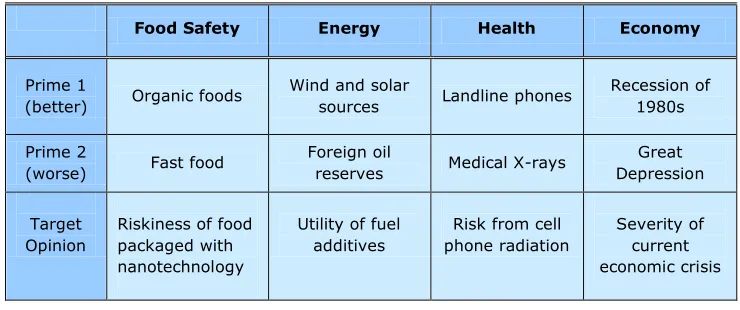
[image:9.612.107.477.411.566.2]Our fourth issue area was the economy. The target issue was assessment of the severity of the current economic crisis. This target issue served as a check on whether any ordinal priming effects evident in the other issues would also appear in the case of such a highly salient issue. For the primes, we used the Great Depression as the worse prime, and the recession of the 1980s as the better prime. We asked people in the worse-prime condition whether they thought the economic crisis was better or worse than the Great depression, and then asked them to evaluate the seriousness of the crisis. People in the better-prime condition compared the crisis with the “Recession of the 1980s,” and then gave an evaluation of the crisis. Table 1 provides a summary of the treatments in all four issue areas. For the text of the treatments, see Appendix A.
Table 1. Treatments.
Sample
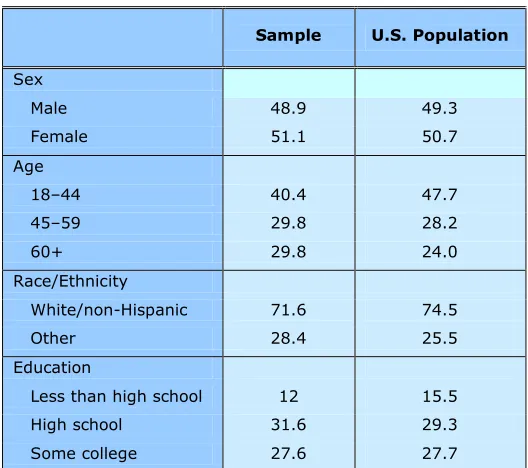
Our sample was designed with considerations of external validity as a priority It comes from a Knowledge Networks panel. From invitations sent to 1,230 people, a total of 809 subjects completed the experiment in April of 2010. Sampling techniques and post-stratification weighting appropriate to produce a survey-quality sample were used. The composition of the panel is comparable to the US. adult population across the categories of sex, age, race, and education, as shown in Table 2.
Food Safety Energy Health Economy
Prime 1
(better) Organic foods
Wind and solar
sources Landline phones
Recession of 1980s
Prime 2
(worse) Fast food
Foreign oil
reserves Medical X-rays
Great Depression
Target Opinion
Riskiness of food packaged with nanotechnology
Utility of fuel additives
Risk from cell phone radiation
Table 2. Subject Demographics.
Sample U.S. Population
Sex
Male 48.9 49.3
Female 51.1 50.7
Age
18–44 40.4 47.7
45–59 29.8 28.2
60+ 29.8 24.0
Race/Ethnicity
White/non-Hispanic 71.6 74.5
Other 28.4 25.5
Education
Less than high school 12 15.5
High school 31.6 29.3
Some college 27.6 27.7
Notes: Sample N=809. Population values from U.S. Census Bureau, American Community Survey, 2009.
Variables and Tests
Dependent Measures
Our outcome measures were evaluative questions about the four target issues. We employed five-point scales with which subjects evaluated the desirability, severity, or risk of our four problems. Higher values indicate a more negative evaluation.
Independent and Control Measures
Results
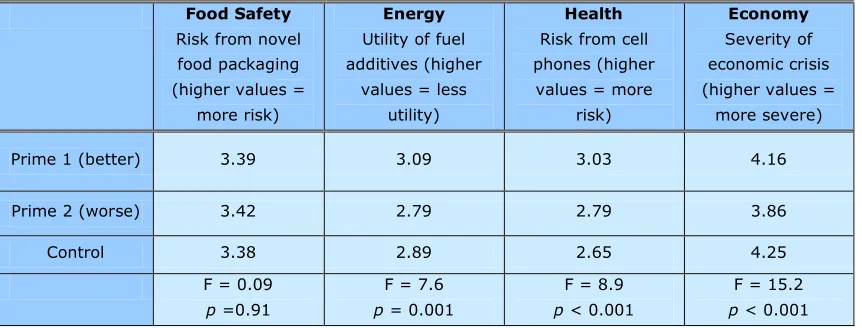
[image:11.612.89.520.260.424.2]We begin with a simple comparison of opinion on each issue across the treatments. As Table 3 shows, differences between conditions exist in three of the four issues: energy, health, and economy. In the energy and health cases, the better-prime condition leads to a worse assessment than the control condition, while in the economy case, the worse-prime condition leads to a worse assessment. To better understand these results, we first consider a main effects model using ANCOVA, with controls for ideology, political knowledge, and NC; we then examine interactions.
Table 3. Ordinal Priming: Mean Scores on Assessments of Four Issues.
The main effects models are shown in Table 4. For the food safety issue, the only variable predicting risk perception is political knowledge. Subjects with more political knowledge make a better (less risky) appraisal of the safety of novel food packaging (B = -0.47, SE = 0.12, p < 0.001). Neither NC nor political ideology predict how people will assess this issue. As suggested by the lack of difference in means, there is no main effect from the treatments.
For the energy question, we again find that political knowledge predicts a better assessment (B = -0.43, SE = 0.11, p < 0.001), and that neither NC nor ideology has an effect. In this case, we find a main effect from the better prime, wind and solar energy. Compared with the control condition (B = 0.23, SE = 0.08, p = 0.004), subjects exposed to the better prime make a worse assessment of the question of fuel additives to improve gas mileage. The effect of the worse prime occurs in the worse direction, but it does not reach significance (B = -0.13, SE = 0.08, p = 0.09). For the health issue, which is shown in the third model in Table 4, we find a somewhat similar result to that for energy. In this case, both political knowledge (B = -0.61, SE = 0.13, p < 0.001) and NC (B = -0.06, SE = 0.03, p 0.043) predict a better (less risky) assessment of risk associated with electromagnetic radiation from cell phones. We again find an effect from the better prime that is associated with a worse (more risky) assessment of cell phones (B = 0.44, SE = 0.09, p < 0.001), but in this case, the worse primes nearly reach significance, in the worse direction also (B = 0.16, SE = 0.09, p = 0.078).
Food Safety Risk from novel
food packaging (higher values =
more risk)
Energy Utility of fuel additives (higher
values = less utility)
Health Risk from cell phones (higher
values = more risk)
Economy Severity of economic crisis (higher values =
more severe)
Prime 1 (better) 3.39 3.09 3.03 4.16
Prime 2 (worse) 3.42 2.79 2.79 3.86
Control 3.38 2.89 2.65 4.25
F = 0.09 p =0.91
F = 7.6 p = 0.001
F = 8.9 p < 0.001
Table 4. Ordinal Priming: Predicting Main Effects of Primes on Assessments of Four Issues.
Food Safety Energy Health Economy
Intercept 3.66*** (.20) 3.41*** (.18) 3.42*** (.20) 4.50*** (.17)
Knowledge -0.47*** (.12)
-0.43*** (.11)
-0.61*** (.13)
-0.09 (.11) NC 0.00 (0.03) -0.03 (.02) -0.06* (.03) -0.01 (.02)
Ideology 0.02 (.02) -0.01 (.02) -0.01 (.03) -0.04 (.02)
Prime 1 (better) -0.04 (.09) 0.23** (.08) 0.44*** (.09) -0.07 (.08)
Prime 2 (worse) 0.03 (.09) -0.13 (.08) 0.16 (.09) -0.35*** (.08)
Control 0 0 0 0
Notes: ANCOVA models. Cell entries are coefficients (standard errors). *p <.05. **p<0.01. ***p<0.001. Prime 1 = better (organic food, wind and solar power, landline phones, recession of 1980s); Prime 2 = worse (fast food, foreign oil, X-ray radiation, Great Depression); Control = unprimed group.
For the economy issue, the effect of knowledge disappears. Political ideology produces an effect that is nearly significant (B = -0.04, SE = 0.02, p = 0.058), with conservatism associated with better (less severe) appraisal of the state of the economic crisis. We find an effect from the worse prime, which also leads to better appraisal of the severity of the economic crisis (B = -0.35, SE = 0.08, p < 0.001). Comparison with the Great Depression makes the current economic crisis look less severe by contrast, while comparison with the recession of the 1980s has no effect compared with the unprimed control group.
To examine sophistication further, we turn to our expectation about interaction. We re-ran the ANCOVA models including interaction terms for political knowledge x treatment and NC x treatment. These results allow us to see which effects remain when interactions are considered, and they are shown in Table 5.
Table 5. Ordinal Priming: Moderating Effect of Sophistication on Assessments of Four Issues.
Food Safety Energy Health Economy
Intercept 3.89*** (.31) 3.57** (.28) 2.96*** (.32) 3.91*** (.27)
Prime 1 (better) -0.39 (.42) 0.12 (.38) 0.78 (.43) 0.29 (.36)
Prime 2 (worse) -0.28 (.40) -0.48 (.37) 1.13** (.42) 1.04** (.35)
Control 0 0 0 0
Knowledge -0.38 (.21) -0.33 (.19) -0.77*** (.22) 0.31 (.18)
NC -0.05 (.05) -0.07 (.04) 0.04 (.05) 0.00 (.04)
Ideology 0.02 (.02) -0.01 (.02) -0.01 (.03) -0.04* (.02)
Prime 1 x Knowledge -0.26 (.29) -0.08 (.26) 0.49 (.30) -0.37 (.26)
Prime 2 x Knowledge 0.00 (.30) -0.26 (.27) -0.02 (.31) -0.84** (.26)
Control x Knowledge 0 0 0 0
Prime 1 x NC 0.09 (.07) 0.03 (.06) -0.11 (.07) -0.02 (.06)
Prime 2 x NC 0.05 (.07) 0.09 (.06) -0.15* (.07) -0.13* (.06)
Control x NC 0 0 0 0
The moderation models show no priming effect for either food or energy. The coefficients for knowledge fall just out of significance at the 0.05 level (p = 0.072, p = 0.081, respectively), and the interaction terms are also not significant. The moderation models show priming effects remaining in the case of the other two issues, health and the economy. For the health issue involving risk from cell phones, the effect of the worse prime is strengthened (B = 1.13, SE = 0.42, p = .007), which means that, when knowledge and NC are low, exposure to the worse prime leads to a worse (more risky) assessment. Exposure to the better prime also exerts an influence in the worse direction, though this effect is just outside of the range of significance (p = 0.071). Among the set of interaction terms, the only effect is that increasing NC leads to a better assessment in the case of the worse prime (B = -0.15, SE = 0.07, p = 0.028).
For the economy issue, the moderation model shows an interesting result. The worse prime is again significant, but the sign changes (B = 1.04, SE = 0.35, p = 0.004) from the main-effects only model, meaning that subjects in the worse prime condition viewed the economic crisis as worse when cognitive sophistication was low. Negative and significant coefficients on the interaction terms for both NC (B = -0.13, SE = 0.06, p = 0.027) and political knowledge (B = -0.84, SE = 0.26, p = 0.002) indicate that, as sophistication increases, assessment of the economic crisis becomes better for subjects in the worse prime condition. This result highlights the potential importance of NC and political knowledge in response to ordinal comparisons.
Discussion
In this study, we were interested in the effects of comparisons between similar issues or problems where an explicit ranking was involved. Issue comparisons of this kind have not been examined in the media effects literature that addresses accessibility and applicability effects. We expected to find that an ordinal priming effect exists, and we considered reasons to anticipate that it could occur in the direction of assimilation or contrast. Our first research question concerned the direction of this effect. Our experiment involved four issues. Three of these are relatively low in salience, in the areas of food packaging, alternative energy, and radiation risk from cell phones, while the fourth is a high-salience issue, the economic crisis. Our results showed that, compared with unprimed evaluations, primed comparisons were significantly different on two of the four issues, one of low salience (risk from cell phones) and one of high salience (the economic crisis). In both cases, the effect was associated with the worse prime (radiation from medical X-rays and the Great Depression), and in both cases, the prime influenced subjects in the direction of assimilation: Comparing the target issue to a relatively worse case made the target itself look worse.
comparisons also casts targets in a worse light. It does appear, however, that comparisons may have a greater effect in the negative direction generally. We do not find support in our policy comparisons for the contrast effect that is well-known in priming studies in psychology. It may be that the influence toward assimilation from similar categorization dominates.
Our second research question addressed the possibility of interaction with cognitive sophistication. Here, results are generally consistent, again, for the cell phone and economic crisis issues. NC in both cases and political knowledge in the case of the economy moderates the negative effect of the worse prime, as more sophistication leads to a more positive assessment of the issues under comparison with a worse prime. This effect suggests that sophistication in ordinal priming works differently than in framing, where more knowledge can increase susceptibility, apparently by providing citizens a greater stock of schema that can be activated by a framed message. As in agenda-setting, more knowledge and cognitive sophistication appear to give people the capacity to resist message effects.
The central challenge in interpreting these findings is the fact that effects are clearly contingent on issue. Our results come from just four issues, only half of which showed an effect, and these cannot shed much light on the extent to which comparisons lead to worse or more negative appraisals across diverse issues in a complex environment for political communication. We do not intend that any of the specific problems we presented subjects, such as cell phone safety, represent any particular class of public policy problem. Our issues contained problems involving risk to the individual, as well as perception of the severity of a national problem. The fact that we found an effect in both types of issues suggests that effects may exist for a broad range of issues. Yet we do not expect effects in all cases. Considerably more work is necessary to model the kinds of issues were ordinal priming may occur.
A second, closely related challenge in interpreting the findings involves the primes themselves. Choosing primes that the subjects will see as unambiguously better or worse is not straightforward. In the case of food safety, where we found no priming effect, it may be that our treatments failed to operate as expected. It could be that some subjects did not perceive fast food to be risky or harmful, or they may have viewed organic food primarily as expensive, rather than as beneficial or healthy. In the case of energy, it may be that variation existed in how harmful subjects perceived reliance on foreign oil to be, and in how they viewed alternative energy sources, such as wind and solar power. In the practice of real-world political communication, speakers commonly address audiences whom they know to possess particular values and beliefs, and so they can construct comparisons that evoke these. In our case of a national survey sample, subjects undoubtedly brought a range of beliefs to the table in responding to our primes. Future research might use a pre-test assessment of subjects’ views on issues to inform the later assignment of treatments, as well as to allow a within-subjects test of priming effects.
We view study of the direction of influence of primed comparisons to be a potential route forward in priming research. Primes in political communication appear to work by creating a baseline for assessing magnitude or difference, possibly in addition to shifting the accessibility or applicability of competing evaluative frameworks. In some comparisons, it is easier to distinguish between these effects than in other cases that may involve magnitude comparisons in addition to framing. We are most confident in this study that the economic crisis case isolated magnitude comparisons within a single frame. Also, our project benefitted from a large sample size, which allowed us the power to discern effects that are not large. We are reasonably confident that Type II error is not great in this study.
Future studies could improve on our simple design in several ways. We presented subjects alternatively with better or worse primes, and then we asked them to make an explicit better-worse comparison before giving their opinion of the issue. A next step is to present more realistic communication scenarios by dropping the explicit comparison step. In conjunction with this, manipulation checks on primes are perhaps the most important improvement, as we found evidence that some of our primes did not have the expected valence for all subjects. A pre-test could establish individual subjects’ reactions to a range of primes. Measuring the perceived credibility of a source, such as a news business, public official, or expert, may show that credibility or ideology affects the magnitude or direction of ordinal priming. The most difficult problem, as in many studies of media effects, is understanding how issue-type affects results. We did not employ a scheme for systematically varying issue type. Future work could measure subjects’ perceptions of the salience of issues and primes, as well as their familiarity and affect toward these. We expect that future research will be able to shed more light on how issue comparisons prime opinion in ways that are not accounted for in traditional media effects frameworks.
References
American Presidency Project. (2012). Database of Presidential record. Retrieved from
http://www.presidency.ucsb.edu/2012_election_speeches.php?candidate=44&doctype=1150
Cacioppo, J., Petty, R. & Kao, C. (1984). The efficient assessment of need for cognition. Journal of Personality Assessment, 48, 306–307.
Chong, D., & Druckman, J. (2007). A theory of framing and opinion formation in competitive elite environments. Journal of Communication, 57, 99–118.
Collins, A., & Loftus, E. (1975). A spreading-activation theory of semantic processing. Psychological Review, 82(6), 407–428.
Delli Carpini, M., & Keeter, S. (1996). What Americans know about politics and why it matters. New Haven, CT: Yale University Press.
Domke, D., Shah, D., & Wackman, D. B. (1998). Media priming effects: Accessibility, association, and activation. International Journal of Public Opinion, 10, 51–74.
Druckman, J., & Nelson, K. (2003). Framing and deliberation: How citizens’ conversations limit elite influence. American Journal of Political Science, 47(4), 729–745.
Druckman, J. (2004). Political preference formation: Competition, deliberation, and the (ir)relevance of framing effects. American Political Science Review, 98, 671–686.
Entman, R. M. (1993). Framing: Toward clarification of a fractured paradigm. Journal of Communication, 43(4), 51–58.
Everyday Health. (2013). Is second hand smoke worse? Retrieved from
http://www.everydayhealth.com/info/v1t01/is-second-hand-smoke-worse?xid=g_dlp&s_kwcid=TC|21765|is%20second%20hand%20smoke%20worse||S|b|164722 54214&gclid=CJf3_pn727QCFZGPPAodsH8AkA&xid=g_dlp-v1t01
HealthMad. (2013). Second hand smoke: Worse than smokers. Retrieved from http://healthmad.com/health/second-hand-smoke-worse-than-smokers
Herr, P. (1986). Consequences of priming: Judgment and behavior. Journal of Personality and Social Psychology, 51, 1106–1115.
Iyengar, S., & Kinder, D. L. (1987/2010). News that matters: Television and American opinion. Updated Edition. Chicago, IL: University of Chicago Press.
Iyengar, S., Peters, M. D., & Kinder, D. L. (1982). Experimental demonstrations of the “not-so-minimal” consequences of television news programs. American Political Science Review, 76, 848–858.
Jacoby, L., Kelly, C., Brown, J., & Jasechko, J. (1989). Becoming famous overnight: Limits on the ability to avoid unconscious influences of the past. Journal of Personality and Social Psychology, 56, 326– 338.
Kaplan, T., & Hernandez, R. (2013, November 26). Cuomo, in aid appeal, cites broad reach of storm. The New York Times. Retrieved from http://www.nytimes.com/2012/11/27/nyregion/governor-cuomo-says-hurricane-sandy-was-worse-than-katrina.html
Kemp, J., & Connor, T. (2012, January 7). New super painkiller Zohydro is more dangerously potent than Vicodin: Narcs and docs. New York Daily News. Retrieved from http://www.nydailynews.com/life-style/health/super-painkiller-zohydro-be10-times-potent-vicodin-narcs-experts-article-1.1002241
Krosnick, J., & Kinder, D. (1990). Altering the foundations of support for the president through priming. American Political Science Review, 84, 497–513.
Lee, N-J., McLeod, D., & Shah, D. (2008). Framing policy debates: Issue dualism, journalistic frames, and opinions on controversial policy issues. Communication Research, 35, 695–718.
Let’s Move It. (2013). How is second hand smoke worse than smoking yourself? Retrieved from http://www.letsmoveit.org/breathe-free/h/how-is-second-hand-smoke-worse-than-smoking-yourself-ps-i-don't-smoke!
Lively, E., Conroy, M., Weaver, D., & Bimber, B. (2012). News media frame novel technologies in a familiar way. In B. Harthorn & J. Mohr (Eds.), The social life of nanotechnology (pp. 223–240). New York, NY: Routledge.
Lombardi, W., Higgins, E. T., & Bargh, J. A. (1987). The role of consciousness in priming effects on categorization. Personality and Social Psychology Bulletin, 13, 411–429.
Martin, L. (1986). Set/reset: Use and disuse of concepts in impression formation. Journal of Personality and Social Psychology, 51, 493–504.
McCombs, M. E. (2004). Setting the agenda: The mass media and public opinion. Malden, MA: Blackwell.
Nelson, T., Clawson, R., & Oxley, Z. (1997). Media framing of a civil liberties conflict and its effect on tolerance. American Political Science Review, 91(3), 567–583.
Newman, L. S., & Uleman, J. S. (1990). Assimilation and contrast effects in spontaneous trait inference. Personality and Social Psychology Bulletin, 16, 224–240.
Obama, B. (2009, July 23). Remarks at a Democratic National Committee Fundraiser in Chicago, Illinois. Retrieved from
http://www.presidency.ucsb.edu/ws/index.php?pid=86461&st=worst+recession&st1=decades
Ottati, V. C., Riggle, E. J., Wyler, R. S., Schwarz, N., & Kuklinski, J. (1989). Cognitive and affective bases of survey responses. Journal of Personality and Social Psychology, 57, 404–415.
Pan, Z., & Kosicki, G. (1997). Priming and media impact on the evaluations of the President’s performance. Communication Research, 24(3), 3–30.
Price, V., & Tewksbury, D. (1997). News values and public opinion: A theoretical account of media priming and framing. In G. A. Barnett & F. J. Boster (Eds.), Progress in communication sciences:
Advances in persuasion (vol. 13, pp. 173–212). Greenwich, CT: Ablex.
Rahn, W. (2012, July 30). No excuse for bad policies: Claiming failure isn’t president’s fault doesn’t fly. Washington Times. Retrieved from http://www.washingtontimes.com/news/2012/jul/30/no-excuse-for-bad-policies
Roessler, P., & Eichhorn, W. (1999). Agenda setting. In H.-B. Brosius & C. Holtz-Bacha (Eds.), The German communication yearbook (pp. 277–304). Cresskill, NJ: Hampton Press.
Romney, M. (2012, August 30). Address accepting the presidential nomination at the Republican National Convention in Tampa, Florida. Retrieved from
http://www.presidency.ucsb.edu/ws/index.php?pid=101966&st=Great+Depression&st1
Satterfield, T., Conti, J., Harthorn, B., Pidgeon, N., & Pitts, A. (2012). Understanding shifting perceptions of nanotechnologies and their implications for policy dialogues about emerging technologies. Science and Public Policy, 39(6). doi: 10.1093/scipol/scs084
Scheufele, D., & Tewksbury, D. (2007). Framing, agenda-setting, and priming: The evolution of three media-effects models. Journal of Communication, 57, 9–20.
Schuman, H., Presser, S., & Ludwig, J. (1981). Context effects on survey responses to questions about abortion. Public Opinion Quarterly, 45, 216–223.
Schwarz, N., Strack, F., & Mai, H-P. (1991). Assimilation and contrast effects in part-whole question sequences: A conversational logic analysis. Public Opinion Quarterly, 55, 3–23.
Slothuus, R. (2008). More than weighting cognitive importance: A dual-processing model of issue framing effects. Political Psychology, 29(1), 1–28.
Sniderman, P., Brody, R., & Tetlock, P. (1991). Reasoning and choice: Explorations in political psychology. New York, NY: Cambridge University Press.
Strack, F., Schwarz, N., & Gschneidinger, E. (1985). Happiness and reminiscing – The role of time perspective, affect, and mode of thinking. Journal of Personality and Social Psychology, 49, 1460–1469.
Takeshita, T. (2005). Current critical problems in agenda setting research. International Journal of Public Opinion Research, 18, 275–296.
TIME. (1968, April 19). Pot: Safer than alcohol? Retrieved from
http://www.time.com/time/magazine/article/0,9171,838231,00.html
Tourangeau, R., & Rasinski, K. A. (1988). Cognitive processes underlying context effects in attitude measurement. Psychological Bulletin, 103, 299–314.
Valentino, N. (1999). Crime news and the priming of racial attitudes during evaluations of the president. Public Opinion Quarterly, 63, 293–320.
Valentino, N., Hutchings, V., & White, I. (2002). Cues that matter: How political ads prime racial attitudes during campaigns. American Political Science Review, 96, 75–90.
Appendix: Treatments
Health
Primes: Some people are concerned with radiation from cell phones. Do you think [Prime 1: using a landline phone / Prime 2: getting X-rays] is less or more risky to
your health than using a cell phone? [Prime 1: Using a landline phone is: / Prime 2: Getting X-rays is]: Less risky or more risky.
Target Issue: About how risky is using a cell phone? [1–5 scale, where 1 = less risky and 5 = more risky.]
Economy
Primes: Do you think the [Prime 1: recession of the 1980s / Prime 2: Great Depression] was less or more difficult for the economy than the current economic
recession? The [Prime 1: recession of the 1980s / Prime 2: Great Depression] was: Much less difficult or Much more difficult.
Target Issue: About how difficult do you think the current economic recession has been for the United States? [1–5 scale, where 1 = not very difficult and 5 = very difficult.]
Background to the Food and Energy Issues
We would like to ask you about a new science described as nanotechnology.
Nanotechnology involves human-made materials or devices that are extremely small, for
instance 10,000 times smaller than a fine grain of sand. Because they are so small, they can have unique physical, chemical, electrical, or other properties. This may produce new health or environmental risks, because these nano-materials can get into the human body through breathing, skin contact, or eating, or they may end up in the environment with unexpected or unknown long-term effects. They’re being developed because they may provide new ways to treat disease, clean up pollution, improve food, and provide cheaper energy. The first set of questions asks you about nanotechnology and also some other technologies. We realize you may not know much about this; that is OK. Do your best anyway.
Food
Primes: Do you think consuming [Prime 1: organic foods / Prime 2: fast food] would be less or more risky than consuming foods packaged and stored with nanomaterials? Consuming [organic foods / fast food] is: less risky or more risky.
Target Issue: About how risky would you say consuming foods packaged and stored with nanomaterials would be? [1–5 scale, where 1 = less risky and 5 = more risky.]
Energy
Primes: Do you think U.S. reliance on [Prime 1: wind and solar energy / Prime 2: foreign oil reserves] is better or worse than reliance on nanotechnology fuel additives to improve existing fuel technologies? U.S. reliance on [Prime 1: wind and solar energy / Prime 2: foreign oil reserves] is: better or worse.