Lecture - 10
on
*
---Prepared by, Jesmin Akhter, Lecturer, IIT,JU
2
TREES
A binary tree T is defined as a finite set of elements, called nodes, such that:
a) T is empty (called the null tree or empty tree), or
b) T contains a distinguished node R, called the root of T, and the remaining nodes of
T form an ordered pair of disjoint binary trees T1 and T2.
If T does contain a root R, then the two trees T1 and T2 are called, respectively, the left
and right subtrees of R. If T1 is nonempty, then its root is called the left successor of R;
similarly, if T2 is nonempty, then its root is called the right successor of R.
*
---Prepared by, Jesmin Akhter, Lecturer, IIT,JU
3
TREES
Any node N in a binary tree T has either 0, 1 or 2 successor. The nodes A, B, C and
H have two successors, the nodes E and J have only one successor, and the nodes D,
F, G, L and K have no successors. The nodes with no successors are called terminal
nodes.
•
The above definition of the binary tree T is recursive since T is defined in terms of the
binary subtrees trees T1 and T2. This means, in particular, that every node N of T
contains a left and a right subtree. Moreover, if N is a terminal node, then both its left
and right subtree are empty.
•
Binary tree T and T ́́́́ are said to be similar if they have the same structure or, in other
words, if they have the same shape. The trees are said to be copies if they are similar
and if they have the same contents at corresponding nodes.
B
C
D
A
F
H
E
G
J
K
L
*
---Prepared by, Jesmin Akhter, Lecturer, IIT,JU
4
Observe that;
(a) B is a left successor and C is a right successor of the node A.
(b) The left subtree of the root A consists of the nodes B, D, E and F,
and the right subtree of A consists of the nodes C, G, H, J, K and L.
TREES
B
C
D
A
F
H
E
G
J
K
L
*
---Prepared by, Jesmin Akhter, Lecturer, IIT,JU
5
TREE
Example 7.1:
Consider the four binary trees in fig. 7.2. The three trees (a), (c) and (d) are similar.
In particular, the trees (a) and (c) are copies since they also have the same data at
corresponding nodes. The tree (b) is neither similar nor a copy of the tree.
A
D
C
B
(a)
A
D
C
B
(c)
E
H
G
F
(d)
H
G
F
E
(b)
Fig. 7.2
*
---Prepared by, Jesmin Akhter, Lecturer, IIT,JU
6
6
Difference Between a Tree & a Binary Tree
•
A binary tree may be empty
;
a tree cannot be empty
.
•
No node in a binary tree may have a degree more than 2, whereas there
is no limit on the degree of a node in a tree.
•
The sub trees of a binary search tree are ordered; those of a tree are not
ordered.
a
b
c
a
*
*
---Prepared by, Jesmin Akhter, Lecturer, IIT,JU
8
8
Arithmetic Expressions as trees(cont.)
*
---Prepared by, Jesmin Akhter, Lecturer, IIT,JU
9
Example 7.2: Algebraic Expressions
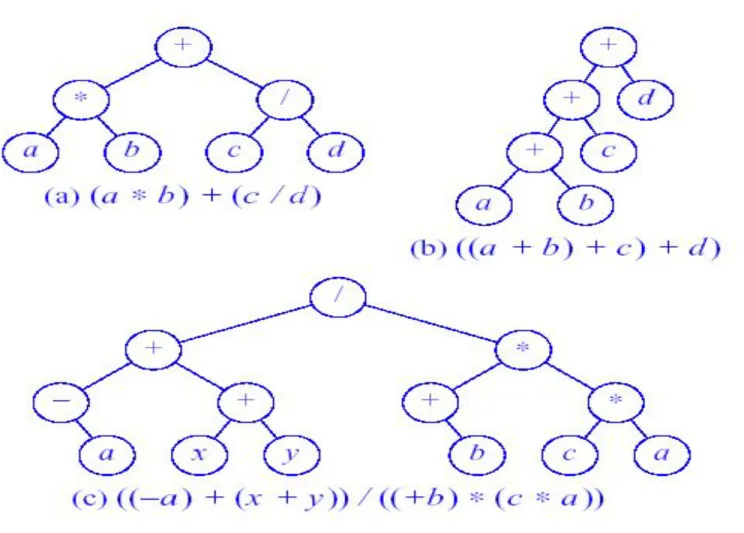
Consider any algebraic expression E involving only binary operations,
such as
E = (a-b) / ((c * d) + e)
E can be represented by means of the binary tree T pictured in fig.
7.3.
Fig. 7.3: E = ( a – b ) / (( c * d ) + e )
/
+
a
*
b
-d
c
e
*
---Prepared by, Jesmin Akhter, Lecturer, IIT,JU
10
TERMINOLOGY
Terminology describing family relationships is frequently used to describe
relationships between the nodes of a tree T. Specifically, suppose N is a node in T with left
successor S
1and right successor S
2. Then N is called the parent or father of S
1and S
2.
Analogously, S
1is called the left child or son of N, and S
2is called the right child or son of
N. Furthermore, S
1and S
2are said to be siblings or brother. Every node N in a binary tree
, except the root, has a unique parent, called the predecessor of N.
*
*
---Prepared by, Jesmin Akhter, Lecturer, IIT,JU
12
Complete Binary Trees
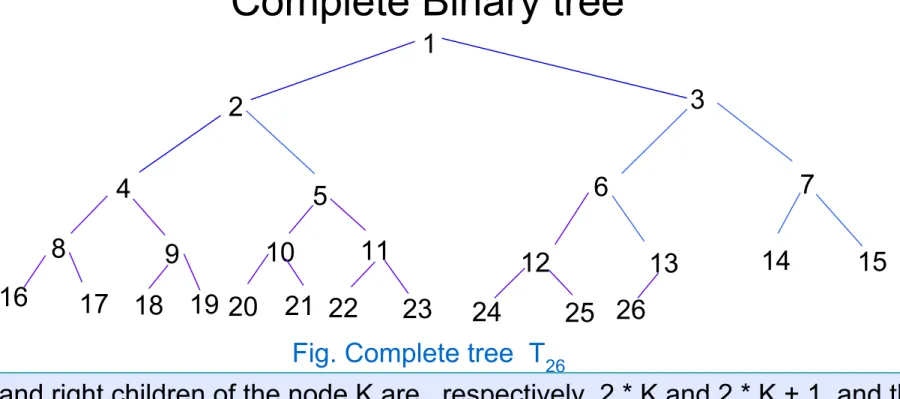
The tree T is said to be complete if all its levels, except possibly the last,
have the maximum number of possible nodes, and if all the nodes at the last
level appear as far left as possible.
*
*
*
*
---Prepared by, Jesmin Akhter, Lecturer, IIT,JU
16
Following this rule, where would the fifth
node have to be placed?
*
*
---Prepared by, Jesmin Akhter, Lecturer, IIT,JU
18
*
*
*
---Prepared by, Jesmin Akhter, Lecturer, IIT,JU
21
No, it isn't since the nodes of the bottom level have not been added
from left to right.
Just to check your understanding, is this binary tree a complete binary
tree?
*
---Prepared by, Jesmin Akhter, Lecturer, IIT,JU
22
No, since the third level was not completed before starting the fourth
level.
*
*
---Prepared by, Jesmin Akhter, Lecturer, IIT,JU
24
*
*
---Prepared by, Jesmin Akhter, Lecturer, IIT,JU
26
1
2
5
4
9
8
10
11
19
18
17
16
20
21 22
23
3
7
6
12
13
14
15
25
24
26
Fig. Complete tree T
26
The left and right children of the node K are , respectively, 2 * K and 2 * K + 1, and the
parent of K is the node [K/2].
The children of node 9 are the nodes 18, 19, and its parent is the node [9/2] =4.
The depth d
n
of the complete tree T
n
with n nodes is given by
D
n
=[log
2
n +1]
This is relatively small number. For example if the complete tree T
n
has n =1000000
nodes, then its depth D
n
=21.
*
---Prepared by, Jesmin Akhter, Lecturer, IIT,JU
27
Extended Binary trees: 2 trees
A binary tree T is said to be a 2 – tree or extended binary tree if each node N has either
0 or 2 children. The nodes with two children are called internal nodes, and the nodes
with 0 children are called external nodes.
–
Circles for internal nodes.
–
Squares for external nodes.
Start with any binary tree and add an external node wherever there is an empty
subtree.
Result is an extended binary tree.
*
---Prepared by, Jesmin Akhter, Lecturer, IIT,JU
28
Sequential Representation
of binary Trees uses only a single linear array TREE together
with a pointer variable END as follows:
(a) The root R of T is stored in TREE[1].
(b) If a node occupies TREE[k], then its left child is stored in TREE[2 * K] and its right child is
stored in TREE[2*k+1]
(c) END contains the location of the last node of T.
*
---Prepared by, Jesmin Akhter, Lecturer, IIT,JU
29
Binary Trees: Array Representation
14
10
15
12
8
16
7
9
11 13
18
1
2
3
4
5 6
7
8
9 10
11
1 2 3 4 5 6 7 8 9 10 11
14 10 16 8 12 15 18 7 9 11 13
Array A:
*
---Prepared by, Jesmin Akhter, Lecturer, IIT,JU
30
30
•
The binary tree is represented in an array by storing each element at the
array position corresponding to the number assigned to it.
*
---Prepared by, Jesmin Akhter, Lecturer, IIT,JU
31
31
Linked Representation of Binary Tree
•
The most popular way to present a binary tree
•
Each element is represented by a node that has two link fields (
leftChild
and
rightChild
) plus an
Info
field
•
The space required by an n node binary tree is
*
---Prepared by, Jesmin Akhter, Lecturer, IIT,JU
32
Fig : 7-6
Linked Representation of Binary trees
1.
INFO[K] contains the data at the node N
2.
LEFT[K] contains the location of the left child of node N
3.
RIGHT[K] contains the location of the right child of node N.
*
---Prepared by, Jesmin Akhter, Lecturer, IIT,JU
33
Fig:7-7
Linked Representation of Binary trees
*
---Prepared by, Jesmin Akhter, Lecturer, IIT,JU
34
Linked representation of a binary tree
Linked representation uses explicit links to connect the nodes. Example:
2 5
3 4 6 7
8 9
Nodes in this tree can be viewed as positions in a sequence (numbered 1 through
9).
+
B
A
-
*
C
/
E
F
1
*
---Prepared by, Jesmin Akhter, Lecturer, IIT,JU
35
Binary tree (linked representation)
We can use a positional sequence ADT to implement a binary tree. Our
example tree, in this case, we be represented as follows:
position 1 2 3 4 5 6 7 8 9
data + - A B * C / E F
leftChild 2 3 null null 6 null 8 null null
rightChild 5 4 null null 7 null 9 null null
parent null 1 2 2 1 5 5 7 7
*
---Prepared by, Jesmin Akhter, Lecturer, IIT,JU
36
36
*
---Prepared by, Jesmin Akhter, Lecturer, IIT,JU
37
Linear representation of a binary tree
Advantages of linear representation:
1. Simplicity.
2. Given the location of the child (say, k), the location of the parent is easy to determine
(k / 2).
Disadvantages of linear representation:
1. Additions and deletions of nodes are inefficient, because of the data movements in
the array.
2. Space is wasted if the binary tree is not complete. That is, the linear representation is
useful if the number of missing nodes is small.
Linear representation of a binary tree can be implemented by means of a linked
list instead of an array
This way the above mentioned disadvantages of the linear representation is
resolved.
*
---Prepared by, Jesmin Akhter, Lecturer, IIT,JU
38
38
Binary Tree Traversal
•
Many binary tree operations are done by performing a
traversal
of the binary tree
•
In a traversal, each element of the binary tree is
visited exactly once
*
*
*
---Prepared by, Jesmin Akhter, Lecturer, IIT,JU
41
*
---Prepared by, Jesmin Akhter, Lecturer, IIT,JU
42
42
*
---Prepared by, Jesmin Akhter, Lecturer, IIT,JU
43
*
---Prepared by, Jesmin Akhter, Lecturer, IIT,JU
44
44
Preorder Example (visit = print)
*
---Prepared by, Jesmin Akhter, Lecturer, IIT,JU
45
45
Preorder of Expression Tree
/ * + a b - c d + e f
*
---Prepared by, Jesmin Akhter, Lecturer, IIT,JU
46
46
Inorder Example (visit = print)
*
---Prepared by, Jesmin Akhter, Lecturer, IIT,JU
47
47
Postorder Example (visit = print)
*
---Prepared by, Jesmin Akhter, Lecturer, IIT,JU