
All Rights Reserved © 2017 IJSETR
138
A Gabor Wavelet Based Supervised Palm-Print
Recognition System using MBLBP
Mr.Ravindra Gupta Mrs.VarshaNamdeo Ms.RashmiChourey Guide H.O.D. Student
Computer Science and Technology Computer Science and Technology Computer Science and Technology R.K.D.F Institute Of Science And Technology R.K.D.F Institute Of Science And Technology R.K.D.F Institute Of Science And Technology
Abstract—Amid various Biometric identifications technologies
palmprint recognition system has been successful due to its simplicity, feature extraction, matching feature, small size, high precision, real time computation, and the resolution of used images. During this instance of time, several different glitches related to palmprint recognition have been addressed. Furthermost of the studies has been done in palmprint recognition due to its stability, reliability and exclusivity. This Research Paper deliberates a novel and efficient method for the palmprint identification based on Gabor wavelet by using multi-block local binary patterns. Proposed method is further supervised through our proposed multi-layer feed-forward neural network for more accurate and computationally efficient recognition. Gabor wavelets efficiently filter the pre-processed image for getting optimum texture features through MB-LBP. Due to accurate feature representation of palm images through proposed LBP, anticipated MLFFNN training rate is high and we are getting much accurate results comparatively. Results are in terms of some validation parameters like false acceptance ratio, false rejection ratio, computational time, recognition percentage and accuracy etc. and from results, it is clear that the proposed approach outperform the available traditional approaches. Chinese Academy of Sciences (CASIA) is considered as a standard database for testing purpose.
Keywords—Palmprint recognition system;Biometric Authentication
system; Person matching; Multi-block local binary pattern; Gabor wavelets; multi-layer feed-forward neural network; Texture features.
I. INTRODUCTION
iometric systems are automated methods of recognizing the identity of a person on the basis of physiological or behavioral characteristics [1]. Nowadays, biometric systems are widely adopted both in forensic and civil applications [2]: from PC logon to physical access control, and from border crossing to voter’s authentication. Although fingerprint is the most widely used biometric trait [3], recently palm print recognition is receiving increasing attention, both for its importance in forensics
(about 30% of the latent found in crime scenes are from palms [4]) and for the several potential civil applications [5]. Palm print is a very promising biometric trait: in fact, it contains the discriminative features of the fingerprint (e.g., ridges, singular points, minutiae) in addition to other features such as principal lines and wrinkles; moreover, it offers a much larger pattern area, which allows to acquire a larger number of features. In the last years, various palm print recognition techniques have been proposed [5]–[8]; they can be grouped into two main categories [8]:
approaches based on low-resolution features, and;
approaches based on high-resolution features. Methods belonging to the first category employ low-resolution images (such as 75 or 150 dpi), where generally only principal lines, wrinkles, and texture are well evident [5]. Some of them (e.g., [9] – [14]) use various edge detection methods to extract palm lines, and match them directly or after some feature transformations. Other approaches (e.g., [15]– [20]) first extract some features (e.g., using Gabor filters or wavelets) then use a subspace projection (e.g., principal component analysis, linear discriminant analysis) to reduce their dimensionality and adopt distance measures or classifiers to compare the reduced features. Finally, some approaches transform palm printimages into another domain (e.g., using Gabor filters, or wavelets), in either a local (e.g., [17], [21]– [24]) or global (e.g., [25], [26]) fashion: local approaches divide the palm print into small regions and then extract features from local statistics such as mean and variance of each region; global approaches calculate statistical features on the whole transformed image.
Techniques belonging to the second category (based on high resolution features) use high-resolution images (500 dpi),
Volume 6, Issue 1, January 2017
139 All Rights Reserved © 2017 IJSETR
where, in addition to principal lines and wrinkles, more discriminant features can be extracted, such as ridges, singular points, and are used for the authentication of a person’s identity. The idea is to use special characteristics of a person to identify him/her. Special characteristics such as face, iris, signature, etc. are being used here. A biometric system is generally a pattern recognition system which makes a personal identification by determining the authenticity of a specific physiological or behavioral characteristic possessed by the user. A biometric system can be either an identification system or a verification (authentication) system;
Identification process:
The selection of a particular biometric for an application involves several factors. Some of the factors are: Universality means that every person must possess that trait. Uniqueness means that the trait must be sufficiently different among the individuals in order to distinguish them from one another among a set of population. Permanence relates to the manner in which trait varies over time. Measurability relates to the ease of acquisition or measurement of that trait. Also the acquired data must be in the form that allows processing and extraction of the relevant feature sets. Performance relates to the accuracy, speed and robustness of technology used.
Acceptability relates to how well the individual accepts the technology such that they are willing to have their trait captured and accessed. No single biometric will meet all the above characteristics in an application. Among the various biometric technologies being considered, the attributes that meets the above characteristics are fingerprints, facial features, hand geometry, voice, iris, palm prints, signature [28].
A biometric system can be classified into two modules-
(i) Database Preparation Module and
(ii) Verification Module.
The Database Preparation Module consists of two sub-modules, and they are (a) Enroll Module and (b) Training Module while the other module, Verification module can be divided into two modules (a)Matching Module and (b) Decision Module.
Among the various biometric attributes, palm print recognition is being investigated over the past ten years as a useful biometric modality. As shown in the below figure 1, the inner surface of palmar region normally consists of three flexion creases, secondary creases and ridges. The flexion creases are called as principal linesand the secondary creases are called wrinkles.
Fig 1: surface of palmar region
The three most salient flexion creases, termed major creases or principal lines divide the palm into three regions: thenar, hypothenar, and interdigital. The secondary creases present in the palm prints are not permanent as the flexion creases present.
Palm prints differ from Finger prints in three main ways:
1. Palm prints are larger than finger prints hence
itcontains more minutiae than finger prints.
2. Palm prints are more deformable than finger prints. 3. Palmar regions of palm prints vary in the quality of
discrimination power and skin distortion.
The ridges present in the palms are unique and persistent. Palm print recognition just like finger prints is based on the aggregate information present in the frictional ridges. This information includes the flow of ridges (Level 1 details), the presence or absence of features along with individual friction ridge paths and their sequences(Level 2 details) and the intricate detail of single ridge(Level 3 details)[29]. When recorded the palm print appears as a series of dark lines and represents the high, peaking portion of the friction ridge skin while the valley between these ridges appears as the white space, and is the low shallow portion friction ridge skin. The palmar region consists of more ridge features than the fingerprints, hence it is considered as more distinctive than fingerprints.
140 All Rights Reserved © 2017 IJSETR
Palm print matching techniques fall in three categories such as minutiae based matching, correlation based matching and ridge based matching. Minutiaebased matching relies on the minutiae pointsspecificallywith orientation, location and direction of each minutiae point. Correlation based matching involves simply lining up the palm images and subtracting them to determine if the ridges in the two palm images correspond. Ridge based matching depends on the ridge pattern features such as sweatpores, spatial attributes and geometric characteristics of the ridges. Around 30% of the prints obtained from crime scenes are palm prints. Hence biometric modalities used for forensic applications and border control systems are more insensitive to skin conditions and changes in age.
For these systems, high resolution such as 500 ppi is the standard resolution for capturing in systems that uses ridge features for identification. Existing palm print matching systems are based on the low resolution (100ppi) images. In these images ridges cannot be observed. Most of the comparison was based on crease features. The main issues of these systems are that they followed fingerprint matching algorithms and hence matching is not much efficient. The existing systems algorithms are not being able to handle noise and distortion. Since ridges are insensitive to distortion and discrimination power, they are very reliable, unique and efficient for palm print recognition. Overcoming these issues many palm print systems are being proposed and is becoming a challenging task in criminal and forensic applications.
The edifying steps of this paper is as follow, Section I shows the basic overview and details about palmprint based biometric authentication system, survey of existing work is reviewed in section II, basic designing and implementation of proposed work is shown in section III and IV, results and validation is presented in section V and at last conclusion and discussion is written in section VI.
II. REVIEW OF LITERATURES
In order to provide an accurate and efficient authentication system, there has been substantial research in the area of palm print recognition system. For this, a number of relevant papers have been reviewed. Tee Connie et al’ haveproposed an automated palm print recognition system [30]. In its proposed approach, they have used Principal Component Analysis (PCA), Fischer Discriminant Analysis (FDA) and Independent Component Analysis (ICA) for the feature extraction from the roi images. PatpraraTunkpien used the approach of compact extraction of principle lines from the palm print images by using filtering operations consecutively [31]. Here, the image is first smoothed and then worked upon.
For this, the palm print images are passed through several filters. Palm print recognition with PCA and ICA [32]
have been presented by Tee Connie et al. K.Y. Rajput et al used the Kekre Fast Codebook Generation [33] algorithm for the feature extraction. I KetutGedeDarmaPutr and Erdiawan have used the two dimensional Gabor [34, 36] for the development of a high performance palm print identification. SinaAkbariMistani et al proposed an approach which makes use of the multispectral analysis [35] of the hybrid features to improve the performance of the palm print recognition system. David Zhang et al have proposed an online palm printidentification system [37]. This system was developed to make authentication possible in the real time also. Hafiz Imtiaz et all have proposed a novel preprocessing technique for DCT domain palm print recognition [38] in which the task of feature extraction is carried out in local zones using 2 dimensional Discrete Cosine Transform (2D-DCT). A survey of all the palm print recognition systems [39, 40] has also been studied.
Gyaourova and A. Ross [41] have proposed an indexing technique that can either employ the biometric matcher that is already present in the biometric system or use another independent matcher. Index codes are generated for each modality using the corresponding matcher. During retrieval, the index code of the probe is compared against those in the gallery using a similarity measure to retrieve a list of candidate identities for biometric matching.
Dai and Zhou [42] introduces high resolution approach for palm print recognition with multiple features extraction. Features like minutiae, density, orientation, and principal lines are taken for feature extraction. For orientation estimation the DFT and Radon-Transform-Based Orientation Estimation are used. For minutiae extraction Gabor filter is used for ridges enhancement according to the local ridge direction and density. Density map is calculated by using the composite algorithm, Gabor filter, Hough transform.
Kong and D. Zhang [43] have presented a novel feature extraction method, the Competitive Coding Scheme for palm print identification. This scheme extracts the orientation information from the palm lines and stores it in the Competitive Code. An angular match with an effective implementation is developed for comparing Competitive Codes. Total execution time for verification is about 1s, which is fast enough for real-time applications.
Jiaa, Huanga and Zhang [44] have proposed palm print verification based on robust line orientation code. Modified finite Radon transform has been used for feature extraction, which extracts orientation feature. For matching of test image with a training image the line matching technique has been used which is based on pixel-to-area algorithm.
D. Huang, W. Jia, and D. Zhang [45] proposed a novel algorithm for the automatic classification of low-resolution palm prints. First the principal lines of the palm are defined
Volume 6, Issue 1, January 2017
141 All Rights Reserved © 2017 IJSETR
using their position and thickness. Principal lines are defined and characterized by their position and thickness. A set of directional line detectors is devised for principal line extraction.
Zhang, Kong, You and Wong [46] have proposed Online Palmprint Identification. The proposed system takes online palm prints, and uses low resolution images. Low pass filter and boundary tracking algorithm is used in pre-processing phase. Circular Gabor filter used for feature extraction and 2-D Gabor phase coding is used for feature representation. A normalized hamming distance is applied for matching. J. You, W. Kong, D. Zhang, and K. Cheung [47] proposed a dynamic selection scheme by introducing global texture feature measurement and the detection of local interesting points. Our comparative study of palm print feature extraction shows that palm print patterns can be well described by textures, and the texture energy measurement possesses a large variance between different classes while retaining high compactness within the class.
W. Li, J. You, and D. Zhang [48], have proposed an effective indexing and searching scheme for an image database to facilitate fast retrieval when the size of a palm print database is large. There are three key issues to be considered: feature extraction, indexing, and matching
In general, in an image database, the extracted features are often associated to the original images as indices. A search for the best matching is conducted in a layered fashion, where one feature is first selected to lead the search by reducing the set of candidates. Then other features are used to reduce the candidate set further. Such a process will be repeated until the final output is determined based on the given matching criteria.
Prasad, Govindan and Sathidevi [49], have proposed Palmprint Authentication Using Fusion of Wavelet Based Representations. Features extracted are Texture feature and line features. In proposed system pre-processing includes low pass filtering, segmentation, location of invariant points, and alignment and extraction of ROI. OWE used for feature extraction. The match scores are generated for texture and line features individually and in combined modes.
Cappelli, Ferrara, and Maio [50] proposed high resolution palm print recognition system which is based onminutiae extraction. Pre-processing is formed by segmentation of an image from its background. To enhance the quality of image, local frequencies and local orientations are estimated. Local orientation is estimated using fingerprint orientation extraction approach and local frequencies are estimated by counting the number of pixels between two consecutive peaks of gray level along the direction normal to local ridge orientation. Minutiae feature is extracted in feature extraction phase.
Zhu and Xing [51] extracted the principal lines in acquired images by overlapping the computed gradient images of four different directions. The resultant overlapped image is filtered and then merged with the edges detected by canny edge operator. In [52], palm print features were extracted by successive filtering operations. Palm images were firstly blurred by a smoothening filter mask for easy detection of edges.
Han et al. [53] deployed Sobel edge detectors to extract the palm line structures and morphological operations for line enhancement. The region of interest (ROI) was subdivided to three different template sizes and a mean value of the pixels in each block was used to obtain the feature vector. Wu et al. [54] used canny edge detector algorithm to identify the principal lines on the palm. The magnitude and angle of orientation of each edge point was determined. The latter parameter was eventually used to form four membership functions with each one indicating a particular direction. Then, the fuzzy energy of each direction derived as was computed to generate the feature vector.
Leung et al. [55] deployed Sobel edge operators to extract the palm lines. In their work, the feature vector was characterized by the numbers of lines present on the palm after thresholding. The researchers further enhanced their algorithm by calculating the threshold value based on the percentage of the image area in order to avoid changes in detected lines. In the work, the dissimilarity between two shapes was determined based on the distance. Similarly, Panigrahi et al. [56] also used the same extraction technique in [55], but only the heart line was considered in the work. Then, a classification algorithm using K-means and particleswam optimization was proposed. In [57], a multimodal system utilizing palm print and veins was proposed. The biometric features were extracted using Susan edge finder followed by morphological operations.
Although, there has been steady growth in the direction of developing a contactless palmprint recognizer, a truly pose invariant and robust palmprint recognition system is yet to be proposed. This makes pose and illumination invariant palmprint recognition a very interesting study. Important points considered are:
Local binary pattern is good method to extract features in terms of texture as compare to other feature extraction methods but some efforts are required to make output textures more clear.
Unsupervised approaches are only applicable for feature to feature comparison. Modern biometric systems required a learning system which can work on every condition.
142 All Rights Reserved © 2017 IJSETR
Several approaches have been proposed by researchers earlier but there’s a need of some real time camera based approach.
Previous works are only applicable for grayscale images and doesn’t applicable for color RGB images.
Some Preprocessing is required to make the recognition more accurate.
A typical Supervised learning method is required to learn unlimited patterns of palm features more accurately.
Accuracy of such supervised learning methods are completely depending upon the input features. So unique combination of palm features is most important in current scenario.
III. PROPOSED WORK DESIGN
TheProposed work deliberates a novel and efficient method for the palmprint identification based on Gabor wavelet by using multi-block local binary patterns. Proposed method is further supervised through our proposed multi-layer feed-forward neural network for more accurate and computationally efficient recognition. Main points includes:
The main objective of our proposed work is to use palmprint features to build a biometric recognition system based on features which are extracted from low resolution palmprint images to achieve simplicity and real-time processing.
To build a recognition system based on palmprint features which can also work with color and real time images.
To apply multiscale transform for palmprint images in order to extract features.
To apply dimensionality reduction technique (LBP) to extract fine features and reduce features size.
To model the recognition of the extracted features by using multi-layer feed-forward neural network.
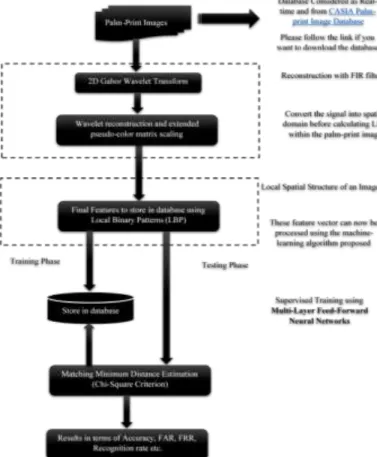
Figure 3 and 4 shows the general block diagram of proposed palmprint based biometric system. As shown in Figure 4, palmprint based biometric system generally consist of the following components:
Data Acquisition Block: This is the block in which biometric data is captured and is transferred to feature extraction and coding block. The biometric data may also be compressed in this block, especially when the data acquisition is performed at a remote location. In Proposed work, CASIA research database is used for the validation of proposed work.
Pre-processing Block: This is an optional block in the sense that some biometric systems do not consist of this block (used for enhancement of input image). Skin
detection, grayscale conversion, histogram equalization and filtering are four main blocks within pre-processing step.
Feature Extraction and Coding Block: This is the block in which acquired biometric sample is processed. Processing consists of segmentation, the process of separating relevant biometric data from background information, and feature extraction, the process of locating and extracting desired data. After segmentation and feature extraction, a biometric template, a mathematical representation of the original biometric, is obtained by encoding extracted features.After that Gabor wavelets are applied and dimension reduction are done by taking row wise mean values of extracted multi-block LBP features.
Distance Matching and Decision Policy Block: This is the final block in a biometric system, where the final decision is made. The biometric template obtained in feature extraction and coding block is compared to one or more templates in the data storage by selected matching algorithm, which determines the degree of similarity between compared templates. The final decision is usually made based on the result of the matching algorithm and empirically determined thresholds.The score of genuine and imposter data using Euclidean dissimilarity test (Meansuring feature difference).
Fig. 3: Simplified Block Diagram of a Biometric System
Capture Capture Process Process Compare Present Biometric Presen t Biometric Enrollment Verificatio n Store No Match Match
Volume 6, Issue 1, January 2017
143 All Rights Reserved © 2017 IJSETR
Fig. 4: Block Diagram of Proposed Palm-print recognition System IV. IMPLEMENTATION DETAILS
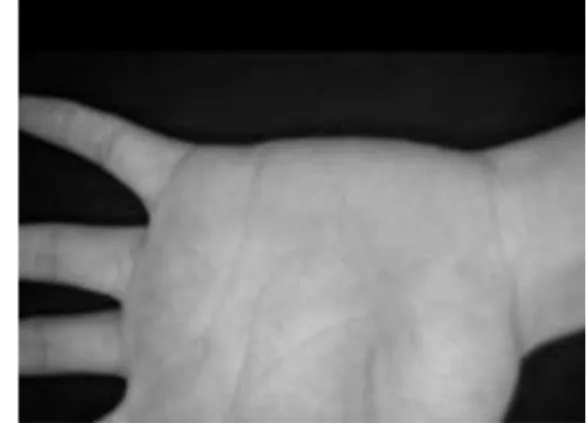
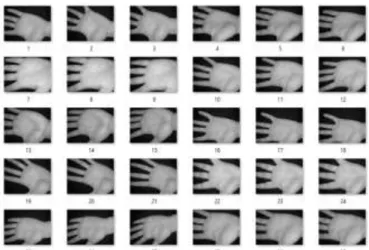
The database images we used, comprehends both digital photo and palmprint images. Input images are taken from CASIA standard palmprint database, and End Results Program. The first stride in the process is to resize the image to have a fixed width (512) but variable size of height. The input may contrast with the level and type of texture in a palm image of a person. Sample images are shown in figure 5.
Fig. 5: Typical Palmprint images in CASIA (Chinese Academy of Sciences Institute of Automation) Palmprint Image database considered in this Research.
A. Image Pre-Processing
Skin detection, grayscale conversion, histogram equalization and filtering are four main blocks within pre-processing step. Skin detection are done using RGB color space model and
histogram equalization is simply equalizing image pixels to an appropriate value.
An RGB space of color is any improver color space created on RGB color model. A specific RGB color space is definite by 3 𝑐𝑟𝑜𝑚𝑎𝑡𝑖𝑐𝑖𝑡𝑖𝑒𝑠 of red, green, & the blue additive primaries, & can generate any chromaticity that is a triangle well-defined by those the primary colors. In order to confiscate unwanted features, primarily some preprocessing has applied to remove the noise and air bubbles on the skin and facilitating image segmentation by median and high pass filters.
B. Feature Extraction
There are some methods which we used for feature extraction within proposed work, they are given below:
1. 2D Gabor Wavelet Transform 2. LBP (Local Binary Patterns) Gabor Wavelet Transform
Elements of a family of mutually similar Gabor functions are called wavelets when they are created by dilation and shift from one elementary Gabor function (mother wavelet), i.e. 𝑔𝛼, 𝜉, 𝑎, 𝑏 (𝑥) = |𝑎|−1/2 𝑔𝛼, 𝜉 𝑥−𝑏
𝑎 … (1)
for𝛼 ∈ ℝ+(scale) and 𝑏 ∈ ℝ (shift). By convention, the
mother wavelet has the energy localized around x = 0 as well as all of the wavelets are normalized ∥ 𝑔 ∥= 1. Although the Gabor wavelets do not form orthonormal bases, the discrete set of them form a frame.
Gabor Function
In the one-dimensional case, the Gabor function consists of a complex exponential (a cosine or sine function, in real case) localized around x = 0 by the envelope with a Gaussian window shape
𝑔𝛼,𝜉 𝑥 = 𝛼/𝜋𝑒−𝛼𝑥 2
𝑒−𝑖𝜉𝑥, … (2)
for𝛼 ∈ ℝ+ and 𝜉, 𝑥 ∈ ℝ, where 𝛼 = (2𝜎2)−1, 𝜎2 is a
variance and 𝜉 is a frequency. Dilation of the complex exponential function and shift of the Gaussian window when the dilation is fixed form kernel of a Gabor transform. The Gabor transform (a special case of the short-time Fourier transform) employs such kernel for time-frequency signal analysis. The mentioned Gaussian window is the best time-frequency localization window in a sense of the Heisenberg uncertainty principle.
In a two-dimensional case, the absolute square of the correlation between an image and a two-dimensional Gabor function provides the spectral energy density concentrated around a given position and frequency in a certain direction. Moreover, the two-dimensional convolution with a circular (non-elliptical) Gabor function is separable to series of one-dimensional ones
144 All Rights Reserved © 2017 IJSETR
𝑔𝛼,𝜉 𝑥 = 𝑔𝛼,𝜉0 𝑥0 𝑔𝛼,𝜉1 𝑥1 , … (3)
for𝜉 = (𝜉0, 𝜉1) and 𝑥 = (𝑥0, 𝑥1). Here, the actual frequency
of the two-dimensional function is determined by 𝜉 = (𝜉02+ 𝜉12)1/2. Furthermore, 𝜗 = 𝑎𝑟𝑐𝑡𝑎𝑛(𝜉1/𝜉0) is an angle
between x-axis and a line perpendicular to the ridges of a wave (wavefronts).
The representation of images by Gabor wavelets is chosen for its biological relevance and technical properties. The Gabor wavelets are of similar shape as the receptive fields of simple cells in the primary visual cortex (V1). They are localized in both space and frequency domains and have the shape of plane waves restricted by a Gaussian envelope function. Simple cells in the primary visual cortex have receptive fields (RFs) which are restricted to small regions of space and highly structured.
Thus, the response 𝑎 of such a cell can be written as a
correlation of the input data, i.e. an image 𝐼(𝑥), with the modeled RF 𝑝(𝑥):
𝑎𝑘 𝑥0 = 𝐼(𝑥)𝑝𝑘(𝑥 − 𝑥0)𝑑𝑥 … (4)
Thus as demonstrated above, we use Gabor wavelets (and not any other wavelets) for image representation because it represents the image based on the way the human mind does. This makes modeling computer vision based on human vision a more efficient and effective process.
The responses of the respective filters can be modeled by Gabor functions of different frequencies and orientations. The Gabor features have been found to be particularly appropriate for texture representation and discrimination and have been successfully applied to texture segmentation, face recognition, handwritten numerals recognition, and fingerprint recognition. In the spatial domain, a 2D Gabor filter is a Gaussian kernel function modulated by a sinusoidal plane wave as follows:
𝐺 𝑥, 𝑦 = 𝑒𝑥𝑝 −𝑥2+𝑦2
2𝜎2 exp[𝑗𝜔(𝑥 𝑐𝑜𝑠𝜃 + 𝑦 𝑠𝑖𝑛𝜃)] … (5)
Where σ is the standard deviation of the Gaussian function in the x- and y-directions and ω denotes the spatial frequency. Family of Gabor kernels can be obtained from eqn. (5) by selecting different center frequencies and orientations. These kernels are used to extract features from an image.
Multi-block local binary Pattern
The actual LBP operator [5] labels pixels of an image by thresholding 3 × 3 neighborhood of each pixel with center value & considering the results as binary code.
LBP code of center pixel in neighborhood is obtained by operator. Converting binary code into the decimal one. Figure 6 gives an illustration for basic LBP Based on operator, each pixel of an image is labeled with the LBP code. The 256-bin histogram of labels contains density of each label & can be used as the texture descriptor of considered region. Procedure of an extracting LBP features for the facial LBP approach can
obtain the relationship among pixels of a facial image in a larger scale, which can contain more face features with the cost of increasing data redundancy. Binary pattern: 11010101
Fig. 6: Fundamental LBP operator
LBP [5] is a gray-scale texture operator that characterizes the local spatial structure of the image texture. Given the central pixel in image, a pattern code is computed by associating it with its neighbors:
𝐿𝐵𝑃𝑃,𝑅 = 𝑠(𝑔𝑝− 𝑔𝑐)2𝑝−1 𝑝
𝑝 =1 … (6)
𝑠 𝑥 = 1, 𝑥 ≥ 0 0, 𝑥 < 0
where𝑔𝑐is gray value of central pixel, 𝑔𝑝 is value of its
neighbors, P is total no. of an involved neighbors & R is the radius of neighborhood. Suppose coordinate of 𝑔𝑐 is (0, 0),
then the coordinates of 𝑔𝑝 are (R*cos(2πp/P), R*sin(2πp/P)).
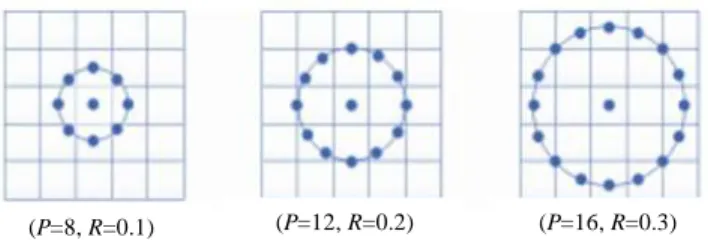
Fig. 7 gives examples of circularly symmetric neighbor sets for different configurations of (P, R). The gray values of neighbors that are not in the center of grids can be estimated by interpolation.
Fig. 7: Circularly symmetric neighbor sets for different (P, R).
We propose a new distinctive rectangle features, called Multi-Block Local Binary Pattern (MB-LBP) feature. The basic idea of MB-LBP is that the simple difference rule in Haar-like features is changed into encoding rectangular regions by local binary pattern operator. The original LBP, is defined for each pixel by thresholding the neighborhood pixel value with the center pixel value. To encode the rectangles, the MB-LBP operator is defined by comparing the central rectangle’s average intensity with those of its neighborhood rectangles. In this way, it can give us a binary sequence. An output value of the MBLBP operator can be obtained as follows:
𝑀𝐵 − 𝐿𝐵𝑃 = 𝑠𝑖=1𝑠 𝑔𝑖− 𝑔𝑐 2𝑖 … (7)
𝑠 𝑥 = 1, 𝑥 ≥ 00, 𝑥 < 0
If the texture image is of size N×M. After identifying LBP pattern of each pixel (i, j), a histogram is built to represent the whole texture image:
Volume 6, Issue 1, January 2017
145 All Rights Reserved © 2017 IJSETR
𝐻 𝑘 = 𝑁𝑖=1 𝑀𝑗 =1𝑓 𝐿𝐵𝑃𝑃 ,𝑅 𝑖, 𝑗 , 𝑘 , 𝑘 ∈ [0, 𝑘]) … (8)
𝑓 𝑥, 𝑦 = 1, 𝑥 = 𝑦 0, 𝑜𝑡𝑒𝑟𝑤𝑖𝑠𝑒
where K is maximal LBP pattern value. U value of the LBP pattern is defined as no. of the spatial transitions (i.e. bitwise 0/1 changes) in that pattern
𝑈 𝐿𝐵𝑃𝑃 ,𝑅 = 𝑠 𝑔𝑝−1− 𝑔𝑐 − 𝑠 𝑔0− 𝑔𝑐 + 𝑠 𝑔𝑝− 𝑝−1 𝑝=1
𝑔𝑐 − 𝑠 𝑔𝑝−1− 𝑔𝑐
… (9)
The dissimilarity of sample and model histograms is a test of goodness-of-fit, which could be measured with a nonparametric statistic test. In this study, the dissimilarity between a test sample S and a class model T is measured by the chi-square distance:
𝐷 𝑆, 𝑇 = (𝑆𝑛−𝑇𝑛)2 (𝑆𝑛+𝑇𝑛) 𝑁
𝑛=1 … (10)
Where, N is the number of bins, 𝑆𝑛 are the values of the
sample, and 𝑇𝑛 are model images at the n th bin
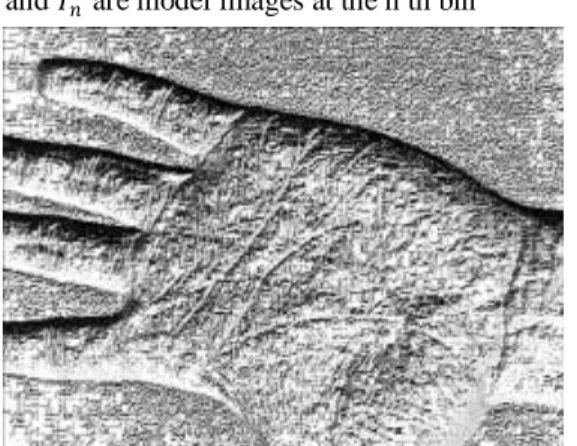
Fig. 8: Texture features after applying MB-LBP on transformed Image.
C. Feature Selection
Among the many variants of neural network architectures that exist, feed-forward neural networks (and specially, those based on the MultiLayer Perceptron, MLP), are one of the most popular models with successful applications in many fields. The power of these networks comes from having several layers of adaptive weights and nonlinear activation functions (e.g. the sigmoid or hyperbolic tangent). Generally, the sum-of-squares error function is employed for estimating the performance of the network that compares the desired signal with the network’s output. There is not a closed-form solution to find the weight values that minimizes the sum-of-squares error function. Hence the common approach is to use the derivatives of the error function with respect to the weight parameters in gradient-based optimization algorithms for finding the minimum of the error function.
In this research we will consider, without loss of generality, a multi-layer MLP like the one shown in Figure 9. The variable names are described below.
Constants I, K, J and S symbolize respectively, the number of inputs, hidden units, outputs and training samples. Each layer of the network consists of a linear matrix 𝑾(𝑛) of
weights 𝑤𝑗𝑖(𝑛 )connecting neuron j in layer n with neuron iin layer n−1, thus the superscript n= 1,…, N is used to refer to each layer. These weight matrices are followed by nonlinear mappings 𝑓𝑗(𝑛), regularly selected to be sigmoid-type functions.
For each layer 𝑛, the input vectors of the MLP are represented as 𝑥(𝑛 ). The bias of each layer has been included
into weight matrix by adding constant inputs 𝑥0𝑠(𝑛 ) = 1, ∀𝑛. In addition, for all j = 1,…, 𝐽; 𝑠 = 1,…, 𝑆, we will denote by 𝑦𝑗𝑠 the real output obtained by the network, 𝑧𝑗𝑠 the inputs
to the non-linearities of the output layer and by 𝑑𝑗𝑠 the desired
response provided in the training set. Finally, in the following we will consider as the training optimization criterion, the MSE between the real y and the desired output d.
Fig. 9: Architecture of a Multi-Layer Perceptron.
The proposed algorithm for linear learning of a multilayer feed forward neural network is as follows:
Step 1: Set the initial weights 𝑾(𝑛)∀𝑛.
Step 2: Using the current weights, propagate the signal
forward to calculate the outputs of each layer.
Step 3: Evaluate the value of the 𝑀𝑆𝐸 between y and d and
update 𝑾(2) (i.e., the output layer) using the linear system of
equations presented in equation 2.
Step 4: Calculate the optimum desired inputs of the output
layer (i.e. the desired outputs for the hidden layer) by using the linear system of equations resulting from the right side of equation 3.
Step 5: Update the weights of the hidden layer 𝑾(1)
according to the optimal desired outputs calculated in Step 4 and using again the linear system of equations in 2.
Step 6: Check convergence criteria. If they are not reached,
continue from Step 2.
Cost function is defined as the Euclidean distance between the gray levels in a histogram to the cluster centers represented in the gray levels. Each pixel in an L×L image can be considered as an object being assigned to one of M labels. Then, the
146 All Rights Reserved © 2017 IJSETR
constraint satisfaction neural network consists of L×L×M neurons that can be conceived as a 3-D array for the image segmentation problem. The number of neurons is dependent on image size; the larger the image size, the more neurons that are required. In a 2-D image, each pixel is assigned one of n gray levels. Consequently, the number of neurons is independent of the image size.
The iteratively updated synaptic weight between the neuronal interconnections will gradually force the network to converge into a stable state where its energy Function is minimized. By Applying Gabor wavelet, we are getting sharp filtered features which are converted into unique texture using proposed multi-block LBP method. Proposed MLFFNN is giving accurate results because of its accurate designing and more efficient features coming from feature extraction block of proposed Work.
V. RESULTS &VALIDATION
In order to verify validity of the algorithm, this article makes numerous simulations & comparisons for above algorithm. The database images we used, comprehends both digital photo and palmprint images. Input images are taken from CASIA standard palmprint database, and End Results Program. The first stride in the process is to resize the image to have a fixed width (512 and 256) but variable size of height. The input may contrast with the level and type of texture in a palm image of a person.
Fig. 10: View of Sample Palmprint images within current directory taken from Biometric Ideal Test.
Skin detection, grayscale conversion, histogram equalization and filtering are four main blocks within pre-processing step. After that Gabor wavelets are applied and dimension reduction are done by taking row wise mean values of extracted multi-block LBP features.
Neural network trained with respect to input image and its texture feature obtained from local binary pattern. In a 2-D image, each pixel is assigned one of n 𝑔𝑟𝑎𝑦 levels. If the
number of sub-regions c is defined in advance, then the MLFFNN consists of 𝑛 × 𝑐 neurons that can be conceived as a 2-D array. The proposed technique first assigns samples to their associated classes in such a manner that the Euclidean distance between arbitrary samples to their class center is minimized. This is referred to as the intra-class assignment. In linear discriminate analysis the concept of within-class scatter matrix is widely used for class 𝑠𝑒𝑝𝑎𝑟𝑎𝑏𝑖𝑙𝑖𝑡𝑦. The iteratively updated synaptic weight between the neuronal interconnections will gradually force the network to converge into a stable state where its energy Function is minimized. All the Algorithms is implemented on the MATLAB 2016a and a database of 200 palm images.Skin detection are done using RGB color space model and histogram equalization is simply equalizing image pixels to an appropriate value.
An RGB space of color is any improver color space created on RGB color model. A specific RGB color space is definite by 3 𝑐𝑟𝑜𝑚𝑎𝑡𝑖𝑐𝑖𝑡𝑖𝑒𝑠 of red, green, & the blue additive primaries, & can generate any chromaticity that is a triangle well-defined by those the primary colors. In order to confiscate unwanted features, primarily some preprocessing has applied to remove the noise and air bubbles on the skin and facilitating image segmentation by median and high pass filters. It works based on neighbor hooding pixels of size m-by-n to approximate the local image mean and standard deviation.
Every Gabor wavelet has a certain wavelength and orientation, and can be convolved with an image to estimate the magnitude of local frequencies of that approximate wavelength and orientation in the image. For the edge detection in palmprint images, the convolution in two perpendicular directions is performed with variously dilated wavelets (e.g., separately in row and column directions). It is necessary to use a wavelet which serves as the first order partial differential operator (e.g., a first derivative of a Gaussian function).
Fig. 11: Output of Gabor Wavelet (Transformation of Palmprint input image).
Consequently, local maxima of moduli are found. Only the maxima above a given threshold are considered (due to noise
Volume 6, Issue 1, January 2017
147 All Rights Reserved © 2017 IJSETR
and slight edges). As a result, the edges for each scale are obtained. This approach is used in detectors based on Laplacian, Laplacian of Gaussian and Difference of Gaussians.
The score of genuine and imposter data using Euclidean dissimilarity test are distributed along 2-D axes to clearly depict the discrimination among them. Experiments are performed to make an analysis for the optimal palm region and LBP neighbourhood. We investigate the matching accuracy for the optimal parameters. The performance of the proposed method in term of accuracy and some other parameters is obtained and compared with some recent methods.These local characteristics are summed and orientation corresponding maximum local intensity pattern is conceded as optimal local direction.
Fig. 12: Texture features extracted after applying MB-LBP on transformed Image (a grayscale texture operator that characterizes the local spatial structure of the image texture).
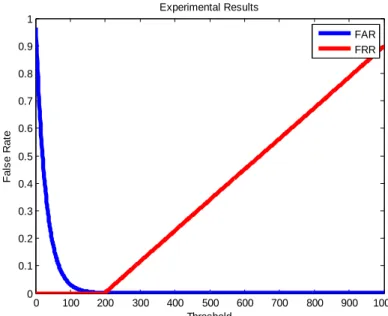
Micro pattern representation is obtained by LBP descriptor. Feature vector is prepared by histograms of 256 bins. In our proposed scheme we use the Gabor wavelets, which has wavelet like property, in orthogonal direction and smoothest contours. Orientation extraction is done optimally to get directional representation and feature size is reduced by extracting LBP histograms. Because of these reasons, it is obvious that our method is performing well. In this palm print recognition system, features such as region mask, orientation field and minutiae are being extracted. An efficient matching algorithm is being implemented which uses these features for comparison of the query palm print with the CASIA database. Graph 13 and 14 below shows the values of false acceptance ratio and false rejection ratio for different number of training images with different threshold.
Fig. 13: FAR and FRR curve of proposed system with 30 Images with a threshold of around 200.
TABLE 1: Table below shows the comparison of recognition
accuracy of proposed work with the approaches proposed earlier in [58]
Method Features Accuracy
Proposed Method Gabor-MBLBP-MLFFNN
99.6752%
Method in [58] Palm-texture 99.2200%
Comparison in [58] Eigen Palms 99.1500%
Comparison in [58] Feature points 94.3000%
Fig. 14: FAR and FRR curve of proposed system with 200 Images with a threshold of around 150.
0 100 200 300 400 500 600 700 800 900 1000 0 0.1 0.2 0.3 0.4 0.5 0.6 0.7 0.8 0.9 1 Experimental Results Threshold Fa ls e R a te FAR FRR 0 100 200 300 400 500 600 700 800 900 1000 0 0.1 0.2 0.3 0.4 0.5 0.6 0.7 0.8 0.9 1 Experimental Results Threshold Fa ls e R a te FAR FRR
148 All Rights Reserved © 2017 IJSETR
TABLE 2: Table below shows the comparison of equal error
rate percentage of proposed work with the approaches proposed earlier in [59]
Method Technique EER %
Proposed Method Gabor-MBLBP-MLFFNN
0.8295
Method in [59] 𝑂𝐿𝑑𝑖𝑟𝐵𝑃 0.9070
Comparison in [59] Comp code 3.3100
Comparison in [59] XOR-SUM 1.0700 Compared to other existing method proposed method provides robustness to noise, low complexity and small features length. Secondly 3x 3 direction pattern employed which extract the edge characteristics locally. Direction pattern further emphasis edge orientation and filter out non edges along irrespective direction of pattern. Local aggregation gives higher 𝐺𝑟𝑎𝑦 value (Local Intensity) at particular orientation. So, the competition for maximum local intensity can better select the orientation information. Secondly orientation information is not affected by intensity variations.
Fig. 15:Figure shows the comparison of proposed method with the traditional methods in [58] in terms of percentage accuracy of Palmprint recognition. It is clear from the figure that proposed method have maximum value of accuracy comparatively.
Fig. 16:Figure shows the comparison of proposed method with the traditional methods in [59] in terms of percentage equal error rate. It is clear from the figure that proposed method have minimum error rate comparatively.
This section conclude that & also here results shows that, proposed work successfully extends stable region and efficiency of the palmprint recognition technique with the lower computational rate & higher values of accuracy and outperform the problem area considered within research work.
VI. CONCLUSION
This Paper considers a novel and efficient method for the palmprint identification based on Gabor wavelet by using multi-block local binary patterns. Proposed method is further supervised through our proposed multi-layer feed-forward neural network for more accurate and computationally efficient recognition. Gabor wavelets efficiently filter the pre-processed image for getting optimum texture features through MB-LBP. Due to accurate feature representation of palm images through proposed LBP, anticipated MLFFNN training rate is high and we are getting much accurate results comparatively.
Experiments are performed to make an analysis for the optimal palm region and LBP neighbourhood. We investigate the matching accuracy for the optimal parameters. The performance of the proposed method in term of accuracy and some other parameters is obtained and compared with some recent methods. These local characteristics are summed and orientation corresponding maximum local intensity pattern is conceded as optimal local direction. Micro pattern representation is obtained by LBP descriptor. Feature vector is prepared by histograms of 256 bins. In our proposed scheme we use the Gabor wavelets, which has wavelet like property,
Propose d Method Palm-texture [59] Eigen Palms [59] Feature points [59] ACCURACY 99.68% 99.22% 99.15% 94.30% 91.00% 92.00% 93.00% 94.00% 95.00% 96.00% 97.00% 98.00% 99.00% 100.00% 101.00% P erc en ta g e a cc u ra cy Number of Methods Percentage Accuracy Proposed Method OLdirBP [59] Comp code [60] XOR-SUM [60] EER % 0.83% 0.91% 3.31% 1.07% 0.00% 0.50% 1.00% 1.50% 2.00% 2.50% 3.00% 3.50% E E R % Number of Methods EER %
Volume 6, Issue 1, January 2017
149 All Rights Reserved © 2017 IJSETR
in orthogonal direction and smoothest contours. Orientation extraction is done optimally to get directional representation and feature size is reduced by extracting LBP histograms. Accuracy of Proposed system is about 99.6% and error rate is below 0.9%.
VII. REFERENCES
[1] A. Jain, P. Flynn, and A. Ross, Handbook of Biometrics. New York: Springer-Verlag, 2007.
[2] J. L. Wayman, A. K. Jain, D. Maltoni, and D. Maio, Biometric Systems— Technology, Design and Performance Evaluation. Berlin, Germany: Springer-Verlag, 2005.
[3] D. Maltoni, D. Maio, A. K. Jain, and S. Prabhakar, Handbook of Fingerprint Recognition, 2nd ed. New York: Springer-Verlag, 2009. [4] S. Dewan, Elementary, Watson: Scan a Palm, Find a Clue. New
York: The New York Times, Nov. 2003.
[5] A. Kong, D. Zhang, and M. Kamel, ―A survey of palm print recognition,‖ Pattern Recognition., vol. 42, no. 7, pp, Jul. 2009. [6] A. Kumar, ―Incorporating cohort information for reliable palm
print authentication,‖ in Proc. ICVGIP, 2008, pp. 583–590.
[7] A. K. Jain and J. Feng, ―Latent palm print matching,‖ IEEE Trans. Pattern Anal. Mach. Intell., vol. 31, no. 6, pp. 1032–1047, Jun. 2009. [8] J. Dai and J. Zhou, ―Multi-feature based high-resolution palm print
recognition,‖ IEEE Trans. Pattern Anal. Mach. Intell., vol. 33, no. 5, pp. 945–n 957, May 2011.
[9] W. W. Boles and S. Y. T. Chu, ―Personal identification using images of the human palms,‖ in Proc. IEEE Region 10 Annu. Conf., Speech Image Technol. Comput. Telecomm. 1997, vol. 1, pp. 295–298. [10] X. Wu, K. Wang, and D. Zhang, ―Fuzzy direction element energy
feature(FDEEF) based palm print identification,‖ in Proc. Int. Conf. Pattern Recogn., 2002, vol. 1, pp. 95–98.
[11] M. R. Diaz, C. M. Travieso, J. B. Alonso, and M. A. Ferrer, ―Biometric system based in the feature of hand palm,‖ in Proc. 38th Annu. Int. Carnahan Conf. Secur. Technol., 2004, pp. 136–139. [12] M. K. H. Leung, A. C. M. Fong, and H. S. Cheung, ―Palm print
verification for controlling access to shared computing resources,‖ IEEE Pervasive Comput., vol. 6, no. 4, pp. 40–47, Oct. 2007.
[13] D. S. Huang, W. Jia, and D. Zhang, ―Palm print verification based on principal lines,‖ Pattern recognition. vol. 41, no. 3, pp. Apr. 2008. [14] W. Jia, D. S. Huang, and D. Zhang, ―Palm print verification based
on robust line orientation code,‖ Pattern recognition. vol. 41, no. 5, pp. 1504–1513, May 2008.
[15] G. Lu, D. Zhang, and K. Wang, ―Palm print recognition using Eigen palms features,‖ Pattern recognition. Lett. vol. 24, no. 9/10, Jun. 2003.
[16] X. Wu, D. Zhang, and K. Wang, ―Fisher palms based palm print recognition,‖ Pattern recognition. Lett. vol. 24, no. 15, Nov. 2003. [17] A. Kumar and D. Zhang, ―Palm print authentication using
multiple classifiers,‖ in Proc. SPIE Symp. DefenseSecur.-Biometric Technol. Hum. Identification, 2004, pp. 20–29.
[18] X. Y. Jing and D. Zhang, ―A face and palm print recognition approach based on discriminant DCT feature extraction,‖ IEEE Trans. Syst., Man, Cybern. B, Cybern. vol. 34, no. 6, pp. 2405–2415, Dec. 2004.
[19] T. Connie, A. T. B. Jin, M. G. K. Ong, and D. N. C. Ling, ―An automated palm print recognition system,‖ Image Vis. Comput., vol. 23, no. 5, pp. 501–515, May 2005.
[20] L. Shang, D. S. Huang, J. X. Du, and C. H. Zheng, ―Palm print recognition using FastICA algorithm and radial basis probabilistic neural network,‖ Neurocomputing, vol. 69, no. 13–15, Aug. 2006. [21] G. Lu, K. Wang, and D. Zhang, ―Wavelet based feature extraction
for palm print,‖ in Proc. 2nd Int. Conf. Image Graph., 2002, pp. 780– 784.
[22] C. C. Han, H. L. Cheng, and K. C. Fan, ―Personal authentication using palm-print features,‖ Pattern recognition., vol. 36, no. 2, Feb. 2003.
[23] J. You, W. K. Kong, D. Zhang, and K. H. Cheung, ―On hierarchical palm print coding with multiple features for personal
identification in large databases,‖ IEEE Trans. Circuits Syst. Video Technol., vol. 14, no. 2, pp. 234–243, Feb. 2004.
[24] A. Kumar and H. C. Shen, ―Palmprint identification using Palm Codes,‖ in Proc. 3rd Int. Conf. Image Graph., 2004, pp. 258–261. [25] L. Zhang and D. Zhang, ―Characterization of palm prints by
wavelet signatures via directional context modeling,‖ IEEE Trans. Syst., Man, Cybern. B, Cybern. vol. 34, no. 3, pp. 1335–1347, Jun. 2004. [26] Q. Dai, N. Bi, D. Huang, D. Zhang, and F. Li, ―M-band wavelets
applications to palm print recognition based on texture features,‖ in Proc. Conf. Image Process., 2004, pp. 893–896.
[27] J. Li and G. Shi, ―A novel palm print feature processing method based on skeleton image,‖ in Proc. IEEE SITIS, 2008, pp. 221–228. [28] A.K Jain, A.Ross, S.Prabhakar (2001), ―Fingerprint matching
using minutiae and Texture features‖, Proc, Int’l Conf.Image processing. [29] B.S. Reddy and B.N. Chatterji (1996), ―An FFT based technique for translation, rotation, and scale-invariantimage registration‖, IEEE Trans. Pattern Analysis andMachine Intelligence, 5(8):1266–1270. [30] Tee Connie, Andrew TeohBeng Jin, Michael GohKah Ong, David
Ngo Chek Ling, ―An automated palmprint recognition system‖, Image and Vision Computing , Vol.23, pp.501–515, 2005.
[31] PatprapaTunkpien, SasipaPanduwadeethorn,
SuphakantPhimoltares, ―Compact Extraction of Principle Lines in Palmprint Using Consecutive Filtering Operations‖, Proceedings of the Second International Conference on Knowledge and Smart Technologies, 2010.
[32] Tee Connie, Andrew Teoh, Michael Goh, David Ngo, ―Palmprint Recognition with PCA and ICA‖, Image and Vision Computing NZ, Palmerston North, pp.227-232, 2003.
[33] K.Y. Rajput, Melissa Amanna, MankhushJagawat and Mayank Sharma, ―Palmprint Recognition Using Image Processing‖ TECHNIA – International Journal of Computing Science and Communication Technologies, Vol. 3, No. 2, pp.618-621, 2011.
[34] I KetutGedeDarma Putra, Erdiawan, ―High Performance PalmprintIdentification System Based On Two Dimensional Gabor‖ TELKOMNIKA Vol. 8, No. 3, pp.309-318, 2010.
[35] SinaAkbariMistani, ShervinMinaee, EmadFatemizadeh, ―Multispectral Palmprint Recognition Using a Hybrid Feature‖ Electrical Engineering Department, Sharif University of Technology, Tehran, 2011.
[36] Kong W.K., Zhang, D., Li W.X., ―Palm print feature extraction using 2-D Gabor filters.‖ Pattern recognition, Vol. 36, 2003.
[37] Zhang W.K. Kong, J. You, M. Wong, ―On-line palm print identification‖, IEEE Transactions on Pattern Analysis and Machine Intelligence, Vol. 25 (9), pp.1041–1051, 2003.
[38] H. Imtiaz, S. Aich, S. A. Fattah, ―A novel pre-processing technique or DCT domain Palm print recognition‖, International Journal of Scientific & Technology Research, Vol.1,Issue 3, pp.31-35, 2012. [39] G.S. Lipane, S.B. Gundre, ―Palm Print Recognition Review
Paper‖, International journals srg , pp. 183-185,.
[40] PriyankaSomvanshi, MilindRane, ―Survey of Palmprint Recognition‖, International Journal of Scientific & Engineering Research, Vol. 3, pp.1-7, 2012.
[41] Gyaourova and A. Ross, ―Index codes for multibiometric pattern retrieval,‖ IEEE Trans. Inf. Forensics Security, vol. 7, no. 2, Apr. 2012. [42] J. Dai, J. Feng, J. Zhou, ―Robust and Efficient Ridge-Based
Palmprint Matching,‖ IEEE Transaction on Pattern Analysis and Machine Intelligence, Vol.34, No. 8, pp. 0162-8828, August 2012 [43] Kong and D. Zhang, ―Competitive coding scheme for palmprint
verification,‖ in Proc ICPR, 2011,pp. 520–523.
[44] Huang,W. Jia, D. Zhang, ―Palmprint verification based on robust line orientation code,‖ Pattern Recognition, Science Direct, 2008. [45] Huang,W. Jia, D. Zhang, ―Palmprint verification based on
principal lines,‖ Pattern Recognition, Science Direct, pp.1316 – 1328, 2008.
[46] D. Zhang, W. K. Kong, J. You, M. Wong, ―Online Palmprint Identification,‖ IEEE Transaction on Pattern Analysis and Machine Intelligence, Vol.25, No. 9, pp. 0162-8828, Sept 2003.
[47] J. You, W. Kong, D. Zhang, and K. Cheung, ―On hierarchical palmprint coding with multiple features for personal identification in
150 All Rights Reserved © 2017 IJSETR
large databases,‖ IEEE Trans. Circuits Syst. Video Technol., vol. 14, no. 2,pp. 234–243, Feb. 2009.
[48] W. Li, J. You, and D. Zhang, ―Texture-based palmprint retrieval using a layered search scheme for personal identification,‖ IEEE Trans. Multimedia, vol. 7, no. 5, pp. 891–898, Oct. 2009.
[49] S. M. Prasad, V. K. Govindan , P. S. Sathidevi, ―Palmprint Authentication Using Fusion of Wavelet Based Representations,‖ IEEE, pp. 978-1-4244-5612-3, 2009.
[50] R. Cappelli, M. Ferrara, and D. Maio, ―A Fast and Accurate Palmprint Recognition System Based on Minutiae,‖ IEEE Transaction on System, Man and Cybernetics- Part B: Cybernetics, Vol. 42, No. 3, pp. 1083-4419, June 2012.
[51] L. Zhu, R. Xing (2009), Hierarchical palmprint recognition based on major line feature and dual tree complex wavelet texture feature. IEEE International conference on fuzzy systems and knowlegde discovery.
[52] P. Tunkpien, S. Panduwadeethorn, S. Phimoltares (2010), Compact extraction of principle lines in palm printusing consecutive filtering operations. In the proceedings of the second International conference on knowledge and smart technologies, pp 39-44.
[53] C. C. Han, H. Cheng, C. Lin, K. Fan (2003), Personal authentication using palm print features. Journal of Pattern recognition, 36(2003).
[54] X. Wu, K. Wang, D. Zhang (2004), An approach to line feature representation and matching for palm print recognition. Journal of Software 15(6), pp 870-880
[55] M. K.H. Leung, A.C.M. Fong, S. C. Hui (2007), Palm print Verification for Controlling Access to Shared Computing Resources. Pervasive Computing, pp 40- 47.
[56] B. S. Panigrahi, H. N. Pratihari, G. Devi, S. Dash (2011), A Palm print feature extraction and pattern classification based on hybrid PSO-K-Means clustering. IJCST, Vol. 2 (2), pp 371-376.
[57] J. Wang, W. Yau, A. Suwandy (2008), Feature level fusion of palm print and palm vein for person al identification based on a junction point representation. IEEE –ICIP, pp 253-256.
[58] Promila, V.Laxmi., ―Palmprint Matching Using LBP‖, 2012 International Conference on Computing Sciences.
[59] PawanDubey, TirupathirajuKanumuri, ―Optimal Local Direction Binary Pattern Based Palmprint Recognition‖, Computing for Sustainable Global Development (INDIACom), 2015 2nd International Conference.

![TABLE 2: Table below shows the comparison of equal error rate percentage of proposed work with the approaches proposed earlier in [59]](https://thumb-us.123doks.com/thumbv2/123dok_us/8214697.2177861/11.918.487.860.81.417/table-table-comparison-percentage-proposed-approaches-proposed-earlier.webp)
