Volume 5, Issue 4, April 2016
Abstract— Video surveillance systems were used in many domains in the last few decades such as crime prevention, human behavior understanding, activity analysis, traffic monitoring etc. Video based face recognition is the process of detecting and recognizing the faces captured by a video camera. Face recognition in video has gained wide attention as it plays an important role in designing automatic surveillance systems. The main challenges in the video based face recognition are the limitation of the camera hardware, the arbitrary poses captured by the camera as the subject is non cooperative, changes in the resolutions due to different lighting conditions, noise and blurriness. Therefore a video based face recognition system must be robust to the changes in the illumination, scale, pose and expression. It must perform the detection and recognition rapidly in real time. In order to minimize the human interaction with the system, it has to be automated. A system capable of recognizing faces from video data in real time is proposed herewith. It is expected that the proposed system will be better than existing system in terms of accuracy, robustness, flexibility and compactness.
Keywords— Face detection, face recognition, face tracking, Surveillance Analysis, Video Surveillance Systems
I. INTRODUCTION
In a country like India public safety is emerged as an important factor, due to the growing crime rates, increasing terrorism, missing children/runaway cases. As the population is increasing day-by-day, controlling the mishaps has become a tedious job as crime, violence, and fear in cities pose significant challenges to law enforcement authorities. Therefore there has to be a direct application in any urban safety strategy, aimed at reducing and preventing problems of crime and insecurity. There are many terrorists, criminals, thieves who have been staying in the country from years fearlessly due to the poor surveillance system. Therefore for serving as a visual deterrent to crime or giving managers and security professionals the tool for security and other controlling aspects, video surveillance system is important. It is one of the most valuable security and loss prevention solution. The incidents like ragging, drug addiction, violence and sexual exploitation can be curbed by the implementation
Manuscript received Apr, 2016
Prof. Archana D. Gaikawad, Department of Computer Engineering, Institute of Knowledge College of Engineering, Savitribai Phule Pune University, Pune, Pune, India, 7741042615.
Prof. Paresh D. Sonawane, Department of Computer Engineering,
Institute of Knowledge College of Engineering, Savitribai Phule Pune University, Pune, Pune, India, 9960975554.
of video surveillance system at the most important places of action like canteen, playground, and hostels.
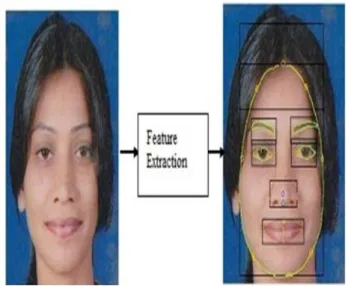
Fig 1: Feature Extraction
Video surveillance systems were used in many domains in the last few decades such as health care, accident detection, traffic monitoring and controlling, traffic flow analysis, counting moving objects, airborne traffic, crime prevention through indoor and outdoor monitoring, human behavior understanding, identification tracking, classification of vehicles, motion detection and activity analysis and classification of people or any object of interest. There is also a vast requirement for automatic surveillance systems to support monitoring indoor and outdoor environment like parking lots, shopping malls, airports, railway station and so on due to the availability and low price of processors and sensors. There are many biometric characters which can be used for person identification in video surveillance system. Unlike other biometric characters, face has many features which can be used collectively for recognizing the person correctly. Fig 1 shows the basic features which are needed to be extracted for face recognition system such as position of eyes, position of nose, distance between eyes etc.
In a highly populated country like India, it is merely impossible for a human being to recognize the faces manually from the video surveillance video. Therefore the system must be automated. An automated system does not require human interruption for recognizing faces. Automatic face recognition has now been studied for over three decades. While substantial performance improvements have been made in controlled scenarios (frontal pose and favorable
Prof. Archana D. Gaikawad, Prof. Paresh D. Sonawane
An Efficient Video Surveillance System Using
Video Based Face Recognition on Real World
Volume 5, Issue 4, April 2016 lighting conditions), the recognition performance is still
brittle with pose and lighting variations. Until recently, face recognition was mostly limited to one or more still shot images, but the current face recognition studies are attempting to combine video and multi-view face models to achieve better performance. Face images captured in surveillance systems are mostly off-frontal and have low resolution. Consequently, they do not match very well with the gallery that typically contains frontal face images. As in video based face recognition system, many frames can be extracted which gives large number of features to process. There are superior advantages of the video-based recognition over the image-based recognition. First, to facilitate the recognition, utilization of the temporal information of faces can be done. Secondly, more effective representations, such as a 3D face model or super-resolution images, can be obtained from the video sequence and used to improve recognition results [16] [17]. Finally, video-based recognition allows learning or updating the subject model over time. An updating-during-recognition scheme, where the current and past frames in a video sequence are used to update the subject models to improve recognition results for future frames. Face recognition in video has gained substantial attention due to its applications in deploying surveillance systems.
Fig 2: A system for video-based face recognition [43]
In video based face recognition system, face verification (or authentication), and face identification (or recognition) can be considered as the two main stages. The detection stage is the first stage; it includes identifying and locating a face in an image. The recognition stage is the second stage; it includes feature extraction, and matching. In feature extraction important information for the discrimination is saved and while in matching phase the recognition result is given using the face database [21]. Fig 2 shows the basic video based face recognition system.
Presently there are many video based face recognition systems which are used worldwide. However these models have limitations such as need of the controlled datasets, and careful image alignment. Some Existing techniques support small pose variations [42]. If the resolution of the extracted frame is low then the performance of the system is degraded. In various studies, it has been documented that the persistent problems are pose and illumination variations in face recognition [6] [7]. Therefore, an automated method for face
recognition that is robust to variations in pose and illumination is proposed. The proposed system also must detect and recognize faces rapidly.
II. PROBLEM DEFINITION
There exist many video based face recognition systems. But many systems have limitation such as the need of a controlled database. Therefore the existing techniques do not work well with the pose, illumination, and shape variant subject. Compared with other challenges, face recognition from low resolution video reduces the performance of the existing systems significantly. Secondly, in the most populated countries like India manual face recognition is merely impossible. Therefore an automated method for face recognition that is robust to variations in pose and illumination is proposed. The system also has to be automated and must work on the uncontrolled databases and it must be computationally less expensive.
III. LITERATURE SURVEY
The face recognition technique is mainly divided into two types. Figure 3 shows the types of the video based face recognition techniques. There are two main types of the face recognition techniques namely set based face recognition and sequence based face recognition technique. Set based approach is again divided into manifold modeling, super resolution, 3D modeling and frame selection where as sequence based is divided into spatio temporal and temporal approach. The major challenges which are faced by the face recognition algorithm are low quality face image or video, uncontrolled environment, lighting problem, appearance problem, covering of faces [14]. To address these difficulties many researchers are working in this area.
Fig 3: Taxonomy of the Face Recognition from Video Literature [23]
To recognize the faces in the video surveillance numerous approaches have been developed. Initially the focus was on the image based technique which is shifted towards the video based techniques during the few last years [18]. These are developed in order to overcome shortcomings of image-based recognizers like sensitivity to low resolution, pose variations and partial occlusion. Bhatt et al. in [24], performed a work based on ranked list aggregation. A dictionary consisting of various intra-personal variations of faces is used in the algorithm. Based on the similarity
Volume 5, Issue 4, April 2016 measure of the faces, the frames from input videos are
captured and arranged. In case if some part of the face is missing then the technique cannot recover the face.
Changbo Hu et al. [25] introduced the face recognition based on the patch based technique. In this the frame was taken from the video whose patch is cropped from the frames of the video. This patch is then compared with the original face and stitched together. This face can be further used for face recognition. In this method part of the face was used for recognition and the face was reconstructed from the patches. Recovery of the missing part can be done with this method. To improve the recognition performance a patch-based image quality assessment method was proposed to select a subset of the “best” face images from the video sequences [26]. However this technique was not robust to the pose and angles.
To recognize pose-variant faces using redundancy in multi-view video data approach was proposed. In Multi-view video data, it consists of faces with multiple viewpoints. Multi-view gives more information compared to the single view data. Pose variation can be easily handled by this technique. The authors claim to have a better recognition rate when compared to traditional algorithms on multi view video database. During recognition in uncontrolled settings, changes in pose, illumination and expression can be addressed using specific strategies [27]. To enable practical applications, it is necessary to investigate face recognition techniques for low-quality video data. Therefore super resolution could be a solution [37], and temporal information in the video could be used to compensate for the lost spatial information.
Fig 4: Pose, Illumination and lightening conditions, (a): Lightening conditions, (b): face poses [35] A face recognition model where training faces from a particular subject are clustered semantically [28]. Further, clustered faces from different persons are again logically grouped according to their semantics. From each group, features are sliced and on these slices, the PCA+LDA algorithm is systematically applied. While testing, each individual frame is assigned to one of the groups in the training stage. Final matching is considered as the sum of the best matching from individual groups. Authors claim that there is a substantial improvement in recognition rate when compared to traditional approaches. Davis, M et al. [29], have demonstrated a real time system of face recognition from surveillance video. This system is robust against pose,
scale, illumination and expression for face recognition. He combined Viola Jones method with skin – tone color information analysis. Irises, nostrils, ear – tips are the local features that they used. It is also mentioned that for real world system more features should be selected but it is unknown how many features are required to provide discrimination over a large population [12]. Fig 4 (a) shows the various lightening condition and fig 4 (b) shows poses that may be captured in an uncontrolled environment.
For illumination invariance a novel approach for video based face recognition was presented [30]. In this approach the image enhancement based on local mean and standard deviation is introduced into conventional PCA. The improved PCA and LDA are combined to recognize faces in videos. LDA is used to solve the small sample size problem. This paper also shows that video based face recognition can also tackle with the problems of image based face recognition. In this way it can enhance the performance and speed of current image based face recognition. For both pose and illumination Yi-Chen, et al [31] proposed a video-based face recognition model in which joint sparsity-based approach was used. In this model a face is partitioned during the training stage, based on different pose and illumination condition and is placed in sub-dictionaries. Particular viewing conditions of each of the face are included in these dictionaries. Authors claim that theirs bring a better recognition rate compared to the existing methods.
X. Liu and T. Chen [32] proposed a novel video-based face recognition algorithm known as sequential sample concensus using sequential sampling and updating scheme. In their proposed method, a training set is created and each individual’s identity is tested against the training set using a probability mass function. Authors claim that this method is robust and resilient against pose variation, if only one frame is available. To solve the multiple sample problems, a region based-approach is exploited to adapt sparse representation in face recognition, using face images that are external to the gallery [33]. Comparing with still-based approaches, videos are becoming more challenging as it has been used extensively for surveillance activities. Videos are tending to provide more information when compared still image-based details. Videos provide the much-needed temporal continuity. The authors have proposed an adaptive Hidden Markov Model (HMM)-based facial recognition algorithm [34]. It works only on the controlled dataset with a very small variance in the pose.
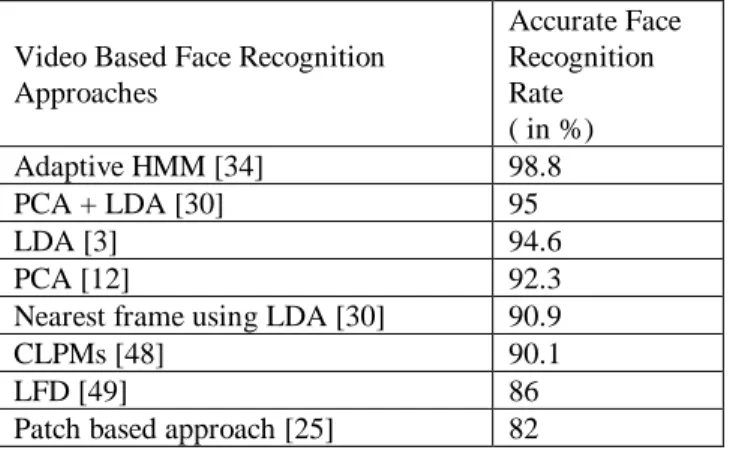
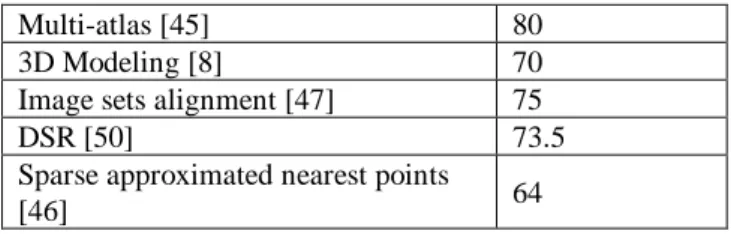
Table I. Comparison of recognition results with existing video-based approaches
Video Based Face Recognition Approaches Accurate Face Recognition Rate ( in %) Adaptive HMM [34] 98.8 PCA + LDA [30] 95 LDA [3] 94.6 PCA [12] 92.3
Nearest frame using LDA [30] 90.9
CLPMs [48] 90.1
LFD [49] 86
Volume 5, Issue 4, April 2016
Multi-atlas [45] 80
3D Modeling [8] 70
Image sets alignment [47] 75
DSR [50] 73.5
Sparse approximated nearest points
[46] 64
Table I shows the performance comparison of some popular techniques with their respective recognition rates. There are many techniques which are providing more than 98% accuracy.
The authors have proposed an average data modeling based on local preserving projections by making use of nearest neighbor graphs and Eigen maps in [35]. Even though the video-based face recognition is gaining popularity, there still exist disadvantages with respect to video-based face recognition [5]. The major limitations in video-based face recognition are poor illumination, different pose variation, occluded face images, and varied expression. Ajmal Mian [19] presented an online learning approach to video-based face recognition that does not make any assumptions about the pose, expressions or prior localization of facial landmarks. This work which have embarked and described literature is an attempt to propose a fresh model that can significantly increase the recognition rate of faces from a video sequence. Typically a video sequence contains faces with different poses and occludes different face images. In above approached the performance of the system was checked on the basis of the recognition. To make the system robust to lightening conditions some methods are introduced. Enhancing low resolution images from the video sequence has been studied by many researchers in the past decades [36]. Work on super-resolution can be categorized into two classes in recent years: H. Huang and H. He [37] introduced the feature-based face recognition and L. Wu., X. Wang [39] introduced learning-based reconstruction of face. To propose and implement an experimental fully automatic face recognition system which will be used to detect faces in real time. Its main strength is to successfully process frames of a great number of different individuals taken in a totally uncontrolled environment.
IV. PROPOSED RESEARCH WORK
Video sequences are normally digitized at lower resolutions than still pictures. From such video a “freeze-frame” taken would be of lower than desirable quality as these video sequences are captured from cameras. Since it is one of the limiting parameters in digital camera design in face recognition, the resolution of images or video frames is a key factor. From the fact that in their most common form (i.e., the frontal view) faces appear to be roughly alike and the differences between them are quite subtle, the difficulty of this problem stems. Consequently, frontal face images form a very dense cluster in image space for traditional pattern recognition techniques. It seems virtually impossible to accurately discriminate among them with a high degree of success. For uncontrolled environments to build an automated real-time capable face recognition system (FRS) is the central goal. With all the challenges they bring along, that make the task harder, it is supposed to handle real-life situations robustly. Partial occlusions can be caused by
accessories and facial hair. Depending on the time of day, time of year and weather conditions daylight lead to very different illumination. The users, i.e. the persons to be recognized are free to switch on and off any light sources that might be available, since they are not supposed to be restrained by the system. This leads to a wide variety of illumination configurations in terms of light intensity, direction and even color.
A. Proposed Methodology
The proposed algorithm to be designed in such a way that a predefined training set is created and the features extracted from the video are matched against the features from the training set. Input: The face image to be recognized and the video in which the face is to be recognized. Output: The Face Marked Frames in which the face is present.
a. Face Detection: In this phase the facial part of the body is detected in the given video.
b. Facial landmark localization: In this, the localization of the facial parts is done e.g. eye centers, mouth corners, ear tips, nose measurements etc. After the face region is detected, three facial landmarks are located: the mouth center and the two eyes.
c. Normalization: The resolution, noise, lighting condition of the detected face are normalized so as to forward it for feature extraction.
d. Face alignment: In this phase if required, the face is aligned in a proper or in a required angle.
e. Feature extraction: Feature extraction in which pose, illumination and shape robustness is provided.
f. Matching Phase: The features extracted in the face extraction phase are used for matching. Matching is done against the training data set. Once it is matched the training image, the result is provided.
B. Possible Research Outcomes
From the literature survey it is found that the low resolution and high dimensionality of video data degrade the performance of the system drastically. To address this issue a novel video based face recognition technique is proposed. To effectively solve the problem of large scale video face recognition, there is a need of comprehensive, compact, and yet flexible representation of a face subject. The outcomes of the research are:
1) An automated video based face recognition system which is capable of recognizing face rapidly in real time.
2) A system robust to pose, illumination and shape. 3) A system capable of providing better accuracy and
flexibility.
C. Key Challenges in the proposed approach
With camera sensors become pervasive in our society, video data has been one of the main sensory inputs in electronic systems. Meantime, huge amounts of video content have been generated. Face recognition in video, which has many applications such as biometric identification, video search and retrieval, visual surveillance, and human-computer interaction, has received much interest in the last decade. Although much progress has been made, the problem remains difficult for videos captured in unconstrained
Volume 5, Issue 4, April 2016 settings. Some major challenges that should be addressed in
future research are considered here:
The strong need for user friendly system that can secure our assets and protects our privacy without losing our identity. As in video surveillance system the object of interest may not be cooperative also the limitations such as light, noise, there are challenges detected in video surveillance. a. Low resolution. The images captured by the surveillance
cameras are at very low resolution as compared with the consumer cameras. There are very limited pixels in account for the face. So in unfavorable conditions the low resolution may become the biggest limitation of video surveillance system [4].
b. Arbitrary poses. In video surveillance system the subject of interest may be in motion at times. So there may be different poses of different faces in different cameras [22].
c. Lighting conditions which are continuously varying. As in the coverage area of surveillance cameras, the lighting is usually not uniform, the illumination on the subject’s face could vary significantly (i.e., from direct sunshine, the subjects walks into the shade.)
d. Noise and blurriness. The noise may always corrupt the captured images and the blurriness is introduced by the motion of the subjects. Variations in resolution, lighting condition and poses are exhibited by the face images. In addition, noise, blurriness and occlusion are also observable.
e. Low-quality Video Data: In many real-life applications, the video data is of low quality (e.g., limited imaging resolution or low frame rate), such as video footage from surveillance cameras and videos captured by consumers via mobile or wearable cameras. The low-quality data could be caused by poor sensor performance, motion blur, environmental factors such as illumination, or video compression. The sensors in the non-visible spectrum (e.g. Near-Infrared) also generate low-resolution videos with much noise. Existing face recognition approaches mainly focuses on good-quality video data, which cannot be directly applied to low-quality video data.
f. Computational Cost: Many applications of face recognition can be foreseen on platforms with limited computing power, for example, video retrieval in mobile devices, smart cameras for video surveillance, user interface of consumer electronics (e.g., toy robotics). The processing power on these devices is limited for traditional video processing tasks like face recognition [10]. Although advanced hardware design and algorithm optimization could be helpful to certain extent [23], most of existing video-based face recognition approaches require high computation, which prevents them for wide applications in low-performance systems. Therefore, there is a great need to investigate low-cost algorithms for face recognition in video.
g. Facial occlusions reduce the face recognition system performance drastically. Two types of occlusions are face in face recognition namely lower occlusion and upper occlusion which slightly degrade the performance of the face recognition system.
h. Changes in the weather conditions as well as Turbulence in the atmosphere affect the system performance. If the weather is too cloudy or too sunny then the captured frames may not be very useful for recognition.
V. CONCLUSION
By using the video based face recognition system public safety can be achieved which can help to reduce the crime ratio. The system can also automatically detect and recognize faces from the surveillance video. The system can be used to achieve the cost effective video based face recognition. The system is invariant to pose, illumination, shape, resolution and plastic surgery invariance.
ACKNOWLEDGMENT
We thank Dr. R. Jayadevan, Professor, AIT, SPPU, Pune for assistance and comments that greatly improved the manuscript.
We would also like to show our gratitude to the Dr. D. J. Garkal, Principal, IOKCOE for sharing their pearls of wisdom with us during the course of this research.
REFERENCES
[1] Ali Moeini, Hossein Moeini, Karim Faez, “Unrestricted pose-invariant face recognition by sparse dictionary matrix”, Image and Vision Computing, Volume 36, Pages 9-22, April 2015, Elsevier.
[2] Rama Chellappa, Ming Du, Pavan Turaga, Shaohua Kevin Zhou, “Face Tracking and Recognition in Video”, pp 323-351, 2011, Publisher Springer London.
[3] Zhiwu Huang, Shiguang Shan, Haihong Zhang, Shihong Lao, Alifu Kuerban, Xilin Chen, “Benchmarking Still-to-Video Face Recognition via Partial and Local Linear Discriminant Analysis on COX-S2V Dataset”, Volume 7725, pp 589-600, 2013, Publisher Springer Berlin Heidelberg.
[4] Zhifei Wang, Zhenjiang Miao, Q.M., Jonathan Wu, Yanli Wan, Zhen Tang, “Low-resolution face recognition: a review” , 2013, Springer-Verlag Berlin Heidelberg.
[5] Gayathri Mahalingam, Chandra Kambhamettu, “Video Based Face Recognition Using Graph Matching”, Volume 6494, pp 82-94, 2011, Publisher Springer Berlin Heidelberg.
[6] Wei Qi, Yaxi Hou, Lifang Wu, Xiao Xu, “A Pose Robust Face Recognition Approach by Combining PCA-ASIFT and SSIM”, Volume 8833, pp 163-172, 2014, Publisher Springer International Publishing. [7] Chao Wang, Yongping Li, Xubo Song, “Video-to-video face
authentication system robust to pose variations”, Expert Systems with Applications, Volume 40, Issue 2, Pages 722-735, 1 February 2013, Elsevier.
[8] Taleb Alashkar, Boulbaba Ben Amor, Mohamed Daoudi, Stefano Berretti, “A Grassmannian Framework for Face Recognition of 3D Dynamic Sequences with Challenging Conditions”, Volume 8928, pp 326-340, 2015, Publisher Springer International Publishing.
[9] Chao Wang, Yunhong Wang, Zhaoxiang Zhang, Yiding Wang, “Incremental learning patch-based bag of facial words representation for face recognition in videos”, 2013, Springer Science+Business Media New York.
[10] Ognjen Arandjelović, “Computationally efficient application of the generic shape-illumination invariant to face recognition from video”, Pattern Recognition, Volume 45, Issue 1, Pages 92-103, January 2012, Elsevier
[11] Little, S., Jargalsaikhan, I., Clawson, K., Nieto, M., Li, H., Direkoglu, C., and Liu, J., “An information retrieval approach to identifying infrequent events in surveillance video”, published in Proceedings of the 3rd ACM conference on International conference on multimedia retrieval, pp. 223-230. 2013, ACM.
[12] Wang, C., Lan, L., Zhang, Y. and Gu, M., “Face Recognition Based on Principle Component Analysis and Support Vector Machine”, Intelligent Systems and Applications (ISA), pp: 1-4, 2011, 3rd IEEE International Workshop.
Volume 5, Issue 4, April 2016 [13] Pietikäinen, M., Hadid, A., Zhao, G. and Ahonen, T., “Local binary
patterns for still images”. In Computer Vision Using Local Binary Patterns, pp: 13-47, 2011, Springer London..
[14] X Tan, B Triggs, “Enhanced local texture feature sets for face recognition under difficult lighting conditions”, Vol: 19(6), pp: 1635–1650, 2010, IEEE Trans. Image Process.
[15] D Huang, C Shan, M Ardabilian, Y Wang, L Chen, “Local binary patterns and its application to facial image analysis: a survey”. IEEE Trans. Syst. Man Cybernetics-Part C: Appl. Rev., Vol: 41(6), pp: 765–781, 2011, IEEE.
[16] Gao, Y., Tang, J., Hong, R., Yan, S., Dai, Q., Zhang, N., Chua, T., “Camera constraint-free view-based 3D object retrieval”. IEEE Trans. Image Process, Vol: 21(4), pp: 2269–2281, 2012, IEEE.
[17] Gao, Y.,Wang, M., Tao, D., Ji, R., Dai, Q., “3D object retrieval and recognition with hyper graph analysis”, IEEE Trans. Image Process, Vol: 21(9),pp: 4290–4303, 2012, IEEE.
[18] Gao, Y.,Wang, M., Zha, Z., Shen, J., Li, X.,Wu, X., “Visual-textual joint relevance learning for tag-based social image search”. IEEE Trans. Image Process, Vol: 22(1), pp: 363–376, 2013, IEEE.
[19] Ajmal Mian “Online learning from local features for video-based face recognition, Pattern Recognition”, Volume 44 Issue 5, Pages 1068-1075 , May, 2011 , Elsevier Science Inc. New York, NY, USA
[20] Ladislav Lenc, Pavel Kral, “Automatic face recognition system based on the SIFT features”, Computers and Electrical Engineering ,2015, Elsevier.
[21] A.J. Goldstein, L.D. Harmon, and A.B. Lesk, “Identification of human faces”, in Proc. IEEE conference on Computer Vision and Pattern Recognition, Vol-59, pp 748-760, May 1971.
[22] [6] Ming Du; Sankaranarayanan, A.C.; Chellappa, R., "Robust Face Recognition From Multi-View Videos," Image Processing, IEEE Transactions, vol.23, no.3, pp.1105,1117, March 2014 , IEEE. [23] Jeremiah R. Barr, Kevin W. Bowyer, Patrick J. Flynn, Soma Biswas,
“Face Recognition From Video:A Review”, International Journal of Pattern Recognition and Artificial Intelligence, April 20, 2012, IEEE. [24] Bhatt, H.S.; Singh, R.; Vatsa, M., "On Recognizing Faces in Videos Using
Clustering-Based Re-Ranking and Fusion," Information Forensics and Security, IEEE Transactions on , vol.9, no.7, pp.1056,1068, July 2014 [25] Changbo Hu; Harguess, J.; Aggarwal, J.K., "Patch-based face recognition
from video," Image Processing (ICIP), 2009 16th IEEE International Conference on , vol., no., pp.3321,3324, 7-10 Nov. 2009.
[26] Y. Wong, S. Chen, S. Mau, C. Sanderson, and B. Lovell, “Patch based probabilistic image quality assessment for face selection and improved video-based face recognition,” in Proc. IEEE Comput. Soc. Conf. Comput. Vis. Pattern Recognit. Workshops, Jun. 2011, pp. 74–81. [27] A. Baradarani, Q. M. J. W., M. Ahmadi, “An efficient illumination
invariant face recognition framework via illumination enhancement and DD-DTCWT filtering”, Pattern Recognition, Vol:.46, pp: 57–72, 2013, Springer.
[28] Dihong Gong; Kai Zhu; ZhiFeng Li; Yu Qiao, "A semantic model for video based face recognition," Information and Automation (ICIA), 2013 IEEE International Conference on , vol., no., pp.1369,1374, 26-28 Aug. 2013.
[29] Davis, M., Popov, S. and Surlea, C., “Real-Time Face Recognition from Surveillance” Video. In Intelligent Video Event Analysis and Understanding, Vol. 332 pp: 155-194, 2010, Springer Berlin Heidelberg. [30] Zhou, Q., Liang, B. and Duan, F., “Combination of improved PCA and
LDA for Video based Face Recognition”. , Vol. 1, pp: 273-280, 2013, Journal of computational information science.
[31] Chen, Yi-Chen, "Video-based face recognition via joint sparse representation." Automatic Face and Gesture Recognition (FG), 2013, 10th IEEE International Conference and Workshops on. IEEE. [32] X. Liu, T. Chen, “Video-Based Face Recognition Using Adaptive Hidden
Markov Models”, CVPR, pp. 340-345, 2003, Elsevier.
[33] G.Aggarwal, S.Biswas, P.J.Flynn, K.W.Bowyer, “A.Sparse Representation approach to face matching across plastic surgery, in:Proceedings of IEEE Workshop on Applications of Computer Vision, Colorado Springs, CO, pp.113–119, January 2012, IEEE.
[34] X. Liu, T. Chen, “Video-based Face Recognition using Adaptive Hidden Markov Model”, CVPR 03, proceeding of 2003 IEEE computer society conference eon computer vision and pattern recognition, pp 340-345, 2003, IEEE.
[35] Radha, V., & Nallammal, N, “Comparative Analysis of Curvelets Based Face Recognition Methods”, In Proceedings of the World Congress on Engineering and Computer Science , Vol. 1), 2011.
[36] Zou, P.C. Yuen, “Very low resolution face recognition problem”, IEEE Trans. Image Process. Vol: 21 (1), pp: 327–340, 2012, IEEE. [37] H. Huang, H. He, “Super-resolution method for face recognition using
nonlinear mappings on coherent features”, IEEE Trans. Neural Netw. Vol: 22 (1), pp: 121–130, 2011, IEEE.
[38] S.H. Sridharan, S. Denman, C. Fookes, “Feature-domain super-resolution framework for Gabor-based face and iris recognition”, in: IEEE
Conference on Computer Vision and Pattern Recognition. Providence RI, pp. 2642–2649, 2012, USA: IEEE.
[39] L. Wu, X. Wang, “A fast algorithm for learning-based super-resolution reconstruction of face image”, in: 2011 4th International Congress on Image and Signal Processing. Shanghai, China: IEEE, pp. 1049–1053, 2011, IEEE.
[40] Zou, P.C. Yuen, “Learning the relationship between high and low resolution images in kernel space for face super resolution”, in: 2010 20th International Conference on Pattern Recognition. Istanbul, Turkey: IEEE, pp. 1152–1155, 2010, IEEE.
[41] Gayathri Mahalingam, Chandra Kambhamettu, “Face Recognition in Videos – A Graph Based Modified Kernel Discriminant Analysis”, Vol: 7724, pp: 370-381, 2013, Publisher Springer Berlin Heidelberg. [42] Le An, Mehran Kafai, and Bir Bhanu, “Dynamic Bayesian Network for
Unconstrained Face Recognition in Surveillance Camera Networks”, IEEE Journal On Emerging and Selected Topics In Circuits And Systems, Vol:. 3, NO. 2, JUNE 2013, IEEE.
[43] Jean-François Connolly, Eric Granger *, Robert Sabourin “An adaptive classification system for video-based face recognition”, Information Sciences Vol-192, pp: 50–70, 2012, Elsevier.
[44] Hadid, A., Pietik¨ainen, M.: “From still image to video-based face recognition: An experimental analysis”. In: IEEE International Conference on Automatic Face & Gesture Recognition (FG), pp. 813–818, 2004, IEEE.
[45] Gou G, Shen R,Wang Y, Basu A, “Temporal-spatial face recognition using multi-atlas and markov process model”,. in Proc. international conference on multimedia and expo, pp 1–4, 2011.
[46] Hu Y, Mian A, Owens R, “Sparse approximated nearest points for image set classification”, In: Proc. CVPR, pp 121–128, 2011.
[47] Cui Z, Shan S, Zhang H, Lao S, Chen X, “Image sets alignment for video-based face recognition”, in: Proc. CVPR, pp 2626–2633, 2011. [48] Li, B., Chang, H., Shan, S.G., Chen, X.L., “ Low-resolution face
recognition via coupled locality preserving mappings”, IEEE Signal Process. Lett. 17(1), pp 20–23, 2010, IEEE.
[49] Lei, Z., Ahonen, T., Pietikainen, M., Li, S.Z., “Local frequency descriptor for low-resolution face recognition”, In: Proc. IEEE 9th Int. Conf. on Automatic Face and Gesture Recognition (FG), Santa Barbara, CA, USA,, pp: 161–166, Mar. 2011, IEEE.
[50] Zou, W.W.W., Yuen, P.C., “Very low resolution face recognition problem”, IEEE Trans. Image Process. 21(1), pp 327–340, 2012, IEEE.
Prof. Archana D. Gaikawad, M.E. Computer, International Papers Published 04, National 02, working as an Assistant Professor in Computer Engineering department, IOKCOE, Pune 412208.
Prof. Paresh D. Sonawane, M.E. Computer, International Papers Published 04, National 02, working as an Assistant Professor in Computer Engineering department, IOKCOE, Pune 412208.
![Fig 2: A system for video-based face recognition [43]](https://thumb-us.123doks.com/thumbv2/123dok_us/8216855.2178580/2.893.103.428.536.758/fig-video-based-face-recognition.webp)