Volume 5, Issue 6, June 2016
Abstract—Wireless sensor network consist spatially distributed sensor nodes to sensing, processing and monitoring environment parameters to reporting at the sink node (base station). Sensor nodes are transmitting data from sensor node to base station. Sensor nodes are measured data in adaptively or dynamically using throttling techniques to reduce data and transmit to the base station. In throttling data reduction technique threshold exceed data transmit from sensor nodes to sink node. In WSN minimize energy consumption using the data reduction throttling algorithm to reduce the size of data. Here, we proposed Controlled Duty Cycle Scheme for minimizing energy consumption in wireless sensor network. CDC Scheme is used for energy efficiency to increase routing fairness. The main goal of data reduction with CDC technique is to increase the life of Wireless sensor network by consuming minimum energy.
Index Terms—Data reduction, Energy efficiency, network lifetime, WSN.
I INTRODUCTION
Wireless Sensor Networks consist of different types of sensors containing small micro-controller boards called as sensor nodes. They are communicating wirelessly using radio link [15]. In development area sensor nodes are deployed in hostile and inaccessible site. WSN provides a broad range of application area including health monitoring, military, industry, sport and agriculture. In wsn consist mostly three steps, Firstly is a sensor node gathering data from environment parameter, the second is processing and third is transmitting data (result) using wireless radio link to sink node. Sensor node is self-organized and transmitting data as well as other sensors messages.
Wireless Sensor Network are many challenges like sensor nodes have limited communication, limited sensing energy, small memory, limited processor capability, Sensor node hardware failure and low battery power etc. Therefore, energy consumption is the main challenge in wireless sensor network. Sensor nodes required energy for
Manuscript received May, 2016.
Manisha P Mashere. Computer Engineering, MIT Academy of Engineering Alandi(D), Pune, India
Sunita S Barve, Department of Computer Engineering, MIT Academy of Engineering Alandi(D), Pune, India
Pramod D. Ganjewar, Department of Computer Engineering, MIT Academy of Engineering Alandi(D), Pune, India
sensing, processing and transmitting Data from sensor nodes to sink node. Sensor nodes are running on battery power. Recharging
and replacing the battery is impossible in WSN. Thus enlightening the issue of power consumption in wireless sensor network. It increases the importance of minimizes power consumption for wireless sensor network which in increase the lifetime of WSN.
Data reduction is the preprocessing strategy in data mining. Data reduction is defined as the process consist reduce the size of transmitting data from sensor node to sink node in WSN. The data reduction method goal of reducing data. In WSN many data reduction techniques are organized in previous review papers. In this paper organization are given in the section II Review of existing work, section III gave proposed work in detailed, section IV given mathematical expression, section V given experimental setup, section VI has given result analysis and in section VII given conclusion.
II. REVIEW OF EXISTING WORK.
M. Arun Raja, V. Malathi proposed in [2], Least Mean Square data reduction technique. LMS is a low
computational technique. Dual prediction and
adaptive filtering techniques are used for data reduction and energy consumption in WSN. In dual prediction technique reduces the communication between sensor nodes and sink node. In dual prediction model, each sensor node have a history of data measurement and transmit reduced data from sensor node to sink node.
Nazim Agoulmine, Carlos Giovanni Nunes de Carvalho, Danielo proposed in [3], multiple linear regression for data reduction and prediction accuracy. Mato's proposed in [5], simple linear regression to reduce sensor node sensing or generated data and compare simple linear regression for prediction based method.
Eric J. Msechu, and Georgios B. Giannakis Proposed in [4], novel data reduction method for sensor node reported data or results are transmitted to the fusion center. Also, using an interval censoring method for each sensor node decides censoring measurement is based on mean square error impact on the estimator. A data reduction technique is used in WSN like dimensionality reduction
Data Reduction in Wireless Sensor Network for
Energy Minimization
Volume 5, Issue 6, June 2016
using convex optimization in [6], [7] paper. Sensor nodes collaboration data reduction technique in given in [8], [9]. Nicholas Paul Borg, Carl James Debono proposed in [10], Adaptive data reduction algorithm. This algorithm reduces data and reporting to base station. This algorithm provides high or excellent performance. In this paper used prediction filter, Adaptive filter and LMS algorithm.
Syed Misbahuddin proposed in [11], a data reduction algorithm for increase throughput. A data reduction algorithm is used on each sensor node. This paper given data reduction algorithm does not transmit repeated data from a set of aggregated dataset. Propose data reduction
algorithm brings maximum throughput
and significant impact on throughput.
Amir Mohammad Roughens, Ali Movaghar, M. Yourself Naderi proposed in [12], PCA. In this paper given combination of data aggregation and data prediction technique. Intermediate nodes aggregate packet and transmit to sink node. Sensor nodes are sending frequently occur
eigenvector value to sink node. This main
problem occurs in [13]. Solving this problem used DPCA method proposed in [14].
III PROPOSED WORK
In this paper, our main objective is to reduce transmitted data from sensor node to sink node using data reduction through throttling techniques in WSN, which consist of Threshold level sampling data reduction algorithm and Adaptive Level sampling data reduction algorithm. In wireless sensor nodes are transmit data from sensor nodes to sink node. The sensor node generates large amounts of data. When a sensor node transmits this data to sink node.
In WSN maximum energy required for high amount of data transmission. Here, we proposed CDC algorithm for consumed minimum energy in wireless sensor network. In CDC, source node wants to send data then select shortest path and transmit data through intermediate nodes to sink node, which further helped minimize energy consumption in WSN. CDC algorithm saves network and node level
Energy. We propose two data reduction technique with CDC algorithm given below:
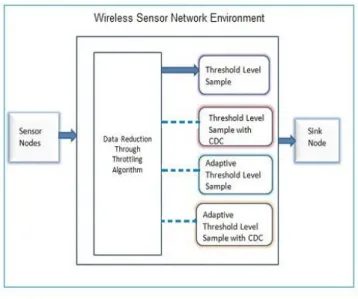
1) Threshold level sampling data reduction with CDC 2) Adaptive level sampling data reduction with CDC In system architecture are divided in main three parts 1)Deployment area
2)Data reduction through throttling algorithm/model 3)Sink node
In Deployment area consist spatially distributed number of sensor nodes are sensing data and communicate each other. Source node transmits sensed data using intermediate nodes to sink node. Sensor nodes communicate wirelessly using radio link. In the second part of System architecture consist data reduction through throttling algorithm used for reduced size of transmitting data. We have proposed TLS with CDC and ATLS with CDC algorithm for consumed minimum
energy. In third part consist sink node (Base station). Sink node are collect, reduced data from sensor nodes.
Fig 1: System architecture
We have divided data reduction Throttling Sample techniques and proposed CDC algorithm work in four models, which are mentioned below:
A. Threshold level Sample Algorithm.
B. Threshold Level Sample with Controlled Duty Cycle Algorithm.
C. Adaptive Level Sample Algorithm.
D. Adaptive Level Sample with Controlled Duty Cycle Algorithm.
A. Threshold Level Sample Algorithm.
In this model taking first three sensor node rainfall, moisture, and pore pressure. Firstly set the threshold value of rainfall, moisture, and pore pressure sensor node. The sensor node transmits only threshold exceed value to sink node. So here sensor nodes are not transmitting below threshold value. Means unnecessary data are not transmitted. Here happened data reduction. This indirectly saves energy to be used for sending unnecessary data.
Algorithm 1: Threshold Level Sample Input: Input data, Initial energy.
Output: Reduced data, Remaining Energy. Start
Transmits-thresholds exceeding value from sensor node to sink node.
Calculate energy, show reduced data End
B. Threshold Level Sample with Controlled Duty Cycle Algorithm
In this model taking first three sensor node rainfall, moisture, and pore pressure. The sensor node transmits only threshold exceed value to sink node. So here sensor nodes are not transmitting below threshold value. Here happened data reduction. This indirectly saves energy to be used for sending unnecessary data. Controlled Duty Cycle algorithm used for network level and node level energy. At CDC, source node to sink node select shortest path. If at any intermediate sensor
Volume 5, Issue 6, June 2016
node energy goes below the threshold, this node sends the acknowledgment to its source node, then the source node will select another shortest path.
Algorithm 2: Threshold Level Sample with Controlled Duty Cycle
Input: Input Data, Initial energy.
Output: Reduced data, Remaining Energy, Start
Set the threshold value initially.
Transmits thresholds exceeding(above) the value to sink node
Each node will find their depth d from sink nodes Initially all source node find shortest path and
maintain shortest path entry in a table.
If any source node want to send data then select shortest path and transmit data.
When any of the node energy level goes below threshold, then this node send acknowledgment to its source node, then source node select another shortest path and transmit data.
Calculate energy, show reduced data End
C. Adaptive Threshold Level Sample Algorithm.
Landslide prediction does not depend on only one parameter, which require more than one parameter. Landslide Parameter like rainfall, moisture, pore pressure. This parameter is interrelated, which will help us to predict a landslide Here, initially all sensor nodes are not active. Suppose rainfall sensor node transmit threshold exceed value, which will go on activating another moisture sensor node. This mean rainfall sensor will activate moisture sensor which further activates pore pressure sensor after exceeding or above their respective threshold value. This model will help us to perfectly guess the landslide.
Algorithm 3: Adaptive Threshold Level Sample Input: Input Data, Initial energy.
Output: Reduced data, Remaining Energy. Start
Set the threshold value of sensor node
1. Transmits-thresholds exceeding the value from sensor node to sink node.
2. Activate next sensor node.
3. Repeat step 3 for next two sensor node Calculate energy, show reduced data End
D. Adaptive Threshold Level Sample with Controlled Duty Cycle algorithm
In this model set the threshold value of rainfall, pore pressure, moisture sensor node. Here, initially all sensor nodes are not active. Suppose, rainfall sensor node transmits data when its threshold value are exceeded, which will go on activating another moisture sensor node. This mean rainfall sensor node will activate moisture sensor node which further activates pore pressure sensor node after exceeding their respective threshold value. Controlled Duty Cycle algorithm used for energy efficient routing to increase
fairness. In this algorithm reduced data are transmitted from sensor node to sink node using shortest path.
Algorithm 4: Adaptive Threshold Sample with Controlled Duty Cycle
Input: Input Data, Initial energy.
Output: Reduced data, Remaining Energy. Start
Set the threshold value of sensor nodes
1. Transmits-thresholds exceeding the value from sensor node to sink node.
2. Activate next sensor node.
3. Repeat step 3 for next two sensor node // Apply CDC algorithm
Each node will find their depth d from sink node Initially all source node find shortest path and
maintain shortest path entry in a table.
If any source node want to send data then select shortest path and transmit data.
When any of the node energy level goes below threshold, then this node send acknowledgment to its source node, then source node select another shortest path and transmit data.
Calculate energy, show reduced data End
IV. MATHEMATICAL EXPRESSION
Energy consumption of a single sensor node and total network is calculated using the following equations: 4.1 Energy consumption at a single node
Single sensor node energy consumed can be obtained by using Equation (1),
Where
Esn=Single sensor node consumed energy Tn=No of transmission
Ep= Process required energy Bp=Number of bit per sample
Etr=Energy required for transmitting one bit of data 4.2 Total energy consumption
The total energy consumed by the network can be obtained by Equation (2),
Where
Et=total energy consumed by the network. Esn=Energy consumed by a sensor node n=total no of sensor nodes in the network.
)
1
...(
Etr)
*
Bp
(
Esn
2 , 1
Tn iEp
)
2
..(
...
Esn
Et
2 , 1
n iVolume 5, Issue 6, June 2016
V.EXPERIMENTAL SETUP
In following table given assumption. This assumption is used in NS3 implementation tool. Network simulation time is 30 second. Here deployment area is taken 500*500m. Network simulation time is 30 second. Here the initial energy of each node in each network given is 10J. We're taking 10, 30,50,70,90 sensor node network. Energy consumed by each network is calculate using following formula:
1) Energy consumed by WSN = (Initial energy of Network - Remaining energy of the network
Table 1: Simulation Parameters
Parameter Value Topological Area 500 500*500m
Number of Nodes Max 500
Topology Random
Network Type Multihopping
Routing Protocol AODV
Initial Energy of node 10J
Packet Size 10 Bytes
VI.RESULT ANALYSIS 1) Energy Saving
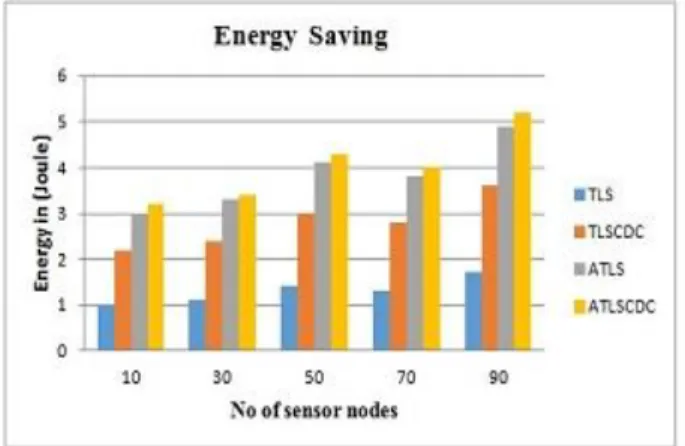
Different cases of the network are compared to Energy Saving and their comparative graph is shown below:
Figure 2: Comparison of Energy Saving in Joule by varying no. of sensor nodes in network
2) % Data Reduction
Different cases of the network are compared to % data reduction and their comparative graph is shown below:
Figure 3: Comparison of % Data Reduction in Bytesby varying no. of sensor nodes in network
CONCLUSION
The proposed TLS with CDC and ATLS with CDC Algorithm is more efficient as compared to the TLS and ATLS Algorithm respectively. Threshold Level Sample with CDC saves approximately 30% to 35% Energy than Threshold Level Sample. Similarly, another proposed algorithm i.e. Adaptive Threshold Level Sample with CDC save approximately 5% energy than Adaptive Threshold Level Sample. As data reduction helps in reducing the size of data to be transmitted in WSN, by applying the Throttling Data Reduction algorithms the data will get reduced which in turn helps in reducing the energy consumed for transmission. REFERENCES
[1]Maneesha Vinodini Ramesh, Senior Member, IEEE, and Venkata Prasanna Rangan, MAY 2014. Data Reduction and Energy Sustenance in Multisensor Networks for Landslide Monitoring, IEEE SENSORS JOURNAL, vol. 14, MAY 2014.
[2]M. Arun raja, V. Malathi proposed in[2], "An LMS Based Data Reduction Technique for Energy Conservation in Wireless Sensor Network (WSN)", Int. J. Computer
Technology & Applications ,Vol 3 (4), 1569-1576, IJCTA July-August 2012
[3]Nazim Agoulmine, Carlos Giovanni Nunes de Carvalho, Danielo." Multiple Linear Regression to Improve Prediction Accuracy in WSN Data Reduction " IEEE, 2011.
[4 ]Eric J. Msechu, Member, IEEE, and Georgios B. Giannakis, 400 IEEE TRANSACTIONS ON SIGNAL PROCESSING, VOL. 60, NO. 1, JANUARY 2012
Sensor-Centric Data Reduction for Estimation With WSNs via Censoring and Quantization
[5] [7] Matos, Brayner, A. Maia, J.E.B. Toward in-network data prediction in wireless sensor networks. In Proceedings
of the ACM Symposium on Applied Computing, Sierre,
Switzerland, pp. 592-596, March 2010
[6] I. D. Schizas, G. B. Giannakis, and Z.-Q. Luo, ―Distributed estimation using reduced-dimensionality sensor observations,‖ IEEE Trans. Signal Process., vol. 55, no. 8, pp. 4284–4299, Aug. 2007.
[7] Y. Zhu, E. Song, J. Zhou, and Z. You, ―Optimal dimensionality reduction of sensor data in Multisensor estimation fusion,‖ IEEE Trans. Signal Process., vol. 53, no. 5, pp. 1631–1639, May 2005.
[8] J. A. Gubner, ―Distributed estimation and quantization,‖
IEEE Trans. Inf. Theory, vol. 39, pp. 1456–1459, Jul. 1993.
[9] A. Ribeiro and G. B. Giannakis, ―Bandwidth-constrained distributed estimation for wireless sensor networks—Part I: Gaussian case,‖ IEEE Trans. Signal Processing, vol. 54, no. 3, pp. 1131–1143, Mar. 2006.
[10] Nicholas Paul Borg, Carl James Debono."An FPGA Implementation of an Adaptive Data Reduction Technique for Wireless Sensor Networks"
[11] C. Guestrin, P. Bodik, R. Thibaux R., M. Paskin and S. Madden: Distributed Regression: an Efficient Framework for
Volume 5, Issue 6, June 2016
Modeling Sensor Network Data". In Proceedings of the 3rd
International Symposium on Information processing in Sensor Networks (IPSN ’04), Berkeley, USA, April 2004.
[12] Amirmohammad Rooshenas, Hamid R. Rabiee , Ali Movaghar , M. Yousof Naderi, "Reducing The Data Transmission in Wireless Sensor Networks Using The Principal Component Analysis", sixth international
conference on intelligent sensor, sensor network , information processing.
[13] Y. L. Borgne and G. Bontempi, ―Unsupervised and supervised compression with principal component analysis in wireless sensor networks,‖ in Proc. First International
Workshop on Knowledge Discovery from Sensor Data, 13th ACM SIGKDD International Conference on Knowledge Discovery and Data Mining, 2007.
[14] Y. L. Borgne, S. Raybaud, and G. Bontempi, ―Distributed principal component analysis for wireless sensor networks,‖ Sensors Journal, vol. 8, pp. 4821–4850, 2008.
[15]Manisha P . Mashere, Sunita S. Barve, Pramod D. Ganjewar, "Energy Minimization using Data Reduction through thresholding in Wireless Sensor Network" Fifth post
graduate conference of computer engineering, cPGCON
2016.
Manisha P. Mashere Student Studying Post Graduation M.E.(Computer) at MIT AOE, Alandi(D), Pune Interest in Computer Network
Sunita S. Barve Is Senior Assistant Professor in Department of computer engineering at MIT AOE, Alandi(D), Pune. Her Area of Research is Cognitive Radio Network.
Pramod D. Ganjewar Is Senior Assistant Professor in Department of computer engineering at MIT AOE, Alandi (D), Pune. His Area of Research Wireless Sensor Network