ISSN: 2278 – 7798 All Rights Reserved © 2014 IJSETR 3431
A Review on Privacy Preservation Method by Applying
Discrimination Rules in Data Mining
Priya Meshram1, Prof. Sonali Bodkhe2¹Department of C.S.E , GHRAET College, Nagpur university, Maharashtra India ² Department of C.S.E , GHRAET College, Nagpur university, Maharashtra India
Abstract: In data mining, when considering the legal and ethical aspects of privacy preservation so discrimination is a very important issue. It is clear that most of the people do not have a wish to discriminate based on their race, nationality, religion, age and so on. This problem mainly arises when these kind of attributes are used for decision making purpose such as giving them a job, loan, Insurance etc. Discrimination is two types direct and indirect discrimination. Direct discrimination is based on sensitive information. Indirect discrimination is based on non-sensitive informative on. In this paper, we mainly review on anti-discrimination a method which also helps to discover and prevent discrimination. Keywords—: discrimination, direct and indirect discrimination.
I. INTRODUCTION
As a social point of view, Discrimination is very sensitive and essential subject. Unfair or unequal treatment of people based on membership to a category or a minority, without regard to individual merit is known as Discrimination. It can divide the people on bases of their race (color), gender, age, nationality etc. Decisions are made by the attributes like giving them a
job, loan, insurance, finance, etc. Discrimination can be classified as Direct or Indirect.
A. DIRECT DISCRIMINATION
Direct discrimination occurs when persons are treated unequally on bases of their gender, age, disability, nationality, religion, race (color) etc. e.g.: Employee is not selected for a promotion at work. The supervisor says that while he thinks the employee could do the job, but he will be retiring soon, so they are looking for someone else who'll be there for a long time with the firm.
B. INDIRECT DISCRIMINATION:
Discrimination is which often less obvious indirect discrimination is. Sometimes, a policy applying equally seems fair, but unfair treatment to some people is observed when looked closely. Due to this some people or groups of people are disadvantage or less able to comply with the rule. This may be indirect discrimination, if these policy or practice is not reasonable. e.g.: People whose first language isn’t English are at a risk as all the information about health & safety is printed in English.
ISSN: 2278 – 7798 All Rights Reserved © 2014 IJSETR 3432
C. DIRECT AND INDIRECT DISCRIMINATORY RULES
There are two types of classification rules:
A. potentially discriminatory rule (PD Rule)
A classification rule X -> C is potentially discriminatory (PD) when X = A, B with A is a discriminatory item set and B a non discriminatory item set. For example, (Foreign worker = Yes, City = NYC->Hire = No). The word “potentially means that a PD Rule could probably lead to discriminatory decisions. It is used for direct discrimination.
B. Potentially non-discriminatory rule (PND Rule)
A classification rule X -> C is potentially discriminatory (PND) when X = D, B is a Non-discriminatory item set. It is used for indirect discrimination. For example, {Zip =10181, Religion =
XYZ, City = NYC -> Hire = No} or {Experience = Low, City = NYC -> Hire = No} PND rule could lead
to discriminatory decisions in Combination with some background knowledge. e.g., if the premise of the PND rule contains the zip Code as an attribute and one knows that zip code 10181 are mostly inhabited by foreign people.
This paper mainly focuses on survey of different papers with the different section or parts where part 1 describes the introduction of direct and indirect discrimination. Part 2 describes discrimination prevention method which have two parts discrimination discovery & discrimination prevention. Part 3 describes existing work where three methods are used. Part 4 describes related work where different methods
or techniques are used. In the part 5 proposal for direct and indirect discrimination prevention describes the different components of architecture. Part 6 shows table which shortly describes related work.
II. DISCRIMINATION PREVENTION METHOD
In this section, we are describing the discrimination discovery and discrimination prevention methods.
A. Discrimination discovery
Discrimination discovery is based on discrimination items. Discrimination is identifying by classification rule. And classification rule is based on PD and PND rule for direct and indirect discrimination.
B. Discrimination prevention
Discrimination prevention method is used to remove discrimination. Discrimination preventing knowledge-based decision support system from making discriminatory decision (discrimination prevention).Discrimination prevention method is divided into three main groups.
(i) Data transformation and hierarchy-based generalization process (pre-processing).
(ii) Changing the data mining algorithms (in-processing).
(iii) Changing the data mining model to reduce the possibility of discriminatory decisions. (Post-processing).
ISSN: 2278 – 7798 All Rights Reserved © 2014 IJSETR 3433 Fig 1: Discrimination prevention methods
With the help of this method discrimination prevention would consist of removing discriminatory attributes from the dataset. However, often attributes which are highly correlated with the sensitive one as given above.
III. EXISTING WORK
From the literature survey has discrimination prevention has different rules. Three approaches are as follows.
A. Pre-processing
In the pre-processing method, data transformation can be gathered from privacy preservation methods in related work. Whenever data can be transferred the original data are removed, after that applies data mining algorithms are applied so that no unequal or unfair or inappropriate decision rules can be mined. In short we can say that data can be changed in this method.
B. In-processing
Different cleaning discrimination methods for different data and non-discriminatory are inbuilt into a decision tree learner with changing its splitting data and pruning strategy through leaf relabeling method. In short data mining algorithms can be changed in such a way that resulting models do not obtain appropriate decision rules in In-process method.
C. Post- processing
In this method the architecture model can be changed or data mining algorithm may also change. Assume that according to CPAR algorithm, a confidence-altering method is extended for classification rules.
IV. RELATED WORK
In this paper different methods are discussed. Those methods have some advantages and disadvantages.
A. Fast algorithm for mining association rules
In data mining, Fast Algorithm is an effective algorithm used to ignore or remove discrimination. In this paper, Apriori algorithm, apriori tid algorithm is used. R.Agrawal and R.Srikant [2] gives brief about association rule method for collecting or storing large database. And they also discovered association for items in the transactions database. And they have described Apriori; AprioriTid Algorithm which is discovers all related association rules in transaction databases. To get the new candidate item extended by the Apriori algorithm is the large item sets. Pruning was done using the fact that any subsection of repeated item set should be frequent. Aprioritid and Apriori algorithm
ISSN: 2278 – 7798 All Rights Reserved © 2014 IJSETR 3434 is related to each other which use Apriori function to
determine the candidate sets.In the AIS algorithm involves two concepts are extension of an item set, determining what should be in the candidate item set. It
is very costly during shifting Apriori to AprioriTid.
B. Naive bayes approaches for discrimination free classification
Navies Bayes Method used for discrimination free classification and this method is modifying for discrimination.
Using decision rules that base their decision on these attributes in classifier. The Navies bayes model is bayes classifier is trained very efficiently in supervised learning. T.Calders and S.Verwer [3] focuses on sensitive attribute. Artificial and real datasets can be applied.
C. Classification without discrimination
F.Kamiran and T.Calders [4] also describes Classification without discrimination Method. The algorithms is used in this paper is classification algorithm. All discrimination is removed completely. The minimum discrimination and high accuracy is applied on CND.
D. Classification with no discrimination by preferential sampling
Faisal Kamiran, Toon Calders [5] describing a pre-processing and Preferential sampling. It reduces noise and improves resolution. Stable and unstable classifier gives desired result. Ethical and legal region can remove discrimination. We can remove the
sensitive data instead of relabeling it. The algorithm used in this paper is classification algorithm. The goal of classification is to accurately predict the target class for each care in the data. Predicts categorical labels and classify the data based on the training set and the values in a classifying attribute and uses it in classifying new data. Data preparation and filtering steps can considerable amount of processing period. Data pre-processing includes cleaning, normalization, transformation, characteristic extraction selection. In preferential sampling arises when the process that determines the data location and the process being modeled are dependent.
E. Discrimination prevention in data mining
Antidiscrimination law states that all people have right to equality. In the political participation people must be treated unequally on the bases of gender, age, race, nationality. Post-processing and pre-processing are methods are used. In data mining, important process is pre-processing method. S. Hajian, J. Domingo-Ferrer, and A. Martinez-Balleste [6] describing Anti-discrimination techniques and discrimination prevention. It is mainly used for Intrusion and crime detection. And if discrimination is found at the time of discrimination discovery then discrimination is eliminated. In there is much irrelevant and redundant information present or noisy and unreliable data, and then knowledge discovery during the training phase is more difficult. Large amount of relevant information is stored and picked is the process of data mining. Transaction data is the statically and logical analysis of huge sets of data in relation to enterprise resource planning in data mining. The
ISSN: 2278 – 7798 All Rights Reserved © 2014 IJSETR 3435 algorithm used in this paper is not efficient this is main
drawback of this paper.
V. THE PROPOSAL PREVENTION FOR DIRECT AND INDIRECT DISCRIMINATION
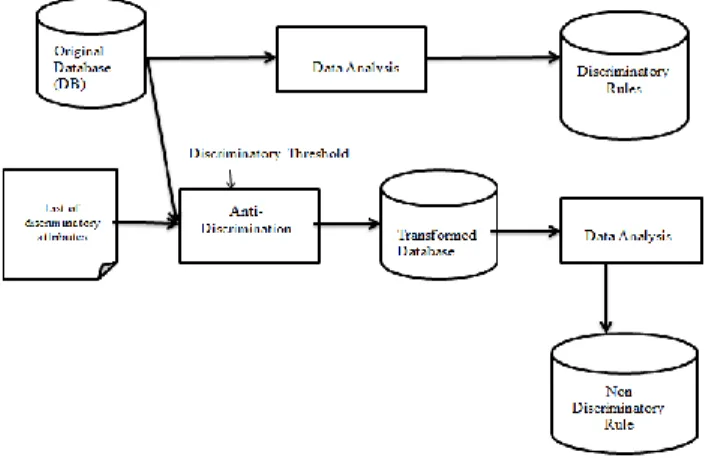
In this section, we are describing different components of work performances through the architecture.
A. System Model
We are creating the database for large datasets
where the large amount of data can store in it with direct discrimination and indirect discrimination items. And also the all discrimination removal methods are maintained in the server.
Fig 2 : Architecture Diagram
B. Data Analysis
Data can be analyzed by discrimination rules are used to find Direct and Indirect discrimination. And system classify into two parts: PD (Potential Discriminatory) and PND (Potential Non-discriminatory) rules. And rules are applied on predetermined discriminatory items in original database. For Potential discriminatory rule identify
direct discrimination. For Potential Non Discriminatory rule identify indirect discrimination. The system model maintained data for direct and indirect discrimination.
C. Data Transformation for Direct Discrimination
There are two rules which are described as follows:
1. Direct Rule Protection
In these components we take data from database of direct discrimination. Discrimination rule is converting it into protective rule. Direct discrimination cause which extracted by system the main discriminatory item sets. Then make negation of decision making attributes. Then finally it remove all discrimination is generated in the database.
2. Rule Generalization
The system performs the negation decision making attributes by integrated set of general rule.
D. Data Transformation for Indirect Transformation
1. Indirect Rule Protection - The system extracts all
items from the database using the above specified process. And item set are still gets discriminated which are not directly resulted in discrimination.
VI. OUR ANALYSIS
Sr. No Studies Used Methods Advantag es Disadvantag es 1 R.Agra wal and R.Srika nt (1994) Apriori,A priori-Tid Algorithm It is discoverin g all significant associatio n rules It is very costly when shifting from Apriori, Apriori-Tid Algorithm
ISSN: 2278 – 7798 All Rights Reserved © 2014 IJSETR 3436 2 T.Calde rs and S.Verwe r (2010) Naive Bayes Methods This method is applied on real and artificial database This method does not consider numerical attributes 3 F.Kamir an and T.Calde rs (2009) Classificat ion without discrimina tion Method All Discrimin ation removed The incorporatio n of numerical attributes and groups of attributes as sensitive attributes 4 Faisal Kamira n, Toon Calders (2010) pre-processing and Preferenti al sampling It reduces noise and improves resolution Ethical and legal region can remove discriminati on 5 S.Hajia n, J.Ferrer (2011) Anti-discrimina tion techniques It is mainly used for Intrusion and crime detection Not efficient VII. CONCLUSION
The main purpose of this paper is to discuss the challenges of previous methods. With the help of these methods, we study the discrimination prevention method with several data transformation methods. At the same time direct discrimination and Indirect discrimination can be performed and prevented. Improve the quality of the resulting data sets & data mining models.
REFERENCES
[1] Sara Hajian and Josep Domingo “A methodology
for Direct and Indirect Discrimination Prevention
in Data Mining”, IEEE Transaction on Knowledge
and Data Engineering Vol.25. No.7. July 2013. [2] R. Agrawal and R. Srikant, “Fast Algorithms for
Mining Association Rules in Large Databases”,
Proc. 20th Int’l Conf. Very Large Data Bases, pp. 487-499, 1994.
[3] T. Calders and S. Verwer, “Three Naive Bayes
Approaches for Discrimination-Free
Classification”, Data Mining and Knowledge
Discovery, vol. 21, no. 2, pp. 277-292, 2010.
[4] F. Kamiran and T. Calders, “Classification without
Discrimination”, Proc. IEEE Second Int’l Conf.
Computer, Control and Comm. (IC4 ’09), 2009.
[5] F. Kamiran and T. Calders, “Classification with no
Discrimination by Preferential Sampling”, Proc.
19th Machine Learning Conf. Belgium and The Netherlands, 2010.
[6] S. Hajian, J. Domingo-Ferrer, and A. Martinez-Balleste, “Rule Protection for Indirect Discrimination Prevention in Data Mining”, Proc.
Eighth Int’l Conf. Modeling Decisions for Artificial Intelligence (MDAI ’11), pp. 211-222, and 2011.
[7] S. Ruggieri, D. Pedreschi, and F. Turini, “Data
Mining for Discrimination Discovery”,ACM Trans.
Knowledge Discovery from Data, vol. 4, no. 2, article 9, 2010.
[8] D. Pedreschi, S. Ruggieri, and F. Turini, “Discrimination-Aware Data Mining”,Proc. 14th ACM Int’l Conf. Knowledge Discovery and Data Mining (KDD ’08), pp. 560-568, 2008.
ISSN: 2278 – 7798 All Rights Reserved © 2014 IJSETR 3437 [9] V.S. Verykios, A.K. Elmagarmid, E. Bertino, Y.
Saygin, E. Dasseni, “Association Rule Hiding”, IEEE Transactions on Knowledge and Data Engineering, vol. 16, pp. 434-447, Apr. 2004.
[10] D.Pedreschi, S. Ruggeri, and F. Turini,
“Measuring Discrimination in Socially-Sensitive
Decision Records”, Proc. Ninth SIAMData Mining
Conf. (SDM ’09), pp. 581-592, 2009.
[11] S. Hajian, J. Domingo-Ferrer, and A. Martınez-Balleste,“Discrimination Prevention in Data
Mining for Intrusion and Crime Detection”, Proc.
IEEE Symp. Computational Intelligence in Cyber Security (CICS ’11), pp. 47-54, 2011.
[12] M. Bendick, “Situation testing for employment
discrimination in the United States of America”,
HorizonsStrategiques, vol. 3, no. 5, pp. 17–39, 2007.
[13] S. Hajian, J. Domingo-Ferrer, and A. Martınez-Balleste, “DiscriminationPrevention in Data
Mining for Intrusion and CrimeDetection”, Proc.
IEEE Symp. Computational Intelligence in CyberSecurity (CICS ’11), pp. 47-54, 2011.
[14] S. Hajian, J. Domingo-Ferrer, and A. Martınez-Balleste, “RuleProtection for Indirect Discrimination Prevention in DataMining,” Proc.
Eighth Int’l Conf. Modeling Decisions for ArtificialIntelligence (MDAI ’11), pp. 211-222, 2011.
First Author: Ms. Priya P. Meshram
Department of Computer Science and Engineering, G. H. Raisoni Academy of Engineering and Technology, Nagpur, Maharashtra, India
Mobile No.-7507548708
Education Details- B.E (CSE) from Smt. Rajshree Mulak college of engineering for womens,Nagpur. Pursuing M.Tech (CSE) From G. H. Raisoni Academy of Engineering and Technology, Nagpur, Maharashtra, India
Second Author: Mrs. Sonali T. Bodkhe