Issue 5, May 2018, ISSN: 2278 -7798
328
Effect of Injection Pressure on the Performance of
CRDI Engine Using Biodiesel Blends
Ashwin Ashok Padmashali
1, Likith Gowda
2, Nagaraj A Badiger
3, Nicky Harries O.S.
4& Madhu K N
51,2,3,4 U G Students, Alva’s Institute of Engineering and Technology, Moodbidri, Karnataka 5Assistant Professor, Alva’s Institute of Engineering and Technology, Moodbidri, Karnataka.
Abstract - Biomass is a renewable resource, whose
utilization has received great attention due to environmental considerations and the increasing demand for energy throughout the world. An alternate to high pollutant diesel derived from renewable energy sources should be environment friendly, economically cheaper technically feasible without compromising the engine performance. Demand of fuel is more, compare to production of petroleum products. For recent year to meet the demand of fuel, need of new alternate resources. As on to satisfy the demand and issue on emission we proposed a solution using non-edible oil to control over emission and demand of society and deforestation. In this present study, non-edible oils like Mahua and Cottonseed biodiesel and their blends were used as a fuel, effect of injection pressure on the performance parameters such as BTE, BSFC, BP and emission parameters such as CO, CO2 HC
and NOX were investigated in a constant speed direct injection
diesel engine with varied injection pressures of 250, 300 and 350 bar. From the result it is seen that the results of Mahua and Cottonseed biofuel blends are having good performance and emission characteristics and the result obtained for Mahua and Cottonseed biofuel blends are near to that of the results obtained for pure diesel.
Keywords - Mahua oil, Cottonseed oil, Biodiesel, Performance, Emission characteristics.
1) INTRODUCTION
In our present-day lifestyle, the internal combustion engines have already become an indispensable and integral part, particularly in the transportation and agricultural field. CI engines are the most trusted power sources which are preferred in the transportation industry also. Due to the problems of fuel crisis and environmental pollution, the survival of these engines has been threatened. Therefore, to protect the global environment, it’s become necessary to search an alternative of oil as energy source. The gradual depletion of world petroleum reserves, increase in crude oil prices, and impact of environmental pollution results in renewed focus on vegetable oils and other renewable lipid source.
The gradual depletion of world petroleum reserves, increase in crude oil prices, and impact of environmental pollution results in renewed focus on vegetable oils and other renewable lipid source. Biofuels appear to be a potential alternative “greener” energy substitute for fossil fuels. A biofuel is any fuel that is derived from biomass – recently living organisms or their metabolic by products, such as manure from cows. It is a renewable energy, unlike other natural sources such as petroleum, coal and nuclear fuels. Biofuels are called carbon dioxide neutral, because the carbon in biofuels was recently extracted from atmospheric carbon dioxide by growing plants. This is in contrast to fossil fuels that contains carbon that was captured millions of years ago. If fossil fuels are burned there is no CO2 capture but only a lot of CO2 emission. Burning biofuels does result in emissions as well, but because the same
amount of CO2 is used to grow the biomass, it does not result in the net increase of carbon dioxide in the earth’s atmosphere. CO2 neutral fuels are therefore seen as a good way to reduce the amount of carbon dioxide released into the atmosphere by using them to replace non-renewable sources of energy.
1.1. BY PRODUCTS, VALUE ADDITION AND SCOPE OF BIOFUEL
Biofuel refinery is an important part of biofuel industries wherein the fuel production wastes are further converted to usable products for different needs. In this way, the various components and intermediates of the biofuels can also be utilized to maximize the value derived from biomass feedstock and adapting to the variations in the market trends, viable for use as concentrated organic manure. Further, biogas production is also possible using this rich organic matter as compost. In Karnataka, non-edible vegetable oil can be obtained from 20-70% from 120 different species of plants from the seeds. Continuous production of about 6-8 months of plants that can suit to different agro-climatic and ecological conditions can also help in creating a carbon neutral environment. Most of the stock plants are readily available in majority of the rural areas and hence, the activity of biodiesel production can be initiated and lead to immediate take off of the program if well backed and supported by the government.
2) TRANS-ESTERIFICATION PROCESS
Transesterification process is a conversion of vegetable oil into biofuel. This process depends upon the free fatty acid (FFA) content in the oil. The following are the methods that are involved in biofuel production:
1) Two Stage Process 2) Single Stage Process 3) Recovery of Methanol 4) Water Wash of Biofuel 5) Drying of Biofuel
May 2018, ISSN: 2278 -7798
329
2.1. TWO STAGE PROCESS
In this Process catalyst used is acid catalyst, reaction of fat with methanol using acid catalyst. This process is conducted in the 3 neck flask using Magnetic stirrer in it. This process is carried out when FFA value is more than 4%. In this process catalyst used is H2SO4. The reflect condenser used because of
methanol condensing back into 3 neck flask. Oil is heated up-to 600C. Then Methanol along with Acid catalyst is introduce
in the reactor and reaction is carried out at constant temperature for 90 min. After 90min the free fatty acid collected at the top would be separated from the oil. Free fatty acid content of the oil has to be calculated again. If the value is more than 4% then repeat the process until the percentage value will be less than 4% and continue with the single stage.
2.2. SINGLE STAGE PROCESS
This process is carried out when the FFA value is less than 4%. It is similar as two stage process, the difference seen here is acid catalyst is replaced with base catalyst and the rest process is to be carried out as same as the two stage process. Repeat the same until FFA value almost reaches nil.
2.3. RECOVERY OF METHANOL
After the single stage process the next step would be methanol recovery where the recovery would take place in the 3 neck flask with a temperature of 700c and with a constant
speed of about 250rpm.This process is carried out until methanol condensation stops.
2.4. WATER WASH OF BIOFUEL
After the recovery of methanol, warm water of about 400 c
and 300ml is to be sprayed into the biodiesel and kept for 15min and the bottom would be drained.
The above process would be repeated for 4-5 times.
2.5. DRYING OF BIOFUEL
To remove the water content after the water-wash, the biofuel would be heated to 1000 C.
3) PREPARATION OF BLENDS & FUEL PROPERTIES
The blends are prepared on a volume basis at room temperature. Clean measuring jars are used to prepare different blends. The required quantity of both biodiesel [Cottonseed and Mahua] are calculated and taken based on the blend percentage and are mixed together to form blend. For example the blend M10+C10+D80 means 10% of Mahua, 10% of cotton seed & 80% of diesel is mixed to form the blend. Similarly the different blends are prepared and named.
Table 1: Properties of fuels
Fuels Density (kg/m3) Flash point 0c Calorific Value KJ/Kg Viscosity Ns/m2 Diesel 825 53 43636 2.38 Mahua 860 168 38294 5.34 Cotton seed 865 192 39215 5.65 M20+C00 +D80 831 76 42752 3.78 M00+C20 +D80 833 81 42568 3.68 M10+C10 + D80 832 79 42660 3.65
4) ENGINE TEST RIG AND EXPERIMENTATION
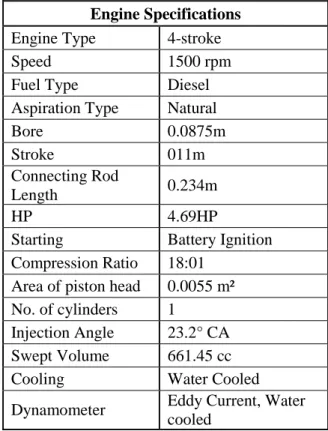
For the current study, a constant engine speed of 1500 rpm, compression ratio of 18:1 is maintained. The diesel engine is run for 3 different injection pressures of 250, 300 and 350 bars with standard being 23° CA injection angle. The load on the engine is applied using eddy current dynamometer. Emissions are recorded by… The engine is put to idling for 10 minutes before every set of observations for attaining steady state. The readings are taken for standard operating conditions of the engine, then the injection pressure of the engine is varied and the same procedure is repeated for the other 2 injection pressures i.e. 300 and 350 bar respectively. The whole procedure is repeated for different blends of biodiesel. The results for modified injection pressures are compared for performance and emission characteristics with each test using both diesel and biodiesel. In each set of readings of the experiment, brake thermal efficiency, brake specific fuel consumption, brake power and emissions of CO, HC and NOx concentrations are taken.
Table 2: Engine Specifications
Engine Specifications
Engine Type
4-stroke
Speed
1500 rpm
Fuel Type
Diesel
Aspiration Type
Natural
Bore
0.0875m
Stroke
011m
Connecting Rod
Length
0.234m
HP
4.69HP
Starting
Battery Ignition
Compression Ratio
18:01
Area of piston head
0.0055 m²
No. of cylinders
1
Injection Angle
23.2° CA
Swept Volume
661.45 cc
Cooling
Water Cooled
Dynamometer
Eddy Current, Water
May 2018, ISSN: 2278 -7798
330
Fig 2: Photographic View of Tested Engine
5) RESULTS & DISCUSSION 5.1. PERFORMANCE ANALYSIS
5.1.1. BSFC
Fig 3: showing variation of BSFC v/s I.P.
Figure 3 shows at 250 bar pressure we got best value of BSFC due to better utilization of fuel at this injection pressure. Compare to diesel BSFC value for biodiesel is because of lower calorific value. For Mahua blend the value of BSFC is lesser than value obtained for Cottonseed blend because calorific value of Mahua is higher than Cottonseed.
5.1.2. B.P
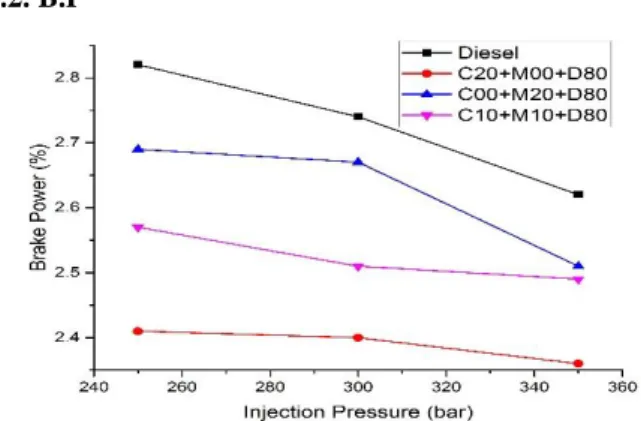
Fig 4: showing variation of BP v/s I.P.
Figure 4 shows that the values of B.P. decreases while increase in injection pressure because of better atomization of fuel at 250 bar increase in atomization momentum of very fine
fuel droplets drops. For bio fuel blends B.P. value slightly less than diesel because of less energy content and high viscosity of biofuels. Break power obtained for mahua biodiesel is more compare to all other biodiesel.
5.1.3. BTE
Fig 5: showing variation of BTE v/s I.P.
Figure 5 shows that the value of BTE obtained for diesel are nearly same with all injection pressure with slightly increase at 250 bar injection pressure. The BTE obtained for Mahua blend is more than the BTE obtained for cottonseed. This is because of lower energy content of Mahua as compared to cottonseed which gives lower values of brake power. The decrease in BTE value is observed with increase in injection pressure. The mahua blend gives nearer value compared to diesel.
5.2. EMISSION ANALYSIS
5.2.1. HC
Fig 6: showing variation of HC v/s I.P.
From the figure 6 it is observed HC emissions is more for the diesel compare to biodiesel this is because the sufficient availability of oxygen at higher temperatures results in complete combustion. When injection pressure increases hydrocarbon emission is decreases this is because of better atomization and higher temperature of gases at higher injection pressures results in increase in combustion efficiency. For Mahua blends HC emissions found less than Cottonseed blends
May 2018, ISSN: 2278 -7798
331 this is because high oxygen content of Cottonseed results in
combustion of unburnt HC at high temperature.
5.2.2. CO
Fig 7: showing variation of CO v/s I.P.
From the figure 7 it is found CO emission is less for the biodiesel blends compare to diesel also CO emissions found decreasing with increase in injection pressure. The biodiesel blends shows lower values of CO as compared to pure diesel this is due to extra amount of oxygen content present in the biodiesel. This extra oxygen results in oxidation of CO into CO2 which reduces CO emission. CO emission is less for
mahua biodiesel compare to all other biodiesel.
5.2.3. NOX
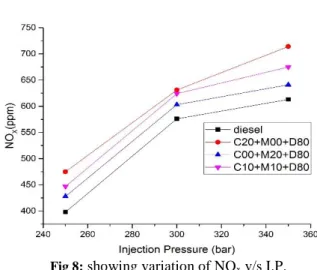
Fig 8: showing variation of NOx v/s I.P.
Figure 8 shows that for both blends and with increase in injection pressure NOx emission increases. This is because
of higher temperature at high injection pressure and high oxygen content of biodiesel. The oxygen content present in the biodiesel reacts with nitrogen present in the intake atmospheric air at high temperatures and results in higher values of NOX emissions. It is observed That NOX emission
is less at lower injection pressure i.e. 250 bar.
6) CONCLUSION
From the results obtained it is concluded that
1. The properties of all biofuel blends of Cottonseed and Mahua with diesel are found closer to that of pure diesel.
2. BP obtained for Mahua and Cottonseed blends are nearly same as diesel with slight decrease.
3. BTE of Mahua blend is found almost near to BTE of diesel. BTE obtained for cottonseed blend is less than Mahua blend.
4. The values HC & CO obtained for all biodiesel blends are less than the values obtained for pure diesel. 5. The NOx values obtained for all biofuel blends are
higher than values obtained for diesel.
6. For performance we have found that 250 bar injection pressure gives optimum value.
7) FUTURE WORK
The following aspects are recommended for future work 1. Experimented can be conducted using preheated
biofuel.
2. Effect of compression ratio on performance and emissions of engine using biofuels can be found. 3. Effect of EGR on NOX emissions can be conducted.
8) NOMENCLATURE
B.P- Brake Power,
BSFC- Brake Specific fuel consumption, BTE- Brake Thermal Efficiency, HC- Hydro Carbons,
CO- Carbon monoxide, NOX- Oxides of nitrogen,
ppm- parts per million.
9) REFERENCES
[1] Prof. Alpesh Mehta, “Performance of single cylinder diesel engine using Jatropha oil with exhaust heat recovery system”, International Journal of Advanced Engineering Technology, E-ISSN 0976-3945
[2] Sudheer Nandi “Performance of C.I Engine by Using Biodiesel-Mahua Oil” American Journal of Engineering Research (AJER), e-ISSN : 2320-0847 p-ISSN : 2320-0936 Volume-02, Issue-10, pp-22-47.
[3] R.T. Sarath Babu1, M. Kannan, P. Lawrence “Evaluation of mahua oil biodiesel and its blends on performance and emission characteristics of diesel engine” International Journal of Advanced Engineering Technology E-ISSN 0976-3945. [4] R Selvam, Dr. M.Senthil Kumar “investigation on improving performance of mahua oil based ci engine using light fuels and lhr techniques” Journal of Chemical and Pharmaceutical Sciences ISSN: 0974-2115.
[5] A. Haiter 1 Lenin, 1R. Ravi and 2K. Thyagarajan “Performance Characteristics of a Diesel Engine Using Mahua Biodiesel as Alternate Fuel” Iranica Journal of Energy & Environment 4 (2): 136-141, 2013, ISSN 2079-2115.
[6] G.Lakshmikanth, G.Arunkumar A.K.Thajudeen, S.Santhanakrishnan, “Performance and emission characteristics of mahua oil biodiesel on a compression ignition engine” International Journal of Engineering Research &
May 2018, ISSN: 2278 -7798
332 Technology (IJERT), ISSN: 2278-0181 Vol. 2 Issue 10,
October – 2013.
[7] N. Jesuraj and C. Thamotharan “Performance of Four Stroke Diesel Engine using Mahua Oil and Herbal Diesel Fuel Additive”International journal of advances in engineering, 2015, 1(4), 464 - 469; ISSN: 2394-9279.
[8] B Kondaiah ,B Durga Prasad “Effect of Exhaust Gas Recirculation on Performance and Emission Characteristics of MOME Blended Fuel C.I. Engine” International Journal of Engineering Inventions, e-ISSN: 2278-7461, p-ISSN: 2319-6491 ,Volume 5, Issue 5 [May 2016] PP: 01-07.
[9] Mr.S.V.Channapattana and Dr.R.R.Kulkarni “Bio-diesel as a fuel in I.C. engines – A review” International Journal Of Computer Science And Applications Vol. 2, No. 1, April / May 2009 ISSN: 0974-1003.
[10] Kazi Mostafijur Rahman, Mohammad Mashud, Md. Roknuzzaman and Asadullah Al Galib. “Biodiesel from jatropha oil as an alternative fuel for diesel engine” International Journal of Mechanical & Mechatronics IJMME-IJENS Vol: 10 No: 03
[11] AkkarajuH. Kiran Theja and Y.V.Hanumantha Rao. “Investigations on effect of fuel injection pressure on performance and emissions of linseed blends in a diesel engine” International Journal of Engineering and Technology (IJET) e-ISSN : 0975-4024
[12] Madhu K N and Dr. Peter Fernandes. “Effect of injection pressure on performance and emission analysis of ci engine using non edible vegetable oils biodiesel and their blends with diesel” IJRET: International Journal of Research in Engineering and Technology. eISSN: 2319-1163 | pISSN: 2321-7308
AUTHORS
1. ASHWIN ASHOK PADMASHALI
U.G. Student, Department of Mechanical Engineering, Alva’s Institute of Engineering and Technology, Mijar
2. LIKITH GOWDA
U.G. Student, Department of Mechanical Engineering, Alva’s Institute of Engineering and Technology, Mijar
3. NAGARAJ A BADIGER
U.G. Student, Department of Mechanical Engineering, Alva’s Institute of Engineering and Technology, Mijar
4. NICKY HARRIES O.S.
U.G. Student, Department of Mechanical Engineering, Alva’s Institute of Engineering and Technology, Mijar
5. MADHU K.N.
U.G. Assistant Professor, Department of Mechanical Engineering, Alva’s Institute of Engineering and Technology, Mijar