R E V I E W A R T I C L E
Open Access
Effects of resistance training on
self-reported disability in older adults with
functional limitations or disability
–
a
systematic review and meta-analysis
Pia Øllgaard Olsen
1*, Anne-Ditte Termannsen
2, Maja Bramming
3, Mark A. Tully
4and Paolo Caserotti
1Abstract
Background:Self-reported disability has a strong negative impact on older people’s quality of life and is often associated with the need for assistance and health care services. Resistance training (RT) has been repeatedly shown to improve muscle function (e.g. strength) and functional capacity (e.g. gait speed, chair-rise) in older adults with functional limitations. Nevertheless, it is unclear whether such objectively assessed improvements translate into a reduction in self-reported disability.
Objectives:To assess: i) whether and to what extent RT interventions have an effect on self-reported disability in older adults (≥65 years) with functional limitations or disability; and ii) whether the effects on self-reported disability are associated with changes in objective measures of muscle strength and functional capacity across studies. Methods:PubMed, Embase, Web of Science, CINAHL and SPORTDiscus electronic databases were searched in June 2018. Randomized controlled trials reporting effects of RT on self-reported disability/function in≥65 year-old adults with defined, functional limitations or self-reported disability were eligible. Data on self-reported disability/function were pooled by calculating adjusted standardized mean differences (SMD) using Hedges’g. Likewise, effect sizes for three secondary outcomes: knee extensor muscle strength; gait capacity; and lower body functional capacity were calculated and fit as covariates in separate meta-regressions with self-reported disability as the dependent factor. Results:Fourteen RCTs were eligible for the primary meta-analysis on self-reported disability. The total number of participants was 651 (interventionn= 354; controln= 297). A significant moderate positive effect of RT was found (SMD: 0.59, 95% CI: 0.253 to 0.925,p= 0.001). Between-study heterogeneity was present (I2statistic = 75,1%,
p< 0.001). RT effects on objective measures of lower body functional capacity were significantly associated with effects on self-reported disability (Adj. R2= 99%,p= 0.002,n= 12 studies), whereas no significant associations with gait capacity or knee extensor strength were found.
Conclusions:This review provides evidence that RT has a moderate positive effect on self-reported disability/ function in old people with or at risk for disability. The effects are strongly associated with effects on objective measures of lower body functional capacity.
Keywords:Disability, Aged, Resistance training, Activities of daily living, Needs assessment, Participation
© The Author(s). 2019Open AccessThis article is distributed under the terms of the Creative Commons Attribution 4.0 International License (http://creativecommons.org/licenses/by/4.0/), which permits unrestricted use, distribution, and reproduction in any medium, provided you give appropriate credit to the original author(s) and the source, provide a link to the Creative Commons license, and indicate if changes were made. The Creative Commons Public Domain Dedication waiver (http://creativecommons.org/publicdomain/zero/1.0/) applies to the data made available in this article, unless otherwise stated. * Correspondence:[email protected]
1Center for Active and Healthy Ageing, Department of Sports Science and Clinical Biomechanics, University of Southern Denmark Campusvej 55, DK-5230 Odense M, Denmark
age [1] and is a serious societal challenge because of the estimated demographic trends towards an ageing popu-lation [2]. In European countries, the increased cost re-lated to the additional need for assistance with activities of daily living (ADL) and long-term institutionalization of older people are projected to rise by 1.1% of gross do-mestic product between 2013 and 2060 [3].
Disability has been defined as a deficit between the capacities of an individual and that individual’s context-ual factors [4]. Self-reported disability reflects an individ-ual’s perception of this relationship, and refers to experienced difficulties in executing a task or being in-volved in a socially defined role including household, self-care and social life. Self-reported measures of dis-ability and function in ADL reflects dependency of as-sistance, which is linked to reduced quality of life in older adults [5]. Moreover, older adult’s perception of function and disability play a role in the allocation of health care services. Health care providers commonly use interviews or questionnaires when rating older per-son’s need for assistance in basic ADL (eating, dressing, bathing, transferring from bed to chair and using the toi-let) as well as more complex activities required for inde-pendent living such as housekeeping, cooking and shopping (instrumental ADL; IADL) [6]. Self-reported disability is therefore a highly relevant outcome which impacts the quality of life of the individual and chal-lenges the sustainability of the health care sector [3,7]. Preventing disability and maintaining independent living are therefore two high priorities in global health strat-egies [8].
Resistance training (RT), defined as exercise that causes muscles to work or hold against an applied force or weight [9], has been consistently reported to improve neuromuscular function (e.g. muscle strength) [10–13] and functional capacity (e.g. gait speed, chair-rise) [13– 19] in older adults. These findings draw attention to RT as a means to preventing disability and dependency [10], and current health-recommendations encourage older adults to engage in RT on a weekly basis [9,20]. Never-theless, whether improvements in neuromuscular func-tion and funcfunc-tional capacity translate into reduced self-reported disability in older adults is yet not conclusively established. This mismatch has been investigated in a randomized controlled trial (RCT) by Chandler et al. [16] in 1998. Their study showed a relationship between gains in strength and functional capacity (i.e. gait speed), but not between strength and self-reported disability after 10 weeks of RT [16]. A similar mismatch was later confirmed in older women with coronary heart disease by Brochu et al. [21]. The authors found a correlation between strength gain and functional capacity
have often used assessments of neuromuscular function (e.g. muscle strength) and objective measures of func-tional capacity such as gait, chair-rise, reaching, stoop-ing, liftstoop-ing, [6, 14, 22], self-reported disability outcomes have received less attention and have shown inconsistent results [14, 23, 24]. In a systematic review, Weening-Dijksterhuis and colleagues [24] found that resistance-type exercise of moderate to high intensity had light to moderate effects on ADL-disability in frail institutional-ized elderly (effects sizes < 0.50). In line with that, a Cochrane review and meta-analysis by Liu and Latham [23] showed that the effects of RT on self-reported dis-ability measured by the functional domain of the 36-Item Short Form Health Survey Instrument (SF-36) and self-reported measures of ADL were significant, but small (33 trials, 2172 participants; SMD 0.14, 95% CI 0.05 to 0.22) [23]. However, the study populations in this comprehensive Cochrane review were heterogeneous in terms of health, functional status and age [23].
Ceiling effect has been suggested as a potential explan-ation for why RT-interventions fail to detect changes in self-reported ADL-disability in relatively well-functioning older adults [22]. Improvements in self-reported disability following RT-interventions may therefore only be detected in older adults with limita-tions or existing disability.
Understanding whether RT-interventions may trans-late into better self-perception of ability in participants with pre-existing limitations is therefore highly valuable for older adults, health care sector as well as for recom-mendation guidelines.
Aims
The primary aim of this systematic review and meta-analysis is to investigate the effects of RT on self-reported disability in older people from the age of 65 years and above with functional limitations or self-reported disability. The secondary aim is to assess asso-ciations between the effects of RT on objective and sub-jective measures of disability across studies.
Study design and methods
reviews of physical therapy interventions – the Physio-therapy Evidence Database scale (PEDro scale) [28]. Eligibility criteria
Participants/study population
Studies including participants from the age of 65 years and above and of any residential status, sex and ethnicity were eligible for inclusion. To ensure that all studies only included participants who met the age criterion, those that enrolled participants < 65 years were excluded, even if the sample mean age was > 65 years. The study population had to be characterized by having functional limitations (e.g. low gait speed) or self-reported disability according to a given criteria set by the authors of the original paper. Studies examining the impact of RT in populations with significant medical conditions such as cancer, renal and hepatic diseases, obstructive pulmon-ary disease, or neural abnormalities were not eligible. Additionally, study samples characterized by cognitive impairments, amputation or permanent use of wheel-chair were excluded.
Intervention
To be considered for inclusion, RT needed to be the dominant component of the exercise intervention, with more than 50% of the intervention involving RT. The warm up and cool down periods were not considered as a part of the intervention and therefore the use of aer-obic training, stretching, functional training and balance exercises during these phases was not used as the basis for exclusion. Interventions of any frequency, intensity and duration were eligible. Trials applying multifaceted interventions combining RT with macro-nutritional, be-havioural, psychological, or medical approaches in all of the experimental groups were excluded as this could im-pact the results. Also, early rehabilitation interventions after joint surgery were ineligible since the influence of the natural post-surgery recovery process, has been iden-tified as a confounding factor [29].
Comparison
Trials were eligible if they comprised at least one inter-vention group (IG) receiving an interinter-vention that ful-filled the above listed criteria, and a control group (CG) that: i) did not receive any treatment or ii) was provided attention control, standard therapy, sham intervention or usual care. In case of the latter two, trials were eli-gible only if it was explicitly stated in the original article that this control treatment was expected to have no ef-fect on the outcome measures.
Outcomes
This study adopted the language of the International Classification of Functioning, Disability and Health (ICF)
[4] as recommended by international health policy makers and the research community [30]. The World Health Organisation (WHO) clearly states that the activ-ity component (i.e. execution of a task or action) and the participation component (i.e. involvement in a life situ-ation) in the ICF-model are overlapping [4]. The lack of clear cut definitions between the domains has been iden-tified as a shortcoming of the ICF-model when used in research [30]. To enable a clear definition of outcomes in this review, the following categorization of outcomes was used.
Primary outcome
Self-reported function/disability: measures aiming to quantify either the degree of functioning or disability in an individual in his/her life setting. These
measures should be obtained from questionnaires, either self-administered or by interview, or by proxy (observation) as this approach is common in studies of the oldest old and institutionalized.
Secondary outcomes
Functional capacity/limitation: objective measures of activities such as gait, stair climb, chair-rise and vari-ous imitated ADLs and IADLs, like transferring, per-sonal care, and household obtained under
standardized circumstances.
Muscle function/impairment: measures of strength,
power and muscle mass.
The primary outcome of the present review is self-reported disability. Trials were eligible if self-self-reported disability was measured by specific disability-questionnaires or by a subscale within disability-questionnaires comprising multiple aspects of health status or health re-lated quality of life. If the data from the relevant subscale were not presented separately in the original article, au-thors were contacted. In cases where more than one eli-gible measure of disability was presented in a trial, the measure with most items reflecting ADL and IADL was selected for analysis. Eligible outcomes could also in-clude items related to mobility-disability.
Trial design
Only RCTs were eligible for inclusion. Trials comprising more than two study arms were eligible if the relevant outcome data were provided in the article separately for all groups, or if it could be obtained by request.
Information sources and searches
1). It comprised the following key search terms: older adults, resistance training, and self-reported ADL-disability representing participants, interventions and outcomes respectively, in accordance with the PICOS. Blocks of relevant synonyms for each key term were cre-ated, and subsequently combined by using Boolean oper-ators. The electronic databases PubMed, Embase, Web of Science, CINAHL and SPORTdiscus were searched on June 27th, 2018. The title and abstract fields were searched in all databases. Moreover the“key words”field and relevant subject headings were searched when ap-plicable. Articles of any western language and publica-tion date were eligible.
Study selection
Upon completion of the search, results were combined in EndNote X7.7.1 and duplicates were removed. The remaining records were then transferred to a web based software for review management (Covidence Veritas Health Innovation Ltd., 2019 [31]) and two reviewers (PO and MB) screened titles and abstracts to identify potentially eligible trials for full text assessment. PO and MB independently included or excluded records accord-ing to defined criteria. In the case of disagreements on any level in the selection process, PO and MB discussed the inclusion of a trial, until consensus was reached or a third reviewer (PC) was consulted.
Data collection and extraction
PO, ADT and MB carried out the quality assessment and data extraction from the eligible records.
Extraction of primary and secondary outcome data
Change from baseline in self-reported disability and all objective measures of muscle function/impairment and functional capacity/limitation data were extracted from each study. The most frequently reported categories of secondary outcome data were selected for the secondary analysis. These were: i) measures of isometric and dy-namic knee extensor strength (KE-strength); ii) measures from tests of gait capacity (i.e. max gait speed, self-selected gait speed, time to cover set distance or distance covered in set time); and iii)lower body functional cap-acityassessed by any objective test of functional capacity relying mainly on the lower body. In order to decrease outcome heterogeneity, tests including chair-rise (e.g. chair-rise tests, timed up-and-go, Short Physical Per-formance Battery tests) were prioritized when studies re-ported various functional tests.
When available, within group mean change-scores (meanchange), baseline means (meanbase), follow-up means (meanend), all corresponding measures of
ranges, interquartile ranges) and p-values of within-group change for each within-group were extracted. As this re-view focusses on the short-term effects of RT-interventions, the baseline and follow-up measures were defined as the time points nearest the initiation and ter-mination of the interventions respectively, and the within-group mean change-score (meanchange) was de-fined as
Meanchange¼Meanendpoint−Meanbaseline
When both the change-score including variability measure, and a complete set of baseline and follow-up means and measures of variability were missing, the au-thors were contacted for additional data. When the data could not be retrieved, the study was excluded from the meta-analysis, but kept in the review to be included in vote-counting analysis (supplementary conservative ap-proach) to summarize intervention effects (described below).
Descriptive data
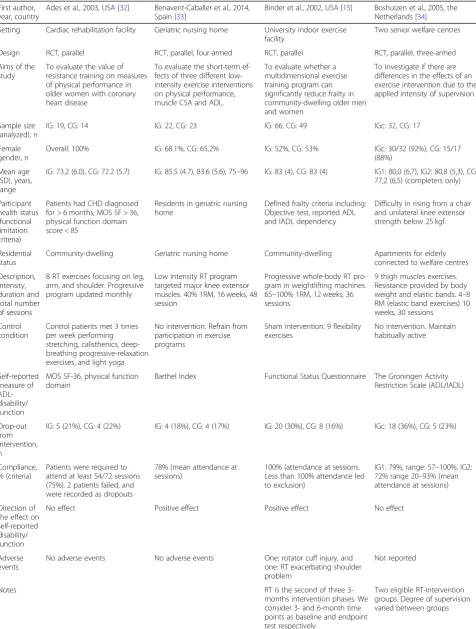
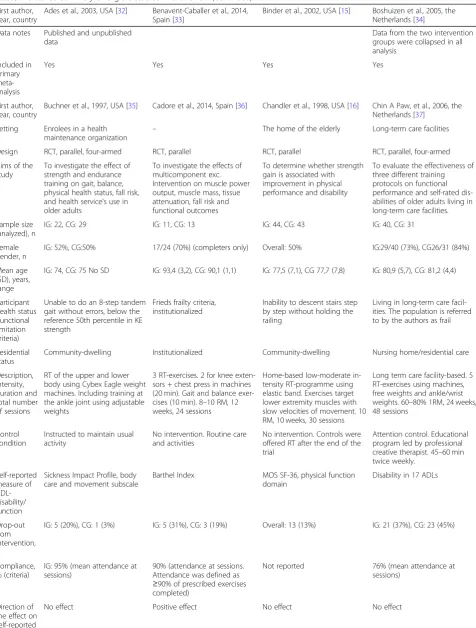
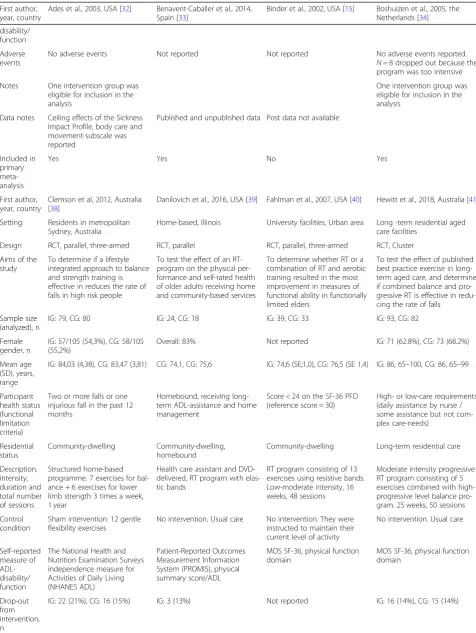
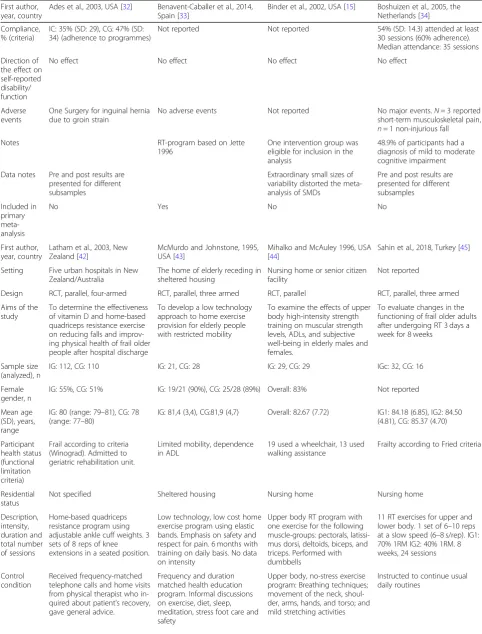
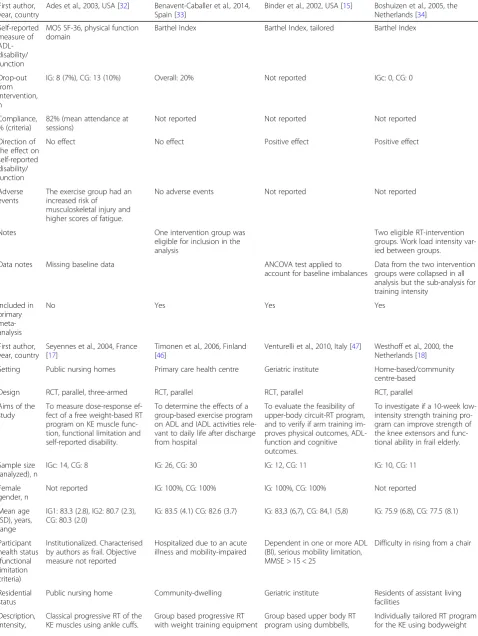
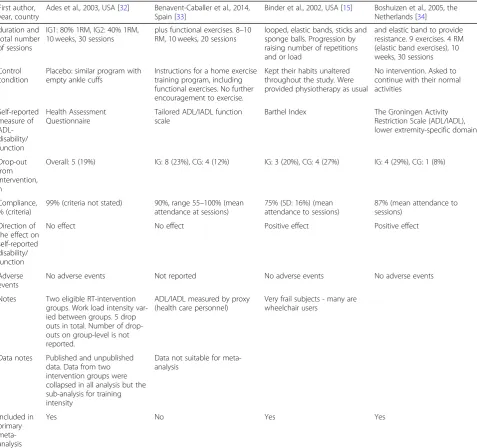
Descriptive items of the included studies First author; year; country; setting; study design; aims of the study; participant characteristics (health status, residential sta-tus and distribution of sex); sample size in analysis; drop-out rate; compliance rate; short description of the intervention; experimental and control conditions; and the direction of the effect for the self-reported disability outcomes were extracted and complemented by relevant additional notes (displayed in Table1). For use in a post hoc sub-analysis, participant mean age was dichotom-ously categorized as≥65–79 years and≥80 years respect-ively. Likewise, categories of gait speed at baseline (≥0.8 vs. < 0.8 m/second) was used as surrogate measure to quantify degree of functional capacity across study samples.
Table 1Detailed summary of eligible studies in the review
First author, year, country
Ades et al., 2003, USA [32] Benavent-Caballer et al., 2014, Spain [33]
Binder et al., 2002, USA [15] Boshuizen et al., 2005, the Netherlands [34]
Setting Cardiac rehabilitation facility Geriatric nursing home University indoor exercise facility
Two senior welfare centres
Design RCT, parallel RCT, parallel, four-armed RCT, parallel RCT, parallel, three-armed
Aims of the study
To evaluate the value of resistance training on measures of physical performance in older women with coronary heart disease
To evaluate the short-term ef-fects of three different low-intensity exercise interventions on physical performance, muscle CSA and ADL.
To evaluate whether a multidimensional exercise training program can significantly reduce frailty in community-dwelling older men and women
To investigate if there are differences in the effects of an exercise intervention due to the applied intensity of supervision
Sample size (analyzed), n
IG: 19, CG: 14 IG: 22, CG: 23 IG: 66, CG: 49 IGc: 32, CG: 17
Female gender, n
Overall: 100% IG: 68.1%, CG: 65.2% IG: 52%, CG: 53% IGc: 30/32 (92%), CG: 15/17 (88%)
Mean age (SD), years, range
IG: 73.2 (6.0), CG: 72.2 (5.7) IG: 85.5 (4.7), 83.6 (5.6), 75–96 IG: 83 (4), CG: 83 (4) IG1: 80,0 (6,7), IG2: 80,8 (5,3), CG: 77,2 (6,5) (completers only)
Participant health status (functional limitation criteria)
Patients had CHD diagnosed for > 6 months, MOS SF > 36, physical function domain score < 85
Residents in geriatric nursing home
Defined frailty criteria including: Objective test, reported ADL and IADL dependency
Difficulty in rising from a chair and unilateral knee extensor strength below 25 kgf.
Residential status
Community-dwelling Geriatric nursing home Community-dwelling Apartments for elderly connected to welfare centres
Description, intensity, duration and total number of sessions
8 RT exercises focusing on leg, arm, and shoulder. Progressive program updated monthly
Low intensity RT program targeted major knee extensor muscles. 40% 1RM, 16 weeks, 48 session
Progressive whole-body RT pro-gram in weightlifting machines. 65–100% 1RM, 12 weeks, 36 sessions
9 thigh muscles exercises. Resistance provided by body weight and elastic bands. 4–8 RM (elastic band exercises) 10 weeks, 30 sessions
Control condition
Control patients met 3 times per week performing stretching, calisthenics, deep-breathing progressive-relaxation exercises, and light yoga
No intervention. Refrain from participation in exercise programs
Sham intervention: 9 flexibility exercises
No intervention. Maintain habitually active
Self-reported measure of ADL-disability/ function
MOS SF-36, physical function domain
Barthel Index Functional Status Questionnaire The Groningen Activity Restriction Scale (ADL/IADL)
Drop-out from intervention, n
IG: 5 (21%), CG: 4 (22%) IG: 4 (18%), CG: 4 (17%) IG: 20 (30%), CG: 8 (16%) IGc: 18 (36%), CG: 5 (23%)
Compliance, % (criteria)
Patients were required to attend at least 54/72 sessions (75%). 2 patients failed, and were recorded as dropouts
78% (mean attendance at sessions)
100% (attendance at sessions. Less than 100% attendance led to exclusion)
IG1: 79%, range: 57–100%, IG2: 72% range 20–93% (mean attendance at sessions)
Direction of the effect on self-reported disability/ function
No effect Positive effect Positive effect No effect
Adverse events
No adverse events No adverse events One: rotator cuff injury, and one: RT exacerbating shoulder problem
Not reported
Notes RT is the second of three
3-months intervention phases. We consider 3- and 6-month time points as baseline and endpoint test respectively
Data notes Published and unpublished data
Data from the two intervention groups were collapsed in all analysis
Included in primary meta-analysis
Yes Yes Yes Yes
First author, year, country
Buchner et al., 1997, USA [35] Cadore et al., 2014, Spain [36] Chandler et al., 1998, USA [16] Chin A Paw, et al., 2006, the Netherlands [37]
Setting Enrolees in a health maintenance organization
– The home of the elderly Long-term care facilities
Design RCT, parallel, four-armed RCT, parallel RCT, parallel RCT, parallel, four-armed
Aims of the study
To investigate the effect of strength and endurance training on gait, balance, physical health status, fall risk, and health service’s use in older adults
To investigate the effects of multicomponent exc. Intervention on muscle power output, muscle mass, tissue attenuation, fall risk and functional outcomes
To determine whether strength gain is associated with improvement in physical performance and disability
To evaluate the effectiveness of three different training protocols on functional performance and self-rated dis-abilities of older adults living in long-term care facilities.
Sample size (analyzed), n
IG: 22, CG: 29 IG: 11, CG: 13 IG: 44, CG: 43 IG: 40, CG: 31
Female gender, n
IG: 52%, CG:50% 17/24 (70%) (completers only) Overall: 50% IG:29/40 (73%), CG26/31 (84%)
Mean age (SD), years, range
IG: 74, CG: 75 No SD IG: 93,4 (3,2), CG: 90,1 (1,1) IG: 77,5 (7,1), CG 77,7 (7,8) IG: 80,9 (5,7), CG: 81,2 (4,4)
Participant health status (functional limitation criteria)
Unable to do an 8-step tandem gait without errors, below the reference 50th percentile in KE strength
Frieds frailty criteria, institutionalized
Inability to descent stairs step by step without holding the railing
Living in long-term care facil-ities. The population is referred to by the authors as frail
Residential status
Community-dwelling Institutionalized Community-dwelling Nursing home/residential care
Description, intensity, duration and total number of sessions
RT of the upper and lower body using Cybex Eagle weight machines. Including training at the ankle joint using adjustable weights
3 RT-exercises. 2 for knee exten-sors + chest press in machines (20 min). Gait and balance exer-cises (10 min). 8–10 RM, 12 weeks, 24 sessions
Home-based low-moderate in-tensity RT-programme using elastic band. Exercises target lower extremity muscles with slow velocities of movement. 10 RM, 10 weeks, 30 sessions
Long term care facility-based. 5 RT-exercises using machines, free weights and ankle/wrist weights. 60–80% 1RM, 24 weeks, 48 sessions
Control condition
Instructed to maintain usual activity
No intervention. Routine care and activities
No intervention. Controls were offered RT after the end of the trial
Attention control. Educational program led by professional creative therapist. 45–60 min twice weekly.
Self-reported measure of ADL-disability/ function
Sickness Impact Profile, body care and movement subscale
Barthel Index MOS SF-36, physical function domain
Disability in 17 ADLs
Drop-out from intervention, n
IG: 5 (20%), CG: 1 (3%) IG: 5 (31%), CG: 3 (19%) Overall: 13 (13%) IG: 21 (37%), CG: 23 (45%)
Compliance, % (criteria)
IG: 95% (mean attendance at sessions)
90% (attendance at sessions. Attendance was defined as
≥90% of prescribed exercises completed)
Not reported 76% (mean attendance at sessions)
Direction of the effect on self-reported
Table 1Detailed summary of eligible studies in the review(Continued)
First author, year, country
Ades et al., 2003, USA [32] Benavent-Caballer et al., 2014, Spain [33]
Binder et al., 2002, USA [15] Boshuizen et al., 2005, the Netherlands [34]
disability/ function
Adverse events
No adverse events Not reported Not reported No adverse events reported. N= 8 dropped out because the program was too intensive
Notes One intervention group was eligible for inclusion in the analysis
One intervention group was eligible for inclusion in the analysis
Data notes Ceiling effects of the Sickness Impact Profile, body care and movement-subscale was reported
Published and unpublished data Post data not available
Included in primary meta-analysis
Yes Yes No Yes
First author, year, country
Clemson et al, 2012, Australia [38]
Danilovich et al., 2016, USA [39] Fahlman et al., 2007, USA [40] Hewitt et al., 2018, Australia [41]
Setting Residents in metropolitan Sydney, Australia
Home-based, Illinois University facilities, Urban area Long -term residential aged care facilities
Design RCT, parallel, three-armed RCT, parallel RCT, parallel, three-armed RCT, Cluster
Aims of the study
To determine if a lifestyle integrated approach to balance and strength training is effective in reduces the rate of falls in high risk people
To test the effect of an RT-program on the physical per-formance and self-rated health of older adults receiving home and community-based services
To determine whether RT or a combination of RT and aerobic training resulted in the most improvement in measures of functional ability in functionally limited elders
To test the effect of published best practice exercise in long-term aged care, and delong-termine if combined balance and pro-gressive RT is effective in redu-cing the rate of falls
Sample size (analyzed), n
IG: 79, CG: 80 IG: 24, CG: 18 IG: 39, CG: 33 IG: 93, CG: 82
Female gender, n
IG: 57/105 (54,3%), CG: 58/105 (55,2%)
Overall: 83% Not reported IG: 71 (62.8%), CG: 73 (68.2%)
Mean age (SD), years, range
IG: 84,03 (4,38), CG: 83,47 (3,81) CG: 74,1, CG: 75,6 IG: 74,6 (SE;1,0), CG: 76,5 (SE 1,4) IG: 86, 65–100, CG: 86, 65–99
Participant health status (functional limitation criteria)
Two or more falls or one injurious fall in the past 12 months
Homebound, receiving long-term ADL-assistance and home management
Score < 24 on the SF-36 PFD (reference score = 30)
High- or low-care requirements (daily assistance by nurse / some assistance but not com-plex care-needs)
Residential status
Community-dwelling Community-dwelling, homebound
Community-dwelling Long-term residential care
Description, intensity, duration and total number of sessions
Structured home-based programme. 7 exercises for bal-ance + 6 exercises for lower limb strength 3 times a week, 1 year
Health care assistant and DVD-delivered, RT program with elas-tic bands
RT program consisting of 13 exercises using resistive bands. Low-moderate intensity, 16 weeks, 48 sessions
Moderate intensity progressive RT program consisting of 5 exercises combined with high-progressive level balance pro-gram. 25 weeks, 50 sessions
Control condition
Sham intervention: 12 gentle flexibility exercises
No intervention. Usual care No intervention. They were instructed to maintain their current level of activity
No intervention. Usual care
Self-reported measure of ADL-disability/ function
The National Health and Nutrition Examination Surveys independence measure for Activities of Daily Living (NHANES ADL)
Patient-Reported Outcomes Measurement Information System (PROMIS), physical summary score/ADL
MOS SF-36, physical function domain
MOS SF-36, physical function domain
Drop-out from intervention, n
Compliance, % (criteria)
IC: 35% (SD: 29), CG: 47% (SD: 34) (adherence to programmes)
Not reported Not reported 54% (SD: 14.3) attended at least 30 sessions (60% adherence). Median attendance: 35 sessions
Direction of the effect on self-reported disability/ function
No effect No effect No effect No effect
Adverse events
One Surgery for inguinal hernia due to groin strain
No adverse events Not reported No major events.N= 3 reported short-term musculoskeletal pain, n= 1 non-injurious fall
Notes RT-program based on Jette
1996
One intervention group was eligible for inclusion in the analysis
48.9% of participants had a diagnosis of mild to moderate cognitive impairment
Data notes Pre and post results are presented for different subsamples
Extraordinary small sizes of variability distorted the meta-analysis of SMDs
Pre and post results are presented for different subsamples
Included in primary meta-analysis
No Yes No No
First author, year, country
Latham et al., 2003, New Zealand [42]
McMurdo and Johnstone, 1995, USA [43]
Mihalko and McAuley 1996, USA [44]
Sahin et al., 2018, Turkey [45]
Setting Five urban hospitals in New Zealand/Australia
The home of elderly receding in sheltered housing
Nursing home or senior citizen facility
Not reported
Design RCT, parallel, four-armed RCT, parallel, three armed RCT, parallel RCT, parallel, three armed
Aims of the study
To determine the effectiveness of vitamin D and home-based quadriceps resistance exercise on reducing falls and improv-ing physical health of frail older people after hospital discharge
To develop a low technology approach to home exercise provision for elderly people with restricted mobility
To examine the effects of upper body high-intensity strength training on muscular strength levels, ADLs, and subjective well-being in elderly males and females.
To evaluate changes in the functioning of frail older adults after undergoing RT 3 days a week for 8 weeks
Sample size (analyzed), n
IG: 112, CG: 110 IG: 21, CG: 28 IG: 29, CG: 29 IGc: 32, CG: 16
Female gender, n
IG: 55%, CG: 51% IG: 19/21 (90%), CG: 25/28 (89%) Overall: 83% Not reported
Mean age (SD), years, range
IG: 80 (range: 79–81), CG: 78 (range: 77–80)
IG: 81,4 (3,4), CG:81,9 (4,7) Overall: 82.67 (7.72) IG1: 84.18 (6.85), IG2: 84.50 (4.81), CG: 85.37 (4.70)
Participant health status (functional limitation criteria)
Frail according to criteria (Winograd). Admitted to geriatric rehabilitation unit.
Limited mobility, dependence in ADL
19 used a wheelchair, 13 used walking assistance
Frailty according to Fried criteria
Residential status
Not specified Sheltered housing Nursing home Nursing home
Description, intensity, duration and total number of sessions
Home-based quadriceps resistance program using adjustable ankle cuff weights. 3 sets of 8 reps of knee extensions in a seated position.
Low technology, low cost home exercise program using elastic bands. Emphasis on safety and respect for pain. 6 months with training on daily basis. No data on intensity
Upper body RT program with one exercise for the following muscle-groups: pectorals, latissi-mus dorsi, deltoids, biceps, and triceps. Performed with dumbbells
11 RT exercises for upper and lower body. 1 set of 6–10 reps at a slow speed (6–8 s/rep). IG1: 70% 1RM IG2: 40% 1RM. 8 weeks, 24 sessions
Control condition
Received frequency-matched telephone calls and home visits from physical therapist who in-quired about patient’s recovery, gave general advice.
Frequency and duration matched health education program. Informal discussions on exercise, diet, sleep, meditation, stress foot care and safety
Upper body, no-stress exercise program: Breathing techniques; movement of the neck, shoul-der, arms, hands, and torso; and mild stretching activities
Table 1Detailed summary of eligible studies in the review(Continued)
First author, year, country
Ades et al., 2003, USA [32] Benavent-Caballer et al., 2014, Spain [33]
Binder et al., 2002, USA [15] Boshuizen et al., 2005, the Netherlands [34]
Self-reported measure of ADL-disability/ function
MOS SF-36, physical function domain
Barthel Index Barthel Index, tailored Barthel Index
Drop-out from intervention, n
IG: 8 (7%), CG: 13 (10%) Overall: 20% Not reported IGc: 0, CG: 0
Compliance, % (criteria)
82% (mean attendance at sessions)
Not reported Not reported Not reported
Direction of the effect on self-reported disability/ function
No effect No effect Positive effect Positive effect
Adverse events
The exercise group had an increased risk of
musculoskeletal injury and higher scores of fatigue.
No adverse events Not reported Not reported
Notes One intervention group was
eligible for inclusion in the analysis
Two eligible RT-intervention groups. Work load intensity var-ied between groups.
Data notes Missing baseline data ANCOVA test applied to
account for baseline imbalances
Data from the two intervention groups were collapsed in all analysis but the sub-analysis for training intensity
Included in primary meta-analysis
No Yes Yes Yes
First author, year, country
Seyennes et al., 2004, France [17]
Timonen et al., 2006, Finland [46]
Venturelli et al., 2010, Italy [47] Westhoff et al., 2000, the Netherlands [18]
Setting Public nursing homes Primary care health centre Geriatric institute Home-based/community centre-based
Design RCT, parallel, three-armed RCT, parallel RCT, parallel RCT, parallel
Aims of the study
To measure dose-response ef-fect of a free weight-based RT program on KE muscle func-tion, functional limitation and self-reported disability.
To determine the effects of a group-based exercise program on ADL and IADL activities rele-vant to daily life after discharge from hospital
To evaluate the feasibility of upper-body circuit-RT program, and to verify if arm training im-proves physical outcomes, ADL-function and cognitive outcomes.
To investigate if a 10-week low-intensity strength training pro-gram can improve strength of the knee extensors and func-tional ability in frail elderly.
Sample size (analyzed), n
IGc: 14, CG: 8 IG: 26, CG: 30 IG: 12, CG: 11 IG: 10, CG: 11
Female gender, n
Not reported IG: 100%, CG: 100% IG: 100%, CG: 100% Not reported
Mean age (SD), years, range
IG1: 83.3 (2.8), IG2: 80.7 (2.3), CG: 80.3 (2.0)
IG: 83.5 (4.1) CG: 82.6 (3.7) IG: 83,3 (6,7), CG: 84,1 (5,8) IG: 75.9 (6.8), CG: 77.5 (8.1)
Participant health status (functional limitation criteria)
Institutionalized. Characterised by authors as frail. Objective measure not reported
Hospitalized due to an acute illness and mobility-impaired
Dependent in one or more ADL (BI), serious mobility limitation, MMSE > 15 < 25
Difficulty in rising from a chair
Residential status
Public nursing home Community-dwelling Geriatric institute Residents of assistant living facilities
Description, intensity,
Classical progressive RT of the KE muscles using ankle cuffs.
Group based progressive RT with weight training equipment
Group based upper body RT program using dumbbells,
meta-regression. For studies presenting intensity as number of RMs (nRM, i.e. the maximal number of repe-titions with a given load) this was translated into %1RM using Brzycki’s equation [48]. When a range of inten-sities was provided, the mean intensity rounded up to nearest 5% as the estimate was used. Intensities based on Rate of Perceived Exertion scales (RPE) did not form part of the covariate.
Quality assessment/risk of bias in individual studies Risk of bias in individual studies was evaluated using the validated PEDro scale [28, 49]. The PEDro quality
assessment tool rates the internal validity of RCTs on a scale from 0 (low quality) to 10 (high quality), with a score of≥6 representing a cut-off for high-quality stud-ies. For this review, two modifications to the scale were made. When awarding points in item four: “the groups were similar at baseline regarding the most important prognostic indicators” original texts and tables were screened for evidence that baseline differences were assessed. However, equality in baseline levels regarding self-reported disability was not always investigated, as this was a secondary outcome in many studies. Conse-quently, we performed meta-analysis of baseline-scores duration and
total number of sessions
IG1: 80% 1RM, IG2: 40% 1RM, 10 weeks, 30 sessions
plus functional exercises. 8–10 RM, 10 weeks, 20 sessions
looped, elastic bands, sticks and sponge balls. Progression by raising number of repetitions and or load
and elastic band to provide resistance. 9 exercises. 4 RM (elastic band exercises), 10 weeks, 30 sessions
Control condition
Placebo: similar program with empty ankle cuffs
Instructions for a home exercise training program, including functional exercises. No further encouragement to exercise.
Kept their habits unaltered throughout the study. Were provided physiotherapy as usual
No intervention. Asked to continue with their normal activities
Self-reported measure of ADL-disability/ function
Health Assessment Questionnaire
Tailored ADL/IADL function scale
Barthel Index The Groningen Activity Restriction Scale (ADL/IADL), lower extremity-specific domain
Drop-out from intervention, n
Overall: 5 (19%) IG: 8 (23%), CG: 4 (12%) IG: 3 (20%), CG: 4 (27%) IG: 4 (29%), CG: 1 (8%)
Compliance, % (criteria)
99% (criteria not stated) 90%, range 55–100% (mean attendance at sessions)
75% (SD: 16%) (mean attendance to sessions)
87% (mean attendance to sessions)
Direction of the effect on self-reported disability/ function
No effect No effect Positive effect Positive effect
Adverse events
No adverse events Not reported No adverse events No adverse events
Notes Two eligible RT-intervention groups. Work load intensity var-ied between groups. 5 drop outs in total. Number of drop-outs on group-level is not reported.
ADL/IADL measured by proxy (health care personnel)
Very frail subjects - many are wheelchair users
Data notes Published and unpublished data. Data from two intervention groups were collapsed in all analysis but the sub-analysis for training intensity
Data not suitable for meta-analysis
Included in primary meta-analysis
Yes No Yes Yes
ADLactivities of daily living,CGcontrol group,CHDcoronary heart disease,IADLinstrumental activities of daily living,IGintervention group,KEknee extensors,
to screen for potential baseline differences in self-reported disability that were not addressed in the ori-ginal articles [50].When this analysis revealed a baseline value in the active intervention group that differed sig-nificantly from that of the control group in a study, that study was awarded a “no” in item four of the PEDro scale, regardless of whether this baseline difference was addressed in the original paper.True participant blinding by a placebo intervention is not possible given the na-ture of the active treatment (i.e. RT). Item 5 “there was blinding of all participants” was therefore considered satisfied if sham intervention or attention control was applied in the control group.
Summary measures
Due to the various eligible self-reported ADL-disability scales, the main summary measure was the standardized mean difference (SMD) in change-scores and the corre-sponding confidence interval (CI). The size of the pooled SMD was interpreted according to the following rule of thumb < 0.40 = small effect, 0.40 to 0.70 = moderate ef-fect, > 0.70 = large effect ([51]; ch. 17.8.2).
Handling of missing data
Missing SDs were imputed from other available mea-sures of variability (SE, CI) or from the exact p-values using methods proposed by Fu et al. [50]. When only a baseline mean, a follow-up mean and the corresponding measures of variability were reported, the meanchange was calculated based on these data whereas SDchangewas imputed from correlation estimates (Corrs) from other studies using the following eq. ([50,51]; ch. 16.1.3.2).
SDchange¼
ffiffiffiffiffiffiffiffiffiffiffiffiffiffiffiffiffiffiffiffiffiffiffiffiffiffiffiffiffiffiffiffiffiffiffiffiffiffiffiffiffiffiffiffiffiffiffiffiffiffiffiffiffiffiffiffiffiffiffiffiffiffiffiffiffiffiffiffiffiffiffiffiffiffiffiffiffiffiffiffiffiffiffiffiffiffiffiffiffiffiffiffiffiffiffiffiffiffiffiffiffiffiffiffiffiffiffiffiffiffiffiffiffiffiffiffiffiffiffiffiffiffiffi SD2
baselineþSD2endpoint− 2CorrmeanSD2baselineSD2endpoint
r
Corrmeanis the mean of all Corrs that could be calcu-lated for the given category of outcome (i.e. self-reported, KE-strength, lower body physical function, or gait capacity). The Corrs for the individual studies were calculated by the below equation when studies provided sufficient information.
Corr¼SD
2
baselineþSD2endpoint−SD2change score
2SD2baselineSD2endpoint
If very few studies provided the data needed to calcu-late the Corrmean, missing SD’s were imputed directly from the other treatment group within the same study or from another included study. Where studies reported multiple intervention groups of more than one RT mo-dality (i.e. varying level of intensity, supervision or fre-quency) versus a control condition, data were combined according to existing recommendations ([51]; ch. 7.7.3.8 and 16.5.4). Non-parametric summaries were used to
estimate means and SDs in two studies [39, 43] regard-less of skewed distribution. This approach is supported by Fu et al. [50] provided the variable of interest has symmetric distribution in most included studies, as was the case in this meta-analysis. An exact description of how missing data have been handled for each study can be retrieved from the corresponding author.
Synthesis of results
The data synthesis was carried out using Stata statistical software (Stata/IC 15.1). The results from the individual studies were combined and pooled by calculating ad-justed SMDs using Hedges’ g. Accordingly, meta-analyses were performed for the primary and the sec-ondary outcomes. For scales where low scores are favourable, the means were multiplied by−1. Consider-ing the broad inclusion criteria for the resistance train-ing interventions, true heterogeneity in intervention effects was expected and the DerSimonian-Laired random-effects method for continuous outcomes was applied accordingly. The extent of between study hetero-geneity was tested with the standard Q2 statistics and the I2 index [52]. There is somewhat agreement across references [51]; ch. 9.5.2, [53]) that heterogeneity should be assumed ifI2is > 50%, indicating that 50% of the vari-ability in the outcome cannot be explained by sampling variation, and cut points of I2values of 25, 50, and 75% may be used to categorize low, moderate, and high amounts of heterogeneity [54].
Secondary analysis
To investigate if the intervention effects on objective measures of functioning were also associated with the changes in self-reported ADL-disability, meta-regressions were performed as follows: the effect sizes (i.e. SMDs) calculated in the meta-analyses on KE-strength, gait capacity and lower body functional cap-acity were fitted as continuous covariates in three separ-ate meta-regressions (metareg-command) using the effect size (i.e. SMD) on self-reported disability/function as the dependant variable and the standard error of that SMD to weight the studies. Three measures from the meta-regressions were used to interpret the results [55]: i) the I2res% is the percentage of the residual variation that is due to between-study heterogeneity (the rest of the heterogeneity (100% - I2res%) is due to within-study sampling variability); ii) the adj. R2% which is the pro-portion of the heterogeneity in the dependent factor that can be explained by the covariate fit in the meta-regression, and iii) ap-value of the overall test of the co-variate in the random effects model.
were also investigated by performing stratified analyses according to participant age, (65 < 80 yr., ≥80 yr.), resi-dential status and relevant study quality parameters (pa-rameters selected post hoc) [53].
Risk of publication bias across studies
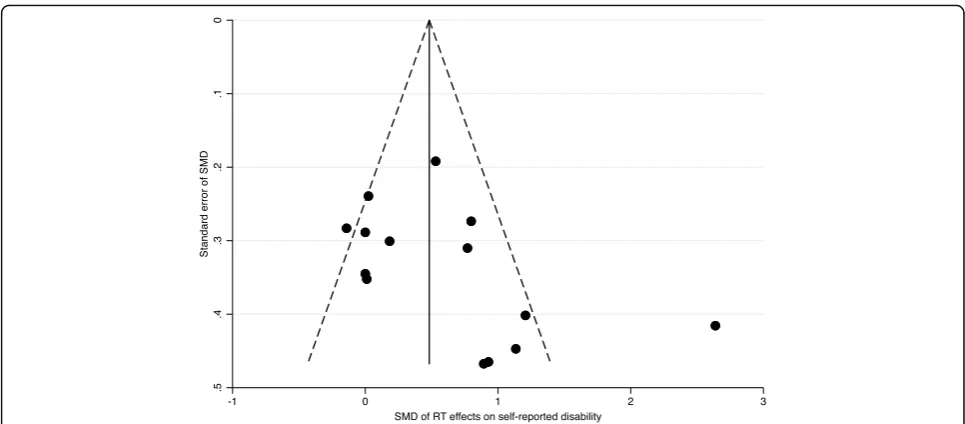
To assess whether publication bias influenced the results of the primary outcome, a funnel plot was created [56] and the Egger’s test [57] (metabias command in Stata) was applied to assess small study effect.
Results
Search and study selection
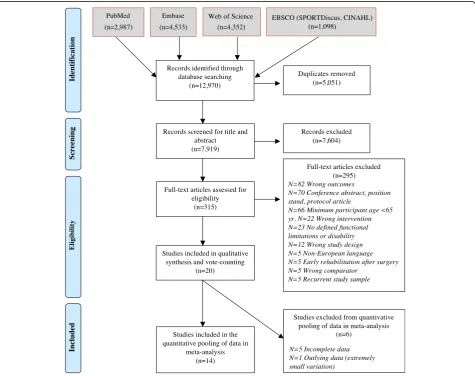
The result of the search is outlined in the PRISMA dia-gram (Fig. 1). The search yielded 12,970 records, of which 5051 were duplicates. Thus, the title/abstract of 7919 records were screened for possible eligibility, lead-ing to the exclusion of 7604 records based on the
excluded (Fig.1). Of the 20 eligible records, 14 included complete data that enabled their inclusion in the pri-mary meta-analysis. In five of the remaining six records, the relevant data were incomplete and was not provided upon request [16,38,41,42,46]. The sixth trial [40] was initially included in the main meta-analysis. However, exceptionally small sizes of variation in change in this study, heavily distorted the results of the meta-analysis (forest-plot of the meta-analysis including this study is included in Additional file 2, Fig. 1a). Consequently, it was decided to exclude the data from this study from the quantitative pooling. Not taking these six studies into account could however increase the risk of system-atic, selective reporting potentially leading to an overly positive conclusion. Consequently, we made a post hoc decision to keep the six trials in the qualitative synthesis of data and include them in an additional vote-counting analysis * ([51]; ch. 9.4.11, [58]). The vote-counting
procedure involves simply comparing the number of studies reporting positive effect (intervention favours ex-perimental group), no effect (the effect was insignificant) and negative effect (intervention favours control group). If a majority of studies fell into any of these three cat-egories, this category was declared the best estimate of the direction of the true relationship between the inde-pendent variable (i.e. RT-intervention) and the dependent variable (i.e. self-reported ADL) [58]. This method has major limitations as it does not take into ac-count the quality of the studies, the size of the samples or the size and variability of the effect. Bushman & Wang [58] advocate that this method should be used only as a supplementary data synthesis approach to complement the primary meta-analysis of SMDs, as was the case in this study.
Study characteristics
A detailed description of the characteristics of the eli-gible studies is presented in Table1.
Overall, a total of 1422 participants were included in the 20 RCTs, with 747 and 675 participants in the inter-vention and control groups respectively. In the sub-sample of trials included in the primary meta-analysis (n= 14), the total number of participants was 651(IG:
n= 354, CG: n= 297). Sample size ranged from 21 to 222 participants (median/mean 50/71). In three trials, the mean age of participants was under 75 years [32,35,
39], all of which were included in the meta-analysis. Eight trials recruited participants who were community-dwelling [15,16,32,35,38–40,46], eight trials recruited institutionalized elderly [17, 33, 36, 37, 41, 44, 45, 47], three trials recruited from sheltered housing [18,34,43], and one trial did not specify residential status [42]. In the five trials that were not included in the main meta-analysis, the participant mean age was above 75 years and they were not institutionalized. The distribution of participant sex was unequal with females being more represented than males. Three included only women [32,46, 47], eight trials had > 60% of female participants [33, 34, 36, 37, 39, 41, 43, 44], five trials included men and women nearly evenly (50–60% female) [15, 16, 35,
38, 42] and four studies did not report sex distribution [17,18, 40,45]. Three trials [17,34,59] had two eligible RT-intervention groups for which data were collapsed as described previously. Regarding the comparison condi-tion, nine trials provided a sham intervention as stretch-ing or exercises without load or attention control equalling or approximating the time spent in RT-intervention [15,17, 32, 37,38, 42–44, 46]. The control groups in the remaining 11 studies were asked to main-tain their current activity level and were provided with usual care when relevant. Four studies did not report compliance [16, 40, 43, 44]. Compliance in the
remaining 16 studies was relatively high with mean com-pliance rates at ~ 75% or above. Comcom-pliance was in most cases expressed as n attended sessions
n planned sessions 100%. In one study
however, a specific compliance criterion was set and compliance below this threshold was characterised as drop-out, making 100% compliance inevitable [32]. All but two studies [40, 44] reported drop-out. The mean drop-out rate was higher among IG’s compared to CG’s (IG mean drop out: 20%, range 6 to 37% vs. CG mean drop out: 15%, range 0 to 45%). One study reported par-ticipants dropping out for reasons related to the inter-vention (e.g. exercise intensity [37]). Seven studies reported some type of adverse events. Major adverse events were reported in two of these studies, with one case of rotator cuff injury [15] and one inguinal hernia [19]. Muscle injury and occasional exacerbation of mus-culoskeletal conditions such as arthrosis were the most frequently reported adverse events [15, 41, 42]. In six studies, no data on adverse events was presented [16,34,
40,44–46].
Resistance training programs
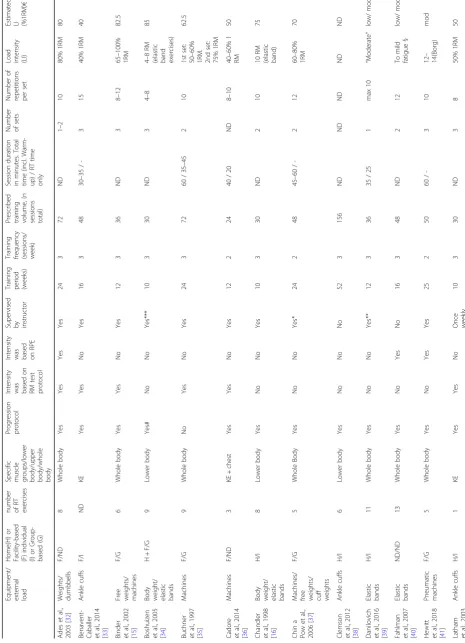
For detailed descriptive overview of the identified RT programs see Table 2. Overall, the majority of exercise programs were characterized as supervised (n= 18), hav-ing a progression protocol (n= 17) and being well de-scribed (i.e. exercise equipment or strategy for applying external resistance was reported, n= 20). The RT exer-cise programs were home-based in 7 trials [16, 18, 34,
38, 39, 42, 43] (including two partly facility-based trials [18,34]). One home-based trial was completely unsuper-vised [38] and one trial failed to report supervision sta-tus [40]. The level and type of supervision varied among the 20 included studies. Supervision frequencies in-cluded once monthly [43], once weekly [42], two out of every three sessions [18, 34] and each session [15, 17,
32,33,35–37,39,44,46,47]. In one trial [39], the usual care staff undertook the training supervision and one study provided guidance by videotape [37]. Exercise pro-gression was not described in three studies [43, 45, 46]. Elastic bands, exercise machines, ankle cuff weights and free weights were nearly evenly being used (elastic bands
n= 7 [16,18,34,39,40,43,47]; machinesn= 6 [15,35– 37, 41, 46]; ankle cuff weights n= 6 [17, 33, 37, 38, 42,
45]); free weightsn= 5 [15, 32,37, 45,47]). Use of body weight in addition to an external resistance was reported in three trials [16, 18, 34]. Sixteen trials [15, 16, 18, 32,
Table 2 Detailed overview of resistance training programs in the eligible studies
Equipment/ external load
Home(H) or Facility-based (F) individual (I) or Group-based (G) number of RT exercises
Specific muscle groups/lower body/upper body/whole body Progression protocol Intensity was based
on
RM
test
protocol
Intensity was based on
RPE
Supervised by instructor Training period (weeks) Training frequency (sessions/ week) Prescribed training volume,
(n sessions total) Session duration in minutes. Total time (incl. Warm-up) / RT time only Number of sets Number of repetitions per set
Load intensity (LI) Estimated LI (%1RM)
Ades et al., 2003 [ 32 ] Weights/ dumbbells F/ND 8 Whole body Yes Yes Yes Yes 24 3 72 ND 1 – 2 10 80% 1RM 80
Benavent- Caballer et
al., 2014 [ 33 ] Ankle cuffs F/I ND KE Yes Yes No Yes 16 3 48 30 – 35 / -3 15 40% 1RM 40 Binder et al., 2002 [ 15 ]
Free weights/ machines
F/G 6 Whole body Yes Yes No Yes 12 3 36 ND 3 8 – 12 65 – 100% 1RM 82.5 Boshuizen et al., 2005 [ 34 ]
Body weight/ elastic bands
H + F/G 9 Lower body Yes# No No Yes*** 10 3 30 ND 3 4 – 84 – 8R M
(elastic band exercises)
85 Buchner et al., 1997 [ 35 ] Machines F/G 9 Whole body No Yes No Yes 24 3 72 60 / 35 – 45 2 10 1st set: 50 – 60% 1RM. 2nd set: 75% 1RM 62.5 Cadore et al., 2014 [ 36 ] Machines F/ND 3 KE + chest Yes Yes No Yes 12 2 24 40 / 20 ND 8 – 10 40 – 60% 1 RM 50 Chandler et al., 1998 [ 16 ]
Body weight/ elastic bands
H/I 8 Lower body Yes No No Yes 10 3 30 ND 2 10 10 RM (elastic band) 75 Chin a Pow et al., 2006 [ 37 ]
Machines/ free weights/ cuff weights
Table 2 Detailed overview of resistance training programs in the eligible studies (Continued)
Equipment/ external load
Home(H) or Facility-based (F) individual (I) or Group-based (G) number of RT exercises
Specific muscle groups/lower body/upper body/whole body Progression protocol Intensity was based
on
RM
test
protocol
Intensity was based on
RPE
Supervised by instructor Training period (weeks) Training frequency (sessions/ week) Prescribed training volume,
(n sessions total) Session duration in minutes. Total time (incl. Warm-up) / RT time only Number of sets Number of repetitions per set
Load intensity (LI) Estimated LI (%1RM)
€
[
42
]
McMurdo & Johnstone 1995
[ 43 ] Elastic bands H/I 24 Whole body No No No once monthly 24 7 168 15 / -1 5 – 10 ND ND Mihalko & McAuley 1996 [ 44 ] Dumbbells F/ND 5 Upper body Yes Yes No Yes 8 3 24 30 / -ND 10 – 12 10 – 12 RM 70 Sahin et al., 2018 [ 45 ] Ankle cuffs, dumbbells ND/ND 11 Whole body No No No Yes 8 3 24 40 / 20 1 6 – 10 IG1: 70% 1RM, IG2: 40% 1RM 40,70 Seynnes et al., 2004 [ 17 ] Ankle cuffs ND/ND ND KE Yes Yes No Yes 10 3 30 ND 3 8 IG1: 80% 1RM, IG2: 40% 1RM 40, 80 Timonen et al., 2006 [ 46 ] Machines F/G ND Lower body No No No Yes 10 2 20 90 / 30 2 8 – 10 8 – 10 RM 80 Venturelli 2010 [ 47 ]
Elastic bands/ barbells
F/G ND Upper body Yes Yes No Yes 12 3 36 45 / 25 3 20 50% 1RM 50 Westhoff et al., 2000 [ 18 ]
Body weight/ elastic bands
of prescribed sessions (168 sessions). The median num-ber of prescribed sessions was 36 and the lowest numnum-ber was 20. The number of sets per exercise varied from one to three, most commonly comprising 8 to 12 repetitions per set (ranging from four to 20 repetitions per set). The calculation of training intensity was based on different strategies among the studies. The most frequently used strategy was to perform a formal RM test (9 trials [15,
17,32,33,35,36,42,44,47]). Six studies failed to report any strategy for calculating the targeted load intensity [16,37–39,45,46]. RPE was used as the only strategy to set the intensity level in two studies [40, 41], and in combination with RM in another study [32]. The applied workload intensities were accordingly reported in a number of ways, most regularly as %1RM (10 trials [15,
17,32,33,35–37,42,45,47]), followed by nRM (5 trials [16, 18, 34, 44, 46]), and RPE (3 trials [39–41]). Two studies did not report workload intensity [38, 43]. Esti-mation of within-study mean %1RM could be obtained as described in the method section in 15 trials [15–18,
32–37,42,44–47] and the estimated mean intensity was ~ 70%, ranging from 40 to 85%. Eight of the fifteen trials applied mean intensities at 70% 1RM and above [15–18,
32,34, 45,46] with two studies having an additional low intensity-intervention group [17,45].
Primary outcome - self-reported ADL-function/disability A full list of all self-reported ADL outcomes extracted from the articles is presented in the additional material (Additional file2, Table1A). In total, 10 different instru-ments for self- or proxy rating of function/disability were represented in the 20 included studies, of these nine were represented in the primary meta-analysis. All instruments were generic (i.e. not condition-specific). The physical function domain (PFD) of the SF-36 and the Barthel Index (BI) [60] were the most frequent out-comes, used in five trials each (SF-36 [16,32,40–42]; BI [33,36,43,45,47]). However, the SF-36 was only repre-sented in the meta-analysis by one study [32]. Different scoring systems were applied across studies for both of these two instruments. The Groningen Activity Restric-tion Scale was applied in two studies [18, 34], one of them presenting separate data on lower extremity-related ADL, which was the target body part of that study intervention [18]. Lowton and Brody’s IADL Scale was likewise used in two studies, but not in its full ver-sion. Six identified instruments were only applied in one study each [15, 17, 22, 35, 37, 39, 44, 46]. Four instru-ments were referred to by the study authors as validated, supported by a reference (the SF-36 [32,40], the BI [36], the Groningen Activity Restriction Scale [18, 34], the Joensuu classification of ADL/IADL skills [46]).
trials that were included in the main meta-analysis (n= 14). KE-strength was reported in nine studies [15,17,18,
34–37, 39, 45]. Eligible data for the lower body func-tional capacity were available from 12 studies [15,17,18,
32–37, 39, 43, 45]. Chair-rise as a single task or chair-rise in combination with walking and/or balance were the most frequent outcomes in this covariate [17,18,33,
34, 36, 37, 39, 43, 45]. Two studies [15, 32] used a bat-tery of functional tests for the entire body. However, one of them [32] reported a separate score for the tests mainly related to the lower body, but it was not specified in the text which tests were selected for this score. Nine studies presented data from gait performance tests [18,
32–37, 39]. Three trials measured the distance reached in six minutes of walking [17,32,33], and the remaining six trials measured time to complete a pre-set short walking distance [18, 34–37,39]. A descriptive overview of secondary outcomes is available in the additional ma-terial (Additional file2, Table2A).
Risk of bias within studies Rating of methodological quality
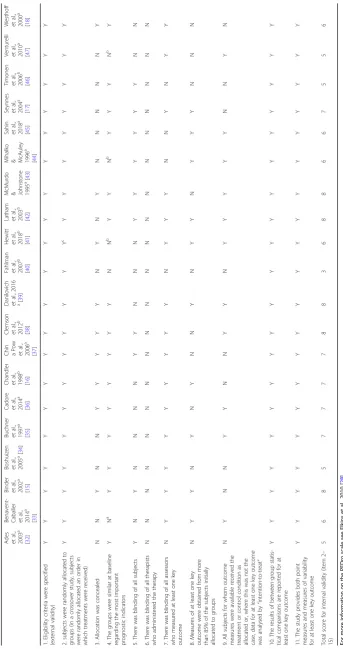
A full overview of the assessment of study quality by the PEDro tool is summarized in Table 3. The majority of studies (15 out of 20) were of high quality. Nine trials [15, 16, 18, 36–39, 41, 43] provided some information about the method of randomization, suggesting that randomization was properly concealed (i.e. the use of concealed envelopes or the randomization was generated by an independent person). Consequently, this item was the least frequently met in the studies. Baseline imbal-ance between groups were reported in two studies [44,
47] who accounted for this by using analysis of covari-ance (i.e. ANCOVA). The meta-analysis of baseline data revealed baseline differences in self-reported ADL-disability outcome in further two studies [18, 33]. The quality criterion“8: Measures of at least one key outcome was obtained from 85% of the subject initially allocated to groups”, was only fulfilled by 10 trials [15–17, 33, 35,
39,41, 42,44, 45], death and severe illness unrelated to the intervention were often reported as major dropout reasons.
Risk of bias across studies Publication bias
Table 3 Asessment of study quality by the PEDro Scale Ades et al., 2003 a [ 32 ]
Benavent- Caballer et
al., 2014 a [ 33 ] Binder et al., 2002 a [ 15 ] Boshuizen et al., 2005 a[ 34 ] Buchner et al., 1997 a [ 35 ] Cadore et al., 2014 a [ 36 ] Chandler et al., 1998 b [ 16 ]
Chin aPow et
al., 2006 a [ 37 ] Clemso n et al., 2012 b [ 38 ] Danilovich et al., 2016 a[ 39 ] Fahlman et al., 2007 b [ 40 ] Hewitt et al., 2018 b [ 41 ] Latham et al., 2003 b [ 42 ]
McMurdo & Johnston
e
1995
a[
43
]
Mihalko & McAuley 1996
Fig. 2Funnel plot with pseudo 95% confidence limits. Funnel plot illustrating risk of publication bias in the analysis of effect of resistance training interventions on self-reported disability. SMD = standardized mean difference
Results of individual studies and synthesis of results Primary analysis - pooled effects of RT on self-reported disability
Data from 14 trials were included in the primary meta-analysis (Fig. 3, Table 4). When the SMDs from these trials were pooled using a random effects model, a sig-nificant moderate positive effect of RT was found (SMD: 0.59 95% CI: 0.253 to 0.925, z = 3.43, p= 0.001) (Fig. 3). However, between-study heterogeneity was high (I2 stat-istic = 75,1%, Q = 52.26 on 13 degrees of freedom (d.f.),
p< 0.001) (Table4).
Complementary analysis–vote-count procedure
All eligible trials (n= 20) were included in the secondary analysis of vote-counts. Seven trials demonstrated a sig-nificant effect of RT on self-reported disability, while no trials found effects favouring the control group. Thus,no effect of RT on self-reported disability was the most fre-quent finding among the studies in this review (n= 13 studies). None of the six trials, that were ineligible for the meta-analysis, found a significant intervention effect on self-reported disability (Table1).
Secondary analysis
Investigation of between-study heterogeneity
The apparent statistical heterogeneity in the pooled data (I2= 75.1%; Q: p< 0.001) was explored using sub-group analysis according to three participant characteristics (age; residential status; and gait speed at baseline), two training modality parameters (workload intensity and session frequency) and six study-quality items (allocation concealment, baseline imbalance, subject blinding, asses-sor blinding, end point data on 85% of participants, and intention-to-treat analysis). The latter were selected post-hoc because they were not satisfied in all trials (see Table3).
All of these subgroup analyses resulted in either non-significant pooled SMDs, heterogeneity, or a very low number of trials (< 4) within the new subgroups (see re-sults in Table5).
In addition to the subgroup analysis, meta-regressions were performed to explore the differences in treatment effect by participant characteristics (mean age as a
continuous variable, and gait speed at baseline as a cat-egorical variable < 0.8 or≥0.8 m/second) and by the RT-modalities (load intensity (%1RM, continuous) and dur-ation (weeks, continuous)). Two studies [17,45] had two intervention groups that only differed by load intensity. These groups were separately represented in the meta-regression regarding RT-load intensity. Intervention dur-ation and mean age were significantly associated with the effects on self-reported disability in that shorter dur-ation and higher age predicted greater effects (durdur-ation: coefficient−0.074, p= 0.024, Adj. R2= 65.1%, I2 res. = 44.9%, n= 13 studies; and age: coefficient 0.088, p= 0.027 Adj. R2= 43.7%, I2 res. = 64.8%, n= 14 studies, Table6).
Association between effects on objective study outcomes
and self-reported ADL–disability
The random effects meta-analyses on KE-strength (n= 9) and lower body functional capacity (n= 12) revealed significant positive effects of RT of large (SMD = 0.97) and moderate (SMD = 0.63) size respectively (Table 4). The effect on gait capacity was small (SMD = 0.36) and did not reach significance (9 studies). Heterogeneity was moderate or high in all three analyses. The effects of RT on KE-strength and gait capacity were not associated with change in self-reported ADL-disability (p= 0.196, and 0.152 respectively). However, effects on lower body functional capacity was significantly associated with SMD in self-reported disability (coefficient: 0.772, 95% CI: 0.49 to 1.06; p< 0.001, Adj. R2= 99.2%, I2res= 0.0%,
n= 12 studies, Fig.4). An overview of results from meta-regressions are presented in Table6.
Discussion
Summary of evidence
This systematic review and meta-analysis showed that resistance training has a significant moderate positive ef-fect on self-reported disability in older adults with pre-existing functional limitations or disability. This evidence was based in 14 trials investigating the effect of resist-ance training on self-reported function or disability re-lated to ADL and IADL.
Table 4Results from primary meta-analysis on self-reported disability and secondary meta-analysis on objective measures of physical function and muscle strength
Summary statistics Heterogeneity statistics
N SMD 95% CI low 95% CI high p-value Q-stat d.f Q-stat.p-value I2%
Effect of RT on self-reported disability 14 0.589 0.253 0.925 0.001 52.26 13 < 0.001 75.1
Effect of RT on gait capacity 9 0.36 −0.016 0.73 0.061 21.96 8 0.005 63.6
Effect of RT on lower body functional capacity 12 0.625 0.223 1.026 0.002 54.42 11 < 0.001 79.8
Effect of RT on knee extensor strength 9 0.970 0.456 1.485 < 0.001 48.22 8 < 0.001 83.4
The quality of the studies was generally high, with 11 out of 14 trials scoring ≥6 on the PEDro scale. There was a trend for publication bias, but this was caused by a single medium-size study. Meta-regressions performed on a subset of the studies, revealed that there was: i) a strong association between improvements in lower body functional capacity objectively assessed (e.g. chair-rise) and reduced self-reported disability (12 trials), ii) no as-sociation between reduced self-reported disability and ei-ther improvements in knee extensor strength or gait capacity (9 trials each). Higher age predicted greater
effects on self-reported disability. In general, RT seems to be a safe method in this population. Transient incon-veniencies (i.e. muscle soreness and exacerbation of musculoskeletal conditions such as arthritis) are the most frequently reported cases, and serious adverse events appear to be rare (two injuries reported in 1422 participants).
Primary results
The eligibility criteria that were applied in this study in-crease participant homogeneity in terms of age (≥65
Summary statistics Heterogeneity statistics
95% CI 95% CI Weight Q-stat.
Variable Sub-group N SMD low high % p-value Q-stat d.f p-value I2%
Overall effect of RT on self-reported disability 14 0.589 0.253 0.925 100.00 0.001 52.26 13 < 0.001 75.1
Participant characteristics
Participant mean age < 80 years 5 0.106 −0.192 0.404 35.3 0.485 4.12 4 0.390 2.9
≥80 years 9 0.830 0.381 1.280 64.7 0.001 38.99 8 < 0.001 79.5
Residential status CD 4 0.163 −0.194 0.520 30.8 0.370 5.00 3 0.172 40.0
SH 3 0.262 −0.199 0.723 21.1 0.265 2.91 2 0.233 31.1 GI 7 1.027 0.438 1.617 48.1 0.001 31.67 6 < 0.001 81.1
Gait speed at baseline ≥0.8 m/s 4 0.154 −0.233 0.540 33.2 0.436 5.48 3 0.140 45.2 < 0.8 m/s 9 0.829 0.312 1.346 66.8 0.002 37.77 8 < 0.001 78.8
Resistance training modalities
Work load intensity** < 70%1RM 7 0.843 0.222 1.464 40.7 0.008 25.74 6 < 0.001 76.7
≥70% 1RM 8 0.580 0.185 0.975 51.8 0.004 20.72 7 0.004 66.2
ND 1 0.000 −0.566 0.566 7.5 – – 0 – –
Frequency, sessions/week 3 11 0.669 0.272 1.067 78.0 0.001 42.69 10 < 0.001 76.6
2 2 0.515 −0.566 1.596 14.3 0.350 4.79 1 0.029 79.1
7 1 0.000 −0.566 0.566 7.8 – – 0 – –
Study quality parameters
Allocation concealment Yes 6 0.352 0.011 0.693 43.7 0.043 9.84 5 0.08 49.2
No 8 0.761 0.207 1.316 56.3 0.007 39.00 7 < 0.001 82.1
Groups were similar at baseline Yes 11 0.506 0.102 0.911 78.1 0.014 45.64 10 < 0.001 78.1
No 3 0.873 0.515 1.231 21.9 < 0.001 0.88 2 0.645 0.0
Subjects were blinded Yes 7 0.651 0.107 1.195 51.9 0.019 37.25 6 < 0.001 83.9
No 7 0.522 0.109 0.935 48.1 0.013 14.86 6 0.021 59.6
Assessors were blinded Yes 11 0.421 0.150 0.639 78.8 0.002 20.84 10 0.022 52.0
No 3 1.128 −0.215 2.472 21.2 0.100 23.90 2 < 0.001 96.6 End point data on 85% of the participants was obtained Yes 7 0.743 0.194 1.293 51.2 0.008 35.24 6 < 0.001 83.0
No 7 0.409 0.028 0.791 48.8 0.036 13.63 6 0.034 56.0
Intention-to-treat analysis were performed Yes 8 0.764 0.191 1.337 56.8 0.009 42.75 7 < 0.001 83.6
No 6 0.349 0.065 0.633 43.3 0.016 6.86 5 0.231 27.2
*Results by the derSimonian and Laird random-effects method using Hedges’g
**In this sub-analysis two studies [17,45] are represented by two intervention groups that exercised at different intensities
SMDStandardised Mean Difference,CIConfidence Intervals,d.f.degrees of freedom,QHeterogeneity statistics,I2
years) and functional state at baseline compared to earl-ier meta-analysis [23]. This may explain the four-fold larger effect on self-reported disability seen in the current meta-analysis compared with the earlier Cochrane review by Liu and Latham (SMD 0.59 vs. SMD 0.14) [23]. Poor performance in functional tests objectively assessed (e.g. gait, chair-rise or balance) is a well-known predictor of future disability in ADL [61– 63]. Therefore, in populations with no or only subtle functional limitation, the baseline levels of perceived ADL-function will expectedly be high, and improve-ments following a strength training intervention may be difficult to detect [6]. Keysor & Jette [22] addressed the inadequacies of the existing tools to measure perceived disability already more than 15 years ago in a systematic
review of exercise effects on disability. These authors stressed that low responsiveness and ceiling and floor ef-fects were major shortcomings in the self-reported ADL-disability outcomes (amongst others the Barthel Index and the SF-36). Despite the two most frequent outcomes in the present review were the Barthel Index and the SF-36, ceiling effects were only discussed as an issue in one of the articles included [35]. Only six studies stated that the selected tool was validated, and the validations were not necessarily performed in the same population (i.e. older adults with functional limitation or disability) or for the same purpose (i.e. detecting the effects of a RT intervention).
The supplementary vote-count analysis allowed us to include six additional studies. This additional analysis
Table 6Results from meta-regressions
Covariate Coeffi-cient Standard error 95% lower CI 95% upper CI t-value p-value Adj.R2% I2res., % N
Participant characteristics
Mean age (years, continuous) 0.088 0.03 0.01 0.16 2.51 0.027 43.7 64.8 14
Gait speed at baseline (< 0.8 /≥0.8 m*s−1) 0.679 0.43 −0.27 1.63 1.58 0.143 13.4 75.6 13 Resistance training program modality
Program duration (weeks, continuous) −0.074 0.03 −0.14 −0.01 −2.62 0.024 65.1 44.9 13 a
Work load intensity (% 1RM, continuous) −0.019 0.01 −0.05 0.01 −1.61 0.134 18.2 68.6 14 Resistance training effects on
Knee-extensor strength (SMD) 0.341 0.24 −0.22 0.91 1.43 0.196 18.1 78.1 9
Lower body functional capacity (SMD) 0.772 0.13 0.49 1.06 6.06 < 0.001 99.2 0.0 12
Gait capacity (SMD) 0.365 0.23 −0.17 0.90 1.61 0.152 57.5 32.9 9
a
For the load intensity covariate two studies [17,45] are represented by two intervention groups that exercised at different intensities
SMDstandardised mean difference from random effects model using Hedges’g