Open Access
Research article
Cataract surgery by appointment – a pilot study
Ioannis Mavrikakis
1, Tassos Georgiou
1, Bobby Paul
1and
Christopher SC Liu*
1,2Address: 1Sussex Eye Hospital, Brighton and Sussex University Hospitals NHS Trust, Brighton, UK and 2Tongdean Eye Clinic, Brighton & Hove, UK
Email: Ioannis Mavrikakis - [email protected]; Tassos Georgiou - [email protected]; Bobby Paul - [email protected]; Christopher SC Liu* - [email protected]
* Corresponding author
Abstract
Background: "Cataract Surgery by Appointment" is a new method of delivery of cataract surgery that reduces the time a patient spends in hospital by their direct arrival at the operating theatre, having self-prepared for surgery, thus avoiding admission to the ward or time spent in the Day Case Unit. The patient can stay as little as 20 minutes from their arrival to going home. We describe the process in detail, and seek to evaluate the visual outcome, safety and patient satisfaction of same.
Methods: Visual outcome and safety data were obtained from patients' medical records, prospectively. Patients were also surveyed by a questionnaire to determine their satisfaction with the service and viability as a prospect for providing a more efficient cataract surgery service.
Results: In 2002, fifty-one eyes of 39 consecutive patients underwent "Cataract Surgery by Appointment". There were 16 male and 23 female. The pre-operative best-corrected visual acuity was 6/9 or better in 17 (33%) eyes. The post-operative best-corrected visual acuity was 6/9 or better in 44 (86%) eyes. There were no per-operative complications. Post-operative complications occurred in 3 (6%) eyes. The average number of days from surgery to final discharge was 14.5 days.
Twenty-eight (72%) completed questionnaires were returned. The results show that the majority of patients were satisfied with their overall experience of this mode of delivery for cataract surgery.
Conclusion: "Cataract Surgery by Appointment" performed under local anaesthesia by a skilled ophthalmic surgeon appears to be safe and effective for highly selected cases. This method of delivery gave a high level of patient satisfaction, and is the ultimate form of day case cataract surgery. The method may gain widespread use should per-operative intracameral pupil dilatation prove to be effective and acceptable. Attention should be paid to risk-stratification, so complex cases are allocated more time on the operating list.
Background
Phacoemulsification with intraocular lens (IOL) implan-tation is the standard treatment for visually significant cat-aract. In the United Kingdom, cataract surgery is usually carried out in a hospital as a day case procedure, without
an overnight stay. Typically, patients for uncomplicated day case cataract surgery undergo at least 4 appointments; one clinical visit, one pre-assessment visit, the operation, and one post-operative visit [1]. At the day of the opera-tion, the patients are admitted 2–3 hours, or longer, Published: 20 April 2006
BMC Ophthalmology2006, 6:18 doi:10.1186/1471-2415-6-18
Received: 23 June 2005 Accepted: 20 April 2006
This article is available from: http://www.biomedcentral.com/1471-2415/6/18
© 2006Mavrikakis et al; licensee BioMed Central Ltd.
before the time of their surgery. A nurse cares for the patient from admission to discharge. Dilating drops are instilled into the patient's eye to be operated on for at least 1 hour before the surgery. On return from theatres, the patient remains in a chair and is ready to go home within a few hours. The time from admission to discharge can be up to seven hours.
We describe a new method of delivery of cataract surgery that reduces patient waiting in the hospital by their direct arrival at the operating theatre, avoiding admission to the ward or time spent in the Day Case Unit. The patient can stay as little as 20 minutes from their arrival to going home. This prospective pilot study was designed to evalu-ate the visual outcome, safety and patient satisfaction of "Cataract Surgery by Appointment".
Methods
Patients are examined at the clinic, and when a visually significant cataract is diagnosed, the risks and benefits of cataract surgery are discussed with them. Then a choice is
given to the patients either for "Cataract Surgery by Appointment" or conventional surgery. Having obtained an informed consent, biometry is performed and an appointment date and time given to the patient to present themselves to the Sussex Eye Hospital Theatre Suite for surgery. The patient is given a supply of gutt. cyclopen-tolate 1% and gutt. phenylephrine 2.5% eye drops. They are advised to instil them in the eye to be operated on, 2 hours prior to their surgical appointment, at half hourly intervals. Patients arrange their own transport. They are asked to have a completely clean face free of all cosmetics, and nails to be clear of varnish. When the patient arrives at the specified time and their identity has been con-firmed, they are led to the operating theatre as soon as the previous case has been completed. Their identity is once again ascertained before their operation is performed by a Consultant Ophthalmic Surgeon (CSCL). Relatives or friends of the patient have the opportunity to view the procedure through a monitor at the waiting area, if all par-ties agree. The surgery is carried out under sub-Tenon's or topical anaesthesia. A theatre nurse instils gutt. Proxymet-acaine in both eyes. The fellow eye also receives topical anaesthesia in case Povidone-Iodine disinfectant inad-vertently enters it. Aqueous Povidone-Iodine 5% is instilled in the eye to be operated on before the drape is placed. The plastic material is divided and the speculum is used to open the eyelids and keep the lashes away from the eye. The scrubbed and masked surgeon then infuses sub-Tenon's anaesthesia unless the patient opted for top-ical anaesthesia alone. A scleral tunnel or corneal incision is performed. A curvilinear capsulorrhexis is performed, a 'divide and conquer' technique is usually used for phacoe-mulsification and the implant is usually an Acrysof®
MA60BM with a 6.0 mm optical diameter. The eye then receives a standard dose of sub-conjunctival cefuroxime. Patients are immediately discharged on a regimen of ster-oids and antibiotic eye drops four times daily and are reviewed the following day and a week later.
Table 1: Level of satisfaction
Level of satisfaction (% of replies)
1 2 3 4 5
Explanation of surgery 64 36 0 0 0
Manner of staff 75 25 0 0 0
Facilities of waiting areas 61 29 7 3 0
Overall service 72 14 14 0 0
Level of satisfaction
1 = very satisfied 2 = satisfied
3 = moderate satisfied 4 = dissatisfied 5 = very satisfied
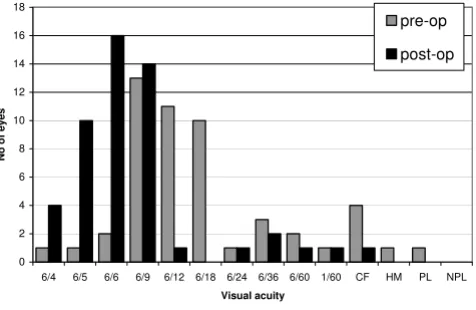
Comparison of preoperative versus postoperative best cor-rected visual acuity
Figure 1
Comparison of preoperative versus postoperative best cor-rected visual acuity.
0 2 4 6 8 10 12 14 16 18
6/4 6/5 6/6 6/9 6/12 6/18 6/24 6/36 6/60 1/60 CF HM PL NPL
Visual acuity
No
o
f eyes
Patient selection was based on the ability to instil the drops by themselves, other members of family, or carers. They also had to arrange for their own transport. Patients unsuitable for local anaesthesia and those who preferred to undergo surgery under sedation were excluded from the study.
The patients were surveyed by a questionnaire to determine their satisfaction with the service and viability as a prospect for providing a more efficient cataract surgery service. The questionnaire groups the questions into those related to the clinic consultation, the time just before they come to hospi-tal, their experience on arrival at the hospihospi-tal, the operation itself, and their overall satisfaction (additional file 1). Patients were asked clearly to answer their questionnaire based on their experience from their first eye cataract sur-gery, with the questionnaires delivered to them after their operations.
Results
Fifty-one eyes of 39 consecutive patients underwent "Cat-aract Surgery by Appointment" from 1st February to 12th
December 2002. There were 16 male and 23 female. Forty-four (86%) patients received sub-Tenon's anaesthe-sia and 6 (14%) topical anaestheanaesthe-sia. A scleral tunnel was performed in 42 (82%) eyes and a clear temporal cornea incision in 9 (18%) eyes.
The pre-operative best-corrected visual acuity was 6/9 or better in 17 (33%) eyes with 4 (8%) eyes achieving 6/6 or better. The post-operative best-corrected visual acuity was
6/9 or better in 44 (86%) eyes with 30 (59%) eyes achiev-ing 6/6 or better (Figure 1).
One eye had a best-corrected visual acuity that became worse post-operatively due to cystoid macular oedema; this patient's best-corrected visual acuity was reduced from 6/18 pre-operatively to 6/36 post-operatively.
Post-operative complications occurred in 3 (6%) eyes. Two eyes of the same patient developed Descemet's folds that settled with increased frequency of steroid eye drops, and there was one case of cystoid macular oedema (as already mentioned above). All patients went home directly from the operating theatre immediately following surgery. Patients were reviewed the day following surgery and at another follow up appointment 1–2 weeks post-operatively. The average number of days from surgery to discharge was 14.5 days.
Twenty-eight (72%) completed questionnaires were returned. Questionnaires were not sent again to the patients who did not reply, as we did not want them to feel pressurised. The results show that the majority of patients were satisfied with their overall experience of this mode of delivery for cataract surgery (Tables 1, 2, 3, 4).
Discussion
Well over 200,000 cataract operations are carried out per annum in the United Kingdom, making this one of the most common surgical procedures in the country [2]. In addition, small incision cataract extraction (phacoemulsi-fication) is effective in terms of increase in vision and is safe with respect to the low incidence of surgical compli-cations [3,4]. However, nationally the average patient wait was 8 to 10 weeks for an initial outpatient consultation and then a further seven months for surgery [1]. This called for long waiting times to be reduced and for services to be redesigned from the patients' point of view. As a result, one stop cataract surgery was introduced, but not without shortcomings [5], including difficulties in using theatre time efficiently, and without time for patients to consider whether to go ahead with surgery. We developed a new method of delivery of cataract surgery, "Cataract Table 3: Other results
Yes (%) No (%)
Adequate instructions for eye drops 100 0
Difficulty with drops 14 86
Self-administration of eye drops 39 61
Preference for nurse to instil eye drops 18 82
Preference for earlier arrival to theatres 0 100
Relatives/friends to watch surgery 89 11
Recommendation to a friend 96 4 Table 2: Level of discomfort
Level of discomfort (% of replies)
1 2 3 4 5
Discomfort during operation 68 29 0 3 0
Level of discomfort
1 = no discomfort 2 = mild discomfort 3 = moderate discomfort 4 = painful
Surgery by Appointment", a modification of day case cat-aract surgery. We conducted the above pilot study as a prelude to a randomised controlled trial comparing "Cat-aract Surgery by Appointment" with Day Case Cat"Cat-aract Surgery.
Of note, no non-steroidal anti-inflammatory preparation such as diclofenac drops (Voltarol Ophtha) was used pre-operatively in this study. We felt it would be too complex to instil three different types of eye drops. In no case did the pupil come down in size during surgery. We are work-ing on combinwork-ing the dilatwork-ing drops with diclofenac or similar in a single slow release preparation. In addition, there is now emerging evidence for the feasibility of per-operative intracameral administration of pupil dilating medication [6,7]. If this proves to be satisfactory, it would make "Cataract Surgery by Appointment" even more patient-friendly. Whilst it has proven to be the case that patients or their carers could be trusted to instil pre-oper-ative dilating eyedrops, the availability of intracameral preparations for pupil dilation for per-operative use can also expand "Cataract Surgery by Appointment" to those patients who cannot instil eye drops themselves, for example due to rheumatoid arthritis.
In terms of patient safety the following apply. The fact that each patient arrives at an appointed time reduces the risk of operating on the wrong patient; there is only ever one patient on site at a time. Patients are fully awake without sedation, so we are in constant conversation with them as to what is about to happen. They know which eye is to be operated on and will have instilled dilating eye drops in that eye only. This reduces the risk of operating on the wrong eye.
"Cataract Surgery by Appointment" performed under local anaesthesia has obvious benefits for patients in reducing waiting time at the hospital on the day of opera-tion. This frees up resources and is also popular with patients.
Routine medical testing before cataract surgery was not employed, as it does not measurably increase the safety of the surgery [8]. The per-operative and post-operative com-plications in our study compare favourably with the national rate of complications [9]. We had no case of pos-terior capsule rupture, vitreous loss or endophthalmitis.
Patient satisfaction is related to the patient's pre-operative expectations and the quality of care given during the hos-pital stay and follow-up [10]. Satisfaction with the process of treatment and facilities was high. Most patients were satisfied with every aspect on which they were questioned. Patient satisfaction may be further improved if Day 1 review could be omitted. We have already started to omit Day 1 review for second eye surgery, but as the time spent in hospital on the day of their operation is so short, it is necessary to spend some time to explain how to use their post-operative eye drops, what activities to avoid, and what to do if symptoms suggestive of a serious post-oper-ative complication should occur. We feel this may be bet-ter done on Day 1, but it is possible that the same effect could be achieved by Day 1 telephone review.
"Cataract Surgery by Appointment" performed under local anaesthesia gave a high level of patient satisfaction. This method of delivery of cataract surgery is safe, effec-tive, and is the ultimate form of day case cataract surgery for highly selected cases, when performed by a skilled ophthalmic surgeon. We recommend this method of delivery of cataract surgery to surgeons who are compe-tent, consistent in speed, and have a low rate of complica-tions. Attention should be paid to risk-stratification, so complex cases are allocated more time on the operating list [11,12]. This type of delivery of cataract surgery is probably not suitable for teaching lists. It may be particu-larly suited to hospitals where the ward or day case unit are physically remote from the operating theatre.
Competing interests
The author(s) declare that they have no competing inter-ests.
Acknowledgements
We thank Nick Astbury, David Allen and Paul Rosen for helpful comments on the manuscript.
References
1. Action on cataracts: NHS Executive. Department of Health 2000. 2. Woodcock M, Shah S, Smith RJ: Recent advances in customising
cataract surgery. BMJ 2004, 328:92-6.
3. Powe NR, Schein OD, Gieser SC, Tielsch JM, Luthra R, Javitt J, Stein-berg EP: Synthesis of the literature on visual acuity and com-plications following cataract extraction with intraocular lens implantation. Arch Ophthalmol 1994, 112:239-252.
4. Fan Y-P, Boldy D, Bowen D: Comparing patient satisfaction, outcomes and costs between cataract day surgery and inpa-tient surgery for elderly people. Australian Health Review 1997, 20(4):27-39.
Table 4: Waiting time before surgery
No <10 mins <20 mins <30 mins >30 mins
Waiting time before surgery 32% 30% 32% 3% 3%
Publish with BioMed Central and every scientist can read your work free of charge "BioMed Central will be the most significant development for disseminating the results of biomedical researc h in our lifetime."
Sir Paul Nurse, Cancer Research UK
Your research papers will be:
available free of charge to the entire biomedical community
peer reviewed and published immediately upon acceptance
cited in PubMed and archived on PubMed Central
yours — you keep the copyright
Submit your manuscript here:
http://www.biomedcentral.com/info/publishing_adv.asp
BioMedcentral
5. Hughes EH, Forrest F, Diamond JP: 'One-stop' cataract surgery: the Bristol Eye Hospital experience 1997–1999. Eye 2001, 15:306-308.
6. Lee JJ, Moster MR, Henderer JD, Membreno JH: Pupil dilation with intracameral 1% lidocaine during glaucoma filtering surgery.
Am J Ophthalmol 2003, 136(1):201-3.
7. Lundberg B, Behndig A: Intracameral mydriatics in phacoemul-sification cataract surgery. J Cataract Refract Surg 2003, 29(12):2366-71.
8. Schein OD, Katz J, Bass EB, Tielsch JM, Lubomski LH, Feldman MA, Petty BG, Steinberg EP: The value of routine preoperative med-ical testing before cataract surgery. N Engl J Med 2000, 342:168-75.
9. Desai P, Reidy A, Minassian DC: Profile of patients presenting for cataract surgery in the UK: national data collection. Br J Oph-thalmol 1999, 83:893-6.
10. Nijkamp MD, Nuijts RM, Borne B, Webers CA, van der Horst F, Hen-drikse F: Determinants of patient satisfaction after cataract surgery in 3 settings. J Cataract Refract Surg 2000, 26:1379-1388. 11. Muhtaseb M, Kalhoro A, Ionides A: A system for preoperative
stratification of cataract patients according to risk of intra-operative complications: a prospective analysis of 1441 cases. Br J Ophthalmol 2004, 88(10):1242-6.
12. Liu C: Risk stratification for the humble cataract. Br J Ophthal-mol 2004, 88(10):1231-2.
Pre-publication history
The pre-publication history for this paper can be accessed here: