R E S E A R C H A R T I C L E
Open Access
Undercorrection of hypernatremia is frequent and
associated with mortality
Stanislas Bataille
1*†, Camille Baralla
2†, Dominique Torro
2, Christophe Buffat
3, Yvon Berland
1, Marc Alazia
2,
Anderson Loundou
4, Pierre Michelet
2and Henri Vacher-Coponat
1Abstract
Background:About 1% of patients admitted to the Emergency Department (ED) have hypernatremia, a condition associated with a mortality rate of 20 to 60%. Management recommendations originate from intensive care unit studies, in which patients and medical diseases differ from those in ED.
Methods:We retrospectively studied clinical characteristics, treatments, and outcomes of severely hypernatremic patients in the ED and risk factors associated with death occurrence during hospitalization.
Results:During 2010, 85 cases of severe hypernatremia≥150 mmol/l were admitted to ED. Hypernatremia occurred in frail patients: mean age 79.7 years, 55% institutionalized, 28% with dementia.
Twenty four percent of patients died during hospitalization. Male gender and low mean blood pressure (MBP) were independently associated with death, as well as slow natremia correction speed, but not the severity of
hyperosmolarity at admission. Infusion solute was inappropriate for 45% of patients with MBP <70 mmHg who received hypotonic solutes and 22% of patients with MBP≥70 mmHg who received isotonic solutes or were not perfused.
Conclusions:This is the first study assessing outcome of hypernatremic patients in the ED according to the treatment provided. It appears that not only a too quick, but also a too slow correction speed is associated with an increased risk of death regardless of initial natremia. Medical management of hypernatremic patients must be improved regarding evaluation and treatment.
Keywords:Intracellular dehydration, Dysnatremia, Hypernatremia, Renal failure, Emergency, Mortality
Background
Hypernatremia is diagnosed in 1 to 2% of patients admit-ted to the Emergency Department (ED). Such patients often have various underlying pathologies implicated in hypernatremia occurrence [1]. In most cases, treatment of hypernatremia is started at ED, but there have been only two reports on the characteristics, symptoms, treatments, and outcomes of severely hypernatremic patients at ED [1,2].
The recommended hypernatremia correction speed, based on pediatric retrospective case-series [2], is 1 mmol/L/h when hypernatremia occurrence has been quick (a few hours) and 0.5 mmol/L/h when it has been long or is
unknown [3-6]. A too fast correction can induce cerebral edema and irreversible neurologic sequels that are avoided with a slow correction [3,5,7]. Unless shock or hypotension are present, isotonic or hypertonic solutes are not recom-mended. Moreover, experts recommend first replacing fluid losses in dehydrated/hypovolemic patients by use of iso-tonic or slightly hypoiso-tonic fluids (e.g. lactated Ringer’s) [8].
To avoid over- or under-treatment, which both might cause neurological complications (cerebral edema, seiz-ure, or coma), management of intravenous fluid must be rationalized. Mathematic calculation of water deficit based on sodium and water distribution in the intra-and extra-cellular spaces has been proposed. This requires two clinical data: natremia measurement and patient weight. For example, Adrogue and Madias’s formula serves to calculate natremia variation after perfusion of * Correspondence:[email protected]
†Equal contributors 1
Aix-Marseille University, APHM, Hôpital de la Conception, Centre de néphrologie et transplantation rénale, Marseille 13005, France Full list of author information is available at the end of the article
one liter of solute according to the type of solute, initial
natremia, and total body water volume: Attended
natre-mia = ([Na] of solute–initial natremia)/(Total body water volume - 1) [3,9,10]. Most formulas consider the human body as a closed system and do not integrate undergoing losses of water. Furthermore, total body water volume re-quired for calculation is extrapolated from weight regard-less of the percentage of body fat variability. Also, these formulas were found to be imprecise in individual pa-tients with deviations > 10 mmol/L [11]. Their inapprop-riate use might lead to hypernatremia under-correction or worsening [12].
Mortality of hypernatremic patients reaches 20% to 60% [2,12-15] and varies according to comorbidities, as-sociated illness, and whether hypernatremia is present at admission or acquired during hospitalization [2,16]. Hypernatremia at admission or acquired during the hospitalization is an independent mortality risk factor [2,15-17].
In this study, we report clinical characteristics, man-agement, outcome and mortality risk factors of severely hypernatremic patients admitted to the ED.
Methods
We retrospectively studied all patients admitted between January 2010 and January 2011 to the main adult ED of the center of Marseille, France. Each day an average of 150 patients are admitted. The medical team was consti-tuted at daytime of 4 senior doctors and 5 residents and at night 3 senior doctors and 5 residents.
Patients were identified using the computerized regis-try of the biochemisregis-try lab. All patients with
natre-mia ≥150 mmol/L at admission were included in the
study. Data collected from medical files were age, gender, place of origin and personal environment (home, institu-tion or home medical care), cause of admission, blood pressure, presence of extracellular dehydration signs (de-creased skin turgor, lower limb edema, hypotonic ocular globes), presence of neurologic symptoms (disorientation, agitation, somnolence, coma), medical history of demen-tia, usual treatments, sequential serum sodium measured during the hospitalization, creatinine at admission, ED main diagnosis, and patient outcome in ED and during the following hospitalization. We also collected compos-ition and perfusion rate of prescribed intravenous perfu-sions. Speed of natremia correction was calculated using available natremia on the first day, the third day,
and the last known natremia (i.e., natremia at death,
normalization, or loss to follow-up). Patients with no natremia improvement between entry and the last known natremia were defined as the no natremia improvement group. The plasma tonicity and osmolarity were calculated using the classical formulas: tonicity = ([Na] + [K]) ×2 + Glycemia; osmolarity = ([Na] + [K]) ×2 + Urea + Glycemia.
Estimated glomerular filtration rate (eGFR) was calculated using the MDRD formula [17].
Hypotension requiring isotonic solute perfusion was defined as a mean blood pressure (MBP) <70 mmHg. Optimal correction rate of hypernatremia was defined as a decreasing rate between 0.5 to 1 mmol/L/h with a maximum of 12 mmol/L/day [3-6].
Statistical analysis was performed using SPSS version 1.0 and Stata 12. Continuous variables were expressed as means ± SD or as median with range (min, max), and categorical variables were reported as count and/or per-centages. A Cox regression analysis was conducted to identify mortality risk factors. A p-value of <0.10 in the univariate analysis was chosen to define the variables to be entered into the selection procedure for the multivar-iable model. A step by step backward procedure was used to identify variables with a p-value <0.05 in the multivariate model. Natremia at admission was included in the multivariate model as an adjustment variable. Hazard ratios were expressed with 95% confidence inter-vals. All the tests were two-sided. Data with more than four groups were clustered to define correct Hazard Ra-tios. Research was conducted according to standard rec-ommendations of the local ethics committee (Comité de Protection des Personnes Sud-Méditerranée II - www. cpp-sudmed2.fr) and followed the standards of the Helsinki Declaration. As defined by the French Public Health Code (Articles L1121-1 and R1121-2), no institu-tional review board and no written informed consent is required for "research in which all practices and prod-ucts are used in the usual way, without any additional or unusual procedure for diagnosis or monitoring", thus, for retrospective studies.
Results
Between January 2010 and January 2011, 54 753 admis-sions were recorded in our ED, 16 351 (29.8%) of them had a serum sodium dosing. Hypernatremia >145 mmol/L was found in 226 admissions,i.e., 0.4% of admissions and 1.4% of admissions with natremia dosing.
Within the 226 hypernatremic admissions, 141 were between 146 and 149 mmol/L and not included in this study. The 85 admissions (82 patients) with severe
hypernatremia, i.e., ≥150 mmol/L (0.2% of admissions
and 0.5% of admissions with natremia dosing), were in-cluded in this study.
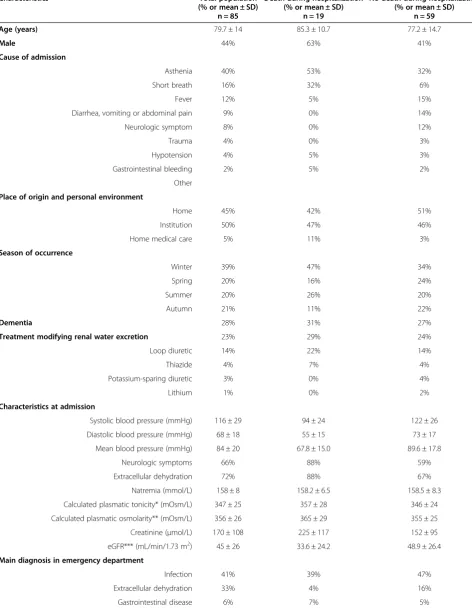
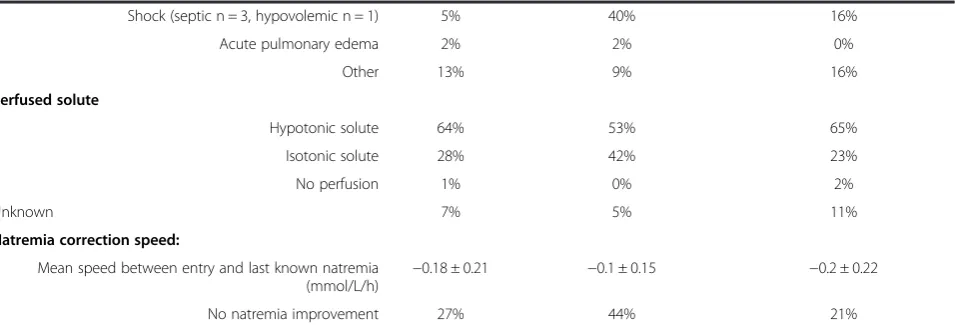
Table 1 Characteristics of hypernatremic patients and risk factors for death occurrence during hospitalization
Characteristics Total population
(% or mean ± SD)
Death during hospitalization (% or mean ± SD)
No death during hospitalization (% or mean ± SD)
n = 85 n = 19 n = 59
Age (years) 79.7 ± 14 85.3 ± 10.7 77.2 ± 14.7
Male 44% 63% 41%
Cause of admission
Asthenia 40% 53% 32%
Short breath 16% 32% 6%
Fever 12% 5% 15%
Diarrhea, vomiting or abdominal pain 9% 0% 14%
Neurologic symptom 8% 0% 12%
Trauma 4% 0% 3%
Hypotension 4% 5% 3%
Gastrointestinal bleeding 2% 5% 2%
Other
Place of origin and personal environment
Home 45% 42% 51%
Institution 50% 47% 46%
Home medical care 5% 11% 3%
Season of occurrence
Winter 39% 47% 34%
Spring 20% 16% 24%
Summer 20% 26% 20%
Autumn 21% 11% 22%
Dementia 28% 31% 27%
Treatment modifying renal water excretion 23% 29% 24%
Loop diuretic 14% 22% 14%
Thiazide 4% 7% 4%
Potassium-sparing diuretic 3% 0% 4%
Lithium 1% 0% 2%
Characteristics at admission
Systolic blood pressure (mmHg) 116 ± 29 94 ± 24 122 ± 26
Diastolic blood pressure (mmHg) 68 ± 18 55 ± 15 73 ± 17
Mean blood pressure (mmHg) 84 ± 20 67.8 ± 15.0 89.6 ± 17.8
Neurologic symptoms 66% 88% 59%
Extracellular dehydration 72% 88% 67%
Natremia (mmol/L) 158 ± 8 158.2 ± 6.5 158.5 ± 8.3
Calculated plasmatic tonicity* (mOsm/L) 347 ± 25 357 ± 28 346 ± 24
Calculated plasmatic osmolarity** (mOsm/L) 356 ± 26 365 ± 29 355 ± 25
Creatinine (μmol/L) 170 ± 108 225 ± 117 152 ± 95
eGFR*** (mL/min/1.73 m2) 45 ± 26 33.6 ± 24.2 48.9 ± 26.4
Main diagnosis in emergency department
Infection 41% 39% 47%
Extracellular dehydration 33% 4% 16%
Mean creatinine at admission was 170 ± 108μmol/L, but no information was available with regard to acute or chronic renal failure. Using the MDRD formula, which is appropriate for chronic renal failure, mean eGFR was 45 ± 26 mL/min/1.73 m2; 94% of patients had an eGFR <90 mL/ min/1.73 m2, 69% an eGFR <60 mL/min/1.73 m2, and 34% an eGFR <30 mL/min/1.73 m2(Figure 1B).
For 47% of patients, main diagnosis recorded at the ED was a medical disease frequently associated with water loss: infection (pulmonary n = 20, urinary n = 11, other n = 4), gastrointestinal disease (diverticulitis n = 1, diarrhea n = 2, gastroenteritis n = 2) (Table 1).
Surprisingly, hypernatremia was more frequent in win-ter (39% of cases) than in spring (20%), autumn (21%), and notably summer (20%). In summer, a short peak was observed in July, the hottest month of 2010 in Marseille (Figure 1C).
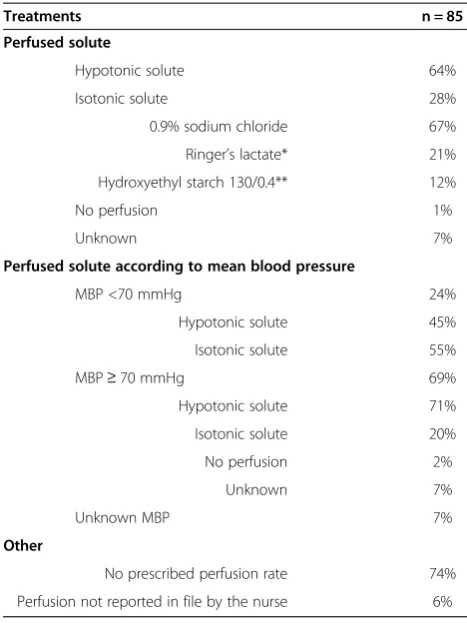
Rehydration treatment prescribed at ED is reported in Table 2. Intravenous perfusions was inappropriate for 45% of patients with MBP <70 mmHg who received a
hypotonic solute, and for 22% with MBP ≥70 mmHg
who received isotonic solute or were not perfused. In 74% of the medical files perfusion speed was missing; in 6% the perfusion setting by the nurse was not reported.
After their ED evaluation, 78 of the 85 patients (92%) were hospitalized (Figure 1A, Table 3), 5 returned to their previous institution, 1 died in the ED, and 1 patient's outcome is unknown. Mean hospitalization duration was 13.1 ± 13 days.
Natremia evolutions and patient outcomes are re-ported in Table 3. Compared to admission, natremia on the next day was worse in 34%, identical in 8%, and proved in 58% of patients. For 65% of patients with im-provement, correction was <0.5 mmol/L/h, for 32% between 0.5 and 1 mmol/L/h, and >1 mmol/L/h for 1
patient who did not die during hospitalization. Overall, only 19% of patients improved their natremia with the recommended rate of 0.5 to 1 mmol/L/h.
During hospitalization, 57% of patients normalized their natremia. Their mean rate of lowering was−0.24 ± 0.2 mmol/L/h in 4.87 ± 3.28 days (from 11 hours to 14 days). Among them, 39% had normal natremia on the third day and 80% on the 7thday. When leaving the hos-pital, 27% of patients had no natremia improvement and 19% had not normalized their natremia.
Hospital mortality rate was 24% (19 patients), occurring 5.8 ± 7 days after their arrival in ED, 47% patients died on the first two days (including the patient who died in ED); 68% in the first week; and 32% after 7 days of hospitalization. Last natremia before death was 155 ± 9 mmol/L, with a
lowering speed of −0.1 ± 0.15 mmol/L/h. Only 11% of
patients had natremia normalized before death.
Because perfusion speed was unknown in 74% of the cohort, we were not able to analyze the link between perfusion speed and natremia correction speed. Taking this limit into account, the type of solute prescribed was not associated with the correction speed during the first day (hypotonic solute−0.2 ± 0.37 mmol/L/hversus−0.21 ±
0.44 mmol/L/h with isotonic solute, p = 0.98).
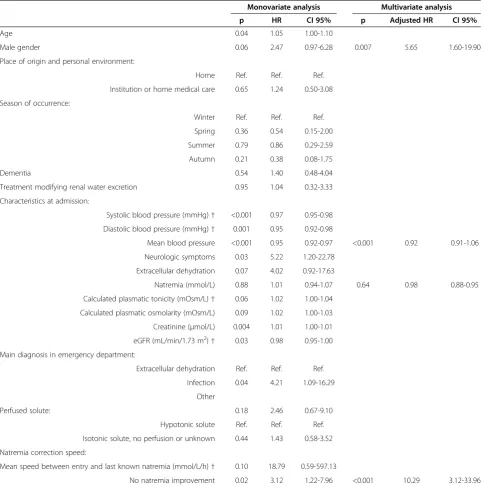
In monovariate analysis, risk factors at admission for in-hospital death were (Table 4) older age (p = 0.04), presence of neurologic symptoms (p = 0.03), lower sys-tolic blood pressure (p < 0.001), lower diassys-tolic blood pressure (p = 0.001), lower MBP (p < 0.001), higher cre-atinine (p = 0.004), lower eGFR (p = 0.03), infection as the main diagnosis in the ED (p = 0.004), and having no natremia improvement (p = 0.02).
In multivariate analysis, male gender (p = 0.007; HR = 5.65 95% CI [1.60-19.90]), lower MBP (p < 10-3; HR = 0.92 95% CI [0.88-0.95]), and slow mean correction speed to Table 1 Characteristics of hypernatremic patients and risk factors for death occurrence during hospitalization
(Continued)
Shock (septic n = 3, hypovolemic n = 1) 5% 40% 16%
Acute pulmonary edema 2% 2% 0%
Other 13% 9% 16%
Perfused solute
Hypotonic solute 64% 53% 65%
Isotonic solute 28% 42% 23%
No perfusion 1% 0% 2%
Unknown 7% 5% 11%
Natremia correction speed:
Mean speed between entry and last known natremia (mmol/L/h) −
0.18 ± 0.21 −0.1 ± 0.15 −0.2 ± 0.22
No natremia improvement 27% 44% 21%
last known natremia (p < 10-3; HR = 10.29 95% CI [3.12-33.96]) were associated with death occurrence during hospitalization.
Discussion
Our study describes initial presentation, management, and outcomes of severely hypernatremic patients (≥150 mmol/L)
in the ED and during the following hospitalization. Relative to the 50 000 patients hospitalized each year in our ED, severe hypernatremia is a rare event. However, unlike in-hospital acquired hypernatremia, most patients with hypernatremia at hospital admission receive initial treatment in the ED. To our knowledge, very few studies have reported on presentation, management and outcome
Figure 1Clinical and biological features of hypernatremic patients. A. Natremia at admission and outcomes of hypernatremic patients.
of severely hypernatremic patients upon their arrival to the hospital (Table 5) [1,2,18]. Arampatzis et al. reported hypernatremia >145 mmol/L in 0.9% of patients admitted toED and 1.5% of patients with natremia dosing, and
se-vere hypernatremia ≥150 mmol/L in 0.1% of admissions
and 0.2% of patients with natremia dosing, which is simi-lar to our results.
In our study, hypernatremic patients were old (mean age 79.7 years-old), lived in medical institutions or at home with medical care (55%), and had cognitive im-pairment (28% had dementia), which are situations of thirst impairment and/or limited access to water and at high risk for dehydration [19-21]. Moreover, for 47% of
patients with severe hypernatremia ≥150 mmol/l, the
main diagnosis was a situation associated with water loss, and 23% of patients had a treatment modifying renal water excretion.
Hot weather is an understandable risk factor for hypernatremia, and summer heat is regularly evoked
[20]. Surprisingly, in our study, hypernatremia was more frequent in winter. Several hypotheses can be proposed: less important care given to patient’s hydration in winter than in summer [22], a higher infection rate in winter [23]. A peak of hypernatremia was also noted in July, the hottest month in our city in 2010 and the 6thhottest July since 1900 with a temperature 1.9°C above normal (Source Météo France, http://climat.meteofrance.com). Clearly, heat is an important risk factor for hypernatre-mia, but our study also highlights that an adequate water intake in the elderly is important all year.
Neurological symptoms are frequent in hypernatremia, and we report that 66% of patients had at least one neurological symptom at admission. This is higher than
Table 2 Initial fluid replacement strategy on arrival at emergency department
Treatments n = 85
Perfused solute
Hypotonic solute 64%
Isotonic solute 28%
0.9% sodium chloride 67%
Ringer’s lactate* 21%
Hydroxyethyl starch 130/0.4** 12%
No perfusion 1%
Unknown 7%
Perfused solute according to mean blood pressure
MBP <70 mmHg 24%
Hypotonic solute 45%
Isotonic solute 55%
MBP≥70 mmHg 69%
Hypotonic solute 71%
Isotonic solute 20%
No perfusion 2%
Unknown 7%
Unknown MBP 7%
Other
No prescribed perfusion rate 74%
Perfusion not reported in file by the nurse 6%
*Ringer’s lactate contains sodium lactate 3.2 g/L and sodium chloride 6 g/L. **Hydroxyethyl starch 130/0.4 contains hydroxyethyl starch 130 60 g/L and sodium chloride 9 g/L.
As described in theMethods, hypotension requiring isotonic solute perfusion was defined as a mean blood pressure (MBP) <70 mmHg. Thus, intravenous perfusion was inappropriate for almost half of patients with MBP <70 mmHG who received hypotonic solutes, and for nearly a quarter when MBP≥70 mmHg who received isotonic solutes or were not perfused.
Table 3 Outcome and natremia evolution in the emergency department and during hospitalization
Outcome n = 85
All patients
Outcome after emergency department
Hospitalization 92%
Back to institution 6%
Died at emergency department 1%
Unknown 1%
In hospital mortality 24%
Mean time to death(days) 5.8 ± 6
Hospitalized patients n = 78 Natremia at admission(mmol/L) 158 ± 8
On the next day(n = 59)
Time lag between initial natremia and next day natremia
17 h21 ± 6 h28
Mean natremia (mmol/L) 156 ± 7
Mean correction speed (mmol/L/h) −0.18 ± 0.39
Worsened natremia 34%
Same natremia as at admission 8%
Improved natremia 58%
At a less than 0.5 mmol/L/h speed 65%
At a 0.5 to 1 mmol/L/h speed 32%
At a more than 1 mmol/L/h speed 3%
On the third day(n = 53)
Time lag between initial natremia and 3rd day natremia (days)
2,47 ± 0.72
Mean natremia (mmol/L) 150 ± 8
Mean correction speed (mmol/L/h) −0.15 ± 0.19
Worsened natremia 11%
Same natremia as at admission 6%
Improved but not normalized natremia 51%
Normalized natremia 32%
Mean hospitalization time(days) 13.1 ± 13
the 38% reported by Arampatzis et al., who do not spe-cify how many patients had previous dementia [2]. Extracellular dehydration was present in most patients (72%) and could be responsible for the hypotension and the renal impairment observed in 69% of patients (eGFR
below 60 mL/min/1.73 m2).
This is the first study analyzing natremia correction speed and treatment given to hypernatremic patients in ED. We show that under-correction is frequent in the
ED and in the first few days following admission: on the day after admission, 42% had a worsened or identical natremia; and on the third day following admission, natremia was normalized in only 32% of patients. More than one patient out of four had no natremia improve-ment between entry and last follow-up. Overcorrection is rare and only one patient with lithium induced nephro-genic insipid diabetes had a correction speed >1 mmol/L/h. He had a good evolution and returned to
Table 4 Factors associated with death during hospitalization: univariate and multivariate analysis using a Cox regression model (n = 78)
Monovariate analysis Multivariate analysis p HR CI 95% p Adjusted HR CI 95%
Age 0.04 1.05 1.00-1.10
Male gender 0.06 2.47 0.97-6.28 0.007 5.65 1.60-19.90
Place of origin and personal environment:
Home Ref. Ref. Ref.
Institution or home medical care 0.65 1.24 0.50-3.08
Season of occurrence:
Winter Ref. Ref. Ref.
Spring 0.36 0.54 0.15-2.00
Summer 0.79 0.86 0.29-2.59
Autumn 0.21 0.38 0.08-1.75
Dementia 0.54 1.40 0.48-4.04
Treatment modifying renal water excretion 0.95 1.04 0.32-3.33
Characteristics at admission:
Systolic blood pressure (mmHg)† <0.001 0.97 0.95-0.98
Diastolic blood pressure (mmHg)† 0.001 0.95 0.92-0.98
Mean blood pressure <0.001 0.95 0.92-0.97 <0.001 0.92 0.91-1.06
Neurologic symptoms 0.03 5.22 1.20-22.78
Extracellular dehydration 0.07 4.02 0.92-17.63
Natremia (mmol/L) 0.88 1.01 0.94-1.07 0.64 0.98 0.88-0.95
Calculated plasmatic tonicity (mOsm/L)† 0.06 1.02 1.00-1.04
Calculated plasmatic osmolarity (mOsm/L) 0.09 1.02 1.00-1.03
Creatinine (μmol/L) 0.004 1.01 1.00-1.01
eGFR (mL/min/1.73 m2)† 0.03 0.98 0.95-1.00
Main diagnosis in emergency department:
Extracellular dehydration Ref. Ref. Ref.
Infection 0.04 4.21 1.09-16.29
Other
Perfused solute: 0.18 2.46 0.67-9.10
Hypotonic solute Ref. Ref. Ref.
Isotonic solute, no perfusion or unknown 0.44 1.43 0.58-3.52
Natremia correction speed:
Mean speed between entry and last known natremia (mmol/L/h)† 0.10 18.79 0.59-597.13
No natremia improvement 0.02 3.12 1.22-7.96 <0.001 10.29 3.12-33.96
his institution after hospitalization. Optimal speed of natremia correction is not clearly established but ex-perts agree that the correction speed should not exceed 1 mmol/L/h, without a given lower limit [3-6]. Never-theless, it is important not to prolong hypernatremia duration which induces cerebral suffering and the risk of neurological sequels, decreases cardiac contractility, increases peripheral insulin resistance and impairs hep-atic neoglucogenesis [24]. We could not determine whether insufficient correction of hypernatremia was due to a low speed of perfusion because perfusion speed was missing in 74% of the cohort. This high percentage of missing data might reflect the lack of precision of medical prescriptions or the lack of transcription of the nurse on the medical file. Moreover, this speed must be adjusted to total body water deficit extrapolated from natremia and body weight, but weight was recorded for only 3 patients. Also, water loss was evaluated from urinary ionogram in only 3 patients. Besides the too slow perfusion speed, mis-takes in the type of solute chosen for rehydration could at least partly explain under-correction, as 22% of patients
with MBP ≥70 mmHg either received isotonic solute or
were not perfused.
Despite the non classical management of hypernatre-mia, the mortality rate of our cohort (24%) is similar to those previously reported, suggesting that our practices are comparable to those of other EDs (Table 5). In inten-sive care units, hypernatremia occurrence is a known mortality risk factor but patients are different and hyper-natremia is frequently iatrogenic [24]. Indeed, the conse-quences of cerebral edema differ with age, with a major risk at younger age when the size ratio of brain to cranial volume is high [25]. In our study, hypernatremic patients were old and often had dementia, two conditions associ-ated with cerebral atrophy. Moreover, we show that hypo-volemia signs (extracellular dehydration, hypotension, and renal insufficiency) are the principal risk factors for death during hospitalization, suggesting that associated illness and medical status are the major risk factors for death in
patients with hypernatremia acquired outside the hospital. This hypothesis is supported by the short delay before death (68% in the first week, most of them during the first 2 days). Three of the 4 patients with a diagnosis of shock at ED died during hospitalization.
In this study, we did not find a statistical link between the level of hypernatremia and mortality. Higher calcu-lated plasmatic tonicity and calcucalcu-lated plasmatic osmo-larity were associated with death in the monovariate model (Table 4), but not in the multivariate analysis. The 85 cases analyzed represent a relatively small cohort and there were numerous confounding factors such as loss to follow-up, associated comorbidities, and associ-ated acute illness. The small cohort size also probably explains why the relationship between hypernatremia and death did not reach statistical significance. More-over, our monocentric study might reflect local practices and a local effect. Nevertheless, in our study, a too slow natremia correction speed was associated with death. This is the first study reporting that under-correction of hypernatremia is associated with an increased mortality. Time spent with intracellular dehydration could be more important than the severity of hypernatremia or hyper-osmolarity. In hyponatremia, it is well known that a too high correction speed can lead to osmotic demyelin-ation. In hypernatremia, similar recommendations are given, but physicians should also be aware that a too slow correction rate could increase the risk of death.
Conclusion
This is the first study assessing outcome of hypernatremic patients in an ED according to the provided treatment. It suggests that medical management of hypernatremic pa-tients must be improved regarding evaluation (weight, di-uresis, urinary ionogram) and management (type of solute, perfusion speed) and that a too slow correction speed is associated with an increased risk of death regard-less of initial natremia.
Table 5 Studies reporting out-of-hospital acquired hypernatremia
Liamis et al. [15] Arampatzis et al. [1] Arampatzis et al. [2] Baralla et al.
Publication year 2008 2012 2012 2013
Country Greece Switzerland Switzerland France
Department Internal medicine Emergency Emergency Emergency
Hypernatremia definition (mmol/L) > 148 > 142 ≥150 ≥150
N= 55 400 74 85
Mean age (years) 76.3 ± 12.2 53 ± 22 NA 79.7 ± 14
Males 40% 59% 62% 44%
Mean Na (mmol/L) 160.4 ± 9.9 144 ± 2 152 158 ± 8
Mortality during hospitalization 28% NA 28% 24%
Competing interests
The authors declare that they have no competing interests.
Authors’contributions
SB and CBa collected and analyzed the data and wrote the paper. DT had the idea and supervised the study. CBu provided the biological data. YB, MA and PM gave advice to improve the study. AL did the statistical analysis. HVC supervised the study and guided SB and CBa in the paper writing. Each author read and corrected the paper. All authors read and approved the final manuscript.
Acknowledgements
We thank Julien Cohen for help with statistical analysis.
Author details 1
Aix-Marseille University, APHM, Hôpital de la Conception, Centre de néphrologie et transplantation rénale, Marseille 13005, France.2Aix-Marseille University, APHM, Hôpital de la Conception, Service d’accueil des urgences, Marseille 13005, France.3Aix-Marseille University, APHM, Hôpital de la Conception, Laboratoire de Biochimie, Marseille 13005, France.4Aix-Marseille University, Laboratoire de Santé Publique EA3279, Marseille 13284, France.
Received: 27 August 2013 Accepted: 10 February 2014 Published: 21 February 2014
References
1. Arampatzis S, Exadaktylos A, Buhl D, Zimmermann H, Lindner G:
Dysnatraemias in the emergency room: Undetected, untreated, unknown?Wien Klin Wochenschr2012,124(5–6):181–183.
2. Arampatzis S, Frauchiger B, Fiedler GM, Leichtle AB, Buhl D, Schwarz C, Funk GC, Zimmermann H, Exadaktylos AK, Lindner G:Characteristics, symptoms, and outcome of severe dysnatremias present on hospital admission. Am J Med2012,125(11):1125.
3. Adrogue HJ, Madias NE:Primary care: hypernatremia.N Engl J Med2000,
342(20):1493–1499.
4. Fall PJ:Hyponatraemia and Hypernatremia (a systemic approach to causes and their correction).Postgrad Med2000,107(5):75–82.
5. Oufella H, Offenstadt G:Troubles de l’équilibre acido-basique et désordres hydro-électrolytiques.La revue du praticien2003,53:883–892.
6. Tareen N, Martins D, Nagami G, Levine B, Norris KC:Sodium disorders in the elderly.
J Nat Med Association2005,97(2):217–224.
7. Robertson GL:Thirst and vasopressin function in normal and disordered states of water balance.J Lab Clin Med1983,101(3):351–369.
8. Lindner G, Funk GC:Hypernatremia in critically ill patients.J Crit Care
2013,28(2):216.e11-20.
9. Adrogue HJ, Madias NE:Aiding fluids prescription for the dysnatrémies. Intensive Care Med1997,23:309–316.
10. Halperin LM, Cherney DZI, Adrogue HJ, Madias NE:Hypernatremia.N Engl J Med2000,343(11):817–818.
11. Lindner G, Schwarz C, Kneidinger N, Kramer L, Oberbauer R, Druml W:Can we really predict the change in serum sodium levels? An analysis of currently proposed formulae in hypernatraemic patients.Nephrol Dial Transplant2008,23(11):3501–3508.
12. Barsoum NR, Levine BS:Current prescriptions for the correction of hyponatremia and hypernatremia: are they too simple?Nephrol Dial Transplant2002,17:1176–1180.
13. Snyder NA, Feigal DW, Arieff AI:Hypernatremia in elderly patients: a heterogeneous, morbid, and iatrogenic entity.Ann Intern Med1987,
107:309–319.
14. Palevsky PM, Bhagrath R, Greenberg A:Hypernatremia in hospitalized patients.Ann Inter Med1996,124:197–203.
15. Funk GC, Lindner G, Druml W, Metnitz B, Schwarz C, Bauer P, Metnitz PG:
Incidence and prognosis of dysnatremias present on ICU admission. Intensive Care Med2010,36(2):304–311.
16. Stelfox HT, Ahmed SB, Khandwala F, Zygun D, Shahpori R, Laupland K:
The epidemiology of intensive care unit-acquired hyponatraemia and hypernatraemia in medical-surgical intensive care units.Crit Care2008,
12(6):R162. doi:10.1186/cc7162.
17. Levey AS, Bosch JP, Breyer Lewis J, Greene T, Rogers N, Roth D:A more accurate method to estimate glomerular filtration rate from serum creatinine: a new prediction equation.Ann Intern Med1999,130:461–470. 18. Liamis G, Tsimihodimos V, Doumas M, Spyrou A, Bairaktari E, Elisaf M:
Clinical and laboratory characteristics of hypernatremia in an internal medicine clinic.Nephro Dial Transplant2008,23:136–143.
19. Chassagne P, Druesne L, Capet C, Ménard JF, Bercoff E:Clinical presentation of hypernatremia in elderly patients: a case control study. J Am Geriatr Soc2006,54(8):1225–1230.
20. Hausfater P, Mégarbane B, Fabricatore L, Dautheville S, Patzak A, Andronikof M, Santin A, Kierzek G, Doumenc B, Leroy C, Manamani J, Peviriéri F, Riou B:
Serum sodium abnormalities during nonexertional heatstroke: incidence and prognostic values.Am J Emerg Med2012,30(5):741–748.
21. Al-Absi A, Gosmanova EO, Wall BM:A clinical approach to the treatment of chronic hypernatremia.Am J Kidney Dis2012,60(6):1032–1038. 22. Himmelstein DU, Jones AA, Woolhandler S:Hypernatremic dehydration in
nursing home patients: an indicator of neglect.J Am Geriatr Soc1983,
31(8):466–471.
23. Davis RE, Rossier CE, Enfield KB:The impact of weather on influenza and pneumonia mortality in New York City, 1975–2002: a retrospective study.PLoS One2012,7(3):e34091.
24. Lindner G, Funk GC, Schwarz C, Kneidinger N, Kaider A, Schneeweiss B, Kramer L, Druml W:Hypernatremia in the critically ill is an independent risk factor for mortality.Am J Kidney Dis2007,50(6):952–957.
25. Ayus JC, Achinger SG, Arieff A:Brain cell volume regulation in hyponatremia: role of sex, age, vasopressin, and hypoxia.Am J Physiol Renal Physiol2008,295(3):F619–F624.
doi:10.1186/1471-2369-15-37
Cite this article as:Batailleet al.:Undercorrection of hypernatremia is frequent and associated with mortality.BMC Nephrology201415:37.
Submit your next manuscript to BioMed Central and take full advantage of:
• Convenient online submission
• Thorough peer review
• No space constraints or color figure charges
• Immediate publication on acceptance
• Inclusion in PubMed, CAS, Scopus and Google Scholar
• Research which is freely available for redistribution