Facilitation, competition and parasitic facilitation
amongst invasive and native liana seedlings
and a native tree seedling
Kris French1, Sharon A. Robinson1, Liza Smith1, Eva Watts1
1 Centre for Sustainable Ecosystem Solutions, School of Biological Sciences, University of Wollongong, Wollon-gong, NSW 2522, Australia
Corresponding author: Kris French ([email protected])
Academic editor:B. Murray | Received 25 April 2017 | Accepted 14 July 2017 | Published 14 August 2017
Citation: French K, Robinson SA, Smith L, Watts E (2017) Facilitation, competition and parasitic facilitation
amongst invasive and native liana seedlings and a native tree seedling. NeoBiota 36: 17–38. https://doi.org/10.3897/
neobiota.36.13842
Abstract
Lianas are prevalent in gaps and edges of forests where they compete intensely with trees, reducing growth and recruitment. Invasive lianas have the potential to be particularly harmful as the competitive advantage of the liana life history may be coupled with the more competitive qualities of invasiveness. However, in early stages of growth of lianas and native tree seedlings, facilitatory interactions or competitive interac-tions associated with soil nutrients may be more prevalent. We investigated interacinterac-tions at the early stages of growth between native and invasive lianas with a common rainforest tree of temperate Australian rain-forests under different light conditions. Invasive lianas, as a group, were not more competitive than native lianas in reducing growth of a native rainforest seedling. At this stage in the life cycle most lianas were as competitive as a conspecific seedling. However, one invasive liana, Anredera cordifolia, was particularly competitive and reduced biomass of tree seedlings. Light had little effect on growth of lianas nor on the impact of competition, however, specific leaf area differed between low and medium light conditions. Moderate light did improve growth in the rainforest tree seedling. When lianas were grown with a rainfor-est tree, three liana species overyielded, while one species was unaffected by growing with the tree seedling. Overyielding suggests a strong positive interaction with the neighbouring plant, mediated through below-ground processes. We discuss the potential for these interactions to be facilitative, parasitic or competi-tive. We therefore show that interactions early in the life of rainforest species can be complex mixtures of interactions which are likely to influence the ability of lianas to dominate rainforests.
Keywords
forest edges, forest interior, interspecific competition, intraspecific competition, invasion ecology, relative growth rates, seedlings, SLA, temperate forests, vines
Introduction
Recently, the focus of competition as the most important plant-plant interaction has been questioned as acknowledgement of the role of positive interactions (facilitation) in influencing neighbouring plants has been established (Callaway and Walker 1997, Brooker et al. 2008; Montgomery et al. 2010, Wright et al. 2014). Gaining advantages from neighbouring plants may increase growth opportunities over and above those gained through competitive superiority, particularly in highly stressful environments (stress gradient hypothesis: Bertness and Callaway 1994, Callaway and Walker 1997, Holmgren et al. 1997). Over the life of a plant, the relative strengths of competition and facilitation vary (Wright et al. 2014; Paterno et al. 2016) and interactions are in-fluenced by other biotic interactions (e.g. herbivory, Hamilton III and Frank 2001). Consequently, understanding community processes involves investigating interactions through the life cycle. Early growth of plants is likely to be an important life stage where interactions are likely to quickly influence the success of seedlings, although this stage has not been investigated widely.
Competition is often measured in the field as lower relative growth compared to the competing plant. However, competitive interactions that may be present are often confounded by species-specific differences in growth rates and resource use as well as a range of other positive and negative interactions amongst other species. Competi-tion is a negative-negative interacCompeti-tion, whereby both species should do worse when growing with the other competitor than each does when growing alone. Competi-tion is only possible when there is a limiting resource and few studies establish the limiting resource where competition is acting. In the field, measuring growth rates of individual plants growing alone is particularly difficult and thus identifying competi-tion and the strength of competicompeti-tion is often not clear. Instead studies often focus on differentiating the relative differences between putative competitors. The outcome of these ‘competitive interactions’ in the field could therefore be caused by a range of other interactions which result in a difference in growth through better acquisition of non-limiting resources, rather than the result of competition with a neighbouring plant. Similarly facilitation is a positive interaction being experienced by at least one
partner in the interaction compared to when growing aloneand is usually associated
Lianas are considered to be strong competitors as they spend fewer resources on mechanical support allowing greater allocation to leaves, stem elongation and roots. They are also often considered to be structural parasites (Stevens 1987). In compari-son to other growth forms, lianas have more leaves and a higher annual increment in new stem mass for a given aboveground mass (Wyka et al. 2013, Ichihashi and Tateno 2015), and increased photosynthetic capacity (Pasquini et al. 2015). Lianas influence tree regeneration in tropical rainforests (Schnitzer et al. 2014) through both above-ground and below-above-ground competition (Schnitzer et al. 2005; Toledo-Aceves and Swaine 2008; Lobos-Catalan and Jiminez-Castillo 2014). Our understanding of lianas in forests is largely associated with work in the neotropics (summarised in Paul and Yavitt 2011) with very little work done elsewhere. In southern hemisphere temperate rainforests, Lobos-Catalan and Jiminez-Castillo (2014) suggested that resource com-petition was less influential as nutrients are greater than in the neotropics. Apart from Lobos-Catalan and Jiminez-Castillo (2014), little work has been done to determine whether lianas in other forest types follow similar trajectories and have similar impacts as those in the tropics. Furthermore, variable use of terminology such as competition and parasitism to describe the same attributes is confusing, highlighting the need to be very clear in attributing the direction of the interaction in studies.
Exotic, invasive lianas have the potential to be particularly harmful to rainforest habitats as the ‘competitive’ advantage of the liana life history may be coupled with the more competitive qualities of invasiveness. Theoretically, the advantage of being invasive is associated with escape from co-evolved pathogens and predators in the native habitat (Enemy Release Hypothesis, Keane and Crawley 2002) which frees up resources to be used in growth and reproduction. For many invasive species, growth is improved in host habitats where species have evolved improved competitive strate-gies (Blossey and Notzold 1995). Invasive species have faster growth stratestrate-gies result-ing in higher specific leaf area (SLA) and assimilation rates (Leishman et al. 2007) which causes higher relative growth rates (James and Drenovsky 2007). There are some examples of equivalent patterns associated with invasive lianas. Leicht-Young
et al. (2011) found that under stronger competition the invasive liana, Celastrus
orbiculatus, had greater relative growth rates, biomass and survival than the native
Celastrus scandens. Osunkoya et al. (2010) found that four invasive lianas had higher
respiration load, higher light compensation points and higher SLA indicating better carbon economy, but similar relative growth rates to four native species in tropical
Australia. In contrast, while an invasive liana in the US, Cayratiajaponica, had faster
growth compared to a native, Parthenocissusquinquefolia, another invasive (
Ampelop-sisbrevipedunculata) did not (Emerine et al. 2013). Native and invasive liana
spe-cies in temperate forests in Australia have similar allometry of growth characteristics (French et al. 2016).
the outcome of species that are seeking to occupy a site. Furthermore, positive inter-actions with neighbours may facilitate early growth in seedling lianas and could neu-tralise or outweigh the negative effects of resource competition. Increases in positive plant-plant interactions during this early stage, relative to negative competitive inter-actions, may improve growth of plants over and above growth when plants are grown alone (known as overyielding) and may buffer high levels of seedling mortality which would be otherwise experienced. Seedling lianas are unlikely to smother seedling trees as there is strong selection to invest in seeking a taller plant to reach the canopy and es-cape the darker ground level rather than continuing to grow large amounts of biomass at this level in the forest. Accordingly, in the early stages of establishment, the growth rates of seedlings of lianas and trees is likely to be more strongly affected by below-ground resources (Toledo-Aceves and Swaine 2008) and positive plant interactions may become relatively more important. Being able to maintain high growth in low-light environments in the early stages of growth would be advantageous, however the relative importance of low light, facilitation and competition for resources on growth at this early stage is unknown. Toledo-Aceves and Swaine (2008) found that although changes in light availability (reflecting gaps and interior conditions) did not influence below-ground competition there was an overall positive effect on early growth in 3 spe-cies. However, Osunkoya et al. (2005) identified an interaction between below-ground competition and light availability for two tree species suggesting that competition may well change depending on the position of seedlings in the rainforest.
Gaps and edges of rainforests are often areas where lianas are particularly prevalent (Putz 1984, Schnitzer et al. 2000, Schnitzer and Carson 2001, Schnitzer et al. 2012) and are areas where they compete intensely with trees, reducing tree growth and re-cruitment (van der Heijden and Phillips 2009, Schnitzer and Carson 2010, Schnitzer et al. 2014). However, within forest interiors, resource limitation, particularly phos-phorus, is important for both trees and lianas although lianas always outperform trees (Pasquini et al. 2015) and can suppress seedling growth and survival (Martinez-Izqui-erdo et al. 2016). Thus comparing competitive and facilitatory effects at the edges and interiors of rainforests may indicate the strength of competition, relative importance of facilitation and how effective lianas are in these early periods of growth.
Methods
Study species
Seedlings of Guioa semiglauca (F.Muell) Radlk. (Sapindaceae) were used in growth
trials in pots in a shade house. G. semiglauca is a common tree up to 18 m used
as a host by lianas in a range of rainforest communities along Eastern Australia (Harden et al. 2006). It can grow in both edges and understorey areas in rainforests. Two native and two invasive lianas were compared in the trial: the native species
were Cissus antarctica Vent. (Vitaceae) and Pandorea pandorana (Andrews) Steenis.
subsp. pandorana (Bignoniaceae) and the invasive species were Araujia sericifera Brot.
(Apocynaceae) and Anredera cordifolia (Ten.) Steenis (Basellaceae). All species were
chosen as all can be abundant in disturbed rainforests. Cissus antarctica is a robust
tendril climber reproducing from berries and spreading clonally through numerous
stems (Fairley and Moore 2010, Harden et al. 2007). Pandorea pandorana subsp.
pandorana is found throughout Australia in a range of vegetation communities
including rainforests. Anredera cordifolia is a succulent climber from South America
which was first introduced to Australia in the early 1900’s (Vivian-Smith et al. 2007). It is currently listed nationally as a Weed of National Significance. It primarily spreads vegetatively through smaller aerial tubers and extensive subterranean tuber
networks (Swarbrick 1999). Araujia sericifera is a common stem twiner native to
Peru and declared a noxious weed in many areas in eastern Australia. It produces numerous wind-dispersed seeds from large pear-shaped fruit (Harden et al. 2007, Pellow et al. 2009).
All native plants were bought commercially as tube stock. The exotic species were
obtained from the field as seedlings (Ar. sericifera) or tubers (An. cordifolia) and grown
in a glasshouse for approximately three months prior to the experiment. Plants were potted (12cm diam pots) in coarse river sand to facilitate final harvest of belowground biomass, and given 5 g of slow-release native fertiliser (Osmocote® native) at the begin-ning of the experiment. Lianas were supplied with wire and rope trellises in the same cardinal direction, hence pots were not rotated during the experiment. We accounted for this by randomly allocating pots to competition treatments within each of the light treatments (see below).
Experimental design
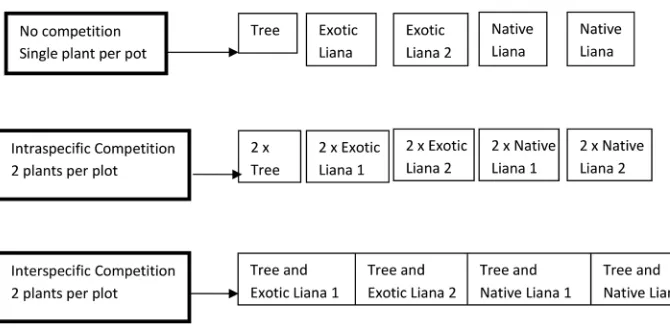
Figure 1.Experimental design showing set up of pot trials to measure maximum growth rate, intraspe-cific competition and interspeintraspe-cific competition of native and invasive lianas and a native host species. Seven replicates of each were grown in both medium and low light conditions.
interspecific competition was measured in pots that contained one individual of the
host species, G. semiglauca, and one individual of a species of liana (Fig. 1).
For the experiment, the two light treatments were created by constructing two adjacent shadehouses using standard shadecloth. Plants were grown in either medium light (ML, 33% daytime PAR) or low light (LL, 7% daytime PAR) to simulate the available PAR in forest edges and interiors respectively. Measurements at various points in each shade house showed them to be an average of 33±2% and 7±1 % full PAR. Readings were made using two Spectrosense dataloggers attached to quantum sensors (Skye Instruments Ltd, Llandrindod Wells, Powys, UK).
Initial measurements of stem, leaf and belowground biomass were obtained from four randomly chosen plants of each species prior to placing in light treatments. Each plant was divided into stem, leaf and belowground portions, washed and oven dried at 60°C for five days before being weighed. Destructive measurements of specific leaf area (SLA = leaf area/ dry weight) were conducted after four weeks from five leaves of each species, using spare plants. Each leaf was labelled and its area measured with a Li-Cor leaf area meter (Model Li-3000A, Lincoln, Nebraska, USA), before being dried and weighed.
During the six months, all pots were watered daily via an automatic mist irriga-tion system and soil was maintained at field capacity. The lianas were allowed to climb freely onto trellises but were prevented from growing onto adjacent hosts by moving
stems away from adjacent plants every few days. Aerial tuber production on Anredera
cordifolia plants was monitored and recorded.
After 24 weeks, final measurements of leaf number were made before all plants
were harvested and then biomass assessed (see below). Aerial tubers from A. cordifolia
Analysis
For the host plant, we investigated changes in biomass by analysing accumulated bio-mass, above- and below-ground biobio-mass, stem and leaf biomass. We also investigated effects on SLA and leaf number. For plants grown with a conspecific we chose a sin-gle plant randomly from each pot as the focal individual to be used for analysis. For comparisons between species we calculated relative growth rate per month using the
following equation: (ln DWf –ln DWi)/no. months, where DWi is the average dry
weight of 4 plants sacrificed at the beginning of the experiment, DWf is the weight of
an individual seedling at the end of the experiment, and no. months is the amount of time, in months, over which plants were in the experiment (5.6 mo).
We undertook two different analyses to test questions about how lianas influence seedling trees. Using two factor ANOVAs, we investigated whether any of our measures
of growth for G. semiglauca varied with competition or light level (JMP Pro 11).
Sec-ondly, we used a linear mixed effects model fitted using restricted maximum likelihood to
investigate how changes in biomass of G. semiglauca varied with origin of the liana species
and light levels. Species of liana were treated as random effects and nested within origin (exotic, native). Only interspecific competition treatments were included in this analysis.
For each liana species, we tested whether inter- or intra-specific competition in-fluenced growth rates using a two factor ANOVA with competition and light level as
fixed factors, comparing each liana speciesgrown alone with those grown with
an-other conspecific or with G. semiglauca. Tubers of An. cordifolia were analysed in two
ways. Initiallywe undertook a nominal logistic model to investigate the probability
of producing tubers associated with different competition and light levels and tested
the effects using a likelihood test. Secondly, for those plants that produced tubers, we
investigated whether dry biomass of tubers varied with competition or light using a two factor ANOVA. Finally, we compared differences in growth amongst the four liana
species and G. semiglauca using an ANOVA on relative growth rates. We included light
level as a factor.
As data fitted the assumptions of normality and homogeneity we did not transform any variables. Tukeys HSD multiple comparisons were used to determine where differ-ences lay in significant factors in the ANOVAs. We used nominal logistic models on pairs of levels of competition when the overall nominal logistic model was significant for tuber production associated with competition, and corrected probability values to
α = 0.017 (a Bonferroni correction) to account for Type 1 errors.
Results
Effect of plant-plant interactions and light on native tree seedlings
Guioa semiglauca seedlings were not significantly affected by intraspecific competition
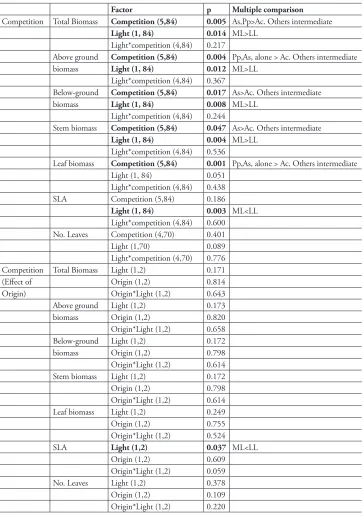
Table 1.Summary of p values of ANOVA tests investigating impacts of competition and light on growth for the tree, Guioa semiglauca. Degrees of freedom of tests are in brackets. Multiple comparisons (Tukeys Test) show where differences lie. Pp = Pandorea pandorana, As = Araujia sericifera, Ac = Anredera cordifolia. ML = medium light (33% PAR), LL = low light (10% PAR).
Factor p Multiple comparison
Competition Total Biomass Competition (5,84) 0.005 As,Pp>Ac. Others intermediate
Light (1, 84) 0.014 ML>LL
Light*competition (4,84) 0.217
Above ground Competition (5,84) 0.004 Pp,As, alone > Ac. Others intermediate
biomass Light (1, 84) 0.012 ML>LL
Light*competition (4,84) 0.367
Below-ground Competition (5,84) 0.017 As>Ac. Others intermediate
biomass Light (1, 84) 0.008 ML>LL
Light*competition (4,84) 0.244
Stem biomass Competition (5,84) 0.047 As>Ac. Others intermediate
Light (1, 84) 0.004 ML>LL
Light*competition (4,84) 0.536
Leaf biomass Competition (5,84) 0.001 Pp,As, alone > Ac. Others intermediate
Light (1, 84) 0.051
Light*competition (4,84) 0.438
SLA Competition (5,84) 0.186
Light (1, 84) 0.003 ML<LL
Light*competition (4,84) 0.600
No. Leaves Competition (4,70) 0.401
Light (1,70) 0.089
Light*competition (4,70) 0.776
Competition Total Biomass Light (1,2) 0.171
(Effect of Origin (1,2) 0.814
Origin) Origin*Light (1,2) 0.643
Above ground Light (1,2) 0.173
biomass Origin (1,2) 0.820
Origin*Light (1,2) 0.658
Below-ground Light (1,2) 0.172
biomass Origin (1,2) 0.798
Origin*Light (1,2) 0.614
Stem biomass Light (1,2) 0.172
Origin (1,2) 0.798
Origin*Light (1,2) 0.614
Leaf biomass Light (1,2) 0.249
Origin (1,2) 0.755
Origin*Light (1,2) 0.524
SLA Light (1,2) 0.037 ML<LL
Origin (1,2) 0.609
Origin*Light (1,2) 0.059
No. Leaves Light (1,2) 0.378
Origin (1,2) 0.109
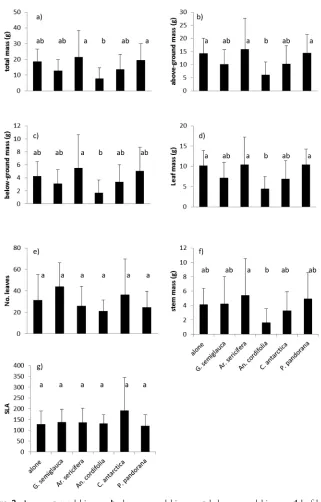
Figure 2. Average a total biomass b above-ground biomass c below-ground biomass d leaf biomass
e number of leaves f stem biomass and g specific leaf area (SLA) of Guioa semiglauca seedlings grown
biomass of plants grown alone. Liana species differed in their ability to affect biomass
of G. semiglauca.Anredera cordifolia reduced overall biomass of G. semiglauca to 42%
of that when it was grown alone, while Araujia sericifera and Pandorea pandorana did
not appear to impact biomass in G. semiglauca seedlings at all (Table 1, Fig. 2a). Where
biomass of G. semiglauca was reduced by interspecific competition (with An. cordifolia)
both above- and below-ground biomass accumulation appeared to be impacted al-though the biomass was often not different to growing alone or in intraspecific compe-tition (Table 1, Fig. 2b, c). There was no evidence of facilitation with any of the lianas.
For G. semiglauca, a reduction in light influenced growth, reducing total biomass
through reductions in both above-ground and below-ground biomass (Table 1, Fig. 3). Above-ground changes were most apparent with an increase in stem growth for plants grown in ML conditions. In deep shade (LL), overall growth was reduced to 70% of growth in the ML treatment. Below-ground biomass was more affected by LL and was reduced to 62% of growth in the ML conditions, while above ground biomass was reduced to only 71%.
The number of leaves produced was not affected by competition or light levels while SLA showed a typical increase in LL conditions (Table 1, Fig. 2e,f). In LL, SLA was 167 + 59 (s.d.) while in the ML treatment it was 116 + 93. The origin of the
com-peting liana had no effect on any growth parameter of G. semiglauca (Table 1).
Effect of plant-plant interactions and light on biomass of lianas
Both invasive lianas showed similar patterns of biomass change in response to
plant-plant interactions, although changes in biomass were only significant for An. cordifolia
(Fig. 4, Table 2). For An. cordifolia, growth appeared to be facilitated by growing with
G. semiglauca (Fig. 4). Growth increased nearly 4-fold from 6.0 + 3.0 g when grown
alone to 22.6 + 7.9 g when grown with G. semiglauca. For An. cordifolia, growth alone
was not different from growth with a conspecific. Increased growth with G. semiglauca
was similar for both above-ground and below-ground biomass and was influenced by a doubling in the number of leaves produced (see Appendix 1).
In contrast, total biomass in Ar. sericifera was less influenced by plant-plant
in-teractions. Again, facilitation was evident when this species was grown with G.
semi-glauca compared with a lower increase in biomass when grown with a conspecific. This
increase could not be assigned to an increase in above- or below-ground biomass but appeared largely influenced by changes in overall leaf biomass (Table 2, Fig. 4).
The two native lianas were quite different in their responses to plant-plant interactions
(Table 2, Fig. 4). Like both invasive species, C. antarctica, plants appeared to be facilitated
by growing with G. semiglauca adding twice the biomass compared to when grown alone
or with a conspecific (Fig. 4). Both below- and above-ground biomass were affected
simi-larly. For C. antarctica, the interaction of competition type with light (Table 2) identified
that plants grown alone put on biomass to similar levels to when grown with G. semiglauca
Figure 3.Average total, below-ground, above-ground, stem and leaf biomass of Guioa semiglauca seed-lings grown under medium (ML) and low (LL) light conditions. Asterisks denote where significant dif-ferences lay.
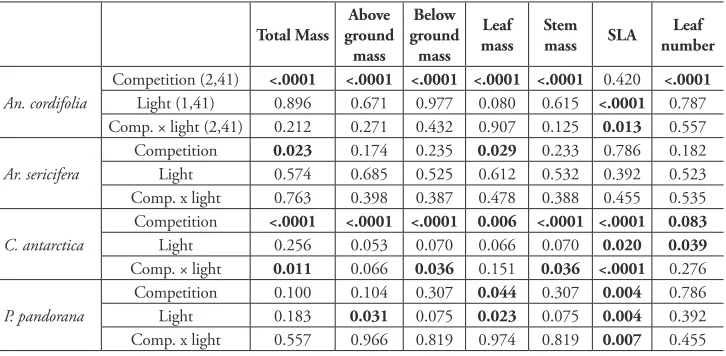
Table 2.Probability values for ANOVA tests for effects of competition and light on accumulated dry bio-mass and leaf characteristics for 4 species of lianas. Degrees of freedom are shown next to the first species.
Probabilities in bold represent significant differences at α = 0.05.
Total Mass Above ground mass
Below ground
mass Leaf
mass Stem mass SLA numberLeaf
An. cordifolia
Competition (2,41) <.0001 <.0001 <.0001 <.0001 <.0001 0.420 <.0001
Light (1,41) 0.896 0.671 0.977 0.080 0.615 <.0001 0.787
Comp. × light (2,41) 0.212 0.271 0.432 0.907 0.125 0.013 0.557
Ar. sericifera
Competition 0.023 0.174 0.235 0.029 0.233 0.786 0.182
Light 0.574 0.685 0.525 0.612 0.532 0.392 0.523
Comp. x light 0.763 0.398 0.387 0.478 0.388 0.455 0.535
C. antarctica
Competition <.0001 <.0001 <.0001 0.006 <.0001 <.0001 0.083
Light 0.256 0.053 0.070 0.066 0.070 0.020 0.039
Comp. × light 0.011 0.066 0.036 0.151 0.036 <.0001 0.276
P. pandorana
Competition 0.100 0.104 0.307 0.044 0.307 0.004 0.786
Light 0.183 0.031 0.075 0.023 0.075 0.004 0.392
Comp. x light 0.557 0.966 0.819 0.974 0.819 0.007 0.455
a conspecific (see Appendix 1). The improvement in biomass accumulation in control
plants was largely attributed to a change in root biomass. For P. pandorana, competition
with different species had little effect on growth. Individuals accumulated on average 19.3 + 10.4 g dry biomass over the experiment.
While light level had some moderate impacts on interactions for C. antarctica,
light level alone did not influence biomass accumulation in lianas, with the exception
of P. pandorana (Table 2). This species responded with an increase in leaf mass under
compared to those in ML, and SLA was not affected by growth in competition in ei-ther invasive species although it was in both native species (Table 2).
Anredera cordifolia developed tubers over the course of the experiment. The
prob-ability of tubers developing was influenced by plant-plant interactions (χ2 = 14.78, p
<0.001). When grown with G. semiglauca, 93% of plants produced tubers whereas
57% of plants produced tubers when grown alone, however these did not differ in
the likelihood of producing tubers (χ2 = 6.24, p = 0.013, α=0.017). When grown
in competition with another An. cordifolia, 29% of plants produced tubers and the
probability of producing tubers did not differ from plants grown alone (χ2 = 2.37,
p = 0.124, α=0.017), however there was a higher probability of producing tubers
when growing with G. semiglauca than when growing with a conspecific (χ2 = 14.77,
p <0.001, α=0.017). For plants producing tubers, there was no difference in tuber
biomass per plant amongst treatments (F 2,19 = 1.68, p = 0.212) or light environments
(F 1,19 = 0.013, p = 0.910). On average plants accumulated 1.45 + 1.58 g dry biomass
of tuber which amounted to 10% additional biomass when in competition with G.
semiglauca, 59% when in competition with a conspecific and 38% additional biomass
when grown alone.
Comparison of growth rates of lianas and G. semiglauca
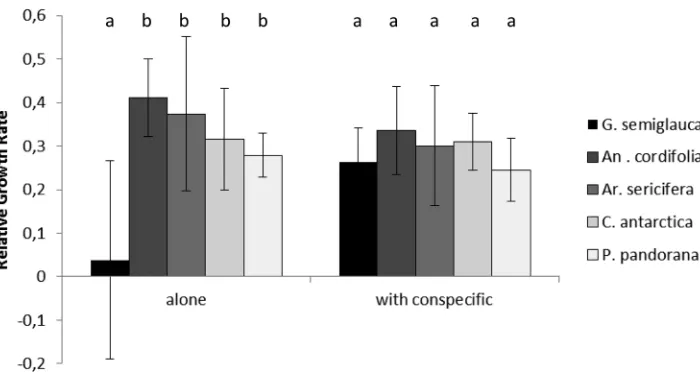
Relative growth rates differed amongst species (F4,120 = 7.17, p <0.0001). Under LL
conditions G. semiglauca had the lowest relative growth rates when grown without
competition with all lianas having relative growth rates about 10 times higher, how-ever, this difference was not evident when plants were grown with a conspecific, with
G. semiglauca having a higher relative growth rate (Fig. 5). There were no differences
amongst species in the ML treatment (F1,120 = 0.661, p = 0.418).
Discussion
Our prediction that invasive lianas would be more competitive than native lianas with a better capacity to add biomass in competition with rainforest seedlings was not sup-ported and light had little effect on the responses. We found strong evidence of facilita-tion although not all lianas benefited. However, the facilitafacilita-tion of growth in lianas was coupled with a loss of growth in the rainforest seedling.
Are invasive or native lianas good competitors in rainforests?
The success of these invasive lianas in establishing in habitats is not based on an
im-proved capacity to compete in early establishment, although for An. cordifolia, early
Figure 5.Average relative growth rate for seedlings of one rainforest tree and four species of lianas grown alone and with a conspecific. Letters above each group of bars are results from Tukeys multiple comparison tests where different letters represent significant differences within each set of bars.
consistent patterns in their effects on native seedling growth, suggesting that invasive lianas are not always more competitive than native lianas in reducing growth of a na-tive rainforest seedling. However, no liana showed any posina-tive effect on nana-tive tree
seedlings, suggesting no facilitation. Exotic An. cordifolia had the capacity to reduce
both above-ground biomass and leaf mass in the rainforest tree, however, the other
exotic species, Ar. sericifera, had no impact on growth of the rainforest tree in these
early stages. Native P. pandorana and C. antarctica did not influence growth. At this
stage in the life cycle, most lianas were as competitive as a conspecific seedling for
G. semiglauca. Osunkoya et al. (2010) identified a number of traits in invasive lianas
which may provide them with competitive advantages but also noted that there were few differences in a range of traits associated with plasticity between native and in-vasive lianas. In temperate regions, our study suggests that competitiveness against a common rainforest tree seedling is not related to being invasive. Similar allometry has been found between these invasive and native lianas, identifying few differences in life history strategies between these two groups (French et al. 2016).
also found no interaction between competition and light, they did find that growth was enhanced with higher light in tropical rainforests. All lianas maintained high rela-tive growth rates in different lighted and competition treatments and appeared quite resilient to these factors and able to successfully maintain growth despite these limiting resources. Similar relative growth rates between native and invasive lianas, including some of the same species as our study, were found in tropical areas of Australia
(Osun-koyaet al.2010).
In contrast, the rainforest tree, G. semiglauca, showed improved growth under the
higher light treatment, associated with both below-ground and above-ground increases, suggesting that it should show improved growth in gaps and along edges of rainforests. This species is clearly more light-limited in the interior of the rainforest although it is not restricted to edges in rainforests. If lianas are increasing in abundance in temper-ate rainforests, as they are in the neotropical rainforests (Schnitzer and Bongers 2011), then lianas are likely to impact on recruitment rates of this rainforest tree. While this is the first experiment to test the effect of such interactions in these temperate forests, there is the potential for a range of other tree species to be negatively affected.
Our results suggest that the invasive, An. cordifolia is a particularly strong
competi-tor in rainforest environments and a serious invasive weed at early stages of growth.
Three results particularly highlight this; overyielding in the presence of G. semiglauca,
coupled with its strong negative effect on G. semiglauca and the increased growth of
tubers while growing with the native tree seedling. Within 6 months, this plant had the capacity to spread in both edge-simulated light levels and interior-forest light levels through the release and dispersal of tubers.
As rainforest communities in temperate Australia are naturally patchy in distribu-tion, edges are important sources of recruitment. Temperate rainforests are likely to be particularly affected by the predicted increase in drought and extreme temperatures in the future and they are already faced with significant threats from habitat clearing. If native and exotic lianas also increase in abundance, then the recruitment capacity at edges and within forests may well be hampered. There is much research to be done on how lianas may interact with rainforest trees within this future environment.
Variation in plant-plant interactions
When lianas were grown with a rainforest tree, rather than experiencing a decrease in biomass (relative to growing alone), three species had enhanced accumulation of
biomass; both exotic species and the native C. antarctica. Overyielding in An. cordifolia
and C. antarctica occurred in both above-ground and below-ground biomass and in
tuber growth in An. cordifolia. For Ar. sericifera, overyielding could not be attributed
to above- or below-ground biomass, as the magnitude of difference compared to plants
grown alone was not as large. Thissuggests that positive plant interactions were far
While not often done (e.g. Montgomery et al. 2010, Dohn et al. 2013), we have measured both sides of the interaction in this experiment, and the positive effect was only seen for one of the participating species (the liana) with a strong negative effect for the native tree seedling. The interaction is, therefore, more associated with the directions of advantage associated with a parasitic interaction (+,-), a term not usually applied to plant-plant interactions where both species are physiologically independent. This is the first time such a plant-plant interaction has been reported to our knowledge;
we have termed this, parasitic facilitation. Without measuring each individual species
response to being grown alone, an understanding of the direction of the interaction would not be able to be distinguished from competition or facilitation, highlighting the complexity of interactions amongst species, and the difficulty of identifying true interactions without suitable controls.
The mechanism for parasitic facilitation is currently unknown but a number of
possibilities can be identified. It is plausible that the parasitic-style interaction that is shown by the three species of liana, is mediated by some change in the soil
envi-ronment rather than above ground. While facilitation was seen in Brazilian Restinga
communities where shrubs facilitated the abundances of vines through providing trel-lises for initial growth (Garbin et al. 2012), we consider that in early stages of growth there was no facilitatory effect of structural support by the native seedling as we did not observe smothering or shading to any great extent. Our results may be associated with coupling through shared mycorrhizae (Simard and Durall 2004; Giovannetti et al. 2004, Walder et al. 2012) lending some weight to the idea that the plant-plant in-teraction is being mediated by a third taxa (mycorrhizal fungae). If this link is present, then the liana could be viewed as being parasitic on the symbiotic mycorrhizae, and the
term parasitic facilitation is useful.
One other possibility is that G. semiglauca changes other soil microflora to enhance
release of nutrients which benefit the lianas as well (Hooper and Vitousek 1998, Zak et al. 2003). In an example of this, Hamilton III and Frank (2001) showed that, when two species were grown together, defoliation increased root exudation of carbon in one species which increased N pools in the soil improving soil resources for neighbouring plants. Likewise, increases in nutrients by nitrogen-fixing species can enhance and cause overyielding in co-occurring crop species (Li et al. 2007). If lianas are competi-tively superior then they may gain greater access to these freed resources at the expense
of the native seedling; perhaps more indicative of a parasitic interaction.
An alternative interpretation is that the liana may be clearly superior in gaining
resources from the fungi, which could be viewed as highly asymmetric resource
competi-tion where the liana is better at using resources provided by the fungi, than the native
seedling. There are a range of studies which have identified changes in mycorrhizal communities associated with invasive plants that influence neighbouring native species (e.g., Stinson et al. 2006; Zhang et al. 2010, Shannon et al. 2014). Marler et al.(1999) showed that the presence of mycorrhizae increased the negative effect of the invasive
Centaurea maculosa on native bunchgrass, Festuca idahoensis. Competitive interactions
better than when grown with a plant. Given the overyielding identified in three of our species (a positive response), a competitive interaction is less accurate as a description, although resource limitation is at the base of our interpretation of the mechanism. It is clearly important to measure responses of both species to distinguish between negative-negative and positive-negative-negative interactions. Using appropriate terminology will be an important factor in understanding plant-plant interactions. Distinguishing between facilitation, competition and other more complicated interactions such as parasitism is difficult experimentally, and confirms that describing accurately many plant-plant interactions is necessary to understand the underlying mechanism of invasion.
Acknowledgments
This project was funded by a grant from Rural Industries Research and Development Corporation (Australian Commonwealth Government).
References
Bertness MD, Callaway R (1994) Positive interactions in communities. Trends in Ecology and Evolution 9: 191–193. https://doi.org/10.1016/0169-5347(94)90088-4
Blossey B, Notzold R (1995) Evolution of increased competitive ability in invasive non-indigenous plants: a hypothesis. Journal of Ecology 83: 887–889. https://doi.org/10.2307/2261425 Brooker RW, Maestre FT, Callaway RM, Lortie CL, Cavieres LA, Kunstler G, Liancourt P,
Tielborger K, Travis JMJ, Anthelme F, Armas C, Coll L, Corcket E, Delzon S, Forey E, Kikvidze Z, Olofsson J, Pugnaire F, Quiroz CL, Saccone P, Schiffers K, Seifan M, Touzard B, Michalet R (2008) Facilitation in plant communities: the past, the present, and the future. J. Ecol. 96: 18–34.
Callaway RM, Walker LR (1997) Competition and facilitation: a synthetic approach to in-teractions in plant communities. Ecology 78: 1958–1965. https://doi.org/10.1890/0012-9658(1997)078[1958:CAFASA]2.0.CO;2
Dohn J, Dembélé F, Karembé M, Moustakas A, Amévor KA, Hanan NP (2013) Tree effects on grass growth in savannas: competition, facilitation and the stress-gradient hypothesis. J. Ecol. 101: 202–209. https://doi.org/10.1111/1365-2745.12010
Emerine SE, Richardson RJ, Arellano C (2013) Porcelain berry (Ampelopsisbrevipedunculata), Bushkiller (Cayratia japonica), and Virginia-crepper (Parthenocissus quinquefolia) in in-terspecific competition. Invasive Plant Science and Management 6: 99–104. https://doi. org/10.1614/IPSM-D-12-00008.1
Fairley A, Moore P (2010) Native plants of the Sydney district. Kangaroo Press, Kenhurst, Australia.
Giovannetti M, Sbrana C, Avio L, Strani P (2004) Patterns of belowground plant interconnec-tions established by means of arbuscular mycorrhizal networks. New Phyt. 164: 175–181. https://doi.org/10.1111/j.1469-8137.2004.01145.x
Hamilton III EW, Frank DA (2001) Can plants stimulate soil microbes and their own nutrient supply? Ecology 82: 2397–2402. https://doi.org/10.1890/0012-9658(2001)082[2397:CP SSMA]2.0.CO;2
Harden G, McDonald B, Williams J (2006) Rainforest trees and shrubs. Gwen Harden pub-lishing, Nambucca Heads, N.S.W.
Harden G, McDonald B, Williams J (2007) Rainforest climbing plants: a field guide to their identification in Victoria, New South Wales and subtropical Queensland using vegetative features. Gwen Harden Publishing, Nambucca Heads, N.S.W.
Hooper DU, Vitousek PM (1998) Effects of plant composition and diversity on nutrient cycling. Ecol. Monogr. 68: 121–149. https://doi.org/10.1890/0012-9615(1998)068[0121:EOPC AD]2.0.CO;2
Holmgren M, Scheffer M, Huston MA (1997) The interplay of facilitation and competi-tion in plant communities. Ecology 78: 1966–1975. https://doi.org/10.1890/0012-9658(1997)078[1966:TIOFAC]2.0.CO;2
Ichihashi R, Tateno M (2015) Biomass allocation and long-term growth patterns of temperate lia-nas in comparison with trees. New Phyt 207: 604–612. https://doi.org/10.1111/nph.13391 James JJ, Drenovsky RE (2007) A basis for relative growth rate differences between native
and invasive forb seedlings. Rangeland Ecol. and Manage. 60: 395–400. https://doi. org/10.2111/1551-5028(2007)60[395:ABFRGR]2.0.CO;2
Leicht-Young SA, Latimerb AM, Silander Jr JA (2011) Lianas escape self-thinning: Experi-mental evidence of positive density dependence in temperate lianas Celastrusorbiculatus
and C. scandens. Perspectives Plant Ecol Evol Syst13: 163–172. https://doi.org/10.1016/j. ppees.2011.04.002
Keane RM, Crawley MJ (2002) Exotic plant invasions and the enemy release hypothesis. TREE 17: 164–170. https://doi.org/10.1016/S0169-5347(02)02499-0
Leishman MR, Haslehurst T, Ares A, Baruch Z (2007) Leaf trait relationships of native and invasive plants: community- and global-scale comparisons. New Phyt. 176: 635–643. htt-ps://doi.org/10.1111/j.1469-8137.2007.02189.x
Li L, Li S-M, Sun J-H, Zhou L-L, Bao X-G, Zhang H-G, Zhang F-S (2007) Diversity enhances agricultural productivity via rhizosphere phosphorus facilitation on phosphorus-deficient soils. PNAS 104: 11192–11196. https://doi.org/10.1073/pnas.0704591104
Lobos-Catalan P, Jiminez-Castillo M (2014) Different patterns of biomass allocation of mature and sapling host tree in response to liana competition in the southern temperate rainforest. Austral Ecol. 39: 677–685. https://doi.org/10.1111/aec.12131
Marler MA, Zabinski CA, Callaway RM (1999) Mycorrhizae indirectly enhance competitive effects of an invasive forb on a native bunchgrass. Ecology 80: 1180–1186. https://doi. org/10.1890/0012-9658(1999)080[1180:MIECEO]2.0.CO;2
McIntire EJB, Fajardo A (2014) Facilitation as a ubiquitous driver of biodiversity. New Phyt. 201: 403–416. https://doi.org/10.1111/nph.12478
Montgomery RA, Reich P B, Palik B J (2010) Untangling positive and negative biotic interac-tions: views from above and below ground in a forest ecosystem. Ecology 91: 3641–3655. https://doi.org/10.1890/09-1663.1
Osunkoya OO, Othman FE, Kahar RS (2005) Growth and competition between seedlings of an invasive plantation tree, Acaciamangium, and those of a native Borneo heath-forest species, Melastomabeccarianum. Ecol. Res. 20: 205–214. https://doi.org/10.1007/s11284-004-0027-4
Osunkoya OO, Bayliss D, Panetta FD, Vivian-Smith G (2010) Variation in ecophysi-ology and carbon economy of invasive and native woody vines of riparian zones in south-eastern Queensland. Austral Ecol. 35: 636–649. https://doi.org/10.1111/j.1442-9993.2009.02071.x
Pasquini SC, Wright J, Santiago L (2015) Lianas always outperform tree seedlings regardless of soil nutrients: results from a long-term fertilization experiment Ecology 96: 1866–1876. https://doi.org/10.1890/14-1660.1
Paterno GB, Siqueira Filh, JA, Ganade G (2016) Species-specific facilitation, ontogenetic shifts and consequences for plant community succession. J. Vege. Sc. 27: 606–615. https://doi. org/10.1111/jvs.12382
Paul GS, Yavitt YB (2011) Tropical vine growth and the effects on forest succession: A review of the ecology and management of tropical climbing plants. Bot. Rev. 77: 11–30. https:// doi.org/10.1007/s12229-010-9059-3
Pellow B, Henwood M, Carolin R (2009) Flora of the Sydney Region (5th Edition), Sydney University Press, Sydney.
Putz FE (1984) The natural history of lianas on Barro Colorado Island, Panama. Ecology 65: 1713–1724. https://doi.org/10.2307/1937767
Schnitzer SA, Bongers F (2011) Increasing liana abundance and biomass in tropical forests: emerging patterns and putative mechanisms. Ecology Letters 14: 397–406. https://doi. org/10.1111/j.1461-0248.2011.01590.x
Schnitzer SA, Dalling JW, Carson WP (2000) The impact of lianas on tree regeneration in tropical forest canopy gaps: evidence for an alternative pathway of gap-phase regeneration. J. Ecol. 88: 655–666. https://doi.org/10.1046/j.1365-2745.2000.00489.x
Schnitzer SA, Kuzee ME, Bongers F (2005) Disentangling above- and below-ground compe-tition between lianas and trees in a tropical forest. J. Ecol. 93: 1115–1125. https://doi. org/10.1111/j.1365-2745.2005.01056.x
Schnitzer SA, Mangan SA, Dalling JW, Baldeck CA, Hubbel SP et al. (2012) Liana abundance, diversity, and distribution on Barro Colorado Island, Panama. PLoS ONE 7: e52114. https://doi.org/10.1371/journal.pone.0052114
Schnitzer SA, Carson WP (2001) Treefall gaps and the maintenance of diversity in a tropical forest. Ecology 82: 913–919. https://doi.org/10.1890/0012-9658(2001)082[0913:TGAT MO]2.0.CO;2
Schnitzer SA, van der Heijden G, Mascaro J, Carson WP (2014) Lianas in gaps reduce carbon accumulation in a tropical forest. Ecology 95: 3008–3017. https://doi.org/10.1890/13-1718.1
Shannon SM, Bauer JT, Anderson WE, Reynolds HL (2014) Plant-soil feedbacks between invasive shrubs and native forest understory species lead to shifts in the abundance of mycorrhizal fungi. Plant Soil 382: 317–328. https://doi.org/10.1007/s11104-014-2158-x Simard SW, Durall DM (2004) Mycorrhizal networks: a review of their extent, function, and
importance. Can J Bot 82: 1140–1165. https://doi.org/10.1139/b04-116
Stevens GC (1987) Lianas as structural parasites: the Burserasimaruba example. Ecology 68: 77–81. https://doi.org/10.2307/1938806
Stinson KA, Campbell SA, Powell JR, Wolfe BE, Callaway RM et al. (2006) Invasive plant sup-presses the growth of native tree seedlings by disrupting belowground mutualisms. PLoS Biol 4(5): e140. https://doi.org/10.1371/journal.pbio.0040140
Swarbrick JT (1999) Seedling production by Madeira vine (Anredera cordifolia). Plant Protection Quarterly 14: 38–39.
Toledo-Aceves T, Swaine MD (2008) Above- and below-ground competition between the liana
Acaciakamerunensis and tree seedlings in contrasting light environments. Plant Ecol. 196: 233–244. https://doi.org/10.1007/s11258-007-9347-0
van der Heijden GMF, Phillips OL (2009) Liana infestation impacts tree growth in a lowland tropical moist Forest. Biogeosciences 6: 2217–2226. https://doi.org/10.5194/bg-6-2217-2009
Vivian-Smith G, Lawson BE, Turnbull I, Downey P (2007) The Biology of Australian weeds 46. Anredera cordifolia (Ten.) Steenis. Plant Protection Quarterly 22: 2–10.
Walder F, Niemann H, Natarajan M, Lehmann MF, Boller T, Wiemken A (2012) Mycorrhizal networks: Common goods of plants shared under unequal terms of trade. Plant Phys. 159: 789–797. https://doi.org/10.1104/pp.112.195727
Wyka TP, Oleksyn J, Karolewski P, Schnitzer SA (2013) Phenotypic correlates of the lianescent growth form: a review. Annals Bot. 112: 1667–1681. https://doi.org/10.1093/aob/mct236 Wright A, Schnitzer SA, Reich PB (2014) Living close to your neighbors: the importance of
both competition and facilitation in plant communities. Ecology 95: 2213–2223. https:// doi.org/10.1890/13-1855.1
Zak DR, Holmes WE, White DC, Peacock AD, Tilman D (2003) Plant diversity, soil micro-bial communities, and ecosystem function: Are there any links? Ecology 84: 2042–2050. https://doi.org/10.1890/02-0433
Appendix 1 Average (standar
d deviations) of tr
eatment effects for differ
ent biomass accumulation measur
es and leaf characteristics for the fiv
e species (one host tr
ee and 4 lianas)
gr
own in competition tr
eatments under two differ
ent light lev
els. O rigin Species Light lev e Competition Total biomass Belo w-gr ound B iomass A bo ve-gr ound B iomass Leaf B iomass
Stem Biomass
-O rigin Species Light lev e Competition Total biomass Belo w-gr ound B iomass A bo ve-gr ound B iomass Leaf B iomass
Stem Biomass