_____________________________________________________________________________________________________
*Corresponding author: E-mail: [email protected];
Screening of
in vitro
Antibacterial Activity of
Rumex vesicarius
(L.) Leaves Extract against
Twelve Pathogenic Bacterial
Arnaba Saha Chaity
1, Md. Ashikul Islam
1, Tamanna Nasrin
2, Sathi Rani Sarker
2,
Amit Kumar Dutta
1, Biswanath Sikdar
1and Md. Faruk Hasan
1*1
Department of Genetic Engineering and Biotechnology, University of Rajshahi, Rajshahi-6205, Bangladesh.
2Department of Zoology, University of Rajshahi, Rajshahi-6205, Bangladesh.
Authors’ contributions This work was carried out in collaboration among all authors. Authors ASC, BS and MFH designed the experiments, developed the methodology and prepared the manuscript. Authors ASC, AKD and MFH collected the data and carried out analysis. Authors ASC, MAI, TN, SRS, BS and MFH assisted with manuscript preparation. All authors read and approved the final manuscript.
Article Information
DOI: 10.9734/JAMB/2019/v19i430199 Editor(s): (1) Dr. Niranjalie Perera, Professor, Department of Food Science and Technology, Faculty of Livestock, Fisheries & Nutrition, Wayamba University of Sri Lanka, Sri Lanka. Reviewers: (2) Khairul Anuar Mat Amin, Universiti Malaysia Terengganu, Malaysia. (3) Esmat Anwar Abou Arab, National Research Center (NRC), Egypt. (3) Pharm. A. O. Akanmu, University of Maiduguri, Nigeria. Complete Peer review History:http://www.sdiarticle4.com/review-history/53862
Received 06 November 2019 Accepted 12 January 2020 Published 17 January 2020
ABSTRACT
There is an alternative approaches from eradication of infections causes by pathogenic bacteria especially resistant bacteria. Methanol extract of Rumex vesicarius leaves were evaluated from in vitro antibacterial activity against twelve bacterial species were used which are four of them gram positive which are Streptococcus constellatus, Staphylococcus gallinarum, Staphylococcus sciuri
and Streptococcus iniae and eight of them gram negative which are Aeromonas diversa,
Xanthomonas campestris, Xanthomonas axonopodies, Siccibacter colletis, Edwardsielloa
anguillarum, Aeromonas cavernicala, Enterobacter xiangfangenis and Vibro rotiferianus. The plant
extract showed highest 12 mm zone of inhibition against Staphylococcus constellatus at the
Chaity et al.; JAMB, 19(4): 1-6, 2019; Article no.JAMB.53862
concentration of 20 μg/disc and no zone of inhibition was found from Aeromonas diversa. In minimum inhibitory concentration (MIC) test, methanol extract of Rumex vesicarious in 200μg/ml concentration showed best result against Vibrio rotiferianus. It can be concluded that methanol extracts of Rumex vesicarious leaves may be used as natural antibacterial from treatment of some diseases, especially local skin diseases.
Keywords: Rumex vesicarius extract; bacteria; MIC values.
1. INTRODUCTION
Rumex vesicarius (L.) is an important medicinal plant [1] belonging to the family ofPolygonaceae. The genus Rumex contains about 150 species extensively distributed among the World. The plant contains anthraquinones and flavonoids [2]. The genus includes several eatable plant species that have medicinal importance of the treatment of some most risky diseases [3]. R. vesicarius L. is a wild edible plant used as a sorrel and collected in spring time and consumed fresh, or cooked. The species used as an important medicinal value uses such as treatment of tumors, hepatic diseases, bad digestion, constipation, calcules, heart troubles, pains, diseases of the spleen, hiccough, flatulence, asthma, bronchitis, dyspepsia, piles, scabies, leucoderma, toothache and nausea. This plant is also used as antioxidant, cool, laxative, stomachic, tonic, analgesic, appetizer, diuretic, astringent, purgative, antispasmodic, aphrodisiac and antibacterial agents. The roasted seeds were taken for the cure of dysentery. Finally, the plant can be used also to reduce biliary disorders and control the levels of cholesterol. The importance of this medicinal plant is a reflection to its chemical composition since this plant contains many bioactive substances such as flavonoids (vitexin, isovitexin, orientin and isorientin), anthraquinones particularly of roots (emodin and chrysophanol), quinones, carotenoids, vitamins (especially vitamin C), proteins, lipids, carbohydrates, reducing sugars, phenols, tannins, saponins, triterepenoids and organic acids. This plant is a good source of minerals, viz; K, Na, Ca, Mg, Fe, Mn, Cu [4,5]. The earlier mentioned bioactive phytochemicals originate in Rumex vesicarius L. like, polyphenols, flavonoids, carotenoids, tocopherols and ascorbic acid that have a role as antioxidant and detoxifying agents. The intake of nutritional antioxidant phytochemicals like carotenodis, phenolic compounds and flavonoids will lead to the defense against non-communicable diseases in human beings; cancer, cardiovascular diseases and cataract [6,7]. We aim in this study to investigation, antibacterial screening for some
pathogenic bacteria and determination of minimum inhibitory concentration of leaves extract of R. vesicarius plants.
2. MATERIALS AND METHODS
2.1 Collection of Bacteria
Twelve pathogenic bacterial isolates were collected from Microbiology laboratory, Department of Genetic Engineering and Biotechnology, University of Rajshahi, Rajshahi-6205, Bangladesh which was previously identified. Four of them gram positive which are
Streptococcus constellatus, Staphylococcus
gallinarum, Staphylococcus sciuri and
Streptococcus iniae and eight of them gram
negative which are Aeromonas diversa,
Xanthomonas campestris, Xanthomlnas
axonopodies, Siccibacter colletis, Edwardsielloa
anguillarum, Aeromonas cavernicala,
Enterobacter xiangfangenis and Vibro
rotiferianus.
2.2 Plant Samples
Fresh leave of R. vesicarius collected from the Rajshahi University Campus of Bangladesh. The surface of the leaves were sterilized with 70% alcohol, which rinsed of sterile distilled water. The leaves were dried for making powder form with the help of grinding machine. The 100 gm of plant leave powdered dried was extracted by 250 ml methanol using conical flask, for shaking and stirring for 14 days. To obtain the huge quantity of extracts the content was pressed of the marking cloth and the whole mixture was then filtered using Whitman filters paper after that the remaining filtrate were dehydrated in vacuo to afford a blackish mass. Then remaining output extracts and fraction was collected in vials and conserved in a refrigerator at 4ºC carefully.
2.3 Antibacterial Activity of Plant Extracts
broth culture containing isolated bacteria was pour sensibly on a nutrient agar plate and spread with a disinfected glass spreader. Discs were saturated on isolated organism cultured plates. The amount of 20 μg/disc of each plant extracts were taken with the help of micropipette and Kanamycin 5g/disc use as a control and incubate at 37ºC for 14 hrs. Finally diameters of zone of inhibition of plant extracts were measured using by mm scale.
2.4 Determination of Minimum Inhibitory Concentration
The rate of MIC was measured according to Owoseni and Ajayi [9], in which different concentrations of R. vesicarius species methanol extract (serial dilutions of the extracts was prepare (25, 50 and 100%). The tubes were then incubated for 48 h at 37ºC.
3. RESULTS
3.1 Antimicrobial Study
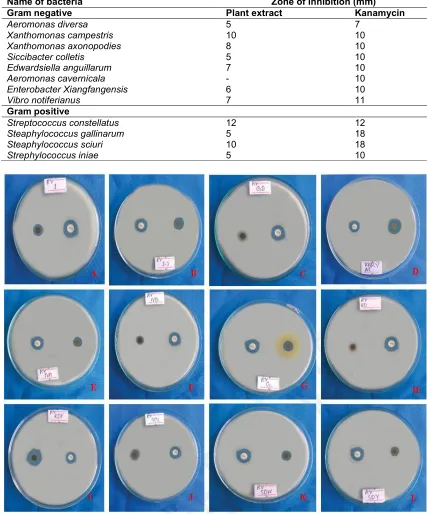
The study showed that the extract of methanol at a concentration of 20 μg/disc has zone of inhibition produced in case of 12 bacterial strains. The highest zone of inhibition was found to be 12 mm against Steaphylococcus constellatus at the concentration of 20 µg/disc while no zone of inhibition was found in
Aeromonas diversa at the same concentration.
The control standard Kanamycin (5 μg/disc) showed zone of inhibition of 7-18 mm against the tested bacteria. The results of antimicrobial activities are presented in Table 1.
3.2 MIC Value Determination
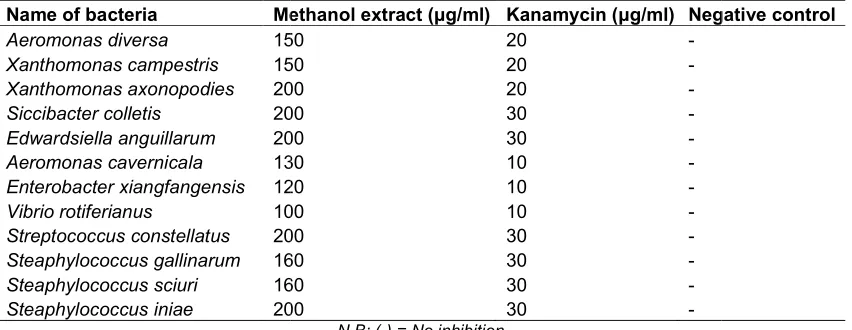
In MIC test, twelve bacteria were used against R. vesicarius leaves extract. The MIC values were 100, 120, 130, 140, 150, 160 and 200 μg/ml respectively, against the tested gram positive and gram negative bacteria. Negative controls exhibited no inhibition against all the organisms. The standard antibiotic kanamycin had MIC value varying 10 to30 μg/ml against the tested organisms. Detail results are presented in Table 2.
4. DISCUSSION
Extracts from R. vesicarious leave demonstrated significant inhibitory effect against all the bacteria except Aeromonas cavernicala. Ether extract of
R. vesicarius isconsider as a very rich source of many valuable volatile compounds [1]. The highest inhibition zone of gram negative bacteria was 10 mm diameters found against
Xanthomonas campestris and it indicate that it is weak bacteria. Similarly the lowest inhibition zone of gram negative bacteria was 5 mm found of Aeromonas diversa and Siccibacter colletis
which indicates those are strong bacteria. The plant extract showed no inhibition zone of
Aeromonas cavernicala. At the same time the highest inhibition zone of gram positive bacteria was 12 mm diameter against Streptococcus
constellatus and lowest inhibition zone was 5 mm
found of Staphylococcus gallinarum and
Staphylococcus iniae. Our present findings
support the previous investigation of Hasan and Sikdar [10]. The maximum zone of inhibition (12.1 mm) was observed against Bordetella by methanol extract of R. dentatus followed by activity against Salmonella and Bacillus (zone of inhibition 11 mm and 11.1 mm respectively) by the same extract [11]. The probable for developing antimicrobial from plants appears satisfying as it will lead to the development of a phytomedicine to act against microbes. Plant- based antimicrobials have huge therapeutic potential as they play vital role with fewer side effects that are often associated with synthetic antimicrobials. This study showed that extracts of
R. vesicarious leaves were effective against
bacterial growth. Hussain et al., [12] informed that methanol extracts of different species of
Rumex genus for example R. persicaria, R.
hastatus and R. dentatus have antibacterial
activities but their inhibitory effects varied of gram negative and gram positive bacteria. However, these extracts did not shows detectable antibacterial activity Aeromonas cavernicala. Fatima et al., [11] also reported the antibacterial potential for gram positive and gram negative bacteria for methanol extracts of roots and leaves of R. dentatus plants. Green tea aqueous extract 10% (v/v) was used to control the Vibrio parahaemolyticus [13]. Dhayanithi et al., [14] used the mangrove plant Avicennia marina (ethyl acetate: methanol 6:4) extract at the concentration of 125 μg/ml to control Vibrio
alginolyticus. Similarly, Rumex vesicarious
Chaity et al.; JAMB, 19(4): 1-6, 2019; Article no.JAMB.53862
Table 1. Antibacterial activity of R. vesicarius leaves extracts against the tested bacteria
Name of bacteria Zone of inhibition (mm) Gram negative Plant extract Kanamycin
Aeromonas diversa 5 7
Xanthomonas campestris 10 10
Xanthomonas axonopodies 8 10
Siccibacter colletis 5 10
Edwardsiella anguillarum 7 10
Aeromonas cavernicala - 10
Enterobacter Xiangfangensis 6 10
Vibro notiferianus 7 11
Gram positive
Streptococcus constellatus 12 12
Steaphylococcus gallinarum 5 18
Steaphylococcus sciuri 10 18
Strephylococcus iniae 5 10
Fig. 1. Antibacterial activities of Rumex vesicarius leaves extracts against the tested pathogenic bacterial. A. Streptococcus constellatus, B. Staphylococcus gallinarum,
C. Staphylococcus sciuri D. Streptococcus iniae E. Aeromonas diversa, F. Xanthomonas campestris, G. Xanthomlnas axonopodies, H. Siccibacter colletis, I. Edwardsielloa anguillarum,
Fig. 2. MIC values of R. vesicarious
Table 2. MIC values of R. vesicarius
Name of bacteria Methanol extract (μg/ml)
Aeromonas diversa 150
Xanthomonas campestris 150
Xanthomonas axonopodies 200
Siccibacter colletis 200
Edwardsiella anguillarum 200
Aeromonas cavernicala 130
Enterobacter xiangfangensis 120
Vibrio rotiferianus 100
Streptococcus constellatus 200
Steaphylococcus gallinarum 160
Steaphylococcus sciuri 160
Steaphylococcus iniae 200
5. CONCLUSION
These results suggested that there are bioactive compound present in Rumex genus. These compounds probably contain high biological activity. Several previous experiments on different parts of plant of different species of
Rumex confirm that, Rumex genus was strong antibacterial agents. Results of this study revealed that the methanol extract from leaves of
R. vesicarious was exhibiting antibacterial
activity, which might be helpful in inhibiting the resistant bacterial infections and can be us alternative agent of medicine. However, further studies are required to find the mechanism of extract of antibacterial efficacy and to analyze the active compounds responsible from biological activity.
R. vesicarious leave extract against some pathogenic bacteria
R. vesicarius leave extract against the tested bacteria
Methanol extract (μg/ml) Kanamycin (μg/ml) Negative control
150 20 -
150 20 -
200 20 -
200 30 -
200 30 -
130 10 -
120 10 -
100 10 -
200 30 -
160 30 -
160 30 -
200 30 -
N.B: (-) = No inhibition
These results suggested that there are bioactive genus. These compounds probably contain high biological activity. Several previous experiments on different parts of plant of different species of genus was strong antibacterial agents. Results of this study revealed that the methanol extract from leaves of was exhibiting antibacterial activity, which might be helpful in inhibiting the resistant bacterial infections and can be used in alternative agent of medicine. However, further studies are required to find the mechanism of extract of antibacterial efficacy and to analyze the active compounds responsible from this
ACKNOWLEDGEMENTS
The authors would like to thank the Dept. of Zoology, University of Rajshahi, Rajshahi Bangladesh for financial support to carry the whole work.
COMPETING INTERESTS
Authors have declared that no competing interests exist.
REFERENCES
1. Alam EA. Volatile compounds of Egyptian fruits of Rumex vesicarius L.
Journal of Pharmacy and Pharmaceutical Sciences. 2014;6(12):18-19.
leave extract against some pathogenic bacteria leave extract against the tested bacteria
Negative control
thank the Dept. of Zoology, University of Rajshahi, Rajshahi-6205, Bangladesh for financial support to carry the
Authors have declared that no competing
Volatile compounds of Egyptian L. International Journal of Pharmacy and Pharmaceutical
Chaity et al.; JAMB, 19(4): 1-6, 2019; Article no.JAMB.53862
2. Zhang H, Guo Z, Wu N, Xu W, Han L, Li N, Han Y. Two novel naphthalene glucosides and an anthraquinone isolated from
Rumex dentatus and their antiproliferation activities in four cell lines. Molecules. 2012; 17(1):843-850.
3. Vermani K, Sanjay G. Herbal medicines for sexually transmitted diseases and AIDS. J Ethnopharmacol. 2002;80:49-66.
4. Mostafa HAM, Elbakry AA, Eman AA. Evaluation of antibacterial and antioxidant activities of different plant parts of Rumex vesicarius L. (Polygonaceae). International Journal of Pharmaceuticals and Pharmacological Sciences. 2011;3(2):109-18.
5. Prasad PSH, Ramakrishnan N. In vitro lipid peroxidation assay of Rumex vesicarius L. International Journal of Pharmaceuticals and Pharmacological Sciences. 2012; 4(Suppl 1):S368 S370.
6. Rao BN. Bioactive phytochemicals in Indian foods and their potential in health promotion and disease prevention. Asia Pacific Journal of Clinical Nutrition. 2003; 12(1):9-22.
7. Matkowski A. Plant in vitro culture for the production of antioxidants—A review. Biotechnology Advances. 2008;26(6):548-560.
8. Hasan MF, Rahman M. Screening of antibacterial, antifungal and cytotoxic activities of Polygonum hydropiper L. stem extracts. Int. J. Biosci. 2011;1(6):47-53. 9. Owoseni AA, Ajayi A. Antimicrobial
properties of ethanolic and aqueous extracts of Cymbopogon citratus on selected bacteria and fungi. Journal of
Medicine and Applied Biosciences. 2010;2: 64-73.
10. Hasan MF, Sikdar B. Screening of antimicrobial, cytotoxic and pesticidal activities of Coccinia grandis (L.) Voigt. Journal of Microbiology, Biotechnology and Food Sciences. 2016;5(6):584 588. 11. Fatima N, Zia M, Rehman R, Rizvi ZF,
Ahmad S, Mirza B, Chaudhary MF. Biological activities of Rumex dentatus L: Evaluation of methanol and hexane extracts. African Journal of Biotechnology. 2009;8(24):6945-6951.
12. Hussain F, Ahmad B, Hameed I, Dastagir G, Sanaullah P, Azam S. Antibacterial, antifungal and insecticidal activities of some selected medicinal plants of polygonaceae. African Journal of Biotechnology. 2010;9(31):5032-5036. 13. Kongchum P, Chimtong S, Chareansak N,
Subprasert P. Effect of Green Tea Extract on Vibrio Parahaemolyticus Inhibition in Pacific White Shrimp (Litopenaeus
vannamei) Post larvae. Agriculture and
Agricultural Science Procedia. 2016;11: 117-124.
14. Dhayanithi NB, Kumar TTA,
Balasubramanian T. In Vitro and Experimental Screening of Mangrove Herbal Extract against Vibrio Alginolyticus
in Marine Ornamental Fish. World Academy of Science Engineering and Technology. 2012;68:1310-1314.
15. Saikot FK, Khan A, Hasan MF. Antimicrobial and cytotoxic activities of
Abroma augusta Lnn. Leaves extract.
Asian Pacific Journal of Tropical Biomedicine. 2012;S1418-S1422.
_________________________________________________________________________________
© 2019 Chaity et al.; This is an Open Access article distributed under the terms of the Creative Commons Attribution License (http://creativecommons.org/licenses/by/4.0), which permits unrestricted use, distribution, and reproduction in any medium, provided the original work is properly cited.
Peer-review history: