RETROSPECTIVE REVIEW OF FEEDBACK FROM
MEDICAL STUDENTS FOLLOWING THE INTEGRATION
OF DISASTER MOULAGE AS A PART OF PERSONAL AND
PROFESSIONAL DEVELOPMENT CAMP (PPD CAMP)
GAME ACTIVITIES.
Dr Ahmed Omar Elludaie MBBS Alfateh university (Tripoli)1, Dr Nik Azlan Nik Muhamad MB Bch
BAO (Ire) MEMed (UKM)1, Prof Dr Shahrir Mohamed Said MBBS (UM), MMed. Int. Med (UKM),
AMM 2
1Department of Emergency Medicine, Faculty of Medicine, Universiti Kebangsaan Malaysia, 56000, Kuala Lumpur
2Head of Rheumatology Unit, Consultant Rheumatology and Medicine, Rheumatology Unit, Universiti Kebangsaan Malaysia, 56000, Kuala Lumpur
Correspondence:
Nik Azlan Nik Muhamad
Emergency Physician , Department of Emergency Medicine, Faculty of Medicine, Universiti Kebangsaan Malaysia, 56000, Kuala Lumpur, Tel: 03-91455555, ext 5703, E mail:
Acknowledgement of Professional and personal development unit (PPD) PPUKM, This study required no funding
ABSTRACT
Keywords: moulage, disaster, teaching learning method, personal and professional
INTRODUCTION
Training of medical students in response phase of disaster would require a huge amount of resource such as finance and teaching staff. Disasters response phase training for medical students in National University of Malaysia (UKM) are done 5 to 6 times per year at every batch of emergency department attachment.
Professional and personal development (PPD) camp has been developed as a core subject in National University of Malaysia for improvement of soft skills among medical students. According to Juriza et al., leadership and teamwork are the important aspects to be developed in the PPD camp.1 Each camp includes the whole batch of the year, which consists of range of 200-300 students per batch. It will be time saving and cost saving to introduce an introduction to response phase of disaster in a camp which would cover the whole batch
In 2015, disaster moulage was introduced in the camp to replace one of the non-clinical team building activities. Students in groups of 12-15 will be tasked to manage on site real time disaster victims. The scenario involves pre-hospital triaging, assessment and treatment of disaster victims which includes treatment of tension pneumothorax, open pneumothorax, head injury and fractured long bones. Students are required to manage the victims using any resources available such as waste, paper and plastic bottles. Following the moulage, feedback forms were given to students to fill. This study retrospectively analyzes the collected feedback forms
METHODS
This is a retrospective review of feedback forms obtained from medical students that participated in the introduced 2015 PPD camp disaster moulage. The general objective is to assess medical student’s perception on introducing disaster moulage as a component of PPD camp based on the feedback form. The specific objectives were to determine the level of interest, perception and comparison with other game activities among medical students towards the disaster moulage in PPD camp. Inclusion criteria were all final year students who participated in the moulage and filled the feedback forms. Exclusion criteria were incomplete feedback forms and students who were unable to participate in the moulage.
The sample size was calculated according to formula by Kish L. 19652, where sample size = •n = (Z1-α)2 (P(1-P)/D2) where •Z1-α = Z0.95 = 1.96 (For CI of 95%, Z=1.96.) P= prevalence is equal to 0.76 (Nidaa et al 2016)3, hence 1.962 x 0.76(1-0.76) / 0.05. The sample size for 5% error was 280. However feedback forms from the whole batch of 5th year medical student who attend the 2015 PPD camp which was only 242. Data was collected and analyzed using SPSS version 23. Ethical committee approval obtained on 30th March 2017 reference No. UKM PPI/111/8/JEP 2017-213.
PPD came game activities
through whispering. Station 3 is a task in composing a song. Station 4 and 5 is the introduced moulage station and reporting of the incident to the commander. In the moulage there were three victims, which were standardized patients, simulated as a tension pneumothorax, open pneumothorax and head injury. Makeup was using fake blood and dough to create the wounds and injuries. A confused but stable patient was injected in the scene as a deviator. Students were expected to perform field triage and basic first aid using whatever equipments available. The scene was a bomb blast in a stationary shop, and there were A4 papers, pens, masking tape and bottles. The students will have to apply their creativity and medical knowledge in order to perform makeshift stabilization of patients. The students then would relay the injuries and treatment done for the victims at station 5 to the field commander. After completion of the game activity, there was a session of debriefing and the feedback forms were distributed. Feedback form
This is a feedback form that was given out to the students in order to gauge the interest and benefit gained. The feedback form was prior to this study and it was not a questionnaire that required any validation. This study analyses the feedback form in a retrospective manner. Question 1 assesses the student’s interest in the activity of the moulage, which was questioned in a Likert scale from not interesting at all to very interesting. Question 2 assesses in a one answer manner, whether the students prefer to have this activity or not. Question 3 to 6 assesses the outcome and benefit that the students perceived to gain from this
activity. The last question is more of a comparison in terms of planning, enjoyment and benefits between all stations in the outdoor explorace. As this was a retrospective study, simple audit statistics were the only calculation possible.
Answers form subjective or open ended questions, such as question 5 was categorized into five different groups manually. Response with the same keywords such as communication, critical thinking during disaster, teamwork and ect. were grouped collectively.
Data collection
This study analyses the feedback form which was stored. The feedback form was filled after the moulage activity, as it was given to the students to fill. There was no time limit in filling the forms. As it was a simple form, students took approximately less than 10 minutes to fill. Incomplete form will be excluded from the study. Forms were collected by the organizing committee and stored for further reference. RESULTS
Table 1: Interest level among 2015 PPD camp disaster moulage participants’
Question 2 was to assess whether the students liked the moulage or not. Question 2 was a more objective question with only 3 answers whether the students enjoyed it / liked it or not.
85.4 % of the students (205) like the disaster moulage stations while 4.6 % (n=11) did not like it. Ten percent (n=24)
they don’t know whether they like it or not.
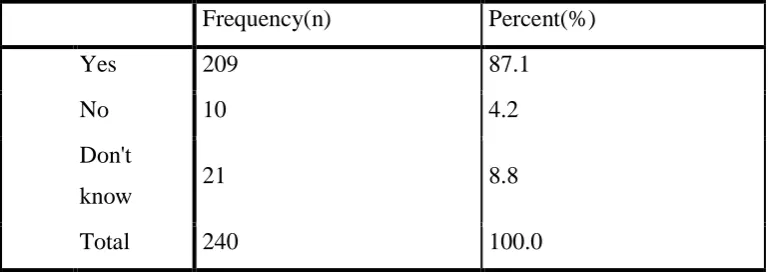
Question 3 assesses the student’s perception on the benefits of this moulage in improving personal and professional skills during emergency situations. All the students answered the question about their perception on benefit
Frequency (n) Percent (%)
Less interested 11 4.6
Moderately interested 51 21.3
Interesting 94 39.2
Very interesting 84 35.0
Not interested at all
Total
0
240
0
Table 2: Benefit in improving personnel and professional skills among 2015 PPD camp disaster moulage participants’
Frequency(n) Percent(%)
Yes 209 87.1
No 10 4.2
Don't
know 21 8.8
Total 240 100.0
Questi on no.4 is to assess the student perception of overall outcome of this activity. It is a multiple choice answer with an open ended stem for selection that was not available. The questions were whether the moulage was fun, or made them understand PPD better, or whether they are being able to think outside the box. They were able to select more than one response. Sixty-seven-point five percent students (n=162) thought they had fun during the disaster moulage. Fifty three percent (n=129) of the students they find the disaster moulage helped them understand the PPD better. Eighty-point four percent of students (n=193) think they could think outside the box. To elaborate further, thinking out of the box would mean the ability of students to apply their clinical skills in situations that is not normally encountered during
daily practice. For an example, this moulage tests the students to perform first aid response without normal hospital equipments. Bottles and stationary were given to test the ability of students to create makeshift first aid equipment.
Questi on number 5 was an open ended question. The question was a subjective question on two important aspects in medicine that was learnt during this session. This subjectively assesses two important aspects regarding student’s perception on learning points from the moulage. The response was manually categorized into five different groups.
The subjective answers were categorized into 5 major groups which were:
Table 3: Perception of 2015 PPD camp disaster moulage participants’
Categorical answers from the subjective response Percentage Number
1. Know how to handle emergency cases 67.9% (n=163)
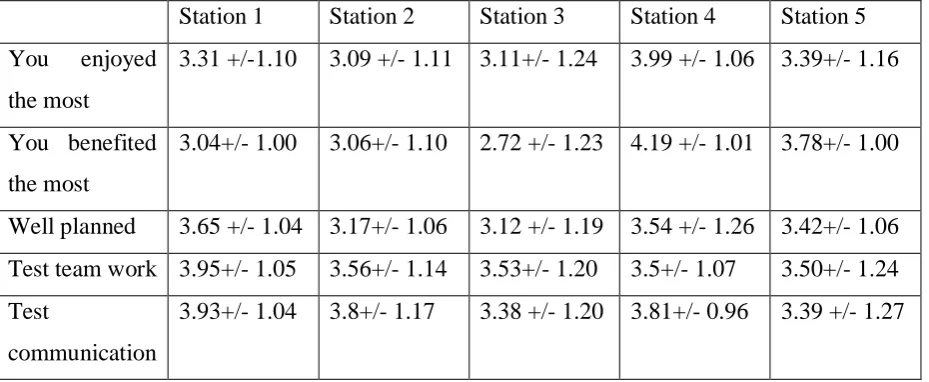
Question 6 was about the perception of students regarding enjoyment, benefit, planning and testing team work and communication of all five stations in the
explorace in PPD. The students are asked to rate from least preferable 1, to 5 most preferable. Below is the average and standard deviation.
Table 4: Comparison among all 5 stations in perception among 2015 PPD camp participants (Activity was rated from 1(least preferable) to 5 (most preferable) for each station)
Station 1 Station 2 Station 3 Station 4 Station 5 You enjoyed
the most
3.31 +/-1.10 3.09 +/- 1.11 3.11+/- 1.24 3.99 +/- 1.06 3.39+/- 1.16
You benefited the most
3.04+/- 1.00 3.06+/- 1.10 2.72 +/- 1.23 4.19 +/- 1.01 3.78+/- 1.00
Well planned 3.65 +/- 1.04 3.17+/- 1.06 3.12 +/- 1.19 3.54 +/- 1.26 3.42+/- 1.06 Test team work 3.95+/- 1.05 3.56+/- 1.14 3.53+/- 1.20 3.5+/- 1.07 3.50+/- 1.24 Test
communication
3.93+/- 1.04 3.8+/- 1.17 3.38 +/- 1.20 3.81+/- 0.96 3.39 +/- 1.27
Station 1 was blindfolded activity, where leaders of each team would have to guide their team members who were blindfolded. Pebbles were scattered on the floor and the team members would have to avoid in with guidance from the team leader. Station 2 was conveying message through whispering. A message was passed to a team member and then passed to their each other colleague in a mannerly fashion. The message from the last student was compared from the first to see the amount of alteration. In station 3, the students would have to compose a song based on patriotism. The disaster moulage which is
station 4 and 5 scored highest for the most enjoyed and most beneficial. It was the second-best station for planning and communication testing.
DISCUSSION
Leadership and teamwork are two important aspects of personal and professional development (PPD) that is included in the camp objectives. As a part of the teaching-learning method (TLM) for PPD, three outdoor camps are scheduled for the medical students with main emphasis on teamwork and leadership1. To 3.Learning about proper communication in disaster
situation
27 % ( n=65)
4. Learn about teamwork, 42.1 % (n=101)
determine the final year students' perception on the introduction of disaster moulage, feedback survey following the PPD game activities has been performed. Two hundred and forty students answered the first self-assessment survey in 2015 after they attended the third camp in their final year. The questionnaire contained six questions cover teamwork and leadership aspects. The student's perceptions on whether they have achieved the learning outcomes were rated on five-point Likert scale. Majority of the students had either agreed or strongly agreed that they have high interest and benefits following the disaster moulage course. The outdoor camp was perceived by students as a beneficial learning activity for building teamwork and leadership. Performing moulage in an outdoor camp is time and cost saving due to the involvement of the whole batch, in comparison to traditional attachment teaching which was done in several small batches throughout the final year.
As a result, from the first question of the feedback form, student’s perception of the interest 39.2 % (94 students) find the disaster moulage is interesting, 35% (84) students find it very interesting and 4.6% (11) they find it less interesting. No student answered that the moulage is not interesting at all. Question two assesses whether the students like the moulage or not. This is related to question number one, and it is as a conformity question. Eighty five percent of the students (205 students) liked the disaster moulage stations while 4.6 % (11) did not like it and 10 %( 24) they don’t know whether they like it or not. This indicates that majority of the students liked the disaster moulage stations. Four-point six percent (4.6%) of the students who did not like it correlated with the 4.6 % who find it less interesting in question no 1. This indicates the same group of students did not like it and did not find it interesting. These results similar to the Saudi Arabia study
(Nidaa et al 2016) where most of the students (76 %) found it interesting.3. From this survey it could be generally accepted that from the student’s perception, introducing response phase disaster moulage in PPD was interesting and beneficial.
Adoption of this course would help to increase the human resources among many medical students or junior practitioner available for dealing with disaster situations
Question 3 assesses the student’s perception on the benefits of this moulage in improving personal and professional during emergency situations. Eighty-seven points one students (87.1 % 209) of the students perceived that disaster moulage is beneficial. A small minority of students 4.2% (10) did not think this disaster moulage is beneficial to personal and professional development. This study correlates with the study done by IM Saiboon et al 20114. According to the study there were significant increase in term of understanding (t value = 5.596; p = 0.001) and confident level (t value = 5.259; p = 0.002) from pre- to post-moulage exercise.4 This increase was measured using a paired T-test. The students rated that their confidence and understanding of the principle of major incident management has improved considerably following the moulage session. This correlates with the current study in which students perceived the moulage as giving overall benefits.
Question no.4 is to assess the student perception on this activity. All the students answered the question of their perception wither the disaster moulage station is fun, or was made them understand PPD better, whether they are being able to think outside the box,
about the student’s perception regarding learning points from the moulage five themes generated. Highest two responses from the students is that the introduction of moulage in the PPD camp activity is increases knowledge in handling emergency cases (67.9%, n=163) and improves teamwork (42.1%, n=101). The emergency cases that were simulated such as open pneumothorax, open long bone fracture and head injury provides training ground for students to practice first aid treatment in disaster scenario. Hands on practice were available for all students in the 10 minutes given for treatment, as there were 3 victims per group. Teamwork was also important in managing, where the team leader would divide the team into 3 smaller groups. Students learn on impromptu task assignment. Communication was less applied because the use of handheld transmitter was limited. This can be correlated to the study by IM Saiboon et al 20114, that even though 2 way handheld transmitter was use in training medical students, from a pre- and post test, confidence level did not increase significantly. Triage was not taught to the students prior to this activity, hence the inability of the students to appreciate its application in this scenario. Question 6 is about the perception of students regarding enjoyment, benefit, planning and testing team work and communication of all five stations in game activities in PPD. Station 1 is about blindfolded assignment and leadership. Station 2 is regarding relaying message through whispering. Station 3 is about composing a song. Station 4 and 5 is the disaster moulage. The students are asked to rate from least preferable 1, to 5 most preferable. Station 4 scored the highest score in the likert scale which was 4.19 +/- 1.01 in which students perceived most beneficial. This is mostly due to the medically oriented activity in comparison
to other activities which was non-medical. Station 4 is the moulage station, where as the 5th station is reporting the findings and treatment in station 4. It also scored the highest in the most enjoyable station, which were 3.99 +/- 1.06. This is probably due to the nature of this station which required adrenaline rush and tactical planning as well as basic clinical acumen. Students also perceived the need for disaster training exposure, in correlation to a study by Barrimah et al, where 229 students endorsed the idea that a training course is needed with a mean likert score of 3.66/55. Planning of the station was not on the first line probably due to the chaotic nature of this station; however that was the design of this station. Improvements in planning of this station were done in subsequent camps, where participants were given 1 day to search and create makeshift equipments for first aid. The students were not prepared for team building and communication as they did not have any knowledge on team leading, triaging and assigning responders in disaster, as they are just finished fourth year and did not yet went through emergency medicine posting. CONCLUSION
REFERRENCE
1. Juriza I, Ruzanna Z, Harlina HS, Rohaizak M, Zulkifli Z, Fauzi MA, M Radniwan, M Razif, M Heikal, Anisah N, Nabishah M, Lokman S. Outdoor camps experiential learning activities for teamwork and leadership among medical students. Procedia Soc Behav Sci. 2011 18, 622-625
2. Kish L, Survey Sampling. New York: John Wiley and Sons, Inc 1965 p 78-94
3. Nidaa B., Djalali, A., Ingrassia PL, Ragazzoni L., Ageely H., Bani I., Corte FD., Evaluation of a new community-based curriculum in disaster medicine for undergraduates. BMC Med Educ. 2016 16,225
4. Saiboon IM., Jaafar MJ., Harunarashid, H., Jamal MS., The Effectiveness of Simulation Based Medical Education In Teaching Concepts of Major Incident Response. Procedia Soc Behav Sci. 2011 18, 372-378
APPENDIX 1: PPD camp feedback form
Kindly fill in this survey on the newly introduced station (disaster moulage –station 4 and 5). There is no need to put any personal details. Thank You. Please return this questionnaire to Dr Nik Azlan
1. How do you find this activity?
A. Not interesting at all B. Less interested C.Moderate D. Interesting E. Very interesting
2. Do you like it?
A. Yes 2-No 3. – Neither
3. Did you benefit from this in terms of improvement of personal and professional skill in emergency situation
A. Yes 2. No 3. Don’t know
4. What did you get from this activity? (You can tick more than one) ___ Fun
___ Understand PPD better ___ Able to think outside the box ___ Other: (specify)
5. Give 2 important aspects of medicine that you learnt from this activity
A) ______________________________________________________________________ B) ______________________________________________________________________ 6. Please rate each station activity in term of 1(least preferrable---→ 5 most preferable)
Station 1 Station 2 Station 3 Station 4 Station 5 You enjoyed the
most
You benefited the most
Well planned Test Team Work Test