Learning from Examples as an Inverse Problem
Ernesto De Vito [email protected]
Dipartimento di Matematica
Universit`a di Modena e Reggio Emilia Modena, Italy
and INFN, Sezione di Genova,
Genova, Italy
Lorenzo Rosasco [email protected]
Andrea Caponnetto [email protected]
Umberto De Giovannini [email protected]
Francesca Odone [email protected]
DISI
Universit`a di Genova,
Genova, Italy
Editor: Peter Bartlett
Abstract
Many works related learning from examples to regularization techniques for inverse problems,
em-phasizing the strong algorithmic and conceptual analogy of certain learning algorithms with regu-larization algorithms. In particular it is well known that reguregu-larization schemes such as Tikhonov
regularization can be effectively used in the context of learning and are closely related to
algo-rithms such as support vector machines. Nevertheless the connection with inverse problem was considered only for the discrete (finite sample) problem and the probabilistic aspects of learning
from examples were not taken into account. In this paper we provide a natural extension of such
analysis to the continuous (population) case and study the interplay between the discrete and con-tinuous problems. From a theoretical point of view, this allows to draw a clear connection between
the consistency approach in learning theory and the stability convergence property in ill-posed
in-verse problems. The main mathematical result of the paper is a new probabilistic bound for the
regularized least-squares algorithm. By means of standard results on the approximation term, the consistency of the algorithm easily follows.
1. Introduction
The main goal of learning from examples is to infer an estimator from a finite set of examples. The
crucial aspect in the problem is that the examples are drawn according to a fixed but unknown prob-abilistic input-output relation and the desired property of the selected function is to be descriptive
also of new data, i.e. it should generalize. The fundamental work of Vapnik and further develop-ments (see Vapnik (1998); Alon et al. (1997) and Bartlett and Mendelson (2002) for recent results)
show that the key to obtain a meaningful solution is to control the complexity of the hypothesis
space. Interestingly, as pointed out in a number of papers (see Poggio and Girosi (1992); Evgeniou et al. (2000) and references therein), this is in essence the idea underlying regularization techniques
for ill-posed problems (Tikhonov and Arsenin, 1977; Engl et al., 1996). Not surprisingly the form of the algorithms proposed in both theories is strikingly similar (Mukherjee et al., 2002) and the point
of view of regularization is indeed not new to learning (Poggio and Girosi, 1992; Evgeniou et al., 2000; Vapnik, 1998; Arbib, 1995; Fine, 1999; Kecman, 2001; Sch¨olkopf and Smola, 2002). In
par-ticular it allowed to cast a large class of algorithms in a common framework, namely regularization
networks or regularized kernel methods (Evgeniou et al., 2000; Sch¨olkopf and Smola, 2002). Anyway a careful analysis shows that a rigorous mathematical connection between learning
the-ory and the thethe-ory of ill-posed inverse problems is not straightforward since the settings underlying the two theories are different. In fact learning theory is intrinsically probabilistic whereas the theory
of inverse problem is mostly deterministic. Statistical methods were recently applied in the context
of inverse problems (Kaipio and Somersalo, 2005). Anyway a Bayesian point of view is considered which differs from the usual learning theory approach. Recently the connection between learning
and inverse problems was considered in the restricted setting in which the elements of the input space are fixed and not probabilistically drawn (Mukherjee et al., 2004; Kurkova, 2004). This
cor-responds to what is usually called nonparametric regression with fixed design (Gy¨orfi et al., 1996)
and when the noise level is fixed and known, the problem is well studied in the context of inverse problems (Bertero et al., 1988). In the case of fixed design on a finite grid the problem is mostly that
we are dealing with an ill-conditioned problem, that is unstable w.r.t. the data. Though such setting is indeed close to the algorithmic setting from a theoretical perspective it is not general enough to
allow a consistency analysis of a given algorithm since it does not take care of the random sampling
providing the data. In this paper we extend the analysis to the setting of nonparametric regression with random design (Gy¨orfi et al., 1996).
Our analysis and contribution develop in two steps. First, we study the mathematical con-nections between learning theory and inverse problems theory. We consider the specific case of
quadratic loss and analyse the population case (i.e. when the probability distribution is known) to show that the discrete inverse problem which is solved in practice can be seen as the stochastic
discretization of an infinite dimensional inverse problem. This ideal problem is, in general,ill-posed
fi-nal goal in learning theory. This clarifies in particular the following important fact. Regularized solutions in learning problems should not only provide stable approximate solutions to the discrete
problem but especially give continuous estimates of the solution to the ill-posed infinite dimensional problem. Second, we exploit the established connection to study the regularized least-squares
al-gorithm. This passes through the definition of a natural notion of discretization noise providing a
straightforward relation between the number of available data and the noise affecting the problem. Classical regularization theory results can be easily adapted to the needs of learning. In
partic-ular our definition of noise together with well-known results concerning Tikhonov regpartic-ularization for inverse problems with modelling error can be applied to derive a new probabilistic bound for
the estimation error of regularized least squares improving recently proposed results (Cucker and Smale, 2002a; De Vito et al., 2004). The approximation term can be studied through classical
spec-tral theory arguments. The consistency of the algorithm easily follows. As the major aim of the
paper was to investigate the relation between learning from examples and inverse problem we just prove convergence without dealing with rates. Anyway the approach proposed in Cucker and Smale
(2002a); De Vito et al. (2004) to study the approximation term can be straightforwardly applied to derive explicit rates under suitable a priori conditions.
Several theoretical results are available on regularized kernel methods for large class of loss
functions. The stability approach proposed in Bousquet and Elisseeff (2002) allows to find data-dependent generalization bounds. In Steinwart (2004) it is proved that such results as well as other
probabilistic bounds can be used to derive consistency results without convergence rates. For the specific case of regularized least-squares algorithm a functional analytical approach to derive
consis-tency results for regularized least squares was proposed in Cucker and Smale (2002a) and eventually
refined in De Vito et al. (2004) and Smale and Zhou (2004b). In the latter the connection between learning and sampling theory is investigated. Some weaker results in the same spirit of those
pre-sented in this paper can be found in Rudin (2004). Anyway none of the mentioned papers exploit the connection with inverse problems. The arguments used to derive our results are close to those used
in the study of stochastic inverse problems discussed in Vapnik (1998). From the algorithmic point
of view Ong and Canu (2004) apply other techniques than Tikhonov regularization in the context of learning. In particular several iterative algorithms are considered and convergence with respect to
the regularization parameter (semiconvergence) is proved.
The paper is organized as follows. After recalling the main concepts and notation of statistical
learning (Section 2) and of inverse problems (Section 3), in Section 4 we develop a formal connec-tion between the two theories. In Secconnec-tion 5 the main results are stated, discussed and proved. In the
Appendix we collect some technical results we need in our proofs. Finally in Section 6 we conclude
2. Learning from Examples
We briefly recall some basic concepts of statistical learning theory (for details see Vapnik (1998);
Evgeniou et al. (2000); Sch¨olkopf and Smola (2002); Cucker and Smale (2002b) and references therein).
In the framework of learning from examples, there are two sets of variables: the input space X , which we assume to be a compact subset ofRn, and the output space Y , which is a subset ofR
contained in[−M,M]for some M≥0. The relation between the input x∈X and the output y∈Y is
described by a probability distributionρ(x,y) =ν(x)ρ(y|x)on X×Y . The distributionρis known only through a sample z= (x,y) = ((x1,y1), . . . ,(x`,y`)), called training set, drawn independently
and identically distributed (i.i.d.) according toρ. Given the sample z, the aim of learning theory is to find a function fz: X→Rsuch that fz(x)is a good estimate of the output y when a new input x is
given. The function fzis called estimator and the map providing fz, for any training set z, is called
learning algorithm.
Given a measurable function f : X→R, the ability of f to describe the distributionρis measured
by its expected risk defined as
I[f] = Z
X×Y
V(f(x),y)dρ(x,y),
where V(f(x),y)is the loss function, which measures the cost paid by replacing the true label y with
the estimate f(x). In this paper we consider the square loss
V(f(x),y) = (f(x)−y)2.
With this choice, it is well known that the regression function
g(x) = Z
Y
y dρ(y|x)
is well defined (since Y is bounded) and is the minimizer of the expected risk over the space of all the measurable real functions on X . In this sense g can be seen as the ideal estimator of the
distribution probabilityρ. However, the regression function cannot be reconstructed exactly since only a finite, possibly small, set of examples z is given.
To overcome this problem, in the framework of the regularized least squares algorithm (Wahba,
1990; Poggio and Girosi, 1992; Cucker and Smale, 2002b; Zhang, 2003), an hypothesis space
H
of functions is fixed and the estimator fzλis defined as the solution of the regularized least squaresproblem,
min f∈H{
1
` `
∑
i=1
(f(xi)−yi)2+λΩ(f)}, (1) where Ωis a penalty term andλ is a positive parameter to be chosen in order to ensure that the discrepancy.
I[fzλ]− inf
is small with high probability. Sinceρis unknown, the above difference is studied by means of a probabilistic bound
B
(λ, `,η), which is a function depending on the regularization parameterλ, thenumber`of examples and the confidence level 1−η, such that
P
I[fzλ]− inf f∈HI[f]≤
B
(λ, `,η)
≥1−η.
We notice that, in general, inff∈HI[f]is larger than I[g]and represents a sort of irreducible error
(Hastie et al., 2001) associated with the choice of the space
H
. We do not require the infimuminff∈HI[f]to be achieved. If the minimum on
H
exists, we denote the minimizer by fH.In particular, the learning algorithm is consistent if it is possible to choose the regularization
parameter, as a function of the available dataλ=λ(`,z), in such a way that
lim
`→+∞P
I[fzλ(`,z)]− inf
f∈HI[f]≥ε
=0, (2)
for everyε>0. The above convergence in probability is usually called (weak) consistency of the
algorithm (see Devroye et al. (1996) for a discussion on the different kind of consistencies). In this paper we assume that the hypothesis space
H
is a reproducing kernel Hilbert space(RKHS) on X with a continuous kernel K. We recall the following facts (Aronszajn, 1950; Schwartz,
1964). The kernel K : X×X →R is a continuous symmetric positive definite function, where
positive definite means that
∑
i,j
aiajK(xi,xj)≥0.
for any x1, . . .xn∈X and a1, . . .an∈R.
The space
H
is a real separable Hilbert space whose elements are real continuous functionsdefined on X . In particular, the functions Kx=K(·,x)belong to
H
for all x∈X , andH
= span{Kx|x∈X}hKx,KtiH = K(x,t) ∀x,t∈X,
whereh·,·iH is the scalar product in
H
. Moreover, since the kernel is continuous and X is compactκ=sup x∈X
p
K(x,x) =sup x∈Xk
KxkH <+∞, (3)
wherek·kH is the norm in
H
. Finally, given x∈X , the following reproducing property holdsf(x) =hf,KxiH ∀f ∈
H
. (4)In particular, in the learning algorithm (1) we choose the penalty term
Ω(f) =kfkH2,
so that, by a standard convex analysis argument, the minimizer fzλ exists, is unique and can be
computed by solving a linear finite dimensional problem, (Wahba, 1990).
3. Ill-Posed Inverse Problems and Regularization
In this section we give a very brief account of the main concepts of linear inverse problems and
regularization theory (see Tikhonov and Arsenin (1977); Groetsch (1984); Bertero et al. (1985, 1988); Engl et al. (1996); Tikhonov et al. (1995) and references therein).
Let
H
andK
be two Hilbert spaces and A :H
→K
a linear bounded operator. Consider the equationA f =g (5)
where g∈
K
is the exact datum. Finding the function f satisfying the above equation, given A andg, is the linear inverse problem associated to (5). In general the above problem is ill-posed, that is, the solution either not exists, is not unique or does not depend continuously on the datum g.
Existence and uniqueness can be restored introducing the Moore-Penrose generalized solution f† defined as the minimal norm solution of the least squares problem
min
f∈HkA f−gk
2
K. (6)
It can be shown (Tikhonov et al., 1995) that the generalized solution f† exists if and only if Pg∈
Range(A), where P is the projection on the closure of the range of A. However, the generalized
solution f† does not depend continuously on the datum g, so that finding f† is again an ill-posed problem. This is a problem since the exact datum g is not known, but only a noisy datum gδ∈
K
isgiven, wherekg−gδkK ≤δ. According to Tikhonov regularization (Tikhonov and Arsenin, 1977) a possible way to find a solution depending continuously on the data is to replace Problem (6) with
the following convex problem
min
f∈H{kA f−gδk
2
K+λkfk2H}, (7)
and, forλ>0, the unique minimizer is given by
fδλ= (A∗A+λI)−1A∗gδ, (8) where A∗the adjoint operator of A. A crucial issue is the choice of the regularization parameterλ
as a function of the noise. A basic requirement is that the reconstruction error
f
λ δ −f†
H
is small. In particular,λmust be selected, as a function of the noise levelδand the data gδ, in such
a way that the regularized solution fδλ(δ,gδ)converges to the generalized solution, that is,
lim
δ→0 f
λ(δ,gδ)
δ −f†
H =0, (9)
Remark 1 We briefly comment on the well known difference between ill-posed and ill-conditioned
problems (Bertero et al., 1988). Finite dimensional problems are often well-posed. In particular it
can be shown that if a solution exists unique then continuity of A−1 is always ensured. Nonethe-less regularization is needed since the problems are usually ill conditioned and lead to unstable
solutions.
Sometimes, another measure of the error, namely the residual, is considered according to the
fol-lowing definition
A f
λ
δ −Pg
K =
A f
λ δ −A f†
K, (10) which will be important in our analysis of learning. Comparing (9) and (10), it is clear that while
studying the convergence of the residual we do not have to assume that the generalized solution exists.
We conclude this section noting that the above formalism can be easily extended to the case of a noisy operator Aδ:
H
→K
wherekA−Aδk ≤δ,
andk·kis the operator norm (Tikhonov et al., 1995).
4. Learning as an Inverse Problem
The similarity between regularized least squares and Tikhonov regularization is apparent comparing Problems (1) and (7). However while trying to formalize this analogy several difficulties emerge.
• To treat the problem of learning in the setting of ill-posed inverse problems we have to define a direct problem by means of a suitable operator A between two Hilbert spaces
H
andK
.• The nature of the noiseδin the context of statistical learning is not clear .
• We have to clarify the relation between consistency, expressed by (2), and the convergence considered in (9).
In the following we present a possible way to tackle these problems and show the problem of learn-ing can be indeed rephrased in a framework close to the one presented in the previous section.
We let L2(X,ν) be the Hilbert space of square integrable functions on X with respect to the marginal measureνand we define the operator A :
H
→L2(X,ν)as(A f)(x) =hf,KxiH,
where K is the reproducing kernel of
H
. The fact that K is bounded, see (3), ensures that A is aan element f is simply
(A f)(x) =f(x) ∀x∈x, f ∈
H
,that is, A is the canonical inclusion of
H
into L2(X,ν). However it is important to note that A changes the norm sincekfkH is different tokfkL2(X,ν). Second, to avoid pathologies connected with subsets of zero measure, we assume thatνis not degenerate.1 This condition and the fact that K is continuous ensure that A is injective (see the Appendix for the proof).It is known that, considering the quadratic loss function, the expected risk can be written as
I[f] = Z
X
(f(x)−g(x))2dν(x) + Z
X×Y
(y−g(x))2dρ(x,y) = kf−gk2L2(X,ν)+I[g],
where g is the regression function (Cucker and Smale, 2002b) and f is any function in L2(X,ν). If f belongs to the hypothesis space
H
, the definition of the operator A allows to writeI[f] =kA f−gk2L2(X,ν)+I[g]. (11) Moreover, if P is the projection on the closure of the range of A, that is, the closure of
H
intoL2(X,ν), then the definition of projection gives inf
f∈HkA f−gk
2
L2(X,ν)=kg−Pgk2L2(X,ν). (12) Given f ∈
H
, clearly PA f =A f , so thatI[f]− inf
f∈HI[f] =kA f−gk
2
L2(X,ν)− kg−Pgk2L2(X,ν)=kA f−Pgk2L2(X,ν), (13) which is the square of the residual of f .
Now, comparing (11) and (6), it is clear that the expected risk admits a minimizer fH on the
hypothesis space
H
if and only if fH is precisely the generalized solution f†of the linear inverseproblem
A f =g. (14)
The fact that fH is the minimal norm solution of the least squares problem is ensured by the fact
that A is injective.
Let now z= (x,y) = ((x1,y1), . . . ,(x`,y`))be the training set. The above arguments can be repeated replacing the set X with the finite set{x1, . . . ,x`}. We now get a discretized version of A
by defining the sampling operator (Smale and Zhou, 2004a)
Ax:
H
→E` (Axf)i=hf,KxiiH = f(xi),where E`=R`is the finite dimensional euclidean space endowed with the scalar product
w,w0
E`=
1
` `
∑
i=1 wiw0i.
It is straightforward to check that
1
` `
∑
i=1
(f(xi)−yi)2=kAxf−yk2E`,
so that the estimator fzλ given by the regularized least squares algorithm, see Problem (1), is the
Tikhonov regularized solution of the discrete problem
Axf=y. (15)
At this point it is useful to remark the following three facts. First, in learning from examples rather
than finding a stable approximation to the solution of the noisy (discrete) Problem (15), we want to find a meaningful approximation to the solution of the exact (continuous) Problem (14) (compare
with Kurkova (2004)). Second, in statistical learning theory, the key quantity is the residual of the
solution, which is a weaker measure than the reconstruction error, usually studied in the inverse problem setting. In particular, consistency requires a weaker kind of convergence than the one
usually studied in the context of inverse problems . Third, we observe that in the context of learning the existence of the minimizer fH, that is, of the generalized solution, is no longer needed to define
good asymptotic behavior. In fact when the projection of the regression function is not in the range
of A the ideal solution fH does not exist but this is not a problem since Eq. (12) still holds.
After this preliminary considerations in the next section we further develop our analysis stating
the main mathematical results of this paper.
5. Regularization, Stochastic Noise and Consistency
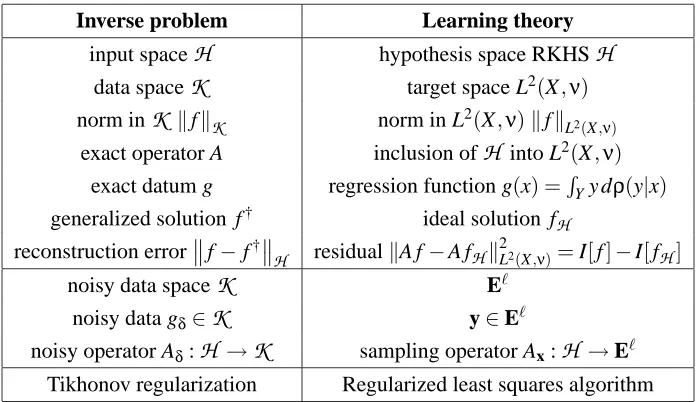
Table 1 compares the classical framework of inverse problems (see Section 3) with the formulation
of learning proposed above. We note some differences. First, the noisy data space E` is different
from the exact data space L2(X,ν) so that A and Ax belong to different spaces, as well as g and y. A measure of the difference between Ax and A, and between g and y is then required. Second,
both Axand y are random variables and we need to relate the noiseδto the number`of examples
in the training set z. Given the above premise our derivation of consistency results is developed
in two steps: we first study the residual of the solution by means of a measure of the noise due to
Inverse problem Learning theory
input space
H
hypothesis space RKHSH
data space
K
target space L2(X,ν)norm in
K
kfkK norm in L2(X,ν)kfkL2(X,ν) exact operator A inclusion ofH
into L2(X,ν)exact datum g regression function g(x) =R
Yy dρ(y|x) generalized solution f† ideal solution fH
reconstruction errorf−f†
H residualkA f−A fHk2L2(X,ν)=I[f]−I[fH]
noisy data space
K
E`noisy data gδ∈
K
y∈E`noisy operator Aδ:
H
→K
sampling operator Ax:H
→E`Tikhonov regularization Regularized least squares algorithm
Table 1: The above table summarizes the relation between the theory of inverse problem and the
theory of learning from examples. When the projection of the regression function is not in the range of the operator A the ideal solution fH does not exist. Nonetheless, in learning
theory, if the ideal solution does not exist the asymptotic behavior can still be studied since
we are looking for the residual.
5.1 Bounding the Residual of Tikhonov Solution
In this section we study the dependence of the minimizer of Tikhonov functional on the operator A and the data g. We indicate with
L
(H
)andL
(H
,K
)the Banach space of bounded linear operatorsfrom
H
intoH
and fromH
intoK
respectively. We denote with k·kL(H) the uniform norm inL
(H
)and, if A∈L
(H
,K
),we recall that A∗ is the adjoint operator. The Tikhonov solutions ofProblems (14) and (15) can be written as
fλ = (A∗A+λI)−1A∗g,
fzλ = (A∗xAx+λI)−1A∗xy
(see for example Engl et al., 1996, Chapter 5, page 117). The above equations show that fzλand
fλ depend only on A∗xAx and A∗A, which are operators from
H
intoH
, and on A∗xy and A∗g,which are elements of
H
. This observation suggests that noise levels could be evaluated controllingkA∗xAx−A∗AkL(H)andkA∗xy−A∗gkH.
Recalling that P is the projection on the closure of the range of A and Y⊂[−M,M], we are ready to state the following theorem.
Theorem 2 Givenλ>0, the following inequality holds
A f
λ z −Pg
L2(X,ν)− A f
λ−Pg
L2(X,ν)
≤
δ1 2√λ+
Mδ2 4λ
for any training set z∈
U
δ.We postpone the proof to Section 5.4 and briefly comment on the above result. The first term in the
l.h.s. of the inequality is exactly the residual of the regularized solution whereas the second term represents the approximation error, which does not depend on the sample. Our bound quantifies the
difference between the residual of the regularized solutions of the exact and noisy problems in terms of the noise levelδ= (δ1,δ2). As mentioned before this is exactly the kind of result needed to derive consistency. Our result bounds the residual both from above and below and is obtained introducing the collection
U
δ of training sets compatible with a certain noise levelδ. It is left to quantify thenoise level corresponding to a training set of cardinality`. This will be achieved in a probabilistic
setting in the next section, where we also discuss a standard result on the approximation error.
5.2 Stochastic Evaluation of the Noise and Approximation Term
In this section we give a probabilistic evaluation of the noise levelsδ1 andδ2and we analyze the behavior of the termA fλ−Pg
L2(X,ν). In the context of inverse problems a noise estimate is a part of the available data whereas in learning problems we need a probabilistic analysis.
Theorem 3 Let 0<η<1. Then
PhkA∗g−Ax∗ykH ≤δ1(`,η),kA∗A−Ax∗AxkL(H)≤δ2(`,η) i
≥1−η
whereκ=supx∈XpK(x,x),
δ1(`,η) = Mκ
2 ψ
8
`log
4 η
δ2(`,η) = κ2
2 ψ
8
`log
4 η
withψ(t) =12(t+√t2+4t) =√t+o(√t).
We refer again to Section 5.4 for the complete proof and add a few comments. The one proposed is just one of the possible probabilistic tools that can be used to study the above random variables.
For example union bounds and Hoeffding’s inequality can be used introducing a suitable notion of
covering numbers on X×Y .
An interesting aspect in our approach is that the collection of training sets compatible with a
to consider indifferently data independent parameter choices λ=λ(`) as well as data dependent choicesλ=λ(`,z). Since through data dependent parameter choices the regularization parameter
becomes a function of the given sampleλ(`,z), in general some further analysis is needed to ensure that the bounds hold uniformly w.r.t.λ.
We now consider the termA fλ−Pg
L2(X,ν) which does not depend on the training set z and plays the role of an approximation error (Smale and Zhou, 2003; Niyogi and Girosi, 1999). The following is a trivial modification of a classical result in the context of inverse problems (see for
example Engl et al. (1996) Chapter 4, Theorem 4.1, p. 72).
Proposition 4 Let fλthe Tikhonov regularized solution of the problem A f =g, then the following
convergence holds
lim
λ→0+
A f
λ−Pg
L2(X,ν)=0.
We report the proof in the Appendix for completeness. The above proposition ensures that,
indepen-dently of the probability measureρ, the approximation term goes to zero asλ→0. Unfortunately it is well known, both in learning theory (see for example Devroye et al. (1996); Vapnik (1998);
Smale and Zhou (2003); Steinwart (2004)) and inverse problems theory (Groetsch, 1984), that such a convergence can be arbitrarily slow and convergence rates can be obtained only under some
as-sumptions either on the regression function g or on the probability measure ρ(Smale and Zhou,
2003). In the context of RKHS the issue was considered in Cucker and Smale (2002a); De Vito et al. (2004) and we can strightforwardly apply those results to obtain explicit convergence rates.
We are now in the position to derive the consistency result that we present in the following section.
5.3 Consistency and Regularization Parameter Choice
Combining Theorems 2 and 3 with Proposition 4, we easily derive the following result (see Section 5.4 for the proof).
Theorem 5 Given 0<η<1, λ>0 and `∈N, the following inequality holds with probability
greater that 1−η
I[fzλ]− inf
f∈HI[f] ≤
Mκ
2√λ+ Mκ2
4λ
ψ8
`log 4 η + A f
λ−Pg
L2(X,ν) 2
(16)
=
Mκ2
s log4η
2λ2` + A f
λ−Pg
L2(X,ν)+o s
1 λ2`log
4 η
! 2
whereψ(·)is defined as in Theorem 3. Moreover, ifλ=O(l−b)with 0<b< 1 2, then lim
`→+∞P
I[fzλ(`,z)]− inf
∈HI[f]≥ε
for everyε>0.
As mentioned before, the second term in the right hand side of the above inequality is an approxi-mation error and vanishes asλgoes to zero. The first term in the right hand side of Inequality (16)
plays the role of sample error. It is interesting to note that sinceδ=δ(`)we have an equivalence between the limit`→∞, usually studied in learning theory, and the limitδ→0, usually considered
for inverse problems. Our result presents the formal connection between the consistency approach
considered in learning theory, and the regularization-stability convergence property used in ill-posed inverse problems. Although it is known that connections already exist, as far as we know, this is the
first full connection between the two areas, for the specific case of square loss.
We now briefly compare our result with previous work on the consistency of the regularized
least squares algorithm. Recently, several works studied the consistency property and the related
convergence rate of learning algorithms inspired by Tikhonov regularization. For the classification setting, a general discussion considering a large class of loss functions can be found in Steinwart
(2004), whereas some refined results for specific loss functions can be found in Chen et al. (2004) and Scovel and Steinwart (2003). For regression problems in Bousquet and Elisseeff (2002) a large
class of loss functions is considered and a bound of the form
I[fzλ]−Iz[fzλ]≤O
1
√ `λ
is proved, where Iz[fzλ]is the empirical error.2 Such a bound allows to prove consistency using the
error decomposition in Steinwart (2004). The square loss was considered in Zhang (2003) where,
using leave-one out techniques, the following bound in expectation was proved
Ez(I[fzλ])≤O
1
`λ
.
Techniques similar to those used in this paper are used in De Vito et al. (2004) to derive a bound of the form
I[fzλ]− inf f∈HI[f]≤
S(λ, `) + A f
λ−Pg
L2(X,ν) 2
where S(λ, `)is a data-independent bound on fz
λ−fλ
L2(X,ν). In that case S(λ, `)≤O
1 √
`λ32
and we see that Theorem 4 gives S(λ, `)≤O√1
`λ
. Moreover in Cucker and Smale (2002a),
Theorem 2 gives O√log`
`λ2
as it can be seen from Equation (3) at p. 12. Finally our results were
recently improved in Smale and Zhou (2004b), where, using again techniques similar to those pre-sented here, a bound of the form S(λ, `)≤O√1
`λ
+O 1
`λ32
is obtained. It is worth noting that
in general working on the square root of the error leads to better overall results.
5.4 Proofs
In this section we collect the proofs of the theorems that we stated in the previous sections. e first now prove the bound on the residual for the Tikhonov regularization.
Proof [of Theorem 2] The idea of the proof is to note that, by triangular inequality, we can write
A f λ z −Pg
L2(X,ν)− A f
λ−Pg
L2(X,ν)
≤ A f λ z −A fλ
L2(X,ν) (17) so that we can focus on the difference between the discrete and continuous solutions. By a simple
algebraic computation we have that
fzλ−fλ = (Ax∗Ax+λI)−1A∗xy−(A∗A+λI)−1A∗g
= [(A∗xAx+λI)−1−(A∗A+λI)−1]A∗xy+ (A∗A+λI)−1(A∗xy−A∗g) (18) = (A∗A+λI)−1(A∗A−A∗xAx)(A∗xAx+λI)−1A∗xy+ (A∗A+λI)−1(A∗xy−A∗g).
and we see that the relevant quantities for the definition of the noise appear. We claim that
A(A∗A+λI)−1 L
(H)= 1
2√λ (19)
(A∗xAx+λI)−1A∗x L
(H)= 1
2√λ. (20)
Indeed, let A=U|A|be the polar decomposition of A. The spectral theorem implies that
kA(A∗A+λI)−1k
L(H) = kU|A|(|A|2+λI)−1kL(H)=k|A|(|A|2+λI)−1kL(H)
= sup
t∈[0,k|A|k
t t2+λ.
A direct computation of the derivative shows that the maximum of t2+tλ is 1
2√λ and (19) is proved. Formula (20) follows replacing A with Ax.
Last step is to plug Equation (18) into (17) and use Cauchy-Schwartz inequality. SincekykE`≤
M, (19) and (20) give
kA f
λ
z −PgkL2 − kA fλ−PgkL2 ≤
M 4λkA
∗A−A∗
xAxkL(H)+ 1 2√λkA
∗
xy−A∗gkH
so that the theorem is proved.
The proof of Theorem 2 is a straightforward application of Lemma (8) (see Appendix) . Proof [Theorem 2] The proof is a simple consequence of estimate (26) applied to the random
vari-ables
ξ1(x,y) = yKx
where
1. ξ1takes value in
H
, L1=κM and v∗1=A∗g, see (21), (23);2. ξ2takes vales in the Hilbert space of Hilbert-Schmidt operators, which can be identified with
H
⊗H
, L2=κ2and v∗2=T , see (22), (24).Replacingηwithη/2, (26) gives
kA∗g−Ax∗ykH ≤δ1(`,η) = Mκ
2 ψ
8
`log
4 η
kA∗A−Ax∗AxkL(H)≤δ2(`,η) = κ2
2 ψ
8
`log
4 η
,
respectively, so that the thesis follows.
Finally we combine the above results to prove the consistency of the regularized least squares algorithm.
Proof [Theorem 4] Theorem 1 gives
kA fzλ−PgkL2(X,ν)≤
1
2√λδ1+ M 4λδ2
+kA fλ−PgkL2(X,ν).
Equation (13) and the estimates for the noise levelsδ1andδ2given by Theorem 2 ensure that r
I[fzλ]− inf f∈HI[f]≤
Mκ
2√λ+ Mκ2
4λ
ψ8
`log
4 η
+ A f
λ−Pg
L2(X,ν)
and (16) simply follows taking the square of the above inequality. Let now λ=0(`−b) with 0<b< 12, the consistency of the regularised least squares algorithm is proved by inverting the relation betweenεandηand using the result of Proposition (4) (see Appendix).
6. Conclusions
In this paper we analyse the connection between the theory of statistical learning and the theory of
ill-posed problems. More precisely we show that, considering the quadratic loss function, the prob-lem of finding the best solution fH for a given hypothesis space
H
is a linear inverse problem andthat the regularized least squares algorithm is the Tikhonov regularization of the discretized version of the above inverse problem. As a consequence, the consistency of the algorithm is traced back to
the well known convergence property of the Tikhonov regularization. A probabilistic estimate of
An open problem is extending the above results to arbitrary loss functions. For other choices of loss functions the problem of finding the best solution gives rise to a non linear ill-posed problem and
the theory for this kind of problems is much less developed than the corresponding theory for linear problems. Moreover, since, in general, the expected risk I[f]for arbitrary loss function does not
define a metric, the relation between the expected risk and the residual is not clear. Further problems
are the choice of the regularization parameter, for example by means of the generalized Morozov principle (Engl et al., 1996) and the extension of our analysis to a wider class of regularization
algorithms.
Acknowledgments
We would like to thank M.Bertero, C. De Mol, M. Piana, T. Poggio, S. Smale, G. Talenti and A. Verri for useful discussions and suggestions. This research has been partially funded by the INFM
Project MAIA, the FIRB Project ASTAA and the IST Programme of the European Community,
under the PASCAL Network of Excellence, IST-2002-506778.
Appendix A. Technical Results
First, we collect some useful properties of the operators A and Ax.
Proposition 6 The operator A is a Hilbert-Schmidt operator from
H
into L2(X,ν)and A∗φ =Z
Xφ
(x)Kxdν(x), (21)
A∗A = Z
Xh·
,KxiHKxdν(x), (22)
whereφ∈L2(X,ν), the first integral converges in norm and the second one in trace norm.
Proof The proof is standard and we report it for completeness.
Since the elements f ∈
H
are continuous functions defined on a compact set andνis a probabilitymeasure, then f∈L2(X,ν), so that A is a linear operator from
H
to L2(X,ν). Moreover the Cauchy-Schwartz inequality gives|(A f)(x)|=|hf,KxiH| ≤κkfkH,
so thatkA fkL2(X,ν)≤κkfkH and A is bounded.
We now show that A is injective. Let f ∈
H
and W ={x∈X|f(x)6=0}. Assume A f =0, then W is a open set, since f is continuous, and W has null measure, since(A f)(x) = f(x) =0 for ν-almost all x∈X . The assumption thatνis not degenerate ensures W be the empty set and, hence,f(x) =0 for all x∈X , that is, f =0.
We now prove (21). We first recall the map
is continuous sincekKt−KxkH2=K(t,t) +K(x,x)−2K(x,t)for all x,t∈X , and K is a continuous
function. Hence, givenφ∈L2(X,ν), the map x7→φKx is measurable from X to
H
. Moreover, for all x∈X ,kφ(x)KxkH =|φ(x)|
p
K(x,x)≤ |φ(x)|κ.
Sinceνis finite,φis in L1(X,ν)and, hence,φKx is integrable, as a vector valued map. Finally, for all f ∈
H
,Z
Xφ
(x)hKx,fiHdν(x) =hφ,A fiL2(X,ν)=hA∗φ,fiH ,
so, by uniqueness of the integral, Equation (21) holds.
Equations (22) is a consequence of Equation (21) and the fact that the integral commutes with
the scalar product.
We now prove that A is a Hilbert-Schmidt operator. Let(en)n∈Nbe a Hilbert basis of
H
. SinceA∗A is a positive operator and|hKx,eniH|2is a positive function, by monotone convergence theorem,
we have that
Tr(A∗A) =
∑
n
Z
X|h
en,KxiH|2dν(x)
= Z
X
∑
n |hen,KxiH|2dν(x)
= Z
Xh
Kx,KxiH dν(x)
= Z
X
K(x,x)dν(x)<κ2
and the thesis follows.
Corollary 7 The sampling operator Ax:
H
→E`is a Hilbert-Schmidt operator andAx∗y =
1
` `
∑
i=1
yiKxi (23)
Ax∗Ax =
1
` `
∑
i=1
h·,KxiiHKxi. (24)
Proof The content of the proposition is a restatement of Proposition 6 and the fact that the integrals
reduce to sums.
For sake of completeness we report a standard proof on the convergence of the approximation
error.
projector P on the range of A is P=UU∗. Let dE(t)be the spectral measure of|A|. Recalling that
fλ= (A∗A+λ)−1A∗g= (|A|2+λ)−1|A|U∗g the spectral theorem gives
A f
λ−Pg
2
K =
U|A|(|A|2+λ)−1|A|U∗g−UU∗g 2 K = =
|A|2 |A|2+λ−1
−1
U∗g 2 H = =
Z k|A|k
0
t2 t2+λ−1
2
dhE(t)U∗g,U∗giH.
Let rλ(t) =t2t+2λ−1=−t2λ+λ, then
|rλ(t)| ≤1 and lim
λ→0+rλ(t) =0 ∀t>0,
so that the dominated convergence theorem gives that
lim
λ→0+
A f
λ−Pg
2
K =0.
Finally, to prove our estimate of the noise we need the following probabilistic inequality due to Pinelis and Sakhanenko (1985). (See Yurinsky, 1995, for the version presented int he following.)
Lemma 8 Let Z be a probability space andξ be a random variable on X taking value in a real
separable Hilbert space
H
. Assume that the expectation value v∗=E[ξ]exists and there are twopositive constants H andσsuch that
kξ(z)−v∗kH ≤ H a.s
E[kξ−v∗k2H] ≤ σ2.
If zi are drawn i.i.d. from Z, then, with probability greater than 1−η,
1 ` `
∑
i=1ξ(zi)−v∗ ≤σ 2 H g 2H2
`σ2 log 2 η
=δ(`,η) (25)
where g(t) =1 2(t+
√
t2+4t). In particular
δ(`,η) =σ
s 2
`log
2 η+o
Proof It is just a testament to Th. 3.3.4 of Yurinsky (1995), see also Steinwart (2003). Consider the set of independent random variables with zero meanξi=ξ(zi)−v∗defined on the probability space
Z`. Since,ξi are identically distributed, for all m≥2 it holds
`
∑
i=1
E[kξikmH]≤ 1
2m!B 2Hm−2,
with the choice B2=`σ2. So Th. 3.3.4 of Yurinsky (1995) can be applied and it ensures P " 1 ` `
∑
i=1(ξ(zi)−v∗) ≥xB ` #
≤2 exp
− x
2 2(1+xHB−1)
for all x≥0. Lettingδ= xB
` , we get the equation
1 2(
`δ
B)
2 1
1+`δHB−2 =
`δ2σ−2
2(1+δHσ−2) =log 2 η,
since B2=`σ2. Defining t=δHσ−2
`σ2 2H2
t2
1+t =log 2 η.
The thesis follows, observing that g is the inverse of 1+t2t and that g(t) =√t+o(√t).
We notice that, ifξis bounded by L almost surely, then v∗ exists and we can choose H=2L and σ=L so that
δ(`,η) =L
2g 8 `log 2 η . (26)
In Smale and Y. (2004) a better estimate is given, replacing the function1+t2t with t log(1+t), anyway the asymptotic rate is the same.
References
N. Alon, S. Ben-David, N. Cesa-Bianchi, and D. Haussler. Scale sensitive dimensions, uniform
convergence, and learnability. Journal of the ACM, 44:615–631, 1997.
A. Arbib, M. The Handbook of Brain Theory and Neural Networks. The MIT Press, Cambridge,
MA, 1995.
N. Aronszajn. Theory of reproducing kernels. Trans. Amer. Math. Soc., 68:337–404, 1950.
P. L. Bartlett and S. Mendelson. Rademacher and Gaussian complexities. Journal of Machine Learning Research, 3:463–482, 2002.
M. Bertero, C. De Mol, and E. R. Pike. Linear inverse problems with discrete data. II. Stability and regularisation. Inverse Problems, 4(3):573–594, 1988.
O. Bousquet and A. Elisseeff. Stability and generalization. Journal of Machine Learning Research,
2:499–526, 2002.
D. Chen, Q. Wu, Y. Ying, and D. Zhou. Support vector machine soft margin classifiers: Error
analysis. Journal of Machine Learning research, 5:1143–1175, 2004.
F. Cucker and S. Smale. Best choices for regularization parameters in learning theory: on the bias-variance problem. Foundations of Computationals Mathematics, 2:413–428, 2002a.
F. Cucker and S. Smale. On the mathematical foundations of learning. Bull. Amer. Math. Soc. (N.S.), 39(1):1–49 (electronic), 2002b.
E. De Vito, A. Caponnetto, and L. Rosasco. Model selection for regularized least-squares algorithm
in learning theory. to be published in Foundations of Computational Mathematics, 2004.
L. Devroye, L. Gy¨orfi, and G. Lugosi. A Probabilistic Theory of Pattern Recognition. Number 31
in Applications of mathematics. Springer, New York, 1996.
H. W. Engl, M. Hanke, and A. Neubauer. Regularization of inverse problems, volume 375 of Mathematics and its Applications. Kluwer Academic Publishers Group, Dordrecht, 1996.
T. Evgeniou, M. Pontil, and T. Poggio. Regularization networks and support vector machines. Adv. Comp. Math., 13:1–50, 2000.
L. Fine, T. Feedforward Neural Network Methodology. Springer-Verlag, 1999.
C. W. Groetsch. The theory of Tikhonov regularization for Fredholm equations of the first kind,
volume 105 of Research Notes in Mathematics. Pitman (Advanced Publishing Program), Boston,
MA, 1984.
M. Gy¨orfi, L.and Kohler, A. Krzyzak, and H. Walk. A Distribution-free Theory of Non-parametric Regression. Springer Series in Statistics, New York, 1996, 1996.
T. Hastie, R. Tibshirani, and J. Friedman. The Elements of Statistical Learning. Springer, New
York, 2001.
J. Kaipio and E. Somersalo. Statistical and Computational Inverse Problems. Springer, 2005.
V. Kecman. Learning and Soft Computing. The MIT Press, Cambridge, MA, 2001.
S. Lang. Real and Functional Analysis. Springer, New York, 1993.
S. Mukherjee, P. Niyogi, T. Poggio, and R. Rifkin. Statistical learning: Stability is sufficient for gen-eralization and necessary and sufficient for consistency of empirical risk minimization. Technical
Report CBCL Paper 223, Massachusetts Institute of Technology, january revision 2004.
S. Mukherjee, R. Rifkin, and T. Poggio. Regression and classification with regularization. Lectures Notes in Statistics: Nonlinear Estimation and Classification, Proceedings from MSRI Workshop,
171:107–124, 2002.
P. Niyogi and F. Girosi. Generalization bounds for function approximation from scattered noisy
data. Adv. Comput. Math., 10:51–80, 1999.
C.S. Ong and S. Canu. Regularization by early stopping. Technical report, Computer Sciences Laboratory, RSISE, ANU, 2004.
I. F. Pinelis and A. I. Sakhanenko. Remarks on inequalities for probabilities of large deviations.
Theory Probab. Appl., 30(1):143–148, 1985. ISSN 0040-361X.
T. Poggio and F. Girosi. A theory of networks for approximation and learning. In C. Lau, editor,
Foundation of Neural Networks, pages 91–106. IEEE Press, Piscataway, N.J., 1992.
C. Rudin. A different type of convergence for statistical learning algorithms. Technical report, Program in Applied and Computational Mathematics Princeton University, 2004.
B. Sch¨olkopf and A.J. Smola. Learning with Kernels. MIT Press, Cambridge, MA, 2002. URL
http://www.learning-with-kernels.org.
L. Schwartz. Sous-espaces hilbertiens d’espaces vectoriels topologiques et noyaux associ´es (noyaux reproduisants). J. Analyse Math., 13:115–256, 1964.
C. Scovel and I. Steinwart. Fast rates support vector machines. submitted to Annals of Statistics,
2003.
S. Smale and Yao Y. Online learning algorithms. Technical report, Toyota Technological Institute,
Chicago, 2004.
S. Smale and D. Zhou. Estimating the approximation error in learning theory. Analysis and Appli-cations, 1(1):1–25, 2003.
S. Smale and D. Zhou. Shannon sampling and function reconstruction from point values. Bull.
Amer. Math. Soc. (N.S.), 41(3):279–305 (electronic), 2004a.
I. Steinwart. Sparseness of support vector machines. Journal of Machine Learning Research, 4: 1071–1105, 2003.
I. Steinwart. Consistency of support vector machines and other regularized kernel machines.
ac-cepted on IEEE Transaction on Information Theory, 2004.
A. N. Tikhonov, A. V. Goncharsky, V. V. Stepanov, and A. G. Yagola. Numerical methods for the solution of ill-posed problems, volume 328 of Mathematics and its Applications. Kluwer
Academic Publishers Group, Dordrecht, 1995. Translated from the 1990 Russian original by R.
A. M. Hoksbergen and revised by the authors.
A.N. Tikhonov and V.Y. Arsenin. Solutions of Ill Posed Problems. W. H. Winston, Washington, D.C., 1977.
V. N. Vapnik. Statistical learning theory. Adaptive and Learning Systems for Signal Processing,
Communications, and Control. John Wiley & Sons Inc., New York, 1998. A Wiley-Interscience Publication.
G. Wahba. Spline models for observational data, volume 59 of CBMS-NSF Regional Conference
Se-ries in Applied Mathematics. Society for Industrial and Applied Mathematics (SIAM),
Philadel-phia, PA, 1990.
V. Yurinsky. Sums and Gaussian vectors, volume 1617 of Lecture Notes in Mathematics. Springer-Verlag, Berlin, 1995.