http://ijessr.com Page 260 THE NEED ANALYSIS FOR DEVELOPMENT OF INQUIRY LESSON-BASED NATURAL
SCIENCES MODULE TO IMPROVE SCIENTIFIC CREATIVITY OF STUDENTS
Siti Zulaichah, Sukarmin and Mohammad Masykuri
Faculty of Teacher Training and Education, Sebelas Maret University, Surakarta, Indonesia
ABSTRACT
Teaching material is one of the essential components in the learning process that can be used as a guide for students in conducting learning activities. The purpose of this study is to analyze the availability of teaching materials in the form of modules in schools, which are in accordance with the nature of science and the demands of 21st-century skills. The study was conducted at one of the junior high schools in Surakarta. The research was conducted using descriptive methods. The instruments used in this study were student questionnaire sheets, teacher interview sheets, and observation sheets of learning activities. The data obtained were then described and analyzed qualitatively. The results showed that an inquiry-based science module was needed to improve students' scientific creativity.
KEYWORDS: Learning Module, Inquiry Lesson, Scientific Creativity
INTRODUCTION
Teaching material is an essential part of the learning process. Teaching materials are learning materials that are arranged thoroughly and systematically based on the learning principles used by students and teachers in the learning process (Sungkono, 2009). Modules are teaching materials that are presented systematically so that users can learn with or without a teacher (Ditjen PMPTK, 2008). Modules can be used independently by students both at school and at home. Modules are developed based on the analysis of needs and conditions (Rahdiyanta, 2016).
Current needs and field conditions must meet the demands of 21st Century life. P21 Partnership for 21st Century Learning states that in the 21st-century learning must develop four skills, namely Communication, Collaboration, Critical Thinking and Problem Solving, and Creativity and Innovation (“21st Century Student Outcomes,” N.D.). Creativity is one of the four skills that need to be considered as a provision of life in the future. Creativity is a person's ability to produce new, original, useful, and adaptive products (Sternberg, 1999). Creativity shows something different, innovative, and follows the needs of the times (Kaufman, 2016).
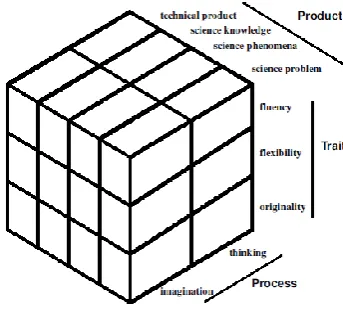
http://ijessr.com Page 261 Adey, consists of 3 dimensions, namely product, trait, and process. These three dimensions are arranged into the Scientific Structure Creativity Model (SSCM), as shown in Figure 1.1.
Figure 1.1. Scientific Structure Creativity Model (SSCM)
Creative products consist of technical products, scientific knowledge, understanding of scientific phenomena, and solving scientific problems. Creative traits consists of fluency, flexibility, and originality. The creative process consists of thinking and imagining. Creative products are obtained through a creative process and are produced by people who have a creative traits. The science module used in learning activities should integrate the dimensions of scientific creativity as one of the skills needed in the 21st century.
The Natural Sciences module must also pay attention to the nature of science, including scientific processes, products, and attitudes (Mukhopadhyay & Malay, 2013). Science learning in the 21st century must be able to sharpen students' thinking processes in-depth, such as asking natural phenomena, designing experiments, observing natural processes, analyzing experimental results, interpreting experimental results, drawing conclusions, communicating experimental results, and reflecting experimental results (Sajidan & Afandi, 2017). Therefore, an appropriate learning model that is applied according to the nature of science and the demands of 21st-century life is needed.
http://ijessr.com Page 262 namely students observing the phenomena presented and describing them, (2) Manipulation, namely students conducting investigations to study phenomena, (3) Generalization, namely students conducting discussion activities to build new concepts/principles of phenomena that have been investigated, (4) Verification, namely students retest the principles/concepts that have been obtained and (5) Applications, namely students apply concepts that have been obtained in other situations or phenomena (Wenning, 2011b).
Through the inquiry lesson syntax, the teacher can include activities that simultaneously train students' scientific creativity, such as presenting phenomena or problems to be solved by students and designing creative products. These learning activities can be arranged in a learning module so that students can carry out activities with clear instructions both at school and at home.
2. MATERIAL AND METHODS
The study was conducted to analyze the availability of teaching materials in the form of modules in schools, which are in accordance with the nature of science and 21st-century skills demands. The study was conducted in one of the junior high schools in Surakarta. The research was conducted using descriptive methods. The instruments used in this study were student questionnaire sheets, teacher interview sheets, and observation sheets of learning activities. The data was obtained by giving questionnaires to 32 students of 8th grade, conducting interviews with two science teachers, and observing the learning activities of students in 8th grade. The data obtained were then described and analyzed qualitatively to find out the follow up that must be done in learning.
3. RESULTS
3.1. Student Questionnaire Results
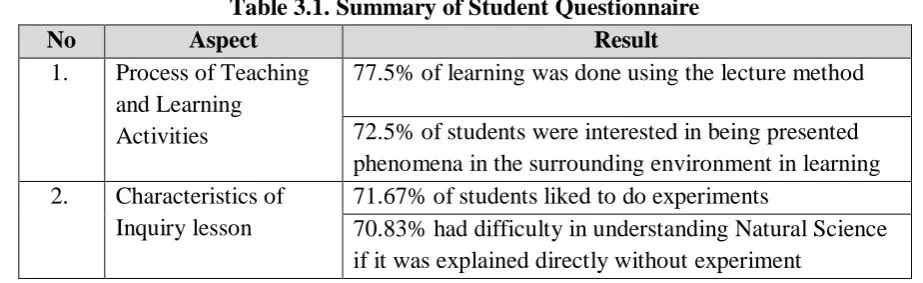
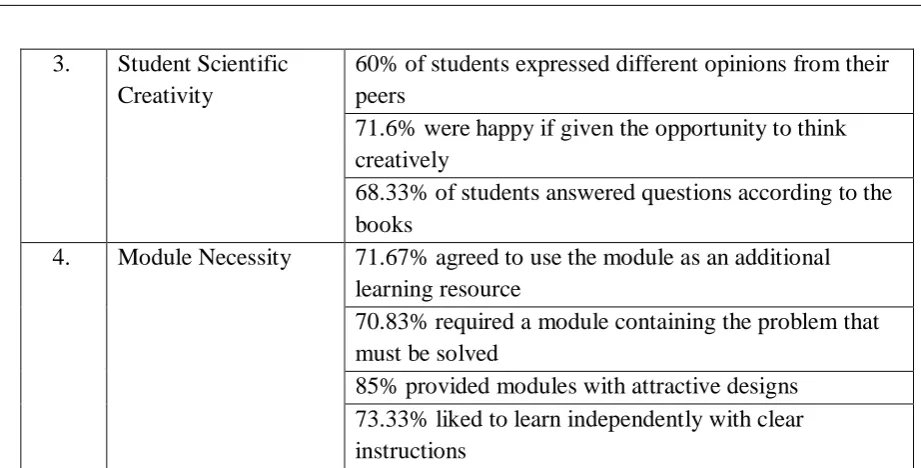
Questionnaires were given to 32 students of 8th grade of junior high school to find out student responses related to the learning activities in the classroom, the application of inquiry lesson models, students' scientific creativity, and the need for learning modules. Student questionnaire results are presented in Table 3.1.
Table 3.1. Summary of Student Questionnaire
No Aspect Result
1. Process of Teaching and Learning
Activities
77.5% of learning was done using the lecture method
72.5% of students were interested in being presented phenomena in the surrounding environment in learning 2. Characteristics of
Inquiry lesson
71.67% of students liked to do experiments
http://ijessr.com Page 263 3. Student Scientific
Creativity
60% of students expressed different opinions from their peers
71.6% were happy if given the opportunity to think creatively
68.33% of students answered questions according to the books
4. Module Necessity 71.67% agreed to use the module as an additional learning resource
70.83% required a module containing the problem that must be solved
85% provided modules with attractive designs 73.33% liked to learn independently with clear instructions
3.2. Teacher Interview
Interviews were conducted with two science teachers who taught 8th-grade students. The interview was conducted to comply with the instructional design conducted by the teacher, learning activities in class, student activities in class, and availability of module teaching materials. The results of the interviews are presented in Table 3.2.
Table 3.2. Results of Science Teachers’ Interview
No Questions Answers
1. What learning models and methods do you often use in class?
Teacher 1: Lecturing, discussion, demonstration, and observation
Teacher 2: often by lecturing, occasionally learning with a demonstration
2. Do you often conduct investigative/ practical activities in your learning activities? How many times in one semester?
Teacher 1: Rarely, two times a semester Teacher 2: Rarely
3. How do you organize learning activities to make students think creatively?
Teacher 1: Give a real example, do what you think, so that it becomes a habit Teacher 2: provide unique problems to be solved by students
4. Do you make a module or summary of materials as one of the supporting teaching materials?
Teacher 1: No. Teacher 2: No.
5. Are modules needed as supporting learning resources in science learning?
http://ijessr.com Page 264 If so, what kind of modules are
needed?
examples that can be replicated and applied in everyday life
Teacher 2: Required modules that are appropriate to the student's character. Modules are presented in a language that is easily understood by students
3.3. Learning Observation
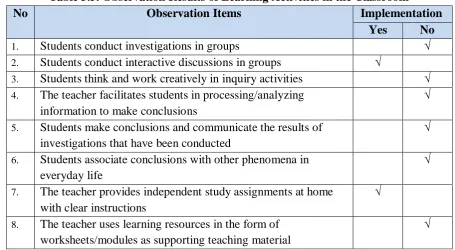
Learning observations were carried out to see real conditions in the classroom, including the way the teacher teaches, student learning activities, and learning resources used during learning. The results of the observation of learning activities are presented in Table 3.3.
Table 3.3. Observation Results of Learning Activities in the Classroom
No Observation Items Implementation
Yes No
1. Students conduct investigations in groups √
2. Students conduct interactive discussions in groups √
3. Students think and work creatively in inquiry activities √
4. The teacher facilitates students in processing/analyzing information to make conclusions
√
5. Students make conclusions and communicate the results of investigations that have been conducted
√
6. Students associate conclusions with other phenomena in everyday life
√
7. The teacher provides independent study assignments at home with clear instructions
√
8. The teacher uses learning resources in the form of worksheets/modules as supporting teaching material
√
4. DISCUSSION
http://ijessr.com Page 265 Student scientific creativity can be trained through learning models that require students to carry out the learning process in class actively, and the teacher acts as a facilitator (Egan, Maguire, Christophers, & Rooney, 2017). One suitable learning model is the inquiry lesson model. Integrating creative thinking in science teaching and learning activities works best if the teacher uses activities that involve inquiry because science process skills can be linked to creativity (Thompson, 2017). In inquiry learning, students are active in the process of finding out and conducting investigations (Hamdani, 2011). Through investigation activities, students are given the opportunity to think and imagine creatively, according to the potential possessed by students. Thus, the scientific creativity of students will be trained and more increasing.
To implement the syntax of the inquiry model well, it requires considerable time. Therefore, supporting teaching materials that can be used by students is needed, one of which is a module. Based on the results of teacher interviews and learning observations, it shows that teaching and learning activities did not use modules and only used textbooks. Both the teacher and students stated the need for modules as additional teaching material in the learning. Modules expected by teachers and students are modules that present examples of phenomena in daily life, make students think creatively, use clear instructions, and have attractive designs.
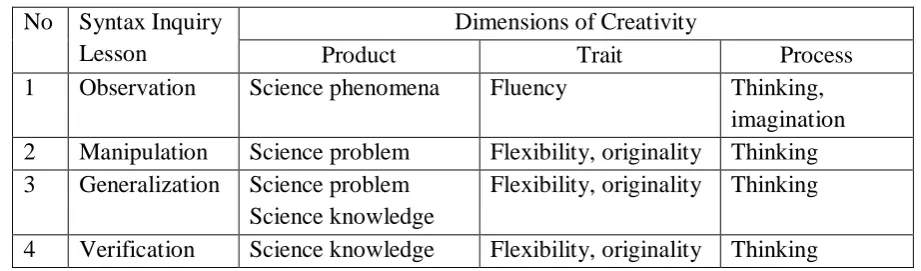
The inquiry lesson-based science module is expected to help students learn meaningfully and independently to improve students' scientific creativity. Learning activities contained in the module can be arranged in accordance with the syntax of the inquiry lesson, where students actively carry out investigation and discovery activities (Utomo, 2018). Through the inquiry lesson syntax, students will be trained to think and imagine creatively to solve problems and discover new things when investigating (Meika, Suciati, & Karyanto, 2016). The link between the inquiry lesson model and the students' scientific creativity that will be integrated into the learning module is presented in Table 4.1.
Table 4.1. The Linkage between the Inquiry Lesson Model and Scientific Creativity
No Syntax Inquiry Lesson
Dimensions of Creativity
Product Trait Process
1 Observation Science phenomena Fluency Thinking,
imagination 2 Manipulation Science problem Flexibility, originality Thinking 3 Generalization Science problem
Science knowledge
Flexibility, originality Thinking
http://ijessr.com Page 266 5 Application Science problem
Scientific product
Fluency, flexibility, originality
Thinking, Imagination
At stage (1), Student observations are presented with scientific phenomena to be observed by students. Students will think and imagine giving ideas, questions, and concepts of the phenomena presented. It will train students to think smoothly, giving as many ideas as possible. The resulting scientific creativity product is understanding scientific phenomena.
In stage (2), Manipulation, students conduct investigative activities to study the phenomena presented using a set of experimental tools. During this process, students will think flexibly and originally according to each student's creativity. The resulting creativity product is scientific problem-solving.
In stage (3) Generalization, students get a new concept based on the results of the investigation. Students think flexibly and originally, so that they will get creativity products in the form of solving scientific problems and increasing students' scientific knowledge.
At stage (4), Verification, students re-check the concepts obtained. Verification is done by communicating the results of student investigations in each group. Students can respond to other groups, and students write the differences in results with other groups. After that, students with the teacher, make class conclusions. The creative product at the verification stage is scientific knowledge.
At stage (5) Application, students apply the concepts that have been obtained in other situations. Students can think and imagine fluently, flexible, and original both in solving problems, understanding natural phenomena, making technical products, and obtaining useful scientific knowledge.
With the development of inquiry lesson-based module products, it is hoped that in learning, students can do the syntax of inquiry lessons, which at the same time, train students 'scientific creativity, so that students' scientific creativity can increase.
5. CONCLUSION
http://ijessr.com Page 267 REFERENCE
Ayas, M. B., & Sak, U. (2014). Objective measure of scientific creativity: Psychometric validity of the Creative Scientific Ability Test. Thinking Skills and Creativity, 13, 195–205. https://doi.org/10.1016/j.tsc.2014.06.001
Blessinger, P., & Carfora, J. M. (2015). Inquiry Based-Learning for Mulidiciplinary Programs: A Conceptual and Practical Resource for Educators (1st ed.). UK: Emerald Group Publising Limited. Ditjen PMPTK. (2008). Penulisan Modul. Jakarta: Ditjen PMPTK Depdiknas.
Egan, A., Maguire, R., Christophers, L., & Rooney, B. (2017). Developing creativity in higher education for 21st century learners: A protocol for a scoping review. International Journal of Educational Research, 82, 21–27. https://doi.org/10.1016/j.ijer.2016.12.004
Hamdani. (2011). Strategi Belajar Mengajar. Bandung: Pustaka Setia.
Hu, W., & Adey, P. (2002). A scientific creativity test for secondary school. International Journal of Science Education, 24(4), 389–403. https://doi.org/10.1080/09500690110098912
Kaufman, J. C. (2016). Creativity 101 (2nd ed.). Springer Publishing Company.
Meika, Suciati, & Karyanto, P. (2016). Pengembangan Modul Berbasis Inquiry Lesson untuk Meningkatkan Dimensi Konten pada Literasi Sains Materi Sistem Pencernaan Kelas XI. Jurnal Inkuiri, 5(3).
Menengah, S., Madrasah, P., Pelajaran, M., & Alam, I. P. (2017). KEMENTERIAN PENDIDIKAN DAN KEBUDAYAAN.
Mukhopadhyay, R., & Malay, K. Sen. (2013). Scientific Creativity- A New Emerging Field of Research : Some Considerations. International Journal of Education and Psychological Research, 2(1), 1–9.
P21 Partnership For 21st Century Learning. (2015). 21st CENTURY STUDENT OUTCOMES. Rahdiyanta, D. (2016). Teknik Penyusunan Modul. Artikel.(Online) Http://Staff. Uny. Ac. Id/Sites/Default/Files/Penelitian/Dr-Dwi-Rahdiyanta-Mpd/20-Teknik-Penyusunan-Modul. Pdf. Diakses, 10.
Sajidan, S., & Afandi, A. (2017). Pengembangan Model Pembelajaran Ipa Untuk Memberdayakan Keterampilan Berpikir Tingkat Tinggi. Prosiding SNPS (Seminar Nasional Pendidikan Sains), 21, 15–27.
Sternberg, R. J. (1999). Handbook of Creativity. United Stated of America: Cambridge University Press.
Sungkono. (2009). Pengembangan Dan Pemanfaatan Bahan Ajar Modul Dalam Proses Pembelajaran. Majalah Ilmiah Pembelajaran, 5(1).
Thompson, T. (2017). Teaching Creativity Through Inquiry Science. Gifted Child Today, 40(1), 29– 42. https://doi.org/10.1177/1076217516675863
http://ijessr.com Page 268 Wenning, C. J. (2011a). Experimental Inquiry in Introductory Physics Courses. Journal of Physics Teacher Education Online, 6(2), 2–8.
Wenning, C. J. (2011b). The Levels of Inquiry Model of Science Teaching. Journal of Physics Teacher Education Online, 6(2), 9–16.