
Studies on pH dependant swelling behavior of acrylic acid ionic hydrogels
5
0
0
Full text
(2) 111. Raja rajeswari K et al., Int. Journal of Pharmacy & Industrial Research Vol – 02 Issue – 02 Apr – Jun 2012. or amine groups renders the polymer more. Pharmaceuticals,. hydrophilic and thus leads to a very high water. reagents and chemicals used were of analytical. 4. Ahmedabad.. All. other. uptake .. grade.. The swelling properties of hydrogels are. Synthesis of Acrylic acid-Xanthan gum. unique. Hydrogels. and. dependant. on. the. pendant H. functional groups. Changes in P , ionic. Hydrogels of Valsartan were prepared by. strength and equilibrium, temperature, etc acts. physical crosslinking method. To an accurately. 5, 6, 7. as inputs for the degree of swelling ions. .. weighed quantity of Xanthan gum, 80 mg of. Other factors like composition of the swelling. valsartan was dissolved in about 15 ml of. medium, valence and nature of the polymer. deionised water by mixing vigorously at a. and the counterion, etc also influence the. speed of 800-900rpm for 10 mins. To the. 8. dynamics and equilibrium swelling behavior .. mixture. The ability to control the dynamics of swelling. homogenized at 1500-200 rpm for 20 mins,. H. acrylic. acid. was. added. and. by changing the P and ionic strength of the. using ultrasonic homogenizer until they were. external swelling medium provides various. completely mixed. Methylene bis acryl amide. opportunities. drug. and potassium per sulfate were dissolved. delivery. Xanthan gum is a natural, high. separately in 5 ml of deionised water and. molecular weight polysaccharide produced by. added to the above mixture. Stirring was. the process of fermentation from xanthomonas. continued for 20 mins. 10 ml of 0.1N NaoH. campestris It is an anionic polyelectrolyte with. and kept aside for 1 Hr. It was then immersed. a. The. in 100 ml of ethanol. After 48 hrs, the formed. anionic character is due to the presence of. gel was filtered using membrane filter paper. glucuronic acid and pyruvic acid groups in the. under vacuum and dried at 50o C. Five. side chain9. Since its discovery xanthan gum. different. has been widely studied and used as tablet. synthesized using various concentrations of. excipient to increase the drug rate of delivery. xanthan gum.. for. stimuli-responsive. β-(1→4)-D-glucopyranose. glucan.. hydrogel. formulations. were. but not much work has been reported concerning the use of this polymer for a. Swelling studies. sustained drug release. The present work was. This process of swelling studies was done in. intended to develop acrylic acid - Xanthan. different media like distilled water, 0.1 N H. gum hydrogels and to study the swelling. Cl, phosphate buffer of PH 6.8. The swelling. kinetics and release mechanisms of the drug. characteristics of the gels were investigated in. H. from the hydrogels in different p media.. triplicate at temperatures ranging from ambient temperature to 25-35o C. Samples of the cured polymer (with drug incorporated) with a mass. Materials and methods Potassium. of 1.1 ± 0.35 g were placed in a petri dish; the. persulfate and N, NI-Methylene bis acrylamide. petri dish was filled with media and placed in a. were procured from Sigma-Aldrich Chemicals. fan oven at the required temperature. Petri dish. Ltd. Valsartan was obtained from Alembic. lids and Petri Seal (Diversified Biotech Ltd.). Acrylic. acid,. Xanthan. gum,. www.ijpir.com.
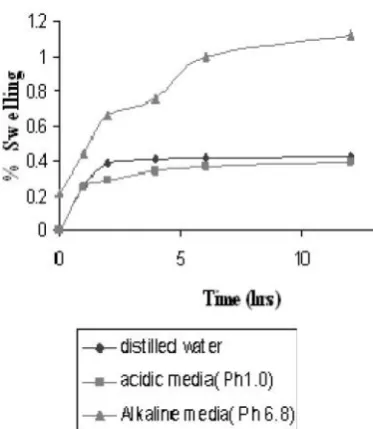
(3) 112. Raja rajeswari K et al., Int. Journal of Pharmacy & Industrial Research Vol – 02 Issue – 02 Apr – Jun 2012. were placed on the petri dishes while in the. Corp, Kyoto, Japan). Cumulative percentage. oven to prevent evaporation. Periodically,. drug release was calculated.. excess polymer solution was removed after predetermined time intervals by pouring the. The mechanism of the drug release was. solution through a Buchner funnel.. investigated by fitting the release data using zero order, first order, Higuchi, Hixon-. The samples were then blotted free of surface. Crowell, Korsemeyer – Peppas models to. water with filter paper, and the wet weight of. predict their release profiles as shown in table. the gel sample was measured at room. 01.. temperature. The samples were re-submerged in fresh distilled water and returned to the oven.. Table 01: Mathematical modeling for the study of release kinetics. Model Zero order Higuchi Korsmeyer-Peppas. The percentage that the hydrogels swelled was calculated using formula (1):. Equation Q = Qo + Kot Q t= Qo + KH t1/2 Qt = KKPtn. Swelling (%) = Wt/ W 0 X 100 Where,. Results and Discussion. Wt is the mass of the gel at a predetermined. The swelling studies for the best hydrogel. time and W0 is the dry mass of the gel.. were conducted in media of varying pH. The. This process was continued until the sample. results were shown in the graphs 1.. appeared to have dissolved. Dissolution studies The study was carried out in triplicate using USP type I (Basket) apparatus (Electro Lab TDT-O8L, Mumbai) , in 900 mL of 0.1 N HCl, at 37-C ± 0.5-C at 50 rpm for the first 2 hours and then replaced by phosphate buffer of PH 6.8 . A sample (5 mL) of the solution was withdrawn from the dissolution apparatus at the appropriate time interval for 24 hours, and the. samples. were. replaced. with. fresh. dissolution medium after every withdrawal. The samples were filtered through a 0.45-μm membrane filter and diluted and absorbances of these solutions were measured at 250 nm using a Shimadzu UV- 1601 UV/Visible double-beam spectrophotometer (Shimadzu. Graph 01: Swelling kinetics of Acrylic acid – Xanthan gum Hydrogels in different pH. Swelling is mainly due to the presence of xanthan. gum. a. complex. extra. cellular. polysaccharide. The rate of swelling mainly depends upon the cross linking nature of the hydrogel. The hydrodynamic free volume is. www.ijpir.com.
(4) 113. Raja rajeswari K et al., Int. Journal of Pharmacy & Industrial Research Vol – 02 Issue – 02 Apr – Jun 2012. high if the gel network is less which in turn. lowers the cross linking density. The higher. swelling is due to the accommodation of more. observed where a hydrogel gains its maximum. of the solvent molecules. The swelling rate. of hydrophilicity and swells. From the study it. was found to be different basing on the. was observed that the rate of swelling was low. concentrations of xanthan gum and acrylic. in acidic media and double distilled water. acid. Due to polymer-polymer interactions and. while it was high in the case of phosphate. solvent-polymer interactions a mixed phase is. buffer.. Dissolution studies. Table 02: Cumulative percentage drug release of hydrogels.. Time (h). F1. F2. F3. F4. F5. 0. 0.49 ± 0.31. 0.44±0.018. 0.40 ± 0.012. 0.41± 0.00. 0.38 ± 0.04. 1. 1.05 ± 0.04. 1.06±0.000. 1.48 ±0.33. 1.48 ± 0.27. 0.52 ± 0.14. 3. 3.52 ± 0.76. 1.49±0.005. 1.97 ± 0.02. 3.66± 0.02. 2.74± 0.09. 4. 22.9 ± 0.09. 18.6±0.000. 31.07.2± 0.25. 47.00 ± 0.01. 48.37 ± 0.04. 6. 31.64 ± 0.23. 26.6±0.971. 31.78± 0.00. 49.20 ± 0.00. 60.39 ± 0.18. 8. 39.60 ± 0.25. 48.4± 0.286. 38.96 ± 0.92. 51.3± 0.00. 64.26 ± 0.13. 12. 44.58 ± 0.18. 55.2±0.005. 44.47 ± 0.00. 56.17 ± 0.15. 69 ± 0.00. 16. 52.66 ± 0.13. 57.7± 0.010. 52.59 ± 0.27. 69.5 ± 0.04. 72.7 ± 0.09. All values are represented as mean ± S.D, n = 3.. drug release was increased by the increase in the xanthan gum concentration. Formulation (F5) showed the best release of 72.7% at the end 16 hrs. Mechanism and mathematical modeling of drug release from the hydrogel The drug release from a hydrogel can be attributed by a number of factors like chemical structure of the polymers, composition of the hydrogel, network structure release condition, release condition etc. In this study the drug release from the hydrogel was affected by the concentrations of the polymers that were incorporated within the hydrogel network. From the results obtained as shown in table 03, it was found that the drug release was low in the acidic media due to poor swelling, but was found to be more in alkaline media due to the enhancement of swelling rate.. Table 03: Data of kinetic models of hydrogel formulations Formulation. It was shown that the cumulative percentage. Parameter (R2). zero order. First order. Higuchi Model. KorsemeyerPeppas Model. F1. 0.671. 0.896. 0.928. 0.896. F2. 0.709. 0.916. 0.925. 0.916. F3. 0.833. 0.869. 0.901. 0.869. F4. 0.834. 0.84. 0.829. 0.84. F5. 0.855. 0.834. 0.813. 0.89. The release of the drug from the hydrogel matrix was may be due to very slow erosion of the polymeric matrix under the test conditions that resulted in slow diffusion of the entrapped drug. The hydrogels followed zero-order nonfickian diffusion mechanism.. Conclusion Cross-linked starch–xanthan gum hydrogels were successfully synthesized. The synthesis. www.ijpir.com.
(5) 114. Raja rajeswari K et al., Int. Journal of Pharmacy & Industrial Research Vol – 02 Issue – 02 Apr – Jun 2012. process is straight forward and can be. Polymer Science and Technology, Vol. 7,. conducted using conventional equipments. The. Wiley, New York, 1985. 783-807.. equilibrium swelling ratio and swelling rate of. 4.. Katchalsky, A., Lifson, S. and Eisenberg,. the Acrylic acid–xanthan gum hydrogels. H.Equation of swelling for polyelectrolyte. increased. gels, J. Polym. Sci. 7, 1951, 571 574.. content.. with The. increasing hydrogels. Xanthan exhibited. gum a. p. H. 5.. Siegel, R.A. and Firestone, B.A. PH. dependant swelling. This can be selectively. Dependent equilibrium swelling properties. utilized as stimuli responsive dosage forms.. of hydrophobic polyelectrolyte copolymer. The results of this work suggest that the new. gels, Macromolecules 21, 1988, 3254-. modified Acrylic acid- xanthan gum hydrogels. 3259.. are a promising material for controlled release. 6.. Tanaka, T. Phase transitions of gels. In:. formulations for a wide range of drugs and. R.S. Harland and R.K. Prud'homme. applications.. (Eds.),. Polyelectrolyte. Gels,. ACS. Symposium Series, Vol. 480, American. Acknowledgements. Chemical Society, Washington, DC, 1992,. Alembic Pharmaceuticals, Ahmedabad are. 1-21. 7.. sincerely acknowledged.. Brannon, M.L. Structural Characteristics and Swelling Behavior of pH- Sensitive. References. Hydrogels,. 1.. Abdekhodaie, M., & Wu, X. Y. Modeling. Chemical. of. University, West Lafayette. a. glucose. membrane. for. sensitive. composite. closed-loop. 8.. Flory,. P.JPrinciples. Chemistry, Ithaca, 3.. Cornell. School of. Engineering,. Purdue IN., 1988,. Mandel, M. Polyelectrolytes. In: H. Mark and J.l. Kroschwitz (Eds.), Encyclopedia. 335, 2009, 21–31. 2.. Thesis,. 324-329.. insulin. delivery. Journal of Membrane Science,. Ph.D.. of University. of Polymer Science and Technology, Vol.. Polymer. 11, Wiley, New York, 1985. 739 829.. Press, 9.. NY, 1953, 570- 590.. Jiangyang,. Kudela, V. Hydrogels. In: H.F. Mark and. H.Zhimin,. J.I. Kroschwitz (Eds.), Encyclopedia of. 241-247.. www.ijpir.com. W.. Kang,. L.. Meimei,. Carbohydr.polym.73.. 2008,.
(6)
Figure

Related documents
To that end, the Open Travel Alliance (OTA) was formed in 1998 and now has a global membership of over 150 travel companies from suppliers, such as airlines, hotels, car rental, rail,
So, this study aims to know the level of customers’ acceptance of IBP that are offered by the Dual Banking system among the non-Muslims and the relationship between acceptance and
Pithawalla College Of Eng... Institute
• Beyond English language needs and a high school diploma, the diverse population of the area will require training in life skills, job readiness and career skills, computer
Other in vivo evidence of the involvement of the glutamatergic system in FTD derives from non-invasive brain stimulation studies using transcranial magnetic stimulation, in
WIP MEMORY CARD Saffiano bonded leather bookmark with page marker and pocket for 4GB USB key or credit card... WIP MEMORY KEY Saffiano bonded leather bookmark with 4GB
These interactions were negative, demonstrating that although subject matter experts’ ratings of HRM practices are positively associated with changes in productivity, this effect
Analysis: the scheme was based on the Bloom filter algorithm, while IBF was simple in process since it need just one filter comparing to BF need two filter to build data
