ISSN: 2306-9007 Alsajjan (2014) 1088
I
www.irmbrjournal.com June 2014I
nternationalR
eview ofM
anagement andB
usinessR
esearchVol. 3 Issue.2
R
M
B
R
Satisfaction-Trust Model: Developing Customer Satisfaction
and Trust Indices for Mobile Service Providers in the UK
BANDER A. ALSAJJAN
Institute of Public Administration P O Box 205 Riyadh 11141 Saudi Arabia
Email: [email protected]
Abstract
This paper introduces a behavioral model that investigates well-known loyalty antecedents. The model proposes that trust and satisfaction mediate the effect of service quality on loyalty. Structural equation modeling confirms the fit of the model, and it demonstrates significance explaining 65% of student loyalty toward mobile service providers in the UK. The invariance analysis demonstrates the psychometric equivalence of the proposed model measurements between two groups: highly satisfied and low satisfied customers. At the structural level, the influence of trust and satisfaction on loyalty varies between the two groups. In addition, two indices are calculated, a customer satisfaction index (CSI) and a customer trust index (CTI). These indexes reveal that customer loyalty and the role of its proposed antecedents vary in accordance with satisfaction and trust levels with respect to telecommunication companies. Additionally, several managerial implications are discussed.
Key Words: Customer Satisfaction Index, Customer Trust Index, Service Quality, Loyalty, Mobile Service.
Introduction
In highly competitive retail sectors, such as cellular line rentals, satisfied customers are critical for the success of telecommunication companies. These companies are now striving to determine their market position among various consumer segments. Telecommunications companies have made substantial investments in an attempt to identify and understand the factors that impact their customers' degree of satisfaction because satisfied customers tend to be loyal customers. However, loyal customers are not necessarily satisfied customers (Fornell, 1992; Morgeson et al., 2011). Hence, having loyal customers is more profitable than trying to acquire new ones (Prentice 2013). A number of national and international customer satisfaction indices have been introduced in the last three decades. Because cause and effect relationship systems or satisfaction models mainly drive these indices (Johnson, et al., 2001), the indices have assisted CEOs, decision makers, and governmental bodies in managing and protecting consumers.
ISSN: 2306-9007 Alsajjan (2014) 1089
I
www.irmbrjournal.com June 2014I
nternationalR
eview ofM
anagement andB
usinessR
esearchVol. 3 Issue.2
R
M
B
R
Academics and leading service organizations recognize that the quality of a service provides a competitive edge in gaining market leadership (Kandampully, 1998). One of the most popular frameworks for measuring the quality of a service is ServQual, introduced by Zeithamel, Parasuraman, and Berry in 1985 and 1988. The framework is capable of explaining consumer perceptions of the quality of services provided.
Providing services to customers requires the establishment of relationships, and trust is central to all relationships (Morgan and Hunt 1994). Consumers generally avoid conducting business with vendors they do not trust (Jarvenpaa and Tractinsky, 1999; Reichheld and Schefter, 2000). As such, they are willing to pay premium prices to trusted vendors (Sotgiu and Ancarani, 2005).
Because previous research has not examined the relationship among trust, satisfaction and service quality, there is room for improvement and further understanding of this issue. This research aims to facilitate the identification, adoption, and improvement of satisfaction indices with respect to their validity and reliability by examining the customer satisfaction index (CSI) for the UK mobile industry at macro and micro levels in a target population of students.
Furthermore, this study identifies the important service quality dimensions that impact customer satisfaction with cellular services and classifies the importance of dimensions of service quality based on the satisfaction levels of customers. Finally, the study investigates the impact of satisfaction, trust and service quality on customer loyalty using a behavioral model.
The paper is organized as follows. The next section discusses the mobile telecommunication industry with a specific focus on the UK market. The third section, a literature review, covers literature related to satisfaction, service quality, and trust. After proposing the research framework, the article describes the research methods employed. The next section includes the research analysis, the results, and a discussion of the findings. The final section presents conclusions, limitations and recommendations for managers, and future research.
Mobile industry
Saturated markets, the deregulation of the telecommunication industry, and the increasing number of wireless service providers drive competition in the telecommunication industry (Turel and Serenko, 2006). In competitive markets, customers‟ long-term relationships with service providers are important to the success of a company (Gerpott et al., 2001).
It is estimated that telecommunication companies lose 2 to 4% of its customers on a monthly basis, which can amount to millions of dollars in lost revenues and profits (Aydin and Ozer, 2005), because of disloyal customers. Therefore, to be competitive and cost efficient and to significantly increase their market share, mobile operators must adjust their marketing strategies and focus on customer loyalty while finding ways to acquire new subscribers.
Low switching barriers and weak customer satisfaction force companies to compete on offered prices. Hence, many researchers consider customer satisfaction the best indicator of a company‟s future profits (e.g., Kotler, 1988).
The UK mobile industry, one of the most competitive in the world, was worth 14.9 billion
ISSN: 2306-9007 Alsajjan (2014) 1090
I
www.irmbrjournal.com June 2014I
nternationalR
eview ofM
anagement andB
usinessR
esearchVol. 3 Issue.2
R
M
B
R
Table 1 UK mobile operator revenue from 2004 to 2009
Year 2004 2005 2006 2007 2008 2009 2010 2011
Total operators revenue 37.3 38.6 40.7 42 42.5 41.2 40.5 39.7
Mobile retail revenue 11.9 13.1 13.9 15 15.4 14.9 14.9 15.1
Mobile percentage revenue of total operators revenue
31.9 %
33.9 %
34.8 %
36.3 %
36.9 %
36.7 %
36.8 %
38%
Source: ofcom communication market report 2010 and 2012
Revenues from retail mobile services in the UK have gro wn by an aver age of 12% per year over the past thirteen years (Figure 1). It is important to note that the revenues increased in a declining trend.
Figure 1 UK retail mobile revenues (1998 to 2011).
Source: ofcom communication market report 2010 and 2012
The 2009 overall telecommunication operator revenues and the mobile service retail revenues have declined, falling below the 2007 levels. This decline was driven by several factors, one of which was the economic downturn. Additionally, the impact of falling prices and a slowdown in the growth of mobile and broadband connections have contributed to the declining revenues. More importantly, the massive growth in data use, the increased availability of super-fast broadband networks and changing consumer behaviors as more people access internet services on mobile phones all played a major role, suggesting that the dynamics of the industry and its offered services have changed. The situation is essentially analogous to the story of audio tapes and digital audio players. These trends, combined with the slow recovery of world economies, remain standing issues. Accordingly, it is reasonable to conclude that the current telecommunication services have entered a stage of maturity although the service re-engineering in the industry is ongoing.
ISSN: 2306-9007 Alsajjan (2014) 1091
I
www.irmbrjournal.com June 2014I
nternationalR
eview ofM
anagement andB
usinessR
esearchVol. 3 Issue.2
R
M
B
R
Literature Review
Satisfaction
Satisfaction reflects the degree to which a consumer believes that using a service induces positive feelings (Rust and Oliver, 1994). Mittal and Kamakura (2001) argued that customer satisfaction, which can be described as a strategic end for customer retention, is an important cornerstone for customer-oriented businesses. Customer satisfaction involves the abstract attributes that describe a customer‟s total consumption experience; thus, it is comparable across individuals, products and service levels (Laroche et al., 2004).
The literature has documented two approaches to customer satisfaction research. One approach is transaction customer satisfaction, which focuses on the relationship between perceived quality and satisfaction (DeRuyter et al. 1997). The second approach, which has recently grown in popularity, is the economic psychology-based approach known as the cumulative satisfaction approach. This approach views satisfaction as the customer‟s overall experience with a product or a service provider to date (Johnson and Fornell, 1991). This approach has the advantage of accurately predicting the subsequent behavior of customers (Fornell et al., 1996).
Satisfaction is an overall post-purchase evaluation. One of its measures is the customer satisfaction index (CSI), a parsimonious framework that captures the primary psychological antecedents of satisfaction (Johnson and Fornell, 1991). Accordingly, it has attained national and international significance with the development of national customer satisfaction indices and barometers in Sweden, the US, Norway, New Zealand, Austria, Korea, and the European Union (Johnson et al., 2001). Moreover, the CSI is predictable and is systematically related to productivity and financial returns (Anderson et al., 1997; Edvardsson et al., 2000). Many studies have demonstrated that service quality is a highly reliable and significant determinant of satisfaction (e.g., Cronin and Taylor, 1992; Oliver, 1996).
Service Quality
Service quality (SQ) refers to the consumer‟s expectations based on experience and reputation. SQ serves as a benchmark for quality interpretations of the service encounter (Laroche et al., 2004), reflecting whether the actual service performance exceeded or failed to meet the customer‟s expectations. There is no consensus on SQ (Bolton and Myers, 2003). Contrary to goods quality, SQ is an abstract and elusive dimension (Cronin and Taylor, 1992) because of four features that are unique to service: the intangibility, inseparability, heterogeneity, and perishability of production and consumption. SQ affects customer satisfaction as well as customer values (Oliver, 1996) and thereby affects customer loyalty (Zeithaml at al., 1996). In causal models, service quality is a prominent determinant of customer satisfaction (Cronin and Taylor, 1992).
In 1992, Cronin and Taylor refined the operationalization of the popular SERVQUAL framework, which was introduced by Zeithaml et al. (1988) to measure perceived SQ. In doing so, they identified service quality as an antecedent of satisfaction and argued that SQ has a lower impact on intention than satisfaction does.
ISSN: 2306-9007 Alsajjan (2014) 1092
I
www.irmbrjournal.com June 2014I
nternationalR
eview ofM
anagement andB
usinessR
esearchVol. 3 Issue.2
R
M
B
R
Trust
Trust involves “perceptions about others’ attributes and a related willingness to become vulnerable to others” (Rousseau et al., 1998, p. 394). Accordingly, trust helps people resolve uncertainty regarding the motives, intentions, and prospective actions of others on whom they depend (Kramer, 1999). Because trust reduces monitoring and legal contract costs, it also allows people to save money and reduce effort (Fortin et al., 2002). As a result, a lack of trust in a service vendor represents an obstacle to the vendor‟s ability to penetrate the market.
Wu and Chen (2005) argued that within social exchange, business transactions are usually conducted without any explicit contract or control mechanism against opportunistic behavior. Consequently, the parties involved in these activities are not able to maintain complete legal protection, exposing themselves in a complicated, uncertain social environment. To ensure better rewards from these economic activities, people attempt to reduce this social complexity and to avoid the risk of being exploited. In social exchange, trust is perceived as a common mechanism for reducing social complexity and perceived transaction risks by increasing the expectation of a positive outcome and the perceived certainty regarding the expected behavior of the trustee (Luhmann, 1979; Grabner-Kraeuter, 2002). In mobile services, if social complexity and the risk resulting from the undesirable opportunistic behavior of the service vendor are not reduced, only short-term relationships are possible. In terms of characteristics, the customer wants the vendor to be willing and able to act in the customer‟s best interest, to be honest in transactions, and to be both capable of and predictable in delivering as promised (McKnight and Chervany 2002). Mayer et al. (1995) suggested that a trustee who possesses these traits is desirable as an exchange partner because it is perceived that this trustee will behave skillfully, ethically, kindly, and consistently in the exchange.
In the mobile phone service context, trust plays two significant roles for the service vendor. First, trust helps to attract new customers; second, it facilitates the relationship between the two parties, especially with respect to the customer.
Research Framework
The original CSI was formally introduced by Fornell (1992) to measure Sweden‟s main industries using the Sweden Customer Satisfaction Barometer (SCSB). In the SCSB model, the ultimate dependent variable is loyalty because of its value as a proxy for profitability and actual customer retention (Johnson et al., 2001). In the SCSB, loyalty is determined by customer satisfaction and customer complaints. Customer complaints represent the customer‟s voice when seeking restitution (Johnson et al., 2001). Thus, both loyalty and complaints are driven by the Hirschman (1970) exit-voice theory. Satisfaction, in contrast, is determined by perceived performance (value) and customer expectations. According to Johnson and his colleagues (2001), perceived performance reflects the customer‟s ability to learn from an experience and predict the level of performance that will be received, whereas customer expectations are what the customer predicts will be received rather than a normative standard or benchmark. Ultimately, customer expectations influence perceived performance (for further details, refer to Fornell, 1992).
In 2000, Anderson and Fornell introduced the American CSI (ACSI), which represented a significant change because it included perceived quality as an antecedent of satisfaction and perceived value. Moreover, it suggested that perceived quality is determined by customer expectations. Different versions of the original CSI have been introduced, including the Norwegian CSB and the European CSI, but all models are comparable in principle.
ISSN: 2306-9007 Alsajjan (2014) 1093
I
www.irmbrjournal.com June 2014I
nternationalR
eview ofM
anagement andB
usinessR
esearchVol. 3 Issue.2
R
M
B
R
satisfaction mediate the effects of service quality. This is consistent with the role of trust in commitment-trust theory and with the SCSB. Furthermore, commitment-trust acts as an antecedent to satisfaction. Ranaweera and Prabhu (2003) argued that the interaction between trust and satisfaction has a significant effect on customer retention, but they also found that the effect of satisfaction is stronger than that of trust.
Figure 2 Proposed model: Satisfaction-Trust Model (STM)
Loyalty is the ultimate dependent variable in the STM. Beerli et al. (2004) defined two dimensions of loyalty. The first dimension is loyalty based on inertia or behavioral loyalty, which means that a service or a brand is used out of habit. This dimension requires little effort, and customers will not hesitate to switch to another brand if the other brand is more convenient. The second dimension is attitudinal loyalty, which refers to repeat purchasing behavior that reflects a conscious decision to continue to purchase a specific product or service. Thus, the psychological definition of loyalty is required in addition to the behavioral factor.
Recent research indicates that trust also plays a critical role in influencing a user‟s willingness to engage in the exchange of money and sensitive personal information (e.g., Friedman et al., 2000; Alsajjan and Dennis, 2010). Such research has shown that perceptions of trust directly and/or indirectly influence intentions to transact (e.g., Grazioli and Jarvenpaa, 2000; Jarvenpaa and Tractinsky, 1999). According to the commitment-trust theory documented by Morgan and Hunt (1994), trust and relationship commitment are significant variables that mediate the relationship between five antecedents (relationship termination costs, relationship benefits, shared values, communication, and opportunistic behavior) and five outcomes (acquiescence, propensity to leave, cooperation, functional conflict, and decision-making uncertainty) in relationship marketing. The literature with respect to loyalty and satisfaction has demonstrated that trust is a strong predictor of loyalty (e.g., Ranaweera and Prabhu, 2003). Hence, the following hypothesis is presented:
H1 Trust has a positive effect on user loyalty.
To date, few studies have proposed that trust is a determinant of customer satisfaction. In fact, some research does not propose any relationship between trust and satisfaction (e.g., Cyr, 2008; Garbarino and Johnson, 1999). However, other researchers have found that trust has a significant influence on customer satisfaction (Kim et al. 2009). Because trust is a pre-purchase belief and satisfaction is a post-purchase belief, this research posits that without trust, voluntary relationships would not exist. Hence, the following hypothesis is presented:
H2 Trust has a positive effect on user satisfaction.
The influence of satisfaction on customer loyalty has been well documented in the literature (e.g., Kim, Park, Jeong, 2004; Hallowell 1996; Anderson and Srinivasan, 2003). Furthermore, this relationship has shaped many behavioral models, such as the CSI Fornell (1992) model and the Cronin and Taylor SERVQUAL model, which was built on the 1988 work of Zeithaml and his colleagues. Hausknecht (1990)
H1 Satisfaction
Loyalty
Trust Service
Quality
H3
H2 H5
ISSN: 2306-9007 Alsajjan (2014) 1094
I
www.irmbrjournal.com June 2014I
nternationalR
eview ofM
anagement andB
usinessR
esearchVol. 3 Issue.2
R
M
B
R
identified more than 30 different satisfaction measurements used in previous research. Among them, three different facets of satisfaction can be identified: 1-general satisfaction, 2-confirmation of expectations, 3- distance from the customer‟s hypothetical ideal product or service. These three facets constitute what is known as the customer satisfaction index (CSI) introduced by Fornell (1992, 1996). Bagram and Khan (2012) found strong relationship between satisfaction and loyalty. Hence, the following hypothesis is presented:
H3 Satisfaction has a positive effect on user loyalty.
One of the most common frameworks for measuring SQ is SERVQUAL (Zeithaml et al. 1988), which identifies five SQ dimensions. The first dimension is tangibles, which represent the physical facilities, equipment, and appearance of personnel. The second dimension is reliability, which refers to an organization‟s ability to dependably and accurately perform the promised service. The third dimension is responsiveness, which assesses the willingness of the provider to assist customers and provide prompt service. The fourth dimension is assurance, which represents the knowledge and courtesy of employees and their ability to inspire trust and confidence. The fifth dimension is empathy, which assesses the caring and individualized attention that the firm offers its customers. Measures of SQ may be more or less applicable and/or more or less meaningful from one person to another, from one industry to another, and from one geographical area to another. Previous research indicates that the perception of quality drives satisfaction (De Ruyter et al., 1997; Cronin and Taylor, 1992). Moreover, because quality assessment does not require customer experience, SQ provides expectations that initiate trust (Cronin and Taylor, 1994). However, previous research has demonstrated that SQ has a significant impact on an individual‟s level of trust in a firm or organization (e.g., Alsajjan 2009). Hence, the following hypotheses are presented:
H4 Service quality has a positive effect on user satisfaction. H5 Service quality has a positive effect on user trust.
Study Method
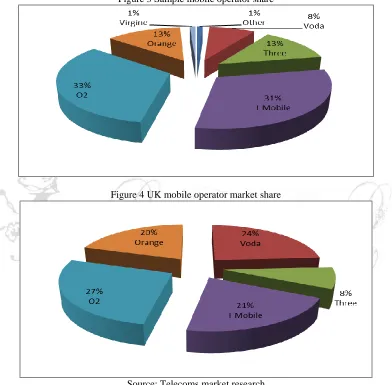
Paper-based questionnaires were distributed at an academic institution in west London, UK with the collaboration of random faculty members in the business school who agreed to distribute questionnaires in their graduate and undergraduate classes. As a result, 322 valid questionnaires were collected. Of the respondents, 56.78% were females and 43.22% were males. The respondents had an average of 3.03 years of experience with their cellular providers, and more than 95% of the respondents were between 18 and 25 years of age. Of the respondents, 86.3% earned less than 1000£ a month, 8% earned between 1000£ and 2000£, and the remaining 5.7% earned more than 2000£. Additionally, 65.5% of the respondents owned one mobile line, 30.2% owned two mobile lines, and 4.3% owned three or more mobile lines. The service providers‟ share of the sample is illustrated in figure 4.
Of the respondents, 67.5% were on contracts with their service providers, and 32.5% were on pre-paid plans. On average, each respondent used 657 voice call minutes, which were worth an average of 28.6 sterling (4.4 pence/minute).
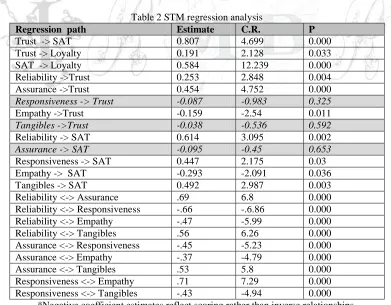
The sample share did not reflect the market share of the companies as illustrated in figure 5. This finding is primarily because the sample segment consisted of students, and other segments were not included in the study.
ISSN: 2306-9007 Alsajjan (2014) 1095
I
www.irmbrjournal.com June 2014I
nternationalR
eview ofM
anagement andB
usinessR
esearchVol. 3 Issue.2
R
M
B
R
the original 1996 Fornell satisfaction scale measurements. According to Fornell (1995), the frequency distribution of satisfaction and quality ratings is always negatively skewed in competitive markets. Accordingly, to reduce the statistical problems of skewness, the ACSI uses 10-point rating scales because they enable customers to better discriminate (Fornell. 1992). Moreover, as Fornell emphasized, the use of multiple indicators reduces skewness.
Figure 3 Sample mobile operator share
Figure 4 UK mobile operator market share
Source: Telecoms market research
The loyalty measures were adopted from Ayden and Ozer (2005), the service quality measures were adopted from Parasuraman et al. (1991), the trust belief measures were adopted from McKnight et al. (2002), and the satisfaction measures were adopted from Fornell et al. (1996).
ISSN: 2306-9007 Alsajjan (2014) 1096
I
www.irmbrjournal.com June 2014I
nternationalR
eview ofM
anagement andB
usinessR
esearchVol. 3 Issue.2
R
M
B
R
Reliability and Exploratory Factor Analyses
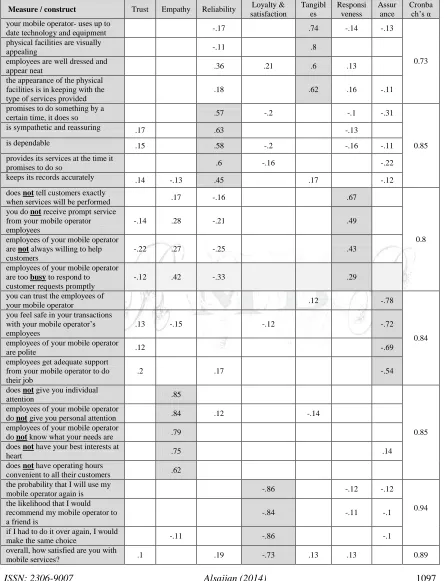
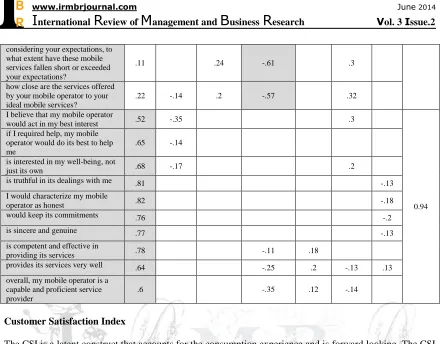
All construct Cronbach‟s alphas (Table 2) were above 0.6, which exceeded Bagozzi and Yi‟s (1988) cut-off. From the principle component analysis (PCA), factors with eigenvalues greater than 1 using the direct oblimin rotation were retained (Table 2) using (SPSS 17.0). The KMO test resulted in a value of 0.93, indicating confidence that the factor analysis was appropriate for these data (Kaiser, 1974). Bartlett‟s test of sphericity was significant (p<0.01), indicating that the correlation matrix was not an identity matrix, and the average communality of the measurements was satisfactory (0.67).
To ensure the discriminant validity of the research tool, the fourth responsiveness item was dropped from further analysis because of its cross-loading in other factors. Loyalty and satisfaction emerged as one factor, although, theoretically, satisfaction and loyalty are two distinct variables. However, the strong correlation between the two variables justifies this result (estimate 0.58; C.T. 12.24; P<0.01), as subsequently confirmed.
Research Framework and Structural Equation Modeling
The proposed framework was operationalized using structural equation modeling (SEM) (AMOS 7.0). The model demonstrated recursion with 561 degrees of freedom (df) and a chi-square (χ²) of 1055.66. Furthermore, the model fit indexes were outstanding, demonstrating a model fit to the data that included a χ²/df=1.88, a CFI=0.94 and a RMSEA=0.052. Regression (structural) weight estimates were, for the most part, significant (Table 3), and satisfaction and trust fully mediated the impact of SQ on loyalty. The model explained 65% of the loyalty variance; trust and service quality explained 53% of the satisfaction variance; and service quality explained 60% of the trust variance (figure 6).
Table 2 STM regression analysis
Regression path Estimate C.R. P
Trust -> SAT 0.807 4.699 0.000
Trust -> Loyalty 0.191 2.128 0.033
SAT -> Loyalty 0.584 12.239 0.000
Reliability ->Trust 0.253 2.848 0.004
Assurance ->Trust 0.454 4.752 0.000
Responsiveness -> Trust -0.087 -0.983 0.325
Empathy ->Trust -0.159 -2.54 0.011
Tangibles ->Trust -0.038 -0.536 0.592
Reliability -> SAT 0.614 3.095 0.002
Assurance -> SAT -0.095 -0.45 0.653
Responsiveness -> SAT 0.447 2.175 0.03
Empathy -> SAT -0.293 -2.091 0.036
Tangibles -> SAT 0.492 2.987 0.003
Reliability <-> Assurance .69 6.8 0.000
Reliability <-> Responsiveness -.66 -.6.86 0.000
Reliability <-> Empathy -.47 -5.99 0.000
Reliability <-> Tangibles .56 6.26 0.000
Assurance <-> Responsiveness -.45 -5.23 0.000
Assurance <-> Empathy -.37 -4.79 0.000
Assurance <-> Tangibles .53 5.8 0.000
Responsiveness <-> Empathy .71 7.29 0.000
Responsiveness <-> Tangibles -.43 -4.94 0.000
ISSN: 2306-9007 Alsajjan (2014) 1097
I
www.irmbrjournal.com June 2014I
nternationalR
eview ofM
anagement andB
usinessR
esearchVol. 3 Issue.2
R
M
B
R
Table 3 Principal component analysis results from the pattern matrix and variables - Cronbach‟sα.
Measure / construct Trust Empathy Reliability Loyalty & satisfaction Tangibl es Responsi veness Assur ance Cronba ch‟s α your mobile operator- uses up to
date technology and equipment -.17 .74 -.14 -.13
0.73 physical facilities are visually
appealing -.11 .8
employees are well dressed and
appear neat .36 .21 .6 .13
the appearance of the physical facilities is in keeping with the type of services provided
.18 .62 .16 -.11
promises to do something by a
certain time, it does so .57 -.2 -.1 -.31
0.85
is sympathetic and reassuring .17 .63 -.13
is dependable .15 .58 -.2 -.16 -.11
provides its services at the time it
promises to do so .6 -.16 -.22
keeps its records accurately .14 -.13 .45 .17 -.12
does not tell customers exactly
when services will be performed .17 -.16 .67
0.8 you do not receive prompt service
from your mobile operator employees
-.14 .28 -.21 .49
employees of your mobile operator are not always willing to help customers
-.22 .27 -.25 .43
employees of your mobile operator are too busy to respond to customer requests promptly
-.12 .42 -.33 .29
you can trust the employees of
your mobile operator .12 -.78
0.84 you feel safe in your transactions
with your mobile operator‟s employees
.13 -.15 -.12 -.72
employees of your mobile operator
are polite .12 -.69
employees get adequate support from your mobile operator to do their job
.2 .17 -.54
does not give you individual
attention .85
0.85 employees of your mobile operator
do not give you personal attention .84 .12 -.14 employees of your mobile operator
do not know what your needs are .79 does not have your best interests at
heart .75 .14
does not have operating hours
convenient to all their customers .62 the probability that I will use my
mobile operator again is -.86 -.12 -.12
0.94 the likelihood that I would
recommend my mobile operator to a friend is
-.84 -.11 -.1
if I had to do it over again, I would
make the same choice -.11 -.86 -.1
overall, how satisfied are you with
ISSN: 2306-9007 Alsajjan (2014) 1098
I
www.irmbrjournal.com June 2014I
nternationalR
eview ofM
anagement andB
usinessR
esearchVol. 3 Issue.2
R
M
B
R
considering your expectations, to what extent have these mobile services fallen short or exceeded your expectations?
.11 .24 -.61 .3
how close are the services offered by your mobile operator to your ideal mobile services?
.22 -.14 .2 -.57 .32
I believe that my mobile operator
would act in my best interest .52 -.35 .3
0.94 if I required help, my mobile
operator would do its best to help me
.65 -.14
is interested in my well-being, not
just its own .68 -.17 .2
is truthful in its dealings with me .81 -.13
I would characterize my mobile
operator as honest .82 -.18
would keep its commitments .76 -.2
is sincere and genuine .77 -.13
is competent and effective in
providing its services .78 -.11 .18
provides its services very well .64 -.25 .2 -.13 .13
overall, my mobile operator is a capable and proficient service provider
.6 -.35 .12 -.14
Customer Satisfaction Index
The CSI is a latent construct that accounts for the consumption experience and is forward looking. The CSI scale uses three measurement criteria: overall satisfaction, expectancy disconfirmation, and performance vs. ideal customer service. Accordingly, the estimated weights are used to construct index values on a 0- to 100-point scale.
The following equation was used to determine the CSI:
∑satisfaction 1-3
CSI = --- *100. 30
The CSI score was 64.4%.
Table 4: CSI, CTI, and sample usage data
Provider CSI
(%)
n St.
Dev. #
mobiles owned
Period with operator (yrs.)
Ave cost
Ave minutes
Cost per minute
CTI (%)
St. Dev.
Voda 63.47 24 13.5 1.7 2.8 49.1 575 .085 64.37 11.4
O2 68.2 97 13.9 1.3 2.86 27.37 640 .043 70.16 13.7
3G 55.9 40 18.4 1.6 2.1 23.5 724.3 .032 62.16 15.91
T-Mobile
66.7 92 14.6 1.4 4.1 26.5 761.4 .035 68.95 13.21
Orange 60.1 40 17.1 1.4 2.3 29.8 525.4 .057 66.04 14.27
ISSN: 2306-9007 Alsajjan (2014) 1099
I
www.irmbrjournal.com June 2014I
nternationalR
eview ofM
anagement andB
usinessR
esearchVol. 3 Issue.2
R
M
B
R
The following equation was used to develop the customer trust index (CTI): ∑Trust 1-10
CTI =--- *100. 70
The CTI score was 67.38%.
Service quality dimension levels based on CSI
To compare the customer perceived SQ of highly satisfying companies and low satisfying companies, the study sample was divided into two groups. The first group included Voda phone (n=24), 'three' (n=40), orange (n=40), and „other‟ mobile service providers (n=27). These were classified as 'low CSI' because their customer satisfaction scores were lower than the sample CSI. The second group included O2 (n=97) and T-Mobile (n=92). These were classified as „high CSI‟ because their customer satisfaction scores were higher than the sample CSI. It is worth noting that the latter two companies received higher customer trust level scores than the sample CTI. To understand the difference between high and low perceptions of service quality among consumers regarding their cellular service providers, invariance analysis was employed.
Invariance Analysis
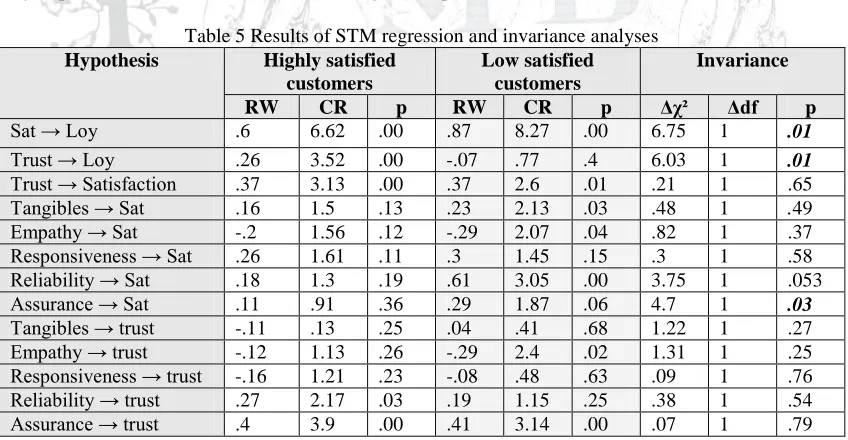
To compare highly satisfied customers and low satisfied customers, factorial invariance (metric equivalence) assesses the extent to which measures have the same meaning for the two groups (Hair et al., 2006). The χ²=1796.85 (1122df) provides the baseline, and CFI=0.91 and RMSEA=0.043 indicate the proposed model‟s outstanding fit across the two groups. Assuming that the unconstrained model is correct and compared with constrained factorial paths, those paths remain invariant across the two groups, with changes in df (Δdf) =26, χ² (Δχ²) =31.796 and p=0.2 that exceed the 0.05 Byrne (2001) cut-off, indicating that the factorial paths are invariant across the two groups. Because metric equivalence is established, the analysis proceeds to test for invariance in the regression paths (Table 5).
Table 5 Results of STM regression and invariance analyses
Hypothesis Highly satisfied
customers
Low satisfied customers
Invariance
RW CR p RW CR p Δχ² Δdf p
Sat → Loy .6 6.62 .00 .87 8.27 .00 6.75 1 .01
Trust → Loy .26 3.52 .00 -.07 .77 .4 6.03 1 .01
Trust → Satisfaction .37 3.13 .00 .37 2.6 .01 .21 1 .65
Tangibles → Sat .16 1.5 .13 .23 2.13 .03 .48 1 .49
Empathy → Sat -.2 1.56 .12 -.29 2.07 .04 .82 1 .37
Responsiveness → Sat .26 1.61 .11 .3 1.45 .15 .3 1 .58
Reliability → Sat .18 1.3 .19 .61 3.05 .00 3.75 1 .053
Assurance → Sat .11 .91 .36 .29 1.87 .06 4.7 1 .03
Tangibles → trust -.11 .13 .25 .04 .41 .68 1.22 1 .27
Empathy → trust -.12 1.13 .26 -.29 2.4 .02 1.31 1 .25
Responsiveness → trust -.16 1.21 .23 -.08 .48 .63 .09 1 .76
Reliability → trust .27 2.17 .03 .19 1.15 .25 .38 1 .54
Assurance → trust .4 3.9 .00 .41 3.14 .00 .07 1 .79
ISSN: 2306-9007 Alsajjan (2014) 1100
I
www.irmbrjournal.com June 2014I
nternationalR
eview ofM
anagement andB
usinessR
esearchVol. 3 Issue.2
R
M
B
R
Discussion
The SEM analysis confirmed the proposed model. Consistent with the argument of Ranaweera and Prabhu (2003) and Aghdaie and Khatami (2013), satisfaction was found to be stronger than trust in affecting customers‟ loyalty to vendors. Deploying SQ as a multidimensional factor in the study revealed that the interactions of the five dimensions with other variables varied such that responsiveness and tangibles had no significant impact on trust. The insignificant relationship of tangibles with trust can be justified because people rely on human relationships more than they do on physical facilities. However, responsiveness, defined as the „willingness to help customers and provide prompt service‟, had an insignificant impact on trust, which requires further investigation.
One possible explanation for the lack of significance of responsiveness is the role of cultural and/or demographic factors. Moreover, assurance, defined as the „knowledge and courtesy of employees and their ability to inspire trust and confidence‟, had an insignificant relationship with satisfaction. This finding might be attributed to the significant impact of assurance on trust; trust was found to be the sole mediator of the effects of assurance on loyalty in the model. Confirming the SERVQUAL framework, all co-variances among SQ dimensions were significant.
The CSI result was 64.4%. From a service context, this percentage is reasonable. In fact, the Fornell (1992) study obtained the same result; the service sectors had an average score of 63%. This result is likely due to the nature of the services, where variability is considered a dominant attribute. O2 customers were the most satisfied, with a CSI of 68.2%, almost four percentage points above the average. Moreover, these customers are less likely to have more than one mobile, with an average of 1.3 mobile per customer (table 4). „Three‟ customers are the least satisfied, with an average CSI of 55.9%, almost nine percentage points below the average. Moreover, the „three‟ customers are more likely to own more than one phone (with an average of 1.6 mobile phones per customer). It is interesting to note that companies with lower CSI scores are those with higher standard deviations, indicating the high variability of customer satisfaction with the services provided by the providers.
The same companies that had above-average CSI scores are also those that had above-average scores on the CTI. Can the CTI be used as a proxy for the CSI? Based on the strong relationship between trust and satisfaction (R.W. 0.81 significant at 0.01 level) and the obvious correlation between the two indices as tested using the two-tailed Pearson correlation that resulted in 0.64 significance at a 0.01 confidence level, it is safe to conclude that the CTI can be used as an indicator for the CSI in the context of this study. However, more research is needed to investigate the practical implications of the CTI compared to the CSI before the generalizability of this conclusion can be determined.
The invariance analysis employed to explore the significant variations between high and low satisfied customers resulted in interesting metrics. Low satisfied customers considered satisfaction very important to their loyalty to service providers. STM explained 67% of low satisfied customers‟ loyalty variance. Trust showed an insignificant relationship with loyalty for low satisfied customers, but this insignificance should be temporary, lasting only until high satisfaction is achieved.
ISSN: 2306-9007 Alsajjan (2014) 1101
I
www.irmbrjournal.com June 2014I
nternationalR
eview ofM
anagement andB
usinessR
esearchVol. 3 Issue.2
R
M
B
R
Managerial implications
As companies strive to win customer loyalty because of its many benefits, they should be aware that loyalty incidents vary in their importance based on the level of customer satisfaction. In other words, the emphasis on the dimensions of service quality among service providers should vary based on customer satisfaction levels. For highly satisfied customers, providing quality service requires that service providers must instill trust among their customers while satisfactorily meeting additional four dimensions of service quality: tangibles, empathy, responsiveness, and reliability. On the other hand, service providers must focus on the five service quality dimensions alongside satisfaction in their communication with customers to enhance their loyalty. Although segmenting markets based on demographic variables, lifestyle, and other common variables is widely accepted in marketing practice, this study suggests that segmenting markets based on levels of customer satisfaction is vital. Satisfaction, trust, and assurance are factors that vary in importance between highly satisfied customers and low satisfied customers.
This study has also demonstrated that satisfied customers own fewer cell lines, have longer relationships with their service providers and use more cell minutes, on average, in comparison to low satisfied customers (table 4). The results indicate that less costly does not necessarily equate to more satisfied, as evidenced by „three‟, which offers the cheapest minutes but has the least satisfied customers. Because price is not the most effective competitive factor, the means of competition that reduces price elasticity among loyal customers is increasingly important, and high levels of customer satisfaction may be that means (Fornell, 1992). This result emphasizes the relationship between highly satisfied customers and service provider success. Finally, to stay ahead of the competition, managers should apply the benchmarking strategy when assessing customer satisfaction and modifying their marketing efforts.
Future Research and Limitations
It is important for future research to use a larger sample that covers different customer populations. Furthermore, the use of CTI as a proxy for CSI requires further investigation. This study did not take into consideration the impact of common moderating variables, such as gender and income, on customer loyalty, satisfaction, trust, and service quality.
Furthermore, the relationships among service quality dimensions, satisfaction and trust require further elaboration. Qualitative research may provide deep insight into these relationships. Although it would be appealing to conclude that trust and satisfaction are the only factors that explain loyalty, the unexplained variance of loyalty suggests that there are other important factors that have not been addressed in research.
Conclusion
This study has proposed the satisfaction-trust model and demonstrated its significance; it explains 65% of the loyalty variance. Although the CSI was calculated for the sample, it was divided between two groups, highly satisfied and low satisfied customers, to investigate the behavioral differences between the groups. The results showed that highly satisfied customers value trust and satisfaction when offering their loyalty to mobile service providers.
ISSN: 2306-9007 Alsajjan (2014) 1102
I
www.irmbrjournal.com June 2014I
nternationalR
eview ofM
anagement andB
usinessR
esearchVol. 3 Issue.2
R
M
B
R
References
Aghdaie, S. & Khatami, F. (2013). A Study of Customer Shopping Behavior and Effective Factors on Building up Customer Loyalty. International Review of Management and Business Research. 2(4). 1011-1024
Alsajjan, B. (2009). The Relative Importance Of Trust Intentions And Trust Beliefs In Internet Banking
Adoption. International Review of Business Research Papers. 5(5). 257-272
Alsajjan, B. & Dennis, C. (2010). Internet banking acceptance model: Cross-market examination. Journal
of Business Research. 63 (9-10). 957–963
Anderson, E., & Fornell, C. (2000). Foundations of the American Customer Satisfaction Index. Total Quality Management. 11(7). 869-882
Anderson, E., Fornell, C., & Rust, R. (1997). Customer Satisfaction, Productivity, and Profitability:
Differences Between Goods and Services. Marketing Science Spring. 16 (2). 129-145
Anderson, R. & Srinivasan, S. (2003). E-satisfaction and e-loyalty: A contingency framework. Psychology
and Marketing. 20 (2). 123–138.
Aydin, S, & Ozer, G. (2005). The analysis of antecedents of customer loyalty in the Turkish mobile
telecommunication market. European Journal of Marketing, 39 (7/8), 910-925
Bagozzi R. & Yi Y. (1988). On the evaluation of structural equation models. Journal of the Academy of Marketing Science; 16 (1). 74-94.
Bagram, M. and Khan, S. (2012). Attaining Customer Loyalty! The Role of Customer Attitude and
Consumer Behavior. International Review of Management and Business Research. 1(1). 1-8
Bayraktar, E., Tatoglu, E., Turkyilmaz, A., Delen, D., & Zaim, S. (2012). Measuring the efficiency of
customer satisfaction and loyalty for mobile phone brands with DEA. Expert Systems with
Applications, 39(1), 99-106.
Beerli, A., Martin, J.D. & Quintana, A. (2004). A model of customer loyalty in the retail banking market. European Journal of Marketing. 38. (1/2). 253-275.
Berry, L.L., Parasuraman, A. & Zeithaml, V.A., (1988). The service-quality puzzle. Business horizons. 31(5). 35-43.
Bloemer, J., KoDe, R., & Pascal P. (1998). Investigating drivers of bank loyalty: The complex relationship between image, service quality and satisfaction. International Journal of Bank Marketing. 16 (7), 276-86.
Bolton, R., & Myers, M., (2003). Price-Based Global Market Segmentation for Services. Journal of Marketing. 67 (3). 108-128
Byrne, B. (2001). SEM with AMOS: Basic concepts, applications, and programming. Routledge.
Cronin, J., & Taylor S., (1992). Measuring Service Quality: A Reexamination and Extension. Journal of Marketing. 56(3). 55-68
Cronin, J., & Taylor S., (1994). SERVPERF Versus SERVQUAL: Reconciling Performance-Based and
Perceptions-Minus-Expectations Measurement of Service Quality. Journal of Marketing, 58 (1).
125-131.
Cyr, D. (2008) Modeling Web Site Design Across Cultures: Relationships to Trust, Satisfaction, and
E-Loyalty. Journal of Management Information Systems. 24 (4). 47 - 72
DeRuyter, K., Bloemer, J., & Peeters, P. (1997). Merging service quality and service satisfaction. An
empirical test of an integrative model. Journal of Economic Psychology, 18 ( 4). 387–406
Edvardsson, B., Johnson, M., Gustafsson, A., & Strandvik, T., (2000). The effects of satisfaction and
loyalty on profits and growth: Products versus services. Total Quality Management. 11 ( 7), 917-927
Fornell, C. (1992). A National Customer Satisfaction Barometer: The Swedish Experience. Journal of Marketing, 56 (1), 6-21
Fornell, C. (1995). The Quality of Economic Output: Empirical Generalizations About Its Distribution and
ISSN: 2306-9007 Alsajjan (2014) 1103
I
www.irmbrjournal.com June 2014I
nternationalR
eview ofM
anagement andB
usinessR
esearchVol. 3 Issue.2
R
M
B
R
Fornell, C., Johnson, M. Anderson, E., Cha, J., & Bryant, B., (1996). The American Customer Satisfaction
Index: Nature, Purpose, and Findings. Journal of Marketing. 60 (4). 7-18
Fortin D., Dholakia R., & Dholakia N. (2002). Emerging issues in electronic marketing: thinking outside the square. Journal of Business Research; 55 (8). 623-627.
Friedman, B., Kahn, P. & Howe, D. (2000). Trust online. Communications of the ACM. 43 (12). 34-40.
Garbarino, E. & Johnson, M. (1999). The Different Roles of Satisfaction, Trust, and Commitment in
Customer Relationships. Journal of Marketing. 63 (2). 70-87
Grabner-Kraeuter, S. (2002). The Role of Consumers' Trust in Online-Shopping. Journal of Business
Ethics. 39(1). 43-50.
Grazioli, S. & Jarvenpaa, S. (2000). Perils of Internet fraud: an empirical investigation of deceptionand
trust with experienced Internet consumers. Systems, Man and Cybernetics, Part A, IEEE Transactions
on, 30(4). 395-410.
Gerpott, T., Rams, W., & Schindler, A. (2001). Customer retention, loyalty, and satisfaction in the German
mobile cellular telecommunications market. Telecommunication Policy, 25(4), 249–269.
Hair J. Black W. Babin B. Anderson R. & Tatham R. (2006). Multivariate Data Analysis. Pearson Education.
Hallowell, R. (1996). The Relationship of Customer Satisfaction, Customer Loyalty, and Profitability: An Empirical Study. The International Journal of Service Industry management. 7 (4). 27–42.
Hausknecht, D. (1990). Measurement scales in consumer satisfaction/dissatisfaction. Journal of Consumer
Satisfaction, Dissatisfaction and Complaining Behavior. 3. 1-11.
Hirschman, A. (1970). Exit, Voice and Loyalty: Responses to Decline in Firms, Organizations and States.
Cambridge, Mass, Harvard University Press.
Jarvenpaa , S. & Tractinsky, N. (1999). Customer trust in an Internet store: A cross cultural validation. J. Comput.-Mediated Comm. 5 (2). 1-33.
Johnson, M., Anders G., Tor Wallin A., Line L., & Jaesung C. (2001), The Evolution and Future of
National Customer Satisfaction Index Models. Journalof Economic Psychology, 22 (April), 217–45.
Johnson, M. & Fornell, C., (1991) . A framework for comparing customer satisfaction across individuals
and product categories. Journal of Economic Psychology, 12 (2). 267–286
Kaiser, H. (1974) An index of factorial simplicity. Psychometrika. 39(1). 31-36.
Kandampully, J. (1998). Service quality to service loyalty: a relationship which goes beyond customer
services. Total Quality Management. 9 (6). 431-441
Kim, M., Park, M., & Jeong, D. (2004). The effects of customer satisfaction and switching barrier on customer loyalty in Korean mobile telecommunication services. Telecommunications Policy. 28 (2). 145–159
Kim, D. Ferrin, D. & Rao, H. (2009). Trust and satisfaction, two stepping stones for successful e-commerce
relationships: A longitudinal exploration. Information Systems Research. 20(2). 237-257.
Kotler, P. (1988). Potential Contributions of Marketing Thinking to Economic Development. In E. Kumcu
and A. Firat (Eds.), Marketing and Development: Toward Broader Dimensions. Supplement 4 of Research in Marketing. 1-10
Kramer, R., (1999). Trust and distrust in organizations: emerging perspectives, enduring questions. Annual
Review of Psychology. 50. 569-598.
Laroche, M., Ueltschy, L., Abe, S., Cleveland, M., & Yannopoulos, P. (2004). Service Quality Perceptions
and Customer Satisfaction: Evaluating the Role of Culture. Journal of International Marketing. 12 (3).
58-85
Luhmann, N., (1979). Trust and Power. John Wiley and Sons.
Mayer, R. Davis, J. & Schoorman, F. (1995). An integrative model of organizational Trust. Academy of Management Review. 20(3). 709-734.
Mcknight, D. & Chervany, N., (2002). What Trust means in e- commerce consumer relationships: an
ISSN: 2306-9007 Alsajjan (2014) 1104
I
www.irmbrjournal.com June 2014I
nternationalR
eview ofM
anagement andB
usinessR
esearchVol. 3 Issue.2
R
M
B
R
Mittal, V. & Kamakura, W. (2001). Satisfaction, Repurchase Intent, and Repurchase Behavior: Investigating the Moderating Effect of Customer Characteristics. Journal of Marketing Research. 38 (1). 131-142
Morgan, R. & Hunt, S. (1994) The commitment–trust theory of relationship marketing. Journal of Marketing.58 . 20-38.
Morgeson, F., Mithas, S., Keiningham, T., & Aksoy, L. (2011). An investigation of the cross-national
determinants of customer satisfaction. Journal of the Academy of Marketing Science , 39( 2), 198-215
Oliver, R., (1996). Varieties of Value in the Consumption Satisfaction Response. Advances in Consumer
Research. 2. 143-147.
Parasuraman, A., Berry, L. & Zeithaml. V., 1991. Understanding Consumer Expectations of Service. Sloan
Management Review, 32 (3). 39-48.
Parasuraman, A., Zeithaml, V. A., & Berry, L. L., (1988). SERVQUAL: A multiple item scale for measuring consumer perceptions of service quality. Journal of Retailing, 64 (1), 12-40.
Prentice, C. (2013). Service quality perceptions and customer loyalty in casinos. International Journal of
Contemporary Hospitality Management, 25(1), 49-64.
Ranaweera, C. & Prabhu, J. (2003). The influence of satisfaction, trust and switching barriers on customer
retention in a continuous purchasing setting. International Journal of Service Industry Management. 14
(4). 374 – 395
Reichheld, F., & Schefter, P. (2000). E-Loyalty. Your secret weapon on the Web. Harvard Business Review, 87(4). 105–113.
Rousseau, D., Sitkin, S., Burt, S. & Camerer, C., (1998). Not so different after all: A cross-discipline view
of trust. Academy of Management Review, 23(3). 393-404.
Rust, R. & Oliver, R. (1994). Service Quality: Insights and Managerial Implications. Sage Publications Sotgiu, F., & Ancarani F. (2005). The drivers of e-retailers price levels. International review of Retail,
Distribution and Consumer Research, 15(1). 75-89.
Turel, O., & Serenko, A. (2006). Satisfaction with mobile services in Canada: An empirical investigation. Telecommunications Policy, 30(5–6). 314–331
WU I., & CHEN J., (2005). An extension of Trust and TAM model with TPB in the initial adoption of
on-line tax: An empirical study. International Journal of Human-Computer Studies, 62(6). 784-808.
Zeithaml V. (1988). Consumer Perceptions of Price, Quality and Value : A Means-end Model and Synthesis Analysis. Journal of Marketing, 52(July), 2-22.