Harmful Expression Extraction in Cyberbullying Detection
Suzuha Hatakeyama
1,*, Fumito Masui
1, Michal Ptaszynski
1, Kazuhide Yamamoto
21 Department of Computer Science, Kitami Institute of Technology, Kitami, Japan.
2 Department of Electrical Electronics, and Information Engineering, Nagaoka University of Technology, Nagaoka, Japan.
Received 15 January 2016; received in revised form 12 March 2016; accepted 25 March 2016
Abstract
We study the social problem of cyberbullying, defined as a new form of bullying that takes place in the Internet
space. This paper proposes a method for automatic acquisition of seed words to improve performance of the original
method for the cyberbullying detection by Nitta et al. [1]. We conduct an experiment exactly in the same settings to
find out that the method based on a Web mining technique, lost over 30% points of its performance since being
proposed in 2013. Thus, we hypothesize on the reasons for the decrease in the performance and propose a number of
improvements, from which we experimentally choose the best one. Furthermore, we collect several seed word sets
using different approaches, evaluate and their precision. We found out that the influential factor in extraction of
harmful expressions is not the number of seed words, but the way the seed words were collected and filtered.
Keywords: cyberbullying, information extraction, text mining, seed word, SO-PMI-IR
1.
Introduction
The method by Nitta et al. [1] uses a Web mining technique (with Yahoo! API) to extract co-occurrences of input
sentences with cyberbullying entries and calculates relevance values using a modified SO-PMI-IR formula [4]. We
repeated their experiment from 2013, with exactly the same settings, to find out how the performance of the Web-based
method changed during the several years since being proposed in 2013 and compare it to the results reported by Nitta et
al. As the evaluation metrics, we used area under the curve (AUC) on the graph showing precision and recall. The result
of the comparison is represented in Fig. 1.
Nitta et al. [1] report a high performance (91%) when it comes to precision for low recall window. Moreover,
originally the performance of their method retained high performance (around 70%) even close to 50% of recall, after
which it decreased overall performance due to drop in precision for higher thresholds. However, when we repeated their
experiment in January 2015, the overall results greatly dropped. Precision did not exceed 60% for the whole threshold
span.
In the following sections, we firstly discuss the potential reasons for the drop in performance (Section 2). Next we
explain the original method (Section 3) and then propose a method for automatic acquisition of seed words to improve
the original method (Section 4). Next, we conduct a series of experiments with automatically obtained different seed
word sets, experimentally choose the one with the best performance (Section 5) and discuss the results (Section 6).
Finally we conclude the paper (Section 7).
*Corresponding author. E-mail address: [email protected]
Fig. 1 Performance comparison for method by Nitta et al. (2013) reported originally in 2013 and repeated in 2015
2.
Discussion on Reasons for Performance Decrease
In this section we discuss possible reasons for the decrease of the performance in the method proposed by Nitta et al. [1].
After thorough analysis of the experiment data, we noticed that most of the informati on extracted in 2013 was not
available in 2015. This could be due to the following reasons. Firstly, fluctuation in page rankings could push the
information to the bottom which makes it not extractable anymore by Nitta et al.’s method. Secondly, frequent deletion
requests of harmful contents by Internet Patrol members could make their efforts pay off.
However, the most probable is the third cause, which is the recent tightening of usage policies by most Web service
providers, such as Google*, Twitter† and Yahoo!, which are used by Nitta et al. This includes recently introduced
DMARC‡ policies related to e-mail spoofing and general improvements in policies aimed at decreasing Internet
harassment.
The fact that the performance of Nitta et al.’s method decreased from over 90% to less than 60% during less than 3
years is an important warning also for other research based on Web mining. Probabilities of such problems have been
indicated some time ago [2], and could become a major problem in the future. Thi s also advocates more focus on either
corpus-based methods or methods providing constant update of applicable seed words (features), such as the one
proposed in this paper.
Fig. 2 Examples of extracted harmful statements. Japanese Romanized (J), English translation (E), adjusted to express the original meaning as closely as possible
3.
Description of Original Method
The method originally proposed by Nitta et al. [1] uses a list of seed words to calculate semantic orientation score
SO-PMI-IR and then maximize the relevance of categories with input sentence. There are three steps in the classiftcation
of the harmfulness of input:
kiero (get lost), shineyo (just die!), munou (incompetent), busaiku (ugly), busu (ugly hag), doutei (virgin),
(2) Categorization and harmful word detection together with harmfulness polarity de- termination,
(3) Relevance maximization.
This method is an extension of the method proposed by Turney [4] to calculate the relevance of words with specified
categories according to the equation 1, where pi is a phrase extracted from the input, wj are three words that are registered in
one category of harmfulness polarity words, hits(pi) and hits(wj) are Web search hits for each category for pi and wj
respectively, hits(pi&wj) is a number of hits when pi and wj appear on the same Web page. Finally, P M I − IR(pi, wj) is the
relevance of pi and wj .
SO-PMI-IR(pi,wj) = log2{
ℎ𝑖𝑡𝑠(𝑝𝑖&𝑤𝑗)
ℎ𝑖𝑡𝑠(𝑝𝑖)ℎ𝑖𝑡𝑠(𝑤𝑗)} (1)
Turney’s method was extended by Nitta et al. to work not only on words, but on phrases. The phrases are automatically extracted from input sentences using depen- dency relations. Next, for all of the phrases the relevance is
calculated with seed words from multiple categories of harmful words. The degree of association for each category,
SO-PMI-IR score is maximized so that the maximum value achieved within all mea- sured categories is considered as the
harmfulness score representative for the input sentence, and is calculated according to the equation 2.
score = max(max(SO-PMI-IR(pi,wj))) (2)
4.
Existing Mechanism
In this section we propose our reimplementation and performance improvement of the method for cyberbullying
detection. This method exists for automatic acquisition and update of seed words used in Nitta et al.’s method.
4.1. Automatic Acquisition of Harmful Words
To improve the performance of Nitta et al.’s method we apply a method proposed by Ishizaka et al. [3].
The method proposed by Ishizaka et al. extends the initial value based on n-gram statistics and uses it to
automatically acquire harmful expressions from a corpus (for example the Web). It calculates a SO -PMI-IR value
(Semantic Orientation mining method based on Point Mutual Information with the statistical data collected by
Information Retrieval [4]; here we abbreviate this to “SO value”.) indicating the degree of harmfulness of a word in a
document. If SO value for a word is greater than or equal zero, the word is considered harmful. The method also allows
controlling the extraction precision by changing the threshold window of n-gram co-occurrence probability.
Originally, the method was successfully applied to harmful word acquisition from a large Japanese electronic
bulletin board system (BBS), called “2-channel.” Some of the examples of harmful statements extracted with this
method are represented in Fig. 2. All example sentences contain harmful expressions.
The method of Ishizaka et al. allows modification and updating of the initial value in Nitta et al.’s method, which
consists of a set of harmful seed words used in the IR procedure (Web mining). Such words could be automatically
acquired and updated regularly, which would greatly decrease the cost of collecting the seed word lists when the Web
mining conditions change.
4.2. Double Filtering of Harmful Seed Words
Ishizaka et al. at first conducted a questionnaire in which they asked three annotators to judge whether a word is
harmful or not. In the questionnaire, they used a set of 2,735 words automatically extracted from harmful BBS entries.
From the initial set, they retained only those words for which all three annotators agreed about. There were 76 of such
words (we refer to them as harmful word candidates). These words were used as a base for automatic selection. Next,
Ishizaka et al. automatically selected a set of 14 most frequent harmful and 17 non-harmful basic words appearing in the
original entries by using n-gram statistics (with n=7). They used those basic words to filter-out he most harmful out of the
initial 76 harmful word candidates selected by human annotators. In our approach we added to the Ishizaka et al.’s 14
harmful basic words additional 9 harmful basic words used by Nitta et al. With overall 23 harmful and 17 non -harmful
basic words we conducted first filtering of the basic words.
We calculated SO values for each of the 76 harmful word candidates with every other basic word, and calculated the
sum of SO values for each word candidate. From the words which obtained SO value higher than 0 we selected those
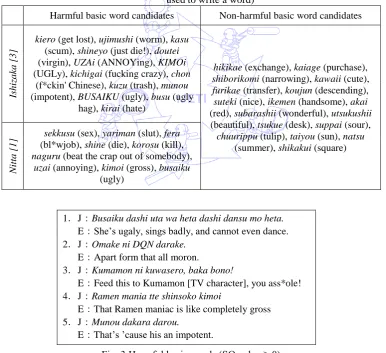
words which also appeared as basic words. The basic word set used in filtering is represented in Table 1. The basic words
that were filtered out are represented in Fig. 3. The first filtering provided a set of basic harmful words which were both
harmful from the point of view of human annotators and were in the strongest relevance to harmful BBS entries.
Table 1 Harmful and non-harmful basic words used in the experiment, with their English translations (meaning as close to original as possible; capital letters indicate different Japanese characters
used to write a word)
Harmful basic word candidates Non-harmful basic word candidates
Is h iz a ka [ 3 ]
kiero (get lost), ujimushi (worm), kasu (scum), shineyo (just die!), doutei (virgin), UZAi (ANNOYing), KIMOi (UGLy), kichigai (fucking crazy), chon
(f*ckin' Chinese), kuzu (trash), munou (impotent), BUSAIKU (ugly), busu (ugly
hag), kirai (hate)
hikikae (exchange), kaiage (purchase), shiborikomi (narrowing), kawaii (cute), furikae (transfer), koujun (descending), suteki (nice), ikemen (handsome), akai (red), subarashii (wonderful), utsukushii (beautiful), tsukue (desk), suppai (sour), chuurippu (tulip), taiyou (sun), natsu
(summer), shikakui (square)
N
itta
[
1
] sekkusu (sex), yariman (slut), fera (bl*wjob), shine (die), korosu (kill), naguru (beat the crap out of somebody),
uzai (annoying), kimoi (gross), busaiku (ugly)
Fig. 3 Harmful basic words (SO value ≥ 0)
In the second filtering we used as basic words: the 17 harmful basic words obtained in the first filtering and the same
17 non-harmful basic words (later called “seed-17”), and calculated the SO value again, this time with a dataset
containing 76 harmful word candidates and 17 non-harmful basic words (93 words in total). We added the non-harmful
words to verify whether the harmful basic words cause a bias in scoring. If so, the non-harmful words would also achieve 1.J:Busaiku dashi uta wa heta dashi dansu mo heta.
E:She’s ugaly, sings badly, and cannot even dance. 2.J:Omake ni DQN darake.
E:Apart form that all moron.
3.J:Kumamon ni kuwasero, baka bono!
E:Feed this to Kumamon [TV character], you ass*ole! 4.J:Ramen mania tte shinsoko kimoi
E:That Ramen maniac is like completely gross 5.J:Munou dakara darou.
(later called “seed-9”), and similarly calculated the SO value for the whole dataset (93 words). Having all SO values, we
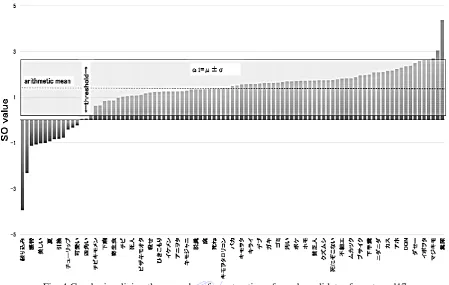
calculated arithmetic mean SO μ and standard deviation σ and automatically set a threshold α1 as μ ± σ.
Finally, we extracted candidates for harmful words w and non-harmful word candidates h as h ≤ α1 ≤ w. A graph visualizing this operation is represented in Fig. 4. All words extracted this way for sets seed-17 and seed-9 are
represented in Table 2. Worth mentioning is the fact that although one would expect the basic words to come on top, they
would be expected to obtain higher SO value due to perfect relevance score with themselves, resulting in the candidate
words extracted according to this procedure did not contain even one word from the basic harmful word set. This
indicates that the double filtering optimized the search and can be considered a viable procedure.
Fig. 4 Graph visualizing the procedure for extraction of word candidates for set seed17
Table 2 Harmful and non-harmful seed words obtained according to the double filtering procedure (seed-17) and for original words used by (Nitta et al. 2013) (seed-9)
Harmful seed words Non-harmful seed words
S
ee
d
-17
dasee (hopeless), bakasayo (stupid communist), fun-nyou (dung), majikimo
(seriously gross), ibo-ota (warty nerd), kuzumasugomi (shitty mass-mudia),
goki-ota (cockroachy nerd)
shiborikomi (narrowing), kaiage (purchase), furikae (transfer), koujun (descending), natsu (summer), suteki (nice), utsukushii (beautiful),
kawaii (cute), hikikae (exchange), akai (red), taiyou (sun), chuurippu (tulip), tsukue (desk)
S
ee
d
-9
bicchi (bitch), ibo-ota (warty nerd), mekuso (eye gum), dappun (feces), kusomushi (dung beetle), bakasayo (stupid communist), dasee (hopeless),
fun-nyo (dung), goki-ota (cockroachy nerd), maji-kimo (seriously gross), kuzumasugomi (shitty mass-mudia),
gumin (ignorant)
shiborikomi (narrowing), chuurippu (tulip), kaiage (pur-chase), suteki (nice), taiyou (sun),
tsukue (desk), natsu (summer), akai (red), shikakui(square), koujun (descending), kawaii
5.
Experiment and Results
After obtaining seed word sets described in section 3, we conducted an experiment to verify whether and how much
does the change in the selection of seed words affect Nitta’s method. Moreover, we calculated the statistical significance
of the results by using the McNemar Test [5].
The experiment was designed as follows. Using filtered seed words we prepared six different harmful word
candidate sets (later referred to as “cases”), applied them as seed words in Nitta’s method and verified its performance.
We show 6 cases of seed word combinations in Table 3.
Table 3 Description of six seed word sets (case 1– case 6) applied in Nitta’s method in the experiment
Case 1 contained 7 double-filtered harmful words (all harmful words under seed-17 in Table 2). Case 2 contained 12
harmful words obtained by single-filtering out the words with the highest harmful relevance using only Nitta et al.’s
original seed word set (all words under seed-9 in Table 2). Case 3 contained Nitta’s original 9 seed words and 7
double-filtered harmful word candidates (overall 16 words). Case 4 contained Nitta’s original 9 seed words and 12
single-filtered candidates. Case 5 contained 5 words originally used by Ishizaka in their article [3]. Finally, case 6
contained only Nitta’s original 9 seed words without any modification.
In the evaluation, we looked at several metrics to choose the best seed word set. We calculated precision (P), recall
(R), and balanced F-score (F) for each case. Then, we first (1) checked which case obtained the highest F-score for the
longest threshold span. Next, (2) we looked at which case obtained the highest break-even point (BEP) on a plot with P
and R. Thirdly, (3) we looked at which of the cases obtained the highest precision in general. Finally, (4) as the last mean
of evaluation we used the same metrics as Nitta et al. [1], namely, area under the curve (AUC) on a plot with P and R. We
also asked ourselves a question (5) whether it was always better to simply add more words, or whether the automatic
filtering of harmful word candidates improved the method and to what extent. Below we address these five questions one
by one.
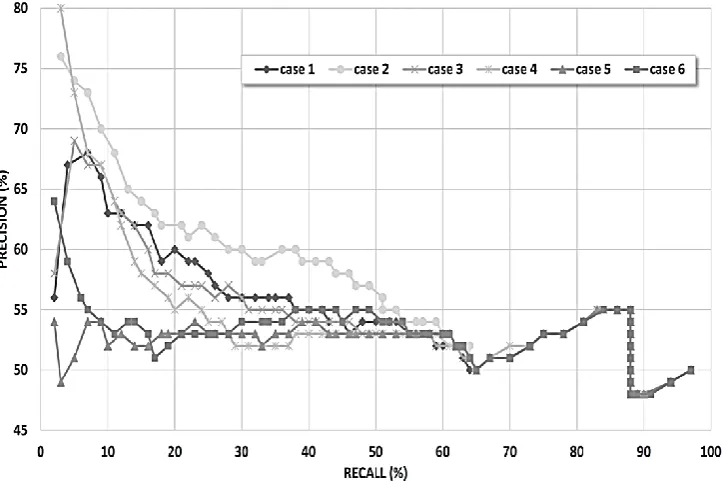
(1) The highest F-score in general was obtained by case 2 (68%). Also case 5 and case 6 obtained similarly high F-score once,
however, for most of the threshold, F for case 2 was always the highest, while for case 5 and case 6 mostly the lowest.
(2) The highest BEP was achieved in order by case 2 (0.59), case 1 (0.56), case 3 (0.55), case 6 (0.54), case 5 (0.53), and case 4
(0.52). This again suggests cases using seed word filtering as better then the others with case 2 achieving the highest score.
The values of BEP for precision and recall for cases 1 to 6 are represented in Table 4.
(3) The highest P was obtained by case 4 (80%). However, its precision, although obtaining the highest score once, quickly
decreases, ending with one of the worst results in general. The second best P was obtained by case 2 (76%). Moreover, case
2 retains high P for most of the threshold span. This supports the previous result indicating case 2 as the best choice.
(4) When it comes to AUC, case 2 outperformed all other cases for most of the threshold span. We consider this as a final
support for case 2 obtaining the best performance. The results were represented in Fig. 5.
Table 4 BEP results for cases 1-6 case 1 7 words from seed17 (Table2) case 2 12 words from seed9 (Table2)
case 3 16 words (7 words from seed-17 + Nitta’s original 9 words) case 4 21 words (12 words from seed-9 + Nitta’s original 9 words) case 5 5 words originally used by Ishizaka et al. [3] case 6 9 words originally used by Nitta et al. [1]
Fig. 5 Results of all compared cases
6.
Discussion
Finally, we verified whether simply adding words to Nitta’s method improves its performance. After analyzing all
evaluation metrics, the cases’ performance was in order: case 2 (12 words), case 1 (7w), case 3 (16w), case 4 (21w), case
6 (9w), case 5 (5w). The Spearman’s Rank Correlation Test calculated between the ranks of cases and numbers of seed
words was ρ = -0.314, which indicates no correlation with minor bias towards negative correlation. This suggests the
following conclusions. Simply adding words does not improve the performance. Minor negative correlation could also
suggest the contrary - less seed words results in better results. However, since there was no statistical significance for the
correlation test (2-sided p-value = 0.564), to prove this more experiments need to be conducted on larger datasets.
Moreover, the two best scores were obtained by the cases applying the proposed double-filtering method. Here,
case1 applies the full filtering procedure (seed17). Case 2 applies single filtering with final set of harmful seed words
extracted with the help of Nitta et al.’s original seed set instead of double-filtered word set. This suggests that the filtering
improves the performance of Nitta’s method in general. Moreover, shortening the filtering from double- to
single-filtering positively influences not only the performance, but also efficiency of the method. Applying only single
filtering instead of double-filtering saves much of the processing time needed to extract the final set of words.
We verified the statistical significance of results using McNemar Test [5], a standard test used for calculating statistical
significance for paired nominal data. Table 5 shows the McNemar Test results.
The comparison of the results of case 5 and case 6 with the results of other cases, indicated that a significant
difference was obtained for all cases except for the difference of case 3 and case 4 with case 5.
Table 5 McNemar Test results (for cases 5 and 6 as baselines)
*p≦0.5, **p≦0.1, ***p≦0.01 case1 case2 case3 case4 case5 case6
case5 189.00 ***
26.88
*** 0.83 0.30 -
16.98 ***
case6 145.00 ***
5.80 *
9.47 **
10.29 **
18.56
7.
Conclusions
In this paper, we presented our re-evaluation of Nitta et al.’s method for cyberbullying detection in informal BBS
websites. We found out that the method originally proposed in 2013 lost over 30% points over two years. The loss in
performance could be caused by several factors, including tightening of usage policies of many Internet services. Next,
we proposed a method for double filtering of seed words using a method by Ishizaka et al. and performed an experiment
on multiple automatically constructed seed word sets. The experiment results clearly showed that simply adding more
words to Nitta et al.’s method is not effective. On the other hand, the proposed filtering method was significantly
effective, although shortening the filtering from double to single improved not only efficiency of the method, but also its
performance, regaining much of the originally reported performance. Moreover, the proposed method not only improved
Nitta et al.’s method for the present time, but it can be used to improve it in the future, if the results drop again due to
fluctuations in Web information.
In the near future, we plan to repeat the experiment by Ishizaka et al. to eliminate any potential ambiguities in
human judgments about the harmfulness of words. We also plan to apply the proposed PMI filtering method to other
Web-mining based methods and verify its potential and limitations in improving such methods in general.
References
[1] T. Nitta, F. Masui, M. Ptaszynski, Y. Kimura, R. Rzepka, and K. Araki,“Detecting cyberbullying entries on informal
school websites based on category relevance maximization,” Proc. of the 6th International Joint Conference on Natural Language Processing (IJCNLP‘13), Oct. 2013, pp. 579-586.
[2] A. Kilgarriff, “Googleology is bad science,” Computational Linguistics, vol. 33, no. 1, pp. 147-151, 2007.
[3] T. Ishizaka and K. Yamamoto, “Automatic detection of sentences representing slandering on the Web,” Proc. of the 17th Annual Meeting of the Association for Natural Language Processing, 2011, pp. 131-134. (In Japanese)
[4] P. D. Turney, “Thumbs up or thumbs down? Semantic orientation applied to unsupervised classification of reviews,” Proc. of ACL-02, Jul. 2002, pp. 417-424.