Tribology in Industry
www.tribology.rsEvaluation of the Surface Roughness of Ti-6Al-4V for
Surface Grinding under Different Cooling Methods
Using Conventional and Vegetable Oil-based Cutting
Fluids
K.N. Ronoh
a,*, N.W. Karuri
a, F.M. Mwema
a,b, H.T. Ngetha
c, S.A. Akinlabi
d, E.T. Akinlabi
baDepartment of Mechanical Engineering, Dedan Kimathi University of Technology, Nyeri, Kenya,
bDepartment of Mechanical Engineering Science, University of Johannesburg, Johannesburg, South Africa, cDepartment of Electrical and Electronics Engineering, Dedan Kimathi University of Technology, Nyeri, Kenya, dDepartment of Mechanical and Industrial Engineering Technology, University of Johannesburg, Johannesburg,
South Africa.
Keywords:
Ti-6Al-4V Cutting fluids MQL
Taguchi
Signal-to-noise ratio ANOVA
Surface roughness
A B S T R A C T
In this research study, the surface roughness of medical grade Ti-6Al-4V alloy was evaluated to understand the effects of cutting fluids, cooling methods, and grinding depths after surface grinding with alumina wheel. Three cutting fluid types namely sunflower oil, sunflower oil-based cutting fluid, and conventional cutting oil were applied to the grinding zone using two cooling methods: minimum quantity lubrication and wet cooling methods. The grinding was undertaken at grinding depths of 0.005, 0.010, and 0.015 mm. The surface roughness of the ground surfaces was determined using a surface profiler. An analysis of variance demonstrated that the individual contributions of cutting fluid types, cooling methods and grinding depths to surface roughness were 42.7 %, 8.46 % and 40.61 % respectively. The design of the experiment was done using Taguchi L9
orthogonal array to determine the collective contributions of the grinding parameters. The analysis of the signal-to-noise ratio shows that the optimal surface roughness of Ti-6Al-4V was obtained with sunflower oil-based cutting fluid, a minimum quantity lubrication of 0.67L/h and a grinding depth of 0.005 mm. This study provides novel evidence of how grinding parameters can be used collectively to optimize Ti-6Al-4V machining.
© 2016 Published by Faculty of Engineering
* Corresponding author:
Kipkurui Nickson Ronoh
E-mail: [email protected] Received: 7 June 2019
Revised: 28 July 2019 Accepted: 18 September 2019
1. INTRODUCTION
Biomaterials have received much support and have been used in the manufacture of the biomedical devices [1,2]. Modern metallic
biomaterials used for making orthopaedic medical implants include titanium-based alloys [1,3]. Ti-6Al-4V is a titanium alloy applied widely in medical industries due to its superior biocompatibility [4], high resistance to corrosion
R
ES
EA
R
in the body fluids [5], high specific density, relatively low modulus of the elasticity (55-110 GPa), high fatigue strength, and high tensile strength [6]. Modification of the surface of titanium alloys is often required to enhance the tribological and biological properties of medical implant materials [7]. One of the techniques for modifying the surfaces of titanium alloys is grinding. Grinding is a finishing process undertaken to achieve a particular surface roughness that will promote osseo-integration [8]. The surface roughness of titanium alloys determines properties of the ground surface such as fatigue strength, the service life, and chemical stability of the medical component [9,10]. The surface roughness generated during grinding depends on the number of process parameters which may interact in their influence on surface roughness during the grinding process. They include the material of the workpiece [11], type of abrasives [12], cutting fluids, cooling methods [13,14], cutting oil viscosity [15], design of a coolant nozzle [16] and cutting parameters such as grinding speed, grinding depth, feed rate [17– 19]. These factors can influence surface roughness individually or collectively.
Ti-6Al-4V is a super-alloy which difficult to machine and requires expensive machinery [5], [20]. Hence, there is a need to devise grinding techniques for Ti-6Al-4V that are cost-effective. The machining processes of Ti-6Al-4V should be sustainable. In a sustainable machining, the expectations are reduction of the machining cost, reduction or elimination of the health and environmental hazards, production of the high quality products [21]. Sustainable machining entails sustainable cooling and lubrication techniques. The sustainable cooling and lubrication techniques includes dry machining, cryogenic cooling, minimum quantity lubrication (MQL) technique, nano-cutting fluids, and MQL nano-fluids [22].
In the MQL technique, the cutting fluid is mixed with compressed air and delivered as an atomized spray. The MQL system reduces the total production costs by approximately 15% [23], lesser cutting forces, less strain hardening and favorable chip formation process [24]. Also, it contributes to the betterment of the surface finish, increasing the life of the tool and lowering the wear of the grinding tools [25]. Choi et al. [26] established that compressed cold air used as
coolant during cylindrical grinding of spindle shaft materials with a CBN wheel was effective with effectiveness nearly comparable with conventional wet-grinding for shallow depths of cut.
Cutting fluids can also influence the cost of grinding Ti-6Al-4V. It generates high temperature during machining hence the selected cutting fluid must have effective cooling and lubrication properties [27].Paleu et al. [28] established that sulphur additive content of 4 % is economical to accomplish the existing standards for cutting fluids wear resistance. Anand et al. [27] explained that there are different types of cutting fluids that are primarily used for cooling and lubrication purposes in a metal cutting operation. They are straight oils, soluble oils, synthetic fluids, semi- synthetic fluids and cryogenic coolants. The cutting fluids used in a grinding process significantly improve the machining characteristics of the process. The conventional cutting fluids are associated with high production costs [23,29] and have environmental and health hazards. This necessitated reduction or complete elimination of lubrication and development of self lubricating materials as a solution [30].
Due to these challenges, vegetable oil-based cutting fluids (VOBCFs) are preferred to conventional cutting fluids during machining. VOBCFs are biodegradable [31], have a higher boiling point and have better lubricating properties than petroleum oil-based cutting fluids [30,32,33]. Due to the benefits of vegetable oil-based cutting fluid, several investigators have studied their influence on grinding of Ti-6Al-4V.
terms of grinding force, grinding temperature, and energy ratio coefficient. They used soybean oil, castor oil, rapeseed oil, sunflower oil, palm and peanut oil during the study. They found out that palm oil and castor oil yielded the lowest and highest grinding temperature, respectively. The performances of the five remaining vegetable oils were in a range between those of palm oil and castor oil.
Hegab et al. [34,35] evaluated the MQL turning performance of Ti-6Al-4V alloy using nano-cutting fluids. The authors established that multi-walled carbon nanotubes (MWCNTs) with the nano concentration of 2 wt % suspended in vegetable oil reduced significantly the flank wear and power consumption. They concluded that there was improvement on the surface quality and cutting performance. Similar results were obtained by Hegab et al. [36] in their study of MQL turning of Inconel 718 where they noted improvement due in the surface quality to usage of nanofluids. Hegab et al. [37] further explained from their study on sustainability assessment of machining with MQL nano-cutting fluids that the nanofluid concentration should be optimized in order to strike a balance between the technical and economic requirements.
Tao et al. [18] investigated the effects of grinding depth, grinding velocity, feed rate, and size of abrasives of the grinding wheel on the surface roughness during grinding of Ti-6Al-4V using silicon carbide grinding wheels. They demonstrated that the values of surface roughness of the Ti-6Al-4V specimen decreased as sizes of the abrasive sizes and grinding depth decreased. Biswojyothi et al. [38] studied the grinding of Ti-6Al-4V by varying MQL parameters of cutting fluid flow rate, cutting fluid concentration and air pressure. They found that the cutting forces and surfaces roughness decreased with increasing air pressure, flow rate, and concentration of the cutting fluids.
Tawakoli et al. [39] compared dry, wet and MQL grinding of the 100Cr6 hardened steel based on the grinding forces and surface quality properties. They found that in MQL grinding of the 100Cr6 hardened steel, the surface roughness obtained were reduced when compared to the flood and dry grinding. Duc et al. [40] carried out a study on the performance of Al2O3 nanofluids in MQL hard milling of
60Si2Mn steel using cemented carbide tools. The results showed that coefficient of friction and tool wear decreased due to the effectiveness of Al2O3 nanofluids. This decrease led to the improvement of cutting performance, surface quality, and tool life. They further established that the lower values of surface roughness was achieved with medium alumina concentration (about 1.13 %) [41]. In a related study, Duc et al. [42] established that Al2O3 soybean-based nanofluids gives the lowest value of surface roughness Ra during MQL hard milling of 90CrSi Steel as compared to MoS2 nanofluids.
Jamil et al. [43] studied the effects of hybrid nanofluid–based MQL and cryogenic cooling when turning Ti–6Al–4V alloy. Results showed that the hybrid nanofluids–based MQL reduced the values of surface roughness, cutting forces and extended the tool life more effectively than the cryogenic technique. Hegab et al. [44] develop an integrated model integrated model (2-D axisymmetric computational fluid dynamics (CFD) and Lagrangian based FE model) to simulate the thermal characteristics of nanofluids when MQL machining of Ti-6Al-4V and Inconel 718. Results shows that both generated cutting temperature and residual stresses showed better performance in case of tests performed using MQL-nano-cutting fluids.
The literature above show that MQL grinding with environmentally benign cutting fluids have promising results. Other studies show that individual grinding conditions can influence surface roughness. However, there are no studies on the collective influence of grinding conditions on grinding Ti-6Al-4V. The goal of this study is to investigate how both individually and collectively the conditions of the cutting fluid types, cooling methods and grinding depth influence surface roughness during grinding of Ti-6Al-4V. From the studies optimal grinding conditions for a specific surface roughness will be identified.
This study experimentally investigated surface roughness generated in grinding Ti-6Al-4V with three cutting fluids; SOBCFs, SO, and conventional cutting oils (CCO). The cutting fluids were applied through three cooling methods; wet cooling method, MQL1 and MQL2 techniques. The Taguchi method was applied to determine the collective influence of the cutting fluid type, cooling methods and grinding depths on the surface roughness. Optimal grinding conditions for desired roughness reported to promote biomedical integration were determined. This study is novel because it investigates the collective influence of grinding parameters on Ti-6Al-4V grinding. It is also novel because it involves the application of sunflower oil-based cutting fluid, through minimum quantity lubrication in grinding of the Ti-6Al-4V. The findings of this research provide a window for identifying optimal and cost-effective conditions of Ti-6Al-4V grinding that can be used to reduce machining costs of this essential biomedical material.
2. RESEARCH METHODOLOGY
Grinding experiments were performed on Ti-6Al-4V to measure surface roughness and determined the influence of each input factor on it.
2.1Formulation of the sunflower oil-based cutting fluids (SOBCFs)
The SOBCFs were formulated using the methods suggested by earlier researchers [49,50]. It contained sunflower oil (Bidco, Kenya) as the base oil along with Tween® 80 (Sigma®, Sigma-Aldrich, Germany) as a non-ionic emulsifier, and coco-diethanol amide (CDE) (Neru Ltd, Kenya), as pH modifier and co-emulsifier. Sunflower oil-based concentrate was formulated by mixing sunflower oil with Tween 80 and CDE in the ratio of 6:3:1 respectively. 600 ml of sunflower oil was determined using a 1-litre measuring jar and mixed with 300 ml of Tween 80, which were added slowly. This mixture was stirred thoroughly using a magnetic stirrer, and when the mixture became a homogeneous liquid, 100 ml of CDE was added and mixed to get a homogeneous mixture. The sunflower oil-based concentrate on its dilution with distilled water and through gentle mixing produces SOBCFs which is an oil-in-water emulsion. Distilled water was used for dilution of SOBCFs to ensure that
fluid life was extended, and proper fluid performance was achieved because water hardness has effects on the cutting fluids. The mixing was done at room temperature, i.e., 22±1 °C using a magnetic stirrer for 10 minutes for proper and uniform mixing. The SOBCFs was checked to ensure that it was monophasic immediately after mixing. The emulsion stability test was carried out by visually inspecting the emulsion after forty-eight hours. The pH of the SOBCFs was determined using digital HANNA pH tester. The HANNA pH meter was calibrated with a standard solution before the measurement.
2.2Material and Grinding Parameters
The material used in all the studies was Ti-6Al-4V alloy (Metals Centre, South Africa). All samples used were cut into small pieces of 25x25x6 mm using wire cut electrical discharge machining (Kens Metal, Nairobi, Kenya). The surfaces of the samples were cleaned in distilled water and iso-Propyl alcohol (Loba Chemie, Mumbai, India) and air-dried.
2.3Experimental Set-up
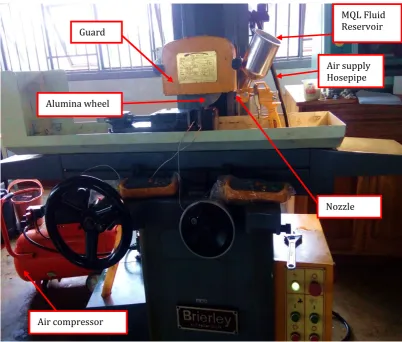
The two different experimental set-ups were used to carry out the grinding process: one uses a wet cooling method, and another use the MQL cooling method. The experimental set-up showed in Fig. 1 was for MQL grinding. In MQL, the cutting fluid in a spray gun is delivered as a mixture with compressed air in an atomized spray into the grinding zone. The range of flow rate is approximately 0.050– 0.600 L/h in an MQL system [38,48,51] though in another study, it was stated that used volume in MQL is in a range of 0.050–1~2 L/h [52]. This flow rate is much below that of the conventional cooling which is approximately 120 L/h. So, the use of 0.57 L/h and 0.65 L/h in the study was within the range of the typical MQL flow rate. The two flow rates were also far less the conventional quantity used of 72 L/h [48,53]. Additionally, we performed trial tests on our grinding facility and these flow rates proved to provide reliable results, hence the choice.
The MQL nozzle was internal mix type-atomizing nozzle (ASG4041, Ingco Tools, China). The nozzle diameter was 1.5 mm, and its outlet position was 82 mm from the grinding zone. The height of the nozzle from the bottom of the wheel was 15 mm and inclined at 25°. These settings were constant for all the experiments. The MQL set-up was gravity fed, and cutting fluids trickle down the tube into the mixing chamber in the nozzle. The flow of the cutting fluids is due to suction pressure created by the injected pressurized air. The air nozzle sprayer has an internal mix type-atomizing nozzle where liquid and compressed air is mixed internally to produce a completely atomized spray.
The compressor compressed air to a pressure of 6 bars and this atomizes the cutting fluid and pushes into the grinding zone. The thermometers were used to monitor the changing temperatures during the grinding process. The results were not very significant to support the discussions in this work. The results were not reliable for inclusion in this work; therefore, they were not included in the paper.
Fig. 1. Experimental set up showing MQL application.
MQL Fluid Reservoir
Air supply Hosepipe
Air compressor Guard
Alumina wheel
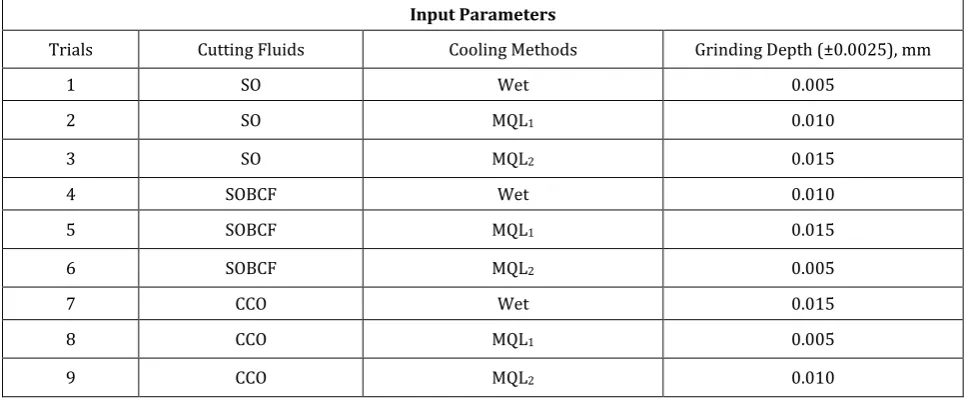
Table 1. Experimental design matrix of the input parameters. Input Parameters
Trials Cutting Fluids Cooling Methods Grinding Depth (±0.0025), mm
1 SO Wet 0.005
2 SO MQL1 0.010
3 SO MQL2 0.015
4 SOBCF Wet 0.010
5 SOBCF MQL1 0.015
6 SOBCF MQL2 0.005
7 CCO Wet 0.015
8 CCO MQL1 0.005
9 CCO MQL2 0.010
2.4Design of Experiment: Taguchi Approach
In this study, there were three input parameters which were varied at three levels due to a selection of the Taguchi Orthogonal Array L9 (34). The orthogonal array reduces the number of experiments carried out [54,55] and in this study, L9 reduced the number of experiments from 27 to 9 [56]. Taguchi analysis was carried out with open source software Minitab 17. The influence of each input parameter on the surface roughness was analysed using analysis of variance and signal-to-noise ratio. Table 1 shows the design matrix of variable input parameters.
2.5Determination of the surface roughness
The surface roughness parameter Ra was measured after grinding using a surface profiler (PhaseII SRG 4500, Upper Saddle River, US). A sampling length lr of 0.8 mm and an assessment length ln of 4.0 mm were used. Prior to the measurements, the profiler was calibrated with a standard specimen supplied by the manufacturer. A Gauss filtering method was used in selecting the filtering method in the profiler. Ten measurements taken along the grinding direction were recorded, and the mean values and associated errors were calculated [57].
2.6Analysis of variance, ANOVA
Minitab 17 was the software used in ANOVA on surface roughness values. ANOVA was carried out at 95 % confidence level, i.e. a 5 % significance level. In this case, an input factor is significant on
the surface roughness if the P value is less than 0.05 and insignificant on the surface roughness if the P value is more than 0.05 [29]. ANOVA was used to find out the percentage influence contributions of the individual parameter on the surface roughness of the ground surface of Ti-6Al-4V [11]. Specifically, the ANOVA was used to analyse the individual influence of cooling methods, cutting fluid types, and grinding depths on the surface roughness.
2.7Determination of Signal-to-Noise ratio (S/N)
The Taguchi technique was used to determine the S/N ratio of the input parameters. The optimal condition is a combination of the input parameters with the highest S/N ratio and is predicted from main effects plot of S/N ratio. There are three characteristic values which can be selected in the S/N ratios and are small-is-better, large-is-small-is-better, and nominal-is-better [11]. In this study, the selected criterion was small-is-better for surface roughness since the aim was to get a better surface finish after grinding.
The equation for computing S/N ratios of the surface roughness was:
2
1
1
10 log
n i i
S
y
N
n
(1)
Where S/N is the signal-to-noise ratio for roughness when small-is-better is the case, yi the
measured surface roughness for the ith
3. RESULTS AND DISCUSSION
The experimental results are analysed and discussed in the following sub-sections.
3.1 Formulation of the SOBCFs
In the formulation of SOBCFs, additives which are harmful to the environment and dangerous for the health were avoided, so that formulated cutting fluid is environmentally friendly. When water was added to the sunflower oil-based concentrate, it formed milky emulsions which were used as cutting fluid. The emulsifiers used in making concentrate caused the sunflower oil to form an oil-in-water emulsion. The emulsion had a milky appearance because the emulsifiers refracted light [58]. From the emulsion stability test carried out, separation of oil and water was not observed before 48 hours of emulsion stability test. This observation indicates the good stability of the emulsion, which is a requirement of any good cutting oil. The pH of the sunflower oil-based emulsions was 9.0 and as recommended by [58, 59], stable emulsions should have a pH value of between 8.4-9.5. The water present in the SOBCFs increases the cooling capacity and rate of heat transfer of the cutting fluid [50]. In this way, the newly formulated SOBCFs makes it possible to have two main cutting fluid properties: proper lubrication and effective cooling, in only one machining fluid [50].
3.2 Surface roughness results
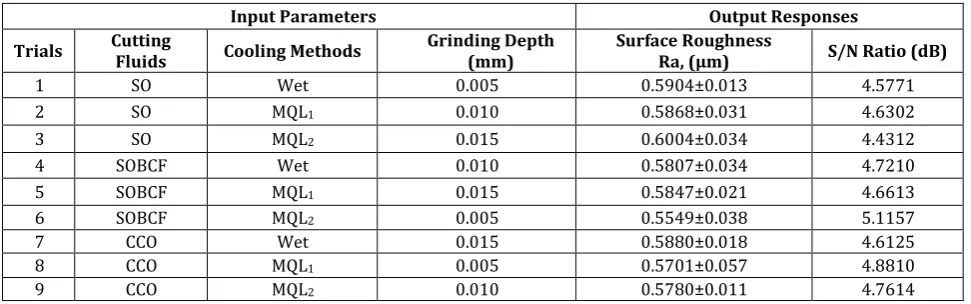
The results of the surface roughness were recorded in Table 2 after grinding using the experimental design matrix. Table 2 also has the average S/N ratio values of each parameter level on the surface roughness.
3.3 Analysis of Variance (ANOVA)
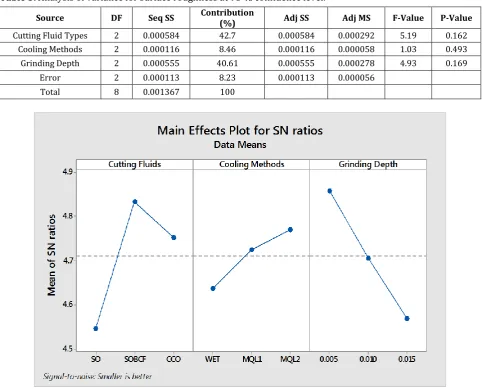
ANOVA was used to determine the influence of cutting fluid types, cooling methods and grinding depths on the surface roughness. Table 3 shows the results of ANOVA for the surface roughness obtained from the experiments. From Table 3, it can be observed that the percentage contributions of cutting fluid types, cooling methods and grinding depths to surface roughness were 42.7 %, 8.46 % and 40.61 % respectively. Based on this ANOVA data, the most important input parameter influencing the surface roughness was the cutting fluid types. The error rate was 8.23 % for the surface roughness and was considerably low. This error meets the requirement which states that for any good and reliable statistical analysis, the error level should be less than 20 % [29].
On examining Table 3, all the three input factors influence surface roughness weakly as P-values are very high at the 95% confidence level. Their corresponding p-values were above 0.05 and were 0.162, 0.493 and 0.169 for cutting fluid types, cooling methods and grinding depths respectively. The cooling methods and the cutting fluid types are input factors which do not influence the surface roughness independently. They influence surface roughness through their interactions with other process parameters. They can be said to have a secondary influence on the surface roughness of a machined component [60]. This observation is similar to the observation made by Rubio et al., [17] in their study where they explained that type of the cooling systems is a factor influencing surface roughness through its interactions.
Table 2. Experimental results on the surface roughness.
Input Parameters Output Responses
Trials Cutting Fluids Cooling Methods Grinding Depth (mm) Surface Roughness Ra, (µm) S/N Ratio (dB)
1 SO Wet 0.005 0.5904±0.013 4.5771
2 SO MQL1 0.010 0.5868±0.031 4.6302
3 SO MQL2 0.015 0.6004±0.034 4.4312
4 SOBCF Wet 0.010 0.5807±0.034 4.7210
5 SOBCF MQL1 0.015 0.5847±0.021 4.6613
6 SOBCF MQL2 0.005 0.5549±0.038 5.1157
7 CCO Wet 0.015 0.5880±0.018 4.6125
8 CCO MQL1 0.005 0.5701±0.057 4.8810
Table 3. Analysis of variance for surface roughness at 95 % confidence level.
Source DF Seq SS Contribution (%) Adj SS Adj MS F-Value P-Value
Cutting Fluid Types 2 0.000584 42.7 0.000584 0.000292 5.19 0.162
Cooling Methods 2 0.000116 8.46 0.000116 0.000058 1.03 0.493
Grinding Depth 2 0.000555 40.61 0.000555 0.000278 4.93 0.169
Error 2 0.000113 8.23 0.000113 0.000056
Total 8 0.001367 100
Fig. 2. Main effects plot for S/N ratio of the surface roughness.
3.4 S/N ratio of surface roughness
The main effects plot for S/N ratio for the surface roughness of ground Ti-6Al-4V is shown in Fig. 2. From the plot, the highest level for each input parameter obtained through the Taguchi method gives the optimal value of that input parameter [29]. In this study, the optimal level for each of the three input parameters was established according to the highest S/N ratio among the levels [11]. It can be observed from Fig. 2 that the optimal input parameters for the surface roughness of Ti-6Al-4V during grinding are SOBCFs as cutting fluid, MQL2 as cooling method and grinding depth of 0.005 mm. The response table for S/N Ratios for surface roughness is shown in Table 4 for the case of smaller-is-better in Taguchi method. From Table 4, the levels of the input factors and S/N ratios, giving the lowest surface roughness value
were determined. It was observed that for cutting fluid, the level was 2 with S/N = 4.833 dB, for the cooling method, the level was 3 with S/N = 4.769 dB and grinding depth, the level was 1 with S/N = 4.858 dB. The bolded values show the optimal input factors for obtaining the lowest surface roughness.
Table 4. Response Table for Signal to Noise Ratios for Surface roughness.
Level Cutting Fluids Methods Cooling Grinding Depth
1 4.546 4.637 4.858
2 4.833 4.724 4.704
3 4.752 4.769 4.568
Delta 0.287 0.133 0.290
Rank 2 3 1
3.5 Mean for surface roughness
surface inconsistency of grinding wheel no matter the dressing behavior and the planting abrasive method adopted. As a result, the surface quality obtained from grinding process is not always perfect. At the beginning of grinding process, poor surface quality can be generated because of the different height of abrasive in grinding wheel surface [18]. Hence the surface roughness value at the beginning of grinding process is much higher than at the end of the grinding process. The surface roughness is becoming stable as experiment continues since the old abrasives wears out and new abrasives are generated. This improves the surface consistency of grinding wheels, and the value of surface roughness reduces. The wearing of the abrasive wheel also affects the morphology of the ground surface [56]. Worn out abrasive wheel cause surface defects affecting the quality of the ground surfaces. Specific surface roughness generated from grinding process depends on the combination of input parameters such as coolant delivery technique, abrasive material, the stability of the machine, vibrations generated, cutting speed and depth of cut employed. The grinding surface roughness generated under same grinding parameters cannot be same but it is a range because of the factors stated above. This
makes the grinding process so dynamic and unpredictable. The research and results presented in this article provide a framework for adoption by machinist to assess and hence improve the machine surface quality of Ti-alloy for various applications.
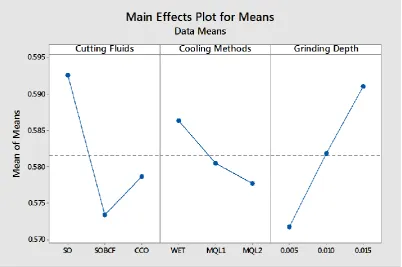
Mean surface roughness, Ra, values of the ground samples are shown in the main effects plot in Fig. 3. It can be observed that surface roughness of the Ti-6Al-4V alloy increases as grinding depth increases in a linear trend as in the case of the classical theory of metal machining. Whenever there is an increase in grinding depth, loads on each abrasive increase, and generates high grinding temperature at the work-piece and wheel interface and this increases the abrasive wear. This abrasive wear will eventually lead to inferior surface finish [54, 60]. Generally, the surface roughness of any part deteriorates with increase in grinding depth when grinding most of the materials [61]. This scenario is because a higher percentage of active cutting grits are engaged in actual cutting at a higher depth of cut. It is also attributed to the thermal effects, loading, and fracture of the grits, the wear, and re-deposition of the material on the ground surface [62].
In considering the aspect of the cooling methods, it was observed that the lowest surface roughness was obtained in both MQL systems, while wet cooling had the highest surface roughness. This observation was due to good penetration of the cutting fluids into grinding zone hence facilitating good cleaning, lubrication, and cooling [51]. Cutting fluids would improve the slippage of grains in the grinding zone and allow the material removed to slip with ease over the workpiece-wheel interface [63]. These factors, when combined, will reduce values of the workpiece surface roughness. A similar observation was also noted by Guo et al. [13] in their research where they explained that the lowest surface roughness occurred after MQL grinding as compared to wet grinding.
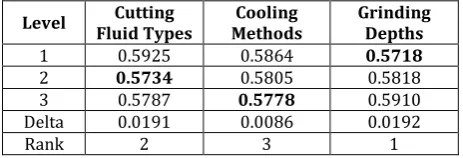
The response table for means for surface roughness is shown in Table 5 for smaller-is-best criterion in Taguchi.
Table 5. Response Table for Means of surface roughness.
Level Fluid Types Cutting Methods Cooling Grinding Depths
1 0.5925 0.5864 0.5718
2 0.5734 0.5805 0.5818
3 0.5787 0.5778 0.5910
Delta 0.0191 0.0086 0.0192
Rank 2 3 1
It can be noted that the surface roughness is lowest when using SOBCFs during the grinding process and highest when using sunflower oil. Low surface roughness values obtained when using sunflower oil-based cutting fluids could be attributed to its combined better lubricating and cooling properties. It can be noted that the surface roughness values are in the range of 0.4-0.6 µm, and this is a good range obtained usually in grinding operations [60].
4. CONCLUSION AND RECOMMENDATION
In this work, Ti-6Al-4V samples were ground under three input parameters and the individual influence of grinding depths, cooling methods and cutting fluid types on the surface roughness of Ti-6Al-4V alloy after surface grinding was determined. The S/N ratio analyses identified the optimal grinding input parameters for grinding Ti-6Al-4V and was given by the highest S/N ratio. In that case, optimal parameters which could generate lowest surface roughness
were sunflower oil-based cutting fluids (SOBCFs) as cutting fluid, MQL2 as a cooling method, and grinding depth of 0.005 mm. From ANOVA, it was noted that the percentage contributions of cutting fluid types, cooling methods and grinding depths to surface roughness were 42.7%, 8.46 % and 40.61% respectively. The ANOVA data shows that the most important input parameter affecting the surface roughness was the cutting fluid types.
This research contributes to the green technology and simple methodology in the grinding process with conventional abrasives, and this can find applications in titanium machining industries. This study is novel because it involves the application of sunflower oil-based cutting fluid, which is green/environmentally friendly cutting fluid, and MQL in grinding of the Ti-6Al-4V.
Further research can be taken up to study the effects of different mixing ratios of sunflower oil-based cutting fluids on grinding performance of the Ti-6Al-4V alloy in terms of surface roughness, grinding forces, grinding temperature, and microstructural alterations. There is a further need for development and application of environmentally friendly cutting fluids, hence achieving green machining. Further research can be undertaken to develop numerical models and standards showing the correlation between grinding parameters and surface integrity of the ground Ti-6Al-4V. Such models and standards would be significant in guiding the choice of the coolant types and method for hard-to-machine metals. Additionally, advanced imaging using atomic force microscopy (AFM) and fractal analyses may be utilized to enhance the surface characterization of the machined surface and present a comprehensive correlation among the parameters.
Acknowledgement
Sincere gratitude to the Dedan Kimathi University of Technology for sponsoring this research study and for providing laboratory resources.
REFERENCES
[1] M. Geetha, A.K. Singh, R. Asokamani, A.K. Gogia,
orthopaedic implants-A review, Progress in Materials Science, vol. 54, iss. 3, pp. 397–425, 2009, doi: 10.1016/j.pmatsci.2008.06.004 [2] Z. Ozdemir, A. Ozdemir, G.B. Basim, Application
of chemical mechanical polishing process on titanium based implants, Materials Science and Engineering: C, vol. 68, pp. 383–396, 2016, doi: 10.1016/j.msec.2016.06.002
[3] R.B. Osman, M.V. Swain, A Critical Review of Dental Implant Materials with an Emphasis on Titanium versus Zirconia, Materials, vol. 8, iss. 3, pp. 932–958, 2015, doi: 10.3390/ma8030932 [4] Damisih, I.N. Jujur, J. Sah, Agustanhakri, D.H.
Prajitno, Characteristics microstructure and microhardness of cast Ti-6Al-4V ELI for biomedical application submitted to solution treatment, AIP Conference Proceedings, vol. 1964, iss. 1, pp. 1–8, 2018, doi: 10.1063/1.5038319
[5] E.O. Ezugwu, B.R. Da Silva, F.W. Sales, R.A. Machado, Overview of the Machining of Titanium Alloys, Encyclopedia of Sustainable Technologies, pp. 487–506, 2017, doi: 10.1016/B978-0-12-409548-9.10216-7
[6] Y. Li, C. Yang, H. Zhao, S. Qu, X. Li, Y. Li, New Developments of Ti-Based Alloys for Biomedical Applications, Materials, vol. 7, iss. 3, pp. 1709– 1800, 2014, doi: 10.3390/ma7031709
[7] S. Kumar, N.T.S.N. Sankara, S.R.S. Ganesh, S.K. Seshadri, Thermal oxidation of Ti6Al4V alloy: Microstructural and electrochemical characterization, Materials Chemistry and Physics, vol. 119, iss. 1–2, pp. 337–346, 2010, doi: 10.1016/j.matchemphys.2009.09.007 [8] F. Klocke, Manufacturing Processes 2: Grinding,
Honing, Lapping, RWTH. Berlin: Springer-Verlag, 2009.
[9] H. Ohmori, K. Katahira, Y. Akinou, J. Komotori, M. Mizutani, Investigation on Grinding Characteristics and Surface-Modifying Effects of Biocompatible Co-Cr Alloy, CIRP Annals, vol. 55, iss. 1, pp. 597–600, 2006, doi: 10.1016/S0007-8506(07)60491-0
[10] R.S.M. Kumar, S.K. Kulkarni, Analysis of Hard Machining of Titanium Alloy by Taguchi Method, Materials Today: Proceedings, vol. 4, iss. 10, pp.
10729–10738, 2017, doi:
10.1016/j.matpr.2017.08.020
[11] S. Chatterjee, R. Rudrapati, P. Kumar pal, G. Nandi, Experiments, analysis and parametric optimization of cylindrical traverse cut grinding of aluminium bronze, Materials Today: Proceedings., vol. 5, iss. 2, pp. 5272–5280, 2018, doi: 10.1016/j.matpr.2017.12.110
[12] D.T. Curtis, S.L. Soo, D.K. Aspinwall, A.L. Mantle,
Evaluation of Workpiece Surface Integrity Following Point Grinding of Advanced Titanium and Nickel Based Alloys, Procedia CIRP, vol. 45, pp. 47–50, 2016, doi: 10.1016/j.procir.2016.02.343 [13] Q. Guo, Z. Liu, Q. An, M. Chen, Investigation on
surface grinding of Ti-6Al-4V using minimum quantity lubrication, Advanced Materials Research, vol. 500, pp. 308–313, 2012, doi: 10.4028/www.scientific.net/AMR.500.308 [14] B. Boswell, M.N. Islam, Sustainable cooling
method for machining titanium alloy, IOP Conference Series: Materials Science and Engineering, vol. 114, pp. 1–13, 2016, doi: 10.1088/1757-899X/114/1/012021
[15] Z.-C. Liu, A. Satoshi, N. Masahiro, The influence of grinding oil viscosity on grinding heat and burn damage in creep-feed grinding{copyright}, Lubrication Engineering, vol. 51, iss. 8, 1995. [16] J.A. Webster, C. Cui, R.B. Mindek, R. Lindsay,
Grinding Fluid Application System Design, CIRP Annals, vol. 44, iss. 1, pp. 333–338, 1995, doi: 10.1016/S0007-8506(07)62337-3
[17] E.M. Rubio, A. Bericua, B. De Agustina, M.M. Marín,
Analysis of the surface roughness of titanium pieces obtained by turning using different cooling systems, Procedia CIRP, vol. 79, pp. 79–84, 2019, doi: 10.1016/j.procir.2019.02.015
[18] Z. Tao, S. Yaoyao, S. Laakso, Z. Jinming,
Investigation of the Effect of Grinding Parameters on Surface Quality in Grinding of TC4 Titanium Alloy, Procedia Manufacturing, vol. 11, pp. 2131– 2138, 2017, doi: 10.1016/j.promfg.2017.07.344 [19] N.M. Vaxevanidis, N.A. Fountas, J.D. Kechagias, D.E. Manolakos, FEM Analysis and ANN Modeling for Optimizing Machinability Indicators during Dry Longitudinal Turning of Ti–6Al–4V ELI Alloy, in D.J. Paulo (Ed.): Metal Cutting Technologies: Progress and Current Trends, Walter de Gruyter GmbH, Berlin, pp. 95–118, 2016, doi: 10.1515/9783110451740-008
[20] A. Beranoagirre, L.N. López de Lacalle, Grinding of Gamma TiAl Intermetallic Alloys, Procedia Engineering, vol. 63, pp. 489–498, 2013, doi: 10.1016/j.proeng.2013.08.182
[21] H.A. Kishawy, H. Hegab, E. Saad, Design for sustainable manufacturing: Approach, implementation, and assessment, Sustainability, vol. 10, iss. 10, pp. 1–15, 2018, doi: 10.3390/su10103604
[23] A. Shokrani, V. Dhokia, S.T. Newman,
Environmentally conscious machining of difficult-to-machine materials with regard to cutting fluids, International Journal of Machine Tools and Manufacture, vol. 57, pp. 83–101, 2012, doi: 10.1016/j.ijmachtools.2012.02.002
[24] S. Ekinović, E. Begović, E. Ekinović, B. Fakić,
Cutting Forces and Chip Shape in MQL Machining of Aluminium Bronze,in Journal of Trends in the Development of Machinery and Associated Technology, 17th International Research/Expert Conference, TMT 2013, Istanbul, Turkey, 10-11 September 2013, pp. 5–8.
[25] L.M. Barczak, A.D.L. Batako, M.N. Morgan, A study of plane surface grinding under minimum quantity lubrication (MQL) conditions, International Journal of Machine Tools and Manufacture, vol. 50, iss. 11, pp. 977–985, 2010, doi: 10.1016/j.ijmachtools.2010.07.005
[26] H.Z. Choi, S.W. Lee, H.D. Jeong, A comparison of the cooling effects of compressed cold air and coolant for cylindrical grinding with a CBN wheel,
Journal of Materials Processing Technology, vol. 111, iss. 1–3, pp. 265–268, 2001, doi: 10.1016/S0924-0136(01)00531-3
[27] A. Anand, K. Vohra, M.I. Ul Haq, A. Raina, M.F. Wani, Tribological considerations of cutting fluids in machining environment: A review, Tribology in Industry, vol. 38, no. 4, pp. 463–474, 2016. [28] V. Paleu, V. Goanţă, B. Istrate, Experimental
investigation on wear resistance of a new cutting fluid using a four ball tribometer – optimization of additive percent, in MATEC Web of Conferences, vol. 112, p. 07026, 2017, doi: 10.1051/matecconf/201711207026
[29] Ç.V. Yıldırım, T. Kıvak, M. Sarıkaya, F. Erzincanlı,
Determination of MQL Parameters Contributing to Sustainable Machining in the Milling of Nickel-Base Superalloy Waspaloy, Arabian Journal for Science and Engineering, vol. 42, iss. 11, pp. 4667–4681, 2017, doi: 10.1007/s13369-017-2594-z
[30] A. Anand, M. Irfan Ul Haq, K. Vohra, A. Raina, M.F. Wani, Role of Green Tribology in Sustainability of Mechanical Systems: A State of the Art Survey, Materials Today: Proceedings,
vol. 4, iss. 2, pp. 3659–3665, 2017, doi: 10.1016/j.matpr.2017.02.259
[31] A. Raj, K.L.D. Wins, K.E. George, A.S. Varadarajan,
Experimental Investigation of Soyabean Oil Based Cutting Fluid during Turning of Hardened AISI 4340 Steel with Minimal Fluid Application, Applied Mechanics and Materials, vol. 813–814,
pp. 337–341, 2015, doi:
10.4028/www.scientific.net/AMM.813-814.337 [32] L. Benkai, L. Changhe, Z. Yanbin, W. Yaogang, J.
Dongzhou, Y. Min, Grinding temperature and energy ratio coefficient in MQL grinding of high-temperature nickel-base alloy by using different vegetable oils as base oil, Chinese Journal of Aeronautics, vol. 29, iss. 4, pp. 1084–1095, 2016, doi: 10.1016/j.cja.2015.10.012
[33] S. Syahrullail, S. Kamitani, A. Shakirin,
Performance of vegetable oil as lubricant in extreme pressure condition, Procedia Engineering, vol. 68, pp. 172–177, 2013, doi: 10.1016/j.proeng.2013.12.164
[34] H. Hegab, H.A. Kishawy, M.H. Gadallah, U. Umer, I. Deiab, On machining of Ti-6Al-4V using multi-walled carbon nanotubes-based nano-fluid under minimum quantity lubrication, The International Journal of Advanced Manufacturing Technology, vol. 97, iss. 5–8, pp. 1593–1603, 2018, doi: 10.1007/s00170-018-2028-4
[35] H. Hegab, U. Umer, I. Deiab, H. Kishawy,
Performance evaluation of Ti–6Al–4V machining using nano-cutting fluids under minimum quantity lubrication, The International Journal of Advanced Manufacturing Technology, vol. 95, iss. 9–12, pp. 4229–4241, 2018, doi: 10.1007/s00170-017-1527-z
[36] H. Hegab, H.A. Kishawy, Towards Sustainable Machining of Inconel 718 Using Nano-Fluid Minimum Quantity Lubrication, Journal of Manufacturing and Materials Processing, vol. 2, iss. 3, pp. 2-8, 2018, doi: 10.3390/jmmp2030050 [37] H. Hegab, B. Darras, H.A. Kishawy, Sustainability
Assessment of Machining with Nano-Cutting Fluids, Procedia Manufacturing, vol. 26, pp. 245– 254, 2018, doi: 10.1016/j.promfg.2018.07.033 [38] M. Biswojyothi, A.S.S. Balan, N. Arunachalam, L.
Vijayaraghavan, A study on the minimum quantity lubrication in grinding of titanium alloy (Ti-6Al-4V), in All India Manufacturing Technology, Design and Research Conference (AIMTDR), 2014, pp. 876(1–6).
[39] T. Tawakoli, M.J. Hadad, M.H. Sadeghi, A. Daneshi, S. Stöckert, A. Rasifard, An experimental investigation of the effects of workpiece and grinding parameters on minimum quantity lubrication-MQL grinding, International Journal of Machine Tools and Manufacture, vol. 49, iss. 12–13, pp. 924–932, 2009, doi: 10.1016/j.ijmachtools.2009.06.015
[40] D.T. Minh, L.T. The, N.T. Bao, Performance of Al2O3 nanofluids in minimum quantity lubrication in hard milling of 60Si2Mn steel using cemented carbide tools, Advances in Mechanical Engineering, vol. 9, iss. 7, pp. 1–9, 2017, doi: 10.1177/1687814017710618
nanofluid concentration on minimum quantity lubrication hard machining for sustainable production, Proceedings of the Institution of Mechanical Engineers, Part C: Journal of Mechanical Engineering Science, vol. 233, iss. 17, pp. 5977– 5988, 2019, doi: 10.1177/0954406219861992 [42] T.M. Duc, T.T. Long, T.Q. Chien, Performance
Evaluation of MQL Parameters Using Al2O3 and MoS2 Nanofluids in Hard Turning 90CrSi Steel, Lubricants, vol. 7, iss. 5, pp. 2-17, 2019, doi: 10.3390/lubricants7050040
[43] M. Jamil, A.M. Khan, H. Hegab, L. Gong, M. Mia, M.K. Gupta, Effects of hybrid Al2O3-CNT nanofluids and cryogenic cooling on machining of Ti–6Al–4V, The International Journal of Advanced Manufacturing Technology, vol. 102, iss. 9–12, pp. 3895–3909, 2019, doi: 10.1007/s00170-019-03485-9
[44] H. Hegab, H.A. Kishawy, U. Umer, A. Mohany, A model for machining with nano-additives based minimum quantity lubrication, The International Journal of Advanced Manufacturing Technology,
vol. 102, iss. 5–8, pp. 2013–2028, 2019, doi: 10.1007/s00170-019-03294-0
[45] J. B. Marcus, Culinary Nutrition: The Science and Practice of Healthy Cooking, 1st ed. Massachusetts: Elsevier B.V, 2013.
[46] N.H. Jayadas, K.P. Nair, Coconut oil as base oil for industrial lubricants-evaluation and modification of thermal, oxidative and low temperature properties, Tribology International, vol. 39, iss. 9,
pp. 873–878, 2006, doi:
10.1016/j.triboint.2005.06.006
[47] Y. Wang, C. Li, Y. Zhang, M. Yang, B. Li, D. Jia, Y. Hou, C. Mao, Experimental evaluation of the lubrication properties of the wheel/workpiece interface in MQL grinding using different types of vegetable oils, Journal of Cleaner Production, vol. 127, pp. 487– 499, 2016, doi: 10.1016/j.jclepro.2016.03.121 [48] R.R. Srikant, P.N. Rao, Use of Vegetable-Based
Cutting Fluids for Sustainable Machining, In J.P. Davim (Ed.): Sustainable Machining. Springer International Publishing AG, Cham, pp. 31–46, 2017, doi: 10.1007/978-3-319-51961-6_2 [49] S.A. Lawal, M.S. Abolarin, B.I. Ugheoke,
Performance Evaluation of Cutting Fluids Developed from Fixed Oils, Leonardo Electronic Journal of Practices and Technologies, no. 10, pp. 137–144, 2007.
[50] S.M. Alves, J.F.G. de Oliveira, Development of new cutting fluid for grinding process adjusting mechanical performance and environmental impact, Journal of Materials Processing Technology, vol. 179, iss. 1–3, pp. 185–189, 2006,
doi: 10.1016/j.jmatprotec.2006.03.090
[51] K.K. Gajrani, P.S. Suvin, S.V. Kailas, M.R. Sankar,
Hard machining performance of indigenously developed green cutting fluid using flood cooling and minimum quantity cutting fluid, Journal of Cleaner Production, vol. 206, pp. 108–123, 2019, doi: 10.1016/j.jclepro.2018.09.178
[52] H. Tschätsch, R. Anette, Cutting fluids (coolants and lubricants ), In H. Tschätsch (Ed.): Applied Machining Technology. Springer-Verlag Berlin Heidelberg, pp. 349–352, 2009, doi: 10.1007/978-3-642-01007-1_21
[53] K. Gupta, R.F. Laubscher, Sustainable Machining of Titanium Alloys : A Critical Review,
Proceedings of the Institution of Mechanical Engineers, Part B: Journal of Engineering Manufacture, vol. 231, iss. 14, pp. 2543–2560, 2016, doi: 10.1177/0954405416634278
[54] A. Saravanakumar, S. Dhanabal, E. Jayanand, P. Logeshwaran, Analysis of Process Parameters in Surface Grinding Process, Materials Today: Proceedings, vol. 5, iss. 2, pp. 8131–8137, 2018, doi: 10.1016/j.matpr.2017.11.500
[55] J. Kechagias, K. Kitsakis, N. Vaxevanidis,
Comparison of Full versus Fractional Factorial Experimental Design for the prediction of Cutting Forces in Turning of a Titanium alloy: A case study, International Journal of Materials, vol. 4, pp. 1–4, 2017.
[56] K.N. Ronoh, F.M. Mwema, S.A. Akinlabi, E.T. Akinlabi, N.W. Karuri, H.T. Ngetha, Effects of cooling conditions and grinding depth on sustainable surface grinding of Ti-6Al-4V: Taguchi approach, AIMS Materials Science, vol. 6, iss. 5, pp. 697–712, 2019, doi: 10.3934/matersci.2019.5.697
[57] S. Du, M. Chen, L. Xie, Z. Zhu, X. Wang, Optimization of process parameters in the high-speed milling of titanium alloy TB17 for surface integrity by the Taguchi-Grey relational analysis method, Advances in Mechanical Engineering, vol. 8, iss. 10, pp. 1–12, 2016, doi: 10.1177/1687814016671442
[58] S.A. Lawal, I.A. Choudhury, Y. Nukman,
Developments in the formulation and application of vegetable oil-based metalworking fluids in turning process, The International Journal of Advanced Manufacturing Technology, vol. 67, iss. 5–8, pp. 1765–1776, 2013, doi: 10.1007/s00170-012-4607-0
[59] K.M. Doll, B.K. Sharma, Emulsification of Chemically Modified Vegetable Oils for Lubricant Use, Journal of Surfactants and Detergents, vol. 14, iss. 1, pp. 131–138, 2011, doi: 10.1007/s11743-010-1203-x
Dry and with Water-based and Vegetable Oil-based Cutting Fluids, Procedia Materials Science, vol. 5, pp. 1966–1975, 2014, doi: 10.1016/j.mspro.2014.07.529
[61] A.V. de Mello, R.B. de Silva, Á.R. Machado, R.V. Gelamo, A.E. Diniz, R.F.M. de Oliveira, Surface Grinding of Ti-6Al-4V Alloy with SiC Abrasive Wheel at Various Cutting Conditions, Procedia Manufacturing, vol. 10, pp. 590–600, 2017, doi: 10.1016/j.promfg.2017.07.057
[62] S.H. Wang, Investigation into the grinding of Titanium Alloys, PhD thesis, School of Industrial and Manufacturing Science, Cranfield University, 2000. [63] M.H. Sadeghi, M.J. Haddad, T. Tawakoli, M. Emami,