Smart Car Management System Using Raspberry Pi
Pooja Sanjay Pagar, Tabassum Jalal Khan, P.R.Ghodekar, M.R.Bhadange,
V.Salve
S.I.E.R.Agaskhind,Nasik
1.INTRODUCTION
With the improvement and applications of various embedded technology, car security system design & tracking are improving.
Many new techniques, like image processing,communicationbiometric recognition & so on, have been implemented in car security systems. Simultaneously, the accident of cars still remains high, specially, Stolen by thief. So, this computer system is designed.Normally car security system depends on many sensors which are costlier. When a car is stolen, it is nearly impossible to track it. So we put forward the face recognition method to be used in car security system as
this technique is fast and effective, and a signal can be sent to make an alarm on or call the police and the host by sending a sms with the help of GSM module in the system. Face recognition techniques have been mostly studied in past few years, and it is an important method with respect to applications to multimedia processing, consumer products, and surveillance.
In this Smart Car Monitoring system, FDS is used to detect faces in a car during the time period in which no one should be present in car, for e.g., at night when the car’s owner is asleep, FDS takes images by a tiny digital camera which is present on Raspberry Pi circuit in the car. As soon as FDS detects a face in this time period, a signal will be sent to the embedded platform, which in turn makes an alarm ON and sends an alert message to user as an MMS which consists of face image detected in the car. And GPS & GSM modules will be working to send location of car to owner and the police.
GPS module sends the position of car by analyzing received GPS signal. The GSM module sends data to owner as an SMS, including position of the lost car and even the face images of driver. All these processes are controlled by the embedded platform called Raspberry Pi, which consists of taking image, face recognition, making an alarm ON, getting GPS information, sending SMS/MMS and exchanging data with other modules in the car.
General Terms- Face recognition, Adaboost algorithm, security, tracking, module, etc .
ABSTRACT:
Now days not only motor bikes, the vehicles like cars, trucks are also theft by the criminals. The mechanical key based lock is the drawback in the present vehicle systems. If someone steals the vehicle’s key he can easily start the engine of the vehicle. To protect our vehicles from being stolen, the present mechanical key based security system has to be replaced with face detection based lock system. This project focuses on the use of face recognition technique for Car ignition, as opposed to the natural method of using keys. Face recognition is a fast increasing, interesting area in real time applications .The face recognition methodology enables face recognition of valid users of the vehicle to be enrolled in a database. Before any user can access the car, the image of his face is matched against the faces in the database. The users with no match in the database are prevented from accessing the vehicle. Haar features are used for object detection and Principal Component Analysis is used for face recognition. This work is implemented on “Raspberry Pi” microcontroller and this is very low cost system.1. BLOCK DIAGRAM
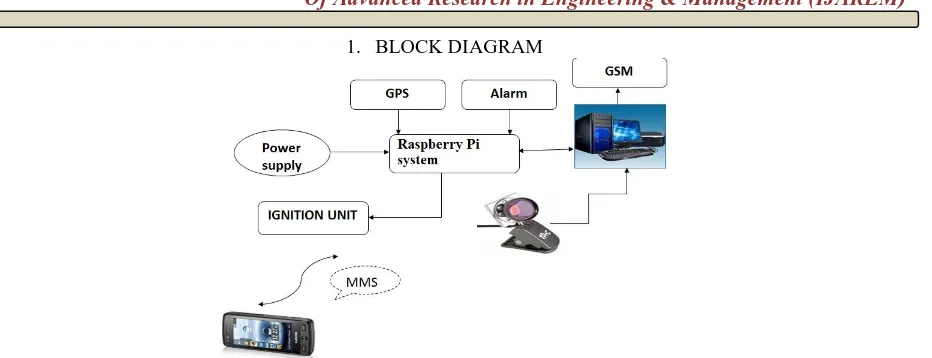
Fig 1: Block diagram of Smart car monitoring system using raspberry pi
In this system the positioning system sends the signal to the Processing Section which is nothing but the Microcontroller. The processor is connected with the ignition unit, the GSM the Web Camera the End user will be the owner where his/her mobile Number is stored in the data base of the computer.
If any intruder enters the car it captures the image of the person and checks with the images that is already stored in the data base and compares it if the image doesn’t matches then the image is sent as MMS to the GSM mobile number that is stored in the data base. And if the instructions are given the required actions take place like stop the car, start the Car, and allow the person to access the car.
2.
FACE DETECTION SYSTEM
Face recognition is to detect faces in one image by the cascade classifiers. Each node finds whether there are faces in the image according the data in classifiers. Hence, face recognition process is purely based on calculations, most of the outcomes of face recognition research papers are obtained by detecting images on personal computer .In several papers of the recent years, Field Programmable Gate Array or Digital Signal Processor are used to increase the speed of detection process and to complete the process in real time, due to this the system becomes costlier. In car security system, the demand of real-time processing may not be necessary unlike other applications, for e.g. to find the criminal out of people on the street. As driver will not come out of the car in a very short time, the security system will have a time of few seconds to do the verification of face which is detected and the time period is enough long for the security system of car to complete the face detection.
To make the hardware of car security system less costlier, and more portable we developed the face recognition process purely by using raspberry pi system.
2.1 Camera Images
In this system, a digital camera is used to capture images in car. This digital camera is pre-situated in the raspberry pi circuit, and the data is sent to FDS module by USB, and the data is converted into jpeg format by the camera before sending it to FDS. Each image is set to 320*240 pixels in resolution ratio to keep it small in size and could be detected quickly.
2.2 Embedded platform
The raspberry pi circuit which is also called as mini CPU with real-time emulation and embedded trace support is used. It has high speed flash memory between 32 KB to 512 KB. It has a wide memory interface of 128-bit and 32-bit code execution at the maximum clock rate is enabled by accelerator architecture. The 16-32-bit Thumb mode optimizes code by more than 30 %.
2.3 Process control
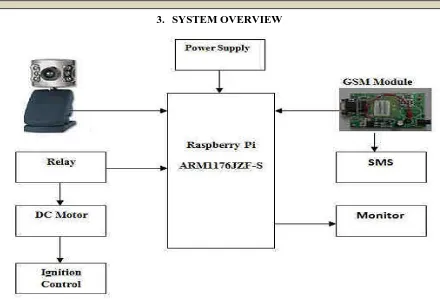
Raspberry pi contains memory, kernel chip, external interface modules etc. Raspberry pi controls the following processes:
1. Obtain images from camera fixed in it;
2. Detect faces in images;
3. Get and handle the data from GPS module;
4. Send messages by GSM module;
5. Control IIC interface.
2.4 Literature Survey
2.4.1 Design and implementation of the autonomous car using raspberry pi
The project aims to build a monocular vision autonomous car prototype using Raspberry Pi as a processing chip. An HD camera along with an ultrasonic sensor is used to provide necessary data from the real world to the car. The car is capable of reaching the given destination safely and intelligently thus avoiding the risk of human errors. Many existing algorithms like lane detection, obstacle detection are combined together to provide the necessary control to the car.
2.4.2 Embedded car security system based on face recognition
In this proposed embedded car security system, FDS (Face Detection System) is used to detect the face of the driver and compare it with the predefined face. For example, in the night when the car s owner is sleeping and someone theft the car then FDS obtains images by one tiny web camera which can be hidden easily in somewhere in the car. FDS compares the obtained image with the predefined images if the image doesn t match, then the information is sent to the owner through MMS. So now owner can obtain the image of the thief in his mobile as well as he can trace the location through GPS. The location of the car as well as its speed can be displayed to the owner through SMS. So by using this system, owner can identify the thief image as well as the location of the car This system prototype is built on the base of one embedded platform in which one SoC named SEP4020 (works at 100MHz) controls all the processes. Experimental results illuminate the validity of this car security system.
3.4.3Accident identification using ARM-7, GPS and GSM
3.
SYSTEM OVERVIEW
Fig 1: Smart car using raspberry pi system overview
4.
GPS MODULE
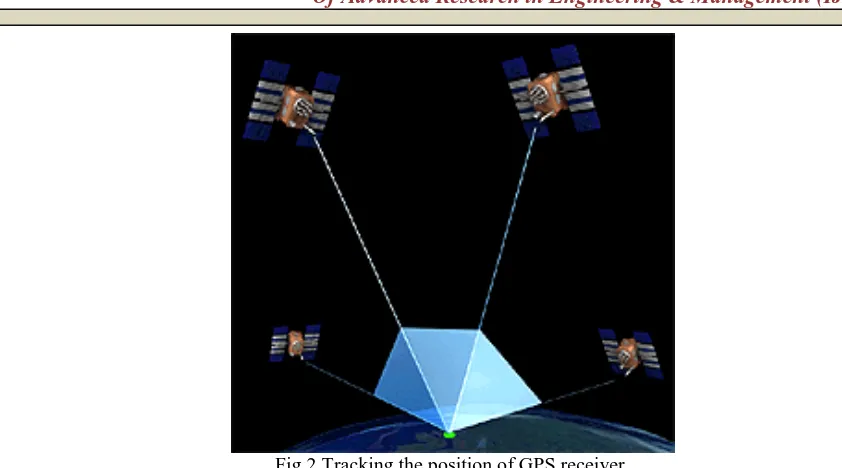
Now a days GPS technique has been used widely both in civil devices and military equipments in recent years. We choose GPS module because it offers the car location in time. It has a Universal Asynchronous Receiver/Transmitter that is used to communicate with many other modules. It is easier to get a series of characters from GPS module at 9600 bps from the Universal Asynchronous Receiver/Transmitter interface, and it is according to NMEA-0183 standard (The National Marine Electronics Association). After analysing the string, we can get the latitude and longitude of the car now.
4.1 How to get the position
Fig 2 Tracking the position of GPS receiver.
4.2 GSM MODULE
GSM modem is of two type’s wireless modem and a dialup modem. The GSM modem used by us is a wireless modem. It works with a wireless GSM network. A wireless modem behaves like a dial-up modem. The main difference between the two of them is that a dial-up modem receives and sends data through a telephone line which is fixed, while a wireless modem receives and sends data using radio waves. In order to operate a GSM modem also requires a SIM card from a wireless carrier, like mobile phone. It can be an external device or a PCMCIA Card /PC Card. Normally, an external GSM modem is connected to a computer through a USB cable or a serial cable.
To get the information of car, a GSM module is included into this system. A GSM modem can quickly send required SMS/MMS messages to the owner’s mobile phone. So the owner can be informed immediately. If a GPRS module is also added in system, the face images of driver can also be sent to owner’s mobile number, and present situation inside the car can be seen.
6. IMPLEMENTATION DETAILS
6.1.1 OpenCVIt focuses mainly on real-time image processing. As OPENCV can support all the Image and Signal processing algorithms and which can be ported onto the Linux platform easily. The major applications of this OPENCV include 2D & 3D feature extractions, Ego motion estimation, Facial recognition system, Gesture recognition, Human computer interaction.
6.1.2 HAAR feature for face recognition
Haar features are digital image feature used for object detection but here we used it for face detection. The biggest advantage of it over most other features is its calculation speed. Figure 3 shows the types of Haar like feature. Generally eye region is darker than other region from the face. Figure 3 shows how Haar like feature is used for face detection purpose. Figure 4 gives the complete preprocessing steps, which includes binary to gray scale image conversion, Histogram Equalization method, Laplacian of Gaussian filter and final step is contrast adjustment. Preprocessing is done because we have to remove influence cause by illumination variation for accurate face recognition.
• Edge feature • Line feature
• Center-surround feature 6.2 System Requirements 6.2.1. Hardware
1. Raspberry pi is a micro-controller development platform with in-built ARM11 processor provided with internet/Ethernet connectivity, 4 USB ports, 512MB memory
2. SDcard
6.2.2. Software 1. OpenCV 2. Java 3. GPS 4. GSM
7. ACKNOWLEDGMENT
We would like to express our heartfelt thanks to our guide Prof. Vinaya Salve for his guidance and encouragement, especially through difficult times. Her suggestions broaden our vision and guided us to succeed in this work. We are also grateful for his comments and guidance while designing part of our paper and learnt many things under her leadership.
We would like to express our appreciation for the wonderful experience while completions of this paper work.
8. REFERENCES
[1]. Dhaval Chheda, Divyesh Darde & Shraddha Chitalia, Smart Projectors using Remote Controlled Raspberry
Pi, International Journal of Computer Applications (0975 – 8887),Volume 82 – No. 16,2013, pp.6-11.
[2]. Stewart Watkiss, Design and build a Raspberry Pi robot [Online], available at:
http://www.penguintutor.com/electronics/robot/rubyrobo t-detailedguide.pdf.
[3]. Wang Lei, Jiang Bing, Chen Gentian, Design Of onboard navigation system based on ARM platform, Microprocessors, Vol 6, pp.104- 106, June 2006 (In Chinese). Tavel, P. 2007 Modeling and Simulation Design. AK Peters Ltd.
[4]. S. Ajaz, M. Asim, M. Ozair, M. Ahmed, M. Siddiqui, Z. Mushtaq, ―Autonomous Vehicle Monitoring & Tracking System,” SCONEST2005, pp. 1 – 4, 2005.Forman, G. 2003. An extensive empirical study of feature selection metrics for text classification. J. Mach. Learn. Res. 3 (Mar. 2003), 1289-1305.
[5]. G. Yang and T.S. Huang,ǁHuman face detection incomplexbackground, ǁPattern Recognition, vol.27, no.1, pp. 53- 63, 1994
[6]. Y.T. Yu, M.F. Lau, "A comparison of MC/DC, MUMCUT and several other coverage criteria for logical