An Evaluation of Energy Per Particle (E/N) of Two
Dimensional Bose Gas using HD,
SD and PP Potential
U. N. SINGH and L. K. MISHRA
Department of Physics,
Magadh University, Bodh-Gaya-824234, Bihar, INDIA Department of Physics,
Kishori Sinha Mahilla College, Aurangabad, Bihar, INDIA
(Received on : May 31, 2012)
ABSTRACT
In this paper, we have pressed a method of evaluation of energy per particle (E/N) of two dimensional Bose Gas using three potential namely HD (Hard-disc potential), SD (Soft disc potential), PP (Zero-range pseudopotential). By using a zero-range pseudopotential we have estimated na22D =o o. 4 as the critical density at which the system becomes unstable against cluster formation.
Keywords: many-body correlation, quantum fluctuation,
Bose-Einstein Condensate, Critical density, Cluster formation.
1. INTRODUCTION
Degenerate low-dimensional gases are presently attracting considerable interest as model system to investigate beyond mean-field effects and phenomena where many-body correlations and thermal and quantum fluctuation play a relevant role.1 In two dimensions (2D), it is well known that thermal excitation destroy ling-range order and Bose-Einstein Condensate (BEC) cannot exist in large bosonic systems at finite
temperature.2 Nevertheless, a defect mediated phase transition from a high temperature normal fluid to a low temperature superfluid was predicted by Berezinski, Kosterlitz and Thouless (BKT)3 and was observed in thin films of liquid 4He.
2
2 2
2
I (1/
MF
D
E
n
N
m
n
na
π
=
h
) (1)
Where m is the mass of the particle, n is the number density, and a2D is the 2D scattering
length. The above result holds for small values of the gas parameter, na22D <<1, and can be obtained within a mean-field approximation using the coupling constant
(
)
2
2 2
2
4
1
1/
D
D
g
m
In
na
π
=
h
(2)The presence at low energy of a density-dependent coupling constant is a peculiar feature of 2D systems.
Bose gases in quasi-2D have been realized with spin-polarized hydrogen on a liquid-helium surface6 and with alkali- metal atoms confined in highly anisotropic harmonoic traps.7-9 In these systems, the transverse motion of the atoms is frozen to zero-point oscillations resulting in fully 2D kinematics, but the interatomic scattering processes are still 3D. In fact, the 3D s-wave scattering length a3D is always much smaller
that the characteristic length of the tight transverse confinement. Theoretical studies of quasi-2D trapped systems predict the existence of a low-temperature quasi condensate phase10,11 whose properties have been investigated using mean-field approaches.12 The nature of the transition in confined systems and whether it belongs to the BEC or BKT universality class is still an open problem both experimentally and theoretically.
An important theoretical prediction for quasi-2D Bose gases in harmonic traps is
the renormalization of the coupling constant due to the tight confinement in one direction. To logarithmic accuracy the result is given by11,13
( )
2
2
2
3
2 2 1
1
1 / 0 2
D
z
Z D
g
a
m In n a
a
π
π
=
+
h
(3)
Where
a
Z=
h
/
m
ω
Z is the oscillatorlength, fixed by the frequency
ω
Z of the tight transverse confinement, and n(o) is the 2D density in the center of the trap. If a3D<<aZ, one can neglect the logarithm termin Eq. (3) and the resulting coupling constant is determined by the 3D scattering length. On the contrary, If a3D>>az,g2D becomes
independent of the value of a3D and a
regime of pure 2D scattering is achieved with a2D=aZ. This regime is highly
interesting and can be realized in trapped gases by using a Feshbach resonance14 to achieve large value for a3D.
2. MATHEMATICAL FORMULAE USED IN THE EVALUATION
We consider a homogeneous system of N spinless bosons 2D described by the many-body Hamiltonian
(
)
2 2
1
2
N
i i j
i i j
H
V r
r
m
= <=
h
∑
∇ +
∑
−
(4)the two-body interatomic potential. We are different choices for the interatomic potential V(r).
(i) Hard-disk (HD) potential defined by
( )
(
(
2)
)
2
0
D HD Dr
a
v
r
r
a
∞ <
=
>
(5)in which case the hard disc diameter corresponds to the scattering length a2D.
(ii) Soft-disk (SD) potential defined by
( )
0(
(
)
)
0
SD
v r
R
V
r
r
R
<
=
>
(6)in which case the scattering length is given in terms of the modified Bessel function I0(x) and its derivative I'0
( )
x(
)
(
)
0 0
2
0 0 0
1
Re
'
DI
RK
a
xp
RK I
RK
=
−
(7)where K02 =mV0/h2 with V0>0. For a finiteV0 one has always R>a2D; if V0 → +∞,
the SD and HD potential coincide with a2D=R In the present calculations, the range
of the SD potential is kept fixed to the value R=5a2D and the height V0 is determined
through Eq. (7) to give the desired value of g2D.
(iii) Zero-range pseudopotential (PP) defined by15
( )
2(
( )
)
( )
2 2 1 pp D r
V r In qr r
m In qa r
δ
π ∂
= − −
∂
h
(8)
where the second term in the square brackets is a regularizing operator with q an arbitrary wave vector. The potential VPP(r) supports a two-body bound state with energy
(
)
2 2
2
4 /
b a ma eD
γ
∈ − h
And wave function
( )
0(
2 /(
2)
)
,b D
f r =K r a e
γ
where K0(x) is the modified Bessel
function and
γ
≈
0.577
is the Euler constant.The calculations with the repulsive potential VHD(r) and VSD(r) are carried out using the diffusion Monte Carlo (DMC) method. This technique solves the many-body time independent Schrodinger equation by evolving the function
( )
, T( ) ( )
,f R
τ
=ψ
R Ψ Rτ
in imaginary time
τ
=it/h according to thetime dependent Schrodinger equation
( )
2( )
( ) ( )
.
,
, ,
R R
f R
D f R D F R f R T
τ τ τ
∂
− = − ∇ + ∇ +
∂
( )
(
,)
L r e f
E R E f R τ
−
(9)
Here Ψ
( )
R,τ
denotes the wave function of the system andψ
T( )
R is a trial function used for importance sampling used for importance sampling. In the above equation(
) ( )
( )
1( )
1..., N , L T T
R= r r E R =
ψ
R − Hψ
R Denotes the local energy,( )
( )
1( )
2 T R T
F R =
ψ
R − ∇ψ
Ris the quantum drift force, D=h2 / (2 )m plays the role of an effective diffusion constant, Eref is a reference energy
energy and other observables of the ground state of the system are calculated from averages over the s\asymptotic distribution function f R
(
,τ
→ ∞)
. Apart from statistical errors, the DMC method determines the ground-state energy of a system of N bosons exactly.In the case of the pseudo potential VPP(r) Eq.(8), the gas like state is not the ground state of the system, but is a highly excited state of the Hamiltonian, We except, however, that for small values of the gas parameter, na22D <<1, the gas like state is stable against formation of many-body bound states. The calculations with the PP potential are performed at the level of the variational Monte Carlo (VMC) method to avoid the technical difficulties that arise in the study of excited states in the DMC method. Nevertheless, the accuracy achieved by using this variational approach is very high. The VMC technique is based on the variational principle
T T
T T
H
E
ψ
ψ
ψ ψ
≥
(10)which is here applied to excited states of the Hamiltonian H. For a trial wave function
T
ψ
with a given symmetry, the variational estimate provides an upper bound to the energy E of the lowest excited state of the Hamiltonian H with that symmetry.In all the calculations the trial wave function
ψ
T( )
R is taken of the Jastrow form(
1...,)
( )
T N ij
i j
r r f r
ψ
<
=
∏
(11)Where the correlation factor f(r) is chosen as the solution of the two-body Schrodinger equation subject to the boundry conditions f(r
≥
d)=1 and f’(r≥
d)=0 on the wave function and its first derivative, respectively, with d a variational parameter. For the repulsive potential, HD and SD, f(r) corresponds to the ground-state two-body wave function. On the country, in the case of the PP interaction, f(r) is chosen as the two-body wave function corresponding to the lowest excited state with positive energy. The pseudopotential VPP imposes the following boundary condition on the pair wave function for zero inter particle distance:( )
( )
( )
0 0(
2)
' 1
' r
D r
rf r
In qa f r In qr ef
=
=
= − −
(12)
The free two-particle problem in
( )
( )
2 2 2 2
2D−h /m∇ f r =h k /mf r ,
holding r≠0gives the general solution F(r)=AJ0(kr)+BY0(kr) (13)
in terms of the J0(x) and Y0(x) Bessel
functions. The boundary condition (12) is imposed by the relation
2
2
exp
2
D
e
A
a
k
B
γ
π
−
=
−
(14)In addition we require that f(r) possess only one node for distance 0<r<d. The boundary conditions at r = d together with Eq. (14) fix the values of the constant A and B and of the wave vector k. if d>>a2D, the eigen energy
2 2
/
k
m
3. DISCUSSION OF RESULTS
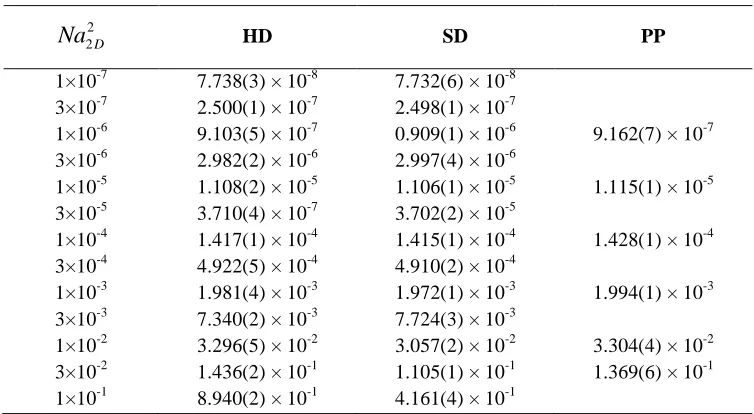
In this paper, we have presented method of evaluation of energy per particle (E/N) as a function of gas parameter Na2 D3
The calculations have been performed for three model potential VHP,VSD and VPP. The resulats and shown in table T1.
The calculations are based on the theoretical
formalism of Mazzanti et.al.16 using the hyperfine head chain approach and VMC at high densities by Xing17 using theVMC method. The DMC results for the HD system are compared with the mean-field results eq. (1). From the evaluated results we observe that the agreement upto large value of Na32 D is quite good.
Table T1
Energy per particle E/N corresponding to the model potential VHD (DMC results),VSD (DMC results) and VPP (VMC results)
[energies are in units of h2/ 2
(
Ma22D)
2 2 D
Na HD SD PP
1×10⁻⁷ 7.738(3) × 10-8 7.732(6) × 10-8 3×10⁻⁷ 2.500(1) × 10-7 2.498(1) × 10-7
1×10⁻⁶ 9.103(5) × 10-7 0.909(1) × 10-6 9.162(7) × 10-7 3×10⁻⁶ 2.982(2) × 10-6 2.997(4) × 10-6
1×10⁻⁵ 1.108(2) × 10-5 1.106(1) × 10-5 1.115(1) × 10-5 3×10⁻⁵ 3.710(4) × 10-7 3.702(2) × 10-5
1×10⁻⁴ 1.417(1) × 10-4 1.415(1) × 10-4 1.428(1) × 10-4 3×10⁻⁴ 4.922(5) × 10-4 4.910(2) × 10-4
1×10⁻³ 1.981(4) × 10-3 1.972(1) × 10-3 1.994(1) × 10-3 3×10⁻³ 7.340(2) × 10-3 7.724(3) × 10-3
1×10⁻² 3.296(5) × 10-2 3.057(2) × 10-2 3.304(4) × 10-2 3×10⁻² 1.436(2) × 10-1 1.105(1) × 10-1 1.369(6) × 10-1 1×10⁻¹ 8.940(2) × 10-1 4.161(4) × 10-1
CONCLUSION
We have carried out a study of the ground-state properties of a 2D homogeneous Bose gas with quantum Monte Carlo techniques. The universal behavior of the equation of state for small values of the
gas parameter has been investigated by analyzing both mean-field and beyond mean-field contributions. By using a zero-range pseudopotential to describe interatomic interactions we have estimated
2
2D 0.04
the system becomes unstable against cluster formation. These results are relevant for present and future experiments with ultracold Bose gases is highly anistropic harmonic traps.
REFERENCES
1. Proceedings of Euroschool on Quantum Gases in Lower Dimensions, Les Houches, edited by L. Pricoupenko, H. Perrin and M. Olshanii, J. Phys. IV. (2003).
2. P.C. Hohenberg, Phys. Rev. 158, 383 (1967).
3. V.L. Berezinskii, Zh. Eksp. Teor, Fiz. 59, 907 (1970) [Sov. Phys. JETP 32, 493 (1971)]; J.M. Kosterlitz and D.J. Thousless, J. Phys. C 6, 1181 (1973). 4. D.J. Bishop and J.D. Reppy, Phys. Rev.
Lett. (PRL) 40, 1727 (1978).
5. M. Schick, Phys. Rev. A 3, 1067 (1971). 6. A. I. Safonov, D .S. Petrov, B. P. Vanzyl
and N. L. Smith., Phys. Rev. Lett. (PRL) 81, 4545 (1998).
7. A. Gorlitz, S. Berger, C. H. Schuneck, Y. Shin and W. Ketterle., Phys. Rev. Lett. (PRL) 87, 130402 (2001)
8. D. Rychtarik, B. Emgeser, H.C. Nagerl and R. Grimn, Phys. Rev. Lett. (PRL) 92, 173003 (2004).
9. N.L. Smith, J. D. Reddy, M. E. Gehm, J. E. Thomas and D. S. Jin, e-print cond-mat/0410101 (2005).
10. V.N. Popov in Functional Integrals in Quantum Field Theory and Statistical
Physics, Reidel, Dordreht, (1983). 11. D.S. Petrov, M. Holzmann and G.V.
Shlyapnikov, Phys. Rev. Lett. (PRL) 84, 2551 (2000).
12. C. Gies, B.P. van Zyl, S.A. Morgan and D.A.W. Hutchinson, Phys. Rev. A 69, 023616 (2004); L. Pricoupenko, Phys. Rev. A 70, 013601 (2004).
13. D.S. Petrov and G.V. Shlyapnikov, Phys. Rev. A 64, 012706 (2001).
14. T. Lofros, M.Veillete, E. G. Moon, J. Carbon and S. Reddy., Phys. Rev. Lett. (PRL) 88, 173201 (2002).
15. M. Olshanii and L. Pricoupenko, Phys. Rev. Lett. (PRL) 88, 010402 (2002). 16. F. Mazzanti, A. Polls and A. Fabrocini,
e-print cond-mat/0410690. (2002) 17. Lei Xing, Phys. Rev. B. 42, 8426 (1990). 18. S. Giorgini, J. Boronat and J. Casulleras,
Phys. Rev. A 60, 5129 (1999).
19. D.F. Hines, N.E. Frankel and D.J. Mitchell, Phys. Rev. A 68, 12 (1978); E.B. Kolomeisky and J.P. Straley, Phys. Rev. B 46, 11749 (1992); A. A. Ovchinnikov, J. Phys.: Condens. Matter 5, 8665 (1993); J.O. Anderson, Eur. Phys. J. B. 28, 389 (2002).
20. J. Boronat and J. Casulleras, Phys. Rev. B 49, 8920 (1994).
21. R. Combsescot, A. Recati, G. Lobo, F.Chevy and M. M. Parish., Phys. Rev. Lett. (PRL) 100,180402 (2007).