Avoiding Non-Proliferation Atrophy:
The effectiveness of multilateral cooperation,
regime dynamics and the case of nuclear
non-proliferation
Author: Enrico Fiorentini Supervisor: Prof. Paolo Foradori
Thesis submitted in partial fulfillment of the requirements for the Degree of Doctor in Philosophy in International Studies
Acknowledgments
I owe a large debt of gratitude to people that are too numerous to mention individually
here. However, I want to seize this opportunity to express my thanks to those who have
contributed, in one way or the other, to my thinking about the subject of multilateral
governance of non-proliferation over the course of my doctoral program, even though
some of the propositions and ideas advanced here long predate the beginning of my
Ph.D. In pursuing this educational experience, first and foremost, I wish to thank my
supervisor, Professor Paolo Foradori; I doubt that without his encouragement I would
have followed such a path in the first place.
I want to offer my thanks to the brilliant scholars and engaged students who have
participated in the International Studies Dissertation Workshop in the Dolomites
organized by the Bruno Kessler Foundation’s Research Center on International Politics
and Conflict Resolution, the University of Bologna, Ca' Foscari University of Venice,
Oxford University and the University of Trento in June 2015. In particular, my
appreciation goes to Professor Joseph Grieco of Duke University who gave me some
precious food-for-thought on my project.
Undisputedly the best and most effective experience throughout the course of my
doctoral years has been the research fellowship at the Belfer Center for Science and
International Affairs at the Kennedy School of Government at Harvard. Here, I want
particularly to acknowledge my gratitude to Matt Bunn, Martin Malin, Steven Miller
and Sean Lynn-Jones for repeatedly challenging the basic premises of my dissertation
and for constantly providing fresh insights, feedback, bibliography and the contact of
staff at the Belfer Center for Science and International Affairs, I wish to express my
gratefulness for having hosted me in such a dynamic and simply beautiful environment.
I am also especially grateful to Terence Taylor, Coordinator of the Group of Experts
supporting the 1540 Committee of the U.N. Security Council, and to Thomas Wuchte,
former U.S. 1540 Coordinator. Each time we met and each time we exchanged
correspondence over the years, they offered me invaluable practical advice on this
dissertation and, most importantly, they gave me a lifetime of lessons about being a
professional.
Last but definitely not least, I owe a large debt of gratitude to my family and to my
sister. Without their constant support and encouragement throughout this process, this
Table of contents
Introduction 1
Chapter One 1.1 Setting the stage 10
1.2 Core concepts and definitions 23
1.2.1 International regimes 24
1.2.2 Implementation 32
1.2.3 Effectiveness 35
1.3 Case selection, methods and sources 37
Chapter Two The problem of institutionalized multilateral non-proliferation cooperation 46
2.1 Pathways to regime effectiveness: relative power, common interests and knowledge 57
2.2 Bridging disciplinary divides 78
2.3 Framework of analysis 84
Chapter Three – NPT 98
Chapter Four – Resolution 1540 170
Chapter Five – Summits on Nuclear Security 228
Chapter Six – Conclusion 279
Appendix – List of interviews 310
Introduction
This study is about the pathways and the mechanisms of
effective multilateralism. The purpose is to explore the
sources of organized cooperation as a means to manage
common (in)security problems and, secondly, to assess the
level of effectiveness in a number of multilateral efforts
across the nuclear non-proliferation domain. In
particular, this research seeks to find out what dynamics
can possibly count for the establishment of agreements and
the implementation of operative arrangements and, second,
whether and to what extent endogenous qualities pertaining
to the specific arrangement matter for explaining
variation in the effectiveness of non-proliferation
regimes.
The questions framing the analysis and structuring the
empirical evaluation are the following. First, which
governing dynamics stemming from international cooperation
theories and regime approaches can possibly lead to more
or less effective arrangements over time? Second, how much
explanatory power do endogenous qualities involving
attributes of arrangements themselves, such as
implementation monitoring, reporting and reviewing
processes, plausibly command to understand relative
institutional effectiveness? Third, are novel
for older ones? In essence, when, why and how are joint
efforts to mitigate nuclear risks proving to work?
In order to uncover causes of institutional
(in)effectiveness, two distinct phases of cooperation are
taken into account, that is, the static stage of the
establishment and, more importantly, the dynamic stage of
the implementation of the cooperative endeavor under
analysis. This latter aspect in the vicissitudes of a
system of rules, norms and practices has been analytically
neglected. While previous non-proliferation studies have
focused on the ‘front-end’ of the cooperation loop by
examining explanatory factors leading states to cut deals
in the first place, others have focused on the ‘back-end’
of it and explored the roles of coercive elements,
including laws and regulations, sanctions and the threat
or use of force.1
Less has been done with regard to
cooperative, rather than coercive, elements of
international regimes, and non-proliferation regimes in
particular. While it is undisputed that effective
problem-solving entails multi-party cooperation, the institutional
aspects of implementation and its review are
underexplored. Both international cooperation and
non-proliferation studies, therefore, tend to overlook the
dynamic, recursive nature of cooperation, or what happens
between ‘front- and back-end’. It is reasonable to assume
that a great deal can be learned about changes in nuclear
multilateralism by examining the sources of cooperation in
the establishment phase and its evolution in the
implementation phase. In addition, most scholarly work on
the theme of regime effectiveness have centered on
examinations of external factors to account for variation
in efficacy across institutions or regimes, including the
presence of powerful actors, the distribution of material
resources and power capabilities, the patterns of
interests entertained by key participants, or the
incidence of crises. Accordingly, internal institutional
features, including the rules, norms, operating procedures
and programs, are considered as if they have no
independent explanatory command because these endogenous
properties are ultimately modeled by powerful and
self-interested actors. Conversely, this research problematizes
our (necessarily) multilateral governance arrangements
through which we come to organize ourselves and explores
intra-regime dynamics as factors potentially affecting
institutional performance.
Informed by International Relations theories that seek
to explain cooperation and by narrower approaches to the
theme of international regimes, single-factor explanatory
accounts with regard to questions of effectiveness can be
the empirical sections. This research thus analyzes
selected cases of multilateral non-proliferation
cooperation with the theoretical arguments presented by
the three main International Relations theories of
Realism, Neoliberalism and Constructivism, identifies the
strengths and weaknesses of each and determines which
theory-based model has greater explanatory heft. The
fundamental premise of this thesis is that, no matter the
issue at stake, common (in)-security problems are
human-driven. Their root causes are pervasively and perversely
anthropological in nature. Far from being exclusively
dictated by exogenous trigger events, such as crises or
changes in the distribution of power-based resources,
these causes are embedded in dynamics pertaining to both
the ‘institutional setup’ and to the ‘cognitive terms of
trade’ that parties entertain around a given multilateral
agreement. Both institutional and cognitive milieus are
not static but evolve over time and, importantly, interact
with one another to produce either progress or regress,
effectiveness or stagnation, with respect to the
objectives of a given instrument.
It is to be acknowledged that the evaluation of the
problem-solving capacity of a given arrangement is a
partly explaining the paucity of related works.2
Further,
information is scarce because of the
sovereignty-conscious, sensitive nature of the issue area. As such,
subjective and qualitative assessments in the form of
semi-structured interviews and interactions with informed
observers are employed to complement the case-study
sections.
The case studies fall within the realm of
multilateral nuclear non-proliferation cooperation. The
first case relates to the Nuclear Non-Proliferation Treaty
and its implementation review process, as it is widely
considered to be both the classic locus of multilateral
non-proliferation efforts and the epitome of attempts at
dealing with the nuclear dilemma – getting nuclear energy
without proliferation risks while paving the way for
disarmament. It focuses on the specifics related to the
text of the NPT and its associated stocktaking review
exercises. In so doing, an exploration into whether and
how this first historical instance of non-proliferation
governance has achieved its ambitious mandate becomes
possible. The second case deals with United Nations
Security Council Resolution 1540, which was adopted in
2004 in order to cope with the emergent nexus between
non-state nuclear risks and proliferation. The third case
2 Hegemann et al., Studying Effectiveness in International Relations. A Guide for Students and Scholars,
deals with the non-proliferation initiative of the Nuclear
Security Summits held between 2010 and 2016.
While non-state proliferation has a narrower policy
focus, and arguably is a rather recent phenomenon around
which organized cooperation has been on the rise,
non-dissemination and disarmament efforts of nuclear weapons
are as old as the United Nations itself, if not even
older. Notwithstanding important differences between the
cases in institutional design (treaty- or
non-treaty-based), problem area (state- or non-state-led
proliferation risks), standard operating procedures
(monitoring and review frameworks), as well as historical
context, these three types arguably serve the common
triadic purpose of furthering the regime’s primary goals,
that is, halting the horizontal proliferation of nuclear
weapons, reducing vertical proliferation on the way to
nuclear disarmament and, thirdly, facilitating peaceful
and safe nuclear energy.
When it comes to assessing their problem-solving or
risk mitigation capacity, one could argue that progress is
easier to achieve with regard to less comprehensive,
technical policy areas, such as nuclear security and
non-state dangers, while it is harder in more politicized
fields, such as state-led proliferation or disarmament.
This is not, however, a foregone conclusion. Not only
pervade joint efforts to stem non-state proliferation
risks, but also the relative successes and failures of a
given regime component arguably affect the other and the
consequences may reverberate across other elements of the
NPT-based non-proliferation regime.
The research findings come from an examination of
both secondary and primary sources. When it comes to the
use of secondary sources of evidence, the study draws on
two bodies of literature. The first strand of works stems
from the analysis of international regimes. This
literature is useful because it depicts a wealth of
explanatory pathways through which multilateral
cooperative arrangements succeed or fail. A second strand
of literature, sometimes called grey literature, is drawn
upon in order to gather additional empirical evidence.
These works include newspapers accounts, conference
records and proceedings, reports, documents and guidelines
from both governmental and non-governmental organizations,
as well as publications from non-advocacy organizations.
These literatures are supplemented by the use of
semi-structured interviews with individuals who had been
involved in relevant multilateral negotiations as well as
with non-governmental experts. In particular, interview
data form and inform the investigation of the two cases of
the Nuclear Security Summit process and Resolution 1540,
The thesis is presented in six chapters and is
organized in the following way. Chapter I introduces the
research topic and explains the reasons why it matters,
both practically and scientifically, against the backdrop
of contemporary developments across the nuclear
non-proliferation domain. It then proceeds to define and
circumscribe critical notions used, such as international
regimes, implementation and effectiveness. Chapter II
problematizes sharpens the research focus on the hard case
of non-proliferation cooperation. A critical examination
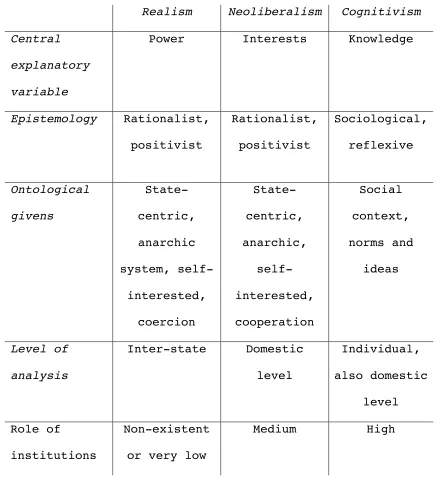
of the scholarly writings on regimes is provided in order
to expose three sets of approaches, each of which
highlights three different single-factor dynamics, that
is, (material) power, (self)-interest, and (common)
knowledge, as the central operating mechanism by which
regimes get formed, stay their course and, eventually,
atrophy. Emphasis is given to questions of effectiveness.
Consequently, this chapter operationalizes the
single-factor explanatory accounts employed to diagnose the
cases. Chapters III to V apply this framework to the three
case studies. Each chapter begins by tracing the history
and evolution of these three different systems of
non-proliferation governance and concludes by reflecting on
the implications on problem-solving effectiveness. For
each, the arguments are presented systematically so as to
might be identified. The concluding chapter VI provides a
summary of the findings and draws preliminary lessons that
can be learned to tackle the question of how arrangements
can be designed in ways that would make them more
Chapter One
1.1 Setting the stage
Current events and developments in the way in which
several issues of human affairs – in spheres ranging from
economic and financial cooperation to environmental and
security matters – are governed highlight the need to
reconsider the theme and, most importantly, the modalities
of multilateral cooperation and reassess the status of
international regimes. Britain’s 2016 decision to leave
the European Union, Trump’s concurrent ascendancy to the
presidency of the United States and his unilateral,
‘go-it-alone’ approach to global problems, growing East-West
divisions with an increasingly assertive China, the
tendency to economic nationalism and protectionism are
symptoms of a diffuse cooperation malaise. These are
trends that seem to point to a widespread crisis of
multilateralism.3
Notably, important structures of
multilateral problem-solving and rules-based approaches
have been fraying. This is precisely why the analysis of
the pathways and mechanisms of multilateral cooperation
acquires saliency.
3 See, for example, Wolf, “In Conversation: Martin Wolf on the Global Economy,” Lowy Institute, 19 May
Present-day geopolitical turbulences raise a number
of tough questions for existing multilateral governance
arrangements. In particular, their effectiveness in
supporting states and other actors achieve shared
objectives and strengthen the rules, norms, procedures and
organizations in given areas of international affairs has
been called into question. The area of international
security cooperation, and the nuclear non-proliferation
domain in particular, is no exception in this regard. To
be sure, troubling developments in the nuclear
non-proliferation regime and signs of rifts across the
international community on the actions through which
proliferation should be tamed and non-proliferation
pursued have been around for a longer time.4
After wide agreement on an action plan to boost
cooperation and strengthen the regime was secured at the
2010 Review Conference of the 1968 Treaty on the
Non-Proliferation of Nuclear Weapons (NPT), both NPT’s nuclear
and non-nuclear weapons states have arguably failed to
implement it, or even backtracked on some points thereof.5
Relatedly, the 2015 NPT Review Conference could not reach
agreement on a substantive final declaration. The
agreement to even hold a conference on the establishment
4 Arbatov, “An Unnoticed Crisis: The End of History for Nuclear Arms Control?” Carnegie Endowment for International Peace, 2015.
5 See, for example, Wan, “Why the 2015 NPT Review Conference Fell Apart,” Center for Policy Research,
of a zone free of nuclear weapons and other weapons of
mass destruction (WMDFZ) in the Middle East remains a case
in point.6
Moreover, negotiations on a multilateral treaty
banning fissile materials for nuclear weapons (FMCT) have
been stuck for several years, if not decades. The terms of
the 1987 Intermediate-Range Nuclear Treaty (INF) and the
2010 New Strategic Arms Reduction Treaty (New START) are
practically no longer implemented, if not openly
contested.7
Compounding the bleak picture, U.S.-Russian
cooperation on nuclear safety and security matters ended
in 2014 and Russia did not take part in the rounds of
talks that led to the last Nuclear Security Summit in
2016. Further, the 1996 Comprehensive Nuclear Test-Ban
Treaty (CTBT), a key component of the global nuclear
non-proliferation architecture, has yet to enter in force for
a lack of few key ratifications.8
The non-proliferation regime, anchored around the
1968 NPT, including a constellation of other arms control,
non-proliferation and disarmament agreements, appear to
find itself deadlocked between broader dynamics of
politics mitigating against the reinforcement of, and even
6 Foradori and Malin, “A WMD-Free Zone in the Middle East: Creating the Conditions for Sustained
Progress,” Belfer Center for Science and International Affairs, 2012; Bino, “The Pursuit of a WMD-Free Zone in the Middle East: A New Approach,” Chatham House, 2017; Davenport, “WMD-Free Middle East Proposal at a Glance,” Arms Control Association, 2017.
7 See Arbatov, “An Unnoticed Crisis” Carnegie Endowment for International Peace; Kimball, FMCT at a
Glance, Arms Control Association, 2017. On New START, Reif, “Nuclear Restraint Agreements Under Serious Threat,” Arms Control Association, 2017.
8 Reif, Ibid. See also, Melamud et al. Banning the Bang or The Bomb? On nuclear security and U.S.–
the recourse to, cooperative relations, on the one hand,
and narrower dynamics pertaining to the design and
operations of arrangements, on the other. Such latter
properties are the subject of this study.
There exists, puzzlingly, a great deal of diversity
among organized cooperative efforts and variation in
effectiveness across the components of the
non-proliferation regime. While the cornerstone of the regime
as a whole, that is, the NPT, viewed here as both textual
agreement (NPT) and operative arrangement in the form of
periodic NPT implementation review processes and
quinquennial diplomatic conferences, as well as other
regime components, such as the CTBT and a possible FMCT,
could be taken as examples of the sorry state of nuclear
multilateralism, there are also counterexamples
highlighting non-proliferation successes. By far the most
positive development concerns the peaceful, negotiated
solution of the long-lasting case of Iran’s nuclear
program. After more than a decade of heated debate and
inflamed rhetoric, a negotiated multilateral agreement and
a fully-fledged, time-limited arrangement was reached in
2015 in the form of the Joint Comprehensive Plan of Action
(JCPOA).9
Despite resistance by the current Trump
Administration, the Iran nuclear deal is being effectively
9 The parties involved in the negotiations were, besides Iran, the five permanent members of the
implemented. Some experts go as far as to claim the JCPOA
to be a model that could be replicated for managing future
nuclear state proliferation risks and, further, some
others herald it as potentially effective blueprint going
beyond outdated NPT language by setting innovative
standards for cooperation, governance and compliance
monitoring.10
On the contrary, the worsening scenario
represented by the nuclear-related controversy with North
Korea points to the need for constructive engagement and
negotiated agreement. What is more, the North Korean case
also testifies to the importance of having a set of
institutions in place, such as common rules, procedures
and organizations to monitor compliance and review
performance.
An additional area where recent positive steps have
been taken is with regard to non-state proliferation
threats and risks. In spite of the lack of U.S.-Russian
nuclear rules-based relations, other cooperative
initiatives to regulate technical aspects of proliferation
and mitigate novel dangers, such as illicit trafficking,
nuclear terrorism and trade in dual-use items, have become
more widely accepted as potentially impactful tools and
mechanisms. To name a few, the 2003 Proliferation Security
Initiative (PSI), the 2004 United Nations Security Council
10 See Mount, “The Iran Nuclear Deal and the Future of Nuclear Order,” Council on Foreign Relations,
2015. See, Biswas, “Iran Deal, NPT and the Norms of Nuclear Non-Proliferation,” The Diplomat, 18 February 2016. Also, Borger, “Merkel Offers German Role in Iran-style Nuclear Talks with North Korea,”
Resolution (UNSCR) 1540 and its Security Council
Committee, the 2006 Global Initiative to Combat Nuclear
Terrorism, co-chaired by the U.S. and Russia, as well as
the Nuclear Security Summits held between 2010 and 2016,
have scored a modicum of progress and registered cautious
welcoming remarks by ever-more participants.11
Be as it may, the current state of multilateral
affairs begets some intriguing questions. Why is that some
institutional arrangements are more successful and seem to
deliver expected results, while others are less successful
and seem to atrophy over time? What are, if any, the
governing dynamics of institutional effectiveness? In a
nutshell, when, why and how are joint efforts to solve
common (in)-security problems and mitigate proliferation
risks proving to work? In this regard, do institutional
features of design and implementation frameworks possibly
explain the puzzle?
While the theme of institutionalized cooperation in
non-proliferation and these very questions acquire
political salience against the backdrop of present-day
failures of rules-based multilateralism, so too is the
case scientifically. There do not exist a lot of academic
studies on the determinants of effectiveness of the
nuclear non-proliferation regime and its sub-regimes,
especially not from a neoliberal perspective. In a recent
overview of the political science literature on collective
efforts to stem nuclear proliferation risks, Sagan has
noted a lack of analyses on non-proliferation arrangements
other than those directly stemming from the NPT and the
IAEA and concluded by observing that these “newer
institutions are crucial elements of the regime and should
not be ignored.”12 This study analyzes newer multilateral
cooperative ventures by disaggregating the traditional
international regime into individual components to explore
the sources of effective multilateral cooperation and
evaluate progress or regress.
A remarkable development in international politics
has been a steady diffusion of cooperative undertakings,
so that international regime building efforts have become
a pervasive, and perhaps permanent, feature of our
contemporary world. In this regard, it is instructive to
observe a constant upward trend in the number of both
inter-governmental organizations (IGOs), as well as in
what can be called ‘first-order’ and ‘second-order’
agreements, that is, core umbrella treaties and
post-treaty, narrower implementation agreements, respectively.
For example, while in 1994 there were 5,401 IGOs and 1,838
12 Sagan, “The Causes of Nuclear Weapons Proliferation,” Annual Review of Political Science 17(14):
agreements, in 2014 there were 7,756 IGOs and over 2,406
multilateral, inter-governmental treaties.13
Unsurprisingly, the topic and the dynamics of
multilateralism – a process by which three or more
entities, usually states, join forces via negotiated
agreements, typically involving the presence of
international organizations, to solve common (in)-security
problems within a given set of commonly shared rules and
practices – has garnered a great deal of attention by
students and scholars of every academic denomination.14
The outburst of institutionalized cooperation has led
economists to worry about the “spaghetti bowl”
phenomenon.15
In other words, the stratification of
multiple trade agreements, initially established with the
aim of enhancing the welfare of the parties, tend over
time to interlock with similar agreements struck on a
preferential or multilateral scale (hence the image of a
plate of noodles), thus causing incoherence and ultimately
making parties worse off. Legal scholars are concerned
about such phenomena as the “fragmentation of
international law” and “treaty congestion”.16
The spread
13 Union of International Associations, The Yearbook of International Organizations, 2014.
14 Thin and thick definitions of multilateralism are numerous in the IR literature. Multilateralism can be
conceived as a form of institutionalism that commits all parties to follow certain procedural and substantive rules of the game that stabilize behavior and make it predictable (Ruggie 1992, 1993). Institutions are “persistent and connected sets of rules (formal and informal) that prescribe behavioral rules, constrain activity, and shape expectations.” (Keohane 1988: 383).
15 Bhagwati et al. “Trading Preferentially: Theory and Policy.” Economic Journal 108(449): 1128-1148,
1998.
16 Koskenniemi and Leino, “Fragmentation of International Law?” Leiden Journal of International Law
and specialization of tribunals and the intermeshing of
agreements at multiple organizational levels is likely to
lead to confusion in rule interpretation and application.
Similarly, and most recently, social and political
scientists working across the disciplinary boundaries of
International Relations and International Law refer to
“institutional complexity” or “regime complexity.”17
In
other words, international regime scholars are
investigating the causes and the implications of
crisscrossing institutional arrangements governing a
specific policy domain.
What is even more puzzling, however, is that these
are recurring and observable phenomena in a field known as
being averse or, according to the Realist school of
thought, immune to long-lasting cooperative endeavors.
Using the vocabulary of IR theory, concerns about the
distribution of material power across the international
system, fears of relative gains (and losses), as well as
national security considerations are seen as trumping
moves toward the establishment of cooperative
relationships. These stumbling blocks to long-lasting
cooperation originate from within the Realist paradigm in
675-710. See also, U.N. International Law Commission, 2006. “Fragmentation of International Law: Difficulties arising from the diversification and expansion of international law.”
17 One of the first scholars in the political science literature interested in exploring questions of growing
institutional “density” is Young. See, “Institutional Linkages in International Society,” Global Governance
2: 1-24, 1996. For recent studies and refinements, Raustiala and Victor, “The regime complex for plant genetic resources.” International Organization 58(2): 277-309, 2004; Alter and Meunier, “The politics of international regime complexity.” Perspectives on Politics 7(1): 13-24, 2009; Oberthür and Stokke,
IR, traditionally employed by political scientists to
diagnose cooperative efforts in security affairs, and
historically learned and applied by statesmen, diplomats
and generals as a rational and pragmatic analytical prism.
This point also partly explains why the theme of
institutionalized non-proliferation is a ‘hard case’ for
theories of international cooperation and approaches to
the study of regimes.
Efforts aimed at regulating the risks posed by
nuclear weapons, sensitive materials, delivery means and
dual-use technology constitute what is termed as
‘non-proliferation’. These formal and informal, bilateral and
multilateral, efforts have been conventionally subsumed
under the concept of “international regime.”18
As such, the
regime of nuclear non-proliferation is the sum of a myriad
arrangements that have been set up to deal with the ‘three
pillars’ upon which the whole regime architecture rests –
that is, nuclear non-proliferation, nuclear weapons
disarmament and the peaceful applications of nuclear
energy.19 No wonder why political scientists and long-term
observers have recently described the nuclear
18 Regimes can be conceived as being a form of institutionalized multilateralism. However, they can be
established bilaterally and can feature no physical organization overseeing implementation. The basic assumptions undergirding the concepts and phenomena of multilateralism and regimes are however similar as they both refer to shared rules and practices around which the behavior of actors converges.
19 For the purposes of this thesis, “nuclear non-proliferation” means measures to prevent additional
proliferation regime as fitting the ‘regime complex’
terminology.20
Notably, for how to reap the benefits of the
atom without furthering the spread of nuclear weapons and
materials while, at the same time, paving the way for the
reduction and eventual elimination of atomic bombs is the
central aim, and yet the fundamental Gordian knot, of the
whole enterprise.
The focus of this study is thus put on institutional
or, to use a similar term, governance effectiveness. Under
conditions of regime complexity, effectiveness – that is,
the capacity to which a given arrangement induces changes
in actors’ understanding of problem and actors’ behavior,
which, in turn, leads to problem mitigation – becomes a
primary objective yet remains, as it will be noted in the
methods section, a challenging concept to operationalize
and evaluate. Empirically, this study delves into the
analysis of three different cases of institutionalized
multilateral nuclear non-proliferation cooperation. The
first case study is represented by the 1968 NPT and its
associated implementation review process in the form of
quinquennial Review Conferences up to 2015. The second
case is U.N. Resolution 1540, adopted by the Security
Council in 2004. The third and final case is epitomized by
the Nuclear Security Summits, held between 2010 and 2016.
20 For example, a participant in a closed-door event at the American Academy of Arts and Sciences held
The importance of examining the origins of
effectiveness by giving analytical relevance to
institutional, endogenous factors is spurred by real-world
developments. Cooperative multilateral efforts in
addressing nuclear dangers gradually shifted from an
initial emphasis on their hardware component, that is,
physical protection measures (the so-called “guns, guards
and gates” approach), stemming from surveillance and
early-warning systems, to cover their software component,
that is, security and organizational culture.21
Notably,
the concept of security culture includes a set of
“managerial, organizational and cognitive
characteristics.”22
Indeed, as General Habiger, former
Commander of the strategic nuclear forces of the United
States, once observed, “good security is 20 percent
equipment and 80 percent culture.”23
Similarly, though in a
more theoretical manner, by acknowledging the concurrent
explanatory power of both interests and ideas, this study
brings the hardware (realist and methodologically
rationalist) and the software (constructivist and
methodologically reflexive) components together, so that a
more nuanced hologram of the subject can be gained.
21 As a matter of illustration, the Convention on the Physical Protection of Nuclear Materials entered
into force in 1980. Nuclear security culture is still in its infancy and the first multilateral endeavors date back to the beginning of the 21st century, actually in September 2001 when the IAEA decided that: “priority should be given to security culture.” (IAEA Nuclear Security Series No. 7, Nuclear Security Culture: 1).
22 Schein, Organizational Culture and Leadership, 2004.
While it is appealing to seek endogenously given
causes of regime effectiveness, for they could be
intentionally manipulated by actors, the history of
non-proliferation has mostly revolved around exogenous
phenomena that, by definition, defy conscious human
control. Major developments across the nuclear domain and
major innovations in non-proliferation regimes occurred in
response to attention-riveting crises and unpredictable
events. However, the challenge that this study takes on is
to explore ways in which change can be endangered without
the occurrence of exogenous factors. In other words, can
implementation monitoring architectures replace crises as
motor for improvement?
Are regimes favoring the powerful at the expense of
the weak, as per Neorealism? Are they rational responses
leading to cost-effective, efficient solutions for
mutually profitable gains, as per Neoliberalism in its
institutionalist form? Are they the expression of ideas
and cognitive structures of meaning espoused by political
leaders, diplomats and other professional groups, as per
Constructivism? Clearly, answers to these questions differ
substantially according to the theoretical and
methodological approach one follows. A note of caution is,
therefore, in order. Providing a hologram of the subject
by seeking to be as eclectic as possible might be
methodologically) untenable. Indeed, this is not to say
that one can arrive at a full-fledged synthesis of
realist, neoliberal and constructivist approaches to
regime effectiveness. Their respective ontologies and
epistemologies, as well as their methodological approaches
to questions of cooperation differ fundamentally. However,
it should be recognized at the outset that hard-power
considerations, interests’ configurations, as well as
ideational and communicative patterns generally affect the
way in which cooperation is organized and, ultimately,
whether regimes are more or less effective. Therefore, the
relative and aggregate relevance of each of these three
single-factor accounts and propositions (power-based,
interests-based and ideas-based) is a matter for empirical
testing to dissect.
1.2 Core concepts and definitions
This section introduces the concepts of international
regime, implementation and effectiveness, and touches on
their contested definitions. Needlessly, a number of other
important social science concepts are dealt with
throughout the chapters. However, these three core
concepts form the building blocks for the development of
selection of each of these concepts is provided and
pondered against alternative conceptualizations.
International Regimes
In their simplest form, international regimes are modes of
international multilateral cooperation.24
To begin with,
the concept of, and ensuing scholarship on, regimes can
offer a useful perspective into the problem of long-term
inter-state cooperation in security matters. The concept
was developed during the 1970s and early 1980s by IR
scholars to understand and explain puzzles about
cooperation between states, specifically those relating to
the origins and the underlying conditions governing
institutionalized cooperation writ large.
Other fields of social inquiry, however, have been
concerned with the subject matter and with the regime
concept in particular. In this regard, international law
specialists have had and continue to have a bearing on the
understandings of this phenomenon. Needless to say, rules,
norms and institutions, including physical organizations,
have been longstanding subjects of legal inquiry.25
In
24 Regimes are the inter-national version of domestic political and social institutions. Regimes can also
exist between two states as well.
25 Chayes and Chayes, The New Sovereignty, 1995. In this study, Chayes and Chayes argue, among other
other words, it can be put forth that international
regimes are to political scientists what international law
is to legal scholars. Interestingly, this latter strand of
literature has contributed to the recent renaissance of
regime-related research themes, including regime
complexity, that lie at the intersection between the two
disciplines.
Right at the outset, it is important to set the
concept against different levels of abstraction. As Oran
Young, one of the most prolific and leading scholars
within the international regime research program, has
noted, regimes should be understood as standing in between
broad political “orders” governing large swathes of
individuals and states, and operating in a large number of
issues, on the one side, and narrow “organizations” or
agencies possessing physical and measureable attributes,
and having a specific functional scope or geographical
reach, on the other side.26
Examples of the former may be
such political orders as democracy and the rule of law.
Examples of the latter may be such organizations as the
International Atomic Energy Agency. Scholarly studies that
focus on nuclear non-proliferation have analyzed “nuclear
orders,” “nuclear non-proliferation organizations,” as
well as the operations of the whole “nuclear
when considering issues of cooperation, Burley, “International Law and International Relations Theory,”
American Journal of International Law 87(2), 1993.
26 Young, International Cooperation: Building Regimes for Natural Resources and the Environment, 1989,
proliferation regime.”27
Such conceptual digression is
important because regime analysis, as opposed to a focus
on specific international organizations, concerns itself
by definition with norms and rules.
The first usage of the term appeared in a 1975
article written by Ruggie and published as special issue
in International Organization titled “International
Responses to Technology.” According to what will become
known as an important figure in jumpstarting
Constructivism, regimes are sets of “mutual expectations,
rules and regulations, plans, organizational energies and
financial commitments, which have been accepted by a group
of states.28
This is the first traceable definition of
international regime. However, it is not the most widely
used. The starting point is Krasner’s 1982 definition of
regimes as “sets of implicit or explicit principles,
norms, rules, and decision-making procedures around which
actors’ expectations converge in a given area of
international relations.”29
To be sure, this definition was
reached by consensus among a methodologically diverse
group of scholars. Again, it was the journal International
27 For a snapshot of research on the topic, Boulden et al., The United Nations and Nuclear Orders, 2009.
See also, Commission of Eminent Persons. “Reinforcing the Global Nuclear Order for Peace and Prosperity,” 2008. On non-proliferation organizations as key components of the broader global nuclear governance, Findlay, “Unleashing the Nuclear Watchdog,” Centre for International Governance Innovation, 2012. For studies on the non-proliferation regime, see for example, Miller, “Nuclear Collisions: Discord, Reform & the Nuclear Non-Proliferation Regime”, 2012.
28 Ruggie, “International Responses to Technology: Concepts and Trends,” International Organization
29(3): 570, 1975. See also, Finnemore and Goldstein, “Power Politics in the Contemporary World” in Finnemore and Goldstein, Back to Basics: State Power in a Contemporary, 2013, 18-27.
29 Krasner, “Structural Causes and Regime Consequences,” International Organization 36(2): 186.
Organization that dedicated a special issue to the project
on regimes, to be then published as a book a year later.
Framed in this general way, international regimes are
ubiquitous. However, over the course of the 1980s,
attempts at narrowing down the definition and at
clarifying the 1982 consensus definition were made. In
essence, three camps, closely associated with the main
‘isms’ in IR theory, can be identified, that is, liberal
institutionalism, social constructivism and neorealism,
respectively.30
First is Keohane, one of the most prominent
representatives of the neo-liberalism school in its
institutional variant, who has argued that regimes are
“institutions with explicit rules, agreed upon by
governments, that pertain to particular sets of issues in
international relations.”31
Seen under this perspective,
the regulatory nature of regimes is highlighted.
Therefore, the sets of rules agreed upon by governments,
usually in the form of binding treaties, are the motor of
action and human conduct. As such, the regulatory
30 In the 1982 International Organization special issue on regimes, three perspectives are distinguished.
The “structural” perspective sees regimes as irrelevant since they do not have any impact between basic causal variables, such as power or interests, and related behavior and outcomes. This view is associated with neo-realists. The second perspective is called “modified structural”, and sees international regimes as having an impact under certain restrictive circumstances, such as when common interests and when positive-sum agreements can be realized. The third is called “Grotian” and sees regimes arising out of the social environment, thereby representing crystallized norms, rules and principles. As such, regimes have a bigger role in shaping behavior and outcomes than the previous two dimensions. Indeed, regimes, behavior and outcome cannot be analytically isolated (Kranser 1982: 189-194).
conceptualization advanced by Keohane’s started to bring
the disciplines of IR and IL closer together.
Secondly, and conversely, Kratochwil and Ruggie, two
prominent exponents of what later would become known as
Constructivism, have focused their attention to the latter
part of the 1982 definition by highlighting the convergent
nature of expectations and by pointing to the
inter-subjective origins of international regimes.32 Seen under
this perspective, mutual and shared understandings as well
as the existence of a common value set or belief system
are seen as the motor of human action. These observations
opened the door for taking into account less positivist
and rational (that is, cognitivist or softly
constructivist)33
methodological approaches to the study of
the vicissitudes of regimes.34
Thirdly, a decade after the 1982 definition, Krasner
distanced himself from the consensus view to argue that
neither of the two visions are correct. For realists,
including Krasner, the “principles, norms, rules, and
decision-making procedures around which actors’
expectations converge” are simply the product of the
preferences of the powerful. Given multiple equilibriums
along the Pareto frontier, it is the relative bargaining
32 See, Kratochwil and Ruggie,“International Organization: A State of the Art on an Art of the State,” International Organization 40(4): 753-775.
33 ‘Hard’ constructivism refers to the view that reality is socially constructed and that there is no such
thing as perfect, full rationality in the actors’ behavior. ‘Soft’ constructivism or cognitive approaches aim to explore the limits of rationality.
power of states, more than any other characteristic, which
determines where cooperation takes place.35
Theoretically, it seems at first glance naive to pit
these grand theories against each other, as each paradigm
has both a distinct set of ontological assumptions and
epistemological passports. Different understandings of
regimes inevitably lead to different research and
evaluation strategies leading to different conclusions.
While for neo-realists and neoliberals rational
choice-based methods, including game theory, are better equipped
to account for instances of cooperation, social
constructivists follow interpretive methods to account for
the causes and consequences of cooperative arrangements.
However, scope for careful and meaningful elaboration
between the three paradigms exists and will be explored in
the next chapter. In the real-world, things look quite
different. Agreements are struck, foreign policy decisions
are made and negotiations are conducted in a manner in
which both material and non-material, ideational and
psychological factors play a role. Inasmuch as relative
capabilities matter in international relations, so does
the communicative and interactive aspect thereof,
especially so when dealing with nuclear weapons and
proliferation issues. This might be even truer in today’s
35 Krasner, “Global Communications and National Power,” World Politics 43(3): 336-366. Citation on
context, characterized by high levels of interconnectivity
and by the 24/7/365 news cycle. The two aspects cannot be
easily isolated. Realism and punishments, on the one hand,
and idealism and rewards, on the other, are two sides of
the same coin.
While this study recognizes the importance of
cognitive dynamics and interaction-based processes to
understand and explain dynamics of institutional efficacy,
it nonetheless takes state-centrism and power seriously.
States and government actors are the salient players that
make, implement, comply with, enforce and eventually break
governance arrangements. This is perhaps the main reason
why other important theoretical approaches to, and
concepts of, multilateral cooperation, including the more
sociologically bent global governance, are considered at
the margins. In a nutshell, should instances of
institutional effectiveness and innovation come up in the
analysis, it is advanced that these are state-led or that,
at a minimum, states and governmental actors do not oppose
novel solutions to non-proliferation impasses.
The emphasis on states as the fundamental, yet not
exclusive, actor is appropriate for the analysis of
nuclear non-proliferation regimes and, at the same time,
does not prevent consideration of other stakeholders.
Other reasons for taking a state-centric perspective stand
and most importantly are the key players in the
establishment of regimes and agreements in the first
place. The formation or establishment phase is important
because it is there where norms, rules and decision-making
procedures are devised in the first place. In addition,
the formation process usually takes place within processes
of diplomatic negotiations. Hence, state-centric
approaches are preferable and yet do not exclude a focus
on agency, nor on interaction and cognition. The allure of
the concept is that it provides a platform of ideas into
which different scholars can delve. A final observation is
on the fact that regimes are issue-specific, thus seeking
to solve a given problem set. This latter observation
gives the analysis a sharper focus.
In essence, state-centrism, state-led negotiations
and issue-specificity call for the analytical usefulness
of sticking to the regime concept. Ultimately, the global
governance concept and the ensuing literature as a way to
look at contemporary world politics, especially in the
area of nuclear (non)-proliferation, is in its infancy and
shrouded by analytical and normative opacity.36
36 Finkelstein, “What is Global Governance?” Global Governance 1(3): 367-372. For counterarguments,
Implementation
The concepts of implementation and effectiveness are
strictly interlinked. Implementation is a process through
which governance arrangements operate and agreements are
put into practice. Implementation is focused on those
“norms, rules and decision-making procedures” that make up
a regime. As such, regimes cannot be truly implemented.
They encompass the wider institutional arrangement.
Regimes need to be dissected into their different elements
and understood as a set of specific working agreements.
Only then it is possible to assess performance.
Implementation is conceptualized as those sets of
processes and activities, which are devised to monitor,
assess, verify or review undertakings and cope with cases
of poor performance or outright non-compliance. Ideally,
these processes and activities connect states, non-state
actors, such as the private sector and international
organizations, and together form a working system. Another
distinctive feature is that these are iterated, open-ended
processes feeding into each other. The phase of
implementation in international regime dynamics is an
under-researched but developing topic across the
non-proliferation regime literature.
Studies taking the role of implementation as
multilateral non-proliferation arrangement are scarce
within the field of IR.37
Three plausible reasons can be
advanced for this neglect. First, this can be related to
the static approach to capture single big, historic
events, once at a time. This is not to say that the
mainstream paradigms have not been concerned with shifts
in behavior and interaction among parties. It is quite the
contrary. However, as a proponent of evolutionary
international relations puts it, processes are presented
as “merely the differential outcome between particular
moments in time, thus essentially ‘freezing’ change within
a static framework.”38
Second, implementation is a process
that requires the action of domestic, national actors, as
it takes place within the domestic structure and operating
system of each state. This is also why there is a paucity
of studies conducted with a specific focus on the
international level.
To explicitly focus on international-level
implementation, then, is to look at the supporting
architecture or framework that is supposed to lead to the
mitigation of a problem set or, in the same manner, of a
security threat. Finally, implementation is sometimes
37 There are notable exceptions. Besides empirical analyses conducted by policy practitioners and
independent research groups pertaining to implementation challenges facing given non-proliferation organizations, academics have not devoted equal attention to questions of management and implementation frameworks. However, implementation-centered hypotheses and accounts to explain effectiveness of a collaborative project, specifically with regard to “nuclear weapons project implementation” at the domestic level, have been recently explored by Hymans (2012, 25).
addressed indirectly by ways of referring to other
concepts, such as compliance. This is a concept that has
been mostly elaborated by legal scholars.39
Yet, while
implementation is a process that may lead concerned actors
to act in accordance with given rules, compliance is a
fait accompli. In other words, whereas implementation is
dynamic, compliance is static. In this regard, a rather
useful hologram to capture implementation at the
international level is the “system for implementation
review” elaborated by David Victor and, among others,
Raustiala.40
Such a system stresses the dynamic nature of
the enterprise. A “system for implementation review” has
been defined as a set of “rules and procedures by which
the parties to international agreements exchange data,
share information on implementation, monitor activities,
assess the adequacy of existing commitments, and handle
problems of poor implementation.”41
As such, this thesis
adopts the view according to which the degree of
effectiveness is assumed to depend on the ways in which
such implementation and post-implementation frameworks are
designed on paper and worked out in practice. This is one
of the reasons behind the focus on the implementation
concept, rather than on (non)-compliance.
39 See, Chayes and Chayes, “On Compliance.” International Organization 47(2): 175-205.
40 See, Victor et al., The Implementation and Effectiveness of International Environmental Commitments,
1998. Notably, Victor and Raustiala have long studied regimes and problems of cooperation and are the first scholars to coin the term “regime complexity.” See, Raustiala and Victor, “The Regime Complex for Plant Genetic Resources,” International Organization 58(2): 277-309.
Effectiveness
This study adopts a common-sense definition of
effectiveness, by which it is meant the extent to which
regimes further the goal for which they were initially
established. This is the standard definition that has been
mostly utilized within the regime research agenda.42
Different taxonomies exist to conceptualize regime
effectiveness. Though effectiveness is synonym with
efficacy, it should not be conflated with the term
efficiency. This latter term is concerned with economic
impact, cost-benefit analyses. However, this study does
not tackle cost-efficiency. For the benefits of a regime
exceeding the costs or achieving problem solving or risk
mitigation capacity at the lowest possible expense is not
the main concern.
Apart from economic approaches to effectiveness,
there are, of course, legal understandings thereof,
including the notion that an international regime or an
agreement is effective if it has entered into force and is
legally binding among the parties. As a general rule of
thumb, if and when a rule is legally binding, then
sanctions and punishments for the breaker can be foreseen.
A fitting example of why this study does not deal with
this formal conception is the following. Even if the CTBT
has not entered into force for the lack of a few key
ratifications, still practice runs counter to a strictly
legal interpretation of effectiveness. The treaty and its
international organization, that is, the CTBTO and its
supporting network are in fact in operation and can
reasonably monitor and verify whether a rule or a process
has been violated. As such, the CTBT is ineffective de
jure, but to some extent effective de facto, with some
fundamental spillover CTBTO-led technological
applications.43
A third approach is the normative one, which links
effectiveness with notions of legitimacy, fairness, equity
and justice.44
In this regard, however, the daunting
challenge is to come up with measures that are comparable
across a number of cases. In addition, the more
all-encompassing the approach taken, the more difficult will
be its operationalization and empirical validity across
cases. Contrary to economic, legal and normative
approaches to effectiveness, this study aims to continue
the tradition of applying a problem solving or, equally, a
proliferation risk mitigation approach. What distinguishes
43 See, Cede, “Enhance the Legal Status of the CTBTO Pending the Treaty Entry into Force,” in Melamud
et al. Banning the Bang or The Bomb? 227-32.
this study from other analyses is that effectiveness is so
conceptualized as to stress its evolving nature.
1.3 Case selection, methods and sources
To uncover potential causes of institutional
(in)-effectiveness, two regime dynamics are analyzed. Informed
by cooperation theories and regime approaches, thanks to
which variables and single-factor explanatory accounts can
be specified, the pathways and mechanisms by which
negotiated agreements (establishment) are turned into
deeds (implementation) via monitoring and review
procedures are analyzed. Detecting the impact of a given
arrangement within a number of similar ones under
conditions of regime complexity is a daunting task to
accomplish in the first place and partly explains the
paucity of studies in international (nuclear
non-proliferation) regime effectiveness. What is more,
information gathering on measurable, objective performance
indicators, which is in and of itself difficult to come
to, is scarce due to the sensitivity of the topic. As
such, subjective, analytical and qualitative assessments
by informed observers may well complement popular
quantitative, numerical data, such as the number of
and geographical location of countries hosting given
events and associated participants.
Two methodological remarks, followed by observations
on case choice, sources and use of evidence, are in order.
This investigation starts with two basic claims regarding
the degree of efficacy of multilateral nuclear
non-proliferation governance arrangements. First, solid
cognitive foundations seeking to undergird or reinforce
actors’ expectations are fundamental.45
Second, frameworks
for implementation do provide the environment whereby the
first claim can be continuously checked. In other words,
properly designed and implemented process-based frameworks
are tools to investigate whether convergence takes place.
The two claims invite different approaches and create
distinct methodological problems.
As regards the first, several considerations need to
be made. The application of a cognitive approach to
understand the behavior of actors in the analysis of
regimes involves considerable challenges but can also
yield interesting insights. The basic problem in need of a
viable solution is how to interpret and decode cognitive
processes from language, whether this comes in the form of
oral accounts through information gathered through expert
interviews or in the form of written statements and
reports. In other words, how can the investigator be
45 To be sure, this does not mean that common understandings cannot change, but that they provide