37
Improving Performance in WIMAX System Based on Wavelet Packet
Modulation Technique and AWGN with DQPSK Modulation Technique
Pooja Patel
1, Dr. Jaipal Singh Bisht
2 Department of EC, RITS, Bhopal (M.P), India1[email protected], 2[email protected]
ABSTRACT: Wi-MAX Mobile network has various applications within the field of data and media broadcasting, digital video broadcasting, internet, personal networks (PANs), native space networks (LANs) and wide space networks (WANs). During this half a projected approach is explained to facilitate the WiMAX-OFDM wireless communication system with the upper information handling capability and with the reduction in noise condition. Communication system is way required as communication services. Wi-max network art used Orthogonal Frequency Division Multiplexing (O-FDM) with DQPSK modulation techniques. Our projected technique AWGN with DQPSK Modulation Technique. Projected encoder technique is improved performance of wi-max system as compare existing encoder wavelet packet modulation technique with DQPSK Modulation Technique). Wi-Max network performance by exploitation WPMT with DQPSK Technique and setting all network parameters to attain performance optimization. For various transmission conditions BER performance has been simulated. Communication system is that the subsequently generation broadband wireless technology that provides higher vary and information measure compared to the alternative out their broadband wireless access technologies like Wi-Fi and immoderate broadband family of standards. The simulation is predicated on the Wi-MAX physical layer that adopted associate O-FDM model within the transmitter and receiver. Wi-MAX system by exploitation totally different modulation techniques likes DQPSK for modulator and detector. The signal is transmitted through the channel and it's received at the receiver finish .Proposed algorithmic rule chance of error, the lower order modulation theme conjointly has the lower BER at low SNR. Projected algorithmic rule minimizing BER at low SNR .Proposed approach is explained to facilitate the Wi-Max Mobile networks in terms higher information handling capability and fewer noise condition. MATLAB Tool is employed to develop the O-FDM model and analysis the performance of WiMAX system. Proposed encoder interleave is additionally used and objective qualities because of higher info information, and improves the SNR performance with larger information
sizes and minimizes the bit error rate supported AWGN with DQPSK Modulation Technique.
Keywords- Wireless Network, SNR,WiMAX, OFDM, adaptive Modulation Techniques, BER, WLAN, DQPSK, quadrature phase Shift Keying, AWGN with DQPSK Modulation Technique, interleave, Higher information Handling capability, WPMT –DQPSK.
I. INTRODUCTION
Wi-MAX could be a broadband wireless access that supports each mounted and mobile net access. it's supported IEEE 802.16 and has most rate of 75Mbits/sec below optimum conditions. WiMAX vary covers up too many kilometers. As a result it will be used for providing wireless broadband across to cities and countries. It will be used as another walk resolution to cable and digital subscriber line. WiMAX uses orthogonal frequency-division multiplexing OFDM and scalable orthogonal frequency-division multiple access (SOFDMA) therefore on this paper we'll do the simulation on the tow form of multiplexing to visualize the result of every one. It additionally supports multiple antennas for higher coverage and higher power consumption. Medium access management (MAC) layer of WiMAX uses a planning algorithmic rule for the initial entry of the subscriber stations (SS) into the network. Then the bottom station (BS) allocates associate access slot to SS and alternative subscribers cannot use that slot. The planning algorithmic rule is additionally used for dominant the information measure potency and quality of service (QoS) parameters
by dynamic the time interval length supported the SS’s
space wireless systems are getting a reality, partially due to the progressively refined styles that are being utilized. Such styles are created potential by theoretical advances and additionally by enhancements in technology that have crystal rectifier to quicker and cheaper implementations compared to older systems. Currently, the main target is on developing 4G systems within the framework of IMT-Advanced, AN ITU platform on that future generation of wireless systems are going to be engineered. This paper could be a survey of a number of the state-of-threat characteristics of the physical (PHY) and medium access management (MAC) layers of 802.16m, one amongst the most important candidates for Next Generation Wireless Systems. The ideas and algorithms that are enforced in 802.16m can terribly probably be utilized in IMT-Advanced systems, either as they'll seem within the 802.16m commonplace or in similar, and probably a lot of refined versions. Therefore, it's of interest not only to present these ideas and therefore the ways in which they address challenges which will got to be tackled so as for Next generation wireless systems to fulfill the objectives set by IMT-Advanced. IMT-Advanced is that the continuation of IMT-2000, the worldwide commonplace for 3G wireless communications. The goal of IMT- 2000 was to give a framework for worldwide wireless access by linking the varied systems of terrestrial and/or satellite based mostly networks [2]. IMT-2000 comprised a variety of activities each within and out of doors the ITU by partnerships like 3GPP and 3GPP2. The most ambition of IMT-2000 was to combat fragmentation and to unify completely different services (such as voice and multimedia) over a typical platform. This way, operators ought to be ready to give seamless property to users anytime and anyplace. Compared to earlier, 2G systems, IMT-2000 systems aimed toward higher transmission rates for each mobile and fixed user. Therefore, IMT-2000 standards required to mix flexibility, affordability, standard style, and be backwards compatible with existing systems. 5 IMT-2000 radio interfaces were approved in 1999. A sixth one, specifically IP-OFDMA TDD WMAN was accessorial in 2007. As are going to be explained below, IP-OFDMA TDD WMAN could be a set of the IEEE 802.16 commonplace and therefore the WiMAX specification the wants of future systems, however conjointly to spot technique. The IEEE 802.16 task cluster has been developing a family of standards for Wireless Metropolitan space Networks (WMANs). WiMAX systems are supported IEEE 802.16. However, to be precise, a WiMAX system is certified by the WiMAX forum, AN
industry-led organization. Certified systems ought to adapt to nominal components of the 802.16 customary and pass carrying into action tests.
Fig1: (a) Wi-max Network Architecture
Fig1: (b)Wi-max Network block Architecture
That said, the terms IEEE 802.16 and WiMAX are usually used interchangeably. The primary 802.16 customary was approved in 2001. It employs Single-Carrier (SC) modulation within the 10-66 GHz band and targets Line-of-Sight (LOS) eventualities. 802.16a, the primary modification, was legal in 2003. It intercalary support for non-LOS environments so as to support last-mile fixed broadband access. For this reason, Orthogonal Frequency Division Multiplexing (OFDM) and Orthogonal Frequency Division Multiple Access (OFDMA) were introduced as choices for the implementation of the physical (PHY) layer. 802.16d that followed 802.16c, a minor modification, outdated all previous 802.16 standards (in the shape of 802.16-2004) and is frequently observed as fixed WiMAX [3].
QOS design IN WIMAX NETWORKS
The Wi-Max Forum’s Network social unit [3], is
architecture, and protocols for Wi-Max, victimization IEEE 802.16e-2005 because the air interface. The network reference model envisions unified specification for supporting mounted, nomadic, And mobile deployments and is predicated on a scientific discipline service model. Figure 1.8 shows a simplified illustration of IP-based Wi-Max specification. [2] the network could also be logically divided into 3 parts: Mobile Station (MS): it's for the tip user to access the mobile network. it's a conveyable station able to move to wide areas and perform information and language. it's all the mandatory user equipments like AN antenna, amplifier, transmitter, receiver and code required to perform the wireless communication. GSM, FDMA, TDMA, CDMA and WCDMA devices etc area unit the samples of Mobile station. Mobile stations employed by the tip user to access the network. Access Service Network (ASN): it's closely-held by NAP, shaped with one or many base stations and ASN gateways (ASNGW) which creates radio access network. It provides all the access services with full quality and economical measurability. Its ASN-GW controls the access within the network and coordinates between knowledge and networking parts. ASN includes one or a lot of base stations and one or a lot of ASN gateways that type the radio access network at the sting.
1. QPSK - construction section Shift Keying: construction section Shift Keying has double the data live potency of BPSK. for every single modulation image, two bits are transmitted. The section of carrier takes on four equally
spaced values like zero, π/2, π, 3 π/2.The two modulated
signals, each of which could be thought-about to be a BPSK signal, square measure summed to provide a QPSK signal. QPSK transmitters and receivers are more tough than those for BPSK. However, with stylish natural philosophy technology, the penalty in price is incredibly moderate. Like BPSK, there are section ambiguity issues at the receiving end, and differentially encoded QPSK is sometimes utilized in follow e [6].
II. EXISTING WORK.
Seyedzadegan et al. [13]. “IEEE 802.16: WiMAX
summary, WiMAX Architecture”. This paper could be a
fast-technical summary and covers: WiMAX summary technological primarily based : customary update and WiMAX design. it's designed for delivering broadband seamless quality transmission services to the top users by combining the similarity of Wi-Fi with the quality of cellular which will deliver personal mobile broadband
that moves with you, WiMAX, the Worldwide ability for Microwave Access could be a new technology addressing provision of information over long distance victimization wireless communication methodology in many alternative ways that. supported IEEE 802.16 WiMAX is claimed as an alternate broadband instead of cable and telephone line. This paper could be a fast-technical summary and covers: WiMAX overview(Fundamental Concept; Technology; customary update) and WiMAX architecture(Network and Node Architectures; Physical Layer; mack Layer), WiMAX (Worldwide ability for Microwave Access) could be a connection-oriented wide space network . It supports high information measure and many users per channel at speeds like presently seen for telephone line, Cable or a T1 connection; guarantees to produce a variety of thirty miles as an alternate to wired broadband like cable and telephone line. It may probably give broadband access to foreign places. Use point-to-multipoint (P2MP) design. it's designed for delivering broadband seamless quality transmission services to the
top users. “WiMAX combines the familiarity of Wi-Fi with
the quality of cellular which will deliver personal mobile broadband that moves with you
WiMAX network; WiMAX (Worldwide ability for Microwave Access) is associate rising wireless communication system that's expected to produce high rate communications in metropolitan space networks (MANs).
Selvarani et al. [15] Wireless networking provides an alternate declare the matter of accessing data from the remote areas wherever the wired networks aren't possible because of high value. it's merely modified the method during which individuals will communicate and share data, without fear concerning the situation or distance. 2 such common wireless broadband networks area unit Wi-Fi (Wi-Fi) and worldwide ability for Microwave Access (WiMAX). Wi-Fi is for Wireless native space Network with the quality IEEE802.11 and WiMAX is for Wireless Metropolitan space Network with the quality IEEE 802.16. These technologies aim to produce broadband wireless access to residential areas and little business enterprises, additionally to providing web access in countries with none wired network infrastructure. This paper provides a summary of Wi-Fi and WiMAX technologies together with the options, specifications, design, advantages, limitations and security. Finally a comparison is created between Wi-Fi and WiMAX. it's steered that once Wi-Fi is synergized with WiMAX, it'll give the simplest answer for walk coverage.
Verulkar et al. [16] IEEE 802.16 network protocol is intended to produce a worldwide ability for Microwave Access (WiMAX). Because of restricted information measure and a chic radio-frequency spectrum on the market for communication, it's necessary to use one information measure over just the once during a same network once it became unused. For that purpose
“Bandwidth Recycling” idea is introduced. The spectrum
(bandwidth) is specifically allotted by agency to varied users, however persistently it's seen that the spectrum isn't totally used by the users within the specific interval. This unused information measure is allotted to alternative users UN agency demands for additional information measure for that specific interval while not dynamical existing information measure scheme. during this paper we have a tendency to analyses completely different algorithms that will the exercise of information measure as per want is conferred. To recycle the unused information measure priority primarily {based} programming (PSA) formula has been developed the exercise effectiveness rejected information measure request initial formula (RBRFA) and history-based
programming formula (HSA) are made public. By implementing these all formula in NetBeans (Version seven.4) machine, we've evaluated the performance of our system. Our simulation and analysis result confirmed that the projected system will recycle unused information measure. a person (Metropolitan space Network) covers town. The simplest legendary samples of MANs are the cable TV (TV) networks on the market in several cities. These systems grew from earlier community antenna systems used in areas with poor air TV reception. Cable TV isn't solely MAN, though' out; recent developments in high speed wireless net access have resulted in MAN. It’s
been projected by IEEE 802.16 and is often referred to as WiMAX.
and benefits of Mobile WiMAX. The growing demand for mobile web and wireless multimedia system applications has driven the event of broadband wireless access technologies in recent years. IEEE 802.16, an answer to broadband wireless access (BWA) ordinarily called Worldwide ability for Microwave Access (WiMAX), could be a recent wireless broadband commonplace that has secure high information measure over long-range transmission .
Khanduri et al. [18] A recent technology for successive generation (fourth generation [4 G]) of mobile broadband networks is usually referred to as Worldwide ability for Microwave Access (WiMAX) that's designed to produce high information measure over long vary transmission. IEEE 802.16e mobile WiMAX is in charge of the duty of creating ability and conformity between merchandise. This paper provides associate transient summary of mobile WiMAX, its options and challenges on the wireless native and metropolitan space Network (MAN) standards IEEE 802.16 and IEEE 802.16e. IEEE 802.16- 2004 Air Interface normal usually referred to as WiMAX play a very important role in fastened broadband wireless metropolitan space networks. the quality specifies fastened broadband wireless access (BWA) techniques for purpose to purpose and purpose to multipoint links. IEEE 802.16e- 2005, adds the options and attributes to the quality necessary to support quality. IEEE 802.16e could be a recent wireless broadband normal, give an answer to broadband (high speed) wireless access in a very metropolitan space. many WiMAX profiles are developed by WiMAX forum for testing of ability. 2 system profiles supported IEEE 802.16 and IEEE 802.16e , known as fastened and mobile system profiles designed by the WiMAX forum embody obligatory and nonobligatory physical (PHY) layers and medium access management (MAC), of BWA. For rising multipath performance in non-line- of-sight environments, the mobile WiMAX Air interface adopts Orthogonal Frequency Division Multiple access (OFDM). so as to empower quick growth in manufactured quantities, market share and ability, the WiMAX forum give the Network social unit (NWG) for developing associate end-to-end network reference model design supported information science supporting each fastened and mobile WiMAX .
Ben-Mubarak et al. [19].Mobile WiMAX could be a
broadband technology that's capable of delivering baseball play services (voice, data, and video). However, quality in mobile WiMAX system remains a problem once
the mobile station (MS) moves and its association is two-handed over between base stations (BSs). Within the handover method, scanning is one in every of the desired phases to search out the target bachelor's degree. throughout the handover scanning method, the MS should synchronize with all the publicized neighbor bachelor's degrees (nBSs) to pick out the most effective BS candidate for the incoming relinquishment action. While not terminating the association between the SBS and MS, the SBS can schedule the scanning intervals and sleep-intervals (also referred to as interleaving interval) to MS for the handover scanning. However, throughout the scanning interval amount, all the approaching transmissions are paused. Therefore, the redundant or redundant scanning of neighbor bachelor's degree cause delay and raincoat overhead which can have an effect on period applications. During this paper, the MS movement direction prediction (MMDP) primarily based relinquishment scanning theme is introduced to beat the mobile WiMAX relinquishment scanning issue. It supported dividing the bachelor's degree coverage space is into zones and sectors. per the signal quality; there are 3 zones, no handover (No-HO), low handover (Low-HO) and high handover (High-HO) zones severally and 6 sectors. During this theme, only 2 BSs will become candidates; the 2 that the MS moves toward them are chosen because the candidate for the relinquishment scanning purpose. Hence, the relinquishment scanning method repetition are reduced with these 2 shortlisted bachelor's degree candidates rather than scanning all nBSs. Thus, MMDP can cut back scanning delay and therefore the range of exchange messages throughout the handover scanning scrutiny to the standard scanning scheme. Although, the MMDP might have an additional process time, the prediction and scanning method are finished before the MS reach the High-HO zone, that mean the end-user’s running application are affected.
Simulation results show that the projected MMDP scheme reduces the overall handover scanning delay and scanning interval period by twenty-five and fifty nothing severally. Also, the dimension of scanning message is reduced, that ends up in reduced signaling overhead.
Mahfooz et al.[20] WiMAX network has perpetually been
additionally give high outturn inside. However, some ambiguity relating to macro /femtohm handover and quality of service (QoS) still exists. This paper suggests a procedure for handover between macro and femtocells. The tactic projected provides higher services to the mobile station (MS). Moreover, it lessens the quantity of inessential handover selections to the FC(s). Higher information rates in wireless networks have perpetually been a requirement of contemporary day users. vocalization information processing (VOIP), radical broadband access, real- time and streamed transmission, diversion services and plenty of alternative such activities need multiplied information measure for perfect communication. Several new technologies square measure being introduced with higher information rates however it might take tons of your time to modify the challenges they'll face. Mobile WiMAX and future evolution (LTE) are among the longer-term wireless technologies which can type the idea of 4G wireless networks. 4G wireless network isn't only backward compatible to previous technologies however also will build widespread use of femto, Pico and small cells for multiplied capability of network, load equalization with macro cells and better outturn.
Hung-Yu et al.[21] Interference-Aware IEEE 802.16
WiMAX Mesh Networks. During this paper authors projected an interference-aware analysis framework for the rising IEEE 802.16 Mesh mode to boost spectral utilization. victimization this framework, they additionally introduced an interference-aware route construction rule for 802.16 mesh network initialization method to boost the network outturn by choosing routes with token interference to existing nodes.
III. SETUP MATLAB
The Performance analysis of MAT-LAB 2013a i.e.used for this thesis Implementation of information mining provides processor optimized libraries for quick execution and computation and performed on input cancer dataset. It uses its JIT (just in time) compilation technology to produce execution speeds that rival traditional programming languages. It may any advantage of multi core and digital computer computers, MAT-LAB give several multi rib algebra and numerical perform. These functions mechanically execute on multiple machine thread during a single MAT-LAB, to execute quicker on multicourse computers. During this thesis, all increased economical information retrieve results were performed in MAT-LAB 2013a.MAT-LAB is that the
high-level language and interactive surroundings utilized by a lot of engineers and scientists worldwide. It lets the explore and visualize concepts and collaborate across totally different disciplines with signal and image process, communication and computation of results. MAT-LAB provides tools to accumulate, analyze, and visualize data, modify you to induce insight into your data throughout a division of the time it'd take victimization spreadsheets or ancient programming languages. it should document and share the results through plots and reports or as disclosed MAT-LAB code. MAT-LAB (matrix laboratory) may well be a multi paradigm numerical computing state of affairs
and fourth generation language. It’s developed by maths
work; MATLAB permits matrix strategies, plotting of perform and data, implementation of formula, construction of user interfaces with programs. MATLAB is supposed primarily for mathematical computing; an optional tool box uses the MuPAD symbolic engine, allowing access to symbolic computing capabilities. it's simulating on mat research laboratory 2013a and for this work we tend to use Intel one.4 GHz Machine and OS window7, window-xp etc. MAT-LAB 2013a may well be a high-level technical reason language and interactive surroundings for formula development, data image, records analysis, and numeric computation Mat research laboratory may well be a coding system program that allows you to try and do information manipulation and image, calculations, mathematics and programming.
IV. RESULT ANALYSIS
To research in the field of wi-max system and identify various challenges. The WiMAX technology to make it more secure, robust and give the customer more reliable service. Our objective is a higher SNR and less BER.
(a) Design and Simulation Parameters of Wi-MAX
Table 1 System Simulation parameters Simulator Used MATLAB TOOL Digital modulation DQPSK
Interleaver size [N* M]., where N=8,M=16 Dimension of
simulated area
WiMax PHY layer
Packet size 128 bits (Frame length). Code rate X/Y. ,where X=171,Y=133; Transmission Network Wi-Max Network
Data Transmission Encoder in Network
(b) Results Graph supported information Size of 1400:
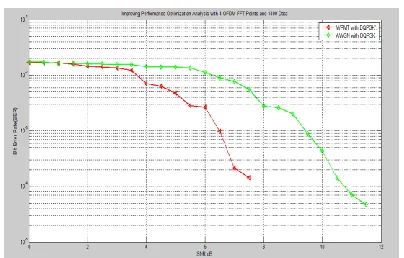
planned encoder AWGN with DQPSK Modulation Technique get less BER values as compare to existing encoder wavelet packet modulation technique with DQPSK get additional values of BER and AWGN with DQPSK Modulation Technique get additional SNR values as compare to existing encoder wavelet packet modulation technique with DQPSK get less values of SNR
Figure1 Comparison performances between AWGN with DQPSK Modulation Technique and wavelet packet modulation technique with DQPSK with FFT size of two and information length of 1400 Bit information
Figure2 Comparison performances between AWGN with DQPSK Modulation Technique and WPMT- DQPSK with FFT size of four and information length of 1400 Bit information
I. Results graph show BER and SNR both less in old method but BER and new method SNR both high . II. Results graph show BER and SNR both less in old
method but BER and new method SNR both high. III. Results graph show BER more and SNR both less in old
method but BER and new method SNR both high. IV. Results graph show BER more and SNR both less in
old method but BER and new method SNR both high
Figure 3 Comparison performances between AWGN with DQPSK Modulation Technique and WPMT- DQPSK with FFT size of eight and information length of 1400 Bit information
Figure 4 Comparison performances between AWGN with DQPSK Modulation Technique and WPMT- DQPSK with FFT size of sixteen and information length of 1400 Bit information.
V. CONCLUSION
projected AWGN with DQPSK Modulation Technique secret writing uses quality programmer in similar having interleave between them. This paper has given an analysis of the electronic equipment modulation techniques that are utilized in the foremost recent wireless standards, like IEEE-802.11and IEEE-802.16 in addition known as Wi-MAX. The Wi-MAX technology is very fast and advances technique used for mobile functions. This technology provides varied protocols and choices as compared to older technologies. The Wi-MAX system supported OFDM model victimization adductive modulation schemes was successfully developed victimization MATLAB software package. AMT enable modification the signal accent system depending on the SNR situation of the link that provides freedom to the Wi-MAX system to decide on either DQPSK. The Wi-MAX system does not need a mounted scheme that is planned for the worst-case things whereas cyclic prefix is further therefore on cut back the lay to rest image interference that happens in multipath channels and to reinforce the bit error rate. WiMAX technology is taken into account one in all the foremost distinguished solutions capable of provision a Broadband Wireless Access in metropolitan areas. This paper concludes the choices and characteristics of Wi-MAX and additionally the protocol IEEE 802.16 is to boot diagrammatic. The WiMAX technology to create it more secure, strong and provides the client additional reliable service. Our objective may be a higher information handling capability and with the reduction in noise condition and low noise. Our projected BER performance Improved of WI-MAX system victimization WPMT with DQPSK Modulation Technique and AWGN with DQPSK Modulation Technique .In this half a projected approach may be a known as projected AWGN-DQPSK with Wi-MAX O-FDM. Explained to facilitate the Wi-MAX-OFDM wireless communication system with the upper information handling capability and with the reduction in noise condition. The utilization of O-FDM technology considerably enhances the information handling capability of the system as seen within the results. It’s
discovered that if the FFT sizes is multiplied the error chance considerably go down and also the makes system higher. Supported experiment it's ended that if the input rate is multiplied for higher speed information transmission like digital video broadcasting. It’s
advantageous to extend the FFT size. This successively improves the BER performance of the system and higher SNR performance is achieved with higher FFT size. The key contribution is that the implementation of WIMAX
system supported AWGN with DQPSK Modulation Technique. IEEE 802.16 is simulated victimization MATLAB software system. The standard WIMAX system that relies on AWGN with DQPSK Modulation Technique with OFDM in AWGN channel is best information transmission. The results AWGN with DQPSK Modulation Technique.
REFERENCES
[1]. Deepak Pareek, "WiMAX: Taking Wireless to the MAX," in WiMAX: Taking Wireless to the MAX.: Taylor & Francis Group, LLC, 2006, pp. 149-189 [2]. Will Hrudey, "Streaming Video Content over IEEE
802.16 / WiMAX Broadband Access," 2009.
[3]. A. Ghosh, D. R. Wolter, J. G. Andrews, and R. Chen,
“Broadband Wireless Access with WiMAX/802.16:
Current performance benchmarks and future
potential,” in IEEE Commun. Mag., vol. 43, no. 2, pp.
129– 136, Feb. 2005.
[4]. José A. Gutierrez, Marco Naeve, Ed Callaway,
Monique Bourgeois, Vinay Mitter, Bob Heile, “IEEE
802.15.4: A Developing Standard for Low-Power
Low-Cost Wireless Personal Area Networks”; IEEE
Network, pp. 12-19, September/October 2001 [5]. (2006, October). IEEE 1451 Family of Smart
Transducer Interface Standards [Online]. Available: http:// grouper.ieee.org /groups /1451/0/ body%20frame_files/ Familyof-1451_handout.htm [6]. J.T. Haitham, M.F.M Salleh, Multi-carrier
Transmission Techniques for Wireless Communication Systems: A Survey, SEAS Transactions on Communications, ISSN: 1109-2742, Vol.8, Issue 5, May 2009.
[7]. B. W. Hiroshi, W.M. Ramjee, Digital Communication, Artech House, London, 2005, pp 5-8.
[8]. G. Tharakanatha, S.K. Mahaboob, V.B. Chanda, I. Hemalatha, Implementation and Bit Error Rate analysis of BPSK Modulation and Demodulation Technique using MATLAB, IJETT, Volume 4, Issue 9, Sep-2013.
[9]. V. Chauhan, M. Arora, R.S. Chauhan, Comparative BER Performance of PSK based Modulation Techniques under Multipath Fading , Advances in Applied Science Research , 2011, 2(4): 521-524. [10].J. Bagga, N. Tripathi, Study and Comparison of
[11].R. Pandey, K. Pandey, An Introduction of Analog and Digital Modulation Techniques in Communication System, Journal of Innovative Trends in Science Pharmacy & Technology, Vol. 1 2014.
[12].Digital Modulation in Communications Systems- An Introduction, Agilent Technologies, Application Note-1298.
[13].Seyedzadegan, Mojtaba, and Mohamed Othman. "IEEE 802.16: WiMAX overview, WiMAX architecture." International Journal of Computer Theory and Engineering 5, no. 5 (2013): 784. [14].Yi Qian ,Lu, Kejie, and H. Chen. "A secure and
service-oriented network control framework for WiMAX networks." IEEE Communications Magazine 45, no. 5 (2007): 124.
[15].Selvarani, D. Roselin, and T. N. Ravi. "Comparative analysis of Wi-Fi and WiMAX." In International Conference on Information Communication and Embedded Systems, pp. 1-7. IEEE, 2014.
[16].Verulkar, Nilesh M., and Dr Umesh S. Bhadade. "Analysis of Bandwidth Recycling in IEEE 802.16 Network using PSA, RB-RFA & HSA‖." International Journal of Engineering Trends and Technology (IJETT) 12, no. 2 (2014).
[17].Pathak, Shantanu, and Shagun Batra. "Next generation 4G WiMAX networks-IEEE 802.16 standard." In Computer Science Conference Proceedings (CSCP), pp. 507-518. 2012.
[18].Khanduri, Rachana, Chhavi Choudhary, and Vishal Gupta. "The Role of IEEE802. 16e Mobile WiMAX." International Journal of Computer Applications 70, no. 16 (2013).
[19].Ben-Mubarak, Mohammed Awadh, Borhanuddin Mohd Ali, Nor Kamariah Noordin, Alyani Ismail, and Chee Kyun Ng. "Mobile station movement direction prediction (MMDP) based handover scanning for mobile WiMAX system." Wireless personal communications 73, no. 3 (2013): 839-865.
[20].Mahfooz, Saeed, and Abeera Ilyas. "Algorithm for an improved Macro-Femto handover decision in mobile WiMAX." In Proc. 15th Annual Postgraduate Symp. the Convergence of Telecommunications, Networking and Broadcasting, pp. 1-5. Liverpool, UK: Liverpool John Moores University, 2014. [21].Wei, Hung-Yu, Samrat Ganguly, Rauf Izmailov, and