Iranian journal of educational Sociology
(Interdisciplinary Journal of Education) Available online at: http://www.iase-idje.ir/
Volume 1, Number 3, June 2017
The effects of train composition with brain learning approach based on the
Educational self-efficacy and written ability of students
Zahra Keshavarzi1
, Soghra Jafari Sani2
, Aboutaleb Seadatee Shami3*
1.M. A student of educational psychology Islamic Azad university, Bojnourd branch, Bojnourd, Iran 2.M. A student of educational psychology Islamic Azad university, Bojnourd branch, Bojnourd, Iran
3.Assistant professor of educational psychology, Islamic Azad university, Science & Research branch, Tehran, Iran
Article history:
Received date: 28 September, 2016 Review date: 7 October 2016 Accepted date:25 November 2016 Printed on line: 15 July 2017
Abstract
Purpose: Present study was conducted with the aim of the effects of teaching method of writing with brain-based learning on educational self-efficacy and written ability of female students in fifth grade of primary school. Materials & Methods: A quasi-experimental method with designing pre-test and post-test with unequal control group was used and to select the sample, the one-stage cluster sampling method was applied. The population of this study included all Esfarayen elementary school fifth grade female students in the academic year of 94-95 that their number was 483 people. The current sample consisted of 30 people who were randomly assigned to two experimental and control groups. Findings:Examining and analyzing of obtained scores, using covariance analysis showed between written language of the control group and the experimental group as well as between academic self-efficacy of experimental and control group there is statistically significant difference. Discussion: Accordingly, training writing with the method of brain-based learning was effective on written language of students. Therefore, it can then be concluded brain-based approach training had desirable effect and can be used practical.
Keywords:
writing, written expression, self-efficacy, brain-based approach
Please cite this article as; Jafari Sani, S; Keshavarzi, Z; Seadatee Shamir, A. (2017). The effects of train composition with brain learning approach based on the Educational self-efficacy and written ability of students. Iranian journal of educational sociology, 1(3), 56-65
*Corresponding Author: Islamic Azad University, Science & Research branch, educational and personality psychology department, Tehran, Iran Email: [email protected]
1. Introduction
Written language is the highest and complex communication form. writing is the last step in the hierarchy of written language abilities, that those are considered as the fundamental learning and useful experiences of lingual skills in listening, speaking, reading and in fact a prerequisite for writing. It is obvious that any difficulties in other areas of language will effect on acquisition act of written language (Wallace & mk Laughlin, translation of Tous, 1373). Writing language proficiency is correct transference of audio cues to linear signs by observing the characteristics of each in order to send a message to the correct manner (Posts by Mario, 1980). Written skills are one of very important lesson skills and after reading less, we can find more importantly skill from it.
2. Research Background
The ability to communicate through writing, is an important part of people's daily life and is crucial for many professions (teaching, business, law, etc.) (Soltani, 1380, quoting Islamite, 1384). Writing or production and contiguous word organizing for writing are complementary of reading cognitive skill. Writing is cognitive skill that it is influenced by the view of the author, readers' understanding, the ability to use language and many other factors (Cerami, 1373, quoted from Islamic, 1384). Self- efficacy is one of the important structures in Bandura’s cognitive – social theories and means reliability and personal belief into their abilities to control their thoughts, feelings, activities and effective functioning in the stressful successes (Capra, Regalia & scabini, 2002). This theory emphasizes on the essential role of self-efficiency beliefs in the growth of human behavior (Meece, Glienke & bury, 2006).
So, it is effective on the actual performance of people, selections, organizing and implementation of action courses to achieve the goals of performance levels, progress and the amount of effort is spent for an activity by person (Regalia & bandura, 2002). Self-efficacy has various fields that it includes: social self-efficacy, academic self-efficacy, and emotional self-efficacy, physical self-efficacy (Lymberichz, 2001; quoted in Thahmasban & Anari, 1388). According to Bandura's social learning theory, self-efficacy beliefs influence on elections of people, field of study, and done activities by person (Zarezadeh & Cadaver, 1386). People who have low self-efficacy, feel helpless and unable to exercise control over life events and when they encounter obstacles, if their primary efforts in dealing with problems is inconclusive, they will quickly have lost hope (Fritzsche & parrish, 2005).
Putwain, sander & larkin (2012) found that students with high self-efficacy than students with lower self-efficacy have higher performance. Many studies have been noted to positive relationship between self-efficacy and academic achievement beliefs (including: Linnenbrink & pintrich, 2003, Malka & coningto ,2006, Zimmerman, Bandura & Martinez, 1992, Pintrich & De groot ,1990). in most studies usually this relationship is such that self-efficacy beliefs as a mediator variable apply effects of variables such as past experiences, cognitive ability and gender and other their beliefs into academic achievement variable. Bandura believes that sense of self-efficacy can play an important role in a person's perspective and view on the objectives, tasks and his challenges (Cain, Bardone- cone, Abramson, vohs & Joiner, 2008).
Komarraju, Nadler (2013) in a research among eighth grade students showed that students with high gain more academic success because of their mastery on challenges. Overall, self- efficiency can predict academic achievement and average due to impulses and movements and self – regulation. Great progress in fields such as molecular biology, neurology, medicine, brain imaging, genetics, and created different fields from cognitive neuroscience allowed us for a closer look at the chemical, structural and functional aspects of what actually happens in the brain during learning (Wesson, 2001, quoted from Hoiland 2005).
Growth and development of any society owes society education system (Sharon, Haghighi and Poladi, 1379). The success or lack of success problem in the education is the most important concerns of any educational system in all societies, academic achievement of every society students reflects the educational system's success in targeting and attention to meet individual needs (Moradi Moghaddam, 1383). The beginning of a child's language interaction with the environment is two "listening” and "speaking" skills. a child who has enough space and worthy opportunity to play and communicate with their surroundings, and receive incentives and necessary feedbacks from the people around him to respond to environmental stimuli, will feel a greater need for the use of language in himself and thus, he will increase his efforts to accumulate and use these experiences (Chand Sharma, 2002; Van Allen and Allen, 1976; quoted from Faramrzy, Karimiyan and Nasrollahi, 1390).
Two other language skills titled "school skills" are "writing" and "reading" skills. if learning is considered as decoding from produced sounds in the child's environment, children with exposure to them and imitate them gradually understand the existing system in them and himself is came as spokesperson of that tongue, access to both reading and writing skills required to obtain another system of language as "writing system" or "writing system” (Zandi, 1385). Two “listening and reading" skills are called as perceptual skills and two "Speaking and writing" skills are called as the generative skills. (Chaind Sharma, 2002; Zrghamyan, 1383).
writing is the most last and difficult lingual proficiency whether in terms of achieving time procedure, and or the terms of generative ability - that for achieving it, the person should have the ability to understand the relationship between sounds and graphical pictures , short and long term memory for storing forms of letters and fittings, motor abilities needed for handwriting, perception of the relationship between motor and visual muscles and coordination among them in writing, the ability to understand the meaning of written and many other skills in addition to having adequate skills in listening and speaking (Dadsetan , 1385). Writing skill got very important in today's complex world in which written symbols have very important application (Brooks & Grundy, 1988). writing or production and organizing interconnected speech for writing was complementary of cognitive skill, oneself is a cognitive skill that affects their view of authors, readers' understanding, the ability to learn the language and many other factors. (Glover & Brunnin, translation of Kharrazi, 1385). And as well as, numerous biological, social, cultural, physical and psychological factors can be effective on learning language skills (written language) be effective (Mashkot al dyny, 1379).
Among these factors , we can point to factors related to family such as cultural and economic factors , social class of parent and the level of literacy and how their employment , the number of family children , and amount of the verbal and nonverbal relationship of child in a family environment, educational factors related to family cohesion, educational status of the family people , all the psychological factors associated with the child's personality such as introversion or extraversion , motivation, educational approaches and self-efficacy beliefs and etc and social factors related to the interaction with peers and adults at home and school (Bandura, 1997).
Self-efficacy beliefs are effective in how to deal people with different situations in achieving goals and has much effects on the motivational process (Pervin & John, 2001). There is mutual or reciprocal causality between self-efficacy beliefs and behavior and human actions and how effect of conditions on self-efficacy beliefs and conversely, how effect of self-efficacy beliefs on motivation and action (Bandura, 1997). Self-efficacy beliefs through four processes of human interactions adjust cognitive processes, motivational processes, emotional processes and selection processes (Bandura, 1997).
Cormarajo & Nadler (2013) found that self-efficacy through impulses and movements and self – regulation can predict academic achievement and average. One of the most important cognitive factors affecting academic achievement, is self-efficacy (Askari, Kahrizi, Sommaye. and Kahrizi, Maryam, 1392). according to the requirement of each skill is self-efficacy, means that it states person confidence and belief in one's own ability to control thoughts, feelings, activities, and also his performance about intended skill, and in the written language as a skill, countless factors may be effective including
psychological factors such as self-efficacy and self-efficacy beliefs, motivation, introversion or extroversion, social factors related to interacting with peers and adults in the home and school and appropriate educational approach (Bandura, 1997).
Also considering that writing and thinking are strongly connected with each other so that writing can be used as a tool for thinking purification and given that, high complex and cognitive activities are necessary to practice writing, writing smoother and more meaningful (Patrishia Wolff, translation of Abolqasemi, 1382). for this purpose, the other skills is necessary to use the appropriate approach to have a firm foundation in the skills of listening and proficiency in the use of written language, means that the capability of thought in the brain and its conversion into segments and appropriate syntactic patterns, designing graphic correct form each of the letters and words in mind, the desirable use of a writing instrument in drawing the shape of the letters, making unique complex relationships, eyes, hands, and enough visual and motor memory, all are from the necessities of writing (Faryar and Rakhshan , 1379). Brain-based learning suggests that the kind of education in which how to get the processing and storage of information and knowledge, with an emphasis on building connection and relationship between them can be serious consideration (Amini, 1391).
Done researches on the brain and its structure, undergoes change the existing approach towards life and consequently, the kind of our approach to education is also affected (Talkhabi, 1387). it should be noted that the human brain has the various parts but our current educational system has pointed a small percentage of it, now, school teachings focus on the narrow part of the brain that it is placed on the left side of the cerebral cortex and the isolation of specific parts of the brain has destroyed correlation and Its systematic cohesion (Carey, 2005). Left brain tends to divide the information for analysis, while the right side of the brain tends to put information together to form an overall picture (Moghadasi, 1391). Neuroscientist’s tests revealed that the human brain contains special applications to improve teaching and learning experiences. New researches suggests that teachers who use the new teaching theories based on their brain, have developed their class experiences to a high level (Chuck Cerve Baasl, 1394). The experiments show that the two hemispheres of the brain play different responsibilities in connection with the thinking and the way it. Subjects that are associated with the left brain, focus on the logical thinking, analysis and accuracy. Subjects, which are associated with the right brain, focused on the virtuosos, emotions and creativity (Herman, 2005). According to what was discussed, question of this the study is that is methods of teaching composition and brain-based learning effective to improve written expression and self-efficacy of students?
3. Methodology
The statistical society of this study include all elementary school fifth grade female students of Esfarayen city in the academic year 95-94 that the number of them was 483 people. The ample of this study included 30 people that were randomly assigned to two experimental and control groups. one-stage cluster random sampling method was used for selection of sample , in this case that the first , two schools were randomly selected among all public schools for girls in Esfarayen city that their number was 14 schools and the first , self-efficacy inventory and written language was performed on all fifth grade students , and among these people , those who had the lowest score , and were ready to participate in the study , 30 people were selected as sample , and were randomly assigned to experimental and control groups. The first pre-test was performed for the control group and witness and then the experimental group was exposed the independent variable (brain-based method) for eight sessions and then after a week, the posttest was conducted in both experimental and control groups, description of conducted sessions is as follows:
The experimental group exposures brain-based learning principles intervention for eight sessions according to view of (Cayenne Vkayn, 2005) after creating the right environment and conditions observation and brain-based learning components.
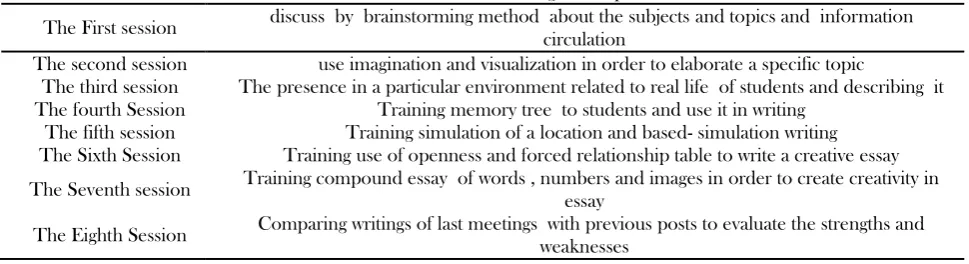
Table 1. Based brain training technique
The First session discuss by brainstorming method about the subjects and topics and information circulation
The second session use imagination and visualization in order to elaborate a specific topic
The third session The presence in a particular environment related to real life of students and describing it The fourth Session Training memory tree to students and use it in writing
The fifth session Training simulation of a location and based- simulation writing The Sixth Session Training use of openness and forced relationship table to write a creative essay The Seventh session Training compound essay of words , numbers and images in order to create creativity in
essay
The Eighth Session Comparing writings of last meetings with previous posts to evaluate the strengths and weaknesses
3.1.Measurement tools
3.1.1. Content analysis of written expression questionnaire
questionnaire of written language analysis of students was designed by Englert (1990) to identify the problems of students in the written language and it is based on 5 sub- process, namely planning, organization, writing, editing, correction and revision, which is scored quantitatively , it has 16 questions which measures questions 1 to 3 in the planning sub- process , questions 4 to 7 in the organization sub- process , questions 8 to 10 in the writing sub- process , questions 11 to 13 in the editing sub- process and questions 14 to 16 in the correction sub- process . The lowest score is zero and the highest score will depend on the number of paragraphs and items you want on the composition of the student (Bahrami, Adamzadeh & mokhtary, 1390). Sharifi and Adamzadeh. (1380) used content validity method to obtain inventory validity and put inventory disposal professors and specialists and they were asked that can have intended questions measure written expression content? According to suggestions and criticisms of these researchers, the intended translated questionnaire was corrected and has been removed its defects.
3.2.Academic self-efficacy scale
Academic self-efficacy scale was designed by Morgan and Jenkins (1999) and is the most extensive list which use itself report levels as a dependent variable. this scale has 30 questions and three subscales talent, effort and texture and is designed using a Likert scale with multiple choice answers included completely disagree (score 1), somewhat disagree (score 2), somewhat agree (score 3) or strongly agree (score 4), that questions 4-5-15-19-20-22 and 23 are scored reversely. The lowest score on this scale is 30 and the highest score is 120 (quoting Karimizadeh and Mohseni, 1385). Morgan and Jenkins have taken advantage factor analysis in order to validity of this inventory. Factor analysis emphasized three main factors in scale. The first item related to talent and the second factor coordinated with items of tissue factor and the third item coordinated with items of effort factor. These researchers have reported items correlation with the total score of this questionnaire in a meaningful and optimal level.
Morgan and Jenkins (1999) reported reliability coefficient of inventory 0.82 and reliability coefficient of each subscale of the talent, effort and tissue 0.78 and 0.66 and 0.70 (quoted from Karimizadeh and Mohseni, 1381). Karimizadeh and Mohseni (1385), obtained reliability coefficient of scale through
Cronbach's Alpha for overall self- efficiency 0.76 and talent and effort and tissue. Sub- variables 0.66 and 0.65 and 0.60.
4. Findings
Table 2. Descriptive information about the self- efficacy and written language of the experimental group and the control group in the pre-test and post-test
variables experim
ental group
control group
experimental group Pre-test Post-test Pre-test Post-test
mean Standard deviation
mean Standard deviation
mean Standard deviation mean Standard deviation
self- efficacy 89.20 8.57 104.13 7.13 87.66 10.16 89.20 10.27
written expression 47.80 5.54 68.93 13.12 42.46 7.91 43.86 5.90
As it is showed in the above table, mean scores of self-efficacy and written expression is increased in the experimental group in post-test and was not created a significant change in the control group.
Table 3. Kolmogorov-Smirnov test results (normal data)
The variable Control The mean Standard deviation Kolmogorov-Smirnov Significance
Self-efficiency Experiment 104.13 7.13 0.566 0.319
control 89.20 10.27 0.608 0.250
Based on the results listed in the table above and considering that the significance higher level of 0.05 can be inferred that distribution of self-efficacy scores in the experimental group and the control group were normal. Therefore, pre –assumption of the normal data be met to perform covariance analysis test.
Table 4. The results of Levine test to determine variances homogeneity of experimental and control groups
The variable F Df1 df2 Sig
The self-efficiency 1.930 1 28 0.176
As it is seen from the performing results of the Levine test in above table, due to the significance level is greater than 0.05, scattering data of experimental and control groups is matched in self-efficacy variable. So, pre-assumption of variances equality be fulfilled in order to run covariance analysis test.
Table 5. Summarization of the results of covariance analysis of effect of training composition with brain-based learning style on self-efficacy of students
sources of changes
sum of squares
df mean of squares F significance mean of share Eta
test exponent
pre-exam 1986.38 1 1986.38 263.22 0.000 0.907 1.000
Group Memberships
1369.27 1 1369.27 181.44 0.000 0.870 1.000
As the above table results show, effect of the group's membership is significant in self-efficacy (p< 0.01). according to the results of above table, significance F (F = 181.448, P<0.01, Partial ƞ2
= 0.870) shows that after adjusting averages of pre-test, there is significant difference between average of experimental and control groups in post-test. in other words, teaching composition by the brain-based learning method makes to increase efficacy scores of students and influences favorably on their self-efficiency and also, the amount of effect is 0.907 means that 91% of the difference between groups is through training and implementation of the test.
Table 6. Kolmogorov-Smirnov test results (normal data) The variable Control The mean Standard
deviation
Kolmogorov-Smirnov
Significance written
expression
Experiment 68.93 13.12 0.630 0.412
control 43.86 5.90 0.422 0.328
Based on the results listed in the table above and considering the significance higher level of 0.05 can be inferred that distribution of the written language scores is in the experimental group and the control group. Therefore, pre –assumption of the normal data be met to perform covariance analysis test.
Table 7. The results of Levine test to determine variances homogeneity of experimental and control groups
The variable F Df1 df2 Sig
written expression 1.350 1 28 0.273
As it is seen from the performing results of the Levine test in above table, due to the significance level is greater than 0.05, scattering data of experimental and control groups is matched in written expression variable. So, pre-assumption of variances equality be fulfilled in order to run covariance analysis test.
Table 8. Summarization of the results of covariance analysis test of effect of training composition with brain-based learning style on writing expression of students
sources of changes
sum of squares
df mean of
squares
F significance level
mean of share Eta
test exponent
pre-exam 683.839 1 683.839 8.329 0.008 0.236 0.794
Group Memberships
2890.975 1 2890.975 35.211 0.000 0.566 1.000
As the above table results show, effect of the group's membership is significant in writing expression (p< 0.01). according to the results of above table, significance F (F = 43.247, P<0.01, Partial ƞ2
= 0.616) shows that after adjusting averages of pre-test, there is significant difference between average of experimental and control groups in post-test. in other words, teaching composition by the brain-based learning method makes to increase written expression scores of students and influences favorably on their written expression and also, the amount of effect is 0.57 means that 57% of the difference between groups is through training and implementation of the test.
5. Discussion
Review scores and analysis them on the basis of table 4-4 shows that brain-based approach had a positive effect on self-efficacy of students and it could improve self- efficiency of students in the brain-based experimental group than the control group. Brain-brain-based approach influenced on self – efficiency of students due to individual differences, creating successful experiences and steps for students, reform and strengthen the learning styles by students themselves, and entrusted with the responsibility of learning by students (Samiye, 1389). The findings of this research are consistent with other numerous studies in the realm of brain-based learning. Including Pashyk and Steele (2007) in their research efforts as (increase student achievement through based – brain strategies)), (multiple intelligences), have shown that brain-based strategies increase students' confidence and reduce their negative behavior and has been made academic achievement of them. Since brain-based learning teaching method is a dynamic and active student-centered method , and active teaching methods can help increase self- efficiency of learners that they can have more perception and control on assignments and also , obtained content is in result of self-learning activities in its creation and refers to a set of methods that stimulate Child's activities in relation to his public needs , and the used ways in this method, follow mental development of student and socialization him (Marefat Nia, 1385 quoted Kayani, 1388).
Goldenberg in based - solution theory points out that with an emphasis on power and mental strength, people references can affect positively self- efficiency and will give this force to people references so
that they can create positive changes in themselves (Goldenberg and Goldenberg, 2000). According to the theory of Garner can be said; (Gardner, 2000) on brain-based learning suggests that coaches should allow students to learn together and also use peripheral learning. The teachers should organize learning based on the actual problems and encourage students so that they learn in situations outside of the classroom and through inside school. They must offer students the opportunity so that they learn as group and through participation and use the surroundings learning. Brain-based learning principles knowledgeable teacher knows that learning does not happen only in the classroom. So, he tries to encourage students learning outside of the classroom.
According to this principle student to take responsibility for their learning and will enhance their learning level and will influence on the composition learning and increase the quality and enriching the written language of students. in explaining else can be said that since the last stage of writing is writing expression, that in real, it is the active writing stage and final stage of writing. The writing or production and organizing interconnected speech as text, was complementary of reading cognitive skill, that it itself is a cognitive skill that affects author's view, readers' understanding, the ability to learn language and many other factors (Glover and Browning, translation of Kharrazi, 1385). And as well as writing and thinking are strongly connected with each other; so that writing can be used as tool for treatment of thinking and as well as complex and many cognitive activities to practice writing, writing smoother and more rich is created (Patricia Wolff, 1998; Translation by Abolqasemi, 1382).
So, the use of cognitive and mental processes can create better and is more complete written works. and as well as according to previous research, we can say that as for composition and the written language have placed the value of creativity that creativity fertilizes students and written expression is a complex thought activity, and teaching creative solving problem influences on the performance of the written language of students in written language skill. Thus we can explain that the use of active learning approaches (Collaboration, problem solving, brainstorming, brain-based learning, innovative, etc.) along with the development of learning resources can improve to a large extent the teaching and learning of writing lessons and written language.
References
Ahmadi, S, A, and Maqdisi, Sh . (1380).the impact of social skills training on composition of elementary third grade students .Quarterly education, 17 (2) ,serial 106, 95-66.
Ali. (1379). Review the important factors of academic failure of boys' high school in Ahvaz city. Journal of Education and Psychology, Volume 7, Issue 3-4, pp. 103- 114.
Ardalan, A, Hosseinchari, M. (1389)Predict academic adjustment based on communication skills through self-efficacy beliefs. Journal of Educational Psychology, 6 (17), 1-28.
Ashoori, Jamal .(1393) .the relationship between self-efficiency and critical thinking, emotional intelligence styles with Nursing students' academic progress. Scientific magazine of Faculty of Nursing and Midwifery of Hamadan city, Volume 22, Issue 3.
Cain, A. Bardone, A.M; Abramson, L. Y; Vohs, K.D.&Joiner, T.E. (2008). Refining the Relationships of perfectionism, self- Efficacy, and stress to Dieting and Binge Eating: Examining the Appearance, and Academic Domains. Oxford press, Caine, N.R.and Caine, J. (2005).12 Brain / mind learning principlets in action.Classes Original Research Article Procedia -
Social and Behavioral Sciences,
Cooc.V.(1991). Second Language Learning and Language Teaching Edward Crowing Press. California. Crystal, David. (1994). Some Early Problems with Verbs, UK: journal of educational psychology, 78, 297-313.
Diamond, M. & Hopson, J. (2002). Magic trees of the mind: How to Nurture differentiated literacy instruction, Minnesota: Hamline University Saint And. Doctoral dissertation, liberty university.
Elliot, J. Alison. (1983). Child Language. Britain: Cambridge University Press.
Fritzsche, B.A. & Parrish, T.J. (2005). Theories and research on job satisfaction. 155-162.
Halliday, M.A.K. (1978). Language and Social Semiotic: The Social Interpretation of Language and Meaning. London: Edward Arnold. Advanced Academics, 18(3) 454-476.
Hoiland, E.E. (2005). Perceptions of reading instruction and use of brain research finding in reading instruction and in teacher preparation Doctoral Dissertation. Seattle University.
Hsieh, P., Sullivan, J. & Guera, N., (2007). A closer look at college student: self -efficacy and goal orientation. Journal of Journal, 10, 13-24
Komarraju, M. & Nadlar, D. (2013). Self- efficacy and academic achievement why do implicit beliefs. Goals, and effort regulation matter. Leavening and Individual Differences, in press. Corrected proof. Available online 8 February 2013. Linnenbrink, E.A. & Pintrich, P.R. (2003). The role of self- efficacy in student engagement and learning in the classroom.
Reading and writing quarterly,
Lockney, J. A. (2004). 12 design principles based on brain – based learning research. Design share: The international Forum for Innovative schools. Retrieved November, 4, 2004
Lucas, R.W. (2004). The creative training idea book: Inspired tips and Grammar, 3rd ed. Britain: Arnold.
Merve Oflaz, (2011). The effect of right and left brain dominance in language learning Original Research Article Procedia - Social and Behavioral Sciences, Vol. 15, Pp: 1507-1513.
Moafyan, F, Ghanizadeh, A. (1390). Study the relationship self-efficiency and critical thinking of language students .Journal of language skills teaching, Islamic Azad University of Mashhad, Volume 3. NO (1). Moghadasi, A (1391), Full brain in effective teaching. Fourth National Conference of creativity, TRIZ and
Innovation in Education, Mashhad.
Montague. N. (1995). The Process Oriented Approach to teachingwrithing to second language learner. New York, State Association for Bilingual narrative in adult L2 literacy instruction, The Reading Matrix, 2(1), 45-47.
Ozlem Y. (2014). The Advantages of Brain based Learning in ELT Park Press.
Pintrich, P., & De Groot, E. (1990). Motivational and self-regulated learning components of classroom academic performance. Journal of Educational Psychology, 82, 33-40.
Pociask, A & Settles, j (2007). Increasing student achievement through brain –based strategies. Master thesis, saint Xavier University.
Putwain,D.sander,P.& Larkin,D.(2012). Academic self-efficacy in study-related reading. Reading. New York: Teachers’ College Press.
Regalia, C. & Bandura, A. (2002). Longitudinal impact of perceived self-regulatory efficacy on violent conduct. European Psychologist, 7, 63-69.
Salami, S.O. (2004). Affective characteristics as of determinants of academic performance of school-going adolescents: Implication for counseling and practice. Sokoto Educational Review, 7,145-160.
Salamtnya, a (1392). The effectiveness of group training of hope withSchneider method approach on increasing self-esteem and self-efficacy School girl students in high school of Ahvaz city .MA thesis in General Psychology, Islamic Azad University, Science and Research Branch of Bushehr.
Salehi, Ali. (1390). Practical solutions for composition lessons. Growth and teaching Persian language and literature magazine, No. IV, pp. 73-70.
Samadi, M (1392). Study the role of professional knowledge and self-efficacy of teachers on their negative and positive relationship practices with the students. Journal of Management in Education, No. 33-30. Samani, S, and Abraham, Dorcheh, A.A (1374). Lack of skills in the written language, Link Magazine, (197).
37-40.
Samii Romdashty., S. (1389).“Brain-based learning-centered education. Journal of Teacher Development, Google.
Sarmad, Z; Hejazi, A, Bazargan, AS. (1386). Research methods in the behavioral sciences. Tehran: Cognizant press.
Shahidi, Zahra; and Fathieghdam, Ghorban. (1394). the math impact with traditional and electronic methods on self-efficacy and progress motivation in secondary school students. The third conference of tomorrow school, 18 September.
Shakiba, M (1383). Analysis of the content of Persian books in elementary school with respect to teaching communication skills. Master's thesis, Faculty of Education and Psychology, martyr Beheshti University in Tehran.
Shams, F; and Tabe Bordbar, F. (1390), the mediating role of academic self-efficacy in relation to the orientation the purpose and math performance. Journal of psychological methods and models, 1 (3), 83-96. Shamshriri, M. (1386). “Brain-based education is a way to rethink, review and reconstruction of teaching –
learning proceedings. Proceedings of the Third Congress of Iranian neuropsychology, SID, Teacher Training University.
Shank, Dal, and Pajars, F. (1387). “self-efficiency and its impact on motivation, learning and student academic achievement. Translated by Masoud Kabiri, schools, 1.
Sharifi dreamed , Parviz. (1380), Explaining the diagnosis and treatment of mental disorders, Tehran: Psychometric publication.
Shaygan, F, (1384). Practical methods of preparing kids and Teens for creative writing. Tehran: Institute for the Intellectual Development of Children and Adolescents.
Shmayzadh, M. (1384). Study the effect of cognitive social career counseling on increasing self-efficiency and Entrepreneurship students of Isfahan University. MA thesis career counseling, Isfahan University, Faculty of Education and Psychology.
Shoarynrjad, A, A (1378). Developmental Psychology .Information publication, Tehran.
Swanson, Jane Laurel; and Fouad, Nadia. (1999) .new career counseling theories and their application, Translation Roghayeh, Mousavi (1383), Tehran: fittest press.
Tapola, a, niemivirta, m (2008), the role of achievement goal urinates in techniques for engaging and effective learning. New York: AMACOM.
Wurr, A. (2002). Language experience approach revisited: the use of personal through adobe science. New York: Dutton
Zahra Kar, K; Rezazadeh, A., and Ahghari, GH. (1389) .evaluate the effectiveness of problem solving skills training on self-efficacy of high school girl students in Rasht.Quarterly new ideas in education, 3.5.