VOLUME 40, ARTICLE 28, PAGES 799
-
834
PUBLISHED 5 APRIL 2019
https://www.demographic-research.org/Volumes/Vol40/28/ DOI: 10.4054/DemRes.2019.40.28
Research Article
The impact of parental death on the timing of
first marriage: Evolutionary versus social
explanations (The Netherlands, 1850–1940)
Matthias Rosenbaum-Feldbrügge
Enrico Debiasi
© 2019 Matthias Rosenbaum-Feldbrügge & Enrico Debiasi.
This open-access work is published under the terms of the Creative Commons Attribution 3.0 Germany (CC BY 3.0 DE), which permits use, reproduction, and distribution in any medium, provided the original author(s) and source are given credit.
1 Introduction 800 2 Historical context and theoretical background 802 2.1 Marriage timing in the Netherlands in the 19th and early 20th
century
802 2.2 Parental death and the transition to marriage 803
2.2.1 Social explanations 803
2.2.2 Evolutionary explanations 805
3 Data, methods, and variables 808
3.1 Data and sample selection 808
3.2 Methods 809
3.3 Variables 810
4 Results 813
4.1 Parental death below age 16 813
4.2 Parental death above age 15 820
5 Concluding discussion 824
6 Acknowledgements 827
The impact of parental death on the timing of first marriage:
Evolutionary versus social explanations
(The Netherlands, 1850–1940)
Matthias Rosenbaum-Feldbrügge1
Enrico Debiasi2
Abstract
BACKGROUND
This article examines the impact of parental death in childhood, adolescence, and adulthood on male and female age at marriage in the Netherlands in the period 1850– 1940. It follows an interdisciplinary approach as it considers explanations based on social and demographic history and evolutionary biology.
OBJECTIVE
We study the classical historical framework in more detail by controlling for the age at parental death. Moreover, we study if evolutionary or social-demographic explanations are better able to predict the impact of parental death on marriage behavior in a historical population.
METHODS
We apply event-history analysis to the Historical Sample of the Netherlands, which includes life courses of more than 24,000 individuals in marital age.
RESULTS
Losing a parent in early childhood delays transition to marriage for sons and has no significant effect on daughters. Parental death in adulthood, however, accelerates entry into marriage for children of farmers.
CONCLUSIONS
Early parental death hindered a smooth transition to marriage but the inheritance of land in adulthood created marriage opportunities both for men and women. The results suggest that farming families employed fast marriage of adult children to restore the gender balance on the farm.
1 Radboud Group for Historical Demography and Family History, Department of History, Radboud
University, Nijmegen, the Netherlands. Email:[email protected].
CONTRIBUTION
Marriage in the period 1850–1940 was strongly determined by regional, cultural, religious, and financial constraints. The proposed evolutionary explanations, and the one based on life history theory in particular, are therefore not able to predict the relationship between parental death and marriage behavior. Accordingly, we advise not to use the age at marriage as a proxy for reproductive and risky sexual behavior.
1. Introduction
Marriage in northwestern Europe in the past usually meant setting up an independent household. As the establishment of a new household was costly, young adults often had to accumulate substantial savings from employment or needed access to family property before entering a marriage. Therefore, especially men had to defer marriage until they could set up an independent livelihood adequate to support a family. The tradition of establishing a nuclear household upon marriage is one of the reasons why the European marriage pattern is uniquely characterized by high ages at marriage and a comparatively large proportion of male and female individuals who never married (de Moor and van Zanden 2010; Dribe, Manfredini, and Oris 2014; Hajnal 1965, 1982).
In his pioneering article from 1965, John Hajnal hypothesizes that the death of a parent and the inheritance of property accelerated the children’s entry into first marriage (Hajnal 1965). Recent research using individual-level data and event-history analysis has indeed shown that both paternal and maternal death in western and northern European farming communities were associated with a faster transition to first marriage for both men and women (Lundh and Kurosu 2014; Neven 2003; Voland and Willführ 2017). In tradition with Hajnal’s interpretation, historical demographers explain this finding with the inheritance of assets that enabled the children to accumulate the savings necessary to establish their own nuclear household (Kurosu and Lundh 2014; Neven 2003).
marriage behavior often do not include information about parental remarriage (Alter and Oris 1999; Janssens 2014; Kurosu and Lundh 2014; Neven 2003; Oris, Alter, and Servais 2014). The arrival of a stepparent might introduce stability and attenuate the potentially harmful consequences of a parental death. Controlling for the presence of stepparents is particularly important because parental remarriage occurred frequently in the Netherlands in the period of consideration (van Poppel 1995). Third, we make a methodological contribution by also controlling for outmigration in our data set. Earlier research typically suffers from migration out of the study area, which might introduce a selection bias because farmers were much more likely to stay in their place of residence than day laborers who did not own property (Dribe 2003; Kok 2004; Neven 2003). If parental death increased the chance of outmigration for landless workers and the remaining farmers who experienced parental death tended to marry earlier, not including migrants creates an overestimation on the accelerating effect of parental death.
In addition to these contributions to Hajnal’s classical hypothesis, in this article we will also consider a competing explanatory framework that has been offered recently and is based on theories derived from evolutionary biology (Voland and Willführ 2017). These theories assume that particularly the absence of the father accelerates the reproductive and marriage behavior of his children due to biological adaptation mechanisms (Belsky, Steinberg, and Draper 1991; Chisholm et al. 1993; Draper and Harpending 1982; Ellis 2004). As the social and evolutionary frameworks make different predictions regarding the mechanism between parental death and the children’s age at marriage, especially with regard to parental death in early childhood, this paper aims to test for the predictive value of these frameworks by using historical data from the whole of the Netherlands in the period 1850–1940.
2. Historical context and theoretical background
2.1 Marriage timing in the Netherlands in the 19th and early 20th century
In line with the European marriage pattern, Dutch individuals born in the second half of the 19th and beginning of the 20th century married traditionally quite late. In the period of consideration, the average age at first marriage remained stable at around 27.5 years for men and 25.5 years for women (Kok 2014; van Poppel 1992). The population averages conceal, however, that the timing of marriage was to a large extent determined by socioeconomic background and varied considerably across social classes. Men from the elite and sons of farmers married comparatively late while working-class sons married relatively early. Between 1870 and 1879, for instance, working-class men entered a marriage on average around four years earlier than sons from the highest social class (van Poppel and Nelissen 1999). Similar class differences were found among women but the contrasts were less pronounced. Lower financial preconditions for marriage among the working class (Engelen and Kok 2002) and strict family controls on partner selection among the upper class (Janssens 2014; Oris, Alter, and Servais 2014) are offered as explanations for the class differences in marriage timing.
It has been argued that individuals in urban areas tended to marry earlier due to the proletarianization of Dutch cities during the second half of the 19th century (Hofstee 1981). Störmer and colleagues (2017) indeed discovered that urban men entered first marriage earlier than their rural counterparts. Urban women, however, postponed marriage compared to women living in rural areas (Störmer et al. 2017; Suanet and Bras 2010). One possible explanation for this gender difference is that sex-ratios in Dutch cities were more beneficial for men as young women were generally overrepresented in urban contexts (Schmidt and van der Heijden 2016; Störmer et al. 2017). Accordingly, it was much easier for urban men to find a potential marriage partner than for urban women.
Marriage in the Netherlands in the second half of the 19th and the beginning of the 20th century was not only determined by class differences and individual migration trajectories but also by cultural factors. First of all, at least for those who had land, the inheritance system mattered (Head-König and Pozsgai 2012). It has been shown that both men and women in the northern and western parts of the Netherlands between 1650 and 1899 married considerably earlier than those living in the east and south of the country (Störmer et al. 2017). This gap is partly explained by differences in the inheritance system as partible inheritance was practiced in the north and west while impartible inheritance was dominating in the east of the country (Suanet and Bras 2010). Under impartible inheritance regimes, property was allocated to one single heir who was not necessarily the eldest son (Bras and Kok 2004). As most of the children did not inherit property under this rule, for a large number of young adults the impartible inheritance system meant a delay in the timing of marriage. Options for the remaining children included migrating as well as staying at the brother’s farm and remaining permanently celibate (Klep 2011). Partible inheritance, in contrast, is characterized by equally distributed property among children, regardless of parity and gender. Partible inheritance theoretically enabled marriage for all children but turned out to be problematic if inheritance shares were too small to establish an independent household. This phenomenon occurred quite frequently in the southern sandy soil regions (Kok and Mandemakers 2010; Suanet and Bras 2010).
Apart from inheritance practices, another important cultural factor that affected the transition to marriage was religion. In the period of consideration, the Catholic Church in the Netherlands as well as orthodox Protestants exerted a strong pressure on young adults to delay marriages until a relatively late age. This is explained by the fact that these groups were, in contrast to liberal Protestants, opposed to practicing ‘modern’ birth control that facilitated birth spacing and stopping. Catholics and orthodox Protestants therefore relied on marriage restraint as a traditional Malthusian method to limit family size and were more likely to experience late marriage as well as permanent celibacy compared to liberal Protestants (Engelen and Kok 2002; Kok 2014; van Bavel and Kok 2005).
2.2 Parental death and the transition to marriage
2.2.1 Social explanations
opportunities for sons and daughters (Kurosu and Lundh 2014; Neven 2003; Voland and Willführ 2017). Moreover, a social gradient has been observed in the sense that the accelerating effect of maternal death was in general stronger for well-off groups such as large-scale farmers (Bengtsson 2014). This indicates that parental death opened up inheritance possibilities, released resources, and made the transfer of assets between elderly parents and adult children easier. Additionally, adult children experienced less family control and gained more individual autonomy after the death of a parent (Oris et al. 2014). As mentioned before, the accelerating effect of parental death is predominantly expected to be observed for adult children of farmers who were very likely to benefit from resources released by inheritance (Hajnal 1965).3 Working-class adults, however, are expected to be weakly affected by parental death as they generally inherited fewer resources and experienced less parental control in general (Janssens 2014). Based on these considerations, we derive the following hypotheses:
Hypothesis 1a: Both paternal and maternal death accelerate adult children’s transition to marriage.
Hypothesis 1b: This relationship is strong for children of farmers but weak for working-class children.
So far, the impact of the child’s age at parental death has been largely neglected by papers studying the relationship of parental loss and marriage behavior in the past. This is surprising as parental death might have completely different consequences depending on the life stage of the child (Voland and Willführ 2017). It is assumed that young and adolescent children experienced parental death very differently than adult children. Parental death in childhood and adolescence did not release resources but was rather associated with decreasing standards of living and severe financial consequences for the household of the children and the widowed parent (Oris and Ochiai 2002; Rosenbaum-Feldbrügge 2018). Especially premature paternal death resulted in the loss of daily income and less accumulated capital over the life course. As a consequence, parental death reduced the financial and economic support for the young child and might therefore delay the child’s entry into marriage in the long run. Additionally, it is expected that children who experienced parental death in childhood may have faced stronger claims by the (elderly) widowed parent for financial and social support, which
3 Regional studies combining qualitative and quantitative evidence challenge Hajnal’s view that farmers’
might further postpone their transition to marriage (Janssens 2014; Lundh and Kurosu 2014). Taken together this leads to the second hypothesis:
Hypothesis 2: Parental death in youth and adolescence delays children’s transition to marriage.
The impact of parental remarriage on children’s transition to marriage in the past has not yet been studied systematically. This is problematic as widowed parents often entered into a new union. For instance, in the city of Gouda in the western part of the Netherlands in the 19th century, roughly 92% of the widowers below age 30 and 81% of those between ages 30 and 44 remarried. The corresponding numbers for widows were 78% and 56%, respectively (van Poppel 1995). The presence of a stepparent might introduce stability by contributing to the household economy and by offering childcare services. Moreover, the presence of a stepparent might release the child from the obligation to care for the elderly parent and younger siblings (Alter 1988). In line with this argument, Kok (2014) found that Dutch children who had once been living with a stepparent were less likely to remain permanently celibate. Therefore, young and adolescent children who experienced parental remarriage are believed to behave more similar to children who did not lose their parents than to their half-orphaned counterparts without a stepparent. Accordingly, the third hypothesis states the following:
Hypothesis 3: Young and adolescent children who experience parental remarriage tend to marry earlier than those who grow up with a single widowed parent.
2.2.2 Evolutionary explanations
In a recent study on a historical population in northern Germany, three evolutionary explanations have been offered to examine the relationship between the father’s death and the child’s transition to first marriage, which is taken as a proxy for reproduction (Voland and Willführ 2017). Even though the role of maternal death is not discussed in that study, the following explanations are to a certain degree also applicable to the loss of the mother.4
The first evolutionary explanation offered is based on the concept of life history theory. Life history theory assumes that young children react to the early death and absence of the father by exhibiting riskier sexual behavior and by accelerating their reproduction. This reaction is seen as an adaptive response to stress in early life in
general and to the experience of mortality in the child’s immediate context in particular. Consequently, individuals who experience mortality and stress in early childhood unconsciously reduce the risk of dying childless by applying earlier reproduction (Belsky, Steinberg, and Draper 1991; Chisholm et al. 1993; Ellis 2004; Nettle, Coall, and Dickins 2011). In line with life history theory, a growing body of literature on contemporary Western societies established a link between paternal absence in childhood and children’s reproductive behavior in adolescence and adulthood. For instance, it has been shown consistently that the father’s absence in childhood reduced the daughters’ age at first menarche and first sexual intercourse and increased their risks of teenage pregnancies (Chisholm et al. 2005; Ellis et al. 2003; Quinlan 2003; Vigil and Geary 2006; Webster et al. 2014). Children who lost a father in early childhood are therefore expected to accelerate reproduction and enter first marriage earlier (Voland and Willführ 2017). Remarkably, this explanation and the second social hypothesis (Hypothesis 2) predict opposing effects of early parental death on the age at marriage.
Hypothesis 4: Paternal loss at a young age accelerates children’s transition to marriage.
Hypothesis 5a: Paternal loss during and especially after adolescence accelerates children’s transition to marriage.
Hypothesis 5b: The more resources available in the family, the stronger the effect will be on marriage timing.
Finally, the third evolutionary explanation proposed by Voland and Willführ (2017) assumes that parents have a strong impact on their children’s mating behavior and that fathers control their offspring’s reproductive decisions out of self-interest. This may result in a parent-offspring conflict, which is believed to be rooted in differences in genetic relatedness to the grand-offspring or in disagreements over the distribution of resources (van den Berg et al. 2013). As a consequence, fathers may manipulate inheritance rights to influence their children’s reproductive decisions (Apostolou 2014). The death of the father, however, inevitably removes this source of conflict between father and offspring and increases the children’s reproductive autonomy. Parental death may therefore eventually lead to an earlier entry into marriage because children do not have to adapt their own reproductive interests to the potentially conflicting interests of the father and the family any longer (Voland and Willführ 2017). According to Voland and Willführ (2017), this explanation does not make assumptions about the child’s age at parental loss and therefore applies to paternal death in general:
Hypothesis 6: Paternal death in general accelerates children’s transition to marriage.
3. Data, methods, and variables
3.1 Data and sample selection
After having discussed the historical background and hypotheses, we will describe the data, methods, and variables. In this article, the Historical Sample of the Netherlands (HSN) 2010.01 release is exploited, which contains detailed life course information of a representative sample of approximately 19,000 male and 18,000 female research persons born in the Netherlands in the period 1850–1922. The sampling procedure ensured that only one person per household would be selected as a research person, which means that observations are not clustered within households. The HSN contains the civil certificates (birth, marriage, and death) of the research persons as well as the population registers, which were introduced throughout the country in 1850. These registers provide demographic information about each individual who was ever present in the research person’s household. Examples are date and place of birth, the relationship to the household head, sex, marital status, occupation, and religion. A unique strength of the HSN is that the population registers enable the researcher to follow the research persons from birth to death even in cases of migration within the Netherlands. Demographic events such as birth, migration in and out of the household, and death were also recorded (Mandemakers 2002). From the end of the 1930s onward, population registers where replaced by personal cards that do not contain household information. Therefore, the period of observation ends in 1940.
3.2 Methods
Event-history analysis is employed to examine the effect of parental death on the transition to first marriage. Event-history analysis calculates the expected duration of time until a certain failure event like first marriage occurs, given a set of control variables such as socioeconomic status or religious denomination. In the regression tables, hazard ratios are presented, which means that a coefficient above 1.00 is associated with an increased risk of marriage, while a coefficient below 1.00 is associated with a reduced risk of marriage (Alter 1988; Cox 1972). Reduced risk of marriage means that marriage generally occurs later and/or less often compared to a reference group. Accordingly, in the regression models not only the timing but also the propensity of marriage are studied.5 The period of observation starts with the 16th birthday of the research person and ends with the first occurrence of one of the following events: marriage, death, loss from observation, 40th birthday, or January 1st 1940, when personal cards where introduced in the entire country. Therefore, research persons born in 1922 are only observed until age 18 and were very unlikely to marry in the period of consideration.
In the event-history models, separate regressions are run for male and female research persons as the age at marriage differs considerably between these two groups (see Table 2 below). In the first part of the analysis, we explore the long-term effect of parental death on age at marriage by studying parental death before age 16. In this part, parental death is introduced as a time-invariant categorical variable. In the second part of the analysis, the short-term impact of parental death on age at marriage is studied. Parental death is therefore included as a time-varying variable, meaning that only parental death after age 15 that occurred before marriage is considered. Children who had lost a parent before age 16 as well as illegitimate children are excluded from the second part of the analysis. In both parts, children who did not experience parental death before marriage form the control group. At this point, we would like to stress that the HSN data collection strategy has a downside with regard to parental death in adulthood. The HSN has information of individuals who lived only in the same household and were mentioned on the same population register as the research person. Population registers, however, were newly generated roughly every 10 years. As a consequence, date of parental death is not available in the HSN if the research person had left the parental household and a new register had been opened between leaving the parental home and parental death. Therefore, parents might be considered alive even though they died after the research person had left the parental home.
5 For the sake of simplicity and readability, in the following parts it will only be referred to differences in
To examine the nature of this problem, Table 1 compares the information available on the population registers with the information given on the marriage certificates for 9,294 individuals who did not experience parental death before age 16 and whose marriage certificate was available. The table shows that in total 1,197 research persons had lost their mother after turning age 16 and before marriage. In 362 cases (30.2%) mothers had died before their offspring’s marriage but maternal date of death was not available on the population register. The corresponding share is 28.5% in the case of paternal death. Excluding these individuals, however, would introduce a bias because the same exclusion cannot be applied to individuals that never married or for whom a marriage certificate could not be found. The overall effect size measured in the second part of the analysis is therefore expected to be conservative as the control group also contains some individuals who experienced parental death after age 15. This is doubtless a limitation of this study.
Table 1: Comparing parental death on marriage certificates and population registers
Maternal death based on population register
Alive Dead Total
Mother alive at marriage based on marriage certificate
Alive 8,080 13 8,093
Dead 362 835 1,197
Unknown 4 0 4
Total 8,446 848 9,294
Paternal death based on population register
Alive Dead Total
Father alive at marriage based on marriage certificate
Alive 7,645 13 7,658
Dead 460 1,152 1,612
Unknown 23 1 24
Total 8,128 1,166 9,294
3.3 Variables
orphans who lost both parents before age 16. In the first part of the analysis, the presence of a stepparent is included as a time-invariant control variable.
With regard to the other independent variables, the highest paternal occupation ever recorded on the research persons birth certificate and the population registers is translated into HISCO and classified into five HISCLASS categories (van Leeuwen and Maas 2011; van Leeuwen, Maas, and Miles 2002). These classes are elite, lower middle class, skilled workers, self-employed farmers and fishermen, and unskilled workers.6 We assumed earlier that socioeconomic differences existed with regard to the relationship between parental death in adulthood and marriage behavior. To test this assumption, interactions between parental death and socioeconomic status are introduced in the second part of the analysis.
As was shown in the literature review, it is important to control for the individual’s religion, which is recorded on the population registers. We divide religion into five categories: Catholics, orthodox Protestants, liberal Protestants, Jewish, and unknown/other. The distinction between orthodox Protestants and liberal Protestants is based on Kok (2017). The regional variation in inheritance systems, agricultural activities, and labor market opportunities is controlled for by dividing the region of residence into north (Groningen and Friesland), west (North Holland, South Holland, Zeeland, and Utrecht), south (North Brabant and Limburg), and east (Overijssel, Gelderland, and Drenthe). Region of residence is included as a time-varying variable. Other time-varying variables are the migration to another province and if the research person lived in a city or in the countryside. Urban municipalities are defined as having over 10,000 inhabitants and less than 2.5% of the population employed in the agricultural sector, as per a national census from 1899 (Kooij 1985).
Other variables included are the total number of younger and older brothers and sisters that survived until age 10 to control for sibling competition and support. Moreover, the total number of siblings that died before age 10 is added as a proxy for poor living conditions and shared adversity. Furthermore, we included the mother’s age at birth and the father’s literacy. Literacy is defined by the father’s ability to sign his child’s birth certificate. Finally, as average marriage ages are believed to slightly decrease over time (Kok 2014), a time component is introduced and the year of birth is divided into three birth periods: 1850–1879, 1880–1899, and 1900–1922.
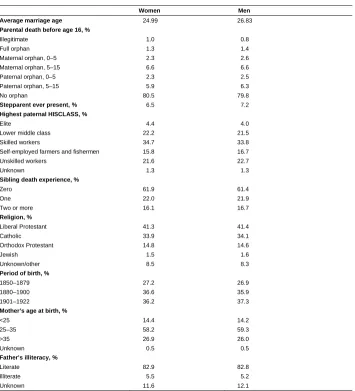
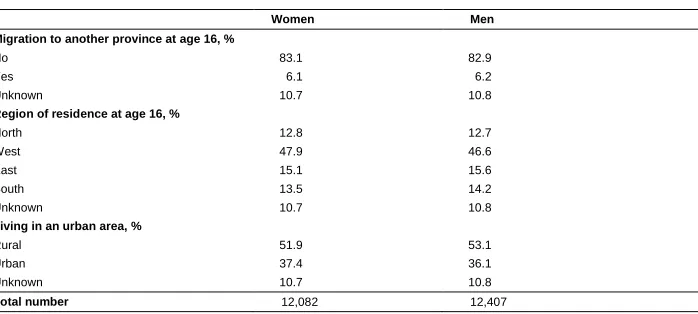
The summary statistics of the variables are depicted in Table 2. Daughters married on average at age 24.99 and sons at age 26.83, and there are no considerable differences between sons and daughters with regard to the independent variables included in the analysis. Very few children experienced illegitimacy and full orphanhood, but more than 17% had lost their mother or father before age 16. This is in line with earlier
6 Occupations were coded into HISCO and HISCLASS using a data set provided by Mandemakers and
research estimating that 23% of Dutch children born between 1850 and 1879 and 13% of Dutch children born between 1900 and 1922 had lost a mother and/or father by age 15 (van Poppel, Schenk, and van Gaalen 2013), which illustrates that parental mortality risk decreased considerably in the end of the 19th and beginning of the 20th century (Wolleswinkel-van den Bosch et al. 1998).
Table 2: Summary statistics of independent variables
Women Men
Average marriage age 24.99 26.83
Parental death before age 16, %
Illegitimate 1.0 0.8
Full orphan 1.3 1.4
Maternal orphan, 0–5 2.3 2.6
Maternal orphan, 5–15 6.6 6.6
Paternal orphan, 0–5 2.3 2.5
Paternal orphan, 5–15 5.9 6.3
No orphan 80.5 79.8
Stepparent ever present, % 6.5 7.2
Highest paternal HISCLASS, %
Elite 4.4 4.0
Lower middle class 22.2 21.5
Skilled workers 34.7 33.8
Self-employed farmers and fishermen 15.8 16.7
Unskilled workers 21.6 22.7
Unknown 1.3 1.3
Sibling death experience, %
Zero 61.9 61.4
One 22.0 21.9
Two or more 16.1 16.7
Religion, %
Liberal Protestant 41.3 41.4
Catholic 33.9 34.1
Orthodox Protestant 14.8 14.6
Jewish 1.5 1.6
Unknown/other 8.5 8.3
Period of birth, %
1850–1879 27.2 26.9
1880–1900 36.6 35.9
1901–1922 36.2 37.3
Mother’s age at birth, %
<25 14.4 14.2
25–35 58.2 59.3
>35 26.9 26.0
Unknown 0.5 0.5
Father’s illiteracy, %
Literate 82.9 82.8
Table 2: (Continued)
Women Men
Migration to another province at age 16, %
No 83.1 82.9
Yes 6.1 6.2
Unknown 10.7 10.8
Region of residence at age 16, %
North 12.8 12.7
West 47.9 46.6
East 15.1 15.6
South 13.5 14.2
Unknown 10.7 10.8
Living in an urban area, %
Rural 51.9 53.1
Urban 37.4 36.1
Unknown 10.7 10.8
Total number 12,082 12,407
4. Results
4.1 Parental death below age 16
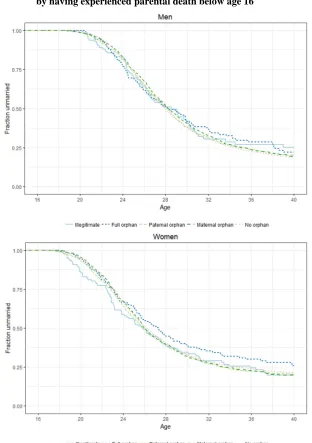
Figure 1 depicts Kaplan–Meier curves representing the fraction of unmarried individuals among illegitimate children, orphans who experienced parental death before age 16 (full, maternal, and paternal), and non-orphans. The upper graph illustrates male and the lower graph female marriage probabilities. The graphs show that men entered marriage substantively later than women and basically did not marry before age 20. In general, no differences in marriage age and propensity are observed between half-orphaned and non-half-orphaned individuals. Illegitimate daughters hastened into early marriage compared to the other groups, while female orphans had lower marriage chances after around age 25. Similar observations are made with regard to illegitimate sons and male orphans, but the differences are less pronounced. However, only very few illegitimate children and orphans are in the sample, and it remains questionable if these differences are statistically significant. This will be further explored in the following multivariate analyses, which also control for the age at parental loss among half-orphans and the arrival of stepparents.
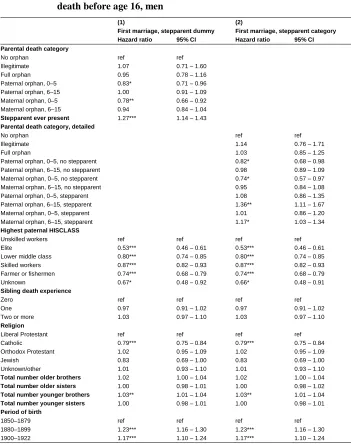
ages 5 and 15. Sons who lost their mother or father in the first five years of life, however, delayed their entry into first marriage. The presence of a stepparent in the household after parental death generally accelerated both men’s and women’s entry into marriage.
The descriptive and multivariate results do not find any support for the evolutionary explanations that paternal death in young age (Hypothesis 4) and paternal death in general (Hypothesis 6) accelerate children’s transition to first marriage. On the contrary, both paternal death and maternal death below the age of 5 delay men’s entry into marriage. This is rather in line with the second social explanation, which assumes that early parental loss hinders marriage due to lower financial support and stronger claims for assistance by the widowed parent (Hypothesis 2).
Table 3: Event-history analysis for time until first marriage and parental death before age 16, men
(1) (2)
First marriage, stepparent dummy First marriage, stepparent category
Hazard ratio 95% CI Hazard ratio 95% CI
Parental death category
No orphan ref ref
Illegitimate 1.07 0.71 – 1.60
Full orphan 0.95 0.78 – 1.16
Paternal orphan, 0–5 0.83* 0.71 – 0.96
Paternal orphan, 6–15 1.00 0.91 – 1.09
Maternal orphan, 0–5 0.78** 0.66 – 0.92
Maternal orphan, 6–15 0.94 0.84 – 1.04
Stepparent ever present 1.27*** 1.14 – 1.43 Parental death category, detailed
No orphan ref ref
Illegitimate 1.14 0.76 – 1.71
Full orphan 1.03 0.85 – 1.25
Paternal orphan, 0–5, no stepparent 0.82* 0.68 – 0.98
Paternal orphan, 6–15, no stepparent 0.98 0.89 – 1.09
Maternal orphan, 0–5, no stepparent 0.74* 0.57 – 0.97
Maternal orphan, 6–15, no stepparent 0.95 0.84 – 1.08
Paternal orphan, 0–5, stepparent 1.08 0.86 – 1.35
Paternal orphan, 6–15, stepparent 1.36** 1.11 – 1.67
Maternal orphan, 0–5, stepparent 1.01 0.86 – 1.20
Maternal orphan, 6–15, stepparent 1.17* 1.03 – 1.34
Highest paternal HISCLASS
Unskilled workers ref ref ref ref
Elite 0.53*** 0.46 – 0.61 0.53*** 0.46 – 0.61
Lower middle class 0.80*** 0.74 – 0.85 0.80*** 0.74 – 0.85
Skilled workers 0.87*** 0.82 – 0.93 0.87*** 0.82 – 0.93
Farmer or fishermen 0.74*** 0.68 – 0.79 0.74*** 0.68 – 0.79
Unknown 0.67* 0.48 – 0.92 0.66* 0.48 – 0.91
Sibling death experience
Zero ref ref ref ref
One 0.97 0.91 – 1.02 0.97 0.91 – 1.02
Two or more 1.03 0.97 – 1.10 1.03 0.97 – 1.10
Religion
Liberal Protestant ref ref ref ref
Catholic 0.79*** 0.75 – 0.84 0.79*** 0.75 – 0.84
Orthodox Protestant 1.02 0.95 – 1.09 1.02 0.95 – 1.09
Jewish 0.83 0.69 – 1.00 0.83 0.69 – 1.00
Unknown/other 1.01 0.93 – 1.10 1.01 0.93 – 1.10
Total number older brothers 1.02 1.00 – 1.04 1.02 1.00 – 1.04
Total number older sisters 1.00 0.98 – 1.01 1.00 0.98 – 1.02
Total number younger brothers 1.03** 1.01 – 1.04 1.03** 1.01 – 1.04
Total number younger sisters 1.00 0.98 – 1.01 1.00 0.98 – 1.01
Period of birth
1850–1879 ref ref ref ref
1880–1899 1.23*** 1.16 – 1.30 1.23*** 1.16 – 1.30
Table 3: (Continued)
(1) (2)
First marriage, stepparent dummy First marriage, stepparent category
Hazard ratio 95% CI Hazard ratio 95% CI
Mother’s age at birth
<25 1.13*** 1.06 – 1.22 1.14*** 1.06 – 1.22
25–35 ref ref ref ref
>35 0.98 0.91 – 1.04 0.98 0.91 – 1.04
Unknown 0.99 0.70 – 1.41 0.99 0.70 – 1.40
Father’s literacy
Literate ref ref ref ref
Illiterate 1.09 0.99 – 1.21 1.09 0.99 – 1.21
Unknown 1.06 0.98 – 1.13 1.05 0.98 – 1.13
Migration to another province
No migration ref ref ref ref
Migration 1.18*** 1.09 – 1.27 1.18*** 1.09 – 1.27
Unknown 0.91 0.38 – 2.19 0.91 0.38 – 2.18
Region of residence
West ref ref ref ref
North 0.97 0.89 – 1.05 0.96 0.89 – 1.05
East 0.85*** 0.79 – 0.92 0.85*** 0.79 – 0.92
South 0.90* 0.83 – 0.98 0.90* 0.83 – 0.98
Living in urban area
Rural ref ref ref ref
Urban 1.20*** 1.13 – 1.27 1.20*** 1.13 – 1.27
Unknown 0.72 0.30 – 1.73 0.72 0.30 – 1.74
Number of subjects 12407 12407
Number of failures 7579 7579
Note: * p<0.05, ** p<0.01, *** p<0.001.
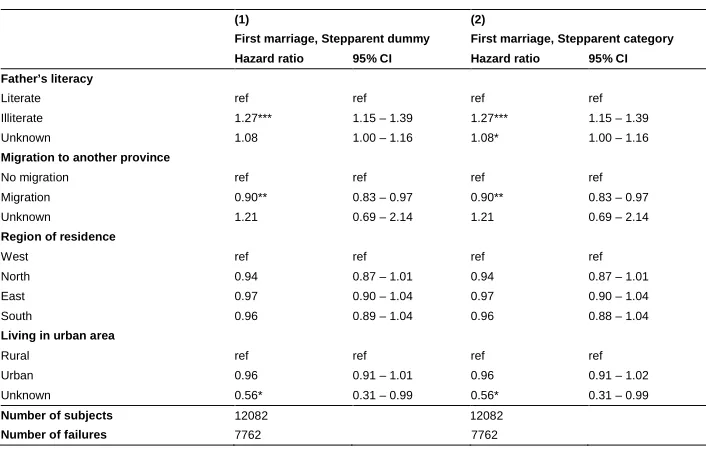
Table 4: Event-history analysis for time until first marriage and parental death before age 16, women
(1) (2)
First marriage, Stepparent dummy First marriage, Stepparent category
Hazard ratio 95% CI Hazard ratio 95% CI
Parental death category
No orphan ref ref
Illegitimate 0.93 0.66 – 1.31
Full orphan 0.89 0.72 – 1.08
Paternal orphan, 0–5 0.95 0.82 – 1.11
Paternal orphan, 6–15 1.04 0.95 – 1.14
Maternal orphan, 0–5 0.88 0.74 – 1.04
Maternal orphan, 6–15 0.99 0.89 – 1.10
Table 4: (Continued)
(1) (2)
First marriage, Stepparent dummy First marriage, Stepparent category
Hazard ratio 95% CI Hazard ratio 95% CI
Parental death category, detailed
No orphan ref ref
Illegitimate 0.98 0.69 – 1.37
Full orphan 0.93 0.76 – 1.13
Paternal orphan, 0–5, no stepparent 0.90 0.74 – 1.09
Paternal orphan, 6–15, no stepparent 1.05 0.95 – 1.15
Maternal orphan, 0–5, no stepparent 1.00 0.77 – 1.30
Maternal orphan, 6–15, no stepparent 1.01 0.89 – 1.14
Paternal orphan, 0–5, stepparent 1.23 0.98 – 1.54
Paternal orphan, 6–15, stepparent 1.20 0.97 – 1.48
Maternal orphan, 0–5, stepparent 0.98 0.82 – 1.16
Maternal orphan, 6–15, stepparent 1.14 0.99 – 1.30
Highest paternal HISCLASS
Unskilled workers ref ref ref ref
Elite 0.49*** 0.43 – 0.56 0.49*** 0.43 – 0.56
Lower middle class 0.67*** 0.62 – 0.72 0.67*** 0.62 – 0.72
Skilled workers 0.74*** 0.69 – 0.79 0.74*** 0.70 – 0.79
Farmer or fishermen 0.71*** 0.66 – 0.77 0.71*** 0.66 – 0.77
Unknown 0.79 0.59 – 1.07 0.79 0.58 – 1.07
Sibling death experience
Zero ref ref ref ref
One 1.05 0.99 – 1.11 1.05 0.99 – 1.11
Two or more 1.11** 1.04 – 1.18 1.11** 1.04 – 1.18
Religion
Liberal Protestant ref ref ref ref
Catholic 0.76*** 0.72 – 0.81 0.76*** 0.72 – 0.81
Orthodox Protestant 0.90** 0.84 – 0.96 0.90** 0.84 – 0.96
Jewish 0.82* 0.68 – 0.99 0.82* 0.68 – 0.99
Unknown/other 0.90* 0.82 – 0.98 0.90* 0.82 – 0.98
Total number older brothers 1.03** 1.01 – 1.05 1.03** 1.01 – 1.05
Total number older sisters 1.02* 1.00 – 1.04 1.02* 1.00 – 1.04
Total number younger brothers 1.00 0.99 – 1.02 1.01 0.99 – 1.02
Total number younger sisters 1.02** 1.01 – 1.04 1.02** 1.01 – 1.04
Period of birth
1850–1879 ref ref ref ref
1880–1899 1.06* 1.01 – 1.12 1.06* 1.01 – 1.12
1900–1922 1.09** 1.02 – 1.16 1.09** 1.02 – 1.16
Mother’s age at birth
<25 1.26*** 1.18 – 1.35 1.26*** 1.17 – 1.35
25–35 ref ref ref ref
>35 0.92** 0.86 – 0.98 0.92** 0.86 – 0.98
Table 4: (Continued)
(1) (2)
First marriage, Stepparent dummy First marriage, Stepparent category
Hazard ratio 95% CI Hazard ratio 95% CI
Father’s literacy
Literate ref ref ref ref
Illiterate 1.27*** 1.15 – 1.39 1.27*** 1.15 – 1.39
Unknown 1.08 1.00 – 1.16 1.08* 1.00 – 1.16
Migration to another province
No migration ref ref ref ref
Migration 0.90** 0.83 – 0.97 0.90** 0.83 – 0.97
Unknown 1.21 0.69 – 2.14 1.21 0.69 – 2.14
Region of residence
West ref ref ref ref
North 0.94 0.87 – 1.01 0.94 0.87 – 1.01
East 0.97 0.90 – 1.04 0.97 0.90 – 1.04
South 0.96 0.89 – 1.04 0.96 0.88 – 1.04
Living in urban area
Rural ref ref ref ref
Urban 0.96 0.91 – 1.01 0.96 0.91 – 1.02
Unknown 0.56* 0.31 – 0.99 0.56* 0.31 – 0.99
Number of subjects 12082 12082
Number of failures 7762 7762
Note: * p<0.05, ** p<0.01, *** p<0.001.
The control variables show the expected effects on male and female marriage age and propensity. Especially social background but also religious denomination and region of residence strongly influenced both men’s and women’s marriage behavior, which indicates that first marriage in the period of consideration was strongly determined by regional, cultural, religious, and financial constraints. In general, the findings reveal that men were more affected by geographical differences in inheritance systems and labor markets, whereas women’s marriage behavior was more directed by religious norms and controls.
decreased after migration and opened up marriage opportunities (Oris 2000). This especially applied to long-distance provincial moves, as studied in this paper. Finally, earlier research on the relationship between migration and marriage behavior in the Netherlands in the 19th century is based on a combination of place of birth and place of marriage (Störmer et al. 2017; Suanet and Bras 2010). This is problematic as in the Netherlands a couple traditionally contracted its marriage in the bride’s place of residence (Ekamper, van Poppel, and Mandemakers 2011) where they did not necessarily live after marriage (Rutten 2005). Comparing the birth place with the place of marriage is therefore potentially misleading when it comes to male migration trajectories. Our study, in contrast, is based on continuously updated population registers, which are more suitable for studying individual migration trajectories.
4.2 Parental death above age 15
Table 5 and Table 6 study the impact of parental death after age 15 on the transition to marriage for male and female research persons, respectively. The first model examines the impact of paternal and maternal loss after age 15, the second model includes interactions between paternal death and social class, and the final model includes interactions between maternal death and social class. In all models, the effects of the control variables are very similar to those obtained in Table 3 and Table 4.
Table 5: Event-history analysis for time until first marriage and parental death after age 15, men
(1) (2) (3)
No interactions Interactions with paternal death
Interactions with maternal death
Hazard ratio 95% CI Hazard ratio 95% CI Hazard ratio 95% CI Maternal death after age 15
Yes 1.08 0.99 – 1.17 1.08 0.99 – 1.18 0.92 0.76 – 1.12
No ref ref ref ref ref ref
Paternal death after age 15
Yes 0.95 0.88 – 1.02 0.81** 0.69 – 0.95 0.95 0.88 – 1.02
No ref ref ref ref ref ref
Highest paternal HISCLASS
Unskilled worker ref ref ref ref ref ref
Elite 0.53*** 0.46 – 0.62 0.52*** 0.44 – 0.61 0.54*** 0.46 – 0.63
Lower middle class 0.78*** 0.72 – 0.85 0.78*** 0.72 – 0.84 0.77*** 0.71 – 0.83
Skilled worker 0.84*** 0.79 – 0.90 0.81*** 0.76 – 0.88 0.83*** 0.78 – 0.90
Farmer or fishermen 0.71*** 0.65 – 0.77 0.68*** 0.62 – 0.74 0.68*** 0.62 – 0.75
Unknown 0.69 0.45 – 1.06 0.72 0.46 – 1.13 0.71 0.46 – 1.12
Paternal death X Highest paternal HISCLASS
Unskilled worker ref ref
Elite 1.14 0.73 – 1.78
Lower middle class 1.06 0.84 – 1.32
Skilled worker 1.29* 1.05 – 1.58
Farmer or fishermen 1.39** 1.10 – 1.75
Unknown 0.44 0.058 – 3.38
Maternal death X Highest paternal HISCLASS
Unskilled worker ref ref
Elite 0.84 0.48 – 1.47
Lower middle class 1.23 0.95 – 1.59
Skilled worker 1.13 0.89 – 1.44
Farmer or fishermen 1.46** 1.12 – 1.91
Unknown 0.57 0.075 – 4.31
Sibling death experience
Zero ref ref ref ref ref ref
One 0.97 0.91 – 1.04 0.97 0.91 – 1.04 0.97 0.91 – 1.04
Two or more 1.01 0.94 – 1.08 1.01 0.94 – 1.08 1.01 0.94 – 1.08
Religion
Liberal Protestant ref ref ref ref ref ref
Catholic 0.77*** 0.72 – 0.83 0.77*** 0.72 – 0.83 0.77*** 0.72 – 0.83
Orthodox Protestant 1.00 0.93 – 1.08 1.00 0.93 – 1.08 1.00 0.93 – 1.09
Jewish 0.82 0.67 – 1.00 0.83 0.68 – 1.01 0.83 0.68 – 1.01
Unknown/other 0.96 0.87 – 1.05 0.95 0.86 – 1.05 0.95 0.86 – 1.05
Total number older brothers 1.02 0.99 – 1.04 1.01 0.99 – 1.04 1.02 0.99 – 1.04 Total number older sisters 1.00 0.98 – 1.02 1.00 0.98 – 1.02 1.00 0.98 – 1.02 Total number younger brothers 1.03** 1.01 – 1.05 1.03** 1.01 – 1.05 1.03** 1.01 – 1.05 Total number younger sisters 1.00 0.98 – 1.02 1.00 0.98 – 1.02 1.00 0.98 – 1.02 Period of birth
1850–1879 ref ref ref ref ref ref
1880–1899 1.22*** 1.14 – 1.30 1.22*** 1.14 – 1.29 1.21*** 1.14 – 1.29
Table 5: (Continued)
(1) (2) (3)
No interactions Interactions with paternal death
Interactions with maternal death
Hazard ratio 95% CI Hazard ratio 95% CI Hazard ratio 95% CI Mother’s age at birth
<25 1.10* 1.02 – 1.19 1.10* 1.02 – 1.19 1.10* 1.02 – 1.19
25–35 ref ref ref ref ref ref
>35 0.99 0.92 – 1.07 0.99 0.92 – 1.07 0.99 0.92 – 1.07
Unknown 1.03 0.70 – 1.51 1.05 0.72 – 1.55 1.02 0.69 – 1.49
Father’s literacy
Literate ref ref ref ref ref ref
Illiterate 1.13* 1.01 – 1.27 1.13* 1.01 – 1.27 1.14* 1.01 – 1.27
Unknown 1.05 0.97 – 1.14 1.05 0.97 – 1.14 1.05 0.97 – 1.13
Migration to another province
No migration ref ref ref ref ref ref
Migration 1.23*** 1.13 – 1.33 1.23*** 1.13 – 1.34 1.23*** 1.13 – 1.33
Unknown 1.08 0.40 – 2.88 1.10 0.41 – 2.94 1.05 0.39 – 2.80
Region of residence
West ref ref ref ref ref ref
North 0.95 0.87 – 1.04 0.95 0.87 – 1.04 0.95 0.87 – 1.04
East 0.85*** 0.78 – 0.92 0.85*** 0.78 – 0.92 0.85*** 0.78 – 0.92
South 0.90* 0.82 – 0.99 0.90* 0.82 – 0.99 0.90* 0.82 – 0.99
Living in urban area
Rural ref ref ref ref ref ref
Urban 1.19*** 1.12 – 1.27 1.19*** 1.12 – 1.27 1.19*** 1.12 – 1.27
Unknown 0.61 0.23 – 1.64 0.60 0.22 – 1.60 0.63 0.24 – 1.69
Number of subjects 9899 9899 9899
Number of failures 6011 6011 6011
Note: * p<0.05, ** p<0.01, *** p<0.001.
Table 6: Event-history analysis for time until first marriage and parental death after age 15, women
(1) (2) (3)
No interactions Interactions with paternal death
Interactions with maternal death Hazard ratio 95% CI Hazard ratio 95% CI Hazard ratio 95% CI
Maternal death after age 15
Yes 1.03 0.94 – 1.13 1.03 0.94 – 1.13 0.99 0.81 – 1.20
No ref ref ref ref ref ref
Paternal death after age 15
Yes 1.01 0.93 – 1.09 0.98 0.83 – 1.16 1.01 0.93 – 1.09
No ref ref ref ref ref ref
Highest paternal HISCLASS
Unskilled worker ref ref ref ref ref ref
Elite 0.51*** 0.44 – 0.58 0.50*** 0.43 – 0.58 0.51*** 0.44 – 0.59
Lower middle class 0.68*** 0.63 – 0.73 0.67*** 0.62 – 0.73 0.68*** 0.62 – 0.73
Skilled worker 0.74*** 0.69 – 0.80 0.76*** 0.70 – 0.82 0.74*** 0.69 – 0.80
Farmer or fishermen 0.72*** 0.66 – 0.78 0.68*** 0.62 – 0.74 0.70*** 0.64 – 0.76
Table 6: (Continued)
(1) (2) (3)
No interactions Interactions with paternal death
Interactions with maternal death
Hazard ratio 95% CI Hazard ratio 95% CI Hazard ratio 95% CI Paternal death X Highest paternal HISCLASS
Unskilled worker ref ref
Elite 1.14 0.75 – 1.73
Lower middle class 1.02 0.80 – 1.29
Skilled worker 0.82 0.66 – 1.03
Farmer or fishermen 1.51*** 1.19 – 1.93
Unknown na na
Maternal death X Highest paternal HISCLASS
Unskilled worker ref ref
Elite 0.88 0.54 – 1.46
Lower middle class 1.00 0.76 – 1.33
Skilled worker 0.98 0.76 – 1.26
Farmer or fishermen 1.27 0.96 – 1.67
Unknown 2.58 0.75 – 8.84
Sibling death experience
Zero ref ref ref ref ref ref
One 1.04 0.97 – 1.10 1.04 0.97 – 1.10 1.04 0.97 – 1.10
Two or more 1.10** 1.02 – 1.18 1.10** 1.03 – 1.18 1.10** 1.02 – 1.18
Religion
Liberal Protestant ref ref ref ref ref ref
Catholic 0.76*** 0.71 – 0.81 0.76*** 0.71 – 0.81 0.76*** 0.71 – 0.81
Orthodox Protestant 0.88** 0.82 – 0.95 0.88** 0.82 – 0.96 0.88** 0.82 – 0.95
Jewish 0.82 0.67 – 1.01 0.82 0.67 – 1.01 0.82 0.67 – 1.01
Unknown/other 0.92 0.84 – 1.02 0.93 0.84 – 1.02 0.93 0.84 – 1.02
Total number older brothers 1.03* 1.01 – 1.05 1.03* 1.00 – 1.05 1.03* 1.01 – 1.05 Total number older sisters 1.03* 1.00 – 1.05 1.03* 1.00 – 1.05 1.03* 1.00 – 1.05 Total number younger brothers 1.01 0.99 – 1.03 1.01 0.99 – 1.03 1.01 0.99 – 1.03 Total number younger sisters 1.02* 1.01 – 1.04 1.03** 1.01 – 1.05 1.02* 1.01 – 1.04 Period of birth
1850–1879 ref ref ref ref ref ref
1880–1899 1.06 1.00 – 1.13 1.06* 1.00 – 1.13 1.06 1.00 – 1.13
1900–1922 1.08* 1.01 – 1.16 1.08* 1.01 – 1.16 1.08* 1.01 – 1.16
Mother’s age at birth
<25 1.28*** 1.19 – 1.38 1.28*** 1.18– 1.38 1.28*** 1.19 – 1.39
25–35 ref ref ref ref ref ref
>35 0.89** 0.83 – 0.96 0.90** 0.84 – 0.97 0.89** 0.83 – 0.96
Unknown 1.08 0.78 – 1.48 1.08 0.78 – 1.49 1.08 0.78 – 1.49
Father’s literacy
Literate ref ref ref ref ref ref
Illiterate 1.33*** 1.20 – 1.48 1.33*** 1.20 – 1.48 1.33*** 1.20 – 1.48
Unknown 1.08 1.00 – 1.17 1.08 1.00 – 1.17 1.08 1.00 – 1.17
Migration to another province
No migration ref ref ref ref ref ref
Migration 0.93 0.85 – 1.02 0.93 0.85 – 1.02 0.93 0.85 – 1.02
Table 6: (Continued)
(1) (2) (3)
No interactions Interactions with paternal death
Interactions with maternal death
Hazard ratio 95% CI Hazard ratio 95% CI Hazard ratio 95% CI Region of residence
West ref ref ref ref ref ref
North 0.94 0.87 – 1.03 0.95 0.87 – 1.03 0.95 0.87 – 1.03
East 0.97 0.90 – 1.05 0.97 0.89 – 1.05 0.97 0.90 – 1.05
South 0.96 0.87 – 1.05 0.95 0.87 – 1.04 0.96 0.87 – 1.05
Living in urban area
Rural ref ref ref ref ref ref
Urban 0.97 0.91 – 1.03 0.97 0.91 – 1.03 0.97 0.91 – 1.03
Unknown 0.46* 0.25 – 0.87 0.46* 0.25 – 0.87 0.46* 0.25 – 0.86
Number of subjects 9725 9725 9725
Number of failures 6176 6176 6176
Note: * p<0.05, ** p<0.01, *** p<0.001.
5. Concluding discussion
This study analyzed the impact of parental death and other determinants on the transition to first marriage for more than 24,000 men and women born in the Netherlands between 1850 and 1922. It studied the classical historical framework in more detail thanks to the inclusion of the children’s exact age at parental death and the presence of stepparents. As described in the previous section, the effects of the control variables were in line with earlier research on the Netherlands and showed that first marriage was subject to many societal constraints.
Results on the impact of parental death, the focus of this study, revealed that bereaved children generally did not display different marriage behavior than non-bereaved children. Differences between the two groups were only observed under certain circumstances. On the one hand, sons who experienced parental death before age 5 and whose widowed parent did not remarry postponed entry into marriage. On the other hand, sons who lost a parent between ages 5 and 15 and whose parent remarried, as well as farmers’ children and skilled workers’ sons who experienced paternal death after age 15 accelerated transition to marriage. The same applies to farmers’ sons who experienced maternal death after age 15.
to a certain degree the inheritance of a business after adolescence accelerated children’s entry into marriage but not family wealth per se. Interestingly, not only paternal death but also maternal death significantly reduced marriage age of farmers’ adult sons in the Netherlands. Similar findings were made for rural east Belgium, southern Sweden, northern and central Italy (Bengtsson 2014; Derosas et al. 2014; Kurosu and Lundh 2014; Neven 2003; Oris et al. 2014), and also for the Krummhörn population (Voland and Willführ 2017, Appendix AII and Appendix AIII).
Earlier work of social and demographic historians offers a plausible explanation for the observation that maternal death facilitated marriage among farmers’ sons. After the death of the mother, adult female labor force and skills with regard to domestic labor were missing on the family farm. This increased the pressure on the elderly male household head to retire and transfer the family property to the adult male heir to facilitate his marriage and overcome the gender imbalance in the farming household. Fast entry into marriage of the son therefore reintroduced the gender cooperation needed to run the farm (Neven 2003: 339; Oris et al. 2014: 272). The same reasoning applies to the relationship between paternal death and the daughter’s marriage. The importance of the gender balance in the farmer’s household is also reflected in the findings of this study. Among the Dutch farming population, maternal death in adulthood had a significant accelerating impact on the marriage of sons but not on daughters. Paternal loss, on the contrary, had a strong accelerating effect on the marriage of daughters. These results therefore confirm the importance of gender complementarities in preindustrial rural household economy (Mönkediek, Kok, and Mandemakers 2016): When the untimely death of a household head or his wife threatened the family continuity, fast marriage of the adult children was a solution to restore the gender balance on the farm and maintain the land in the family line.
Sons who experienced early parental death before the age of 5, however, postponed their entry into first marriage. In line with the second social explanation (Hypothesis 2), this indicates that parental death in early life decreased living standards and hindered a smooth transition to marriage. Sons might have been more affected by parental death in young childhood and its harmful consequences because men, compared to women, were to a larger degree expected to accumulate substantial savings before establishing an independent household. Parental death in an early stage of life therefore potentially complicated the accumulation of savings over the life course and eventually resulted in increased ages at marriage for sons.
between ages 5 and 15 and the arrival of a stepparent tended to marry even earlier than their non-bereaved counterparts. As has been argued earlier, parental remarriage might have reduced marriage ages because it introduced a stable household situation and released the children from the responsibility to take care for the elderly widowed parent (Alter 1988). This is also in line with the results that sons living with single widowed parents delayed their entry into marriage. A second argument refers to the finding that parental death in the past was associated with earlier ages at leaving the parental home (Bras and Kok 2004; Bras and Neven 2007; Dribe 2000; Lundh and Öberg 2018; Steckel 1996). Even though they did not control for the arrival of a stepparent, Bras and Kok (2004) as well as Dribe (2000) suggest that leaving the parental home at younger ages might have been related to tensions with stepparents, especially during adolescence. Tensions with the stepparents and earlier ages at leaving home might also explain why sons who lost a parent between ages 5 and 15 and experienced parental remarriage tended to marry the earliest.
Generally, the overall results indicate that hypotheses derived from social and demographic history are substantially better able to explain the marriage behavior of parentally bereaved children born in the Netherlands between 1850 and 1922 than the evolutionary explanations proposed. Just like Voland and Willführ (2017) in their Krummhörn study, we do not find any support for the hypotheses that bereaved children in general (Hypothesis 6) and children who lost a father (or mother) in early childhood (Hypothesis 4) married earlier than the non-bereaved control group. The explanation based on life history theory (Hypothesis 4) even predicted the opposite effect of what was observed for male children in this study. Possibly, no evidence for life history theory was found because both studies focused on the transition to first marriage. The transition to first marriage in the past, however, was strongly determined by regional, cultural, religious, and financial constraints, as shown in this article. As a result, the importance of strict societal norms and constraints leads to a lower predictive value of explanations based on evolutionary biology. Therefore, we advise not to use the age at marriage as a proxy for reproductive behavior. Instead, further research aiming to test life history theory and other evolutionary explanations with the help of historical family reconstitution data should rather study illegitimate births or premarital pregnancies, which are an indicator for risky sexual behavior.
with an accelerated transition to marriage for farmers’ children but not for other wealthy socioeconomic groups such as the elite, where early marriages were socially not accepted. This also explains why Voland and Willführ (2017) in their own study did not find differences between small-, medium-, and large-scale farmers. Second, it is unclear why the reconsideration of benefits and costs of marriage after parental death in adulthood is described as an evolutionary adaptation, as the reference to costs and benefits is not necessarily an evolutionary concept. Consequently, the question remains how this evolutionary explanation actually differs from Hajnal’s (1965) ideas about marriage opportunities proposed more than fifty years ago, and further developed by many other historical demographers ever since (e.g., Lundh and Kurosu 2014). In conclusion, we therefore suggest to enhance collaborations between (historical) demographers and evolutionary biologists to reduce misunderstandings and benefit from earlier insights gained in both disciplines.
6. Acknowledgements
References
Alter, G. (1988).Family and the female life course: The women of Verviers, Belgium, 1849–1880. Madison: University of Wisconsin Press.
Alter, G. and Oris, M. (1999). Access to marriage in the East Ardennes during the 19th century. In: Devos, I. and Kennedy, L. (eds.). Marriage and rural economy: Western Europe since 1400. Turnhout: Brepols: 133–151.doi:10.1484/M.CORN -EB.4.00126.
Apostolou, M. (2014).Sexual selection under parental choice: The evolution of human mating behaviour. New York: Psychology Press.
Belsky, J., Steinberg, L., and Draper, P. (1991). Childhood experience, interpersonal development, and reproductive strategy: An evolutionary theory of socialization.
Child Development 62(4): 647–670.doi:10.2307/1131166.
Bengtsson, T. (2014). The influence of economic factors on first marriage in historical Europe and Asia. In: Lundh, C. and Kurosu, S. (eds.). Similarity in difference: Marriage in Europe and Asia, 1700–1900. Cambridge: MIT Press: 121–168. doi:10.7551/mitpress/9780262027946.003.0005.
Bras, H. (2003). Maids to the city: Migration patterns of female domestic servants from the province of Zeeland, the Netherlands (1850–1950). The History of the Family 8(2): 217–246.doi:10.1016/S1081-602X(03)00027-7.
Bras, H. and Kok, J. (2004). ‘Naturally, every child was supposed to work’: Determinants of the leaving home process in The Netherlands, 1850–1940. In: Van Poppel, F., Oris, M., and Lee, J.Z. (eds.). The road to independence: Leaving home in Western and Eastern societies, 16th–20th centuries. Bern: Peter Lang: 403–450.
Bras, H. and Neven, M. (2007). The effects of siblings on the migration of women in two rural areas of Belgium and the Netherlands, 1829–1940.Population Studies
61(1): 53–71.doi:10.1080/00324720601048319.
Chisholm, J.S., Ellison, P.T., Evans, J., Lee, P.C., Lieberman, L.S., Pavlik, Z., Ryan, A.S., Salter, E.M., Stini, W.A., and Worthman, M. (1993). Death, hope, and sex: Life-history theory and the development of reproductive strategies. Current Anthroplogy 34(1): 1–24.doi:10.1086/204131.
Cox, D.R. (1972). Regression models and life tables. Journal of the Royal Statistical Society Series B: Statistical Methodology 34(2): 187–220.
de Moor, T. and van Zanden, J.L. (2010). Girl power: The European marriage pattern and labour markets in the North Sea region in the late medieval and early modern period. Economic History Review 63(1): 1–33.doi:10.1111/j.1468-028 9.2009.00483.x.
Derosas, R., Breschi, M., Fornasin, A., Manfredini, M., and Munno, C. (2014). Between contraints and coercion: Marriage and social reproduction in Northern and Central Italy in the eighteenth and nineteenth centuries. In: Lundh, C. and Kurosu, S. (eds.).Similarity in difference: Marriage in Europe and Asia, 1700– 1900. Cambridge: MIT Press: 295–348. doi:10.7551/mitpress/9780262027946. 003.0009.
Draper, P. and Harpending, H. (1982). Father absence and reproductive strategy: An evolutionary perspective.Journal of Anthropological Research 38(3): 255–273. doi:10.1086/jar.38.3.3629848.
Dribe, M. (2000). Leaving home in a peasant society: Economic fluctuations, household dynamics and youth migration in Southern Sweden, 1829–1866. Södertälje: Almqvist & Wiksell.
Dribe, M. (2003). Migration of rural families in 19th century southern Sweden: A longitudinal analysis of local migration patterns.The History of the Family 8(2): 247–265.doi:10.1016/S1081-602X(03)00028-9.
Dribe, M., Manfredini, M., and Oris, M. (2014). The roads to reproduction: Comparing life-course trajectories in preindustrial Eurasia. In: Lundh, C. and Kurosu, S. (eds.). Similarity in difference: Marriage in Europe and Asia, 1700–1900. Cambridge: MIT Press: 89–120. doi:10.7551/mitpress/9780262027946.003.00 04.
Ekamper, P., van Poppel, F., and Mandemakers, K. (2011). Widening horizons? The geography of the marriage market in nineteenth and early-twentieth century Netherlands. In: Merchant, E.R., Glenn, D.D., Gutmann, M.P., and Sylvester, K.M. (eds.). Navigating time and space in population studies. Dordrecht: Springer: 115–160.doi:10.1007/978-94-007-0068-0_6.
Ellis, B.J., Bates, J.E., Dodge, K.A., Fergusson, D.M., Horwood, L.J., Pettit, G.S., and Woodward, L. (2003). Does father absence place daughters at special risk for early sexual activity and teenage pregnancy? Child Development 74(3): 801–
821.doi:10.1111/1467-8624.00569.
Engelen, T. and Kok, J. (2002). Permanent celibacy and late marriage in the Netherlands, 1890–1960.Population 58(1): 67–95.doi:10.3917/pope.301.0067.
Hajnal, J. (1965). European marriage patterns in perspective. In: Glass, D.V. and Eversley, D.E.C. (eds.).Population in history: Essays in historical demography. Chicago: Aldine: 101–143.
Hajnal, J. (1982). Two kinds of preindustrial household formation system.Population and Development Review 8(3): 449–494.doi:10.2307/1972376.
Head-König, A.-L. and Pozsgai, P. (2012).Inheritance practices, marriage strategies and household formation in European rural societies. Turnhout: Brepols. doi:10.1484/M.RURHE-EB.5.106190.
Hofstee, E.W. (1981).Korte demografische geschiedenis van Nederland van 1800 tot heden. Haarlem: Fibula-Van Dishoeck.
Janssens, A. (2014).Labouring lives: Women, work and the demographic transition in the Netherlands, 1880–1960. Bern: Peter Lang.doi:10.3726/978-3-0352-0273-1.
Klep, P.M.M. (2011). Gezinssolidariteit en ‘rotten kids’: Schaarste, seks en het vierde gebod op het platteland in Nederland in de twintigste eeuw. Nijmegen: Radboud Repository.
Kok, J. (2004). Choices and constraints in the migration of families: The central Netherlands, 1850–1940. History of the Family 9(2): 137–158. doi:10.1016/ j.hisfam.2004.01.002.
Kok, J. (2014). ‘At age 27, she gets furious’: Scripts on marriage and life course variation in the Netherlands, 1850–1970.Historical Social Research 39(1): 113–
132.doi:10.12759/hsr.39.2014.1.113-132.
Kok, J. (2017). Church affiliation and life course transition in the Netherlands, 1850– 1970. Historical Social Research 42(2): 59–91. doi:10.12759/hsr.42.2017.2.59-91.
Kok, J., Mandemakers, K., and Damsma, D. (2010). Atrophied hearts? Partner choice and social reproduction of farmers in the North-Western part of the Netherlands in the 19th and early 20th century. In: Arrizabalaga, M.-P., Bolovan, I., Eppel, M., Kok, J., and Nagata, M.L. (eds.). Many paths to happiness? Studies in population and family history: A festschrift for Antoinette Fauve-Chamoux. Amsterdam: Aksant: 362–387.
Kooij, P. (1985). Stad en platteland. In: van Holthoon, F.L. and Berting, J. (eds.).De Nederlandse samenleving sinds 1815: Wording en samenhang. Assen: Van Gorcum: 93–115.
Kurosu, S. and Lundh, C. (2014). Nuptiality: Local populations, sources, and models. In: Lundh, C. and Kurosu, S. (eds.).Similarity in difference: Marriage in Europe and Asia, 1700–1900. Cambridge: MIT Press: 47–85. doi:10.7551/mitpress/ 9780262027946.003.0003.
Lundh, C. and Kurosu, S. (2014). Eurasian marriage: Actors and structures. In: Lundh, C. and Kurosu, S. (eds.).Similarity in difference: Marriage in Europe and Asia, 1700–1900. Cambridge: MIT Press: 25–46. doi:10.7551/mitpress/978026202 7946.003.0002.
Lundh, C. and Kurosu, S. (2014). Similarity in difference: Marriage in Europe and Asia, 1700–1900. Cambridge: MIT Press.doi:10.7551/mitpress/9780262027946. 001.0001.
Lundh, C. and Öberg, S. (2018). Routes and determinants of leaving home: The city of Gothenburg, 1915–1943. History of the Family 23(2): 260–289. doi:10.1080/ 1081602X.2017.1417145.
Mandemakers, K. (2002). Building life course datasets from population registers by the historical sample of the Netherlands (HSN). History and Computing 14(1–2): 87–107.doi:10.3366/hac.2002.14.1-2.87.
Mandemakers, K., Muurling, S., Maas, I., van de Putte, B., Zijdeman, R., Lambert, P. S., van Leeuwen, M.H.D., Van Poppel, F., and Miles, A. (2013). HSN standardized, HISCO-coded and classified occupational titles, release 2013.01 [electronic resource]. Amsterdam: International Institute of Social History.