1: Department of Immunology, School of Medicine, Isfahan University of Medical Sciences, Isfahan, IR-Iran.
Subcutaneous Immunization with
Recombinant
Lactococcus lactis
Expressing F1S1
Fusion Protein Induces Systemic and Mucosal
Immune Responses in BALB/C
Mice
Ali Torkashvand
1, Fariborz Bahrami
2, Minoo Adib
1, Soheila Ajdary*
2Abstract
Background:Lactic acid bacteria such as Lactococcus (L.) lactis are powerful tools that can function as live
delivery vectors and heterologous protein expression hosts in development of novel vaccines. Pertussis toxin (PT) and filamentous hemagglutinin (FHA) are important virulence factors of Bordetella (B.) pertussis and constitute the major components of commercially available acellular pertussis (aP) vaccines. The purpose of the present study was to express F1S1 fusion protein, consisted of the N-terminal region of S1 subunit from PT
and FHA type 1 immunodominant domain by L. lactis and to evaluate its immunogenicity.
Methods: The fusion gene composed of sequences encoding the F1S1 and the signal peptide of usp45
fragments (SECF1S1) was codon optimized for protein production in L. lactis and was synthesized and inserted in-frame inside pNZ8149 plasmid. The resulting pNZ8149-SECF1S1 construct was introduced by
electroporation into L. lactis cells (LL-F1S1). BALB/c mice were subcutaneously immunized with LL-F1S1 or
commercial DTaP vaccine. The immune responses were investigated.
Results:The LL-F1S1-immunized mice produced significant levels of specific IFN-g compared to their
respective controls and DTaP-immunized mice. The F1S1- specific IgG antibody response was lower in LL-F1S1-immunized mice while the IgG2a/IgG1 ratio was higher in this group compared to the DTaP-immunized mice. Moreover, anti-F1S1 IgA antibodies were only detected in the lung homogenates of the LL-F1S1-immunized mice, suggesting the induction of a mucosal immune response.
Conclusions: These results indicate the feasibility of expression of F1S1 fusion protein in L. lactis. This
recombinant bacterium could induce mucosal and Th1-type systemic immune responses following
subcutaneous administration.
Keywords: Bordetella pertussis, FHA, Lactococcus lactis, Pertussis toxin.
Introduction
Studies on expression of heterologous proteins in nonpathogenic lactic acid bacteria (LAB) during the last two decades have shown their potency as interesting expression systems and delivery vehicles. LAB are used in the food industry for preparation of fermented products; hence, are classified as GRAS (generally regarded as safe) organisms (1). Lactococcus (L.) lactis is the best-known LAB and
has been extensively manipulated for heterologous protein production (2-9). One of the most successful tools for regulated gene expression in L. lactis is Nisin-controlled gene expression system (NICE). Nisin which is a bacteriocin produced by L. lactis and a natural preservative in the food industry, is the inducer of protein expression in this system (10). These particular features of L. lactis make it an
interesting host for the production of recombinant proteins for very different purposes. In addition, L. lactis exhibits immunomodulatory properties and has been used to inhibit the allergic responses in mice (3, 8) Moreover, the intrinsic Th1 adjuvant activity of L. lactis has been demonstrated in several studies (2, 3).
Pertussis (also known as whooping cough), is responsible for persistent respiratory infections in adults and remains one of the world's leading causes of vaccine-preventable deaths in susceptible infants. Despite the relative success of whole cell pertussis (wP) vaccines in mid-twentieth century, local and systemic reactogenicity cases incited a shift from wP to the more purified acellular (aP) versions, in high-income industrialized countries within recent decades (10). However, the high cost of purification of major antigens is a drawback, particularly for their widespread usage in the developing countries. Moreover, aP vaccines elicit Th2 type immune response which is not the optimum profile of the immune responses required for protection against the infection (11, 12). Among the several virulence factors of the bacterium, pertussis toxin and filamentous haemagglutinin (FHA) are considered to be very important and are components of almost all commercially available aP vaccines. PT is composed of five subunits, termed as S1 to S5; among them, S1 is the most immunogenic part (13, 14). This subunit and the 180 N-terminal amino acid residues of it have been reported to induce protective immune responses against pertussis (15, 16). FHA consists of two immunodominant domains, named type 1 and type 2, corresponding to the carboxyl and amino termini of the protein, respectively. The type 1
immunodominant domain is the most
immunogenic portion and induces systemic and mucosal antibody responses in humans and mice, following the infection (17, 18).
We have previously used L. lactis for expression of a fusion protein, consisted of the N-terminal region of S1 subunit from PT and FHA type 1 immunodominant domain (LL. F1S1) and have evaluated its immunogenicity (19). In the present study, the systemic and mucosal immunogenicity of LL-S1F1 was assessed using BALB/c mice.
Materials and methods
Constructions of the F1S1-expressing L. lactis
The sequence encoding 456 amino acid residues of type I immunodominant domain of FHA (NCBI GenBank accession number X52156.1) was linked via a flexible linker (i.e. Pro-Gln-Asp-Pro-Pro) to the sequence encoding the N-terminal 180 amino acid residues of the mutant S1 (PT-9K/129G) subunit (NCBI GenBank accession number AJ920066.1), to construct F1S1 gene fragment. For the extracellular expression, the N-terminus of F1S1 was fused to SPUsp45 which is the signal peptide of Usp45, the major
extracellular secretary protein in L. lactis
subspecies cremoris MG1363 (NCBI GenBank
accession number: EU382094.1)(20). The
nucleotide sequence was optimized according to
the codon bias of L. lactis using
<http://www.jcat.de>/ website and was
synthesized by GeneCust (Dudelange,
Luxembourg).The synthesized fragment
(SECF1S1) was inserted into pNZ8149
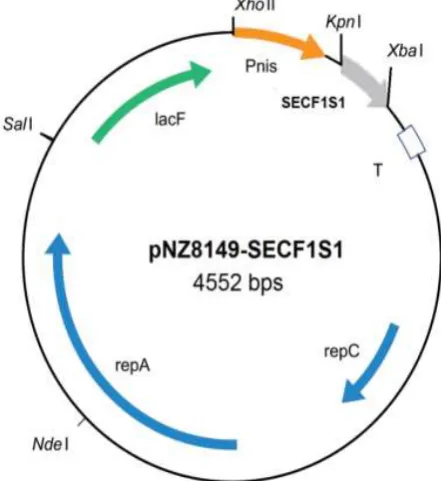
expression vector and the construct (i.e. to pNZ8149SEC-F1S1, Fig. 1) was transformed into L. lactis NZ3900 as previously described (19).
Fig. 1 Schematic representation of L. lactis expression vector pNZ8149-SECF1S1. The pNZ8149-SECF1S1 vector carries the lacF:food-grade selection marker for growth on lactose; Pnis: nisin-inducible promoter; T: transcriptional terminator; repA and repC: replication elements; nisA.
Preparations of live bacteria inocula for immunization
LL-F1S1, as well as L. lactis harboring a non-expressing pNZ8149 plasmid (LL; used as a negative control) were grown in LM17 broth medium (Merck, Germany), supplemented with 0.5% lactose (LM17) at 30°C without shaking. Cells were grown until optical density (OD600) of 0.5 and then were inducted with 20 ng/mL of nisin (Sigma) for 4 h. The cellular pellets were harvested by centrifugation (5,000 x g at 4°C, 15 min) and were then washed twice with sterile phosphate-buffered saline (PBS). The pellets were adjusted to 2 x 10¹⁰ colony forming units (CFU)/ml in the same buffer and the inocula were immediately administered to the mice.
Animals and immunization procedures
Female BALB/c mice (4–6-weeks-old) were
purchased from animal facility of Production Complex of Pasteur Institute of Iran (Karaj, Iran). All animal experiments were performed in accordance with relevant institutional ethics guidelines, set by Ethical Committee of Pasteur Institute of Iran. Groups of 5 mice were subcutaneously immunized in the tail base with 2
x 109 CFU of nisin-induced LL-F1S1 or LL for a
total of 3 immunizations on days 0, 14 and 28. A
third group of mice was immunized
subcutaneously with a 1/4 of standard human dose of a commercial DTaP vaccine (containing 2 μg PT, 2 μg of FHA and 0.6 μg PRN; Boostrix, Belgium). Another group of mice were immunized with alum, using the same schedule.
Cytokine measurements
Two weeks after the last immunization, the spleens were removed aseptically and the splenocytes from each individual mouse were collected and adjusted to a concentration of 2 x 10⁶/ml in RPMI 1640 medium (Sigma, Germany), supplemented with 10% fetal calf serum (FCS), 2 mM l-glutamine, 100 U/mL penicillin and 100 μg/ml streptomycin. The Cells
were then restimulated with F1S1 (final
concentration: 1 μg/ml) for 72 h at 37°C in a
humidified 5% CO2 incubator. Thereafter, the
supernatants were collected and were assayed for the quantity of IFN-γ and IL-4 by commercially available ELISA kits (eBioscience, USA), according to the manufacturer’s instructions.
F1S1-specific antibodies
Two weeks after the last immunization, mice were bled for sera preparation. The lungs were excised from each mouse, washed with PBS and homogenized into 0.5 ml of cold PBS. The resulting suspensions were then centrifuged (5,000 x g, 4°C, 15 min) and the clarified supernatants were collected. The fresh fecal pellets (100 mg) from each mouse were suspended in 1 ml PBS containing 1 mM phenylmethylsulfonyl fluoride (PMSF; Sigma, USA) and 1% BSA, and were incubated for 16 h at 4°C. The tubes were then centrifuged (10,000 x g, 4°C, 10 min) and the supernatants were used for detection of secretory IgA (sIgA). ELISA was used to determine the levels of anti-F1S1 specific IgG, IgG1 and IgG2a in serum of each individual mouse, using plates coated with purified F1S1. Similarly, the presence of IgA anti-F1S1 antibodies in the lung extracts of each individual mouse and in the fecal extracts of the different groups of mice were determined, using the methods described previously (19). Recombinant F1S1 had been produced using C-terminally histidine-tagged expression vector
pET21a (Novagen, USA) in E. coli BL21 (DE3),
as previously described (19).
Statistical analysis
One-way analysis of variance (multiple
comparisons Tukey’s post-hoc test) was performed using GraphPad Prism 6.0 for Windows to detect statistical differences (GraphPad Software Inc, USA). P-values < 0.05 were considered to be statistically significant.
Results
Cytokine responses
Two weeks after the last immunization, mice were euthanized and the concentration of the main Th1- (IFN-) and Th2- (IL-4) type cytokines upon in vitro stimulation of the splenocytes with F1S1 protein were analyzed by ELISA. As shown in Fig. 2A, significant quantities of F1S1-specific IFN- were secreted by splenocytes, isolated from the mice that were immunized with LL-F1S1, compared to those of LL control (P < 0.0001). In response to stimulation with F1S1 protein, the splenocytes from DTaP group did not produce significant levels of IFN-. However; in this group,
significant amounts of IL-4 were detected, compared to the alum group (Fig. 2B; P < 0.05).
Fig. 2. Concentrations of IFN- (A) and IL-4 (B) in the supernatant of splenocytes of different groups stimulated with F1S1 measured by ELISA kits. mean+ SD (n = 5; *P < 0.05, **** P < 0.0001).
LL-S1F1 -specific antibody responses
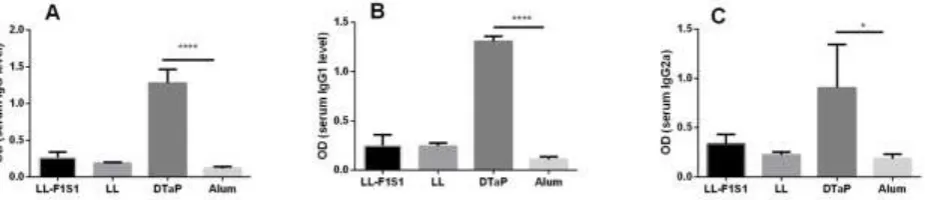
Two weeks after the last immunization, antigen-specific antibody responses against LL-F1S1 in the sera were analyzed and compared with those raised in the control groups. In LL-F1S1 group, very weak F1S1-specific IgG antibody response was induced; whereas significantly higher levels of specific IgG antibodies in DTaP- immunized mice was detected (Fig. 3A; P < 0.0001).
Antigen-specific humoral responses were further analyzed for the levels of both IgG1 and IgG2a antibodies. As shown in Fig. 3B and 3C, significantly higher levels of IgG1 (P < 0.0001) and IgG2a (P < 0.05) were induced in DTaP-immunized mice, compared to the alum group. No significant levels of IgG1 and IgG2a were detected in LL-F1S1 group. The IgG2a/IgG1 ratio in LL-F1S1 and DTap groups were 1.36 and 0.69, respectively.
Fig. 3. Evaluation of anti-F1S1 IgG (A), IgG1 (B), and IgG2a (C) by ELISA. Results depict A450 of sera diluted (1:100) and expressed as
mean+ SD (n = 5; *P < 0.05, ****P < 0.0001).
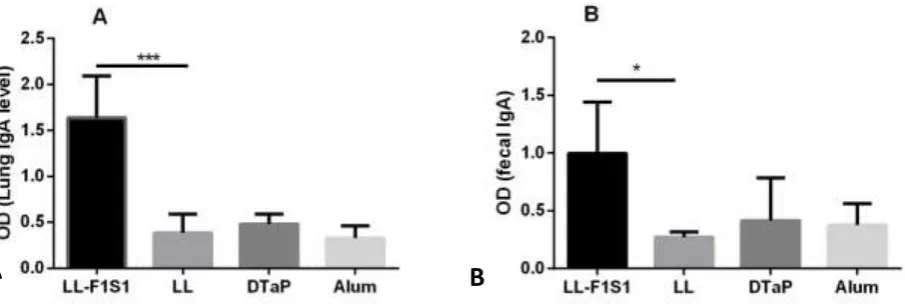
We also evaluated whether immunization with LL-F1S1 was capable of inducing mucosal anti-F1S1 antibody responses. For this purpose, F1S1-specific IgA in the lung homogenates were determined 2 weeks after the last immunization. As shown in Fig. 4A, the levels of anti-F1S1 IgA
were significantly higher in the lung
homogenates of LL-F1S1 group, compared to LL group (P < 0.001). No significant levels of anti-F1S1 IgA were detected in the lung
homogenates of DTaP group (Fig. 4A). In addition, the effects of the immunization in production of F1S1-specific fecal IgA were evaluated using fresh fecal pellets from the immunized mice. The mice immunized with LL-F1S1 showed significantly elevated levels of F1S1-specific fecal IgA response (P < 0.05), compared to the LL group. There was not any significant amount of IgA in fecal extracts of DTaP group (Fig. 4B).
Fig. 4. Evaluation of anti-F1S1 IgA (A) in the lung homogenates and the feces (B) from different groups by ELISA. Results depict A450 of the lung homogenate diluted 1:50 and the fecal extracts (100 mg/ml) as mean+ SD (n = 5; *P < 0.05, ***P < 0.001).
Discussion
The reemergence of pertussis has motivated efforts to develop improved pertussis vaccines. Presently, the commercially wP vaccines suffer from undesirable local and systemic side-effects. Although aP vaccines are safer, their high costs of production and supply chains limit their worldwide application. Meanwhile, the replacement of natural proteins of B. pertussis with the pure recombinant ones in conventional prokaryotic expression systems will reduce the cost of production; however the pure proteins are less immunogenic and usually require powerful adjuvants to induce strong humoral and cellular immune responses (10). Furthermore, proteins which are produced in Gram-negative bacteria are contaminated with LPS which should be removed through a costly depyrogenation process before their parenteral administration (21).
Recent studies on expression of heterologous proteins in LAB such as L. lactis have shown their potency as versatile expression systems and delivery vehicles, capable of being engineered to express various proteins in a nonpathogenic and noninvasive manner (2-9). The food-grade selection marker lacF which confers L. lactis the ability to grow on media containing lactose as a carbon source (instead of the traditionally-used screening methods by antibiotic resistance genes) overcomes the potential risk of antibiotic-resistance in this system (22, 23). Another advantage of L. lactis is that the vector itself elicits weak immune responses; hence the major
immune responses are directed against the expressed heterologous antigens (24).
In the present study, a previously-constructed
recombinant L. lactis strain which could express
FIS1 fusion protein, containing the most immunogenic parts of PT and FHA proteins
from B. pertussis was used for subcutaneous
immunization of BALB/c mice and the induced immune responses were evaluated and compared with the data from mice which were immunized with a commercial DTaP vaccine. Our results indicated that the administration of LL-F1S1 induced a Th1-type response. Similar to the
natural pertussis infection, wP vaccine
preferentially induces Th1 responses that favors cell-mediated immunity and is associated with the protection. In contrast, aP vaccine induces Th2 responses which do not appear to be as effective as the Th1 responses in clearance of B. pertussis from the respiratory tract (11, 12, 25). In comparison with DTaP-immunized mice, the highest levels of specific IFN- secretion were detected for the mice immunized with LL-F1S1 in our study. However, consistent with another study, no significant levels of F1S1-specific IFN- secretion were detected in mice that were subcutaneously immunized with a commercial DTaP vaccine (26).
L. lactis has generally been used for mucosal immunization; however, parenteral immunizations have also been practiced with different results. For
instance, LACK and A2 antigens from Leishmania,
C-repeat region (CRR) of M protein from Streptococcus pyogenes, fragment C of the tetanus
A
B
toxin and major birch pollen allergen (Bet v1) have
been expressed in L. lactis and administered
parentally (6-8, 27, 28). Subcutaneous
immunization with recombinant L. lactis
expressing LACK or A2 have been reported to induce high levels of antigen-specific serum antibodies (6, 7); however in contrast to our study, the responses in both studies were predominantly a Th2-type response, characterized by higher levels of antigen-specific IgG1 titers, compared to the levels of IgG2a. We observed that the F1S1-specific IgG antibody response in mice immunized with LL-F1S1 was lower than the response obtained by the DTaP-immunized mice; however, the ratio of IgG2a/IgG1 was higher in the former group which confirms the induction of a Th1-type immune response against F1S1 antigen, delivered by L. lactis. This was in agreement with another study in which L. lactis expressing Bet v1 induced significantly lower IgG1/IgG2a ratios, compared to purified Bet v1, in subcutaneous immunization (8). Moreover, the IL-5/IFN- ratio was lower in mice immunized with recombinant L. lactis, compared to the mice which had been immunized with the protein, indicating a shift toward Th1-like immune responses.
Considering that IgA is the key antibody of the mucosal immune response, and according to the important role of secretory IgA in controlling of B. pertussis infection (3, 29-31), we investigated the presence of IgA in lung extracts of the immunized mice. The results showed that in LL-F1S1-immunized mice, significant levels of IgA
could be detected in the lung extracts while consistent with other studies (32), DTaP-immunized mice did not stimulate any mucosal immune responses (18). The induction of IgA response in the mucosa was in contrast to Mannam et al. (28) who did not find secretory IgA after subcutaneous immunization with recombinant L. lactis that expressed CRR. It appears that the difference in the immune
responses induced by recombinant L. lactis
expressing different proteins could be attributed to factors such as the route of administration, the nature of the proteins themselves and the differences in the proteins expression yields.
Considering the importance of the route of vaccination in determination of the immune responses, as well as the perceived practical advantages of mucosal delivery of vaccine antigens, full understanding of the potential benefits of Lactococcus-based vaccines such as LL-F1S1 merits further investigation. As an alternative to the commercially available whole cell- or toxin-based vaccines, LL-F1S1 which does not require antigen purification can serve as a basis for the development of a new generation of safe and inexpensive prophylactic measures against pertussis.
Acknowledgment
This study was supported by Pasteur Institute of Iran. The authors declare no potential conflict of interest.
References
1. Yang E, Fan L, Jiang Y, Doucette C, Fillmore S.
Antimicrobial activity of bacteriocin-producing lactic acid bacteria isolated from cheeses and yogurts. AMB Express. 2012 Sep 10;2(1):48. PubMed PMID: 22963659. Pubmed Central PMCID: PMC3488010.
2. Hanniffy SB, Carter AT, Hitchin E, Wells JM. Mucosal delivery of a pneumococcal vaccine using Lactococcus lactis affords protection against respiratory infection. J Infect Dis. 2007 Jan 15;195(2):185-93. PubMed PMID: 17191163.
3. Abgral R, Repa A, Grangette C, Daniel C,
Hochreiter R, Hoffmann-Sommergruber K,
Thalhamer J, et al. Mucosal co-application of lactic acid bacteria and allergen induces counter-regulatory immune responses in a murine model of birch pollen allergy. Vaccine. 2003 Dec 08;22(1):87-95. PubMed PMID: 14604575.
4. Wells JM, Wilson PW, Norton PM, Gasson MJ,
Le Page RW. Lactococcus lactis: high-level expression of tetanus toxin fragment C and protection against lethal challenge. Mol Microbiol. 1993 Jun;8(6):1155-62. PubMed PMID: 8361360.
5. Liu S, Li Y, Xu Z, Wang Y. Subcutaneous or oral
immunization of mice with Lactococcus lactis
expressing F4 fimbrial adhesin FaeG. J Vet Med Sci. 2013;75(6):779-84. PubMed PMID: 23386358. 6. Yam KK, Hugentobler F, Pouliot P, Stern AM, Lalande JD, Matlashewski G, et al. Generation and evaluation of A2-expressing Lactococcus lactis live vaccines against Leishmania donovani in BALB/c mice. J Med Microbiol. 2011 Sep;60(Pt 9):1248-60. PubMed PMID: 21527547.
7. Hugentobler F, Yam KK, Gillard J, Mahbuba R,
Olivier M, Cousineau B. Immunization against Leishmania major infection using LACK- and IL-12-expressing Lactococcus lactis induces delay in footpad swelling. PLoS One. 2012;7(2):e30945. PubMed PMID: 22348031. Pubmed Central PMCID: PMC3277590.
8. Daniel C, Repa A, Wild C, Pollak A, Pot B, Breiteneder H, et al. Modulation of allergic immune responses by mucosal application of recombinant lactic acid bacteria producing the major birch pollen allergen Bet v1. Allergy. 2006 Jul;61(7):812-9. PubMed PMID: 16792578.
9. Chatel JM, Nouaille S, Adel-Patient K, Le Loir Y, Boe H, Gruss A, et al. Characterization of a Lactococcus lactis strain that secretes a major epitope of bovine beta-lactoglobulin and evaluation of its immunogenicity in mice. Appl Environ Microbiol.
2003 Nov;69(11):6620-7. PubMed PMID:
14602621. Pubmed Central PMCID: PMC262270.
10. Berbers GA, de Greeff SC, Mooi FR. Improving
pertussis vaccination. Hum Vaccin. 2009
Jul;5(7):497-503. PubMed PMID: 19242096. 11. Ausiello CM, Urbani F, la Sala A, Lande R, Cassone A. Vaccine- and antigen-dependent type 1 and type 2 cytokine induction after primary vaccination of infants with whole-cell or acellular
pertussis vaccines. Infect Immun. 1997
Jun;65(6):2168-74. PubMed PMID: 9169747. Pubmed Central PMCID: PMC175299.
12. Ryan M, Murphy G, Ryan E, Nilsson L,
Shackley F, Gothefors L, et al. Distinct T-cell subtypes induced with whole cell and acellular
pertussis vaccines in children. Immunology. 1998 Jan;93(1):1-10. PubMed PMID: 9536112. Pubmed Central PMCID: PMC1364099.
13. Kamachi K, Konda T, Arakawa Y. DNA
vaccine encoding pertussis toxin S1 subunit induces protection against Bordetella pertussis in mice. Vaccine. 2003 Nov 7;21(31):4609-15. PubMed PMID: 14575775.
14. Sato H, Ito A, Chiba J, Sato Y. Monoclonal antibody against pertussis toxin: effect on toxin activity and pertussis infections. Infect Immun. 1984
Nov;46(2):422-8. PubMed PMID: 6094351.
Pubmed Central PMCID: PMC261549.
15. Kamachi K, Arakawa Y. Expression of a C terminally truncated form of pertussis toxin S1 subunit effectively induces protection against pertussis toxin following DNA-based immunization. Infect Immun. 2004 Jul;72(7):4293-6. PubMed PMID: 15213178. Pubmed Central PMCID: PMC427423.
16.Pizza M, Bartoloni A, Prugnola A, Silvestri S, Rappuoli R. Subunit S1 of pertussis toxin: mapping of the regions essential for ADP-ribosyltransferase activity. Proc Natl Acad Sci U S A. 1988 Oct;85(20):7521-5. PubMed PMID: 2902632. Pubmed Central PMCID: PMC282223.
17. Leininger E, Bowen S, Renauld-Mongenie G, Rouse JH, Menozzi FD, Locht C, et al.
Immunodominant domains present on the Bordetella
pertussis vaccine component filamentous hemagglutinin. J Infect Dis. 1997 Jun;175(6):1423-31. PubMed PMID: 9180182.
18. Knight JB, Huang YY, Halperin SA, Anderson
R, Morris A, Macmillan A, et al. Immunogenicity and protective efficacy of a recombinant filamentous haemagglutinin from Bordetella pertussis. Clin Exp Immunol. 2006 Jun;144(3):543-51. PubMed PMID: 16734625. Pubmed Central PMCID: PMC1941966.
19. Torkashvand A, Adib M, Bahrami F, Ajdary S.
Subcutaneous administration of an experimental vaccine composed of pertussis toxin S1 subunit and filamentous hemagglutinin from Bordetella pertussis with imiquimod is immunogenic and induces
mucosal responses in BALB/c mice. Microb Pathog. 2018 May; (120):155-160. PubMed PMID: 29738814.
20. Wells JM, Wilson PW, Norton PM, Le Page RW. A model system for the investigation of
heterologous protein secretion pathways in
Lactococcus lactis. Appl Environ Microbiol. 1993 Nov;59(11):3954-9. PubMed PMID: 8285699. Pubmed Central PMCID: PMC182558.
21. Parlane NA, Grage K, Lee JW, Buddle BM, Denis M, Rehm BH. Production of a particulate hepatitis C vaccine candidate by an engineered Lactococcus lactis strain. Appl Environ Microbiol. 2011 Dec;77(24):8516-22. PubMed PMID:
21984246. Pubmed Central PMCID:
PMC3233089.
22. Pontes DS, de Azevedo MS, Chatel JM,
Langella P, Azevedo V, Miyoshi A. Lactococcus lactis as a live vector: heterologous protein production and DNA delivery systems. Protein Expr Purif. 2011 Oct;79(2):165-75. PubMed PMID: 21704169.
23. de Ruyter PG, Kuipers OP, Meijer WC, de Vos
WM. Food-grade controlled lysis of Lactococcus lactis for accelerated cheese ripening. Nat Biotechnol. 1997 Oct;15(10):976-9. PubMed PMID: 9335048.
24. Jing H, Yong L, Haiyan L, Yanjun M, Yun X,
Yu Z, et al. Oral administration of Lactococcus lactis delivered heat shock protein 65 attenuates atherosclerosis in low-density lipoprotein receptor-deficient mice. Vaccine. 2011 May 31;29(24):4102-9. PubMed PMID: 21497632.
25. Higgs R, Higgins SC, Ross PJ, Mills KH. Immunity to the respiratory pathogen Bordetella pertussis. Mucosal Immunol. 2012 Sep;5(5):485-500. PubMed PMID: 22718262.
26. Ryan M, Gothefors L, Storsaeter J, Mills KH.
Bordetella pertussis-specific Th1/Th2 cells generated following respiratory infection or immunization with an acellular vaccine: comparison of the T cell cytokine profiles in infants and mice. Dev Biol Stand. 1997;89:297-305. PubMed PMID: 9272363.
27. Norton PM, Brown HW, Wells JM, Macpherson
AM, Wilson PW, Le Page RW. Factors affecting the immunogenicity of tetanus toxin fragment C expressed in Lactococcus lactis. FEMS Immunol Med Microbiol. 1996 Jun;14(2-3):167-77. PubMed PMID: 8809553.
28. Mannam P, Jones KF, Geller BL. Mucosal
vaccine made from live, recombinant Lactococcus lactis protects mice against pharyngeal infection with Streptococcus pyogenes. Infect Immun. 2004 Jun;72(6):3444-50. PubMed PMID: 15155651. Pubmed Central PMCID: PMC415684.
29. Brandtzaeg P, Baekkevold ES, Farstad IN,
Jahnsen FL, Johansen FE, Nilsen EM, et al. Regional specialization in the mucosal immune system: what happens in the microcompartments? Immunol Today. 1999 Mar;20(3):141-51. PubMed PMID: 10203706. 30. Mills KH. Immunity to Bordetella pertussis. Microbes Infect. 2001 Jul;3(8):655-77. PubMed PMID: 11445452.
31. Hellwig SM, van Spriel AB, Schellekens JF, Mooi FR, van de Winkel JG. Immunoglobulin A-mediated protection against Bordetella pertussis infection. Infect Immun. 2001 Aug;69(8):4846-50. PubMed PMID: 11447159. Pubmed Central PMCID: PMC98573.
32. Clements JD, Freytag LC. Parenteral vaccination can be an effective means of inducing protective mucosal responses. Clin Vaccine Immunol. 2016 Jun;23(6):438-41. PubMed PMID: 27122485. Pubmed Central PMCID: PMC4895008.