LOMCF: Forwarding and Caching in Named
Data Networking Based MANETS
Anusha P1, Yashaswini V2, Prof. Vanitha T N3, Dr K.S Jagadeesh Gowda4
B.E. Student, Department of Computer Science & Engineering, Sri Krishna Institute of Technology, Bangalore,
Karnataka, India1,2
Assistant Professor, Department of Computer Science & Engineering, Sri Krishna Institute of Technology, Bangalore,
Karnataka, India3
Professor and Head, Department of Computer Science & Engineering, Sri Krishna Institute of Technology, Bangalore,
Karnataka, India4
ABSTRACT: Named data networking (NDN) settle the conventional TCP/IP based Internet issues(i.e., region penniless, complex utilize, adaptability, poor resource utilize et cetera.) and is considered as a qualified contender for cutting edge Internet perspective. In NDN-based versatile extraordinarily named frameworks (MANETs), the participating center points are worked in significantly novel and test skilled condition, for instance, low battery control, channel changes, sporadic system and so forth. On account of the impart thought of the remote channel, the NDN-based MANETs highlight outrageous issues (e.g., divide, flooding, data reiteration, package retransmissions), which moreover degenerate the framework execution. In this paper, to adjust to these issues, we have proposed a novel tradition, named territory careful on-ask for multipath putting away and sending (LOMCF) for NDN-based MANETs. Execution of the proposed tradition is evaluated by using test framework, called NDNSIM. Wide trials along their results show that proposed tradition performs better as appearing differently in relation to the next late proposed traditions to the extent substance recuperation time, Interest retransmissions, and the total number of Interest packages implanted and discarded in the framework.
KEYWORDS: Named data networking (NDN),MANETS, TCP/IP.
I. INTRODUCTION
At this moment, Internet building relies upon the TCP/IP perspective in which correspondence is held using a contraption or machine physical address. It is hard to revive the present Internet building and further redesign its correspondence parameters, which is furthermore called solidifying of the Internet. Moreover, the TCP/IP-based Internet has a couple of drawbacks (e.g., territory subordinate, security, inefficient resource utilize). Starting at now, the measure of remote devices (e.g., propelled cell phones, PCs, tabs) has extended firmly in view of the fast change in advancement. Accordingly, Internet movement has similarly extended exponentially. Today, customers are more enthused about getting/sharing their pined for substance (e.g., video, music, photo, content) than the regions from where these substance are extremely recuperated.
Fig.1 NDN hourglass
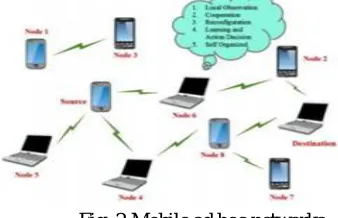
Named data arranging (NDN) perspective is expanding more noteworthy acclaim and is extensively recognized in the examination amass due to its direct correspondence designing. Fig. 1 shows the hourglass building of both NDN-(right side) and TCP/IP (left side) based perfect models. MANET is a blend of self-dealt with, resource obliged propelled contraptions that can particularly talk with each other using a short transmission run. In this structure, the topology and interconnectivity are phenomenal, as focus focuses sporadically move and furthermore proficiently show up and vanish from the system, as appeared in Fig.2.
Fig. 2 Mobile ad hoc networks
On a very basic level, a vital sort of correspondence in MANET is data driven in nature, for instance, condition care information, programming revives, observation data, and so forth. For more than 10 years, regular IP-based traditions have been proposed for MANETs that are have driven in nature. Furthermore by utilizing the TCP/IP approach, taking an intrigue compact centers need to help end-to-end course system to pass on. This wonder is in like manner hard to achieve in one of a kind and disaster organizes in which channels are intermittent and flawed (e.g., MANETs).Similar to wired frameworks, NDN moreover exhibits gainful central focuses in remote uniquely designated frameworks and subjective radio extemporaneous systems. Due to the convey thought of the remote channel, the NDN-based MANETs include outrageous issues (e.g., package crashes, flooding, data overabundance, divide) that further corrupt the frameworks execution. In advance, the center points utilized the frameworks organization holding property of the NDN that can store data bundles at any center point (i.e., leave copy wherever putting away approach). In this manner, the data redundancy is moreover extended in the framework. In this paper, we propose a novel tradition, region careful on-ask for multipath putting away and sending (LOMCF) for NDN-based MANETs. It is acknowledged that all the taking an intrigue center points can get to their present zone information at whatever point using any outside organization, for instance, the overall arranging system (GPS). The fundamental duties of this examination are highlighted. Propose a responsive and on-ask for sending tradition that thinks about a center's available territory, in its package sending process.
II. EXISTINGSYSTEM
Thought Due to the convey thought of the remote channel, the NDN-based MANETs highlight extraordinary issues (e.g., allocate, flooding, data repetition ,bundle retransmissions), which moreover spoil the framework execution. Count Packet affect evading. Figuring Definition-In a past report, the makers utilized the NDN approach in remote frameworks to lessen the video allocate. They furthermore display another timeout count for the estimation of assortments in course trip time estimation. Shortcomings of existing system are if a purchaser center point needs some substance from a provider center, it takes after the normal NDN correspondence strategy. Conveys an Interest package to the provider center point. Interminable supply of the Interest package, hand-off center point 2 checks its CS for the availability of a Data divide.
III. PROPOSEDSYSTEM
The Performance of the proposed tradition is surveyed by using test framework, called NDNSIM. Expansive investigations along their results show that proposed tradition performs better as appearing differently in relation to the next late proposed traditions to the extent substance recuperation time, Interest retransmissions, and the total number of Interest bundles injected and furthermore discarded in the framework. Figuring Interest package add up to for creating and key MANETs. Estimation Definition-A package is sent or dropped in perspective of the partition information and the data download rate. In a past report, the makers [2] showed an arrangement to download the substance from convenient cloud. In this approach, the forwarder center point is picked in each quadrant. Inclinations of existing structure are this ponder is hard to achieve in one of a kind and lossy frameworks in which channels are sporadic and uncertain (e.g., MANETs). Like wired frameworks, NDN furthermore shows gainful central focuses in remote exceptionally selected frameworks and scholarly radio improvised frameworks.
IV.LITERARYSURVEY
This paper [1] depicts the get-together to oppose the web impasse, and proposes a way virtualization may be utilized to beat it. At the same time, thought of plan and verbal experience among fussbudgets and pluralists are investigated. The present Internet is at an impasse in light of the way that new models can't be sent, or even sufficiently studied. By a wide edge an extensive segment of Internet look at is either exploratory or incremental, while both research are essential, they are not attractive to address fringes and noteworthy difficulties. We should need to give fundamental access to virtual demonstrating grounds; there will be renaissance to incrementally deployable course of action, Also to raise the sights of research gathering. The time has come to plainly confront it and whipping it.
This paper depicts that IoT is broadly perceived as key empowering driver in natural checking frameworks, its innate abilities to give detecting and incitation functionalities on dispersed premise. In the meantime larger part of IoT applications are Information driven by outline. A natural observing framework can be effortlessly set up by letting at least one gathering stations to buy in the occasions or detected esteems, produced by IoT hubs scattered in situation of intrigue. All examined arrangements falls inside two primary methodologies: pull-based and push-based. It rose that all ICN designs can execute the two plans. For the most part one of them locally upheld while other one is actualized by presenting fitting augmentations. Future research exercises will concern plan of logical models of recognized methodologies, by considering portability conditions.
Depicts the Interdependent power mastermind disruptor (IPND) change issue to perceive essential center points in dependent power arrange whose removals maximally annihilate its abilities due to glitch of centers and falling dissatisfactions of related correspondence compose. A wide examination not simply demonstrate feasibility of approach on facilitate with different topologies and interdependencies, yet moreover include some fundamental recognitions to sharpen power of dependent frameworks in future.
exhibiting all out constraints on general model. Multilayer frameworks got a lot of thought starting late and creating gathering of research has been totally investigated. A gigantic gathering of research in the field has been declined to upgrade and aggregate up existing instruments to the occasion of frameworks with various subsystems and layers of system. Despite the way that stating varies exhaustively, in like way to each specific case, such frameworks can be generally insinuated as multilayer frameworks. Makers try to unite the written work by introducing a general framework for multilayer frameworks. Such structure can address the particular thoughts of frameworks (e.g., monoplex frameworks, multiplex frameworks, related frameworks, frameworks of frameworks) by basically introducing consolidated necessities on the general model. Scholars also review attempts to entirety up single-layer investigative and estimations, for instance, center degree, gathering coefficient, aggregate structure, related fragments, dynamic and spreading shapes. , this work hopes to be only an introduction regarding the matter.
V. SYSTEMDESIGN
This is the course towards portraying the building, modules, interfaces, and information for a framework to fulfill chose prerequisites. Structures course of action could be viewed as the use of frameworks hypothesis to thing change. NDN gives particular functionalities, for example, in-systems association holding, security local people, and multicast transport. In NDN, correspondence depends upon content names, and each substance is especially seen by its name. Two sorts of bundles, Interest and Data gatherings, are utilized as a bit of its correspondence approach. Additionally, three sorts of tables, content store (CS), pending Interest table (PIT), and sending data base (FIB), are eaten up for the control of the Interest and Data packs. In CS, the Data packs are secured for at some point later. On the off chance that some other neighbour focus focuses require practically identical Data disseminate future, they can get it from closest focus point that has Data bundle in its CS.
PIT table is utilized for the control of Interest groups. It contains all the pending deals territories that unmistakable focuses are asked for specific Data packets. FIB table is used for forwarding purposes. It contains the moving closer/dynamic interfaces data. A fundamental correspondence process (i.e., all around requested) in consistent NDN in which a customer concentrate needs to download a Data segregate the provider center point. In any case, it sends an Interest package exemplifying the name of the pined for substance and populated by utilizing a managing convention Right when a hand-upside down point gets the Interest package, it looks CS table for the pined for substance. In case a Data package is open, the exchange center sends it back to the buyer center. If it isn't in the CS, the exchange center point checks its PIT table. In case a basically indistinguishable territory is open, It prescribes some another node(s) adequately requested comparable Data package. Thusly, the hand-upside down point discards the Interest pass on. If there is no entry, it moreover reviews the FIB table. If there is no relating FIB an area, by then the exchange discards the present transmission. Else, it merges the present Interest package partition in the PIT table and further advances it to the provider center point. Wearisome supply of the Interest package, the provider center point answers with the Data circulate. The Data isolate takes after the PIT table areas in the pivot course. Each exchange center point can in like way store the Data package in its CS table. Later on, if a neighbour center requires equal data segment, will be given by the hand-upside down core interests.
VI.IMPLEMENTATION
NETWORK MODEL: Create topology of a wireless ad hoc networks by a graph G(V;E) where V and E are the set of
nodes(vertices) and links(edges), respectively. Each node is assigned a unique integer identifier between 1 and n=|V| .Nodes are assumed to be battery powered. The remaining battery energy of a node u belongs to V is represented by Cu. If the battery energy of node falls below a threshold Cth, the node is considered to be dead. Without out loss of generality. We assume Cth=0. A link in the network denoted by (u; v), in which u and v are sending and receiving nodes, respectively. The criterion for having a link from u to v is as follows: there could be a link from u to y, if the received signal strength by v is above a threshold. This threshold is usually specified in a such a way that a targeted link error probability is satisfied.
FIND POSSIBLE PATH: The possible pth between a source and destination node are found using DJIKISTHRA’s
MESSAGE SENDING WITH CACHING: When sender or neighbour sends message, a copy of message is saved in cache. This message is used for retransmission purpose, if ack not received from receiver.
MESSAGE RETRANSMISSION: The node waits for ACK from receiver or neighbour. If ACK is not received within
timeout period, the message will be retransmitted. This process is done until ACK is received from receiver.
MESSAGE RECEIVER: Receiver sends ACK from every received message. If receiver doesn’t send ack, message is
retransmitted from neighbour until ACK is received.
VII. EXPERIMENTALRESULTS
We conduct the several experiments to evaluate the performance of the proposed as well as the compared protocols by considering the impact of the node density, node speed, and the number of consumer/provider pairs. The following sections explain and analyze in detail the results obtained from these experiments. 1) Node Density: In the first round of experiments, we investigate the performance of the proposed LOMCF protocol and other protocols by varying the number of nodes in the net-work.
The CRT metric is considered a function of the number of nodes in the network. Currently, one consumer/provider pair is considered during this experiment. As the number of nodes increases (e.g., 40; 60; 90), the CRT value also increases. However, the proposed LOMCF protocol significantly outperforms the other protocols in terms of CRT. The reason is that the proposed LOMCF protocol utilizes the location-aware multi-route forwarding mechanism. This is due to the fact that, in a dense environment, the traffic in the network also increases. Consequently, more nodes using LOMCF protocol take part in the communication and enter the Critical State
2) Node Speed: In a second round of experiments, we explore the performance of the proposed LOMCF protocol and other compared protocols by considering the more challenging environment (e.g., node speed). Fig. 13(a) and (b) show the CRT and IR as a function of the node speed. Presently, one consumer/provider pair and 90 nodes are set for this simulation. The proposed LOMCF protocol significantly achieves a higher performance than other protocols (i.e., BF, PAF). This is because the participating nodes forward packets based on the location of the consumer and provider nodes. If a relay node is far away from a consumer or provider node, it does not further forward the DATA-PAC or INT-PAC, respectively. This phenomenon reduces the unnecessary packet flooding in the network. Consequently, the proposed LOMCF protocol achieves lower CRT and IR values than other protocols. On the other hand, the BF protocol has a flooding nature, which unavoidably leads it to the higher CRT and IR values. In the PAF protocol, nodes implicitly select one route, which is hard to maintain in a dynamic environment. In contrast, in the proposed LOMCF protocol, packets are forwarded on multiple routes. If one route becomes unreachable, then the packets utilize the other ones. This technique mitigates the IR in the network
VIII. CONCLUSION
In this study, we have proposed a novel protocol called LOMCF for resource constrained NDN-based MANETs .Proposed LOMCF protocol has four distinguish characteristics. Firstly, it considers the node’s current location in its packet forwarding mechanism. Secondly, in this protocol, the packets follow multiple routes. Consequently, high reliability in packet transmission is achieved especially in dynamic MANET’s environment. Thirdly, in proposed LOMCF protocol, by utilizing the distance based caching policy; the contents are stored near to the consumer nodes which further reduce the retrieval time for the future requests. Fourthly, LOMCF protocol takes the remaining Energy of the node into account that improves the node as well as network performance.
REFERENCES
[1] D.S.J. De Couto, D. Aguayo, J. Bicket, and R. Morris, “A High- Throughput Path Metric for Multi-Hop Wireless Routing,” Proc. ACM
MobiCom, pp. 134-146, 2003.
[2] S. Singh and C. Raghavendra, “PAMAS—Power Aware Multi- Access Protocol with Signalling for Ad Hoc Networks,” ACM Computer
Comm. Rev., vol. 28, pp. 5-26, 1999.
[3] J. Gomez, A.T. Campbell, M. Naghshineh, and C. Bisdikian, “PARO: Supporting Dynamic Power Controlled Routing in Wireless Ad Hoc
Networks,” Wireless Networks, vol. 9, no. 5, pp. 443-460, 2003.
[4] S. Banerjee and A. Misra, “Minimum Energy Paths for Reliable Communication in Multi-Hop Wireless Networks,” Proc. ACM MobiHoc, pp.
146-156, June 2002.
[5] Q. Dong, S. Banerjee, M. Adler, and A. Misra, “Minimum Energy Reliable Paths Using Unreliable Wireless Links,” Proc. ACM MobiHoc, pp.
449-459, May 2005.
[6] X.-Y. Li, Y. Wang, H. Chen, X. Chu, Y. Wu, and Y. Qi, “Reliable and Energy-Efficient Routing for Static Wireless Ad Hoc Networks with
Unreliable Links,” IEEE Trans. Parallel and Distributed Systems, vol. 20, no. 10, pp. 1408-1421, Oct. 2009.
[7] X. Li, H. Chen, Y. Shu, X. Chu, and Y.-W. Wu, “Energy Efficient Routing with Unreliable Links in Wireless Networks,” Proc. IEEE Int’l
Conf. Mobile Adhoc and Sensor Systems (MASS ’06), pp. 160-169, 2006.
[8] S. Singh, M. Woo, and C.S. Raghavendra, “Power-Aware Routing in Mobile Ad Hoc Networks,” Proc. ACM MobiCom, Oct. 1998.
[9] C. Toh, “Maximum Battery Life Routing to Support Ubiquitous Mobile Computing in Wireless Ad Hoc Networks,” IEEE Comm. Magazine,
vol. 39, no. 6, pp. 138-147, June 2001.
[10] D. Kim, J.J.G. Luna Aceves, K. Obraczka, J. Carlos Cano, and P. Manzoni, “Routing Mechanisms for Mobile Ad Hoc Networks Based on the