32 | P a g e
Asian Journal of Pharmaceutical Science & Technology
e-ISSN: 2248 – 9185
www.ajpst.com
Print ISSN: 2248 – 9177
FORMULATION AND EVALUATION OF BILAYER FLOATING
TABLET CONTAINING ANTIHYPERTENSIVE AGENT
Asha Spandana KM
*, SK Senthil Kumar, S Parthiban
Department of Pharmaceutics, Bharathi College of Pharmacy, Bharathi Nagara, Mandya, Karnataka – 571 422, India
ABSTRACT
The present investigation concerns the development of a bilayer floating tablet, which has immediate release layer which produces required effective drug concentration and sustained release layer which prolong the gastric residence time and increases bioavailability of drugs, which are predominantly absorbed from gastric region. With this aim, bilayer floating dosage form containing Verapamil Hydrochloride as drug, HPMC K100 and Carbopol as release retarding polymer was prepared. Sodium bicarbonate and citric acid were used as gas generating agents by direct compression method. All the bi-layered floating tablet formulations were subjected to post-compression evaluation parameters such as hardness, friability, weight variation, thickness,
drug content, lag time subsequently buoyancy time, and in-vitro dissolution studies. The assay of the formulation revealed that
the drug content was within the limits. In-vitro floating revealed that all the formulations showed buoyancy of more than 12 hours. Dissolution tests were performed using USP dissolution apparatus at 75 rpm in pH 1.2 buffer. The tablet split in to 2 layers i.e. floating and immediate layer in the dissolution medium, which exhibited biphasic release of Verapamil Hydrochloride. It can be concluded from Release kinetic models that the release followed Korsmeyer’s Peppas, as the correlation coefficient (R2 value) was high in all the evaluated models. The release mechanism followed Fickian diffusion as the release exponent (n-value) was <0.5 in all the optimized formulations.
Key words: Verapamil hydrochloride, HPMC, Carbopol and Bilayer floating tablet.
INTRODUCTION
The focus of pharmaceutical research is steadily shifted from the development of new chemical entities to the development of novel drug delivery system of existing drug molecule to maximize their effectiveness in terms of therapeutic action, reducing frequency of dosing and wastage of drugs, patient compliance and reduced adverse effects. To minimize drug degradation and loss, to prevent harmful side-effects and to increase drug bioavailability and the fraction of the drug accumulated in the required zone, various drug delivery and drug targeting systems are currently under development. Oral drug delivery is the most desirable and preferred method of drug delivery for achieving both systemic and local therapeutic effects [1].
The real challenge in the development of an oral controlled-release drug delivery system is not just to sustain the drug release but also to prolong the presence of the dosage form within the gastrointestinal tract (GIT) until all the drug is completely released at the desired period of time. Indeed, gastric drug retention has received significant interest in the past few decades. Most of the conventional
oral delivery systems have shown some limitations related to fast gastric-emptying time [2].
One of the novel approaches in the area of oral sustained release drug delivery is gastroretentive drug delivery system (GRDDS). Drugs those are having a narrow absorption window and having more solubility in gastric region are suitable candidates for GRDDS. GRDDS prolongs the retention time of dosage forms in the stomach or upper gastrointestinal tract, as to improve solubility, bioavailability and the therapeutic efficacy of the drugs. Several techniques have been proposed to increases the gastric residence time of dosage forms such as buoyancy or floating system, hydrodynamically balanced system, expanding or swelling system, bio/mucoadhesive system, sedimentation or high density system, geometry or modified shape system may also use to increase gastric residence time [3].
The biphasic system is used mostly when maximum relief needs to be achieved quickly and it is followed by a sustained release phase. It also avoids repeated administration of drug. Coronary vasodilator,
33 | P a g e
antihypertensive, antihistaminic, analgesic, antipyretics and antiallergenic agents are mainly used for this system. The biphasic system may contain one or two drugs for immediate release and sustained release layer [4].
Verapamil, an antihypertensive agent, has been widely used for the treatment of hypertension, Angina and arrythmia. Verapamil has been shown to be effective and safe alone or in combination, in patients with hypertension and or coronary artery diseases. The profile of verapamil hydrochloride indicates that it is a drug with short half life (3-6 hrs) and hence requires frequent dosing like 3-4 tablets daily. This frequent dosing result in fluctuating drug levels in body and need for constant monitoring and counseling of patient for adherence to dose regimen. This consequently reduces the compliance of patients who are to take these medicines almost lifelong. Hence, the major task in treatment of hypertension and other such chronic ailments is of minimizing fluctuations of drug levels in blood by using dosage form which offer sustained, steady drug release profiles [5,6].
In comparison with the single layer tablet, a double layer matrix offers advantages; this formulation of the matrix dosage form with two distinct layers allows separate regulation of the floating capabilities and drug release kinetics. The present investigation aims to develop a BFT of Verapamil Hydrochloride with a view of prolonging GRT [7].
MATERIALS AND METHODS Materials
Verapamil HCl was obtained as a gift sample from Apotex research Pvt Ltd, Bengaluru. Carbopol-940 was purchased from Rolex Laboratories Chennai., HPMC-K-100
was purchased from Shreeji Chemicals, Sodium
Bicarbonate and Citric acid were purchased from S.D. Fine Chemicals Mumbai. Other materials and solvents used were of analytical grade or better.
Methods
Calculation of Dose
t1/2= 3hrs
MEC= 100 ng/l= 0.100µg/l Vd= 3.1 litres= 3100000µ/litres
= = 0.231 hr-1
=
=71.61 3
= 214.83 mg
Initial dose calculations:
A= Maintenance dose B= Initial Dose H= Number of hours
214.83= 0.693 B
= = 77.5 mg
= 214.83 + 77.5
= 292.33 mg
For ease, the Drug dose has been Round off to= 293mg (215+78)
Formulation
Bilayer tablets consist of floating matrix layer as bottom and immediate release layer as top layer. The drug and all the excipients were sifted through mesh # 40, weighed accurately, and then was mixed in a plastic bag for 5 minutes, followed by lubrication which, was carried out in a plastic bag for 5 minutes by adding the weighed quantity of magnesium stearate and mixing. Tablets were prepared by direct compression technology using tablet punch machine. Bilayer floating tablets were prepared in two stages. First stage was formulation of floating layer tablets. The drug, polymer, gas generating agent such as sodium bicarbonate, citric acid and lactose are mixed geometrically and compressed by using 12 mm round flat punches with low hardness to produce floating layer tablets. Second stage was formulation of bilayer floating tablets. The drug and lactose were mixed separately for immediate release layer. Floating layer was placed in punching die. Then contents of immediate release layer were placed over the floating layer tablet and compressed to obtain hardness in the range of 8-9 kg/cm2 to produce bilayer floating tablets [8].
Evaluation
Pre Compression Parameters Bulk density (Db)
It is the ratio of powder to bulk volume. The bulk density depends on particle size distribution, shape and cohesiveness of particles. Accurately weighed quantity of powder was carefully poured into graduated measuring cylinder through large funnel and volume was measured mg/hr.
A= 0.693 B
Total Dose = Maintenance dose + Initial
Dose
34 | P a g e
which is called initial bulk volume. Bulk density is expressed in gm/cc and is given by,
Db = M / Vo
Tapped density (Dt)
Ten grams of powder was introduced into a clean, dry 100ml measuring cylinder. The cylinder was then tapped 100 times from a constant height and tapped volume was read. It is expressed in gm/cc and is given by,
Dt = M / Vt
Angle of repose (θ)
It is defined as the maximum angle possible between the surface of pile of the powder and the horizontal plane. Fixed funnel method was used. A funnel was fixed with its tip at a given height (h), above a flat horizontal surface on which a graph paper was placed. Powder was carefully poured through a funnel till the apex of the conical pile just touches the tip of funnel. The angle of repose was then calculated using the formula,
θ = tan-1(h/r)
Post compression parameters
The tablets were subjected to the following tests:
Hardness
The hardness of the tablet was determined using a Pfizer Hardness tester. It is expressed in kg/cm2.
Friability (F)
The Friability of the tablet was determined using Roche friabilator. It is expressed in percentage (%). 10 tablets were initially weighed (Winitial) and transferred in to
the friabilator. The friabilator was operated at 25 rpm for 4
mins. The tablets were weighed again (Wfinal). The %
friability was then calculated by
Thickness
The Thickness of the tablets was measured using Screw gauge and expressed in millimeter.
Weight variation
Weight variation was carried out for both immediate release and sustained release layers. 20 tablets were weighed and the average weight was calculated. Then the tablets were weighed individually. The percentage weight deviation of each tablet from average weight was calculated using the following formula
Assay/drug content
Ten tablets were selected randomly, weighed and triturated; a quantity of triturate equal to 100mg of Verapamil HCl was transferred to 100ml volumetric flask and was dissolved in 0.1N HCl. It was sonicated for 30 min and filtered through 0.45µm membrane filter. The absorbance after suitable dilutions was measured in a UV-Visible Spectrophotometer at 278 nm using 0.1N HCl as blank [9].
In vitro Buoyancy Studies
The in vitro buoyancy was determined by floating lag time. The tablets were placed in a beaker containing 100mL 0.1N HCl and the time required for the tablet to rise to the surface and float was determined as floating lag time [10,11].
In vitro Dissolution Studies
Release rate of all the designed formulations were studied up to 12 hours using USP type II dissolution apparatus (Rotating Paddle method) at 75 rpm. A distance of 2.5 cm± 0.2 cm was maintained between the paddle and bottom of dissolution vessel. The dissolution medium (900 ml) consisted of 0.1N hydrochloric acid (1.2 pH),
maintained at 37oC ± 0.5 oC. Sample of 5 ml was withdrawn
at specific time intervals throughout the dissolution study of 12 hours for analysis and replaced with fresh dissolution medium. After appropriate dilution the samples were
analyzed for Verapamil HCl using UV-Visible
spectrophotometer at 278nm. The release studies were conducted in triplicate [12-14].
Fourier Transform Infrared Spectroscopy (FT-IR)
In order to check the integrity (Compatibility) of drug in the formulation, FT-IR spectra of the formulations along with the drug and other excipients were obtained and compared using Shimadzu FT-IR 8400 spectrophotometer. In the present study, Potassium bromide (KBr) pellet method was employed. The samples were thoroughly blended with dry powdered potassium bromide crystals. The mixture was compressed to form a disc. The disc was placed in the spectrophotometer and the spectrum was recorded. The FT-IR spectra of the formulations were compared with the FT-IR spectra of the pure drug and the polymers.
RESULTS AND DISCUSSION
35 | P a g e
Buoyancy lag time and duration of floating were determined using 100 ml beaker containing 0.1N HCl medium are shown in Table 4. It was observed that there was no significant difference in the release of drug in all the formulation but it was found that the lag time of the formulation (F6) was short compared to other formulation and the total buoyancy time was found to be more than 13 hours for all the formulations [15-17].
All the Bilayer floating formulations were subjected for the dissolution studies using USP dissolution apparatus II (paddle) in 900 ml of 0.1N HCl medium. Average value were obtained from the triplicate values and taken as the final value. The results are given in Fig 1.
To analyze the Verapamil Hydrochloride release
mechanism the in vitro release data were fitted into various
release equations and kinetic models first order, zero order, Higuchi and Korsemeyer and Peppas. The values are
reported in table No 5. As indicated by the value of R2, it was found that the best fit model was achieved with Peppas. The value of n was found to be in the range of 0.2842 to 0.3774, indicating release governed by Fickian diffusion [18].
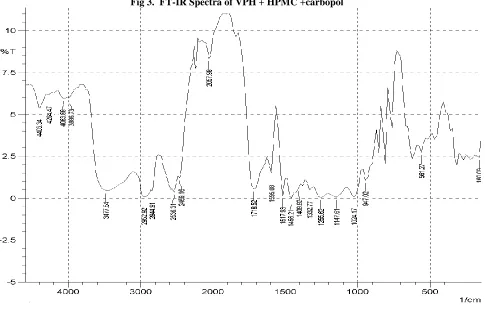
Drug polymer compatibility studies were carried out using Fourier Transform Infra-Red spectroscopy to establish any possible interaction of Verapamil HCl with the polymers used in the formulation. The FT-IR spectra of the formulations were compared with the FT-IR spectra of the pure drug. The results indicated that the characteristic absorption peaks due to pure Verapamil HCl have appeared in the formulated tablets, without any significant change in their position indicating non-existence of chemical interaction between Verapamil HCl and Polymers (Fig2 to Fig4).
Table 1.Formulation of Maintenance And Loading Dose
Table 2. Drug Evaluation
Post- Compression Parameters
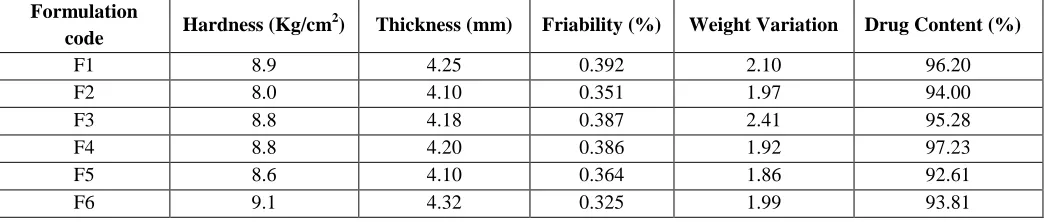
Table 3.Values of Thickness, Hardness, Friability, Weight variation, Assay and Physical evaluation of Bilayer floating tablets of Verapamil Hydrochloride
Formulation
code Hardness (Kg/cm
2
) Thickness (mm) Friability (%) Weight Variation Drug Content (%)
F1 8.9 4.25 0.392 2.10 96.20
F2 8.0 4.10 0.351 1.97 94.00
F3 8.8 4.18 0.387 2.41 95.28
F4 8.8 4.20 0.386 1.92 97.23
F5 8.6 4.10 0.364 1.86 92.61
F6 9.1 4.32 0.325 1.99 93.81
Formulation and ingredients
Quantity taken in mg
Maintenance Dose Loading Dose
MF1 MF2 MF3 MF4 MF5 MF6 LF1 LF2 LF3 LF4 LF5 LF6
Verapamil
HCL 215 215 215 215 215 215 78 78 78 78 78 78
HPMC K100 60 60 60 60 60 60 _ _ _ _ _ _
Carbopol 940 140 140 140 140 140 140 _ _ _ _ _ _
Sodium
Bicarbonate 55 60 65 70 75 85 _ _ _ _ _ _
Citric acid 30 35 40 45 50 45 _ _ _ _ _ _
Lactose 60 50 40 30 20 15 22 22 22 22 22 22
Sl. No Parameters Results
1 Bulk density (g/cc) 0.383
2 Tapped density (g/cc) 0.448
3 Angle of repose (ө) 23.550
36 | P a g e
Table 4. Floating Properties
Formulation Batch Lag time or buoyancy time Floating duration or buoyancy duration
F1 9 min, 50 sec > 13 hrs
F2 9 min, 13 sec > 13 hrs
F3 6 min, 42 sec > 13 hrs
F4 3 min, 27 sec > 13 hrs
F5 3 min 03 seconds > 13 hrs
F6 1 min, 05 sec > 13 hrs
Table 5. Regression co-efficient (r2) values of different kinetic models and diffusion exponent (n) of Peppas model for Verapamil Hydrochloride Bilayer floating tablet
Fig 1. Comparison of In Vitro Drug Release Profile
Fig 2. FT-IR Spectra of Verapamil HCl
Formulation Zero order First order Higuchi Matrix Peppas plot
r2 value ‘n’ value
F1 0.8347 0.9421 0.9601 0.9822 0.3016
F2 0.8311 0.9610 0.9615 0.9849 0.3022
F3 0.8934 0.9520 0.9867 0.9886 0.3731
F4 0.8976 0.943 0.9872 0.9889 0.3774
F5 0.8860 0.9560 0.9855 0.9890 0.3648
37 | P a g e
Fig 3. FT-IR Spectra of VPH + HPMC +carbopol
38 | P a g e
Fig 5. In-Vitro Floating of Bilayer Tablets
A-Tablet placed in 1.2 pH dissolution media,
B-Separation of immediate and sustained release layer from bi-layer tablet,
C-Floating sustained release layer separated from immediate release layer and floating on dissolution media.
D-Separate two layers i.e. immediate and sustained release layer,
E-separated immediate and sustained release layer.
CONCLUSION
The present study was carried out to develop the Bi-layer floating tablet of Verapamil HCl using HPMC and carbopol. All the post-compression studies like hardness, friability, weight variation, thickness, Lag time, total floating duration and drug content indicated that the values are within the IP limit and hence passable. From the observation, it was concluded that the addition of gel-forming polymers (HPMC and Carbopol) and gas generating agent, sodium bicarbonate along with citric acid were essential to achieve in vitro buoyancy profile.
And from the observation we can conclude that on increasing the concentration of effervescent agents, floating lag time was found to be decreased. In vitro dissolution
39 | P a g e
REFERENCES
1. Vairappan Kamalakkannan, Ayarivan Puratchikody, Viswanadhan Vasantha Prasanth, Krishnamoorthi Masilamani.
Enhancement of Drugs Bioavailability by Floating Drug Delivery System – A Review. International Journal of Drug
Delivery,3, 2001, 558-570
2. Tadros MI. Controlled-release effervescent floating matrix tablets of ciprofloxacin hydrochloride. Development, optimization
and in vitro–in vivo evaluation in healthy human volunteers. Eur J Pharm and Biopharm, 74, 2010, 332-339.
3. Londhe S, Gattani S, Surana. Development of floating drug delivery system with biphasic release for verapamil
hydrochloride: In vitro and In Vivo evaluation. J PharmSci Tech,2(11), 2010, 361-367.
4. Jagdale SC, Ghorpade SA, Kuchekar BS, Chabukswar AR. Effect of polymer and gas forming agent on floating drug
delivery of tramadol hydrochloride using response surface methodology: In vitro and in vivo evaluation. International
Journal of Pharmaceutical Applications, 2(3), 2011, 181-194.
5. Triggle DJ. Calcium channel antagonists: clinical uses- past, present and future. Biochemical pharmacology, 74, 2007, 1-9.
6. Eisenberg MJ, Brox A, Bestwros AN. The Calcium Blockers: An update. American Journal of Medicine, 116, 2004, 35-43.
7. Dinesh Kumar P, Rathnam G, Prakash CR, Saravanan G, Karthick V, Selvam P, formulation and characterization of bilayer
floating tablets of Ranitidine. Rasayanj.Chem, 3(2), 2010, 368-374.
8. Lakshmi A, Ashwini Kumar1 G, Karnaker Reddy T, Anand Kumar M. Development and invitro evaluation of gastroretentive
Verapamil Hydrochloride floating tablets. International Journal of Pharmacy and Pharmaceutical Sciences,4(1), 2012,
360-363.
9. Baumgartner S, Kristel J, Vreer F, Vodopivec P, and Zorko B. Int. J. Pharm., 2(5), 2001, 95
10. ICH Harmonized Tripartite Guidelines, 2003. Stability testing of new drug substances and products. Q1A (R2).
11. Lokendra Pal Singh, Rajesh KS, Deepak G. Umalkar, Vijay Kumar Chauhan, ViralKumar Rana, Kamini S. Vasava. Floating
Effervescent tablet: A review. Journal of Pharmaceutical and biomedical sciences, 5(11), 2011, 1-6.
12. Vishnu M Patel, Bhupendra G Prajapati, Anand K Patel. Controlled Release Gastroretentive dosage form of Verapamil
Hydrochloride. International Journal of PharmTech Research, 1(2), 2009, 215-221.
13. Ziyaur Rahman, Mushirali, R.K.Khar., Design and evaluation of Bilayer Floating Tablets. Acta Pharm,56, 2006, 49-57.
14. Borkar SN, Suresh R, Sawant VA, Shende VS, Mokale VJ and Dama G. An approach to Formulate Bilayerd Gastro
Retentive Floating Drug Delivery System of Cefpodoxime Proxetil. International Journal of Chem Tech Research, 22(2),
2010, 1229-1242.
15. Rajashree Masa Reddy, Shivakumar Yellanki, Bhushan R.Patil, Manvi FV. Development and Evaluation of Floating Matri’x
Tablets of Riboflavin. International Journal of Pharm Tech Research, 2(2), 2010, 1439-1445.
16. Aisha Khanum, Vinay Pandit and Shyamala Bhaskaran. Formulation and Evaluation of Bilayer Tablets of Propranolol
Hydrochloride. IJPER, 43(3), 2009, 290-294.
17. Ravindra S.Dhumal, Samit Kumar T, Rajmore Sanjay T. Dhumal and Atmaram P. Pawar. Design and evaluation of Bilayer
Floating tablets of Cefuroxime Axetil for Bimodel release. J.scientific. Industrial Res,65, 2006, 812-816.
18. Lunana Perioli, Valeria Ambrogi, Stefano Giovagnoli, Maurizio Ricci, Paolo Blas I, and Carlo Rossi. Mucoadhesive