55 Research note
Phase Inversion in a Batch Liquid – Liquid Stirred System
M. Amouei, P. Khadiv-Parsi∗, M.M. Moosavian, N. Hedayat and A.A. Davoodi
School of Chemical Engineering, University College of Engineering, University of Tehran, Iran.
Abstract
Phase inversion phenomenon occurs in many industrial processes including liquid- liquid dispersions. Some parameters such as energy input or the presence of mineral compounds in the system affect this phenomenon.
The aim of this research is to study the speed of rotation or energy input at a range of 400 to 800 rpm in a batch liquid-liquid system containing toluene and water. The presence of sodium chloride and magnesium sulphate in the system was also studied. It was shown that the increase of energy input had a more obvious effect on oil in water (O/W ) dispersion at lower values of holdup. It was also shown that the ambivalence (o/w → w/o) region of the phase inversion curve shifted downward and became wider as a result of the decrease in interfacial tension.
It was observed that inorganic salt, used in both single and dual (mixed) shapes, enhanced phase inversion for O/W dispersion. Therefore, the greater the ionic strength of salt, the greater the tendency to phase inversion is.
Keywords: phase inversion, holdup, ambivalence region, delay time, O/W dispersion
∗ Corresponding author: E-mail: [email protected]
Introduction
Liquid-Liquid dispersions have been extensively used in chemical, petrochemical, pharmaceutical, and food industries [1, 2]. Due to the different natures of molecular forces existing in aqueous and organic phases, there is a noticeable difference between O/W and W/O dispersion when separation of two phases occurs. Therefore, it is very important to precisely select the dispersed or drop phase [3].
At steady state condition, equilibrium exists between the processes of coalescence and breakage of drops, which leads to a rather constant drop size distribution with an
average drop size [4-6].
Depending on the circumstances, the rate of coalescence of drops exceeds that of breakage in such a manner that the dispersed phase will be replaced by the continuous phase and vice versa. In other words, the experimental studies indicate that the drop holdup can be increased only up to a critical value, beyond which the dispersion un-dergoes phase inversion [3, 7, 8].
56 Iranian Journal of Chemical Engineering, Vol. 5, No. 2
Another way of explaining phase inversion has been presented by Groeneweg et al. and Bouchma et al. [10]. They observed that for certain conditions the drop size increases considerably before phase inversion takes place. This is explained by assuming the inclusion of small droplets of the continuous phase into the dispersed phase drops. They describe this as the formation of a multiple dispersion.
Phase inversion may be of some interest in cases such as the production of margarine or in producing fine emulsion through the process under successive heating and cooling, but it is the most important factor for emulsion instability in a sense [6,11]. Usually, phase inversion takes place spontaneously, though some experiments showed a delay of between 5 and 1500 seconds needed to complete this phenomenon which is mainly due to the chemical properties of the system [12].
Critical dispersed phase holdup or the volume fraction of drop phase at the phase inversion point depends mainly on some factors as follows: [3,6]
- Physico-chemical properties of the system such as viscosity and interfacial tension. It has already been shown that viscosity has high influence compared to other properties [6].
- Operating conditions such as energy input, type of impeller.
- Initial condition or history of system, i.e. whether the impeller was first placed in aqueous or organic phase, or if it was the first run of successive experiments or not.
- Mass transfer, especially from drop to continuous phase which enhances the drop-drop coalescence.
- Wall effect and wettability of impeller. - Effect of additives and surface active
agents.
- Temperature, mainly effective for the case of nonionic surfactants.
Most work has been done in stirred vessels and columns with mechanical parts. The
main purpose of this work was the determination of the ambivalence region related to the curve of critical hold up versus speed of rotation in a batch stirred vessel [10, 13-18].
Phase inversion has been recognized as sophisticated, so a single mechanism governing this phenomenon cannot be specified. Overall, it is obvious that it is a true function of rates of drop coalescence and breakup.
Materials and Methods
Materials
All the chemicals, Toluene, n-Heptane, NaCl and MgSo4, were purchased from Merck and
used as received. Distilled water was used in all the experiments. Purity of chemicals was all above 99%.
Density of each phase was measured with a Picnometer with a volume of 25 ml. Viscosity was measured by a Cannon-Fensk viscometer with the aid of a stopwatch having a precision of 0.1 s. Interfacial tension was measured by a digital Wilhelmy plate Kruss tensiometer.
Volume fraction measurement was done by using equations 1 and 2.
X +Y= A (1)
X/A=B (2)
Iranian Journal of Chemical Engineering, Vol. 5, No. 2 57
examined. Also, two cases of the absence and presence of inorganic salts of NaCl and MgSO4 were investigated in the shapes of
single and dual (Mixed). All the experiments were done in absence of any surfactant. Before each run, the two phases were mixed completely in a separate beaker, becoming mutually saturated. This prohibited the undesirable mass transfer which might be one of the important factors responsible for phase inversion [19, 20]. After separating the two phases, a definite volume of the prescribed continuous phase (aqueous phase), say about 70% by volume was added to the vessel.
Then, the second phase (drop phase) was added gradually to the continuous phase while the shaft of the impeller rotated at a definite rate. Addition of the second phase was continued till the commencement of
inversion that was shown by a change in the conductivity of the system.
In this way, the critical holdup at a fixed and definite rotation speed was obtained. Experiments were conducted and carried out for other speeds of rotation and hence, we obtain the other points of the upper curve of ambivalence region (O/W → W/O).
These processes were also carried out at fixed holdup, while increasing the rotating speed in order to be assured of the accuracy of the obtained curve.
All the aforementioned steps were done for the lower curve of the ambivalence region (W/O→ O/W) through the selection of the organic phase as the continuous phase. In addition, the presence of salts as single and mixed forms were examined on the phase inversion.
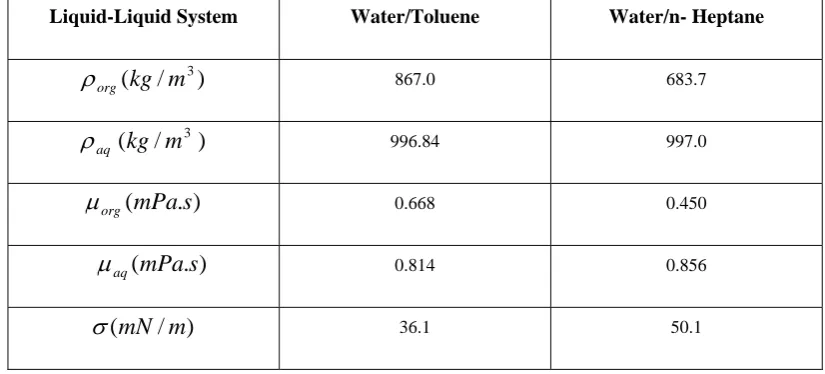
Table 1. Physical properties of the liquid-liquid system used in experiments at room temperature.
Liquid-Liquid System Water/Toluene Water/n- Heptane
) /
(kg m3
org
ρ 867.0 683.7
aq
ρ 3
/
(kg m ) 996.84 997.0
) . (mPas
org
μ 0.668 0.450
) . (mPas
aq
μ 0.814 0.856
) / (mN m
σ 36.1 50.1
Apparatus
The experiments were conducted in a batch mixed vessel or contactor. The vessel was made of pyrex glass which contained a stainless steel impeller with a shaft in the shape of a hollow cylinder, comprising two parallel disks attached by vertical rods. The
58 Iranian Journal of Chemical Engineering, Vol. 5, No. 2 Figure 1. Diagram of experimental equipment
Table 2. Characteristics of mixed vessels which were chosen based on the information available in literature [15]
Internal diameter of vessel (cm) 9.5
External diameter of vessel (cm) 10.0
Height of vessel (cm) 16.0
External diameter of central shaft (cm) 0.8
External diameter of impeller (cm) 4.6
Height of impeller (cm)
4.0
Since the observation and registration of phase inversion is difficult at high speeds of rotation, we used a digital conductivity meter, type WPA England CMD510. It is clear that at phase inversion from W/O to O/W, the conductivity of system drops significantly [6].
Results and discussion
- Effect of energy input
Figures 2 and 3 show the behavior of the ambivalence region for systems of W/n-C7
and W/Toluene, respectively.
As noted earlier, the upper curve represents inversion of O/W to W/O dispersion and the lower one represents vice versa.
Clearly, ambivalence region is a function of operating and hydrodynamic circumstances which represents an interval between O/W and W/O called hysteresis.
As seen from these figures, for critical drop holdups less than 0.5, phase inversion by increasing the agitation rate does not take place, neither for the organic drops (upper curve) nor for the aqueous phase drops (lower curve).
Based on these figures, the characteristics of two types of inversion are primarily different from each other. It was observed that the drop holdup required for upper curve (critical holdup) was reduced while increasing the rotor speed. But for the lower curve the was an increasing trend. One of the reasons might be due to the repulsive electrostatic forces between aqueous drops in continuous organic phase [1, 8].
F Frame V Vessel
M Motor B Baffle
C Coupling TC Top Cover
H Bearing House TB Teflon Bushing
Iranian Journal of Chemical Engineering, Vol. 5, No. 2 59 Figure 2. Ambivalence region for the system of W/n-C7.
Figure 3. Ambivalence region for the system of W/Toluene.
0.3 0.35 0.4 0.45 0.5 0.55 0.6 0.65 0.7
200 300 400 500 600 700 800 900
Agitation Rate (rpm)
V
o
lum
e Fra
ction o
f O
rga
nic
Pha
se
O/W
W/O
0.3 0.35 0.4 0.45 0.5 0.55 0.6 0.65 0.7
200 300 400 500 600 700 800 900
Agitation Rate (rpm)
Vo
lu
me
Fracti
o
n
o
f Org
an
ic P
h
ase
60 Iranian Journal of Chemical Engineering, Vol. 5, No. 2
Secondary dispersion takes place in W/O dispersion which leads to an O/W/O dispersion or fine droplets of the organic phase in aqueous drops. Hence, increasing the rate of mixing causes fine droplets that reduce the secondary dispersions inside the dispersed phase and consequently reduces the effective holdup.
- Effect of interfacial tension
Comparison of two chemical systems as seen in Figure 4 explains that, for the system of w/toluene, the ambivalence region shifts downward with an increase in the width of a region. The effect of the reduction of interfacial tension is more pronounced in the
upper curve (O/W→W/O).
It might be due to the absence of secondary dispersion in O/W. It was found that reduction of interfacial tension did stabilized O/W dispersion with respect to W/O dispersion [21]. This is because of producing smaller drops accompanied by a reduction in the coalescence rate.
The figure shows that phase inversion holdup of w/toluene at a fixed rotor speed is more than the case of w/n-C7 when W/O inverts to
O/W. But, this is not true for O/W inversion to W/O. This may reveal the effect of other physical properties such as density and viscosity on phase inversion.
Figure 4. Comparison of ambivalence curves for two systems of W/Toluene and W/n-C7
- Effect of inorganic salts
Tables 3 to 6 explain the behavior of the systems of w/toluene and w/nC7 in the
presence of NaCl and MgSO4, separately.
For an average drop holdup of 0.6, increasing the salt concentration reduced the energy input needed for the phase inversion of O/W.
This means that inversion becomes simpler and the upper curve of ambivalence region moves to the left for other values of holdups. As a result, the curve becomes smaller in length. This effect is more observable for the MgSO4 salt.
0.3 0.4 0.5 0.6 0.7
200 300 400 500 600 700 800 900
Agitation Rate (rpm)
V
o
lum
e
Frac
tio
n
of
O
rgan
ic Phas
e
Iranian Journal of Chemical Engineering, Vol. 5, No. 2 61 Table 3. The effect of NaCl on Phase Inversion in
Toluene/ Water System at φ0= 0.6
NaCl Concentration (mol/lit)
Speed of Rotation (rpm)
0.0 565 0.5 525 1.0 495 1.5 465
Table 4. The effect of NaCl on Phase Inversion in
n-Heptane/ Water System at φ0= 0.6
NaCl Concentration (mol/lit)
Speed of Rotation (rpm)
0.0 775 0.5 720 1.0 685 1.5 650
Table 5. The effect of MgSO4 on Phase Inversion in
Toluene/ Water System at φ0= 0.6
MgSO4 Concentration
(mol/lit)
Speed of Rotation (rpm)
0.0 565 0.5 485 1.0 455 1.5 415
Table 6. The effect of MgSO4 on Phase Inversion in
n-Heptane/ Water System at φ0= 0.6
MgSO4 Concentration
(mol/lit)
Speed of Rotation (rpm)
0.0 775 0.5 685 1.0 615 1.5 575
The effect of salt on drop holdup may be related to one of two reasons, i.e. the effect on interfacial tension and/or the effect on electrostatic interactions.
It was observed that the surface tension of an electrolyte solution in contact with air is larger than that of pure water. The surface tension increase is caused by negative adsorption (depletion) of electrolyte ions at
the air/water interface due to the electrostatic repulsive interaction between ions and their images with respect to the air/water interface. Agreement with the experiment, however, is good only at very low electrolyte concentrations [22-26]. When the system has no ion, organic drops, regardless of degree of polarity, have a considerable zeta potential which becomes more negative with pH. Hence, drops become charged. The reason is not exactly clear or known. Some investigators attribute this to the adsorption of the hydroxyl group at drop-continuous phase interface [8].
The addition of salt to a dispersion increases the ion strength of the aqueous phase and reduces electrostatic repulsion forces between adjacent organic drops. The ions make a dense double electrical layer in such a manner that Van der Waals attraction force and electrical repulsive force overlap each other. This results in drop-drop coalescence, and O/W dispersion inverts at low holdup [6].
In other words, salt increases the ionic strength of the aqueous phase which influence phase inversion through reduction of repulsive forces among organic drops. The higher the concentration of salt, the simpler the phase inversion occurs at low speeds of rotation for a fixed holdup.
Adding the second salt at a fixed holdup, reduces the energy input, which relates to the increase in the ionic strength of the continuous phase. The results of using the mixture of salts of NaCl and MgSO4 are
observed in Tables (7) and (8).
Table 7. The effect of addition of NaCl and MgSO4
simultaneously with equimolar ratio on phase
inversion in n-Heptane/ Water system at φ0= 0.6
Concentration ( mol/ lit) Speed of Rotation (rpm)
0.0 775 0.5 700
1.0 635
Table 8. The effect of addition of NaCl and MgSO4
62 Iranian Journal of Chemical Engineering, Vol. 5, No. 2
inversion in Toluene / Water system at φ0= 0.6
Concentration ( mol/ lit) Speed of Rotation (rpm)
0.0 775
0.5 510
1.0 470
Conclusions
Experiments showed a difference between the phase inversion behavior of two initial dispersions of O/W and W/O. The O/W dispersions inverted to W/O dispersion at lower holdup when rotation or energy input increased, while this was reversed for W/O dispersion. It was strongly related to secondary dispersions formed in W/O.
It was found that the interfacial tension widened the ambivalence region accom-panied by a downward shift.
Adding salt to an O/W dispersion enhanced the phase inversion which was more obvious for salt with a higher charge. Also, the mixture of two salts of NaCl and MgSO4 was
examined and revealed that mixed salts proceed phase inversion phenomenon well in comparison to a single salt.
Nomenclature
Greek letters
ρ density (kg/m3)
μ viscosity (mPa.s)
σ interfacial tension (mN/m)
φ holdup
Subscripts
aq aqueous phase
org
o, organic phase
w water
References
1. Hu, B., Angeli, P., Matar, O. K., Hewitt, G. F., "Prediction of Phase Inversion in Agitated Vessels using a Two-Region Model" Chem.
Eng. Sci., 60, 3487 (2005).
2. Ioannou, K., Nydal, O. J., Angeli, P., "Phase
Inversion in Dispersed Liquid-Liquid Flows"
Experimental Thermal and Fluid Sci., 29,
331 (2005).
3. Yeo, L. Y., Matar, O. K., Perez de Ortiz, E. S., Hewitt, G.F., "Phase Inversion and associated Phenomena" Multiphase Sci.
Technol, 12, 51 (2000).
4. Tsouris, C., Dong, J., "Effects of Electric Fields on Phase Inversion of Liquid-Liquid Dispersions" Chem. Eng. Sci., 55, 3571 (2000).
5. Deshpande, K. B., Kumar, S.,"A New Characteristic of Liquid-Liquid Systems_ Inversion Holdup of Intensely Agitated Dispersions" Chem. Eng. Sci., 58, 3829 (2003).
6. Norato, M. A., Tsouris, C., Tavlarides, L. L., "Phase Inversion Studies in Liquid-Liquid Dispersions" Can. J. Chem. Eng., 76, 486 (1998).
7. Noui-Mehidi, M. N., Wu, J., Zhu, Y., "A few New Findings on Phase Inversion in a Liquid-Liquid System" AIChE J., 50, 3281 (2004).
8. Kumar, S., "On Phase Inversion Characteristics of stirred Dispersions" Chem.
Eng. Sci, 51, 831 (1996).
9. Piela, K., Delfos, R., Ooms, G., Westerweel, J., Oliemans, R.V.A., Mudde, R.F., "Experimental Investigation of Phase Inversion in an Oil-Water Flow through Horizontal pipe loop" International J.
Multiphase Flow, 32, 1087 (2006).
10. Bouchma, F., Van Aken, G.A., Autin, A. J. E., Koper, G. J. M., "On the Mechanisms of Catastrophic Phase Inversion in Emulsions"
Colloids Surf. A: Phys. Eng. Aspects, 231, 11
(2003).
11. Walde, A., Tesmann, H., Leonard, M., Förster, T., “Phase Inversion in Emulsions: CAPICO- Concept and Application”, in M. M. Rieger and L.D.Rhein, Eds., “ Surfactants Cosmetics”, 2nd ed., Marcel Dekker, NewYork (1997).
12. Gilchrist, A., Dyster, K. N., Moore, I. P. T., Nienow, A. W., Carpenter, K. J., "Delayed Phase Inversion in stirred Liquid-Liquid Dispersions" Chem. Eng. Sci., 44, 2381 (1989).
Iranian Journal of Chemical Engineering, Vol. 5, No. 2 63 Monolaurate/ Polyoxyethylene Sorbitan
Monolaurate (Span 20/Tween 20)" Colloids
Surf. A: Phys. Eng. Aspects, 218, 241 (2003).
14. Davis, G. A., “Mixing and Coalescence Phenomena in Liquid-Liquid Systems”, in Thornton, J. D., Ed., " Science and Practice of Liquid-Liquid Extraction", Vol. 1, Oxford, London (1992).
15. McClarey, M. J., Mansoori, G. A., "Factors affecting the Phase Inversion of Dispersed Immiscible Liquid-Liquid Mixtures" AIChE
Symposium Series, 74, 134 (1978).
16. Arashmid, M., Jeffreys, G. V., " Analysis of the Phase Inversion Characteristics of Liquid-Liquid Dispersion" AIChE J., 26, 51 (1980). 17. Khadiv-Parsi, P. and Moosavian, M.A.
"Suggestion of a New Correlation for the Height of Shallow Dispersion Bed Formed in a Rotating Disc Contactor" Can. J. Chem.
Eng., 82, 256(2004).
18. Yeo, L. Y., Matar, O. K., Perez de Ortiz, E. S., Hewitt, G. F., "A Simple Predictive Tool for Modeling Phase Inversion in Liquid-Liquid Dispersion" Chem. Eng. Sci., 57, 1069 (2002).
19. Khadiv-Parsi, P. and Moosavian, M.A. "Suggestion of New Correlations for Drop/ Interface Coalescence Phenomena in the Absence and Presence of Single Surfactant"
Iran. J. Chem. & Chem. Eng., 23, 79 (2004).
20. Khadiv-Parsi, P. and Moosavian, M.A. "The Influence of Bicomponent Mixed Surfactants on Drop/Interface Coalescence" Iran. J.
Chem. & Chem. Eng.,23, 89 (2004).
21. Brösel, S., Schuber, H., "Investigations on the Role of Surfactants in Mechanical Emulsification using a High-Pressure Homogenizer with an Orifice Valve" J.
Chem. Eng. Proc., 38, 533 (1999).
22. Lobo, L., Svereika, A., "Coalescence during Emulsification: 2. Role of Small Molecule Surfactants" J. Colloid Interface Sci., 261, 498 (2003).
23. Ohshima, H., and Matsubara, H., "Surface Tension of Electrolyte Solutions" Colloid
Polym. Sci., 282, 1044 (2004).
24. Palazolo, G.G., Sorgentini, D.A., Wagner, J.R., "Coalescence and Flocculation in O/W Emulsions of Native and Denatured Whey Soy Proteins in Comparison with Soy Protein Isolates" Food HydroColloids, 19, 595 (2005).
25. Urbina-Villalba, G., Garcia-Sucre, M., "Influence of Surfactant Distribution on the Stability of Oil/Water Emulsion towards Flocculation and Coalescence" Colloids
surfaces A:Physicochemical Eng. Aspects,
190, 111 (2001).
26. Koh, A., Gillies, G., Gore, J., Saunders, B.R., "Flocculation and Coalescence of Oil-Water Poly(Dimethyl Siloxane Emulsions" J.