ISSN(Online): 2320-9801
ISSN (Print): 2320-9798
I
nternational
J
ournal of
I
nnovative
R
esearch in
C
omputer
and
C
ommunication
E
ngineering
(An ISO 3297: 2007 Certified Organization)
Vol. 3, Issue 4, April 2015
Optical Flow Estimation with Gradient
Detection for Identifying Flames
Indu Seethanathan1, Kurian George 2, Ambikadevi Amma. T3
P.G. Student, Department of Computer Science and Engineering, JCET, Lakkidi, Kerala, India1 Assistant Professor, Department of Computer Science and Engineering, JCET, Lakkidi, Kerala, India2
Professor, Department of Computer Science and Engineering, JCET, Lakkidi, Kerala, India3
ABSTRACT: Detecting fire break out is absolutely necessary in order to prevent loss of life and property. The vision – based fire detection techniques with surveillance systems have become popular in the past decade. Video camera covers wide viewing range and from the data captured by video camera additional information can be extracted. Video sequences provide an insightful view about how the object and scenes in the video change over time. For indoor fire detection, traditional point sensors were used to detect heat or smoke particles. However, when it comes to open space it is not viable to employ these point sensors. Optical flow estimators transform the image sequence into estimated motion. Optical flow vector is created in the system and is used to depict the magnitude and direction of motion of an object as it moves from one frame to another. Based on the motion estimators, a set of motion features is presented that exploits the difference between dynamic fire motion and rigid fire motion. Two optical flow methods are designed for flame flow vector creation, namely, Non-Smooth Data (NSD) and Optimal Mass Transport (OMT). NSD and OMT methods are used for modelling flame with dynamic texture and saturated fire blob respectively. To further enhance the process of flame detection, gradient optical flow estimation methods and classification based on feature vectors have to be done.
KEYWORDS: Fire detection, flow vector, gradient estimation, optical flow, optimal mass transport, non-smooth data. I. INTRODUCTION
It is important to detect fire at an early stage in order to avoid loss of life and property. Vision–based detection is used to monitor a large area and the exact position of the fire can be detected. To detect objects from images and video sequence, some image processing techniques have been developed. Fire unlike other object is a complex visual phenomenon because of its dynamic texture. The flame is dynamic in nature and is always flickering and hence optical flow is used. The pattern of motion of objects, surfaces, and boundaries in a video caused by the relative motion between an observer and the scene is called Optical flow. In optical flow estimation, the difference between pixels in the current frame and the previous consecutive frame of the image sequence is found.
Color and motion of fire regions are absolutely necessary for flame detection. The boundaries and shape of fire regions keep varying and the motion depends on the surrounding environmental factors like the flow of air and type of burning material. Numerical analysis was used to analyze video in order to differentiate usual events from dangerous ones. Initially fire like pixels are detected. After separating objects from the background, the pixels are grouped in regions, then motion within the region is analyzed to determine if the regions are dangerous or not. This analysis is subjected to shape and its change with time. Pixel classification is important and must be designed precisely to attain high detection probability and low false detection rate. Fire does not satisfy the constant intensity assumption because rapid intensity change occurs during the burning process which is the result of fast pressure and heat dynamics. Classical optical flow methods were purely based on brightness constancy.
ISSN(Online): 2320-9801
ISSN (Print): 2320-9798
I
nternational
J
ournal of
I
nnovative
R
esearch in
C
omputer
and
C
ommunication
E
ngineering
(An ISO 3297: 2007 Certified Organization)
Vol. 3, Issue 4, April 2015
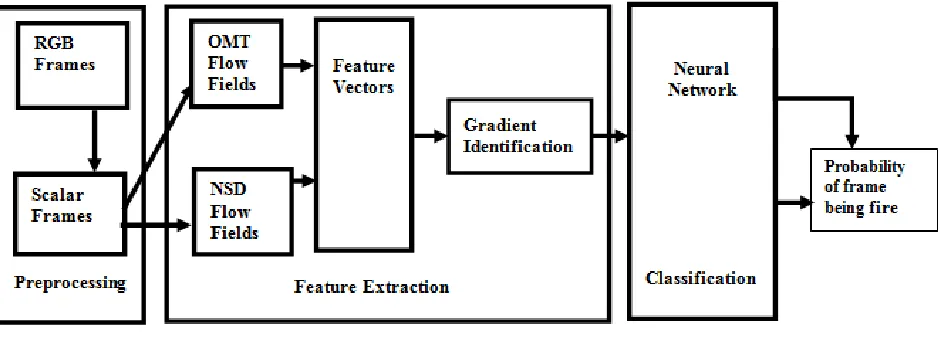
extraction is the technique to detect a specific object or target based on the need. The calculated features are used as input to the neural network. Classification algorithm is based on the belief that a particular image represents one or more features and that each of these features belong to a distinct class.
Fig. 1. Flame Detection System
The main objective is to set up a system that detects flame in video sequence automatically. The necessary features are extracted using Non Smooth Data (NSD) and Optimal Mass Transport (OMT) algorithms. To determine if the video sequence has actually captured fire itself, the extracted features are fed into the neural network. The neural network generates an output that shows the probability of frame being fire. This new video based flame detection system uses the optical flow vectors to calculate the optical flow features. The optical flow vectors are generated to extract the features required and then the features are classified by using the trained neural network. The optical flow vectors are used to determine the amount of motion experienced by the object, which in this case, is the fire.
II. BACKGROUND STUDY
Detection of flames using video surveillance is applied mostly for industrial surveillance. The most popular fire detection systems are the heat and smoke detectors used indoors. This type of detection approaches requires the sensors to be installed very close to fire or smoke areas and often give out false alarms. However, these traditional detectors are not very useful in large open areas because point detectors use ionization and scattering of light which are not effective in wide and open spaces.
Existing methods to detect fire depends on spectral analysis, which is also vulnerable to false alarms. This is because of the objects which have the same color as that of the fire sets the fire alarm and other factors like slight smoke might trigger the alarm of a smoke detector, thereby, giving false indication of fire.
ISSN(Online): 2320-9801
ISSN (Print): 2320-9798
I
nternational
J
ournal of
I
nnovative
R
esearch in
C
omputer
and
C
ommunication
E
ngineering
(An ISO 3297: 2007 Certified Organization)
Vol. 3, Issue 4, April 2015
disadvantage of this system is that it is a color based system and sudden change in light intensity or lighting condition leads to error in detection.
There was another technology that used to detect flame using generic color model [2]. The generic color model is used for flame pixel classification. YCbCr color space is used by the system to separate luminance from chrominance effectively. Flame pixel classification is done by a generic chrominance model that is constructed using the YCbCr color space. Cb and Cr, stand for chrominance blue and chrominance red respectively, and Y stands for luminance. RGB color space has some rules defined like, R ≥ G ≥ B, that can be translated into YCbCr space as
Y(x,y) >Cb(x,y) (1) Cr(x,y) >Cb(x,y) (2)
Where Y(x,y), Cb(x,y) and Cr(x,y) are luminance, Chrominance Blue and Chrominance Red values at the spatial location (x,y). The Chrominance Red value should always be greater than Chrominance Blue, whereas, the flame luminance value should always be greater than Chrominance Blue. Fire region will be a bright region in the sequence and the important information will be contained in the mean values of the three channels, Ymean, Cbmean and Crmean. For
the given flame region, the mean Y component is smaller than the value of Y component, value of mean Cb is greater than the value of Cb and value of Cr component is bigger than mean Cr component. The main disadvantage of this system is that it does not consider the flickering nature of fire.
In [3], the system analyses frame to frame changes and the low level features like color, size, area, boundary and surface coarseness is taken under consideration. It is seen that for a fire pixel Red channel value is greater than Green channel value and the value of the green channel component should be greater than blue channel value.
The typical flickering property of fire is analyzed in wavelet domain [5]. In [6] color look- up table was used to detect fire colored region. In [7] the required optical flow equations were solved for the pixels in the region. In [8], the YUV color model is used to represent video data, where the luminance component Y is used to denote candidate fire region. The chrominance components U and V classify the fire pixel as whether or not they are in the fire sector. In [9], the HSI color model is used to detect fire regions for dark and bright environments.
III.METHODOLOGY
This system employs optical flow techniques in order to generate an output that shows if flame is present in the frame or not. Two consecutive frames in a video sequence are considered and each of these frame set is processed. The processing begins by converting the frames with RGB color space into scalar images. Then the foreground is separated from the background. By analyzing the magnitude of flow vector, the pixels with the least motion are eliminated. After analyzing the flow vector, four required features are calculated. The features are then classified using a neural network. The steps involved in this system are as follows:
1. Selection of consecutive frames
The first step is to take a pair of consecutive frames for processing. For a frame i, (i+1)th frame is the consecutive frame. Optical flow vector for (i+1)th frame is calculated on the basis of ith frame. The frames are then resized to 240*240 resolutions. Classical optical flow is purely based on two assumptions:
1) Intensity or brightness of an object is constant over time
2) Close points in an image move in a similar way. This concept is called velocity smoothness constraint. Optical flow estimators compare the pixels of ith and (i+1)th frame of an image sequence of a video.
0
I
xu
I
yv
I
tdt
dI
(3)
where I(x, y, t) represent a sequence of intensity image. (x,y) is the spatial coordinates and t is a time variable. This condition is satisfied if the intensity is constant.
ISSN(Online): 2320-9801
ISSN (Print): 2320-9798
I
nternational
J
ournal of
I
nnovative
R
esearch in
C
omputer
and
C
ommunication
E
ngineering
(An ISO 3297: 2007 Certified Organization)
Vol. 3, Issue 4, April 2015
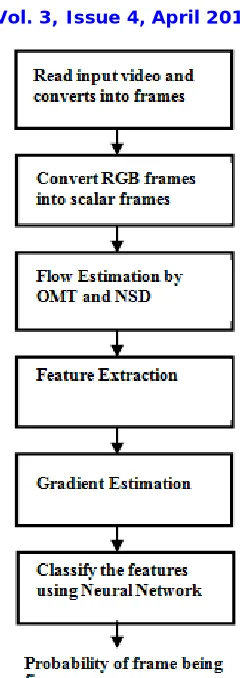
Fig. 2. Flow Diagram
2. Preprocessing
Preprocessing step is used to obtain a scalar image on which optical flow is done. Preprocessing converts a video file into individual frames, thereby making it suitable for future processing. Color transformation takes place in the preprocessing step where it converts RGB color frames into a grayscale image. Different device has reproduced RGB values differently since the R, G and B levels vary among different manufacturers. RGB frame converter takes an AVI video as input and converts the video file into RGB frames, thereby, making it suitable for fire detection. After obtaining the RGB frames, it is given as input to the RGB to scalar converter to obtain scalar frames. Scalar frames are composed of different shades of gray. In gray scale image each pixel carries the intensity information.
3. Feature Extraction
This step is designed for detecting a particular target. Feature extraction is employed by incorporating already known physical properties in order to reduce the problem dimensionally. Since the intensity constancy assumption is not satisfied by the fire, two optical flow models are designed specifically for flame detection. Two optical flow estimators that model the characteristics of flame motion are Non- Smooth Data (NSD) and Optimal Mass Transport (OMT). OMT flow method models fire with dynamic texture and NSD flow method models saturated flame. Optical flow is used to estimate object motion across a series of frames.
4. Optimal Mass Transport (OMT) flow model
ISSN(Online): 2320-9801
ISSN (Print): 2320-9798
I
nternational
J
ournal of
I
nnovative
R
esearch in
C
omputer
and
C
ommunication
E
ngineering
(An ISO 3297: 2007 Certified Organization)
Vol. 3, Issue 4, April 2015
high values 2) OMT Sink/ Source: This is used to compute the match between ideal flow and OMT flow field. The solution for OMT method is,
)
(
)
(
I
A
A
1A
b
u
T T
(4)Here, b = - where is the difference of current frame from the previous frame.
5. Non Smooth Data (NSD) flow model
This technique models saturated fire blobs that have non smooth boundary motion. The flow vector standardizes the flow magnitude and does not impose smoothness. It proves its use to detect saturated fire in terms of NSD optical flow energy. This technique is used under unfavorable lighting conditions, where fire blobs are saturated, thus defying the assumption of OMT that fire is purely dynamic in nature. The boundary motion of the fire blob is characterized by the NSD optical flow. Gray scale image is fed as input to NSD flow field and two features are extracted from the flow field. The first feature is the magnitude which has high values of objects in motion, for fire colored objects and also differentiates turbulent motion from rigid motion by comparing the direction of flow. The other feature is the directional variance. It differentiates object with rigid motion from boundary motion of fire blob by computing the variance of flow detection of moving pixel. High variance value denotes uncorrelated motion in different directions, whereas a low variance value denotes unidirectional motion. The solution for NSD method is,
2 2 || || I t I x I
u (5)
2 2 || || I t I y I
v (6)
Here α is set as 0.4 and , , are called the image derivatives. For fire motion, the created flow vectors are non-smooth, while smooth vectors are created for objects with rigid motion.
6. Feature Extraction Vector
A list of flow features is presented and it considers all possible distortions of a pixel. The distortions are then averaged to produce a probability of characteristic direction or magnitude. There are four features: f1, f2, f3, and f4, of which f1 and f2 measure mean magnitude, whereas, f3 and f4 analyze the direction of motion. The feature f3 consider the spatial structure of flow vector and f4 is more of a general feature that can detect multiple directions. For an image region Ω
and optical flow field vectors uOMT and uNSD, the features are:
OMT Transport Energy
Fire and fire colored objects in the colored spectrum will generate high value for this feature. The mean of the transport energy is measured for every pixel in the sub region.
NSD Flow Magnitude
For fire colored objects, the value of NSD will be high. NSD flow magnitude is calculated by considering each pixel and measuring norms of its NSD flow vectors. The norm is then squared and halved and the mean is taken.
) 2 2 || || 2 1 (
2 mean u NSD
f
(8)
OMT Source/Sink Matching
Vector source and sink are used to create flow vectors from turbulent fire motion. This feature is calculated by convoluting the OMT flow vectors created with an ideal flow of fire.
| ) 2 || || ( ) 2 || || ( | max 3 OMT u vOMT T v OMT u uOMT T u
f
(9) ) 2 2 || || 2 1 (
1 mean uOMT
f
ISSN(Online): 2320-9801
ISSN (Print): 2320-9798
I
nternational
J
ournal of
I
nnovative
R
esearch in
C
omputer
and
C
ommunication
E
ngineering
(An ISO 3297: 2007 Certified Organization)
Vol. 3, Issue 4, April 2015
NSD Directional Variance
This feature differentiates the boundary motion of rigidly moving objects from saturated fire blobs at moving pixels by variance computation of direction of flow.
) 1 ,...., 0 , var{
4 si i n
f (10)
7. Gradient Estimation
After generating the feature vectors from the optical flow methods, the gradients are identified from the flow. Finally feature values from gradients are classified using neural network. Gradient block helps to get rid of static pixels. Here the optical flow method is enhanced with Gradient based detection methodology. Image gradient is used to retrieve information from the images. A directional change in the intensity or color of an image is called an image gradient and it is the building block of image processing. Each pixel of the gradient image measures the change in intensity or color at the same point in the original image.
8. Classification
Classification algorithm use computed features as input. A trained neural network is used to classify feature vectors. Training a neural network means performing a regression which is non-linear, in order to separate the trained data into classes. During the test phase, feature vectors are supplied as input and the output is the probability that the feature vector has a match with a particular class. The neural network involves a series of algorithm that identifies relationships in a data set. By identifying the relationship, the neural network provides the output probability.
IV.RESULT AND DISCUSSION
Motion related information about the fire is taken into account to characterize the fire region. Infusing gradient estimation technique to this system helps to remove static pixels. The neural network is used for classification and classifies the gradient values. Hence the optical flow techniques are made more effective with gradient based detection methodology.After modifying the existing system, which was mostly color based, the enhanced system has much reduced false detections and detects flame effectively based on its motion. This enhanced flame detection system is evaluated and the detection rate is compared with the existing system and then represented in a chart.
Fig. 3. Detection Chart
This flame detection system is very effective in lots of circumstances. All the algorithms were implemented using MATLAB. Moving sun or orange flag will not set false alarm as the global motion rate is less than flame motion. Lighting conditions do not affect this system. It detects fire irrespective of the environmental conditions. This system
0 20 40 60 80 100 120
System Model
N
u
m
b
e
r
o
f
fr
a
m
e
s
d
e
te
c
te
d
Number of frames =100
Existing System
ISSN(Online): 2320-9801
ISSN (Print): 2320-9798
I
nternational
J
ournal of
I
nnovative
R
esearch in
C
omputer
and
C
ommunication
E
ngineering
(An ISO 3297: 2007 Certified Organization)
Vol. 3, Issue 4, April 2015
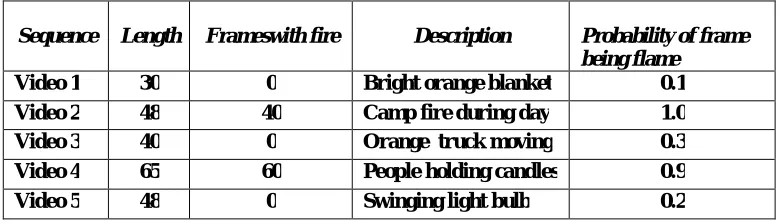
was tried on a set of sample videos and frames detected were manually counted. If the probability value is one, then fire is detected.
Sequence Length Frameswith fire Description Probability of frame
being flame
Video 1 30 0 Bright orange blanket 0.1
Video 2 48 40 Camp fire during day 1.0
Video 3 40 0 Orange truck moving 0.3
Video 4 65 60 People holding candles 0.9
Video 5 48 0 Swinging light bulb 0.2
Table 1. Experimental data V. CONCLUSION
The complex and dynamic nature of flame has motivated the use of optical estimators to differentiate fire motion from other kinds of motion. This system deals with detecting fire at its initial stage by video processing. Video based detection technique captures the characteristics of fire, such as motion, flickering pattern, background, etc. Two optical flow estimators are used to detect the flow of fire, namely, Non –Smooth Data (NSD) and Optimal Mass Transport (OMT). Gradient estimation is employed with optical flow that makes the system more efficient and makes it easy to see the flow by removing the static pixels. These techniques successfully detect fire and reduce false detections to a huge extent. Neural network classifies the gradients into classes which is a hard step.
REFERENCES
1. T. Çelik and H. Demirel, “Fire detection in video sequences using a generic color model,” Fire Safety Journal, Vol. 44, no. 2, pp. 147–
158, 2009.
2. T. Celik, H. Demirel, H. Ozkaramanli and M. Uyguroglu, “Fire Detection using statistical color model in video sequences”, Journalof
Visual Communication and Image Representation, Vol. 18, no. 2, pp. 176-185, 2007.
3. P. Borges and E. Izquierdo, “A probabilistic approach for vision-based fire detection in videos”,IEEE Transactions, Circuits and Systems
for Video Technology, Vol. 20, no. 5, pp. 721–731, May 2010.
4. M. Muller, P. Karasev, and I. Kolesov, “Optical flow estimation for flame detection in videos”, IEEE Transactions, Image Processing,
Vol.2, no. 7, pp. 2786- 2797, 2013.
5. B. Ko, K. Cheong, and J. Nam, “Fire detection based on vision sensor and support vector machines,” Fire Safety Journal, Vol. 44, no. 3,
pp. 322–329, 2009.
6. W. Phillips III, M. Shah, and N. da Vitoria Lobo, “Flame recognition in video,” Pattern Recognition Letters, Vol. 23, nos. 1–3, pp. 319– 327, 2002.
7. B. Lucas and T. Kanade, “An iterative image registration technique with an application to stereo vision,” International Joint Conferenceon Artificial Intelligence, Vol. 2, pp. 674–679, 1981.
8. G. Marbach, M. Loepfe, and T. Brupbacher, “An image processing technique for fire detection in video images,” Fire Safety Journal, Vol.
41, no. 4, pp. 285–289, 2006.
9. W.B. Horng, J.W. Peng, and C.Y. Chen, “A New Image-Based Real-Time Flame Detection Method Using Color Analysis”, Networking,