Volume 65, 2019, Pages 113–126
GCAI 2019. Proceedings of the 5th Global Conference on Artificial Intelligence
Combining Conflict-Driven Clause Learning and
Chronological Backtracking for
Propositional Model Counting
Sibylle M¨
ohle and Armin Biere
Johannes Kepler University Linz, Austria
Abstract
In propositional model counting, also named #SAT, the search space needs to be explored exhaustively, in contrast to SAT, where the task is to determine whether a propositional formula is satisfiable. While state-of-the-art SAT solvers are based on non-chronological backtracking, it has also been shown that backtracking non-chronologically does not significantly degrade solver performance. Hence investigating the combination of chronological backtracking with conflict-driven clause learning (CDCL) for #SAT seems evident. We present a calculus for #SAT combining chronological backtracking with CDCL and provide a formal proof of its correctness.
1
Introduction
The task of computing the number of models of a propositional formula, also referred to as #SAT, has various applications in hardware and software verification [5,4,12, 15,11] as well as cryptography[16]. Classical applications are found in the area of probabilistic reasoning [24] as well as Bayesian networks [2,19,27] which are adopted in medical diagnosis and planning. A counting characterization of diagnoses is presented in [18]. Propositional model counting finds further applications in product configuration [32,17] and planning [1,31].
Challenges in model counting. In contrast to SAT solving, where the search terminates as soon as a satisfying variable assignment is found, in #SAT the search space needs to be explored exhaustively. State-of-the-art SAT solvers implement conflict-driven clause learn-ing (CDCL) [22, 28], i.e., in case of a conflict they learn a clause which might be used to
backjumporbacktrack non-chronologically to a potentially much smaller decision level by unas-signing all literals at greater decision levels. This allows them to escape search space regions without solution. In the context of #SAT, however, backjumping might cause an erroneous model count since already counted models might be found again.
One therefore might ask whether chronological backtracking and CDCL might be combined in order to benefit from the strengths of both methods. A second motivation is given by the fact that CDCL may lead to redundant work since after backjumping assignments discarded might be repeated [30] which has a greater negative impact on solver performance in #SAT.
Combining CDCL and chronological backtracking. A partial answer to this question was provided in [23]. In this paper, chronological backtracking was enabled under certain conditions violating invariants considered crucial to CDCL. In CDCL with non-chronological backtracking the current variable assignment is represented by the trail which is a sequence of literals. The trail is partitioned into subsequences of literals between decisions identified by a decision level which is assigned to the literals contained in them. One of the violated invariants says that the literals on the trail are ordered in ascending order with respect to their decision level.
This is not the case in [23] anymore. Assume the formula under consideration evaluates to false under the current assignment. A clause is learned which is used to determine the jump level, i.e., the decision level to which the solver backjumps. Let` be the literal of the learned clause propagated after backjumping. It is assigned to the jump level which, after backtracking chronologically to the backtrack level, might be lower than the decision level of another literal preceding ` on the trail. In this case variable assignments at decision levels higher than the jump level might conflict with the current assignment. This issue is dealt with by introducing a variant of backtracking in which no blocks of literals are unassigned but only the literals with decision level greater than the backtrack level, which need not be consecutive anymore.
To define more precisely the concepts introduced in [23], in [21] we provided a formalization and formal proof and generalization of the procedure. Our goal was to understand which invariants are crucial and which are redundant and to empirically confirm the effectiveness of chronological backtracking. A second motivation, which is explored in depth in this paper, was the potential use of chronological backtracking for model counting, i.e., #SAT.
In [21], we characterized five invariants, three of which are violated by chronological back-tracking. Still the procedure remains correct and we proved empirically that always executing chronological backtracking in combination with CDCL does not degrade significantly solver performance confirming the suitability of chronological backtracking for model counting.
Exact propositional model counting. The state of the art in exact propositional model counting goes back to a paradigm presented in [14]. In this method the formula under con-sideration is split into subformulae over disjoint sets of variables which are then solved inde-pendently and their results multiplied to yield the model count of the formula. In this work the need for so-calledgood learning is identified. Several modern #SAT solvers implement this paradigm [25, 26, 29], a parallel version [6] as well as a distributed version [7] are available. Another method is based on knowledge compilation [8] in which the formula is transformed into another language in which model counting can be executed efficiently.
A totally different approach, inspired by [13,10], was presented in [3,20]. It isdual, i.e., it takes as input a formula together with its negation. The basic idea is based on the fact that a formula evaluates to>under a given variable assignment if and only if its negation evaluates to⊥under the same assignment. This method also enables the detection of partial models.
Our contribution. In this work we extend our framework [21] to serve propositional model counting and provide a formal proof of its correctness. We present a counting algorithm based on model enumeration. Basically, our procedure yields a formula which is logically equivalent to the formula under consideration. The generated formula is a disjunction of pairwise contradicting conjunctions of literals, hence its model count can be determined in polynomial time.
fol-lowing manner. Our argument is based on the concepts ofpending search space, i.e., the variable assignments not yet tested, andpending models, i.e., the models not yet found. Obviously the two concepts are related, and the pending models are contained in the pending search space. In an implementation therefore one might decide to sum up the number of the detected models instead of recording them explicitly.
First, we extend the original calculus [21] by one rule, to capture the situation where a model is found. Second, the states now include all the (partial) models found at any point in time of the search. Compared to [20] this extension is not dual. It also exclusively uses chronological backtracking which renders blocking clauses superfluous. As a consequence, it does not need the concepts of flipping nordiscounting, as introduced in [20]. In [20] we also showed by an example that combining dual reasoning and the use of blocking clauses might result in models counted twice. We also provided another example in which combining discounting and blocking clauses leads to the loss of models, i.e., a discounted modelm is not detected anymore due to a blocking clause. These issues do not exist anymore in our new framework.
2
Preliminaries
LetF be a propositional formula over the set of variablesV. We callliteral a variablev∈V
or its negation ¬v. The variable of a literal ` is obtained by V(`). We denote with ` the complement of the literal`, i.e., `=¬`, supposing¬¬`=`.
A clause is a disjunction of literals, and a cube is a conjunction of literals. A formula in Conjunctive Normal Form (CNF) is a conjunction of clauses, whereas a Disjoint Sum-of-Products (DSOP) formula is a disjunction of pairwise contradicting cubes. We interpret CNF formulae as sets of clauses and DSOP formulae as sets of cubes where convenient. By writingC∈F we refer to a clause or cubeC in a formulaF. Analogously we write`∈C if`is a literal in a clause or cubeC. The empty CNF formula and the empty cube are represented by>, the empty DSOP formula and the empty clause are denoted by⊥.
Atrail, writtenI=`1. . . `n, is a sequence of literals with no duplicate variables which may
also be interpreted as the conjunction of its literals. ByV(I) the variables of the literals on the trail I are obtained. We denote the empty trail by ε. Trails may be concatenated, I =J K, providedV(J)∩V(K) =∅. We writeJ 6IifJ is a subsequence ofIandJ < Iif furthermore
J 6=I. The position of literal ` on the trailI is denoted by τ(I, `). We may interpret I as a set of literals and write`∈Ito refer to the literal`onI. Similarly to [20], the decision literals on the trail are marked by a superscript, e.g.,`d denoting open “left” branches in the sense of
DPLL. Flipping the value of a decision can be seen as closing the corresponding left branch and starting the “right” branch. Thus its decision literal`d becomes aflipped literal `.
Thedecision level function δ:V 7→N∪ {∞} returns the decision level of a variablev∈V.
We define δ(v) = ∞ if v is unassigned, andδ is updated whenever a variable is assigned or unassigned. The extension to literals`, clauses C and trails I is straightforward by defining
δ(`) =δ(V(`)),δ(C) =max{δ(`)|`∈C} forC 6=⊥andδ(I) = max{δ(`)|` ∈I} for I6=ε. We further define δ(⊥) = δ(ε) = 0. We write δ[` 7→ d] to denote the updated function δ in which V(`) is assigned to decision level d. Similarly, by δ[I 7→ ∞] all literals on the trail I
are unassigned. We may write δ ≡ ∞ as a shortcut. The function δ is left-associative, i.e.,
δ[I7→ ∞][`7→e] first unassigns all literals onI and then assigns literal`to decision levele. By δ(L) ={δ(`)| `∈ L} we denote the set containing the decision levels of its elements. The set of decision literals on the trail I is denoted by decs(I) = {` | `d ∈ I} and the set
containing their complements bydecs(I) ={`|`∈decs(I)}. ByI6nwe refer to the subsequence
τ I δ 0 1 0 1 2 1 2 3 0 3 4 2 4 5 1 τ I δ 0 1 0 1 2 1 2 3 0 3 5 1 τ I δ 0 1 0 1 3 0
Figure 1: In the trailI on the left, from the three trails shown, literals 3 and 5 are placed out of order. In fact, their decision level δ is lower than the decision level of a literal preceding them on the trail, i.e., with lower positionτ. The trails in the middle and on the right show the results of backtracking to decision levels 1 and 0. When backtracking to thebacktrack level b, only literals`withδ(`)> bare removed from the trail, while the assignment order is preserved.
restricted to decision literals`whereδ(`)6dby writingdecs6d(I) =decs(I6d). We callslice a
subsequence ofIcontaining all literals inIhaving the same decision level, e.g.,slice(I, n) =I=n.
Backtracking to decision level inow amounts to unassigning literals ` ∈I with decision level greater thani, i.e., where`∈slice(I, j) forj > i.
We clarify these concepts by means of an example taken from [21]. Consider the trailIon the left hand side of Fig.1over variables{1, . . . ,5}(in DIMACS format) whereτrepresents the position of a literal onI andδ represents its decision level. Literals 1 and 3 were propagated at decision level zero, literal 5 was propagated at decision level one. The literals 3 and 5 areout-of-order literals, i.e., their decision level is smaller than the one of a literal preceding them: We have δ(2) = 1 > 0 = δ(3), whereas τ(I,2) = 1 < 2 = τ(I,3). In a similar manner, δ(4) = 2 > 1 = δ(5), and τ(I,4) = 3 < 4 = τ(I,5). Moreover, I61 = 1 2 3 5,
decs(I) = {2,4}, decs61(I) = {2}, slice(I,1) = 2 5. Upon backtracking to decision level one,
the literals inslice(I,2) are unassigned. The resulting trail is visualized in the middle of Fig.1. Note that since the assignment order is preserved, the trail still contains one out-of-order literal, namely 3. Backtracking to decision level zero unassigns all literals inslice(I,2) and slice(I,1) resulting in the trail in which all literals are placedin order, i.e., they are ordered in ascending order with respect to their decision level, depicted on the right hand side.
A total assignment is a mapping from the set of variables V to the truth values 0 and 1. The trailImay also be interpreted as apartial assignmentwhereI(`) = 1 iff`∈IandI(`) = 0 iff¬`∈I. Thus,I(`) is undefined ifV(`)6∈V(I). Analogously,I(C) andI(F) are defined. We denote withV −I=V \V(I)⊆V the set of variables in V and not inI. By 2|V−I|we denote the number of total assignments covered by the partial assignment represented byI.
The residual of a formula F under the trail I is referred to by F|I. It is obtained by
replacing the literals ` ∈ I in F by > and their negation with ⊥. Analogously, C|I for a
clauseCis defined. As an example, letF = (a∨b)∧(¯b∨c) be a formula andI=a bthe current trail. Then the residual ofF under Iis given byF|I = (c).
We say that the trailIsatisfies a formulaF, denoted byI|=F, ifI(F)≡ >, i.e.,F|I =>.
ThenIis called amodel ofF. The model count ofF, denoted by #F, is given by the number of total assignments satisfyingF. If insteadI(F)≡ ⊥, i.e., I(C)≡ ⊥for a clause C∈F, we say thatI falsifies F, callC theconflicting clause andδ(C) theconflict level.
Aunit clauseis a clause{`}containing one single literal`calledunit literal. Byunits(F) we refer to the set of unit literals inF. Similarly,units(F|I) is defined. By writing `∈units(F|I)
3
Counting via Enumeration with Chronological CDCL
LetF be a CNF formula over variablesV. A DSOP representation M ofF consists of cubes representing pairwise disjoint sets of (partial) models ofF. Obviously, M is not unique. The model count ofM and hence ofF equals the sum of the model counts of the cubes inM:
M is a DSOP representation ofF =⇒ #F = X
C∈M
2|V−C|
Let I be the current trail. We denote with O(I) the pending search space of I, i.e., the assignments consistent with the trail not yet tested. It is given by I and its (open) right branches R(I). ObviouslyO(I) is not known, but it can be determined fromI. LetIbe of the formI=I0`d1I1. . . `dmIm. Then the pending search space with respect to the trailIis given by
O(I) = `1∧I<1∨`2∧I<2∨`3∧I<3∨. . .∨`m∧I<m∨I6m
= I=0∧(`1∨I=1∧(`2∨I=2∧(`3∨I=3∧(. . .∨I=m−1∧(`m∨I=m). . .))))
which, if multiplied out, obviously is a DSOP (since I=i contains `i). Its cubes represent
pairwise disjoint sets of total assignments. More generally, we define the pending search space of a trailIas
O(I) =I∨R(I) where R(I) =_
`∈decs(I)
R=δ(`)(I) and R=δ(`)(I) =`∧I<δ(`) for`∈decs(I)
denotes the right branch of the decision ` at decision level δ(`). We also define Ropn(I) =
R(Iopn), where op ∈ {6,>, <, >,=}. Then the pending models of F, i.e., the models of F
contained in O(I), are given by F ∧O(I). Assuming the models of F already found are represented byM, thenM ∨(F∧O(I))≡F. The pending search spaceO(I) and the found models M are both DSOPs as well as their disjunction M ∨O(I), assuming M ∧O(I)≡ ⊥. The model count ofF therefore is given by
#F = # (F∧O(I)) + X
C∈M
2|V−C|
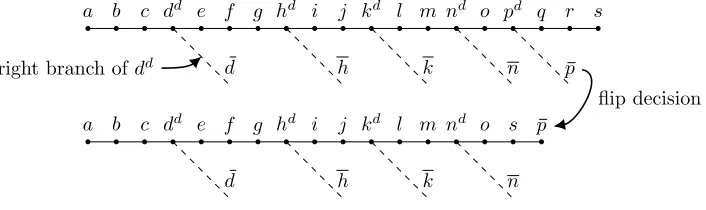
Example 1. Let F be a formula and let the trail be I = abcddef ghdijkdlmndopdqrs with
decisions decs(I) ={d, h, k, n, p} whereδ(d) = 1, δ(h) = 2,δ(k) = 3,δ(n) = 4, and δ(p) = 5. Let the further decision levels be δ(a) = δ(b) = δ(c) = δ(f) = 0, δ(e) = δ(g) = δ(m) = 1,
δ(i) = δ(j) =δ(l) = 2, δ(s) = 3, δ(o) = 4, and δ(q) = δ(r) = 5. The slices are I=0 =abcf,
I=1=ddegm,I=2=hdijl,I=3=kds,I=4=ndo,I=5=pdqr. We have
O(I) = I ∨ _
`∈decs(I)
(`∧I<δ(`)) = I∨(d∧I<1)∨(h∧I<2)∨(k∧I<3)∨(n∧I<4)∨(p∧I<5)
visualized in Fig.2. The dashed lines below the decision literals denote the assignments where the respective decision literal is flipped, i.e., together withIthey form the pending search space. Now assumeI(F) =>. We assume we backtrack chronologically and flip the last decision literalp. We get J =abcddef ghdijkdlmndosp=I
<5p as shown at the bottom of Fig.2and
O(J) = J∨_
`∈decs(J)
(`∧I<δ(`)) = (d∧I<1)∨(h∧I<2)∨(k∧I<3)∨(n∧I<4)∨(p∧I<5)
whereδ(p) = 4. Note thatO(J)∨I=O(I).
a b c dd
d e f g hd
h i j kd
k l m nd
n o pd
p q r s
right branch ofdd
a b c dd
d e f g hd
h i j kd
k l m nd
n o s p
flip decision
Figure 2: Trail after backtracking chronologically inBack{True,False}. The trail itself together with the dashed lines represents the pending search space, i.e., the assignments not yet tested.
4
Calculus
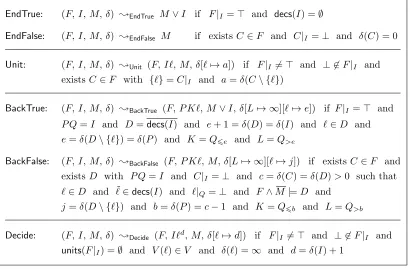
We describe our calculus as a state transition system where non-terminal states are denoted by (F, I, M, δ) in whichF is a CNF formula over variablesV,I denotes the current trail and
M the DSOP containing the models found so far. Finally,δdenotes the decision level function. The initial state is given by (F, ε,⊥, δ0) where F, ε and ⊥ denote the original formula, the
empty trail and the empty DSOP andδ0 ≡ ∞. The terminal state is equal to M which is a
DSOP representation ofF. The rules are listed in Fig.3. Next we provide explanations of the rules, and in Sect.5 we proof their correctness.
EndTrue/ EndFalse. If the trailI satisfiesF and there are no decision literals left on I, it is added toM and the search terminates since the search space has been traversed exhaustively. If the trail I falsifies F, there exists a clause C ∈ F such that I falsifies C. If in addition the conflict level δ(C) is zero, the pending search space is given by O(I) = I60. We have
I60(F) =⊥, i.e., there are no more assignments to be tested, and the search terminates.
Unit. The trailIneither satisfies nor falsifiesFand there exists a clauseC∈F that becomes a unit clause{`}underI. The trailIis extended by`which is assigned to decision levelδ(C\{`}). BackTrue. The trailIis a model ofF and is added toM. We defineDas the clause consisting of all negated decision literals onI. There exist subsequencesP andQofI such thatI=P Q
and δ(P) = δ(I)−1 = e and a literal ` ∈ D such that D|P = {`}. We use D as a kind
of “reason” and backtrack chronologically to decision level e. This involves unassigning all literals with decision level greater than e. For instance, ` ∈ decs(I) and δ(`) = e+ 1 and upon backtracking` is unassigned. After backtracking we propagate ` and assign it decision levelδ(D\ {`}) =eresulting in the trailP K`where δ(P K`) =e.
BackFalse. There exists a clauseC ∈F such thatC|I =⊥. The conflict level isδ(C)> 0,
i.e., there is a decision left onI. We can determine (usually by way of conflict analysis1 or just using the negated decisions) a clause D for whichF ∧M |= D such that δ(D) = c > 0 and whose residual is unit, e.g.,{`}, at jump level j =δ(D\ {`})< c. In fact, upon backtracking to any decision level b where j 6b < c the residual ofD under the trail becomes unit. This holds in particular forb=c−1. There exist subsequencesP andQofIsuch thatI=P Qand
δ(P) =band a literal`∈D such thatD|P ={`}. We backtrack to decision levelbusingD as
a reason. As for rule BackTrue, all literals with decision level greater than b are unassigned
1In contrast to [21] we require`to be the negation of the last decision which corresponds to learning the
EndTrue: (F, I, M, δ) ;EndTrue M∨I if F|I => and decs(I) =∅
EndFalse: (F, I, M, δ) ;EndFalse M if existsC∈F and C|I =⊥ and δ(C) = 0
Unit: (F, I, M, δ) ;Unit (F, I`, M, δ[`7→a]) if F|I 6=> and ⊥ 6∈F|I and
existsC∈F with {`}=C|I and a=δ(C\ {`})
BackTrue: (F, I, M, δ) ;BackTrue (F, P K`, M ∨I, δ[L7→ ∞][`7→e]) if F|I => and
P Q=I and D=decs(I) and e+ 1 =δ(D) =δ(I) and `∈D and
e=δ(D\ {`}) =δ(P) and K=Q6e and L=Q>e
BackFalse: (F, I, M, δ) ;BackFalse (F, P K`, M, δ[L7→ ∞][`7→j]) if existsC∈F and
existsD with P Q=I and C|I =⊥ and c=δ(C) =δ(D)>0 such that
`∈D and `∈decs(I) and `|Q =⊥ and F∧M |=D and
j=δ(D\ {`}) and b=δ(P) =c−1 and K=Q6b and L=Q>b
Decide: (F, I, M, δ) ;Decide (F, I`d, M, δ[`7→d]) if F|I 6=> and ⊥ 6∈F|I and
units(F|I) =∅ and V(`)∈V and δ(`) =∞ and d=δ(I) + 1
Figure 3: Rules for propositional model enumeration with chronological backtracking. The formulaF takes variables in V. If I satisfies F and there is no decision at conflict level left, the search terminates (ruleEndTrue). Otherwise the last decision literal is flipped (BackTrue). In case of a conflict at conflict level zero the search terminates (EndFalse). If I falsifies F at conflict level c > 0, a clause D is learned. The solver backtracks chronologically to decision levelc−1 whereDbecomes unit and propagates its unit literal (BackFalse). If the residual ofF
underI is undefined, either unit propagation is applied (Unit) or a decision taken (Decide).
after which`is propagated obtaining the trailP K`where δ(P K`) =b.
Decide. The trail I neither satisfies nor falsifies F and there are no unit literals in F|I. An
unassigned variable is chosen and assigned to decision leveld=δ(I) + 1.
Example 2. We now explain our calculus by a small example, precisely, the one for which our calculus in [20] would fail if incorrectly blocking clauses and dual reasoning were combined.
Step Rule I δ(1) δ(2) δ(3) F|I M
0 ε ∞ ∞ ∞ (1∨2)∧(1∨2) ⊥
1 Decide 3d ∞ ∞ 1 (1∨2)∧(1∨2) ⊥
2 Decide 3d2d ∞ 2 1 > ⊥
3 BackTrue 3d2 ∞ 1 1 (1)∧(1) 32
4 Unit 3d21 1 1 1 ⊥ 32
5 BackFalse 3 ∞ ∞ 0 (1∨2)∧(1∨2) 32
6 Decide 31d 1 ∞ 0 (2) 32
7 Unit 31d2 1 1 0 > 32
8 BackTrue 31 0 ∞ 0 (2) 32∨312
9 Unit 312 0 0 0 > 32∨312
10 EndTrue 32∨312∨312
Figure 4: Execution trace for Ex. 1.
after which literal 1 is decided and assigned to decision leveld= 1 (step 6). Due to the reason clauseC= (1∨2) with decision levela= 1, literal 2 is propagated by assigning it to decision level 1 and model 312 is found (step 7). RuleBackTrue is executed with D = (1) and e= 0. We backtrack chronologically by unassigning literals 2 and 1 and propagating literal 1 assigning it to decision level 0 (step 8). Literal 2 is propagated, the reason clause is (1∨2) at decision levela= 0, and model 312 is found (step 9). There are no decisions left onI, and the model found in step 9 is added toM. The search terminates withM = 32∨312∨312 (step 10).
The choice of the decision literal is non-deterministic and might have a significant impact on the trace length as we are going to show. Assume in step 1 we decide literal 2 assigning it decision level 1. We immediately find model 2 and apply ruleBackTrue with D = (2) and
e= 0, i.e., we flip the last decision literal 2 by unassigning it and assigning its complement to decision level 0. The residual ofF under the trail is (1)∧(1), hence we apply rule Unitwith
C= (1∨2) and propagate literal 1 at decision levela= 0. We get a conflict withC= (1∨2) at decision level 0 and our procedure terminates withM = 2 after only four steps. If we start by deciding 2 instead, in the next step we might propagate literal 1 which leads to a conflict as in the last example. RuleBackFalseyieldsD= (2) withj=b= 0 and after applying ruleUnitand propagating literal 2 at decision level 0, we find model 2. Since the trail contains no decision literal, the procedure terminates by means of rule EndTruein stateM = 2 after four steps as well. Now let us decide literal 1 first. Then I = 1d and F|
I = (2), literal 2 is propagated
due to reason (1∨2) at decision level 1 and model 12 is found. By means of rule BackTrue backtracking occurs to decision level 0 and the decision literal 1 is flipped. We now haveI= 1 andF|I = (2). Again, literal 2 is propagated resulting in I=I2 which satisfies F. The trail
contains no decision literals, and ruleEndTrueis applied. Hence, after five steps the procedure terminates in state M = 12∨12. If the first decision is 1, analogously the following steps are executed: propagation of literal 2 finding the model 12 (Unit), backtracking and flipping decision 1 (BackTrue), propagating literal 2 (Unit), finding model 12 and terminating with
M = 12∨12 (EndTrue). In total, five steps are required.
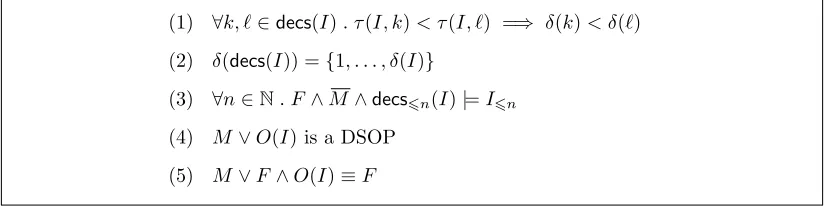
(1) ∀k, `∈decs(I). τ(I, k)< τ(I, `) =⇒ δ(k)< δ(`) (2) δ(decs(I)) ={1, . . . , δ(I)}
(3) ∀n∈N. F∧M ∧decs6n(I)|=I6n
(4) M ∨O(I) is a DSOP (5) M ∨F∧O(I)≡F
Figure 5: Invariants for propositional model counting with conflict-driven clause learning and chronological backtracking.
5
Proofs
For proving the correctness of our method, we make use of the invariants listed in Fig.5the first two of which were introduced in [21], while the third one is Inv. (3) in [21] strengthened by the negation ofM. This strengthening is required to show that after backtracking upon finding a model (ruleBackTrue) the propagated literals are indeed implied. Their “reason” is the clauseD
consisting of the negated literals of the model just found. In contrast to ruleBackFalse,Dis not implied by the formulaF but subsumed by the negation of a cube in its DSOP representationM
instead, namely the model just found.
Invariants (4) and (5) represent statements concerning the pending search space needed to show that in the end state M is logically equivalent to the formula and thus their model counts coincide. Invariant (4) states that M is DSOP, hence, its model count equals the sum of the number of models of its cubes. Invariant (5) says that all models ofF are represented by the formula obtained by the disjunction of M and the pending models ofF. Thus, upon termination of the procedure the second disjunct is empty, i.e.,M contains all models ofF.
5.1
Invariants in Non-Terminal States
Lemma 1. Invariants (1)–(5) hold in non-terminal states.
The proof is carried out by induction over the number of rule applications. Assuming that Inv. (1) – (5) hold in a non-terminal state (F, I, M, δ), we show that they are met after the transition to another non-terminal state for all rules.
Unit
Invariants (1) and (2): Except for the DSOP M contained in the state, ruleUnitmatches the one in [21], hence Inv. (1) and (2) are met.
Invariant (3): The argument is the same as for Inv. (3) in [21] replacingF byF∧M where
M remains unaltered, hence Inv. (3) also holds after the application of ruleUnit.
Invariant (4): We have thatM ∨O(I) is a DSOP and we need to show thatM ∨O(I`) is a DSOP as well. According to its definition,O(I`) is a DSOP. We have O(I`) =I`∨R(I`) =
I`∨R6a(I`)∨R>a(I`). Since δ(`) = aand `6∈decs(I`), `does not occur inR6a(I`), hence
O(I`) =I`∨R6a(I)∨R>a(I)∧`. SinceM ∨O(I) is a DSOP,M ∨O(I`) is a DSOP as well.
Invariant (5): SinceF∧I|=`, we haveF∧O(I)≡F∧O(I`). From this we getM∨F∧O(I)≡
BackTrue
Invariants (1) and (2): We need to prove that the order of the decisions left on the trail remains unaltered and no new decisions are taken. We show that (A)K contains no decision literal and (B) in the post state`is not a decision literal either.
(A) We haveI=P QandK=Q6e, i.e.,Kis obtained fromQby removing all literals with
decision level greater thane. Furthermore, for allk∈K,p∈P, we haveτ(P K, p)< τ(P K, k) and δ(K) 6 δ(P) = e. By the definition of decision literal and since Inv. (1) holds before applyingBackTrue, the decision literal with decision leveleis contained inP. SinceKcontains no literal with decision level greater thane,K contains no decision literal.
(B) It is sufficient to consider the case where δ(I)> 0. We have δ(D\ {`}) = e = δ(P) and δ(D) = e+ 1. According to Inv. (1) and (2) there exists exactly one decision literal for each decision level, and since D = decs(I) and ` ∈ D, ` ∈ decs(I). Furthermore, ` ∈ Q, hence ` is unassigned upon backtracking, i.e., {`, `} 6∈ P K, and D|P K = {`}. Due to the
definition of D there exists a literal k ∈D where k 6=` such that δ(k) =δ(`) =e for which
τ(P K, k)< τ(P K, `). Due to Inv. (1) and the definition of decision literal, ` is not a decision literal. The order of the decision literals left on the trail is not affected, hence Inv. (1) holds. Also, the remaining decisions remain unaltered, and Inv. (2) holds as well.
Invariant (3): We need to showF ∧(M∨I)∧decs6n(P K`)|= (P K`)6n for all n. First
note that the decision levels of all the literals inP K do not change while applying the rule. Only the decision level of the variable of ` is decremented from e+ 1 to e. It also stops being a decision variable. Since δ(P K`) =e, we can assume n 6e. Observe F∧(M ∨I)∧ decs6n(P K`) ≡ I∧(F ∧M ∧decs6n(I)) since ` is not a decision in P K` and I6e = P K
and thus I6n = (P K)6n by definition. Now the induction hypothesis is applied and we get
F∧(M∨I)∧decs6n(P K`)|=I6n. Again usingI6n = (P K)6n this almost closes the proof
except that we are left to proveF ∧(M∨I)∧decs6e(P K`)|=` as ` has decision level e in
P K`after applying the rule and thus ` disappears in the proof obligation for n < e. To see this note that F ∧D |= I using again the induction hypothesis for n = e+ 1. This gives
F∧decs6e(P K)∧`|=I and thusF∧decs6e(P K)∧I|=` by conditional contraposition.
Invariant (4): We assumeM∨O(I) is a DSOP and need to show that (M∨I)∨O(P K`) is a DSOP as well. NowO(I) =I∨R6e+1(I) sinceδ(I) =e+ 1. Further,O(I) =I∨R6e(I)∨
R=e+1(I). The pending search space of P K` is equal to O(P K`) = P K`∨R6e(P K`). But
P K = I6e and P K` = I6e` = R=e+1(I) since ` ∈ decs(I) and δ(`) = e+ 1. In addition,
R6e(P K`) =R6e(P K) since`6∈decs(P K`) andδ(`) =ewhich gives usR6e(P K`) =R6e(I).
We haveO(P K`) =R=e+1(I)∨R6e(I). From this we getO(P K`)∨I=O(I) and (M∨I)∨
O(P K`) =M∨(I∨O(P K`)) =M ∨O(I) which is a DSOP, and Inv. (4) holds.
Invariant (5): GivenM∨(F∧O(I))≡F, we need to show that (M∨I)∨(F∧O(P K`))≡F. FromO(P K`)∨I=O(I) we getM∨F∧O(I) =M∨F∧(O(P K`)∨I) =M∨(F∧O(P K`))∨ (F∧I). But I |= F and F∧I ≡I. Therefore M ∨F∧O(I) = M ∨(F∧O(P K`))∨I = (M∨I)∨F∧O(P K`)≡F, and Inv. (5) is met.
BackFalse
Invariant (1) and (2): Except for the DSOPM added to the state, the fact that clauseD
is not added to F and that F ∧M |= D, rule BackFalse corresponds to rule Jump in [21] whereb=c−1. Therefore, ruleBackFalseis a special case of ruleJumpand Inv. (1) – (2) still hold after the execution of ruleBackFalse.
Invariant (3): Letnbe arbitrarily fixed. Before executingBackFalse,F∧M∧decs6n(I)|=
i.e., F∧M ∧decs6n(P K)|= (P K)6n. Fromj =δ(D\ {`}), c =δ(D) and δ(P) =c−1 we
get D|P K = {`}. On the one hand F ∧M ∧decs6n(P K) |=D\ {`} and on the other hand
F ∧M ∧decs6n(P K) |= D, therefore, by modus ponens, F ∧M ∧decs6n(P K) |=`. Since
`is not a decision literal, as shown above,F∧M∧decs6n(P K)≡F∧M ∧decs6n(P K`) and
F∧M∧decs6n(P K`)|= (P K`)6n. So, Inv. (3) holds after applying ruleBackFalse.
Invariant (4): Given thatM∨O(I) is a DSOP, we need to show thatM∨O(P K`) is a DSOP as well. As shown for ruleBackTrue,O(P K`)∨I=O(I) if`∈decs(I). Due to the premise, we haveM∧O(I)≡ ⊥. Therefore,M∧O(I) =M∧(O(P K`)∨I)≡(M∧O(P K`))∨(M∧I)≡ ⊥, in particularM ∧O(P K`)≡ ⊥, and Inv. (4) holds.
Invariant (5): Given thatM∨(F∧O(I))≡F, we need to show thatM∨(F∧O(P K`))≡F
as well. Analogously to ruleBackTrue we haveM ∨F∧O(I) =M ∨(F∧O(P K`))∨(F∧I). ButF∧I≡ ⊥, henceM∨F∧O(I) =M∨F∧O(P K`)≡F, and Inv. (5) is met.
Decide
Invariant (1) and (2): Except for the DSOPM contained in the state, ruleDecidematches exactly the one in [21], and, following the argument given there, Inv. (1) – (2) are met.
Invariant (3): Letnbe arbitrarily fixed. Note that literal` is a decision literal. Therefore
F∧M∧decs6n(I`)≡F∧M∧decs6n(I)∧`|=I6n(I)∧`≡(I`)6n, and Inv. (3) holds.
Invariant (4): AssumingM∨O(I) is a DSOP, we need to show thatM∨O(I`) with decision literal`is a DSOP as well. We haveO(I`) =O6d(I`) whered=δ(I) + 1 since`∈decs(I`) and
δ(`) =d. Further,O(I`) =I`∨R6d(I`) =I`∨R6d−1(I`)∨R=d(I`) =I`∨R6d−1(I`)∨`∧I6d−1
whereδ(I) =d−1. Observing that`6∈(I`)=i fori < d, i.e., (I`)6i=I6ifori6d−1 =δ(I),
we getO(I`) =I`∨R(I)∨`I=I(`∨`)∨R(I) =I∨R(I) =O(I). This gives usM∨O(I`) =
M∨O(I) which due to our premise is a DSOP, and Inv. (4) holds.
Invariant (5): As just shown,O(I`)≡O(I). Therefore,M∨F∧O(I`)≡M∨F∧O(I)≡F, and after executing ruleDecideInv. (5) still holds.
5.2
Equivalence and Model Count
Proposition 1. If Enumeratereaches a terminal stateM, thenM ≡F and the model count ofF is given by #F =P
C∈M2| V−C|.
Due to Inv. (4) and (5), in every non-terminal stateM is a DSOP of models ofF, but we still need to show that the resultingI∨M in EndTrueandM inEndFalseare equivalent toF. EndTrue. Prior to applying ruleEndTrue,M∨O(I) is a DSOP andM∨F∧O(I)≡F. Since decs(I) =∅, we haveR(I) =⊥andO(I) =I, i.e.,M ∨I is a DSOP as well. SinceI |=F, we haveF∧I≡I andM∨(F∧O(I))≡M∨(F∧I)≡M∨I≡F due to the premise.
EndFalse. For showing thatM ∨F∧O(I)≡F we observe thatR(I) =R6δ(C)(I) =⊥. We
therefore haveO(I) =I∨R(I) =I∨ ⊥=I. Furthermore,I falsifies F, i.e.,F∧I≡ ⊥. This gives usM∨F∧O(I)≡M∨F∧I≡M ≡F due to the premise.
5.3
Progress
Proposition 2. Enumerate always makes progress, i.e., in every non-terminal state a rule is applicable.
Assume F|I = >. If decs(I) = ∅, rule EndTrue can be applied. Otherwise we choose
D=decs(I). We haveδ(D) =δ(I) =e+ 1 and due to Inv. (2)D contains exactly one decision literal `such that δ(`) =e+ 1 and thereforeδ(D)\ {`}) =e. We chooseP andQ such that
I =P Q ande =δ(P) and in particular `|Q =⊥. After backtracking to decision levele, we
haveI6e=P K whereK=Q6eandD|P K ={`}. All preconditions of ruleBackTrueare met.
If insteadF|I =⊥, there exists a clauseC∈Fsuch thatC|I =⊥. Ifδ(C) = 0, ruleEndFalse
is applicable. Otherwise, by Inv. (3) we haveF∧M∧decs6c(I)≡F∧M∧decs6c(I)∧I6c |=I6c.
SinceI6c(F)≡ ⊥, alsoF∧M∧decs6c(I)∧I6c ≡F∧M∧decs6c(I)≡ ⊥. We chooseD=decs(I)
obtainingF∧M∧D∧I6c≡ ⊥, thus F∧M |=D. Similarly to the proof of progress given in
Prop. 2 in [21], but forb=c−1, it can be shown that all preconditions of ruleBackFalsehold. Note that we do not explicitly addD toF since in CDCL with chronological backtracking we need no blocking clauses. We useD exclusively to determine`instead.
The proof for the case where F|I 6∈ {>,⊥} is identical to the one for Prop. 2 in [21], since
apart fromM in non-terminal states rulesUnitandDecideare equal in both frameworks. Since all possible cases are covered by this argument, in every non-terminal state a rule is applicable, i.e.,Enumeratealways makes progress.
5.4
Termination
Proposition 3. Enumerate always terminates, i.e., no infinite state sequence is generated.
The proof is analogous to the one in [21] with ruleBackFalse replacingJumpand the addi-tional ruleBackTrueto which the observations concerningBackFalse apply as well.
6
Conclusion
The results for combining chronological backtracking with CDCL presented in [23] and its potential for propositional model counting conjectured in [21] provided the main motivation for our work. We have presented a formal calculus for propositional model counting based on these ideas and provided a formal proof of its correctness.
For our framework we chose a model enumeration approach. The main motivation therefore was the following. Let F be a formula and I the current trail. A statement of an invariant taking into account the model count alone would be something likeM C+M O=M F where
M Cdenotes the number of total models ofF found so far,M Odenotes the number of pending total models ofF andM F denotes the model count ofF. But only one of the three quantities is known, namelyM C, whereas the newly introduced Invariants (4) and (5) allow first for a precise characterization of both the found and pending models and second to show that the union of the two yields the models ofF.
The preconditions F|I 6=>and⊥ 6∈F|I may be omitted in rulesUnitandDecide without
compromising the procedure’s correctness. The most important remaining open question is whether literal`in rule BackFalseneeds to be a flipped decision.
We plan to implement our rules to experimentally validate their effectiveness and to investi-gate possible applications in SMT and QBF. Our hope is to avoid the overhead of introducing blocking clauses in order to make use of learning. We want to extend the presented approach to projected model counting, also in combination with dual reasoning [20]. We further target component-based reasoning.
References
[1] Rehan Abdul Aziz, Geoffrey Chu, Christian J. Muise, and Peter J. Stuckey. #∃SAT: Projected model counting. In SAT, volume 9340 of Lecture Notes in Computer Science, pages 121–137. Springer, 2015.
[2] Fahiem Bacchus, Shannon Dalmao, and Toniann Pitassi. Solving #SAT and Bayesian inference with backtracking search. J. Artif. Intell. Res., 34:391–442, 2009.
[3] Armin Biere, Steffen H¨olldobler, and Sibylle M¨ohle. An abstract dual propositional model counter. InYSIP, volume 1837 ofCEUR Workshop Proceedings, pages 17–26. CEUR-WS.org, 2017. [4] Fabrizio Biondi, Michael A. Enescu, Annelie Heuser, Axel Legay, Kuldeep S. Meel, and Jean
Quilbeuf. Scalable approximation of quantitative information flow in programs. In VMCAI, volume 10747 ofLecture Notes in Computer Science, pages 71–93. Springer, 2018.
[5] Jan Burchard, Dominik Erb, and Bernd Becker. Characterization of possibly detected faults by accurately computing their detection probability. InDATE, pages 385–390. IEEE, 2018.
[6] Jan Burchard, Tobias Schubert, and Bernd Becker. Laissez-faire caching for parallel #SAT solving. InSAT, volume 9340 ofLecture Notes in Computer Science, pages 46–61. Springer, 2015. [7] Jan Burchard, Tobias Schubert, and Bernd Becker. Distributed parallel #SAT solving. In
CLUS-TER, pages 326–335. IEEE Computer Society, 2016.
[8] Adnan Darwiche and Pierre Marquis. A knowledge compilation map.J. Artif. Intell. Res., 17:229– 264, 2002.
[9] Martin Davis, George Logemann, and Donald W. Loveland. A machine program for theorem-proving. Commun. ACM, 5(7):394–397, 1962.
[10] Katalin Fazekas, Martina Seidl, and Armin Biere. A duality-aware calculus for quantified Boolean formulas. InSYNASC, pages 181–186. IEEE, 2016.
[11] Linus Feiten, Matthias Sauer, Tobias Schubert, Alexander Czutro, Eberhard B¨ohl, Ilia Polian, and Bernd Becker. #SAT-based vulnerability analysis of security components - A case study. In DFT, pages 49–54. IEEE Computer Society, 2012.
[12] Linus Feiten, Matthias Sauer, Tobias Schubert, Victor Tomashevich, Ilia Polian, and Bernd Becker. Formal vulnerability analysis of security components.IEEE Trans. on CAD of Integrated Circuits and Systems, 34(8):1358–1369, 2015.
[13] Alexandra Goultiaeva, Martina Seidl, and Armin Biere. Bridging the gap between dual propagation and CNF-based QBF solving. InDATE, pages 811–814. EDA Consortium San Jose, CA, USA / ACM DL, 2013.
[14] Roberto J. Bayardo Jr. and Joseph Daniel Pehoushek. Counting models using connected compo-nents. InAAAI/IAAI, pages 157–162. AAAI Press / The MIT Press, 2000.
[15] Vladimir Klebanov, Norbert Manthey, and Christian J. Muise. SAT-based analysis and quantifi-cation of information flow in programs. In QEST, volume 8054 of Lecture Notes in Computer Science, pages 177–192. Springer, 2013.
[16] Stefan K¨olbl, Gregor Leander, and Tyge Tiessen. Observations on the SIMON block cipher family. InCRYPTO (1), volume 9215 of Lecture Notes in Computer Science, pages 161–185. Springer, 2015.
[17] Andreas K¨ubler, Christoph Zengler, and Wolfgang K¨uchlin. Model counting in product configu-ration. InLoCoCo, volume 29 ofEPTCS, pages 44–53, 2010.
[18] T.K. Satish Kumar. A model counting characterization of diagnoses. InDX 02, pages 70–76, 2002. [19] Wei Li, Peter van Beek, and Pascal Poupart. Performing incremental Bayesian inference by
dynamic model counting. InAAAI, pages 1173–1179. AAAI Press, 2006.
[20] Sibylle M¨ohle and Armin Biere. Dualizing projected model counting. InICTAI, pages 702–709. IEEE, 2018.
Computer Science, pages 250–266. Springer, 2019.
[22] Matthew W. Moskewicz, Conor F. Madigan, Ying Zhao, Lintao Zhang, and Sharad Malik. Chaff: Engineering an efficient SAT solver. InDAC, pages 530–535. ACM, 2001.
[23] Alexander Nadel and Vadim Ryvchin. Chronological backtracking. In SAT, volume 10929 of Lecture Notes in Computer Science, pages 111–121. Springer, 2018.
[24] Dan Roth. On the hardness of approximate reasoning. Artif. Intell., 82(1-2):273–302, 1996. [25] Tian Sang, Fahiem Bacchus, Paul Beame, Henry A. Kautz, and Toniann Pitassi. Combining
component caching and clause learning for effective model counting. InSAT, 2004.
[26] Tian Sang, Paul Beame, and Henry A. Kautz. Heuristics for fast exact model counting. InSAT, volume 3569 ofLecture Notes in Computer Science, pages 226–240. Springer, 2005.
[27] Tian Sang, Paul Beame, and Henry A. Kautz. Performing Bayesian inference by weighted model counting. InAAAI, pages 475–482. AAAI Press / The MIT Press, 2005.
[28] Jo˜ao P. Marques Silva and Karem A. Sakallah. GRASP: A search algorithm for propositional satisfiability. IEEE Trans. Computers, 48(5):506–521, 1999.
[29] Marc Thurley. sharpSAT – counting models with advanced component caching and implicit BCP. InSAT, volume 4121 ofLecture Notes in Computer Science, pages 424–429. Springer, 2006. [30] Peter van der Tak, Antonio Ramos, and Marijn Heule. Reusing the assignment trail in CDCL
solvers. JSAT, 7(4):133–138, 2011.
[31] Erik Peter Zawadzki, Andr´e Platzer, and Geoffrey J. Gordon. A generalization of SAT and #SAT for robust policy evaluation. InIJCAI, pages 2583–2590. IJCAI/AAAI, 2013.