Available Online at www.aextj.com
Agricultural Extension Journal 2018; 2(1):27-31 RESEARCH ARTICLE
Determinants of Soil Conservation: An Insight of Tea Smallholders
H. M. P. M. Dayarathne1, A. L. Sandika1, S. D. Wanniarachchi2
1Department of Agricultural Economics and Extension, Faculty of Agriculture, University of Ruhuna, Mapalana, Kamburupitiya, Sri Lanka, 2Department of Soil Science, Faculty of Agriculture, University of Ruhuna,
Mapalana, Kamburupitiya, Sri Lanka
Received: 17-11-2017; Revised: 27-12-2017; Accepted: 05-01-2018
Address for correspondence: H. M. P. M. Dayarathne,
E-mail: [email protected]
ABSTRACT
Soil erosion is one of the most devastating problems in Sri Lanka, which threatens the sustainability of Agriculture. To design future policy and effective outreach, this study examines the factors behind farmers’ decision making attitude of soil conservation. The study was conducted in Ratnapura District. Hundred tea smallholder farmers were selected by following multistage random sampling, and primary data were collected through administrating a pre-tested structured questionnaire. Pearson correlation coefficient was employed between soil conservation attitude which was measured on a scale that consisted of 15 soil conservation measures, and farmers’ socio-economic and other factors considered in the study. Results obtained that age, level of education, income, property size, and, awareness on soil erosion, and associated problems with it were influencing on decision-making attitude of soil conservation while gender was not a significant factor. The study suggested obtaining farmers’ decision-making in soil conservation practices will require the use of various implementation tools such as subsidy, technical assistance, teaching, and extension efforts as well as it should facilitate regional social capital formulation to enable and thrive in the collective decision of soil conservation.
Key words: Attitude, decision-making, influencers, soil conservation
INTRODUCTION
Prevailing natural resources are capable to feed the world current population. Even in some countries which undergo hunger, there might be untouched potential of resources.[1] However, it is not possible to meet increasing food demand while shrinking land resource. In contrast, agricultural production approaches have to be sustainable in economic, ecological, and social terms, to deliver feed for the rising global population.[2] However, agricultural intensification have resulted in weakening biodiversity and other environmental complications in agro-ecosystems.[3]
The increasing population growth rate is creating notable pressure on land and other natural resources.[4] In Sri Lanka, the average net per capita land availability is only about
The community is increasingly aware of the impending negative environmental effects of agriculture that include health hazards, water pollution, soil degradation, and loss of other key environmental services.[12,13] Hence, society has created nature conservation and environmental programs to counter the negative trends in land usage.[2] “Soil conservation has defined as a rational use of land resources, application of erosion control measures, water conservation technologies, and adoption of appropriate cropping patterns to improve soil productivity and to prevent land degradation and thereby enhance livelihoods of the local communities.”[14] Sometimes, conservation in agricultural systems relies primarily on voluntary action by farmers. However, such endeavors vastly determined by farmers’ attitudes, acting the primary determinant of their behavior.[15]
Surveys of decision-making attitudes to conservation on farms have a long history.[15] The major factors influencing in decision-making process of soil conservation in individual farmers can be categorized into personal, economic, institutional, and physical groups.[9] Anonymous[16] suggested a conceptual model which demarcates the influencing factors for soil conservation [Figure 1].
Although there is number of documents in literature, efforts to recognize such influences on farmer conservation attitudes have been
largely inconclusive in the Sri Lankan context. Understanding stimuli (as well as obstacles) for participation in soil conservation is essential to design future policy and effective outreach. Therefore, this paper examines the factors behind decision-making attitude of soil conservation in Sri Lanka, refers to tea smallholding sector.
METHODOLOGY
The study was conducted in Ratnapura District (low-country wet zone) Sri Lanka. To select 100 tea farmers, the study followed two steps, first the area and second the respondents, following multistage random sampling. Primary data were collected by administrating a pre-tested structured questionnaire. Moreover, informal interviews and focused group discussions were conducted with selected respondents.
The questionnaire was majorly consisted of two parts. First measuring the attitude of soil conservation and second, the degree of influencing factors. Attitude of soil conservation was measured through a scale which ranges from 0 to 2 where 0 represents “disagree,” 1: Moderately agree, “2”: “Strongly agree.” A mark was assigned to each farmer, correspondingly to the answers they made on 15 soil conservation activities stated in the questionnaire. When selecting the statements, soil conservation practices in tea lands were considered
Figure 1: Influencing factors of soil conservation
as stated by Tea Hand Book.[17] The average of the scale values was considered as the mark they obtained for each practice. The reliability of soil conservation practices listed in questionnaire was measured using Cronbach’s Alpha test.[18] Open-ended questions were stated to identify the degree of sociodemographic, economic, and awareness variables regarding soil conservation. Ultimately, the relationship between soil conservation attitude and these variables were analyzed using Pearson correlation coefficient.
RESULTS AND DISCUSSION
Personal profile of respondents
From the interviewed farmers, the majority was male (70%). Most of the respondents were old farmers whose mean average age was 51 years. The age of the respondents ranged between 30 and 68 years. For the farming community, the average age was satisfactorily fit because young society is gradually abstain in farming activities. Majority of the respondents were schooled up to grade eight. Yet, the sample consisted of completely illiterate farmers as well as graduated farmers. The average property size of the respondents was 1.15 acres which provide the mean annual income of LKR 82, 940.
Influences of soil conservation
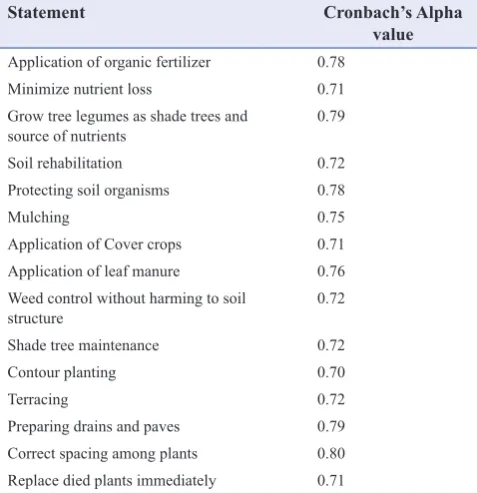
The study examined the reliability of each soil conservation practice using Cronbach’s Alpha test. Results obtained are demonstrated in Table 1. It was revealed that all practices have a higher Cronbach’s Alpha value than 0.70, which means the items have relatively high internal consistency. Next, the factors influencing soil conservation attitude was tested. Results obtained that age, level of education, income, property size, and, awareness on soil erosion and associated problems with it were influencing on the attitude of soil conservation while gender was not a significant factor [Table 2]. Gender could be a positive significant factor in some regions where male farmers are dominating in household income and take part in associations of tea cultivation where soil conservation concepts introduce to farming folk. Anonymous[19] observed age was a significant factor. They explained younger farmers are more educated and they consider erosion as a problem hence, perceive
benefits through soil conservation, as they are keen on attend to meetings, more energetic, prompt, curious, enthusiastic and innovative than older people. Anonymous[16] explained farmers’ education is related to greater information on conservation measures, productivity consequences of erosion and higher management expertise; thus the positive relationship with soil conservation could be expected. Further, they described that income level positively influences in soil conservation effort in two reasons. First, financial constraints to the application of soil conservation are less for high-income earners and second, income is positively correlated with the education.
Table 1: Reliability of the statements of soil conservation
Statement Cronbach’s Alpha value
Application of organic fertilizer 0.78
Minimize nutrient loss 0.71
Grow tree legumes as shade trees and
source of nutrients 0.79
Soil rehabilitation 0.72
Protecting soil organisms 0.78
Mulching 0.75
Application of Cover crops 0.71 Application of leaf manure 0.76 Weed control without harming to soil
structure 0.72
Shade tree maintenance 0.72
Contour planting 0.70
Terracing 0.72
Preparing drains and paves 0.79 Correct spacing among plants 0.80 Replace died plants immediately 0.71
Table 2: Influencing factors on attitude of soil
conservation
Factor Attitude on soil conservation Correlation
value Significance (P)
Gender −0.89 0.380
Age −0.323 0.001*
Level of education 0.210 0.000*
Income 0.234 0.019*
Property size 0.218 0.029*
Awareness on soil
erosion 0.729 0.000**
Extent of soil erosion 0.461 0.000* Extent of soil moisture
retention 0.508 0.000**
Extent of fertility
depletion with time 0.613 0.000**
In advance, Anonymous[20] embellished that the financial factors, including income and debt, are most important influences while perception on erosion, educational level, off-farm employment, and tenancy also act as a stimulus in conservation efforts as extraneous factors.
The study revealed that land area is proportionate to conservation attitude because large landowners are more likely to take part in associations and follow guidelines of soil conservation to have benefits from these associations, i.e., subsidies. Anonymous[21] explained farmers have small plot size are likely to put less conservation than those who have large plots because conservation structure proportionally more space in small plots and the future economic benefit may be insufficient to offset the decline in production. Further, he described that large farms may be expected to have greater level of quality management. In addition, he explained that the awareness, perceived the extent of soil erosion and it is associated problems are a crucial first step for the decision-making of soil conservation. Anonymous[9] observed that once an erosion problem is perceived the farmer decides whether or not to adopt soil conservation practices. Moreover, they have explored that farmers who have been involved in agricultural activities for a long time period in their own land may know the impacts, i.e., productivity impact of soil erosion. Therefore, a positive relation is assumed to exist between awareness on soil erosion and decision-making attitude on conservation.
A similar study conducted in Tanzania by anonymous[22] revealed that gender, age, and level of education were positive significant factors for soil and water conservation while farm size and off-farm income were not. Further, they explained that these influencers vary with the region. Moreover, anonymous[23] found in their Tanzanian study, that the level of education and the institutional factors were the predominant influencers for soil conservation while, gender, farm size, and income from off-farm activities also showed a clear interaction with soil conservation attitude. Anonymous[24] found that age and farm size were the most significant factors in soil and water conservation by an Ethiopian study. Anonymous[25] observed that education (as it supports to cross-cultural bounds), gross farm income and farm size were moderately associated with farmers’ awareness and adoption on soil conservation. These results have also proven by anonymous[26] through their investigation in
Kenya. Apart from the mentioned factors, they observed that neighborhood social influences and subjective norms were determinants of soil conservation. Anonymous[14] observed that seven major determinants of soil conservation. They mentioned that caste of the respondent and memberships of the conservation and development groups were significant rather than the common factors.
CONCLUSIONS AND RECOMMENDATIONS
General accomplishments of the study revealed that age, level of education, property size, income, awareness on soil erosion and associated problems with it are the key determinants of soil conservation decision of farmers. Based on that, several inferences in policy formulation could be suggested.
Formal education may be an effective variable to capture the environmental awareness of farmers who are basically literate.[9] In addition, obtaining farmer adoption in soil conservation practices will require the use of various implementation tools such as subsidy, technical assistance, teaching, and extension efforts. Anonymous[26] suggested policy formulation should focus on local groups and assists capacity building by training of trainers in the community to strengthen leadership, knowledge, and innovativeness. In addition, to enhance the participation in soil conservation, incentive-based motivations on natural resource conservation may be an effective mechanism. Moreover, protection of this soil resource brings non-excludable positive externalities; it should encourage regional social capital formulation to enable and thrive in collective decision. However, the huge part of the conservation responsibility tolerates by the local institutions. Hence, these institutions should be strengthened, and members empowered such that they can run active institutions and endorse technology adoption at the local level themselves. Further in line with Anonymous[9] present study also embellishes the need of strong public-privet partnerships to achieve soil conservation.
REFERENCES
2. Ahnström J, Hockert J, Bergea HL, Francis CA, Skelton P, Hallgren L. Farmers and nature conservation: What is known about attitudes, context factors and actions affecting conservation? Renew Agric Food Syst 2009;24:38-47.
3. Benton TG, Bryant DM, Cole L, Crick HQ. Linking agricultural practice to insect and bird populations: A historical study over three decades. J Appl Ecol 2002;39:673-87.
4. Blaikie P, Brookfield H, editors. Land Degradation and
Society. London: Methuen, Routledge; 2015.
5. Fernando SL, Shariff NM. The relationship between land use/land cover change and factors for ecotourism development in the partial nature based wetland using remote sensing and GIS techniques. Int J Sci Res Innov Technol 2015;2:82-92.
6. Hewage T, Jayasekara A, Wickramasinghe W, Mahanama I, Gamage G. National Action Programme for Combating Land Degradation in Sri Lanka, United Nations Development Programme (UNDP) Sri Lanka Environment Action 1 Project (EA1P). 1st ed. Sri
lanka: Baththaraulla; 2003. p. 22.
7. Coomaraswamy A, Ekanayake A, Chisholm A, Jayasuriya SK. Effect of land degradation on tea productivity. Economic Policy Reforms and the Environment: Land Degradation in Sri Lanka. Colombo: Ministry of Plantation Industries; 1999.
8. Krishnarajah P. Soil Erosion Control Measures for Tea Land in Sri Lanka. Sri Lanka J Tea Sci 1985;54:91-100. 9. Illukpitiya P, Gopalakrishnan C. Decision-making in
soil conservation: Application of a behavioral model to potato farmers in Sri Lanka. Land Use Policy 2004;21:321-31.
10. Asrat P, Belay K, Hamito D. Determinants of farmers’ willingness to pay for soil conservation practices in the southeastern highlands of Ethiopia. Land Degrad Dev 2004;15:423-38.
11. Brown S, Shrestha B. Market-driven land-use dynamics in the middle mountains of Nepal. J Environ Manage 2000;59:217-25.
12. Vandermeer J. The ecological basis of alternative agriculture. Ann Rev Ecol Syst 1995;26:201-24.
13. Traore N, Landry R, Amara N. On-farm adoption of conservation practices: The role of farm and farmer characteristics, perceptions, and health hazards. Land Econ 1998;74:114-27.
14. Tiwari KR, Sitaula BK, Nyborg IL, Paudel GS. Determinants of farmers’ adoption of improved soil conservation technology in a middle mountain watershed of central Nepal. Environ Manage 2008;42:210-22. 15. Carr S, Tait J. Differences in the attitudes of farmers
and conservationists and their implications. J Environ Manage 1991;32:281-94.
16. Ervin CA, Ervin DE. Factors affecting the use of soil conservation practices: Hypotheses, evidence, and policy implications. Land Econ 1982;58:277-92.
17. Tea Hand Book; 1998. Available from: http://www. navagoviya.org. [Last accessed on 2016 Nov 22]. 18. Bonett DG, Wright TA. Cronbach’s alpha reliability:
Interval estimation, hypothesis testing, and sample size planning. J Organ Behav 2015;36:3-15.
19. Hoover H, Witala M. Operator and Landlord Participation in Soil Erosion in the Maple Creek Watershed in Northeast Nebraska. Washington DC: USDA; 1980.
20. Norris PE, Batie SS. Virginia farmers’ soil conservation decisions: An application of Tobit analysis. J Agric Appl Econ 1987;19:79-90.
21. Adjaye J. Factors affecting to adoption of soil conservation methods: A case study of Fijian Cane farmers. J Agric Resour Econ 2008;33:99-117.
22. De Graaff J, Amsalu A, Bodnar F, Kessler A,
Posthumus H, Tenge A. Factors influencing adoption
and continued use of long-term soil and water
conservation measures in five developing countries.
Appl Geography 2008;28:271-80.
23. Tenge AJ. Participatory appraisal for farm-level soil and water conservation planning in West Usambara highlands. Tanzania: Doctoral Thesis Wageningen University; 2005.
24. Amsalu A, de Graaff J. Farmers’ views of soil erosion problems and their conservation knowledge at Beressa watershed, central highlands of Ethiopia. Agric Hum Values 2006;23:99-108.
25. John CE, McLeod M, William RL, Dillman D. The Farmer Absentee Land Owners and Erosion: Factors
Influencing the use of Control Practices. Moscow:
Idaho Water Resources Research Institute, University of Idaho; 1977.
26. Willy DK, Holm-Müller K. Social influence and