INFORMATION TECHNOLOGY AND INDIAN LIBRARIES
AL Moorthy and SS Murthy
Defence Scientific Information & Documentation Centre (DESIDOC) Metcalfe House, Delhi-110 054
1. INTRODUCTION
In this paper, information technology (IT) is meant to cover the technologies of computers, commu-nications and CD-ROMs. In other words, the use of the technologies of bibliographic database develop-ment, online networks including e-mail and Internet and CD-ROM databases in Indian libraries is discussed. Further, the term libraries wherever used means libraries and information centres.
1.1 Computerisation - The Beginnings
Computerisation had its beginning in India when punch cards were used during the late 1950s and early 1960s for some applications in the insurance sector and census operations. However, in 1960s com-puters ‘came’ to India, and during this period computerisation efforts started using direct input into hard disk drives (HDDs). Mini computers started penetrating the market in late 1970s while microcomputers were introduced in the 1980s in the country. However, use of punch cards continued till 1980s, mainly due to the high cost of mainframe and mini computers which did not replace the existing punch-card-based computer systems and total shift to happened only after the advent of microcomputers which were less expensive than the mainframes and the minis which many organisations could afford.
Computerisation in India started with the installation of the first computer at the Indian Statistical Institute (ISI), Calcutta in 1955. The system was HEC-2M (of Hollerith India Ltd, later known as ICL) which was followed by the second computer from Russia (Ural), also installed at ISI in 1958 [1].
During the introductory phase of 1955-64, 16 computers were introduced (10 of them were from IBM) in the country. Out of these 16, two were in government departments, six in educational institutions, seven in R&D institutions and one in the private sector. During the second phase of 1965-72, 170 computers were installed in India (127 of these were from IBM). Out of these, 69 were in public sector institutions, 76 were in private sector and 35 were in academic and R&D institutions. Although the first indigenous computer ISIJU was designed and developed by ISI and Jadavpur University and was installed at Jadavpur Univer-sity in July 1964, commercial production of indigenous computers started only in 1973 when ECIL started manufacturing computers. ECIL, during 1973-78 installed 94 computers. It was estimated that by 1978 there were about 448 computers installed in India [1].
It was reported that there were 2000 mini computers in India in 1984 which rose to 10,000 in 1985 and about 1 lakh by the end of the Seventh Plan [2].
1.2 Library Automation
With the introduction of minis during late 1970s and micros later in 1980s, many of the libraries and information centres started using computers for their work. As these computers were costly, only elite institutions in the public, academic, R&D and private sectors could afford to buy them. And so, libraries in these institutions were able to utilise them only to some extent. They could not get adequate time slots on mainframes due to high costs involved and also the lower priorities in allotting computer time for library work. Priority was given to production, marketing, scientific and R&D jobs for assigning computer time in these institutions. As a result, library automation did not progress well. However, with the arrival of micro-computers (PCs) into the Indian market in the 1980s, library automation picked up momentum.
services using computers, to the various units of the company.
2. EXTENT OF USE OF IT IN INDIAN LIBRARIES 2.1 Academic and Research Libraries
It is well-known that in India most of the libraries function in the government sector. These are in academic and research institutions and under the public library system which is again under the state and central governments. In order to have an idea of the magnitude of the library automation task to be done in the country, it would be useful to know the number of academic and research institutions in the country. Table 1 gives the number of educational, S&T and social science institutions in the country during 1990s.
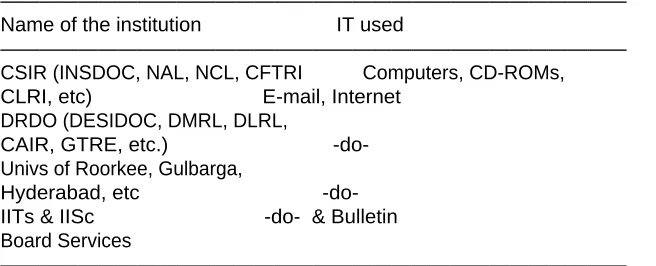
Since there cannot be an academic, educational or research institution without a library, the number of libraries will also be almost the same as the number of institutions mentioned in Table 1. While most of the academic and college libraries do not use IT for their activities, the situation in S&T libraries, which come under the category of special libraries is somewhat better. A good number of libraries, though small in number when compared to the total number of libraries in the country, use current IT products and systems like computers, e-mail, CD-ROMs, and online searching. Libraries and information centres of research institutions like those of CSIR, DRDO, ICAR, ICMR, DAE, ISRO, DST, etc. and institutes of higher learning like the IITs, IISc, RCEs and well reputed universities of Roorkee, Delhi, Madras, Pune, Bombay etc. are the institutions having such li-braries. Table 2 gives an idea of technologies used in some of these institutions.
Table 1. Number of academic institutions in India
Type of institution Number
Univs & higher academic 230
institutions
Colleges (up to graduation) 5200 S&T research institutions
(special libraries) 3290 Social science & humanities
research institutions 910 Public libraries
(up to block level) 2223
————————————————————————
Table 2. Technologies used in some of the institutions
———————————————————————————————— Name of the institution IT used
———————————————————————————————— CSIR (INSDOC, NAL, NCL, CFTRI Computers, CD-ROMs, CLRI, etc) E-mail, Internet
DRDO (DESIDOC, DMRL, DLRL,
CAIR, GTRE, etc.) -do-Univs of Roorkee, Gulbarga,
Hyderabad, etc -do-IITs & IISc -do- & Bulletin Board Services
————————————————————————————————
Table 3 shows details of IT infrastructure used in academic and research institution libraries as per a survey conducted during 1994-95 [3].
Table 3. IT infrastructure in government funded academic and research libraries
_________________________________________________________________ Institu- No. of libraries Use Databases
Total Responded PCs Lib S/W CDs Online searching
_________________________________________________________________ Univs (incl 186 82 47 35 14 1 34
deemed univs)
Engg colleges 342 36 24 20 6 4 4 Medical coll 148 47 15 9 12 1 5 S&T orgs* 251 104 75 61 40 17 44
_________________________________________________________________
*Includes institutions of DST, DOE, ICMR, ICAR, DRDO, CSIR, DAE and institutions of national importance.
2.2 Public Library System
While the use of IT is largely confined, till now to the libraries and information centres of research and higher academic institutions, the public library system in the country is practically unaffected by the IT till now. This is largely because of the following reasons:
(a) Lack of funds for acquiring necessary hardware and software facilities,
(b) Lack of adequately trained manpower in the use of IT, and
(c) Resistance on the part of library staff to change from their traditional practices to the use of IT.
3. APPLICATION OF IT IN INDIAN LIBRARIES
Application of IT for different activities and services in Indian libraries and information centres is briefly discussed here.
3.1 Development of Bibliographic Databases
Although database industry in India is of recent origin [4] it had roots in 1970s when India participated actively in many international database initiatives, especially those promoted by the UN like INIS, AGRIS, etc. In addition, many of the libraries and information centres in the S&T, research and academic institutions have been using both printed and online versions of foreign bibliographic databases since more than a decade. However, serious efforts in the development of bibliographic databases in the country were started only in the late 1980s. INSDOC and NASSDOC took initiative in this direction with the development of National Union Catalogue of Scientific Serials in India (NUCSSI) and Union Catalogue of Social Science Periodicals, respectively. During this period, NISSAT provided thrust to the development of indigenous databases on machine tools, leather, food, drugs and pharmaceuticals, textiles, chemicals, ceramics, etc.
An international conference on the subject was organised by DESIDOC which has provided momentum to these efforts. In 1990, a publication brought out [5] by the National Management Information System (NMIS) of DST listed 89 databases in S&T developed by 58 government, public and private sector agencies. A majority of these databases were in computerised form, with a few in non-computerised form. The recently compiled Indian Abstracting and Indexing Services and Databases in Science and Technology (INDAB) by NISSAT [6,7] contains 201 machine-readable databases which include 43 databases of abstracting and indexing (A&I) services and 43 databases of directories (Table 4).
Table 4. Type of products in INDAB database
———————————————————————————————— Category Total Machine-readable
No. databases
———————————————————————————————— A&I services 202 45
Directories 83 43 Database 113 113 ——
———-Total 398 201
These databases are developed/produced by as many as 177 agencies which include 38 in the government departments, 72 in R&D institutions, 48 in universities and other institutions, and 19 in private institutions. However, most of the databases (more than 80 per cent) fall in science and technology and only about 80 databases are in social sciences, management, business, industry, etc. Many database vendors are operating in India who provide public access to the indigenous databases (see ref. 4 for a detailed discussion about a dozen vendors). Some of these databases are available on CD-ROM. Financial and business databases dominate the scene at present with a couple of databases being provided online (for example, JURIX and BISNET). It is expected that the trend is likely to improve further in the next decade.
3.2 Development of Library Networks
In a broad sense, networks can be into two categories [8]:
(i) Infrastructural networks which provide the hardware, software, protocols and freeways for the flow of information. Networks like I-NET, NICNET, ERNET and INDONET fall under this category.
(ii Application networks which are set up by or for a specific community or for serving a well defined end-users. INFLIBNET, metropolitan/city networks like DELNET, CALIBNET, etc and networks like RAILNET, SAILNET, RABMIN, etc. fall under this category.
The library networking efforts in developed countries got a boost with the breathtaking breakthroughs in microelectronics, computers and communication technologies during 1960s and 1970s. In India, efforts in this field started in the late 1980s with the initiation of metropolitan/city networks. The earliest such networks are the Calcutta Library Network (CALIBNET) and the Delhi Library Network (DELNET). These were followed by other city networks like Madras Library Network (MALIBNET), Ahmedabad Library Network (ADINET), Bombay Library Network (BOMNET), Pune Library Network (PUNENET), etc. At the national level, the largest library network is the Information & Library Network (INFLIBNET) of the University Grants Commission (UGC) for networking libraries of all the institutions of higher learning and research and development. During this period, the Indian Medlars Centre (IMC) established jointly by the National Informatics Centre (NIC) and the Indian Council of Medical Research (ICMR) in 1987 and the Biotechnology Information System (BTIS) of the Department of Biotechnology (established in 1988), started using the NIC’s satellite-based national-level information network called NICNET. During the 1990s, CALIBNET and DELNET started providing some services and INFLIBNET also started functioning pending its registration as an autonomous society under the UGC. INFLIBNET was registered in 1996 as a society and as an inter-university centre of UGC [9].
The present status of library networking in India is that most of the libraries covered by some network or the other are creating databases of their holdings and in automating the library activities, the former being the first priority. Commonly, the periodical holdings are attempted first in building up the databases as it takes less time than for the other types of library documents. This is followed by the databases of holdings of books, reports, dissertations, standards, etc. The library network centres (i.e., the coordinating agencies of the net-works) also are concentrating on acquiring holdings of databases of their member libraries and merging them to provide the users with access to the total records. They provide such access either by e-mail or online through the telephone network. In addition, these centres also try to provide a common software for database development and automation of library activities and services [9].
It can be observed that except DELNET, MALIBNET and INFLIBNET, most of the other library networks have yet to develop databases of library holdings in a significant way. Even these three networks have to go a long way to cover in their databases the entire holdings of all the participating libraries. Unless this is achieved, the networks would not be able to achieve significant resource sharing as well as rationalisation in library acquisitions. Most of the networks are however, making efforts towards this end by conducting training programmes for the staff of the participating libraries in data capturing (covering library holdings), database development, and automation of library activities and services.
3.3 Internet
RPG, BI Infotech, Datapro, UUNET, DART, etc. in the private sector. Generally, the charges of private sector agencies are higher compared to that of public sector providers. Computer and business magazines and daily newspapers were the first to establish links with Internet by publishing “Internet editions”. Presently, Business India, Filmfare, India Today, Express Computer, Dataquest, PC Quest, Voice and Data, the Hindu, The Pioneer, The Times of India and The Hindustan Times are some of the publications which are available on Internet [11]. In 1996 Wolinsky reported [12] 35 Indian Web Servers operating in India. Many public and private agencies are establishing Web sites on Internet for journals, magazines and newsletters. Many libraries are also accessing Internet for various purposes, including information dissemination, online searching of databases, etc [13].
3.4 Online Access to Remote Databases
Use of public data networks for accessing online external
databases started during 1980s in a very limited way. Only a few institutes like Bharat Heavy Electricals Ltd (R&D), Hyderabad followed by DESIDOC, Delhi started using telex as an access medium to conduct online searches of Dialog’s databases.
A couple of years later a few such institutions started using public telephone lines for accessing databases of Dialog and other database vendors or producers like Data Star, SDC, BRS, National Library of Medicine, European Space Agency/Information Retrieval System (ESA-IRS), etc. In this connection, mention may be made of a week-long experiment successfully conducted by TIFR, Bombay in September 1976 by getting online access to ESA-IRS databases through a temporary dedicated line from TIFR to Overseas Communication Service (OCS) (presently called as Videsh Sanchar Nigam Ltd or (VSNL) at Bombay. Similarly, a one-week experiment was conducted by National Aeronautical Laboratory (NAL), Bangalore for getting online access to ESA-IRS databases in March 1981 which was also successful. This was followed by a two-year long service of online access to ESA-IRS databases by NAL during 1986-1987.
However, with the availability of the VSNL PADs (packet assemblers disassemblers) which were made operational at big cities like Delhi, Calcutta and Madras, the telecommunication costs of online searching drastically came down. This was followed by the advent of the packet switched public data network called I-Net of the Department of Telecommunications (DOT) in the early 1990s. This has further encouraged the libraries and information centres to make online use of foreign databases. Parallelly, the spurt in the publishing of CD-ROM versions of databases, journals, and other publications has encouraged libraries and information centres to subscribe to CD-ROM versions of most frequently used databases, thereby reducing the cost of online searching of foreign databases. The libraries and information centres have been striking a balance between the use of CD-ROM databases and online searching of databases, using online access only for meeting the information requirements which cannot be met with the CD-ROM databases and other collections received in the libraries.
With the availability of e-mail services in the country provided by the Education and Research Network (ERNET) of the Department of Electronics (DOE) since 1992 and the NIC since 1994, libraries and information centres have been active in using e-mail service for disseminating information to their users. Also, some of them like the libraries of Physical Research Laboratory (PRL), Ahmedabad; Indian Institute of Science (IISc), Bangalore; etc. started operating Bulletin Board Services (BBS). Since a couple of years, the use of Internet has also been growing very steeply. Parallelly, the acquisitions in research and special libraries are also undergoing gradual change with the acquisition of more and more electronic versions like the CD-ROM publications.
3.5 Use of CD-ROMs
Although CD-ROMs became very popular with developed countries soon after they entered the market in the late 1980s, it is only in the 1990s it caught up with the library and information professionals in India. This was mainly because of the costs involved in producing CD-ROM versions of databases, and also in acquiring those produced in other countries. The factors that effect the production and use of CD-ROMs are : (a) the high initial cost involved in setting up a CD-ROM production facility, (b) government policy in importing CD-ROMs which were subjected to customs duty and related problems, (c) the agreements between the subscriber (buyer) and the publisher (copyright holder) regarding multiple usage, and (d) the clause in the agreement between the buyer and publisher that the old CD-ROMs should be returned if the subscription is discontinued, which created a lot of accounting and audit problems [14]. Because of these aspects, only elite institutions were able to use CD-ROM products, which mostly covered reference tools such as directories, encyclopedias and large databases like INSPEC, COMPENDEX, LISA, etc.
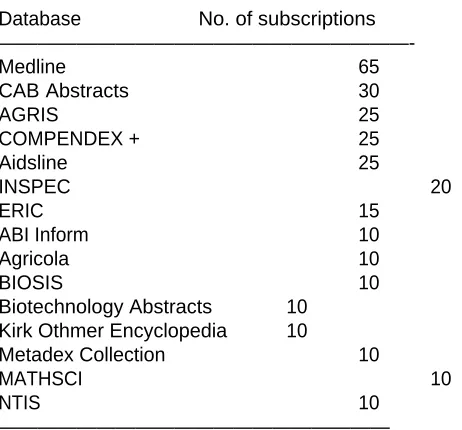
end CD products (like games, educational and recreation kits, etc) and the government liberalisation policies. There are as many as 20 CD-Nets available in the country with various institutions [15]. It is not uncommon to have multiple copies of the same CD-ROM database in the same city subscribed by different institutions. Many national institutions like DESIDOC, INSDOC, NIC, NML, AIIMS, NAL, etc are subscribing to the major secondary services in CD-ROM. The databases which are subscribed by multiple institutions (more than 10) are listed [15] in Table 5.
Table 5. Popular CD-ROM databases subscribed in India
—————————————————————-Database No. of subscriptions
—————————————————————-Medline 65
CAB Abstracts 30
AGRIS 25
COMPENDEX + 25
Aidsline 25
INSPEC 20
ERIC 15
ABI Inform 10
Agricola 10
BIOSIS 10
Biotechnology Abstracts 10 Kirk Othmer Encyclopedia 10
Metadex Collection 10
MATHSCI 10
NTIS 10
————————————————————
Some agencies in the public and private sectors are actively engaged in or associated with the CD-ROM production. These include National Institute of Science Communication (NISCOM, formerly PID), Electronic Research & Development Centre (ERDC), and INSDOC in the public sector and Informatics (India) Pvt. Ltd., Odyssey Technologies Ltd., Kirloskar Multimedia Ltd., NASSCOM, etc. in the private sector. Many software companies (for example, NASSCOM, Tata Unisys, etc) and magazines (for example, Business India, PC Quest) are issuing their products on CD-ROM. NISSAT has been playing a key role in the disseminatoin of information on CD-ROMs by establishing and supporting a national information centre on CD-ROM at the Foundation for Innovation and Technology Transfer (FITT) in collaboration with IIT, Delhi. FITT-NISSAT CD-ROM Centre acts as a repository of all CD-ROMS published in India and acquires at least a copy each of such publications.
3.6 Development of Multimedia Products
Multimedia products integrate of data, text, images and sound in digital environment to provide interactive access to information contained in them. These qualities make it an ideal tool for application in sel-learning kits for educational training and also as an excellent medium for audio visual presentations, besides applications in electronic publishing (e.g., encyclopaedias), tourist guides, entertainment (e.g., interactive games), etc.
Multimedia is comparatively a new technology which is gradually getting acceptance by the libraries and information centres in our country. Multimedia information kiosks are one of the most important applications in libraries. Here a user is taken around a library or a museum. The information included in such miltimedia products include the details of various sections/ divisions, services rendered, facilities available, resources and where to find them, etc and also the floor plans. Such kiosks are already in use at National Museum of Natural History, National Science Museum and Rail Transport Meseum, all in New Delhi.
have jointly developed a product, ‘Palace on Wheels’ which includes seven packaged themes with information on forts, palaces, fairs, heritage and culture, etc of Rajasthan. ERDC of DOE has brought out a trilingual multimedia programme on heart and ECG. Indira Gandhi National Centre for Arts, New Delhi is currently working on a number of multimedia projects relating to Indian arts and culture including Gita Govinda of Jayadeva. DESIDOC has produced a couple of multimedia products including one on its sister laboratory for its centenary celebrations. C-DAC of Pune and NIIT of New Delhi are also actively involved with the developments of multimedia in the country.
4. FUTURE TRENDS
In India there are pockets of excellence in several subject areas while in many areas the level of attainment is not significant. Similarly, in some of the IT areas. India is not much behind the advanced countries, particularly in the computer software development, library management methods and techniques etc. The country’s achievements in telecommunications and computer hardware are also significant if we look at the work of C-DOT and C-DAC under DOE and ANURAG in DRDO. But the coming years are expected to witness certain developments which may change the present scenario in libraries for the better.
Although the use of IT in libraries as whole is presently quite low, it is expected to go up in the coming years with continual reduction in the prices of the hardware and software. Also, the extent of use of IT in the libraries which are already using it, will increase substantially. However, developments in the use of IT will mostly be confined to academic and research libraries. In other libraries like public libraries the use of IT will be mostly insignificant at least in the coming 5-7 years with perhaps a few exceptions.
The following picture is likely to emerge in the coming decade [16]:
4.1 General Developments
More and more university departments, colleges and elite schools will have more IT environment. Their libraries will also be using PCs.
A dedicated TV channel is likely to come up for education and training. AI-based training will be available at advanced training institutions (including those in the R&D and industrial sector).
Library science as a discipline will have limited growth. The field will be increasingly dominated by IT. Library professionals are likely to lose top positions to other IT specialists. To go up in the profession and to acquire senior positions, library science specialists must develop expertise in database production, network management, etc.
Shift to the use of IT among the library users will not be as fast as we expect. Readers’ preference will continue for paper-based materials.
4.2 Computers
Many of the new computer hardware and related technologies coming up in the advanced countries will be arriving in India soon thereafter due to the large market and globalization of the Indian economy.
In software, more and more powerful indigenous packages will come up. Expert systems and artificial intelligence systems will be used only by a few elite libraries and information centres, on an experimental basis.
4.3 Database Development
About 75 per cent of the retroconversion of library holdings data will be completed in special libraries by the year 2005. A large number of other databases also will come up in S&T, industrial and commercial sectors.
Remote browsing of databases and tele-delivery of library documents will be mostly limited to the elite users and institutions for a decade from now.
While the library networks of DELNET, CALIBNET, MALIBNET, and INFLIBNET are already operational, other city library networks like BOMNET, PUNENET, ADINET, etc. will be operational by the year 2000. However, the level of services will significantly vary among them in terms of sophistication and efficiency.
Packet-switched networks will be common by the year A.D. 2000. However, tariffs for the communication services may not come down. Digital transmission will be available on trunk routes. Glass fibres and optical laser channels will be introduced in a limited way.
4.5 CD-ROM, E-mail and Internet
Use of e-mail and Internet will be very common among government departments, research and higher academic institutions. Even students and general public will be using these facilities and much more by libraries and information centres.
Resource sharing will grow only slowly. Use of CD-ROMs will increase further.
On-demand publishing will be common. Authors will increasingly use DTP for preparing their texts. Product (publication) design by authors will not however be common.
There will be many electronic publications in the country, particularly on Internet. Internet editions of periodicals and other publications will significantly increase.
Major library suppliers will provide stock position through e-mail and some online. They will supply more non-paper and composite publications.
More and more library users will carry out CD and online searches by themselves. So, library professionals must develop expertise in conducting complicated searches and in using expert system/hypertext methods.
4.6 Multimedia
Multimedia learning systems will be commonly available in the elite institutions. Growth of multimedia collections will be only in the libraries of elite institutions. Production of multimedia products like publications, course materials and entertainment kits will steeply increase.
Multimedia technical presentations will be common among elite institutions.
References
1. Saxena SC; Mehta, SN; and Singh, SN. Computerisation of bibliographic information in India. In Advances in library and information science, Vol. 1: Computer applications, edited by CD Sharma and DC Ojha. RBSA Publishers, Jaipur, 1988. pp 97-112.
2. Mehra, O.P. Inaugural session. InSISTRANS 7 : Proceedings of the Fifth SIS Annual Convention and Conference on Use of Microprocessors in Information Analysis and Library Applications, 9-11 December 1985, IIT-Bombay, edited by S. Nagarajan. SIS, New Delhi, 1986. p. 1.
3. Biradar, S.K. A report on organisation study and market research for evaluation of technological infrastructure of government, academic and research libraries for dissemination of information to users. MBA Dissertation submitted to Kousali Institution of Management Studies, Dharwad, 1995.
4. Vyasamoorthy, P. Database industry in India : A current scenario. DESIDOC Bulletin of Information Technology, 1995, 15(4), 11-22.
5. NMIS. Directory of Science and Technology Information Systems. DST, New Delhi, October 1990. 153p.
7. Sur, S.N. and Sunder Singh, B.G. The Indian database scenario portrayed through INDAB. DESIDOC Bulletin of Information Technology, 1997, 17(5), 3-10.
8. Haravu, L.J. Library Automation and Networking in India : An overview of recent developments. Annals of Library Science & Documentation, 1993, 40(1), 32-40.
9. Murthy, S.S. Library networks in India—An overview. DESIDOC Bulletin of Information Technology, 1996,
16(1), 3-9.
10. Jacobson, Thomas L. The electronic publishing is not ‘global’. Journal of the American Society for Information Science, 1994, 45(10), 745-52.
11. Lakshmana Moorthy, A and Karisiddapa, C.R. Impact of Internet on library and information centres : A review. Paper presented at the 30th DRTC Workshop on Advances in IT : Impact on Library & Information Field, 28-30 October 1996. DRTC, Bangalore, 1996.
12. Wolinsky, Judi. Internet sites of librarians interest. DESIDOC Bulletin of Information Technology, 1996,
16(3), 21-28.
13. See DESIDOC Bulletin of Information Technology (Special Issue on Internet for the Librarian), 1996, 16(3) for detailed coverage of various issues related with Internet.
14. Saha, Karuna. Library automation : Status, problems and future. In CALIBER 97 : Papers presented in the Fourth National Convention for Automation of Libraries in Education and Research, 6-8 March 1997, Patiala, edited by A.L. Moorthy and P.B. Mangla. INFLIBNET, Ahmedabad, 1997. pp. 15-18.
15. Subba Rao, S CD-ROM technology : World scenario and Indian experience. Information Today and Tomorrow, 1996, 15(2), 3-16.