Modern Journal of Language Teaching Methods ISSN: 2251-6204
Vol. 8, Issue 7, July
2018
Page 1
Modern Journal of Language Teaching Methods ISSN: 2251-6204
Vol. 8, Issue 7, July
2018
Page 2
Modern Journal of Language Teaching Methods (MJLTM)
ISSN: 2251 - 6204
www.mjltm.com
[email protected]
Editorial Board:
1.
Hamed Ghaemi,Assistant Professor in TEFL,Islamic Azad University (IAU),Iran
2.
Domingo Docampo Amoedo,Full Professor,Department: Signal Theory and
Communications, Vigo University,spain
3.
Barbara Sicherl Kafol,Full Professor of Music Education University of
Ljubljana,slovenia
4.
Agüero-Calvo Evelyn,Professor of Mathematics,Technological Institute of Costa
Rica
5.
Tito Anamuro John Albert,Assistant professor Universidad del Norte,Colombia
6.
Dlayedwa Ntombizodwa,Lecturer,University of the Western Cape,South Africa
7.
Doro Katalin,PhD in Applied Linguistics,Department of English Language
Teacher Education and Applied Linguistics,University of Szeged,Hungary
8.
Dutta Hemanga,Assistant Professor of Linguistics,The English and Foreign
Languages University (EFLU),India
9.
Fernández Miguel,PhD,Chicago State University,USA
10.
Grim Frédérique M. A.,Associate Professor of French,Colorado State
University,USA
11.
Izadi Dariush,PhD in Applied Linguistics,Macquarie
University,Sydney,Australia
Modern Journal of Language Teaching Methods ISSN: 2251-6204
Vol. 8, Issue 7, July
2018
Page 3
12.
Kaviani Amir,Assistant Professor at Zayed University,UAE
13.
Kirkpatrick Robert,Assistant Professor of Applied Linguistics,Shinawatra
International University,Thailand
14.
Mouton Nelda,PhD in Education Management,North-West University
(NWU),South Africa
15.
Naicker Suren,Department of Linguistics and Translation,University of South
Africa
16.
Ndhlovu Finex,PhD,Linguistics Programme,University of New
England,Australia
17.
Raddaoui Ali Hechemi,PhD,Associate Professor of Applied
Linguistics,University of Wyoming in Laramie,USA
18.
Rolstad Kellie,PhD,Associate Professor of Education,University of
Maryland,USA
19.
Shahbazirad Mohammad,PhD candidate in English language and
Literature,Yerevan State University,Armenia
20.
Stobart Simon,PhD,Dean of Computing,Teesside University,UK
21.
Suszczynska Malgorzata,Senior Assistant Professor,University of
Szeged,Hungary
22.
Weir George R. S.,PhD in Philosophy of Psychology,University of
Strathclyde,Glasgow,UK
23.
Zegarac Vladimir,PhD,University of Bedfordshire,UK
Modern Journal of Language Teaching Methods ISSN: 2251-6204
Vol. 8, Issue 7, July
2018
Page 4
Abstracting/Indexing
Index
Copernicus 2011
Modern Journal of Language Teaching Methods ISSN: 2251-6204
Vol. 8, Issue 7, July
2018
Page 5
Linguistics Abstract
EBSCO Publication
Lulu Publication
Modern Journal of Language Teaching Methods ISSN: 2251-6204
Vol. 8, Issue 7, July
2018
Page 6
Directory of Open Access Journals
ProQuest
Modern Language Association
Cabell's Directories
Modern Journal of Language Teaching Methods ISSN: 2251-6204
Vol. 8, Issue 7, July
2018
Page 7
COPE
Directory of Research Journal Indexing (DRJI)
Indian Citation Index
Modern Journal of Language Teaching Methods ISSN: 2251-6204
Vol. 8, Issue 7, July
2018
Page 8
International Society of Universal Research in Sciences
Ulrich's
Modern Journal of Language Teaching Methods ISSN: 2251-6204
Vol. 8, Issue 7, July
2018
Page 9
Table of Contents
Effect Of Emotional Focus On Students Behavior Self-Control Who Are Prone To Addictions
Sergey M. Kargapoltsev1, Tatjana V. Ezhova2, Olga A. Sorokina3, Olga V. Popova4,5, Tatyana G. Ilkevich6,Elena V. Spirina7 , Elena A. Smirnova8
Corporate Governance Practice Development In Russian State-Owned Companies
Irina Yu. Belyayeva1, Khvicha P. Kharchilava2, Nadezhda P. Kozlova3
Features Of Pedagogical Management In The Information Society Conditions
Tatyana A. Olkhovaya1*, Elvira R. Saitbaeva2, Tatyana N. Kriskovets3, Irina V. Chikova4, Vladimir M.
Shinkaruk5, Larisa N. Gorbunova6, Kirill S. Ezhov7, Olga V. Popova8,9
The Phenomenon Of A Game And Its Psychological And Pedagogical Resources
Tatyana L. Khudyakova1, Elena L. Pozharskaya2, Elena V. Pronina3, Nikolay P. Dedov4, Marina E.
Zhelezniakova5, Svetlana A. Mikhalkina6, Ekaterina E. Karpova7
Russian Thought: Reality Or Fiction
Tamara P. Matyash1*, Dmitry V. Matyash2, Galina S. Kharlamova3, Elena Y. Polozhenkova4, Petr A.
Ponomaryov5
Students Adaptation To Training In University In Educational Environment Optimization
Terms
Vladimir V. Baranov 1*, Ludmila P. Ovchinnikova 2, Olga F. Piralova 3, Natalia L. Maksimova 4, Alexander
A. Shumeyko 5, Natalya V. Semenova 6, Valery P. Kargapolov 7, Olga V. Popova 8,9
Conceptual Foundations Of Adaptive Management Of Higher Education Based On The
Integrated Approach
Almaz M. Galimov 1*, Rezeda R. Khadiullina 2
Text Comprehension As A Process Of Emotional Feeling
N.P. Peshkova,A.A. Anishchenko,Ya.A. Davletova,A.V. Moiseeva,A.S. Titlova
Poetry of W. Whitman in the literary-critical interpretation of K.I. Chukovsky
Dmitry N. Zhatkin1,Svetlana N. Morozova2
Comparative analysis of Russian, Turkish and Kabardino-Circassian set expressions with
zoocomponents
L.H. Kharaeva, Z.Kh. Dzhankhotova, L.M. Abazova, K.V. Abazova*, M.K. Unezheva
Genre-thematic evolution of the Dagestan literary ballad
Ashabali M. Abdusalamov1, Inna H. Alhlavova2, Malik A. Huseynov3, Zarema R. Ismailovа4, Gjulahmed
N. Mallaliev5
Geography And Spatial Analysis In Diachronic Linguistics
Krasikova E.N.,Lomteva T.N. ,Kamensky M.V.,Kalashova A.S.,Chepurina I.V. ,Nagamova N.V.
Humanitarian World Picture within Pedagogical Education
Norair M. Asratyan,Azat G. Mukhametshin,Zoya D. Asratyan
System-Effective Model of a Modern Teacher Professional Competency Evaluation
Nailya G. Khakimoma,Nataliya V. KaguyThe professional potential of students and their adaptation to the structure of “company
town” employment
Alfinur A. Galiakberova,Alfiya R. Vazieva
Early period of Gaziz Gubaidullin’s scientific, pedagogical and public activities
Lenar M. Galiev,Almaz F. MiftakhovModern Journal of Language Teaching Methods ISSN: 2251-6204
Vol. 8, Issue 7, July
2018
Page 10
Psychology of the Existence of Children’s Mythological Stories (Bylichkas)
Svetlana I. Grakhova,Irina M. Zakharova,Lily R. SadykovaLearning the Freestyle Swimming at Physical Education and Sport Subject in the Higher
Education of Other Profiles
Vladimir Potopa*, Elena-Diana Simab, Veaceslav Manolachic
Bilingualism and Comparison of the Attitudes of the Learners towards Foreign Language
Learning
Halil Küçükler
Cognitive-Perceptive Features And Communicative Orientation Of Nominative Meaning Of
The Verbs Of Olfactory Semantics In French
Arkadiy P. Sedykh,Inna A. Koteneva,Natalia V. Trescheva,Nellya L. Krivchikova,Tatiana V. Osintseva
Concept formation as a method of developing creativity in the "Tourism" branch students in
the process of foreign language learning
A.L. Gelyastanova, A.Kh. Malkanduyeva*, F.A. Tugusheva, A.G. Khamurzova, L.Kh.Kharaeva
Pedagogical reflection in the professional fine arts teacher training
Svetlana V. Bolshakova
Educational technologies as an interactive form of students’ teaching
Aelita M. Safina, Guzel M. Khafizova, Tatyana V. Garnysheva, Leyla V. Rakhmatullina
Application analysis of appraisal in the course of cooperative work with people with special
educational needs
Leyla V. Rakhmatullina 1, Lyubov Y. Komarova 2, Yulia S. Zhytkova 3, Alesya V. Zybina 4, Julia N.
Anisimova 5, Leysan M. Zakirova 6
Formation of Multicultural Personality of a Preschooler in the Global Society
Nataliya V. Kaguy, Ilsiyar Z. KhabibullinaRole expectations and claims of spouses in mono- and inter-ethnic Russian and Tatar
families
Rezida R. Khusnutdinova, Marina M. Gumerova
Goal-setting and Ideal Activity Patterns as Basis for Children and Youth Vision of Future
Natalia M. Safonova, Aleksandra V. Potanina, Anastasia A. SinichkinaAnalysis of the linguistic and educational capabilities of ICT tools for organizing and
conducting project activities in teaching foreign languages
Lyudmila Petrovna Merkulova1, Krasnoshchekova Galina Alekseyevna2, Elena Vladimirovna Smirnova3,
Liliya Alexandrovna Meteleva4, Irina Anatolyevna Kireeva5
Modern Journal of Language Teaching Methods ISSN: 2251-6204
Vol. 8, Issue 7, July
2018
Page 11
Effect Of Emotional Focus On Students Behavior Self-Control Who Are
Prone To Addictions
Sergey M. Kargapoltsev1, Tatjana V. Ezhova2, Olga A. Sorokina3, Olga V. Popova4,5, Tatyana G.
Ilkevich6, Elena V. Spirina7 , Elena A. Smirnova8
1 Department of General and Professional Pedagogy, Orenburg State University, Orenburg, Russia.
2 Department of Foreign Languages, Orenburg State Pedagogical University, Orenburg, Russia.
3 Department of Special Disciplines, Kumertau Branch of Orenburg State University, Kumertau, Russia.
4 Department of Legal Regulation of Economic Activity, Financial University under the Government of
the Russian Federation, Moscow, Russia.
5 Department of History and Theory of State and Law, Russian State University of Humanities, Moscow,
Russia.
6 Department of Physical Culture and Life Safety, Gzhel State University, Elektroizolyator, Russia.
7 Department of Biology, Veterinary Genetics, Parasitology and Ecology, Ulyanovsk State Agrarian
University named after P.A. Stolypin, Ulyanovsk, Russia.
8 Department of Theory and Methods of Professional Education, State Social-Humanitarian University,
Kolomna, Russia. *corresponding
Abstract
Modern Russian youth, including students has the problem of propensity to addictive behavior which is no less acute. The prevalence of propensity to alcohol, drugs, Internet addiction and other forms of addictive behavior does not show a significant tendency to decline. The formation of skills of behavior self-regulation, which is determined including the emotional orientation of the person, to be one of the important factors defining the level of susceptibility to addictive behavior, which makes the study of these phenomena relevant one. The purpose of the research is to study the features of self-regulation and the impact on them of the emotional orientation of the University students’ individual who are prone to addictive behavior. The article presents the results of an empirical study on the features of behavior self-regulation and the impact on it of the emotional orientation of the University students’ individual who are prone to addictive behavior in the educational environment. It is found that students with a high tendency to addictions have poorly formed aspects of behavior self-regulation, such as planning, programming, flexibility, evaluation of results and self-motivation. They have less pronounced communicative, Gloria, Gnostic and Acquisition emotional orientation of the person.
Keywords: self-regulation of behavior, emotional orientation, propensity to addictive behavior, University students, educational environment.
Introduction
The relevance of this study is due to the high prevalence of addictive behavior among young people in general and among such part of it as students, in particular. The number of types of addictions dangerous for the individual and society is also increasing. If until recently as the main negative types of addictive behavior were considered alcohol and drug addiction, now more and more attention is drawn to Internet addiction, gadget addiction, dependence on social networks, adrenaline and other forms of addiction, the most common among young people and students (Kvon et al., 2018). The need to develop effective programs to prevent them and reduce the risk of their negative impact on the individual becomes the cause of various scientific theoretical and empirical studies on this topic.
Modern Journal of Language Teaching Methods ISSN: 2251-6204
Vol. 8, Issue 7, July
2018
Page 12
The main reason for addictive behavior is the dissonance between the previously formed worldview of a person and new activities in which he has to be included due to changes in values, norms and rules of behavior in modern society, the need for adaptation and socialization in the new rapidly changing conditions (Rostovtseva & Mashanov, 2012; Kubiatko, Usak & Masalimova, 2016; Davoudi et al., 2018; Fartash et al., 2018). As a result, there is a spiritual and emotional crisis, internal security disappears, there is a sense of uncertainty in the future and the lack of clear prospects in the future, the processes of self-regulation of behavior and activity are disrupted, the emotional orientation of the individual changes. A person begins to feel his/her loneliness in society, increasing the tendency of individualization, selfishness and hedonism as a way of existence, which, without finding its satisfaction, lead to a personal crisis. In such circumstances, a person begins to look for protection from the surrounding reality, ways to change it, and more specifically, the ways of substitution of the reality by illusory world to satisfy him/her. And it is a favorable ground for the spread of various forms of addictive behavior as a way of escape from reality, getting pleasure, shifting the emphasis from the real, useful to society and human activities to specific activities related to addiction.
In addictive behavior, violations in the self-regulation of behavior and human activity, as well as negative emotional orientation can simultaneously act as its cause and as its consequence. Features of behavior self-regulation and emotional orientation of the individual in addictive behavior and propensity to it, especially in student age, insufficiently are studied in modern domestic psychological science, which also actualizes the problem of our study.
The problem of human behavior regulation is studied by many researchers who develop different approaches to this topic. Aristotle wrote about the ability of man to regulate mental processes and States in his works (Aristotle, 2016). The scientific study of self-regulation as a certain process in living systems arose in the early twentieth century. In the 20s, L.S. Vygotsky (2018) began to study the regulation of human actions and mental processes. He noted that the developed forms of self-regulation are characterized by artificial symbolic meanings and are carried out through the integration of various mental functions into an integral functional system that regulates the activity or any mental process. In the 80 years of the twentieth century, O.A. Konopkin (2008) expressed the idea of the need to create a new area of psychological knowledge – the psychology of self-regulation of subject activity and behavior. According to his definition, mental self-regulation is one of the highest levels of regulation of living systems’ activity, reflecting the qualitative specifics of the mental means of reflection and construction of reality, which include the subject's reflection on himself/herself, his/her activity, activity, behavior. K.A. Abulkhanova-Slavskaya (1991), considering the regulation of human activity, writes that self-regulation is a mechanism that provides a centralizing, directing and activating position of the subject. With the help of self-regulation, mental possibilities, compensation of shortcomings, regulation of individual States in accordance with the tasks and events of activity are optimized. It also ensures the correspondence of the goals and meanings of the subject's actions to these events, timeliness, proportionality of actions, etc.
In modern research under mental self-regulation is understood conscious human impact on all mental phenomena that are inherent to him/her (processes, States, properties), the activities carried out by him/her, on his/her behavior to preserve or change the characteristics of their course. The mental processes of self-regulation are clearly conscious (but not in all phases are conscious) and targeted and proactive by nature (Nikiforov & Shingaev, 2014; Cherdymova et al., 2017; Masalimova, Usak & Shaidullina, 2016; Tastan et al., 2018).
The concept of emotional orientation of the person was proposed by B.I. Dodonov (1978). He defined the emotional orientation as the need of the individual in specific experiences and as associated with it the desire for circumstances (conditions, situations) that cause them. The emotional sphere of personality, its
Modern Journal of Language Teaching Methods ISSN: 2251-6204
Vol. 8, Issue 7, July
2018
Page 13
features is largely determined by the leading type of emotional orientation. In turn, the emotional sphere affects the choice of a person's sphere of activity, circle of communication, goals in life and ways to achieve them, the perception of reality. All orientations of the personality (moral, value, worldview, etc.), although they exist independently of each other, are United by the leading type of emotional orientation, which is associated with the functioning of emotion as a value and gives the whole human life a certain emotional color.
The emotional orientation of a person can be considered as the orientation of feelings and experiences of a person, as the emotional and evaluative activity of a person. Types of emotional orientation of the person determine the basic functions of emotions, and thus are the determinants of management and regulation of human behavior in certain situations. So they can be seen as specific elements that determine the success of adaptation to social conditions (Pozhitkina, Papushina & Petrova, 2012).
Thus, insufficient study of the characteristics of the styles of behavior self-regulation and emotional orientation of the individual and their relationship with students with low and high levels of addiction determined the main direction of our study.
Materials and Methods
We conducted an empirical study aimed at studying the severity of the individual’s emotional orientation and the styles of students’ behavior self-regulation with low and high levels of addiction, using a set of focused on their study of valid and proven techniques:
1. The technique "Determination of the General emotional orientation of the person", developed by B.I. Dodonov (1978). According to this technique, it is possible to measure the emotional orientation of the individual, to know the nature of attitudes and in what areas of activity the individual can be charged with positive emotions. Needs of the person are closely connected with emotions. Positive emotions arise when satisfying the needs, as well as when possible to meet them. If the desired need is not satisfied or cannot be satisfied, then a person has negative emotions. In a normal state, people prefer positive emotions, and, of course, strive to meet their needs. The desire of the individual to certain types of experiences, to meet the desired needs of B.I. Dodonov outlined by the General emotional orientation. Using this technique the following components of emotional orientation of the personality are examined: Altruistic, communicative, Gloria, Praxic, Pugna, Romantic, Gnostic, Aesthetic, Hedonistic, Acquisition (Dermanova, 2002).
2. The multi-scale survey technique "Style of behavior self-regulation ", proposed by V.I. Morosanova (2001), which diagnoses the degree of conscious self-regulation formation and its characteristic profiles, the components of which include private regulatory processes. This technique can be used both in scientific research and in the practical diagnosis of various aspects of individual self-regulation of personality. According to many years of scientific and practical research, the degree of development of individual self-regulation is a significant factor in the productivity of various activities’ implementation. The technique is characterized by the following scales: Planning, Modeling, Programming, and Evaluation of results, Flexibility, Independence and the General level of self-regulation.
3. To determine the level of tendency to the addictive behavior the questionnaire "Propensity to addictions" was used, developed by A.N. Gryaznov and E.A. Cheverikina (2016), which allows determining the level of addiction to alcoholism and drug addiction and dependent behavior in General.
Modern Journal of Language Teaching Methods ISSN: 2251-6204
Vol. 8, Issue 7, July
2018
Page 14
Results and Discussions
3.1. Features of the Emotional Orientation of Students’ Personality with High and Low Level of Addiction
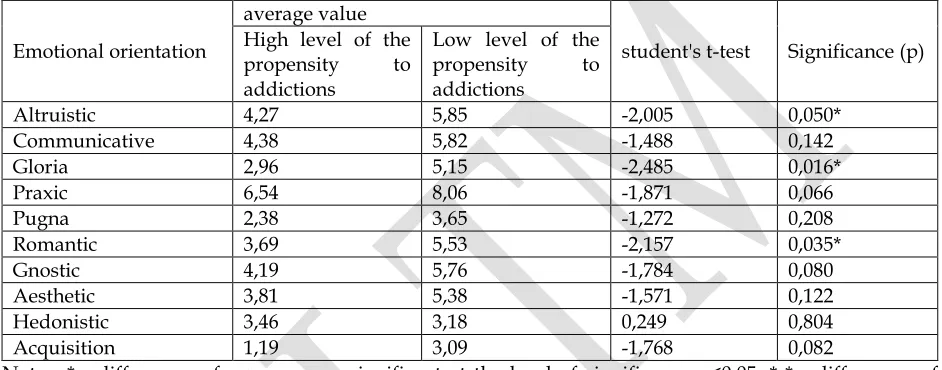
The authors of the article have studied the features of the emotional orientation of students’ personality with high and low levels of propensity to dependence (Table 1).
Table 1. The reliability of differences in average indicators on the scales of the technique on measuring the overall emotional orientation of the student personality with high and low levels of addiction
Emotional orientation
average value
student's t-test Significance (p)
High level of the
propensity to
addictions
Low level of the
propensity to
addictions
Altruistic 4,27 5,85 -2,005 0,050*
Communicative 4,38 5,82 -1,488 0,142
Gloria 2,96 5,15 -2,485 0,016*
Praxic 6,54 8,06 -1,871 0,066
Pugna 2,38 3,65 -1,272 0,208
Romantic 3,69 5,53 -2,157 0,035*
Gnostic 4,19 5,76 -1,784 0,080
Aesthetic 3,81 5,38 -1,571 0,122
Hedonistic 3,46 3,18 0,249 0,804
Acquisition 1,19 3,09 -1,768 0,082
Notes: * - differences of averages are significant at the level of significance p≤0.05, * * - differences of averages are significant at the level of significance p≤0.01.
It is established that students with a low level of propensity to dependencies have more pronounced elements of emotional orientation, as altruistic, Gloria and romantic emotions. Therefore, students with a low addiction tendency, unlike students with a high addiction, get more positive emotions from situations in which they can realize their need to give, contribute, and share and help. They have a stronger need for fame, glory, to experience success in front of public, which also brings them positive emotions. They also have a more pronounced desire for something unusual, mysterious, to what students with a high tendency to addictions pay less attention.
To study the features of emotional orientation system of students’ personality with high and low addiction, the authors conducted a correlation analysis of the results using the Pearson correlation coefficient. Its results are shown in figure 1.
Modern Journal of Language Teaching Methods ISSN: 2251-6204
Vol. 8, Issue 7, July
2018
Page 15
High propensity to addictions Low propensity to addictions
Figure 1. Correlation of system elements of the drug addicted personalities’ General emotional orientation before and after tertiary socialization
Notes: a) Emotional focus: 1 – altruistic, 2 – communicative, 3 – glory, 4 – praksical, 5 – punic, 6 – romantic, 7 – Gnostic, 8 – aesthetic 9 – hedonistic, 10 – achizitive; b) the bold lines correspond to the correlation coefficients, statistically significant at p≤0.01, thin – at the level of p≤0.05; a) solid line – direct relationship, dashed line – feedback.
As the figure shows, students with high level of propensity to addictions have almost all of the elements of common emotional orientation system of the individual which are interrelated, only Pugna orientation associated with the need to overcome difficulties, to take risks, has relationships with only two emotional directions – the romantic and the Gnostic determining the need for new knowledge and charm, which, most likely, and is satisfied through addictive behavior and the risks associated with it. And Acquisition orientation has a relationship only with Gloria orientation, that is, the presence of a large number of almost useless things for such students is one of the things that satisfy the need for fame and success among other people.
Students with a low level of propensity to addictions possess emotions which are associated with the accumulation, collecting almost useless things (Acquisition focus) and the need for physical and emotional comfort, pleasure (hedonic orientation) and they are excluded from the overall emotional orientation. The number of connections between the other elements of the system is smaller, the Central core is altruistic, communicative, praxic, romantic, Gnostic and aesthetic emotional orientation. As a result, for this group of students the basis of emotional orientation system of the individual are emotions that are associated with the satisfaction of the need to promote, give, help, share, communication needs, needs for active actions, in achieving the goal, in achieving the desired results, the need to obtain new knowledge, and in enjoying the perception of beauty.
Modern Journal of Language Teaching Methods ISSN: 2251-6204
Vol. 8, Issue 7, July
2018
Page 16
3.2. Features of Students’ Behavior Self-Regulation with High and Low Level of Addiction
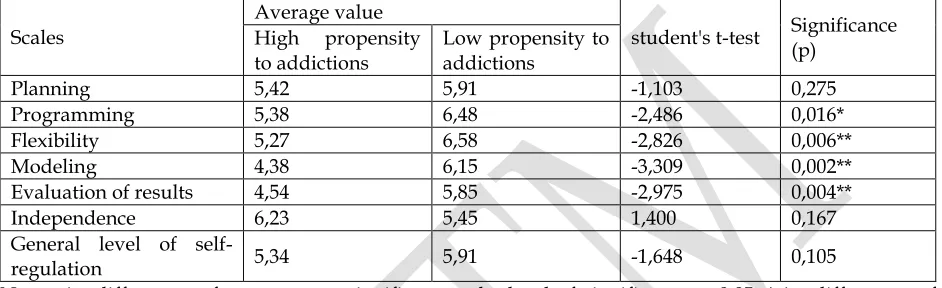
To study the features of behavior self-regulation, we studied the styles of self-regulation among the students with high and low levels of addiction. The results of the average indicators’ comparison on the method "Style of behavior self-regulation" are presented in table 2.
Table 2. The reliability of differences in the average indicators on the questionnaire "Students’ style of behavior self-regulation” with high and low levels of addiction
Scales
Average value
student's t-test Significance (p) High propensity
to addictions
Low propensity to addictions
Planning 5,42 5,91 -1,103 0,275
Programming 5,38 6,48 -2,486 0,016*
Flexibility 5,27 6,58 -2,826 0,006**
Modeling 4,38 6,15 -3,309 0,002**
Evaluation of results 4,54 5,85 -2,975 0,004**
Independence 6,23 5,45 1,400 0,167
General level of
self-regulation 5,34 5,91 -1,648 0,105
Notes: * - differences of averages are significant at the level of significance p≤0.05, * * - differences of averages are significant at the level of significance p≤0.01.
The results of the study show that students with a low level of addiction have significantly better formed styles of self-regulation, such as programming, flexibility, modeling and evaluation of results. That is, students with a low level of addiction in the field of behavior self-regulation have the following abilities which are more developed:
to think over ways of one’s own actions and behavior for the promotion of the planned goals, to create independently the detailed and developed programs, tactfully and flexibly to change them in unusual circumstances and to keep their stability in a situation of hindrances. If the results do not meet the objectives, they are able to adjust the program of actions and behavior to the desired result (programming style).
They demonstrate greater plasticity of all regulatory processes. If unforeseen circumstances
arise, they can more easily vary the plans and programs of their own actions and behavior; if there is a mismatch of the results with the goal – to assess the fact of mismatch in time and be able to make the appropriate correction; while adequately respond to the rapid variation of events and successfully resolve tasks in a risk situation (style of flexibility).
They have more developed ideas about the external and internal significant conditions;
there is a degree of awareness, adequacy and detail. The ability to identify significant conditions in achieving the goals, both in the current situation and in the future, is more pronounced, which is manifested in accordance with the action programs and action plans, also in accordance with the results obtained according to the accepted goals (scale of modeling).
They demonstrate a stronger development and adequacy of self-assessment, maturity and
durability of subjective criteria for assessing results (style of evaluation of results).
It can be said that students with a low tendency to addictions have General level of self-regulation which is higher than for students with high level, which suggests that they are more independent, more flexible and adequately respond to changing conditions, aware of the processes of promotion and achievement of
Modern Journal of Language Teaching Methods ISSN: 2251-6204
Vol. 8, Issue 7, July
2018
Page 17
the goal. Due to the high motivation of achievement, they are more capable of forming such a style of self-regulation, which allows them to compensate for the influence of personal, characteristic features that complicate the achievement of the goal. It is easier for them to learn new activities; they feel more confident in unfamiliar situations, which make their progress in ordinary activities more stable.
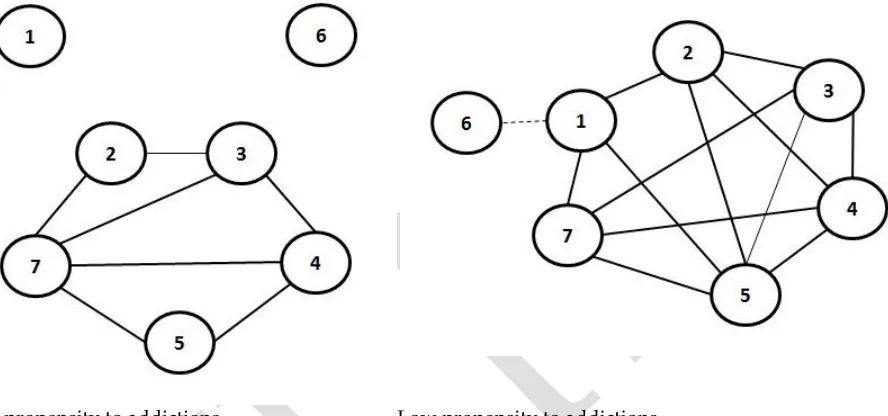
The correlation analysis of the data obtained by this method is shown in figure 2.
High propensity to addictions Low propensity to addictions
Figure 2. The results of correlation analysis of data on the technique "Style of behavior self-regulation" among the students with high and low levels of addiction
Notes: a) self – regulation styles: 1 – planning, 2 – programming, 3 – flexibility, 4 – modeling, 5 – evaluation of results, 6 – independence, 7 – General level of self – regulation; b) bold lines correspond to the correlation coefficients, statistically significant at the level of p≤0.01, thin – at the level of p≤0.05; c) solid line-direct connection, dashed line-feedback.
As can be seen from the results of correlation analysis, students with a high level of addiction have planning and independence which are not integrated into the system of behavior self-regulation. Students with low level of propensity to addictions have a planning style which is integrated into the system and directly linked to the overall level of self-regulation.
3.3. Interrelation of the Personality’s Emotional Orientation and Students’ Styles of Self-Regulation with High and Low Tendency to Addictions
To identify the relationship of emotional orientation of the individual and styles of self-regulation among the students with high and low tendency to addictions, the authors of the article conducted a correlation analysis obtained in the study by methods of studying the General emotional orientation of the individual and styles of behavior self-regulation.
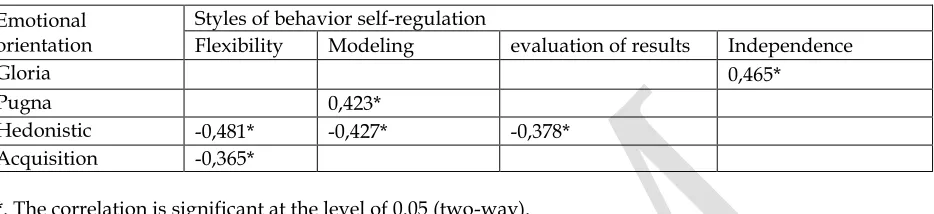
The results of correlation analysis in a group of students with a high level of addiction are presented in table 3.
Modern Journal of Language Teaching Methods ISSN: 2251-6204
Vol. 8, Issue 7, July
2018
Page 18
Table 3. Established relationships between types of emotional orientation of the individual and styles of students’ self-regulation with a high tendency to addictions (Pearson correlation coefficient)
Emotional orientation
Styles of behavior self-regulation
Flexibility Modeling evaluation of results Independence
Gloria 0,465*
Pugna 0,423*
Hedonistic -0,481* -0,427* -0,378*
Acquisition -0,365*
*. The correlation is significant at the level of 0.05 (two-way).
As the table shows, students with a high propensity for addictions have direct connections of Gloria emotional orientation with autonomy as a style of self-regulation and Pugna with modeling. The feedback is established between hedonic emotional orientation and flexibility, modeling and evaluation of the results as styles of behavior self-regulation, Acquisition – with flexibility.
Consequently, students with a high level of propensity to addictive behavior have a strong expression of emotions associated with satisfying the need for fame and popularity among other people, which enhances the regulatory autonomy in the organization of their activities, independent choice of behavior and ways to achieve the goal. Emotions associated with the need to take risks, overcome dangers enhance the ability to correlate assessments of internally significant conditions and external circumstances, the results achieved and the goals adopted. Meeting the need for collecting things that have no practical value reduces the ability to rebuild, adjust the system of self-regulation when changing external and internal conditions. And strong emotions associated with the satisfaction of bodily needs, receiving momentary pleasure reduce the ability to self-regulation in changing conditions, and to assess the ratio of internal and external conditions in a given situation, and to adequately assess themselves and the results of their activities and behavior.
The results of correlation analysis in the group of students with low addiction level are presented in table 4.
Table 4. Established relationships between types of emotional orientation of personality and styles of students’ self-regulation with low addiction (Pearson correlation coefficient)
Emotional orientation
Styles of behavior self-regulation
Planning Flexibility modeling evaluation of results Independence Self-regulation
Altruistic 0,378*
Praxic 0,477** 0,464**
Pugna 0,447*
Gnostic 0,356*
aesthetic 0,444*
Hedonistic -0,561** -0,566** -0,409*
*. The correlation is significant at the level of 0.05 (two-side). **. Correlation is significant at the level of 0.01 (two-side).
Modern Journal of Language Teaching Methods ISSN: 2251-6204
Vol. 8, Issue 7, July
2018
Page 19
Students with a low propensity for addictions have a direct connection of the altruistic emotional direction with planning as a style of behavior regulation, Praxic – with the flexibility and self-regulation, Pugna and aesthetic with the flexibility and Gnostic with independence. Feedbacks are established between hedonistic emotional orientation and such styles of self-regulation as modeling, evaluation of results and self-regulation.
Thus, students with a low level of propensity to addictions have positive emotions associated with the need to give, share, promote, help other people, with the need for active actions, achieving the goal, obtaining the desired results, with the need to effectively overcome difficult situations, with obtaining new knowledge and perception of the beautiful increase their regulatory functions, the adequacy of situations’ assessment, planning goals and actions, as well as their changes, provided the change of internal and external conditions. And hedonistic emotions associated with the satisfaction of the need for physical and mental comfort, on the contrary, have a negative impact on self-regulation of behavior.
Conclusion
One of the most important problems that need to be solved in the modern world is the problem of psychological dependence, addictive behavior. The paradox of human life today is that the formed consumer society requires the emergence, development and distribution of different types of dependencies, as they are the basis of consumer society – commodity production and trade. Addictive behavior is becoming the most common type of deviant behavior in modern reality. Addiction becomes an insurmountable obstacle in the way of man to the desired self-realization, the causes of psychological and physical problems, deformities and diseases. This is especially dangerous for young people and students, as it is during this period that abilities and skills of successful socialization and personal development, internal semantic content of these processes and the external social environment in which they occur are formed.
It is found that students with a high tendency to addictions have poorly formed aspects of behavior self-regulation, such as planning, programming, flexibility, evaluation of results and self-motivation. They have less pronounced communicative, Gloria, Gnostic and Acquisition emotional orientation of the person.
In this regard, it can be concluded that students with a high level of propensity to addictive behavior have the desire to obtain positive emotions from the possession of the object of addiction (alcohol, drugs, the ability to play computer or gambling, communicate in social networks, etc.) which prevents them to adequately respond to changes in the environment, external and internal conditions of their activities. They are ready to use psychoactive substances or perform other acts of addictive behavior for the sake of achieving not only their own pleasure, but also for the sake of fame and popularity in their social microenvironment. Hedonism, indulging one's weaknesses and striving to get pleasure from satisfying addictive desires greatly reduces the ability to self-regulation both at the stage of making those decisions and at the stages of their implementation, and at the moment assessing the results of one's activities to achieve them.
Therefore, in the prevention of addictive behavior and reducing the level of susceptibility to addictive behavior among the students it is necessary to take into account the peculiarities of their emotional orientation and self-regulation styles for their normalization and harmonization, which will reduce the level of addiction.
The materials of the article are of practical value for psychologists and teachers who develop and implement psychological and pedagogical programs aimed at preventing the tendency to additive behavior among University students, to develop skills of self-regulation of behavior.
Modern Journal of Language Teaching Methods ISSN: 2251-6204
Vol. 8, Issue 7, July
2018
Page 20
References
Abulkhanova-Slavskaya, K.A. (1991). Life strategy. Moscow: Mysl. ISBN: 5-244-00380-1. Aristotle (2016). Policy. Moscow: AST. ISBN: 978-5-17-099791-6.
Cherdymova, E.I., Kuznetcov, V.A., Machnev, V.Y., Solovova, N.V., Sarbaeva, I.Yu. & Masalimova, A.R.
(2017). Eco-Vocational Consciousness Formation Model of a Specialist in Modern Mega Polis. Eurasian
Journal of Analytical Chemistry, 12(A Multidisciplinary Approach to science 5b), 493-507.
Davoudi SMM, Fartash K, Venera G. Zakirova, Asiya M. Belyalova, Rashad A. Kurbanov, Anna V. Boiarchuk, Zhanna M. Sizova (2018). Testing the Mediating Role of Open Innovation on the Relationship between Intellectual Property Rights and Organizational Performance: A Case of Science and Technology Park, EURASIA Journal of Mathematics Science and Technology Education, 14(4), 1359-1369.
Dermanova, I.B. (2002). Diagnosis of emotional and moral development. St. Petersburg: Rech. ISBN 5-9268-0103-6.
Dodonov, B.I. (1978). Emotions as value. Moscow: Politizdat.
Fartash K., Davoudi, S.M.M., Tatiana A. Baklashova, Natalia V. Svechnikova 4, Yulia V. Nikolaeva, Svetlana A. Grimalskaya (2018). The Impact of Technology Acquisition & Exploitation on Organizational Innovation and Organizational Performance in Knowledge-Intensive Organizations, EURASIA Journal of Mathematics Science and Technology Education, 14(4), 1497-1507.
Gryaznov, A.N., Cheverikina, E.A. (2016). Features of mental States of addictive and prone to addiction personalities. Kazan: publishing house "Danis". ISBN: 978-5-89917-203-8.
Konopkin, O.A. (2008). Conscious self-regulation as a criterion of subjectivity. Questions of psychology,3,
22-34. ISSN: 0042-8841.
Kubiatko, M., Usak, M. & Masalimova, A.R. (2016). Czech Lower Secondary School Pupils' Knowledge about Developing Countries. Revista de Cercetare si Interventie Sociala, 55, 215-230.
Kvon, G.M., Vaks, V.B., Masalimova, A.R., Kryukova, N.I., Rod, Y.S., Shagieva, R.V., Khudzhatov, M.B.
(2018). Risk in Implementing New Electronic Management Systems at Universities. EURASIA Journal of
Mathematics, Science and Technology Education, 14(3), 891-902.
Masalimova, A.R., Usak, M. & Shaidullina, A.R. (2016). Advantages and disadvantages of national and international corporate training techniques in adult education. Current Science, 111(9), 1480-1485. Morosanova, V.I. (2001). Individual style of self-regulation: phenomenon, structure and functions in any human activity. Moscow: Science. ISBN 5-02-013166-0.
Nikiforov, G.S., Shingaev, S.M. (2014). Types of mental self-regulation. Bulletin of Leningrad state
University, 1(5), 92-101. ISSN: 1818-6653.
Pozhitkina, N.V., Papushina, A.V., Petrova, A.V. (2012). Study of the relationship of androgyny and types
of emotional orientation. Humanitarian scientific research, 6, 255-264. URL:
http://human.snauka.ru/2012/06/1493 E-ISSN: 2225-3157.
Rostovtseva, M.V., Mashanov, A.A. (2012). Philosophical meaning of the concept "social adaptation" Bulletin of Krasnoyarsk state agrarian University,6, 288−293. ISSN: 1819-4036.
Taştan, S.B., Davoudi, S.M.M., Masalimova, A.R., Bersanov, A.S., Kurbanov, R.A., Boiarchuk, A.V., Pavlushin, A.A.(2018). The Impacts of Teacher’s Efficacy and Motivation on Student’s Academic Achievement in Science Education among Secondary and High School Students, EURASIA Journal of Mathematics Science and Technology Education, 14(6), 2353-2366.
Vygotsky, L.S. (2018). Issues of child psychology. Moscow: perspective. ISBN: 978-5-99063-765-8.
Modern Journal of Language Teaching Methods ISSN: 2251-6204
Vol. 8, Issue 7, July
2018
Page 21
Corporate Governance Practice Development In Russian State-Owned
Companies
Irina Yu. Belyayeva1, Khvicha P. Kharchilava2, Nadezhda P. Kozlova3
1 Department of Corporate Finance and Corporate Governance, Financial University under the
Government of the Russian Federation, Moscow, Russia.
2 Department of Corporate Finance and Corporate Governance, Financial University under the
Government of the Russian Federation, Moscow, Russia.
3 Department of Corporate Finance and Corporate Governance, Financial University under the
Government of the Russian Federation, Moscow, Russia. *corresponding author
Abstract
To date, certain progress has been achieved in development of corporate management in Russian companies with state ownership, namely public ones. The basis for this progress has been provided by both regulatory fixation of best standards of corporate governance and requirements on information disclosure regarding their compliance. Implementation of best practices by state companies is supported with demands of the main shareholder - the state, in particular, by road maps on introduction of corporate governance code requirements. Information on realization of the governance code requirements is regularly published both in annual reports and on websites of companies (primarily public ones). Thus, by this moment, sufficient data regarding standing of corporate governance in public companies with state participation is available in open access. Also presence of wide range of tools for implemented processes quality assessment is worth noting. However, only few of them allow to conduct quantitative assessment of the effect of best corporate governance practices application. Implementation of the national corporate governance index will make it possible to solve this problem.
Keywords: corporate governance, State-owned companies, with state participation, Corporate governance evaluation, Corporate governance index, The board of directors, transparency.
Introduction
In 2015 MICEX Stock Exchange launched the calculation of the State Companies Index – composite index based on prices of deals with securities of state companies (Joint-Stock Companies in relation to which the right to determine the position of the shareholder – the Russian Federation, belongs to the Government of the Russian Federation, the Chairman or with his order the Deputy of the Chairman of the Government of the Russian Federation) accepted to trading on the Stock or other securities recommended by the Ministry of Economic Development or Federal Agency For State Property Management (FASPM). The Index is considered to be the benchmarking figure for the efficiency of the managers of state companies (The methodology of calculating index shares for the companies with state participation and companies with regulated activities, 2015).
According to the Index calculation methodology, it includes not only the information about deals made during the Stock trading, but also the amount of the paid dividends. This economic figure is used by the Ministry of Economic Development and FASPM to determine the efficiency of the management of state companies in terms of their capitalization change. Also, it is crucial for state public companies and the Government as their owner to understand the efficiency of corporate governance instruments, especially the one expressed in value terms, taking into account the significant amount of costs spent on companies` functionality (Methodological guidelines, 2013).
Modern Journal of Language Teaching Methods ISSN: 2251-6204
Vol. 8, Issue 7, July
2018
Page 22
According to the 2015 Gazprom PJSC annual report (Gazprom Annual Report, 2015), remuneration of corporate governance authorities was 3500 million rubles (among these 352 million rubles was paid to the Board of Directors, 2703 – to the Management Board, 13 – to the Audit Committee). Taking into account significant amount of those payments, the main owner – Government or shareholders can raise questions for the relevance of such expenses and for determining not only the way of controlling the efficiency of corporate governance authorities, but also its influence on the KPIs.
Moreover, the lack of appropriate corporate governance is considered as additional significant risk by analysts and rating agencies connected with the complexity of shareholders control over the management.
In the global practice there are many instruments used for corporate governance evaluation (Kvon et al., 2018; Davoudi et al., 2018; Fartash et al., 2018; Tastan & Davoudi, 2015). They can differ for various types of companies in accordance with their size, shareholders` quantity, status and main purposes of corporate governance evaluation.
For non-public companies with 100% ownership of a single shareholder there are more relevant evaluation objects, such as the quality of shareholders` control and the efficiency of decision-making systems, which can be analyzed in the process of self-evaluation. Non-public companies with significant amount of shareholders are interested in trustworthy balanced corporate governance systems. For such companies, in addition to self-evaluation, other measures become important: attraction of external independent experts and benchmarking, peer comparison. As for the public companies, which need ensuring trust not only among shareholders, but also among external investors there are special requirements to provide reports on compliance with the national corporate governance standards (as a rule, required by stocks or authorities) and numerous quality instruments implemented by investors: matrices, rankings, ratings, corporate governance indices.
However, none of above mentioned methods have the ability to provide “digital” measurement figure of corporate governance in a company including public state-owned companies.
Materials and Method
During the research, the following methods were used: theoretical (analysis, synthesis, concretization, generalization, method of analogies, modeling); empirical (studying the experience of foreign stock exchanges, rating agencies, companies with state participation); methods of the theory and practice of corporate governance, methods for calculating the index of corporate governance, methods of tabular representation and graphical visualization of results.
International standards of corporate governance in companies with state participation are defined in OECD Principles of Corporate Governance in State Companies. In these principles, there are guidelines regarding ensuring of efficient regulatory and legal frameworks for state companies; position of government as active owner; equal treatment of shareholders and ensuring equal access to necessary information for all shareholders; responsibilities of state companies to report on engagement with stakeholders; high level of transparency and disclosure of information; responsibility and integrity of state companies` Boards.
In Russian Corporate Governance Code (Bank of Russia, 2014). those principles are developed and extended despite the fact that they cover not only state, but all companies. Moreover, for main regulators and state authorities on the Russian market this information about compliance with the Code recommendations has become the main benchmarking for evaluation of the quality of corporate governance and its efficiency in companies with state participation.
I. The Russian Government Instructions:
Modern Journal of Language Teaching Methods ISSN: 2251-6204
Vol. 8, Issue 7, July
2018
Page 23
Following the meeting with members of the Government Expert Council Dmitry Medvedev gave
instructions (resolution of 28th May 2014 DM-P36-46) about improvement of corporate governance in
companies with state participation and property. Specifically, the following:
- form the list of stock companies, in which the share of government is over 50% and implementation of the Code of corporate governance is primary;
- for those entities plans or “road maps” shall be prepared with accent on such points as appointment and termination of the sole executive body by the Board of Directors, as well as the Board control over significant deals and corporate actions of affiliates;
- develop structure of an annual report about corporate governance for above mentioned entities, including achievement of KPIs and implementation of long-term development programs.
II. FASPM
For the purposes of implementation of the above-mentioned instructions by the Government, among many other methodological documents FASPM developed the “Methodology of Corporate Governance quality self-evaluation in companies with state participation” (The Order of FASPM 36, 2014). In this document, approaches to complex Corporate Governance quality self-evaluation are introduced. Among others, those approaches take into account the compliance with the principles and recommendations of the national Code of Corporate Governance.
Results
There are following necessary requirements in terms of corporate governance set by MICEX for 1st and
2nd level issuers:
Requirements for Issuer`s corporate governance compliance to which is the necessary condition
for inclusion of shares in the first and second level (point 2.18-2.19 Appendix 2 to Listing Rules by MICEX)
Requirements for an Issuer`s corporate governance compliance to which is the necessary
condition for inclusion of Bonds in the first level (point 2.20 Appendix 2 to Listing Rules by MICEX)
Criteria for determining the independence of the members of the Board of Directors (Supervisory
Board) (Appendix 4 to Listing Rules by MICEX)
Requirements for the composition and functions of the Board of Directors, the organization and functioning of its committees, the role and functions of the Corporate Secretary etc. contained in these documents, in general, fully correlate with the principles and recommendations of the Corporate Governance Code.
I. The Bank of Russia
With the Letter of 17.02.2016 IN-06-52/8 “On the disclosure in an annual report of a public joint-stock company statement about compliance with corporate governance principles and recommendations of the Corporate Governance Code” the Bank of Russia recommends a number of measures aimed at “qualitative disclosure in key areas of corporate governance (such as the Board of Directors (supervisory board), the organization of the decision-making process and the effectiveness of its work, the role of large shareholders, transactions in which there is interest (related party transactions), adopted in an entity remuneration system, risk management and internal control, etc.)”. Also, this recommendation letter has reference to the other binding document – the Bank of Russia Regulation of 12.30.2014 454-P “On information disclosure by issuers of securities” (Regulation on Disclosure of Information), Chapter 70 of which sets out the requirements for reporting on compliance with the principles and recommendations of the Corporate Governance Code in an annual report. To date, the majority of public companies, including
Modern Journal of Language Teaching Methods ISSN: 2251-6204
Vol. 8, Issue 7, July
2018
Page 24
the state ones, follow the Bank of Russia requirements, disclosing the information according to the format of the annual reports.
Thus, there is clearly defined and documented Government`s and regulatory authorities` position regarding the implementation of the best standards of corporate governance and disclosure of these processes. This, in turn, creates a complete regulatory framework for determining the criteria for the effectiveness of implementation of efficient corporate governance in public companies, including state ones.
According to the "Report on the management of federally owned shares of open joint-stock companies and the use of special rights of the Russian Federation to participate in the public companies` management ("golden share ") on the basis of 2014 results", prepared by the FASPM in 2015, "the latest developments in the field of application of rules and principles of corporate governance in Russian state and private companies highlight the qualitative improvement of their level of development: there is a significant extension of the planning horizon, a clear definition of objectives, conducting deliberate strategic policy, the strengthening of internal control by the owners ".
Also, progress in implementing the recommendations of the Corporate Governance Code for companies with state participation is noted by Russian independent experts. For example, an article published on the website "The Country and the World" on June 2, 2016 (http://inklgd.com/strana-i-mir/25066) with reference to the Expert Council under the Government of the Russian Federation states that there has been a significant improvement of Russian companies with state participation in the implementation of the priority recommendations of the Corporate Governance Code
First of all, the article mentions 13 most significant and largest companies: “Rostelecom”, “Rosneft”, “Transneft”, “Alrosa”, “RusHydro”, “Aeroflot”, “Rossetti”, VTB, FGC, “Russian Railways”, "Sovcomflot", "Gazprom" and “Sberbank” (the latter interacts on the implementation of the Code with the Bank of Russia, the implementation of the Code there has not been analyzed by experts), as well as the company “Bashneft”, which has started to implement the recommendations of the Code on its own initiative. Analysis of information on compliance with the Corporate Governance Code in the annual reports of other public companies, including the state ones, confirms the fact that despite the difficulties with introduction of corporate governance standards, overall, current level of corporate governance is already sufficiently high. Open access to information that allows to conduct analysis and measurement of the quality of corporate management of Russian state companies with the tools used in international and Russian practice, both private and public companies.
3.1. Current Tools of Corporate Governance Quality Evaluation
As mentioned above, for public companies in the international practice exists mandatory reporting on compliance with national standards for corporate governance (usually at the request of regulators and stock exchanges) and various tools of quality assessment used by investors: the matrix, rankings, ratings, corporate governance codes (see. Figure 2). Ratings` users are consumers, investors, and competing public companies. Indices are more limited tool designed for use by the investment community interested in assessing the potential risks to invest.
Methodology for evaluation of the corporate governance of the International Finance Corporation (IFC) is one of the most popular tools for evaluating the quality of corporate governance. The main evaluation criteria relate to the following issues:
- Management's commitment to corporate governance principles, - Practice of the Board of Directors,
- Disclosure and transparency, - Protection of shareholders' rights.
Modern Journal of Language Teaching Methods ISSN: 2251-6204
Vol. 8, Issue 7, July
2018
Page 25
Currently, the methodology applied in "The conceptual basis for the development of corporate governance" - the document of 2011, used by more than 30 international development institutions. The methodology allows to evaluate the investment community`s expectations, including funds and portfolio investors, for specific entity. The main instruments are the focus group assessment and the detailed study of a particular situation. The evaluation results of the IFC methodology simplify the process of formation of the "road map" for further development of corporate governance in the company, as it is based on international principles of corporate governance. However, it is necessary to note that the use of this tool is quite time-consuming evaluation of a broad investment group, and, as a rule, evaluation results are not publicly disclosed or partially disclosed.
A broader base for comparison is provided by another tool - the international "scoring" of the quality of corporate governance. This tool is offered, for example, by the company ISS. The system of corporate governance risks monitoring "Quick Score" is based on the analysis of companies reporting in English and the data base includes 4000 companies worldwide. This evaluation system is designed for market analysts and portfolio managers. The evaluation criteria include parameters such as the structure of the Board of Directors, compensation and remuneration, shareholder rights, supervision in the field of audit and risk management. The purpose of evaluation in accordance with this methodology is to help investors in an integrated assessment of the corporate governance risks. In accordance with the methodology, tools, offered by the ISS, are based on publicly disclosed information, covering large public companies. However, the main emphasis in the analysis is on the risks of corporate governance, and the evaluation results are not available to all market participants.
Corporate Governance Ratings are assigned by analogy with credit ratings. The procedure for assigning a rating is carried out at the request of the company for a fee. Rating assignment, as a rule, is based not only on an analysis of publicly available information, but also internal, private data, as well as interviews with management, the findings of rating agency analysts in relation to corporate governance. Typically, the ratings only cover some of the largest companies, and not all companies disclose the results of the evaluation.
In the Russian practice among those forms of self-evaluation of compliance with the national Code recommended by the Bank of Russia, the Moscow Stock Exchange and FASPM there are other applied ratings: the Russian Institute of Directors Management (RIM) corporate ratings, the National Rating Agency (NRA). Therefore, in Russia there are forms for corporate governance evaluation similar to those used in the international practice and, moreover, are tailored to the best ones.
However, at a closer look at the Russian corporate governance measurement tools, we can see that this range lacks another tool - the Corporate Governance Index, actively used in a number of countries, such as Brazil, Italy, South Africa, South Korea, China, Mexico. The relevance of its use on the financial market is explained by the importance of understanding the effective yield in relation to the results of asset management by professional managers, in other words, the quality of management.
On the basis of the information disclosed, as well as ratings and efficiency of corporate governance scoring in public joint stock companies, the global index providers and stock exchanges establish and maintain appropriate calculation of stock indices, which are based on an assessment of the effectiveness of corporate governance.
Often corporate governance index criteria originate in national standards and legislation. For the purpose of the index database formation, all public companies that disclose sufficient information or have ratings or scorings recognized on the market are analyzed. Securities of leaders (usually from 10 to 30 companies) define the calculation basis for corporate governance index.
Brazil
Modern Journal of Language Teaching Methods ISSN: 2251-6204
Vol. 8, Issue 7, July
2018
Page 26
In December 2000, Brazilian stock exchange BOVESPA launched a new segment for the Novo Mercado issuers (translated from the Portuguese "New Market") to form the new requirements to issuers and their corporate policy in relation to minority shareholders, obliging issuers to work with minority groups on the same basis as with majority shareholders.
China
In 2007, the China Securities Regulatory Commission has initiated work aimed at promoting corporate governance among the companies that have passed the listing procedure. To support this initiative in the end of 2007 Shanghai Stock Exchange launched a market segment called Corporate Governance Board, which securities automatically fell into the Corporate Responsibility Index of the Shanghai Stock Exchange. The key idea of the changes is to improve the transparency of issuers in terms of equity, conflict of interests, affiliates, and the most significant problem of Chinese companies – influence of majority shareholders on the distribution of dividends and the choice of the members of the Board of Directors.
Europe
If on emerging markets like Brazil and China the issue of minority rights was solved by these actions, in the more developed economies corporate responsibility issue was observed from a different angle. For example, Italy, in 2001, formed a new listing segment for small and medium-sized companies under the name STAR. Basic requirements for listing included the opportunity to assess the quality of corporate governance of the applicant and the appropriate level of transparency of activities. As a result of 10 years of STAR, the following positive effect on issuers of this segment has been recorded: a constant flow of higher liquidity compared to small and medium-sized companies.
Examples of corporate governance indices: Brazil, Novo Mercado BM&FBovespa -Corporate Governance Index includes securities of a special segment Novo Mercado, which allows users to highlight companies on the market with high level of corporate governance,
Italy, Borsa Italiana Corporate Governance Index allows users to determine the leaders in the field of corporate governance on the basis of self-evaluation with external confirmation, China, SSE Shanghai Stock Exchange, Corporate Governance Index is based on companies` self-evaluation and analysis of additional public information, Grupo BMV, Mexico The weight of corporate governance criteria in the national index of sustainable development is 34%, South Africa, The Index is based on more than 90 indicators, including corporate governance (based on the recommendations of the National Code), environment and social responsibility.
In the formation of the index the inherent regional characteristics must be taken into account. The majority of corporate governance indices suggest two types of criteria: the quality of corporate governance evaluation and market characteristics (the acceptable level of free-float and liquidity).
The relatively wide range of corporate governance indices, successfully used by other countries, raises questions about the feasibility of such tool in our country. In addition, there are arguments to support the implementation of corporate governance index in Russia.
Discussion
Russian Corporate Governance Code is considered to be the most objective foundation for identifying national leaders in the field of corporate governance from the viewpoint of compliance with its recommendations.
Accordingly, the index in Russia is an indicator of corporate governance development in Russian companies, which determines the degree of their compliance with the principles determined by the national Code.