JOURNAL OF MATHEMATICAL NANOSCIENCE
JMNS
Vol. 2, No. 1, 2012, 37-41
37
A note on eccentric distance sum
MAHIN SONGHORI
Department of Mathematics, Faculty of Science, Shahid Rajaee
Teacher Training University, Tehran, 16785 – 136, I R. Iran
ABSTRACT. The eccentric distance sum is a graph invariant defined as G G
v V G ( ) ( ) ( )v D v
,where G( )v is the eccentricity of a vertex v in Gand D vG( )is the sum of distances of all vertices in G from v. In this paper, we compute the eccentric distance sum of Volkmann tree and then we obtain some results for vertex−transitive graphs
Keywords: eccentricity, eccentric distance sum, Volkmann tree.
1. INTRODUCTION
A graph is a collection of points and lines connecting a subset of them. The points and lines of a graph are also called vertices and edges of the graph, respectively. The vertex and edge sets of the graph G are denoted by V G
and E G
, respectively.A molecular graph is a simple graph such that its vertices correspond to the atoms and the edges to the bonds. Note that hydrogen atoms are often omitted. Chemical graph theory is a branch of mathematical chemistry which has an important effect on the development of the chemical sciences.
In this paper, in the next section we give necessary definitions and some preliminary results. Section 3 contains the main results, i.e., the explicit formulas for the eccentric distance sum of Volkmann tree.
Jo
u
rn
a
l o
f
M
a
th
e
m
a
ti
c
a
l N
a
n
o
S
c
ie
n
c
2. PRELIMINARY NOTES
If x y V G,
then the distancedG
x y,
between x and y is defined as the length of any shortest path in G connecting x and y. For a vertex u of V G
its eccentricityG( )u
is the largest distance between u and any other vertex v of G ,
G( ) maxu v V G( )d u vG( , )
. The maximum and minimum eccentricity over all vertices of G are called the diameter and radius of G and denoted by d G
, r G
respectively,see [9]. The total eccentricity of the graph G , can be defined as
Gu V G
G u
( ) ( )
,
see [2]. The eccentric distance sum d
G
of a graph G is defined as [7]:
d
G G
u V G
G ( ) ( ) ( ),u D u
where D uG( ) denotes the sum of distances of all vertices in G from v. The eccentric
distance sum was a novel distance-based molecular structure descriptor which can be used to predict biological and physical properties. It has a vast potential in structure activity/property relationships, se for more details [1,3-8] Here our notation is standard and mainly taken from [9].
3. MAIN RESULTS
The aim of this section is to compute d
G
of Volkmann tree. In continuing we compute this index for vertex−transitive graphs and non - vertex transitive graphs that their automorphism group has exactly two orbits. In the following examples, we present the eccentric distance sum of two well-known graphs.
Example 1. Let Kn be the complete graph on n vertices. Then for every v V K ( n),
( ) 1
D v n and ecc vG( ) 1 . This implies that ξ (d ) ( 1) n
K n n .
Example 2. Let Cn denote the cycle of length n. Then if n is an odd number,
D v n2
( ) ( 1)/ 4, else D v n2
( ) / 4 and ecc vG( ) n/ 2 for all vertices v. Hence,
2
3
( 1) / 2 / 4 2 | ( )
/ 2 / 4 2|
d n
n n n n
C
n n n
.
3.1 Vertex−transitive graphs
An automorphism of the graph G( , )V E is a bijection on V which preserves the edge set E, i.e., if e=uv is an edge, then ( )e ( ) ( )u v is an edge of E. Here the image of vertex u is denoted by ( )u . The set of all automorphisms of G under the
Jo
u
rn
a
l
o
f
M
a
th
e
m
a
ti
c
a
l
N
a
n
o
S
c
ie
n
c
39
composition of mappings forms a group which is denoted by Aut G
. We say Aut G
acts transitively on V if for any vertices u and v in V there is Aut G
such thatu v
( )
.
Theorem 1. If Aut G
acts transitively on V, then we have the following Theorem:
d
G 2 ( ) ( )d G W G
.
Proof. Since this action is transitive, there exist an automorphism such as Aut G( )
such that ( )u v and so
G( ) maxv x V G ( )d v xG( , ) max y V G ( )dG( ( ), ( ))u y G( ).u
This completes the proof.
3.2 Actions with two orbits
In all over of this section by and ( )G mean the automorphism graph Aut G
and ( )G d G
r G( ), respectively. Also the action of group on the set is denoted by ( | ) . Suppose is a group which acts on the set . If x, letx g x g
( ) { . | }
. The set ( )x is called the orbit of x. The stabilizer of x is the subset
x {g | .g x x}.
In other words, when group acts on set , then
n
1 2 ...
where i(1 i n) are orbits of . In the following lemma, we can deduce a generally formula for eccentric distance sum of G .
Lemma 2. LetG( , )V E be a graph and it's action ( | ) V has orbits V ,i 1 i s. Then
i
s d
i i G
i v V
G V u D v
1
| | ( ) ( )
.Proof. It is well-known fact that the action of a group on its orbits is transitive. Hence by using Theorem 1, the proof is straightforward.
In continuing we consider graph G such that it's action ( | ) V has exactly two orbits. We denote this graph by TO-graphs. The vertex set V under this action divides to subsets V1 and V2, where n1V1, n2V2 andn n 1n2| |V . Further, It is easy to see that degrees of vertices of V are the same and we denote them by i ki,
i 1, 2
. Hence, by above notations, we have the following theorem.Theorem 3. Let G be a TO-graph with m edges, V V 1 V2 andviV i 1, 2i
. Then,
d
G k n1 1 ( ) ( ) 2 ( )( ( )G D v1 W G G r G( )).
Jo
u
rn
a
l o
f
M
a
th
e
m
a
ti
c
a
l N
a
n
o
S
c
ie
n
c
Proof. It is not difficult to see that
1 1 1 2 2 2
1 1 1 1 2 2 2 2 1 1 1 1 1 1 2 2
( ) ( ) ( ) ( ) ( )
= ( ) ( ) ( ) ( )= ( ) ( ) (2 ) ( ) ( ).
d
v V v V
G D v v D v v
k n v D v k n v D v k n v D v m k n v D v
Since k n D v1 1 ( )1 k n D v2 2 ( 2) 2 ( ) W G thus
1 1 1 1 1 1 1 2 1 1 1
( )= ( ) ( ) (2 ( ) ( )) ( )= ( ) ( ) 2 ( ). ( ).
d G k n v D v W G k n D v v k n G D v W G r G
3.3 Eccentric distance sum of Volkmann tree
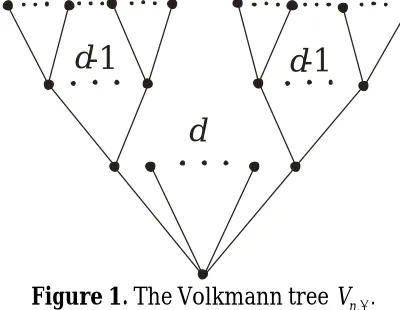
The Volkmann tree Vn, is a tree on n vertices and maximum vertex degree defined as follows:
Start with the root having neighbors. Every vertex different from the root, which is not in one of the last two levels, has exactly 1neighbors. In the last level, while not all vertices need to exist, the vertices that do exist fill the level consecutively. Thus, at most one vertex on the level second to last has its degree different from
and 1, see Figure 1.
Figure 1. The Volkmann tree Vn,.
Theorem 4. The eccentric distance sum of Volkmann tree is as follows
k k
d m m
n
m m k
k
i i
V A B C d d k m A B C d d m
k id d
( 1)/2
1 1
,
1 ( 1)/2
1
1
( ) ( 1) ( 2) ( ) ( 1)
( 1) ,
where, m n n i n iS m n m n d m n i d d
1 1
1
2 1
[( ) ( )( 1) ( 2 )( 2)( 1) ],
A2m 1 (m1)(d1)S,
m
i m
i
B i d d m d
1
1
1
( 2 ( 2)( 1) ) 2 ( 1)
m
n m i i
R n m i d d
2
0
( 2( 1)( 2)( 1)
41
k
n m n
n m
C n m d n m d R
1
(( )( 1) ( )( 1) ).
Proof. The proof is straightforward.
REFERENCES
[1]. A. R. Ashra i, M. Saheli and M. Ghorbani, The eccentric connectivity index of nanotubes and nanotori, Journal of Computational and Applied Mathematics, 235 (2011), 4561 – 4566.
[2] T. Doslić, M. Ghorbani and M. Hosseinzadeh, Eccentric connectivity polynomial of some graph operations, Utilitas Mathematica, 84 (2011), 297-309.
[3] M. Ghorbani, Connective eccentric index of fullerenes, J. Math. NanoSci., 1 (2011), 43–52.
[4] M. Songhori, ccentric connectivity index of fullerene graphs, J. Math. NanoSci., 2 (2011), 21–27.
[4] V. Sharma, R. Goswami and A. K. Madan, Eccentric connectivity index: Anovel highly discriminating topological descriptor for structure-property andstructure-activity studies, J. Chem. Inf. Model., 37 (1997), 273 – 282.
[5] S. Gupta, M. Singh and A.K. Madan, Eccentric distance sum: a novel graph invariant for predicting biological and physical properties, J. Math. Anal. Appl., 275 (2002), 386 – 401.
[6] A. Ilić, G. Yu and L. Feng, On the eccentric distance sum of graphs, J. Math. Anal. Appl., 381 (2011), 590 – 600.
[7] V. Lather and A. K. Madan, Application of graph theory: Topological models for prediction of CDK-1 inhibitory activity of aloisines, Croat. Chem. Acta, 78 (2005), 55 – 61.
[8] B. E. Sagan, Y.-N. Yeh and P. Zhang, The Wiener polynomial of a graph, Int. J. Quantum. Chem., 60 (1996), 959 – 969.
[9] D. B. West, Introduction to Graph Theory, Prentice Hall, Upper Saddle River, 1996.
Jo
u
rn
a
l o
f
M
a
th
e
m
a
ti
c
a
l N
a
n
o
S
c
ie
n
c